Leading With Hope and Kindness: 5 Ways to Be a Better Leader

Five Qualities of a Great Leader: Hope, Trust, Gratitude, Strength, and Purpose

By Christine O’Connell, Ph.D. for Psychology Today

Leadership isn’t just about making decisions or hitting targets, it is about inspiring, empowering, and creating a culture where people feel valued. The best leaders don’t just manage; they uplift. By fostering hope, trust, and a strong sense of purpose, leaders can help their teams thrive.

1. Lead With Hope and Vision

Hope is a job that starts at the top. A 2025 Gallup Poll found that 56% of people believe hope is the most important trait in a leader. When employees see a leader who believes in a better future, they are more engaged, motivated, and resilient. Hope fuels optimism, encourages problem-solving, and helps people navigate challenges with confidence. Leaders should share their vision clearly, celebrate progress, and remind their teams that they are part of something meaningful.

2. Foster a Culture of Trust

Trust is the foundation of strong leadership. When teams trust their leaders, they collaborate more effectively, take creative risks, and perform better. Research shows that employees in high-trust environments are not only more productive but also happier and healthier. Trust isn’t built overnight—it comes from consistency, transparency, and genuine connection. Leaders should communicate openly, follow through on commitments, and actively listen. By doing so, they create a culture where people feel safe and supported.

3. Practice Gratitude and Invest in Well-Being

Gratitude isn’t just a nice gesture, it’s a leadership superpower. Studies show that when leaders express appreciation, employees feel more engaged, satisfied, and loyal. A simple “thank you” can go a long way in building a positive work culture. But beyond words, investing in whole-person health, including mental, emotional, and physical well-being, ensures that employees feel valued and supported, and helps avoid burnout. Burnout affects your bottom line. A Workhuman and Gallup poll found that workplace turnover due to burnout alone is 15-20% of payroll. Investing in whole-person health creates a deeper connection to the organization and builds workplace community. Supporting work-life balance, encouraging wellness, and recognizing individual contributions create an environment where people stay, and can do their best work.

4. Empower Others by Recognizing Their Strengths

Great leaders don’t just correct mistakes, they amplify strengths. A strengths-based leadership approach leads to higher engagement, better performance, and stronger teams. Instead of focusing on weaknesses, leaders should recognize what their team members excel at and give them opportunities to shine. Great leaders also recognize their own strengths and lean into those. When people feel seen for their talents, they gain confidence, take ownership, and contribute more meaningfully.

5. Lead With Kindness and Purpose

Leadership isn’t about being the loudest voice in the room, it’s about lifting others up. Kindness isn’t a weakness; it’s a powerful leadership tool. Leading with empathy, active listening, and genuine care creates an environment where people feel valued and motivated. And having a clear purpose beyond just profits or productivity helps inspire others to work toward something bigger than themselves.

The Leadership We Need Today

In a world filled with uncertainty, strong leadership matters more than ever. The best leaders don’t just focus on results, they focus on people. By fostering hope, trust, and purpose, they create workplaces where individuals feel empowered, supported, and driven to make a difference. As Maya Angelou wisely said, “A leader sees greatness in other people. He or she can’t be much of a leader if all she sees is herself.” The greatest leaders inspire, uplift, and leave a lasting impact.

Upholding High Ethical Standards

CAMICB Updates Its CMCA Standards of Professional Conduct and Enforcement Procedures

By CAMICB Executive Director, Matthew Green, CAE

A key component of CAMICB’s Credentialing Program requires a Certified Manager of Community Associations (CMCA) to adhere to a high standard of ethical conduct. This means CMCA credential holders must comply with the 10 CMCA Standards of Professional Conduct, which are designed to ensure that managers uphold their fiduciary responsibilities and comply with laws, governing documents, and professional integrity.?

CAMICB recently conducted a thorough review of the CMCA Standards of Professional Conduct as part of its regular cycle to ensure these critical elements of the CMCA certification program continue to align with industry standards and best practices. In addition, the review was designed to ensure that the standards remain relevant and applicable to the evolving demands of the community association management industry, both domestically and globally. While some changes were made to the standards themselves, the most significant updates are found within the accompanying clarification document. This document provides detailed guidance on the practical application of the standards, ensuring they are interpreted and enforced consistently. By modernizing the standards and clarifications, CAMICB ensures that CMCAs are held to up-to-date ethical standards while addressing global applicability and evolving industry standards. 

Said Greg Smith, CMCA, AMS, PCAM, Chair of the CAMICB Board of Commissioners, “These revisions reflect a commitment to maintaining high ethical standards and professionalism for CMCA credential holders while incorporating more explicit guidance on fiduciary responsibilities, conflict-of-interest disclosures, and data security practices.”

A summary of the key changes and updates follows:

Standard 1: Global Applicability and Compliance

The changes to Standard 1 make the policies globally applicable by removing jurisdiction-specific references.

Standard 6: Gratuities, Compensation and Disclosure

The changes to Standard 6 strengthen the requirements for disclosure of gratuities and compensation to enhance transparency while reducing the likelihood of conflicts of interest.

Standard 7: Continuing Professional Education

The updates to Standard 7 further emphasize the need for continuous education aligned with CMCA recertification. 

Standard 8: Fiduciary Duty

The changes to Standard 8 clarify the expectations around fiduciary duty by detailing what constitutes a breach.

Standard 9: Professional Conduct and Violations

The revisions to Standard 9 shift the focus from defining what constitutes a breach of due diligence to emphasizing the expectation of maintaining professional conduct at all times.

Standards 10: Records, Confidentiality, and Data Security

The updates to Standard 10 focus on the handling of client records, particularly the secure management of electronic data, in line with current data security practices. 

“These updates ensure that CMCA credential holders are equipped to meet the evolving demands of the community association management industry, reinforcing the value and trust associated with the CMCA credential,” added Smith.

CMCAs are encouraged to review the updated standards and the clarification document thoroughly to ensure their practices continue to align with CAMICB’s expectations for ethical conduct and professionalism. By staying informed on these updates, CMCAs can confidently uphold the high standards required for maintaining their credential and serving their communities effectively.

About The Standards Of Professional Conduct

The Standards of Professional Conduct, detailed at https://www.camicb.org/standards/, range from understanding laws applicable to community association management, to being knowledgeable on association policies and procedures, to carrying out fiduciary responsibilities, and participating in continuing education coursework. A violation of any of these Standards of Professional Conduct may be grounds for administrative action and possible revocation of the CMCA certification by CAMICB.  Abiding by these Standards of Professional Conduct help protect consumers and associations that hire or contract with community association managers. 

Enforcing the Standards of Professional Conduct

In order to maintain and enhance the credibility of the CMCA Certification Program, the CAMICB Board of Commissioners follow strict procedures that allow consumers and others to bring complaints concerning CMCAs to the Board. Similar to a regular review of the Standards of Professional Conduct, CAMICB also reexamined the procedures for suspending and revoking certification every two years. 

Through this process, CAMICB enhanced its procedures for reviewing, suspending, and revoking certifications to ensure they reflect the latest industry standards. These improvements underscore our commitment to maintaining the highest level of professional conduct and ensuring our processes remain transparent, fair, and aligned with global best practices.

More information, including a set of Frequently Asked Questions, a list of the 10 clearly outlined Standards of Professional Conduct, the procedures for enforcing the standards, and other pertinent documents, can be found at https://www.camicb.org/standards/.

HOA Homefront: Why is HOA living and governance so HARD

By KELLY G. RICHARDSON | kelly@roattorneys.com | Contributing Columnist for the LA Daily News

Living in HOAs and governing HOAs can seem frustrating at times, but there are reasons for that frustration, and sometimes recognizing the issues helps.

Property independence

Our society highly prizes the independent ownership of land. The “my home; my castle” philosophy is uniquely strong in the American culture, and it’s hard for us to embrace shared ownership of property.

However, for over 50 years, economic forces have pushed the American public increasingly to common interest communities to make property ownership affordable with amenities in desirable living locations. Many cultures around the world have few problems with the concept of shared control of property, but we haven’t fully embraced it yet.

Failure to embrace the trade-offs

What makes common interest communities work is the tradeoff of shared benefits for shared control. It’s great to be able to use a tennis court or a nice clubhouse, but it’s not mine, it’s OURS. That means the individual doesn’t have control over management of the court or clubhouse. Homeowners who enjoy HOAs the most are those who recognize and appreciate that trade-off.

Failure to read governing documents

The Covenants, or “CC&Rs” operate as an agreement that automatically binds all owners in the HOA. This is very powerful document, with provisions enforced by California courts unless there is a specific legal reason not to do so. However, many HOA homebuyers never bother to read through the CC&Rs before agreeing to close escrow.

Only later, after getting a violation letter from the HOA do they learn that, for example; recreational vehicles cannot be parked in driveways, that pets or rentals are subject to limitations, or that certain aspects of the home cannot be altered without HOA permission.

HOA CC&Rs, bylaws, and rules should be reviewed by homebuyers before their cancellation rights cease, to avoid major surprises that can change the way the homebuyer might have expected to own in that HOA.

Believing myths

One very common HOA problem is the homeowner who “shoots first, and asks questions later” regarding alterations of their property or common area around their property.

There is a reported appeal case in Southern California upholding a judge’s order that a homeowner dismantle the second story they had added to their house (in violation of the CC&Rs) and that they pay the HOA’s attorney fees.

Some people think that once they’ve moved a fence or changed their driveway that it will be harder for the HOA to challenge it, which often proves to be a very expensive mistake.

“Me” instead of “we”

Brilliant and otherwise highly accomplished people can become highly negative factors in their HOA because either as a homeowner or a director they focus only on their own desires and interests and base their comments, actions, and decisions on that focus.

If one only wants to focus on their own desires and has no time for anyone else’s values, opinions, or desires, that person will not do well in the common interest community housing model – as a homeowner or volunteer leader.

Here’s hoping these help toward better understanding and neighborliness in your community!

Kelly G. Richardson CCAL is a Fellow of the College of Community Association Lawyers and Partner of Richardson Ober LLP, a California law firm known for community association advice. Send column questions to Kelly@roattorneys.com .

City Partners With AI to Rework Condo Property Tax Assessments

New York City HABITAT Magazine

The robots are coming! The robots are coming!

New York City’s arcane, unfair and unloved property tax system is about the get help from a new source: artificial intelligence.

The Department of Finance has partnered with technology firm C3 AI for a six-month pilot program that will explore using AI to calculate the assessed value of the city’s residential condo properties, Crain’s reports. The program will use machine learning along with market and sales data, and it will investigate how practical it is to base property tax bills on sales comparisons for condo buildings with more than 10 units. Under the current system, co-op and condo assessed values are based not on sale prices but on the the value of comparable rental properties. (Assessed values, a fraction of market values, are part of the equation used to calculate property tax bills.)

C3 AI’s “approach is considered a more fair and transparent way to assess properties,” and the program could boost property tax revenues if successful, according to a notice published in the city record.

C3 AI’s appraisal platform would allow the city to identify and resolve data discrepancies, appraise several properties simultaneously and identify sites that require additional judgment, according to a promotional video on the company’s website. Every appraisal comes with “an evidence package and sales comparables that explain how the AI property value was generated.”

Valuations play a huge role in New York’s notoriously byzantine and controversial property tax system. Although officials tend to undervalue buildings, which leads to a lower tax bill, owners still frequently go to court to challenge their valuations.

The city released its tentative property tax assessment roll for fiscal year 2026 in January, which put the overall market value of the city’s buildings at about $1.6 trillion, up 5.7% year over year. It anticipated a 7.3% increase in the market value for condos, co-ops and rental apartment buildings.

If successful, the C3 AI pilot program could lead to a longer-term contract. Meanwhile, the organization Tax Equity Now New York (TENNY) is in the middle of a lengthy legal battle seeking to upend New York’s overall property tax system. The group argues that it breaks federal fair-housing laws by overtaxing neighborhoods where people of color make up the majority of residents and breaks the state real property tax law by overtaxing rental properties compared to owned homes.

The current law puts a cap on annual property tax increases, which has had the effect of lowering tax bills in neighborhoods where property is appreciating rapidly, while punishing neighborhoods that are experiencing slow or no appreciation in values.

The TENNY suit dates back to 2017, and the Court of Appeals revived it last year.

City Partners With AI to Rework Condo Property Tax Assessments

New York City — HABITAT Magazine

The robots are coming! The robots are coming!

New York City’s arcane, unfair and unloved property tax system is about the get help from a new source: artificial intelligence.

The Department of Finance has partnered with technology firm C3 AI for a six-month pilot program that will explore using AI to calculate the assessed value of the city’s residential condo properties, Crain’s reports. The program will use machine learning along with market and sales data, and it will investigate how practical it is to base property tax bills on sales comparisons for condo buildings with more than 10 units. Under the current system, co-op and condo assessed values are based not on sale prices but on the the value of comparable rental properties. (Assessed values, a fraction of market values, are part of the equation used to calculate property tax bills.)

C3 AI’s “approach is considered a more fair and transparent way to assess properties,” and the program could boost property tax revenues if successful, according to a notice published in the city record.

C3 AI’s appraisal platform would allow the city to identify and resolve data discrepancies, appraise several properties simultaneously and identify sites that require additional judgment, according to a promotional video on the company’s website. Every appraisal comes with “an evidence package and sales comparables that explain how the AI property value was generated.”

Valuations play a huge role in New York’s notoriously byzantine and controversial property tax system. Although officials tend to undervalue buildings, which leads to a lower tax bill, owners still frequently go to court to challenge their valuations.

The city released its tentative property tax assessment roll for fiscal year 2026 in January, which put the overall market value of the city’s buildings at about $1.6 trillion, up 5.7% year over year. It anticipated a 7.3% increase in the market value for condos, co-ops and rental apartment buildings.

If successful, the C3 AI pilot program could lead to a longer-term contract. Meanwhile, the organization Tax Equity Now New York (TENNY) is in the middle of a lengthy legal battle seeking to upend New York’s overall property tax system. The group argues that it breaks federal fair-housing laws by overtaxing neighborhoods where people of color make up the majority of residents and breaks the state real property tax law by overtaxing rental properties compared to owned homes.

The current law puts a cap on annual property tax increases, which has had the effect of lowering tax bills in neighborhoods where property is appreciating rapidly, while punishing neighborhoods that are experiencing slow or no appreciation in values.

The TENNY suit dates back to 2017, and the Court of Appeals revived it last year.

Obstructed views at ‘The Waterview’ leave Rosslyn homeowners threatening lawsuit

By Scott McCaffrey for ALRNow

A dispute over obstructed views from multimillion-dollar condos in Rosslyn has left some officials up in arms and homeowners threatening a lawsuit.

County-government staff last month received multiple tongue-lashings from members of the Board of Zoning Appeals (BZA) over their handling of a 2023 zoning matter at The Waterview condo building in Rosslyn.

However, BZA members ultimately determined they had no authority to give aggrieved residents at the Waterview condominium more than words of sympathy for their plight.

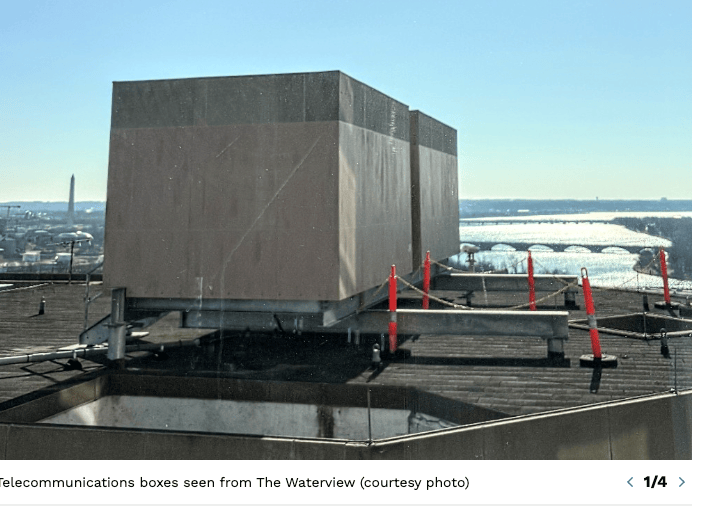
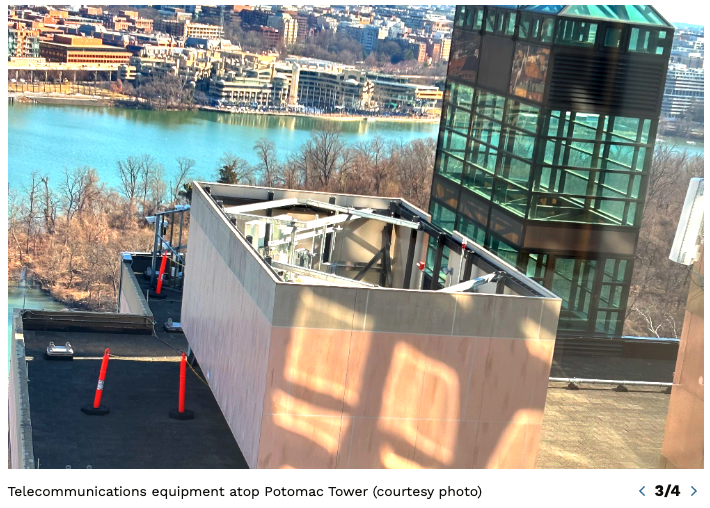
As a result, homeowners are considering heading to court over world-class views now partially blocked by rooftop telecommunications equipment.

‘We Were Completely Blindsided’

Theodore and Georgene Boll purchased a 25th-floor condominium unit in the 31-story Waterview building at 1111 19th Street N. for $2.625 million in early 2023.

From the perch, they were able to enjoy glorious views of the national monuments and Potomac River.

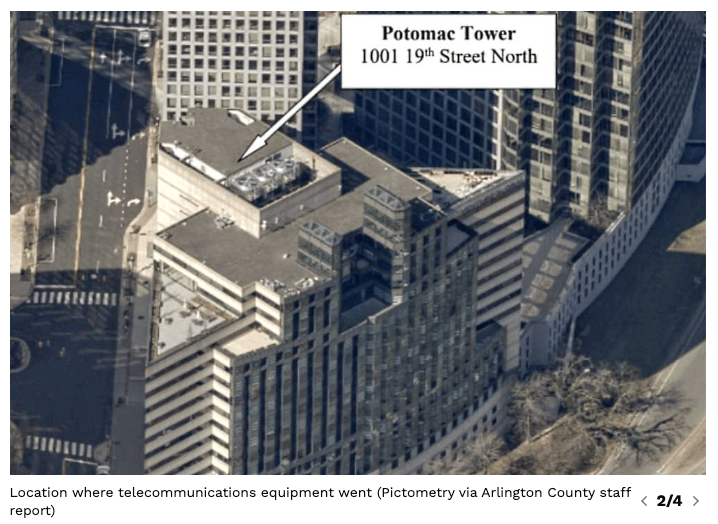
But since December 2023, a large telecommunications-equipment box atop the adjacent Potomac Tower office building at 1001 19th Street N. has obscured those vistas.

“We were completely blindsided by these installations. We received no advance notice whatsoever,” Theodore Boll said at the Feb.19 BZA meeting. “Dealing with the county has been arduous and slow.”

The Bolls, and others in the building whose views have been compromised, have the backing of Waterview’s condominium board in the dispute with the county government.

“It’s our home, and we feel we have been compromised — and it doesn’t feel very good,” said Jim Matthews, president of that body.

Their complaint was not entirely with the telecommunications box itself. It was with limits to public outreach and the fact that, they allege, the County Board’s action allowed the equipment to rise nearly nine feet higher than allowed in the county’s zoning code.

“It was illegal from the beginning,” said Gifford Hampshire, a land-use attorney representing the Bolls. “A county cannot violate its own ordinance.”

That was not the view of the county government’s zoning administrator, Arlova Vonhm, or her legal counsel.

At the BZA meeting, they argued that the county’s site-plan amendment for the site in June 2023 trumped other portions of the zoning code. As a result, county staff contend, the 31.9-foot-tall equipment is legal even though the zoning code’s limit is 23 feet.

BZA Sides with Staff on Technical Grounds

County officials argued that BZA members had no jurisdiction to compel the zoning administrator to rule on whether the telecommunications equipment, used by Verizon and AT&T, was legal.

BZA members ultimately concluded they had no jurisdiction to rule on the matter, handing a win to the county government. But before reaching that point, several BZA members expressed frustration over how county officials handled the matter.

The whole issue “looks like a serious failure of the public process,” said BZA member Inta Malis, telling the Bolls she was “sorry for what has happened.”

“Things were not handled well,” added BZA member Carol McCoskrie. “We don’t have the ability, unfortunately, to correct that process.”

Residents of Waterview say they were not provided notice of the June 2023 public hearing, which like most county-government advertising was placed in the Washington Times.

“To think we’re going to read the Washington Times? Are you kidding me?” Matthews said.

Joseph Ventrone, president of the North Rosslyn Civic Association, alleged that the county’s lack of transparency represented “serious misjudgment” and “a disregard for the concerns of the community.”

“The neighbors were deprived of the opportunity to voice their views,” Ventrone told BZA members.

Was Outreach Sufficient?

Under state law, anyone wishing to challenge the June 2023 County Board action had 30 days after it occurred to file their objections with the Circuit Court.

That window of opportunity came and went, however, without many Waterview residents knowing about the Board’s action.

“It really makes us suspect,” Matthews said. “The issue is bigger than cell towers. It really is about justice and fairness.”

An attorney representing zoning officials acknowledged that only the “bare minimum” required under state law was done to communicate the matter with the public.

Hampshire, representing the Bolls, contends that limited outreach was a major failing of the planning process.

“How was somebody supposed to know to appeal to Circuit Court in 30 days if they have no notice?” he asked. “This has all the indications of being designed so that members of the public wouldn’t know about it and wouldn’t raise a stink about it.”

BZA members seemed to be on his side.

“The process failed. It’s very disturbing that something like this could happen,” member Judy Freshman said. “I’m troubled by the fact I can’t see where the remedy is for the people who have been damaged.”

Three of five current County Board members were elected to office after the 2023 zoning action was taken. Freshman suggested it might be best for County Board members to revisit the issue.

County Board Declines to Comment

Speaking on behalf of the Arlington County Board, spokesperson David Barrera cited a policy against Board members commenting on BZA matters when contacted with questions.

A county staff report for the June 2023 meeting noted that placards were placed in various locations surrounding the subject property, and that the North Rosslyn Civic Association and Rosslyn Business Improvement District (BID) were contacted about the proposal.

The BID expressed its support of the proposal in advance of the meeting, while the North Rosslyn Civic Association did not respond, the staff report said.

Barrera’s response did not address one of the key demands of the North Rosslyn Civic Association made last month — that Board members investigate the situation to determine what went wrong, and what could be done better in the future.

At the BZA meeting, Malis said she did not blame County Board members for approving the site-plan amendment, given the information and feedback they had in front of them at the time of the 2023 vote.

But, Malis said, a final decision might have been different if the body had all the facts in front of it.

Next Stop May Be a Courtroom

The telecommunications equipment placed atop Potomac Tower is designed to replace equipment that previously had stood atop the nearby RCA Building.

That 1950s-era office building was demolished in 2023 to make way for construction of a new residential building.

Despite the 30-day period for appealing the matter to court having long since expired, the Bolls and potentially other residents may move forward with a legal challenge to rulings by the zoning administrator and BZA, one source told ARLnow.

The BZA’s Malis intimated that might be the only course left to them.

“I don’t know how we can make [the situation] right or the county can,” she said.

Hampshire provided an inkling of what might be at stake if the matter heads to court.

Noting that the other building is just 20 feet away from the kitchen and dining-room windows of his clients, he suggested the now-obscured views might cost homeowners “$1 million” in terms of resale prices of the affected properties.

Looking Ahead: My Role as CAMICB Vice Chair

By Michael Darby, CMCA

Serving on the CAMICB Board has been an incredibly rewarding experience. Being part of an organization dedicated to advancing education and professionalism in community association management—both in the U.S. and globally—has reinforced my deep passion for this profession. It is truly fulfilling to contribute to an industry that plays such a vital role in communities around the world, including here in Australia.

Recently, I was honored to be elected as CAMICB Vice Chair. I look forward to collaborating closely with the Executive Team, Chair Noelle Hicks, and my fellow Board members as we work toward achieving the Board’s strategic goals.

A key priority this year is a comprehensive review of our long-term strategic plan. With several major milestones already achieved, this is a pivotal moment to assess our progress, refine our approach, and set bold new objectives that will guide CAMICB’s growth and impact in the years ahead.

We are also focused on ensuring the CMCA exam continues to serve as a reliable benchmark for competency in the field. With the launch of the updated exam format in December, we are closely monitoring participation rates and candidate experience to ensure the exam remains accessible, relevant, and reflective of the evolving profession.

Another major initiative on the horizon is the development of a global guide to community management—a practical resource aimed at defining best practices and providing essential guidance for managers worldwide. With insights from experienced professionals, this guide has the potential to set a new industry benchmark and support managers in navigating the evolving complexities of the profession. I look forward to sharing updates as the project progresses.

I am excited about what lies ahead and grateful for the opportunity to contribute to CAMICB’s continued success.

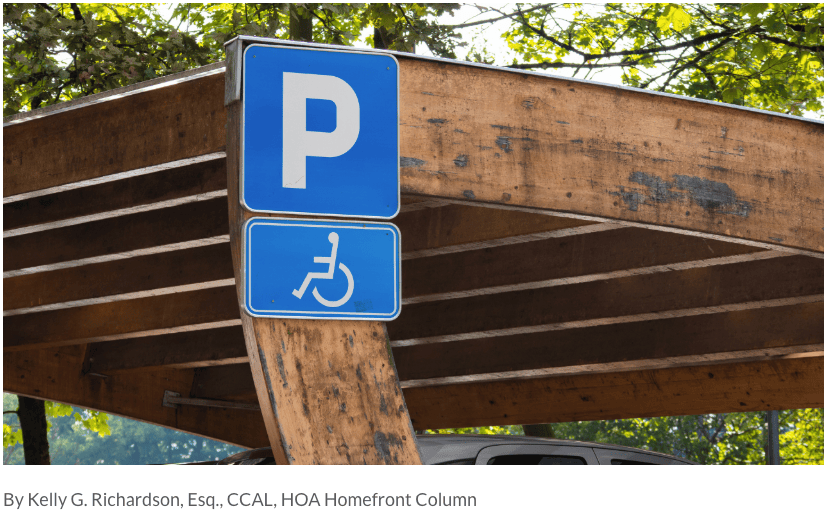
Should We Have Handicapped Parking?

Richardson/Ober Attorneys Blog

Hi Kelly: My wife has a handicapped decal on her license plate. Although she has mobility issues and has a tough time getting in and out of her car when it is in the garage, she was told that ADA rules do not apply in private communities, and if she parks her car in the parking lot at night, rather than in the garage, the car will be towed. Are ADA rules not applicable in private communities? Please let us know, this is going to be very tough on my wife. S.K, Mission Viejo

Hi Kelly: Are there any HOA rules concerning parking and handicapped parking? There is a common parking lot but there is no designated handicapped parking.  Aren’t there laws concerning having handicapped parking? Thank you, D.J, Rancho Santa Margarita

Kelly: Our board recently voted to change the parking rules within the community and now handicapped stalls will follow the visitor parking rules, so a car is towed after 6 nights within a month. So, individuals with valid placards can no longer use these parking spaces after the 6th night. Does this not comply with Fair Housing Act and ADA law? The HOA advised that my handicapped mother cannot use this parking stall going forward even with a valid placard. Thank you! N.K., Irvine


Dear S.K., D.J., and N.K.: Residential HOAs are normally not considered “public accommodations,” so the Americans with Disabilities Act (“ADA”) does not apply. However the federal and state Fair Housing laws and California Fair Housing Regulations DO apply.

The fact that someone has a DMV-issued handicapped placard or license plate does not automatically mean that the driver of that vehicle is considered disabled and given protection. Sometimes, there are people driving who have recovered from their disability but use placards or “borrow” a disabled person’s placard. Disabled persons are permitted to ask for reasonable accommodations of their disability, but unless they are obviously disabled (such as clearly requiring a wheelchair or walker) they must provide written verification from a qualified person as to their disability and as stating the help they need. 

When parking accommodations are involved, sometimes residents misunderstand that accommodation requested must somehow help respond to their disability – I frequently see residents seeking special parking privileges due to a claim of disability, but they are actually asking for the right to park farther away from their home (because their garage is full). 

HOAs may need to make exceptions to their parking rules to accommodate (meaning help) disabled resident requests. So, the existence or lack of designated handicapped parking spaces doesn’t close the door on the subject. If there are spaces closer to the elevator or residence and the HOA can reassign spaces, the HOA will be expected to do so to help a disabled resident.

Remember, the California Civil Rights Department (https://calcivilrights.ca.gov/) may be looking over your shoulder if there is a complaint – so make sure your HOA understands the requirements regarding accommodating disabilities and is on the right side of this issue.

Residents, if you need help, ask for it, and be prepared to provide documentation of disability. Please don’t invoke Fair Housing laws just to get what you want – you may be taking spaces away from someone who truly needs that help. 

Sincerely, Kelly

HOA Boards Enjoy Broad Powers on Borrowing and Spending

HABITAT Magazine

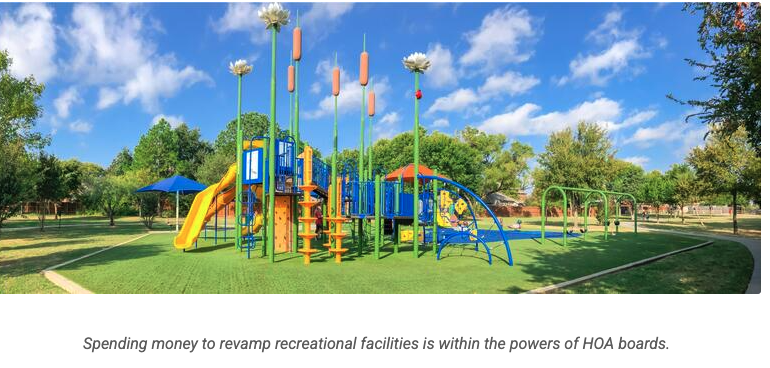
Q: The board at our homeowners association (HOA) on Long Island has decided unilaterally to take out a seven-figure loan to revamp the recreational facilities. To repay it, the board is diverting our annual assessments away from their intended purpose of funding reserves. Our governing documents do not require the board to seek approval before borrowing, and do not put limits on how much the board can borrow. What can residents do?

A: In an HOA the board of directors is elected to make decisions for the community, and this typically includes borrowing for renovations, replies the Ask Real Estate column in The New York Times. Whatever the benefits of the HOA arrangement, there’s little residents can do in a situation like this.

“When you move into an association, you give up certain rights and are submitting to certain powers of the board as set forth in the governing documents,” says Marc Schneider, the managing partner at the law firm Schneider Buchel.

If HOA board members are acting in accordance with the governing documents and they’re making decisions in good faith, then they are protected from liability through a legal principle called the business judgment rule. Borrowing to renovate the community’s recreational facilities is typically permissible in associations’ governing documents, and would be an action considered in good faith.

If you were in a condo, it would be a different story. Condominiums in New York are governed by a law requiring that unit-owners vote on all borrowing. Condo boards cannot borrow unilaterally, unless the bylaws contain that right.

There are two aspects of your HOA’s project that could potentially contravene the governing documents, giving you a legal claim: First, whether the board is adding new amenities that didn’t exist before; and second, whether the documents allow the use of annual assessments for the loan repayment to fund the renovations (which isn’t an unusual practice).

“The governing documents should be carefully reviewed to determine if the board is exceeding its powers,” Schneider says.

As always, collective action with your neighbors can change the direction of your community. Andrew Lieb, founder of his eponymous law firm, offers a modest proposal: “Why not just run for the board against these board members if you disagree with the allocation of funds, and use that as your platform?”

Technological Proficiency In Community Association Management

By Lydia Pelliccia and Matthew Green, CAE

We had the privilege of speaking with Candace Lewis, CMCA, AMS, PCAM, into this particular topic. She is the Director of Marketing for Cardinal Management Group, LLC, a privately held, locally founded firm in Woodbridge, VA.

It’s crucial for professionals in every industry to stay up to date on new technologies and the community association management profession is no different. Managers are embracing a variety of tools to improve efficiency, productivity, communication, resident satisfaction and better collaboration with Boards and business partners. From selecting the right device (phone, tablet, app, etc.) to choosing the appropriate software that suits their needs, these tools help make managers’ lives and jobs more rewarding. 

Technology in Action: Streamlining Processes, Maximizing Efficiency 

“There was a time when information about communities was kept in a binder and, as a manger, you had to lug that binder to meetings so you had the information you needed at your fingertips,” said Candace Lewis. CMCA, AMS, PCAM. “Now, having it digitally accessible on your phone, tablet or computer allows for easier access and searchability. Most documents have Optical Character Recognition (OCR), which makes finding specific language or keywords much easier in a litany of governing documents. For example, I was at an Architectural Review Committee appeal hearing with a Board of Directors questioning what the rule stated about the height of a retaining wall; I was able to quickly find the answer on my tablet. Instead of delaying their decision to the next meeting, the Board was able to quickly move forward.”

Candace further explains that tasks like violation reporting and tracking have significantly improved with technology. “Instead of using a clipboard, pen and paper to log violations, we now have community management software, such as CINC, SmartWebs or FrontSteps, that help managers efficiently handle these issues by quickly uploading photos while sending the violation notice in real-time,” said Candace.  “Homeowners receive an email about the violation and, in turn, more swiftly remedy the issue. Depending on the platform used, homeowners can also log-in to see their outstanding violations and any photos the manager has uploaded.”

Digitizing resales in HOAs helps modernize the process, making it faster, more efficient, and more transparent. It provides significant benefits in terms of operational efficiency, cost savings, enhanced communication, and compliance. Candace explains, “There was a time when a potential buyer had to wait for a large package of documentation to arrive in the mail before they could review the association’s governing documents, prior to moving to settlement. Hard copies required an individual in an office to print, organize and mail to the potential buyer. Now, services like CondoCerts, HomeWise and others offer a digital delivery of these documents making it less time consuming with minimal paperwork. “For both homeowners and managers, the transition to a digital system creates a smoother, more convenient experience while also improving the long-term management and oversight of the community,” added Candace.

The pandemic fueled the rise of virtual meetings and the use of Zoom, Microsoft Teams, or Google Meeting platforms to host these events.  As a result, many Board and Annual Meetings are now hybrid or fully virtual. Further, what has also become an option for many managers is the opportunity to continue working remotely. “In the past, when homeowners or homeowner volunteers wanted to meet with us, we’d convene at the office or onsite,” said Candace. “Now, we can quickly arrange a virtual meeting, which is helpful when having difficult conversations that are easily misinterpreted via phone or email. In addition, regularly scheduled virtual team meetings have also enhanced collaboration and meaningful “in-person” dialogue.”

Artificial Intelligence Supporting Communications Efforts 

Candace offered one of the most popular uses of technology, as a manager, is the thoughtful use of AI platforms to help managers craft email responses, homeowner notices, newsletters, email blasts, requests for proposals, policy resolutions, bid comparisons, and more. “I use ChatGPT and Grammerly, like many others; however, some software companies have developed their own AI add-ons, such as MicroSoft’s Azure AI,” said Candace. “AI is also a great tool to use on most mobile devices when communicating with a homeowner whose first language is not English.”

Are there challenges in convincing homeowners to use newer technology? Absolutely. “Most people need another login credential like they need a crack in their foundation,” quipped Candace. “Urging anyone to download an app or create a new sign-in, isn’t always easy.”

Candace notes, more importantly, as data and operations go digital, cybersecurity becomes a critical concern. Managers must stay updated on best practices for protecting resident data and ensuring that functions such as online payment systems, communications channels and other digital tools are secure from breaches.

Staying abreast of new technology helps community association managers improve operational efficiency, reduce costs, enhance resident satisfaction, maintain compliance, and stay competitive in a changing market. “It’s not just about keeping up with trends – it’s about using technology to create a more streamlined, responsive, management approach,” said Candace.

Candace expressed that information about new technology is often in mainstream media; however, technology specific to community associations is best discovered at the CAI Annual Conference or local chapter conferences and expos. Additionally, she finds “ads and articles in CAI publications have been a great help in spreading the word about the many options available.”

Technological Proficiency In Community Association Management is the sixth in a series of articles, produced by CAMICB staff, that delve into the important issues and topics affecting community association managers. 

Lydia Pelliccia is a freelance writer. Matthew Green is executive director of Community Associations Managers International Certification Board.