
Richardson/Ober Attorneys Blog
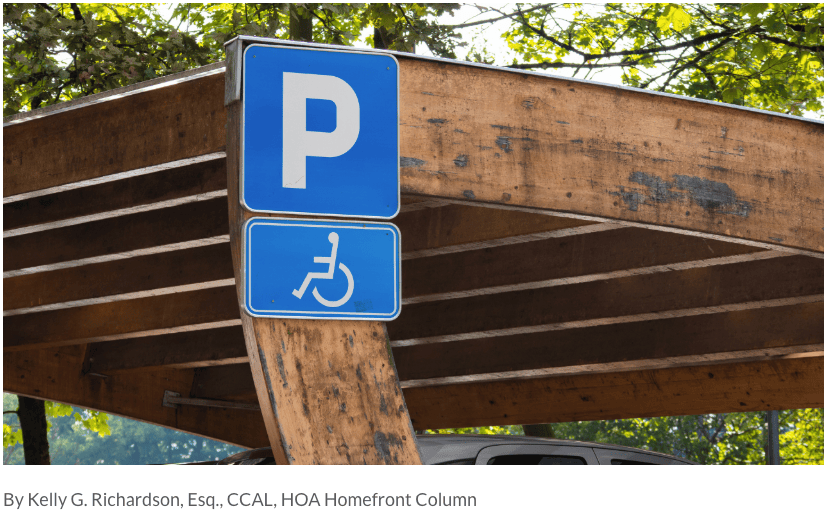
Hi Kelly: My wife has a handicapped decal on her license plate. Although she has mobility issues and has a tough time getting in and out of her car when it is in the garage, she was told that ADA rules do not apply in private communities, and if she parks her car in the parking lot at night, rather than in the garage, the car will be towed. Are ADA rules not applicable in private communities? Please let us know, this is going to be very tough on my wife. S.K, Mission Viejo
Hi Kelly: Are there any HOA rules concerning parking and handicapped parking? There is a common parking lot but there is no designated handicapped parking. Aren’t there laws concerning having handicapped parking? Thank you, D.J, Rancho Santa Margarita
Kelly: Our board recently voted to change the parking rules within the community and now handicapped stalls will follow the visitor parking rules, so a car is towed after 6 nights within a month. So, individuals with valid placards can no longer use these parking spaces after the 6th night. Does this not comply with Fair Housing Act and ADA law? The HOA advised that my handicapped mother cannot use this parking stall going forward even with a valid placard. Thank you! N.K., Irvine
Dear S.K., D.J., and N.K.: Residential HOAs are normally not considered “public accommodations,” so the Americans with Disabilities Act (“ADA”) does not apply. However the federal and state Fair Housing laws and California Fair Housing Regulations DO apply.
The fact that someone has a DMV-issued handicapped placard or license plate does not automatically mean that the driver of that vehicle is considered disabled and given protection. Sometimes, there are people driving who have recovered from their disability but use placards or “borrow” a disabled person’s placard. Disabled persons are permitted to ask for reasonable accommodations of their disability, but unless they are obviously disabled (such as clearly requiring a wheelchair or walker) they must provide written verification from a qualified person as to their disability and as stating the help they need.
When parking accommodations are involved, sometimes residents misunderstand that accommodation requested must somehow help respond to their disability – I frequently see residents seeking special parking privileges due to a claim of disability, but they are actually asking for the right to park farther away from their home (because their garage is full).
HOAs may need to make exceptions to their parking rules to accommodate (meaning help) disabled resident requests. So, the existence or lack of designated handicapped parking spaces doesn’t close the door on the subject. If there are spaces closer to the elevator or residence and the HOA can reassign spaces, the HOA will be expected to do so to help a disabled resident.
Remember, the California Civil Rights Department (https://calcivilrights.ca.gov/) may be looking over your shoulder if there is a complaint – so make sure your HOA understands the requirements regarding accommodating disabilities and is on the right side of this issue.
Residents, if you need help, ask for it, and be prepared to provide documentation of disability. Please don’t invoke Fair Housing laws just to get what you want – you may be taking spaces away from someone who truly needs that help.
Sincerely, Kelly