
Survey Says: Ethics Still Matter in Business

The Darden Report The University of Virginia

By McGregor McCance

Does the stakeholder approach to business still matter in a climate dominated by raw, power-play decision-making?

Stakeholder proponents like Darden School of Business Professor Ed Freeman say the answer is yes, even as corporate executives pull back on commitments to workers and political leaders today enact massive changes that will deeply affect employees and other stakeholders.

“The opportunity for businesses to step up is huge,” Freeman said.

New research suggests that is exactly what people want.

A recent survey gauging what people expect from corporate America ranked ethical leadership as the No. 2 expectation people have for business. That result was up from the No. 7 spot last year.

Similarly, respondents listed the expectation that corporations “communicate transparently” rose to the No. 4 rank this year, from No. 12 the previous survey.

The No. 1 result: People expect and want fair, living wages.

The annual Americans’ Views on Business Survey, conducted by JUST Capital, is intended to identify what the public expects from business, what issues matter most, and where there are opportunities for business leadership.

JUST Capital was co-founded in 2014 by a group from business, finance and civil society who “believed that business and markets can and must be a greater force for good.” The founding members include investor Paul Tudor Jones II, who earned an economics degree from the University of Virginia.

Freeman, who collaborates regularly with JUST Capital, said this year’s survey results are not surprising, as they fit with a pattern of public sentiment for ethical, fair behavior toward employees and other stakeholders such as suppliers, communities and investors.

“If you ask American people what they want about their business, they want them to essentially create value for their stakeholders. That’s the short form of what this survey says,” Freeman said. “They place fair wages, dealing with customers in the right way, and ethics, at the top of the list. This isn’t some weird idea. It’s what people expect.”

Stakeholder capitalism is defined broadly as an approach to business in which a company or organization considers how its actions will affect all stakeholder groups, rather than fulfilling a responsibility only to shareholders. The approach urges consideration of employees, customers, suppliers, the community and the environment – as well as shareholders.

“The opportunity for businesses to step up is huge.”

ED FREEMAN, DARDEN PROFESSOR

Stakeholder capitalism or stakeholder theory have long been core to Darden’s curriculum and School values. Freeman, who has taught stakeholder theory and ethics at Darden since 1987, is credited with articulating the original stakeholder tenets in a business context in his 1984 book “Strategic Management: A Stakeholder Approach.”

JUST Capital said the latest survey results mirror sentiments expressed by voters in the November 2024 election cycle: “Americans are concerned about their economic well-being, about how they are treated as consumers, about being able to support their families. And they appear distrustful of institutions as they repeatedly call for increased transparency, corporate accountability and leadership.”

For Freeman, the results bolster Darden’s commitment to teaching responsible leadership, while giving corporate and government leaders more reason to think about how their decisions affect others.

“When the effects are not good, you’re partially responsible for that,” he said. “Stakeholders are responsible too, but you’re partially responsible for the effects of your actions. That’s just ethics 101.”

The survey’s top 10 issues that members of the public identify for business:

  1. Pays a fair, living wage
  2. Acts ethically at the leadership level
  3. Supports worker wellbeing
  4. Communicates transparently
  5. Provides benefits and work-life balance
  6. Supports workforce advancement and training
  7. Treats customers fairly
  8. Offers fair pricing
  9. Creates jobs in the U.S.
  10. Protects customer privacy

About the University of Virginia Darden School of Business

The University of Virginia Darden School of Business prepares responsible global leaders through unparalleled transformational learning experiences. Darden’s graduate degree programs (MBA, MSBA and Ph.D.) and Executive Education & Lifelong Learning programs offered by the Darden School Foundation set the stage for a lifetime of career advancement and impact. Darden’s top-ranked faculty, renowned for teaching excellence, inspires and shapes modern business leadership worldwide through research, thought leadership and business publishing. Darden has Grounds in Charlottesville, Virginia, and the Washington, D.C., area and a global community that includes 18,000 alumni in 90 countries. Darden was established in 1955 at the University of Virginia, a top public university founded by Thomas Jefferson in 1819 in Charlottesville, Virginia.

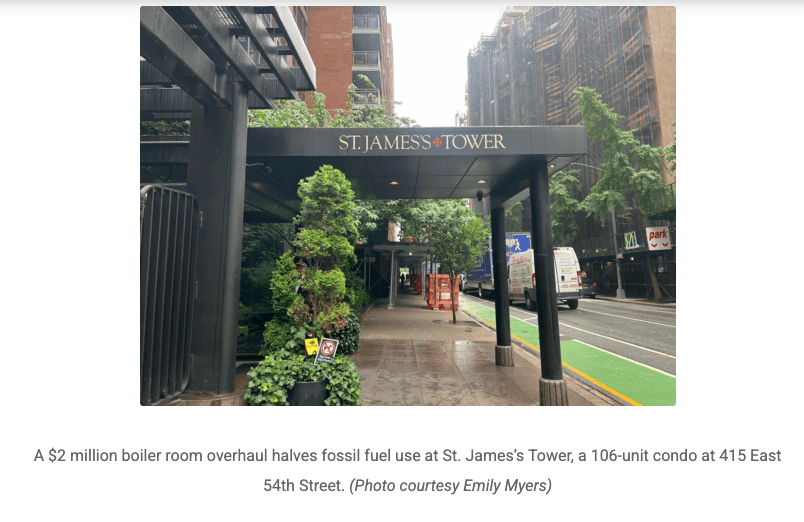
Boiler Room Overhaul Halves Gas Use and Emissions at Sutton Place Condo

Emily Myers in Bricks & Bucks

Sutton Place, Manhattan

Keen to comply with emission rules under Local Law 97, the board at St. James’s Tower Condo, a 106-unit highrise in Sutton Place, has halved the building’s fossil fuel use with a $2 million boiler room overhaul. The 31-story condo ditched steam for a water-based — or hydronic — boiler system and also added a cogen plant. A steam heat system operates at much higher temperatures than one circulating hot water, so a move to a hydronic circuit makes a big dent in gas usage.

Cogen equipment, also known as clean heat and power or CHP, uses gas to generate electricity via a turbine, which creates reusable exhaust heat. “The cogen was black and white to us,” says board president Donald Epstein. It not only boosts efficiency but also means the condo has extra security if there are issues with the grid. “In the event of a blackout we would have service to run our elevator and hot water,” says building manager John Faldetta.

The board began reevaluating the building’s energy use in 2022. At the time, the condo had two gas-fired boilers to create steam for heating and hot water. Robert F. Germain Jr., owner of the engineering firm R. Germain Inc., led the redesign, and says the “beauty” of the new configuration at St. James’s Tower is that “the building was already piped for hot water.” This means that even though the building moved from a steam to water-based circuit, the work was largely contained in the boiler room. “We are just supplying the pipes differently and more efficiently,” Germain says.

The new system uses a single gas boiler to heat water, which is then circulated through a heat exchanger and around the building. Recirculating the waste heat from the cogen keeps the boiler from cycling on too frequently. “The boiler really only fires when it’s very cold out,” Germain says. So in warmer months it is barely used. The savings are dramatic. “They will cut their bills in half,” Germain says, explaining how gas usage from the new boiler configuration has fallen from 100,000 therms (a measure of heat energy) per year to a little over 50,000 therms.

The domestic hot water at the condo is supplemented by an electric hot-water boiler with storage tanks on the roof. One of the challenges with the project was sizing the equipment correctly. The condo’s demographic includes many international owners who come and go. “The building is 65% occupied at any one time,” Faldetta says. This can make it difficult to estimate energy needs.

To support the new system, variable frequency drives (VFDs) were added to the pumps to allow for adjustments to motor speeds. Without a VFD, a pump is typically on or off, but once they are added, the pump speed can be tweaked automatically to improve efficiency. “The building is saving money on electricity with the pumps and no one knows the difference,” Germain says. “That’s why VFDs are good on any type of system.”

The work was funded with a $3.8 million special assessment, which included money raised for facade repairs and a new fire-alarm system. Over the past two years, shareholders contributed around $40,000 in quarterly payments to fund the projects. The new system became operational in February, concluding the two-and-a-half year project, with installation completed by Controlled Combustion. The project also qualified for $48,000 in incentives.

Based on data from 2023, St. James’s Tower is facing annual Local Law 97 emission penalties of $44,400 starting in 2030. “We expect that to be removed completely with the 50% reduction in gas,” Germain says. This is welcome news for the board. “We knew energy efficiency was a requirement and there would be fines imposed if we didn’t comply,” Epstein says.

Survey Says: Ethics Still Matter in Business

The Darden Report The University of Virginia

By McGregor McCance

Does the stakeholder approach to business still matter in a climate dominated by raw, power-play decision-making?

Stakeholder proponents like Darden School of Business Professor Ed Freeman say the answer is yes, even as corporate executives pull back on commitments to workers and political leaders today enact massive changes that will deeply affect employees and other stakeholders.

“The opportunity for businesses to step up is huge,” Freeman said.

New research suggests that is exactly what people want.

A recent survey gauging what people expect from corporate America ranked ethical leadership as the No. 2 expectation people have for business. That result was up from the No. 7 spot last year.

Similarly, respondents listed the expectation that corporations “communicate transparently” rose to the No. 4 rank this year, from No. 12 the previous survey.

The No. 1 result: People expect and want fair, living wages.

The annual Americans’ Views on Business Survey, conducted by JUST Capital, is intended to identify what the public expects from business, what issues matter most, and where there are opportunities for business leadership.

JUST Capital was co-founded in 2014 by a group from business, finance and civil society who “believed that business and markets can and must be a greater force for good.” The founding members include investor Paul Tudor Jones II, who earned an economics degree from the University of Virginia.

Freeman, who collaborates regularly with JUST Capital, said this year’s survey results are not surprising, as they fit with a pattern of public sentiment for ethical, fair behavior toward employees and other stakeholders such as suppliers, communities and investors.

“If you ask American people what they want about their business, they want them to essentially create value for their stakeholders. That’s the short form of what this survey says,” Freeman said. “They place fair wages, dealing with customers in the right way, and ethics, at the top of the list. This isn’t some weird idea. It’s what people expect.”

Stakeholder capitalism is defined broadly as an approach to business in which a company or organization considers how its actions will affect all stakeholder groups, rather than fulfilling a responsibility only to shareholders. The approach urges consideration of employees, customers, suppliers, the community and the environment – as well as shareholders.

“The opportunity for businesses to step up is huge.”

ED FREEMAN, DARDEN PROFESSOR

Stakeholder capitalism or stakeholder theory have long been core to Darden’s curriculum and School values. Freeman, who has taught stakeholder theory and ethics at Darden since 1987, is credited with articulating the original stakeholder tenets in a business context in his 1984 book “Strategic Management: A Stakeholder Approach.”

JUST Capital said the latest survey results mirror sentiments expressed by voters in the November 2024 election cycle: “Americans are concerned about their economic well-being, about how they are treated as consumers, about being able to support their families. And they appear distrustful of institutions as they repeatedly call for increased transparency, corporate accountability and leadership.”

For Freeman, the results bolster Darden’s commitment to teaching responsible leadership, while giving corporate and government leaders more reason to think about how their decisions affect others.

“When the effects are not good, you’re partially responsible for that,” he said. “Stakeholders are responsible too, but you’re partially responsible for the effects of your actions. That’s just ethics 101.”

The survey’s top 10 issues that members of the public identify for business:

  1. Pays a fair, living wage
  2. Acts ethically at the leadership level
  3. Supports worker wellbeing
  4. Communicates transparently
  5. Provides benefits and work-life balance
  6. Supports workforce advancement and training
  7. Treats customers fairly
  8. Offers fair pricing
  9. Creates jobs in the U.S.
  10. Protects customer privacy

About the University of Virginia Darden School of Business

The University of Virginia Darden School of Business prepares responsible global leaders through unparalleled transformational learning experiences. Darden’s graduate degree programs (MBA, MSBA and Ph.D.) and Executive Education & Lifelong Learning programs offered by the Darden School Foundation set the stage for a lifetime of career advancement and impact. Darden’s top-ranked faculty, renowned for teaching excellence, inspires and shapes modern business leadership worldwide through research, thought leadership and business publishing. Darden has Grounds in Charlottesville, Virginia, and the Washington, D.C., area and a global community that includes 18,000 alumni in 90 countries. Darden was established in 1955 at the University of Virginia, a top public university founded by Thomas Jefferson in 1819 in Charlottesville, Virginia.