
Emily Myers in Bricks & Bucks
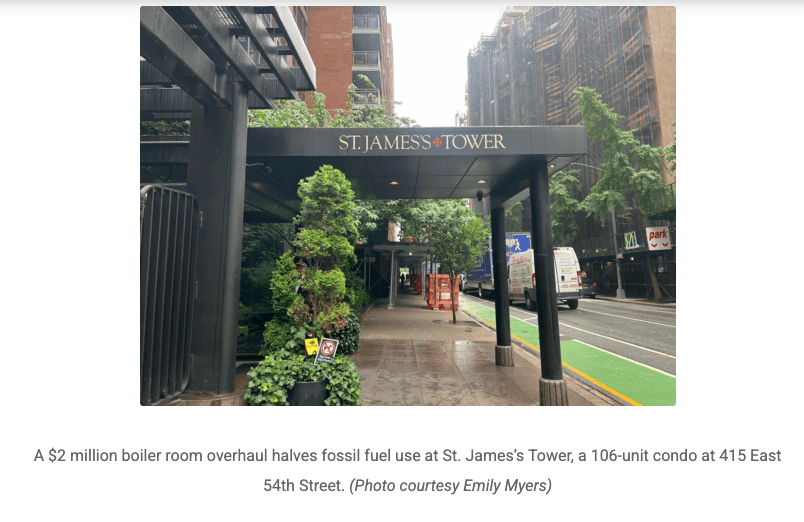
Keen to comply with emission rules under Local Law 97, the board at St. James’s Tower Condo, a 106-unit highrise in Sutton Place, has halved the building’s fossil fuel use with a $2 million boiler room overhaul. The 31-story condo ditched steam for a water-based — or hydronic — boiler system and also added a cogen plant. A steam heat system operates at much higher temperatures than one circulating hot water, so a move to a hydronic circuit makes a big dent in gas usage.
Cogen equipment, also known as clean heat and power or CHP, uses gas to generate electricity via a turbine, which creates reusable exhaust heat. “The cogen was black and white to us,” says board president Donald Epstein. It not only boosts efficiency but also means the condo has extra security if there are issues with the grid. “In the event of a blackout we would have service to run our elevator and hot water,” says building manager John Faldetta.
The board began reevaluating the building’s energy use in 2022. At the time, the condo had two gas-fired boilers to create steam for heating and hot water. Robert F. Germain Jr., owner of the engineering firm R. Germain Inc., led the redesign, and says the “beauty” of the new configuration at St. James’s Tower is that “the building was already piped for hot water.” This means that even though the building moved from a steam to water-based circuit, the work was largely contained in the boiler room. “We are just supplying the pipes differently and more efficiently,” Germain says.
The new system uses a single gas boiler to heat water, which is then circulated through a heat exchanger and around the building. Recirculating the waste heat from the cogen keeps the boiler from cycling on too frequently. “The boiler really only fires when it’s very cold out,” Germain says. So in warmer months it is barely used. The savings are dramatic. “They will cut their bills in half,” Germain says, explaining how gas usage from the new boiler configuration has fallen from 100,000 therms (a measure of heat energy) per year to a little over 50,000 therms.
The domestic hot water at the condo is supplemented by an electric hot-water boiler with storage tanks on the roof. One of the challenges with the project was sizing the equipment correctly. The condo’s demographic includes many international owners who come and go. “The building is 65% occupied at any one time,” Faldetta says. This can make it difficult to estimate energy needs.
To support the new system, variable frequency drives (VFDs) were added to the pumps to allow for adjustments to motor speeds. Without a VFD, a pump is typically on or off, but once they are added, the pump speed can be tweaked automatically to improve efficiency. “The building is saving money on electricity with the pumps and no one knows the difference,” Germain says. “That’s why VFDs are good on any type of system.”
The work was funded with a $3.8 million special assessment, which included money raised for facade repairs and a new fire-alarm system. Over the past two years, shareholders contributed around $40,000 in quarterly payments to fund the projects. The new system became operational in February, concluding the two-and-a-half year project, with installation completed by Controlled Combustion. The project also qualified for $48,000 in incentives.
Based on data from 2023, St. James’s Tower is facing annual Local Law 97 emission penalties of $44,400 starting in 2030. “We expect that to be removed completely with the 50% reduction in gas,” Germain says. This is welcome news for the board. “We knew energy efficiency was a requirement and there would be fines imposed if we didn’t comply,” Epstein says.