
Lessons From the Girl Scouts

By Peter Economy

They sell $800 million dollars’ worth of cookies every year, and not just to parents. Your company can learn a lot from them. In fact, so can you.

The annual Girl Scout Cookie campaign is a big business, generating sales of more than 200 million boxes of Thin Mints, Samoas, Do-Si-Dos, and other delights. That makes the Girl Scouts the Number 3 seller of cookies nationally. According to the organization’s leaders, selling those iconic cookies teaches girls five key entrepreneurial skills. Guess what? Those same skills are what will drive success at your company. Scout’s honor.

1. Set Goals

As the saying goes, “Life without goals is like a race with no finish line-;you’re just running to nowhere.” We all need goals to give focus to our lives and to help us create the plans that lead to success. However, there are right ways and wrong ways to set goals, and it’s up to you to teach your people the best ways while providing them with the information, resources, and support they need. The acronym SMART still makes sense: All goals should be specific, measurable, attainable, relevant, and time-bound.

2. Improve Decision-Making

Everyone in business needs to make decisions big and small. Decision-making is a skill that gets better when it’s exercised. Help your people make better decisions by delegating tasks to them and granting them the autonomy they need. Start with small tasks and work up. Your employees will learn vital decision-making skills along the way while becoming more engaged in their jobs.

3. Embrace Financial Literacy

Your people should understand where revenue comes from and the role that each person plays in creating it. While salespeople are often well aware of a company’s sales figures, and how much of that total they generated, chances are that your accounts receivable clerk or your facilities manager has no idea about the figure or how the work they do contributes to it. Teach your people the key numbers for your business-;such things as revenue, income, expenses, inventory turnover, and profit-;and then be diligent about communicating them on a regular basis, ideally every week.

4. Emphasize People Skills

Business is all about people, and building strong and positive relationships with coworkers, vendors, customers, and members of the community in which you do business. While some people are naturals when it comes to interacting with others, some are not. Provide your employees with opportunities to build their people skills by working in teams that have the authority to do valuable work and make important decisions. They will learn valuable people skills along the way.

5. Put Ethics First

Every business should be built on a firm foundation of honesty and ethical values. The best way to achieve this is to model these behaviors yourself. Be honest and transparent in all your employee, customer, and vendor interactions, and be very clear to your people that you expect them to behave in exactly the same way. Be sure to praise employees for doing the right thing, and make it a part of the performance appraisal process.
CMCA Reinstatement Policy

CAMICB Board of Commissioners has changed the CMCA Reinstatement policy.  Individuals can now reinstatement more than one time in their career.

CAMICB policy permits a CMCA to reinstate the CMCA credential once during the course of a CMCA’s career, subject to the reinstatement policies outlined in the “Reinstatement” portion of the                         CMCA Candidate Handbook, including payment of a $200 reinstatement fee and fulfillment of applicable continuing education requirements.

A CMCA seeking subsequent reinstatement(s) of a lapsed CMCA credential must complete the application for reinstatement and:

  • Re-take      and pass the CMCA exam. Full application fees apply.
  • Or: Submit to the CAMICB office      proof of completion of 16 hours of continuing education for each year in      which the credential was inactive; submit payment of a $105 service fee      for each year in which the credential was inactive; and submit payment of      a $200 reinstatement fee.

Any CMCA requesting an initial or subsequent reinstatement of the CMCA credential must attest that, during the period in which the credential was inactive, the CMCA:

  • Has      upheld the CMCA Standards of Professional Conduct
  • Has      not represented himself/herself as an active CMCA

Reinstatement of the CMCA credential is subject to review by the CAMICB Board of Commissioners.

Should reinstatement of the CMCA credential be denied for any reason a CMCA has the right to appeal the denial. The appeal process is outlined in the CMCA Candidate Handbook.

Recertification

CAMICB sent reminder notices this week to individuals who need to recertify and/or pay their annual service fee by April 1, 2014. Here are a few helpful links:

A few things to note:

  1. It is the responsibility of each CMCA to provide documentation of their 16 hours of continuing education at the time of recertification. CAMICB does not track your CEs. If you took a class with CAI, please log into their website (caionline.org) to print out a certificate of completion.
  2. Only courses completed between April 1, 2012 and April 1, 2014 present will count as continuing education.
  3. If you have held an active AMS, PCAM, FL CAM, NV CAM or NAHC-RCM for at least a year, this will satisfy your CMCA continuing education requirement.
  4. Credit hours may be earned only for education that meets either of the following criteria: It pertains to community association operations or management and/or it contributes to the professional development of the CMCA.
  5. The CMCA Annual Service Fee is $105.00. Oftentimes this fee is confused with CAI’s individual manager membership. Recently, CAI increased the rate of the individual manager membership from $130.00 to $134.00. While CAMICB maintains an affiliate relationship with CAI, we are an independent credentialing body: separately incorporated, governed by an independent Board of Trustees, and guided in the administration of our program by the standards of our accrediting body, the National Commission for Certifying Agencies. We are not a membership organization; we do not collect membership dues. We assess our credential holders an annual maintenance fee which is used to support the development and delivery of our core exam and the operation of our program in accordance with best practices in professional credentialing.

Roland Richardson, Certification Assistant, is happy to assist you with the recertification process. Contact Roland at rrichardson@camicb.org with any questions

U.S. Census Bureau: Alternative Credential Data

This month the US Census Bureau released its first data on measuring alternative educational credentials.  According to the U.S. Census Bureau’s study, Measuring Alternative Educational Credentials, 12 million adults had both a professional certification or license and an educational certificate; 34 million had only a professional certification or license; and 7 million had only an educational certificate. The report shows that, in general, these alternative credentials provide a path to higher earnings. The report also showed that among full-time workers, the median monthly earnings for someone with a professional certification or license only was $4,167, compared with $3,433 for one with an educational certificate only; $3,920 for those with both types of credentials; and $3,110 for people without any alternative credential.

This information coincides with The Foundation for Community Association’s (cairf.org) most recent salary survey that says community association managers holding the CMCA certification earn approximately 18% more than those without the CMCA credential. 

Credentials are playing a major role in improving the earnings of community association managers and other professions. 

Community Associations and Snow

By: Jeffrey Van Grack

As the entire country continues to endure severe winter weatehr conditions, Jeffrey Van Grack takes on the issue of snow in community associations.

From Thanksgiving until the end of winter (and sometimes even later), snow may fall in area community associations and create issues of safety and parking that can escalate and become dangerous. The biggest concern and perhaps the biggest complaint that boards struggle with is snow removal. This is usually a no-win situation for the manager (think Snowmaggedon).

Despite what individual owners may think, boards of directors have no control of the snow, but they are responsible for snow removal (or lack thereof). In an effort to meet their legal obligation and to diminish the amount of callers, the board and management should hire a competent, properly insured snow removal company that is reliable. Hiring at the last minute the guy who shows up with the plow at the end of his truck is a mistake waiting to happen. Hiring someone who you are assured will show up as required pursuant to a written contract will go a long way towards goodwill of the owners for the entire year. Aside from the inconvenience and chaos it creates in the community, the removal of snow can be filled with liability issues, so having a competent properly insured contractor in place before the first snowfall is vital.

My favorite issue in a blizzard is when an owner (especially in townhouse communities) cleans a parking space and returns 20 minutes later to see a neighbor has taken over the “common area” parking space. Wars sometime start with this process. Your association may wish to send a reminder at the beginning of the season that all spaces are common spaces and that they may not be reserved.

Jeff Van Grack is a community association attorney whose practice has been devoted exclusively to representing community and homeowners associations, condominiums and co-operatives for more than 30 years. For more information visit www.lerchearly.com/team/jeffrey-van-grack.

8 Ways to Improve Body Language

BY Jeff Haden

Sometimes how you move matters more than what you say. Check out eight ways to use your body language to your advantage

We’re all students of body language. Too bad we’re not students of our own body language.

Here are some tips to help ensure your body language works for you and not against you:

1. Prep with a power pose.

It turns out Leo was on to something: According to Harvard professor Amy Cuddy, two minutes of power posing–standing tall, holding your arms out or towards the sky, or standing like Superman with your hands on hips–will dramatically increase your confidence.

Try it before you step into a situation where you know you’ll feel nervous, insecure, or intimidated. (Just make sure no one is watching.)

It may sound strange… but it works.

2. Dial up your energy level.

Imagine you’ve just led a meeting. Now rate your energy level on a scale of 1-10.

Most people will give themselves an 8 or 9. Unfortunately, most of the people in the room will give you a 3 or 4. What feels high energy to us can come across flat and lifeless to others.

Next time, remind yourself to dial up the energy by 20 percent or so. You don’t have to go all Matthew Lesko, but you should definitely display more enthusiasm and passion than you would under other circumstances.

3. When the going gets tough, start smiling.

Frowning, grimacing, glowering, and other negative facial expressions send a signal to your brain that whatever you’re doing is difficult. That causes your brain to send cortisol into your bloodstream, which raises your stress levels. Soon stress begets more stress–and pretty soon you’re a hot mess.

Instead, force yourself to smile. It works.

Plus when you smile, that helps other people feel less stress, too. Most of us mirror the actions of others, so if you smile, other people will smile. If you nod, others will nod.

And if you frown, soon others will be frowning, too.

4. Play supermodel to reduce conflict.

Standing face to face can feel confrontational. One way to reduce the instinctive level of threat you and the other person may feel is to shift your stance slightly so you’re standing at an angle–much like models who almost never stand with their bodies square to the camera.

If you’re confronted, don’t back away; just shift to a slight angle. And if you wish to appear less confrontational, approach the person and stand at a 45-degree angle (while still making direct eye contact, of course.)

Best of all, try to find a way to stand side by side, because that implicitly signals collaboration.

5. Don’t gesture above your shoulders.

Unless you’re one of these guys. Or this guy. Otherwise it just looks odd.

Watch any Steve Jobs presentation. He never raises his arms above his shoulders.

That should be enough of a reason for you not to, either.

6. Talk more with your hands.

The right gestures add immeasurably to your words. Think about how you talk and act when you’re not “on.”

Then act the same way when you’re in professional situations. You’ll feel more confident, think more clearly, naturally punctuate certain words and phrases, and fall into a much better rhythm.

7. Use props to engage.

Body positions affect attitude. People who stand or sit with their arms crossed and heads tilted forward are naturally more resistant and defensive.

So pull them out of their resistant poses. Shake hands. Ask for their business card. Offer a drink. (I have a friend who is the king of, “I’m going to get a water, can I bring you one?” He feels the act of handing someone a bottle of water is not only courteous but also forces them to open up their body position, which also helps overcome resistance.)

Or if you’re speaking to a group, ask questions that involve raising hands. Pass around relevant items. Find a way to get people to stand or change seats.

The more people move and open up the more engaged they feel.

8. Think before you speak.

Eye contact is important, but it’s hard to maintain eye contact when you have to think. Most of us look up, or down, or away and then we swing back when we’ve gathered our thoughts.

Here’s a better way. If you have to look away to think, do it before you answer. Take a pause, look thoughtful, glance away, and then return to making eye contact when you start speaking.

Then your words are even more powerful because your eyes support them.

Mortgage rates creep down toward 4%

feb 2014 econ map

(CNNMoney)

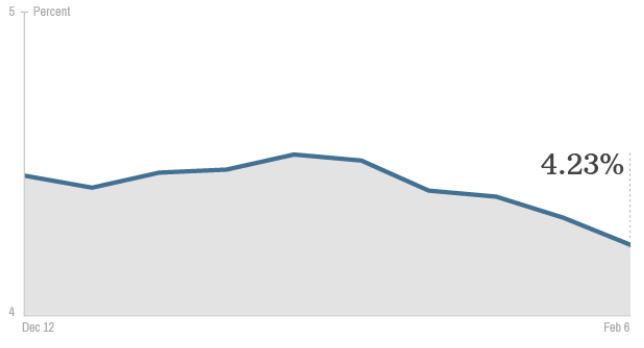
Maybe the days of rock-bottom mortgage interest rates aren’t numbered, after all. Once again, rates are creeping down towards 4%.

Rates dropped 0.09 percentage point this week to 4.23% for a 30-year, fixed -rate home loan, according to the latest weekly report from Freddie Mac.

Mortgage rates started the year at 4.53%, and have sunk each week in 2014, falling a total of 0.3 percentage point.

Borrowers with a 4.23% mortgage would pay $982 a month on a $200,000 balance, compared with $1,017 on a 4.53% loan.

Frank Nothaft, Freddie Mac’s chief economist, attributed the move to cooling home sales.

“Mortgage rates fell further this week following the release of weaker housing data,” he said. “The pending home sales index fell 8.7% in December to its lowest level since October 2011.”

The drop in mortgage bond purchases by the Federal Reserve, the so-called taper, that started last month, was expected to push rates gradually higher.

But worrisome economic news and a plunge in stocks has counter balanced the Fed action, according to Keith Gumbinger of HSH.com, a mortgage information company. Anxious investors have scurried to safe havens like treasury bonds and mortgage backed securities.

“Much to the benefit of mortgage shoppers, this move [to bonds] is dragging down yields and mortgage rates,” said Gumbinger. “This is a nice surprise” for people looking to purchase or refinance their homes in a rising rates environment, he said.

Rates may keep dropping, according to Gumbinger.

“The reduction in Fed support, slowing manufacturing activity here and in China, some less-than-stellar figures on consumer spending, housing, and more are causing some concern that the economy has decelerated over the last couple of months,” he said. “The economy doesn’t need to slow very much to put us back into the kind of funk we’ve been hoping to escape since the recovery began several years ago.”

Featured CE course

April 1, 2014 recertifications were just sent out.  Are you due for recertification?  Check here. Each week CAMICB will be featuring a course by a pre-approved course provider to help you meet the 16 hours of required CEs for recertification.

Community Associations Institute is offering a new online course on ethics.  The course is approved for 6 CMCA CE credits.

M-300: Ethics and the Community Manager

Learn how to become a more ethical and professional community manager.

This interactive, online course discusses the nature of ethics and how it applies to community management. Registrants will learn to apply CAI’s Professional Manager Code of Ethics, examine the fundamental ethical responsibilities of a professional manager, resolve potential conflicts of interest, identify the appropriate response to the potential receipt of gifts and other remuneration and accurately identify situations where disclosure is necessary. Topics include:

  • Codes of ethics
  • Duty of care and duty of loyalty
  • Common ethical challenges faced by community managers
  • Consequences of unethical behavior
  • Ethical relationships with fellow managers, including competitors

Course Length: Students have 4 months—120 days from purchase date—to complete the course and take the 60-minute exam to receive credit.

Course Materials: All materials are included in digital format within the course.

Tuition: APCM member: $445 | Nonmember: $545

Continuing Education Credit: M-300 meets requirements for PCAM redesignation, is approved for six hours of continuing education for CMCA recertification, and is approved for continuing education credit by many states.

 Registration: Register now for the M-300 online course.

 Check out the CAI website for more information on their courses and stay tuned for next week’s featured course!

5 Easy Ways to Work Smarter, Not Longer

By Erik Sherman

Working insanely long hours is doing you more harm than good. It’s time to distance yourself from the cult of overwork–here’s how.

You know what they call a Wall Street banker with an hour free from work? Unemployed. The assumption has been that if you’re not at the grindstone all the time, you’re not pulling your weight and are unsuitable for promotion, responsibility, and opportunity.

Entrepreneurs, of course, are often driven to work similar hours–there’s always more to do, right?

Now consider this: according to the New Yorker, a number of major banks and brokerages are putting limits on work hours. In an article called “The Cult of Overwork,” James Surowiecki notes that Goldman Sachs has banished junior investment bankers from work on Saturdays. Analysts are supposed to work no more than 70 to 75 hours a week. Credit Suisse has told its analysts to stay home on Saturdays, and Bank of America Merrill Lynch now insists that analysts take 4 weekend days off per month.

OK, so that may sound like a diet consisting of only 4,000 calories a day. But as Surowiecki wrote, this type of change is “positively radical.” The short take is the companies have begun to realize that they’re not getting more work out of people with even longer hours, and might be cutting down on the volume and quantity of effort they actually could get. Fatigue and sleep deprivation slows thinking and impedes effectiveness, not just in the extra hours, but during the whole week.

Seeing the dangerous effects takes an open mind (and perhaps a break from work for some perspective). Here are five easy ways to extricate yourself from the cult of overwork:

Be ruthless about prioritizing tasks.

One of the biggest drivers of overwork is to assume that absolutely everything is important and, therefore, must be done. But that is silly. Is changing the shade of red on an interior page of your website something that will make or break the business? Of course not. I’ve written about the famous time-management tip that Bethlehem Steel CEO Charles Schwab thought so valuable that he paid a consultant what today would have been $550,000 after he saw its effectiveness. List your items to do, prioritize them, and work on the most important, then the second most important, and so on. Now you need to move beyond your own day and prioritize the tasks for your company as a whole. Focus on what drives value for customers, investors, and employees. Everything else is superfluous.

Don’t start anything without a plan first.

The biggest time waster is redoing a task you didn’t do completely the first time around, thus doubling the time it takes. That includes not having everything you need at hand to accomplish something, allotting insufficient time for what is necessary, failing to track and follow up on items when you were supposed to, or otherwise wasting opportunity because you didn’t think things through sufficiently up front. Planning takes a little extra time up front, but you save enormous amounts–more than you think possible, until you try it and see the results.

Be realistic about how many gains you can really make.

You need to think and dream big. It’s one of the cardinal differences between you and people who settle for following orders all their lives. But temper your long-term ambitions with short-term realism. Want to squeeze in one more city during a business trip? You can try, but cutting short buffers for planes that may leave late could have you miss an important meeting. Get a few more sales this week? Great thought, but not if you prospect when your customers are out on a long weekend. Examine every effort and ask yourself, “Will this really make a difference, or am I indulging in wishful thinking that keeps me in the long-hours cult?”

Invest in help.

You want to save money–understandably. And you want things done right. Trying to do everything yourself, though, is another way of ignoring priorities and avoiding planning. You can’t do everything yourself and shouldn’t. Get the help you need and train people to do a job the way it needs to be done. At the same time, avoid being overbearing. Don’t expect others to put in the same efforts when they don’t own part of the business. Put people on a treadmill and you’ll help them build up enough momentum to walk right out the door.

Carve out and protect time for yourself.

One of the hidden problems of overwork is that people often have put their entire sense of identity into the business or job. You end up working more and more because there’s either not enough going on in your life or you’re not recognizing its importance. Schedule time to keep yourself healthy, maintain important relationships, and follow passions that aren’t related to your current venture.

By giving up the cult of long hours, you will probably find that you do at least as well as you did and run a good chance of doing better than ever before.