CAMICB is a more than 25 year old independent professional certification body responsible for developing and delivering the Certified Manager of Community Associations® (CMCA) examination. CAMICB awards and maintains the CMCA credential, recognized worldwide as a benchmark of professionalism in the field of common interest community management. The CMCA examination tests the knowledge, skills, and abilities required to perform effectively as a professional community association manager. CMCA credential holders attest to full compliance with the CMCA Standards of Professional Conduct, committing to ethical and informed execution of the duties of a professional manager.
The CMCA credentialing program carries dual accreditation. The National Commission for Certifying Agencies (NCCA) accredits the CMCA program for meeting its U.S.-based standards for credentialing bodies. The ANSI National Accreditation Board (ANAB) accredits the CMCA program for meeting the stringent requirements of the ISO/IEC 17024 Standard, the international standards for certification bodies. The program's dual accreditation represents compliance with rigorous standards for developing, delivering, and maintaining a professional credentialing program. It underscores the strength and integrity of the CMCA credential.
Privacy Policy: https://www.camicb.org/privacy-policy
Living in HOAs and governing HOAs can seem frustrating at times, but there are reasons for that frustration, and sometimes recognizing the issues helps.
Property independence
Our society highly prizes the independent ownership of land. The “my home; my castle” philosophy is uniquely strong in the American culture, and it’s hard for us to embrace shared ownership of property.
However, for over 50 years, economic forces have pushed the American public increasingly to common interest communities to make property ownership affordable with amenities in desirable living locations. Many cultures around the world have few problems with the concept of shared control of property, but we haven’t fully embraced it yet.
Failure to embrace the trade-offs
What makes common interest communities work is the tradeoff of shared benefits for shared control. It’s great to be able to use a tennis court or a nice clubhouse, but it’s not mine, it’s OURS. That means the individual doesn’t have control over management of the court or clubhouse. Homeowners who enjoy HOAs the most are those who recognize and appreciate that trade-off.
Failure to read governing documents
The Covenants, or “CC&Rs” operate as an agreement that automatically binds all owners in the HOA. This is very powerful document, with provisions enforced by California courts unless there is a specific legal reason not to do so. However, many HOA homebuyers never bother to read through the CC&Rs before agreeing to close escrow.
Only later, after getting a violation letter from the HOA do they learn that, for example; recreational vehicles cannot be parked in driveways, that pets or rentals are subject to limitations, or that certain aspects of the home cannot be altered without HOA permission.
HOA CC&Rs, bylaws, and rules should be reviewed by homebuyers before their cancellation rights cease, to avoid major surprises that can change the way the homebuyer might have expected to own in that HOA.
Believing myths
One very common HOA problem is the homeowner who “shoots first, and asks questions later” regarding alterations of their property or common area around their property.
There is a reported appeal case in Southern California upholding a judge’s order that a homeowner dismantle the second story they had added to their house (in violation of the CC&Rs) and that they pay the HOA’s attorney fees.
Some people think that once they’ve moved a fence or changed their driveway that it will be harder for the HOA to challenge it, which often proves to be a very expensive mistake.
“Me” instead of “we”
Brilliant and otherwise highly accomplished people can become highly negative factors in their HOA because either as a homeowner or a director they focus only on their own desires and interests and base their comments, actions, and decisions on that focus.
If one only wants to focus on their own desires and has no time for anyone else’s values, opinions, or desires, that person will not do well in the common interest community housing model – as a homeowner or volunteer leader.
Here’s hoping these help toward better understanding and neighborliness in your community!
Kelly G. Richardson CCAL is a Fellow of the College of Community Association Lawyers and Partner of Richardson Ober LLP, a California law firm known for community association advice. Send column questions to Kelly@roattorneys.com .
CAMICB Updates Its CMCA Standards of Professional Conduct and Enforcement Procedures
By CAMICB Executive Director, Matthew Green, CAE
A key component of CAMICB’s Credentialing Program requires a Certified Manager of Community Associations (CMCA) to adhere to a high standard of ethical conduct. This means CMCA credential holders must comply with the 10 CMCA Standards of Professional Conduct, which are designed to ensure that managers uphold their fiduciary responsibilities and comply with laws, governing documents, and professional integrity.?
CAMICB recently conducted a thorough review of the CMCA Standards of Professional Conduct as part of its regular cycle to ensure these critical elements of the CMCA certification program continue to align with industry standards and best practices. In addition, the review was designed to ensure that the standards remain relevant and applicable to the evolving demands of the community association management industry, both domestically and globally. While some changes were made to the standards themselves, the most significant updates are found within the accompanying clarification document. This document provides detailed guidance on the practical application of the standards, ensuring they are interpreted and enforced consistently. By modernizing the standards and clarifications, CAMICB ensures that CMCAs are held to up-to-date ethical standards while addressing global applicability and evolving industry standards.
Said Greg Smith, CMCA, AMS, PCAM, Chair of the CAMICB Board of Commissioners, “These revisions reflect a commitment to maintaining high ethical standards and professionalism for CMCA credential holders while incorporating more explicit guidance on fiduciary responsibilities, conflict-of-interest disclosures, and data security practices.”
A summary of the key changes and updates follows:
Standard 1: Global Applicability and Compliance
The changes to Standard 1 make the policies globally applicable by removing jurisdiction-specific references.
Standard 6: Gratuities, Compensation and Disclosure
The changes to Standard 6 strengthen the requirements for disclosure of gratuities and compensation to enhance transparency while reducing the likelihood of conflicts of interest.
Standard 7: Continuing Professional Education
The updates to Standard 7 further emphasize the need for continuous education aligned with CMCA recertification.
Standard 8: Fiduciary Duty
The changes to Standard 8 clarify the expectations around fiduciary duty by detailing what constitutes a breach.
Standard 9: Professional Conduct and Violations
The revisions to Standard 9 shift the focus from defining what constitutes a breach of due diligence to emphasizing the expectation of maintaining professional conduct at all times.
Standards 10: Records, Confidentiality, and Data Security
The updates to Standard 10 focus on the handling of client records, particularly the secure management of electronic data, in line with current data security practices.
“These updates ensure that CMCA credential holders are equipped to meet the evolving demands of the community association management industry, reinforcing the value and trust associated with the CMCA credential,” added Smith.
CMCAs are encouraged to review the updated standards and the clarification document thoroughly to ensure their practices continue to align with CAMICB’s expectations for ethical conduct and professionalism. By staying informed on these updates, CMCAs can confidently uphold the high standards required for maintaining their credential and serving their communities effectively.
About The Standards Of Professional Conduct
The Standards of Professional Conduct, detailed at https://www.camicb.org/standards/, range from understanding laws applicable to community association management, to being knowledgeable on association policies and procedures, to carrying out fiduciary responsibilities, and participating in continuing education coursework. A violation of any of these Standards of Professional Conduct may be grounds for administrative action and possible revocation of the CMCA certification by CAMICB. Abiding by these Standards of Professional Conduct help protect consumers and associations that hire or contract with community association managers.
Enforcing the Standards of Professional Conduct
In order to maintain and enhance the credibility of the CMCA Certification Program, the CAMICB Board of Commissioners follow strict procedures that allow consumers and others to bring complaints concerning CMCAs to the Board. Similar to a regular review of the Standards of Professional Conduct, CAMICB also reexamined the procedures for suspending and revoking certification every two years.
Through this process, CAMICB enhanced its procedures for reviewing, suspending, and revoking certifications to ensure they reflect the latest industry standards. These improvements underscore our commitment to maintaining the highest level of professional conduct and ensuring our processes remain transparent, fair, and aligned with global best practices.
More information, including a set of Frequently Asked Questions, a list of the 10 clearly outlined Standards of Professional Conduct, the procedures for enforcing the standards, and other pertinent documents, can be found at https://www.camicb.org/standards/.
Organisations are losing an average of $15,138.03 per employee annually due to unnecessary tasks, according to a new report from Wrike.
Wrike’s 2024 Impactful Work Report found that employees are spending 11.24 hours or 30% of their work week on unnecessary work.
The biggest time waster? Finding information from multiple systems because it isn’t all accessible through a single interface (2.4 hours)
Also a problem are:
Having to find and send information to other people they work with because it isn’t easily accessible to them (1.4 hours)
Chasing other people they work with for status updates, approvals, etc. (1.5 hours)
Doing work only to find actions weren’t recorded correctly, so it isn’t what should have been done (1.1 hours)
Repeating work they’ve already done because the original work was lost (1 hour)
Doing work only to find out someone else has also done the same thing, so they’ve duplicated one another’s actions (1 hour)
Repeating work they’ve already done because they can’t demonstrate to superiors that it’s been done (0.9 hour)
According to Wrike, the “whopping” $15,138.03 figure does not even account for low-impact work, or tasks that are necessary to complete but do not directly impact goals.
These kinds of tasks make up 46% of the tasks performed by employees across organisations, consuming 18.4 hours of work per week, the report found.
But the problem also extends to business decision-makers.
According to Wrike, only 57% of business decision-makers’ work is considered high-impact. The remaining time is spent on low-impact activities, such as:
Telling people they now have to complete an action and/or finding out whether they themselves need to complete an action
Providing status updates to teams/individuals
Wrike has calculated that this equates to $7,016.82 in lost productivity per business leader each year, excluding the time spent setting up projects.
Paradox of increased workloads
The monetary costs of unnecessary tasks come as Wrike’s report uncovers a paradox within the workplace: increased workloads are not translating to higher productivity.
The report, which surveyed 1,000 business leaders and 2,500 knowledge workers across various regions, highlights growing dissatisfaction as employees face escalating demands but less impactful results.
Knowledge workers reported a 31% increase in their workload over the past year, while business leaders saw an even larger increase of 46% for their teams.
Despite these growing demands, only 54% of work completed by knowledge workers is considered high-impact.
“So, knowledge workers are doing more, but they are achieving less as things stand. Despite good intentions, increasing the number of applications knowledge workers use on a daily basis has added to workloads instead of reducing them,” the report read.
Efficiency measures, including the integration of artificial intelligence (AI) tools, have been implemented across many organisations in recent years. However, Wrike’s findings suggest these measures have not yet reached their full potential.
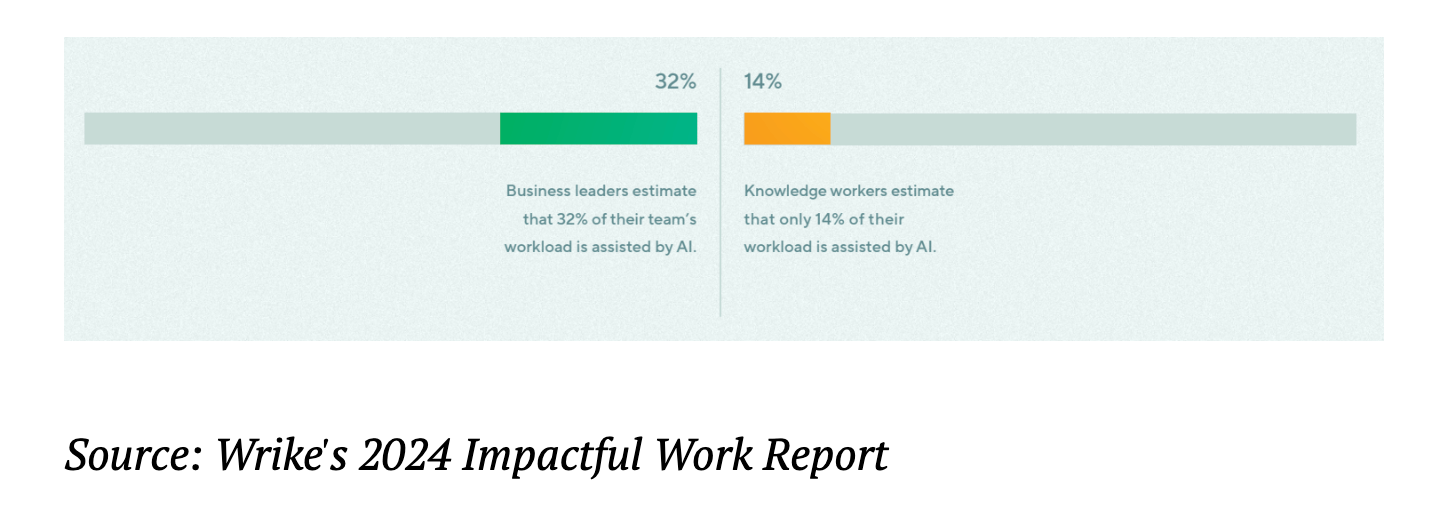
Business leaders believe AI assists with 32% of their workload, but knowledge workers report a much lower figure of 14%.
According to Wrike, its findings underscore the need for businesses to align on goals, eliminate unnecessary work, automate low-impact work, and prioritise high-impact initiatives.
“Our research shows that businesses are at a critical juncture,” said Thomas Scott, CEO of Wrike, in a statement.
“Organisations that take decisive action to prioritise impactful work, consolidate tools, and embrace automation will not only see increased efficiency but also happier, more engaged employees.”
In 2023, 64.8% of all new single-family homes started were built within a community or homeowner’s association. This share increased from the 62.6% recorded in 2022, according to data tabulated from the Census Bureau’s Survey of Construction (SOC). This marks the third highest share since the beginning of the series in 2009, after the high point of 67.1% in 2020 and 65.5% in 2021. Prior to 2021, the share had been on a decade-long upward trend. In absolute numbers, a total of 601,558 homes were started in community associations in 2023.
The Census Bureau defines community or homeowner’s associations as “formal legal entities created to maintain common areas of a development and to enforce private deed restrictions; these organizations are usually created when the development is built, and membership is mandatory.”
A recent NAHB study, What Home Buyers Really Want, asked recent and prospective home buyers to rate the influence that 29 community features would have on their purchase decision. For more than 65% of buyers, being near retail space and park areas, and having walking/jogging trails are the most influential community features. In contrast, only 39% feel the same way about a homeowner’s association.
When analyzed by the nine census divisions, the highest share of new homes started within a homeowner’s association was in the Mountain Division, where 81.9% of new homes were in such communities. In the Middle Atlantic Division, on the other hand, the share was only 28.6%. The share of new homes started within a community across U.S. divisions are shown in the map below.
The word “final” has been getting a workout from the city’s Department of Buildings this year. The DOB has just released yet another “final” set of rules laying out how co-op and condo boards and other building owners can comply with the city’s ambitious and controversial climate law, Local Law 97.
With the first year of the law’s implementation drawing to a close, the DOB is seeking to allay concerns of building owners who are worried that the retrofits required to bring their buildings’ carbon emission into compliance will be financially devastating. Here are a few of the highlights of the latest batch of rules:
The Affordable Housing Reinvestment Fund will help pay for electrification retrofits in rent-stabilized apartments and low-income co-ops. Under the program, dubbed GreenHOUSE, building owners will be able to buy carbon offset certificates early next year, before the May 2025 deadline when owners of covered buildings need to file their initial report detailing their 2024 emissions and a decarbonization plan. They can buy offset certificates for up to 10% of their emissions limit.
Adjustments for legal, physical or financial constraints. The new rules lay out case-by-case adjustments to emissions limits if buildings face constraints that prevent compliance — such as historic preservation or accessibility requirements, physical conditions, or distressed finances. The proposed rules provide much-needed detail on why and how those adjustments may be granted.
Detail on fees. The proposed rules also set fees for various covered-building submissions, including simple building emissions reports, complex building emissions reports and “good faith efforts” reports, which apply to owners who make a sincere attempt to comply with the law but are financially unable to bring their carbon emissions below prescribed caps.
On Oct. 9 at 10 a.m., Urban Green Council is hosting a special webinar with the DOB to unpack the proposed rules. To participate, register here.
The DOB will also hold an online public hearing on the proposed rule changes at 11 a.m. on Nov. 7. To participate, register here.
The majority of covered buildings are already in compliance with Local Law 97’s first emissions caps, which went into effect on Jan. 1, 2024. But many will need to make retrofits to comply with more stringent caps that will go into effect in 2030 and in future years. A bill now before the city council, sponsored by Queens Councilmembers Linda Lee and Sandra Ung, would delay fines and increase carbon emissions caps for co-ops and condos across the city, especially the garden apartment complexes that are prevalent in their districts. Plus, Local Law 97 is facing a legal challenge from building owners in Queens who hope to overturn it.
It turns out, finally, that very little about Local Law 97 is final.
By CAMICB Director of Credential Services, Madeline Hay, CAE
Significant updates to the Certified Manager of Community Associations (CMCA®) exam take effect on Dec. 9. These changes stem from CAMICB’s 2021-2022 job analysis study that assessed the key tasks and knowledge areas required of community managers to ensure the exam content aligns with current professional standards.
Exam Changes
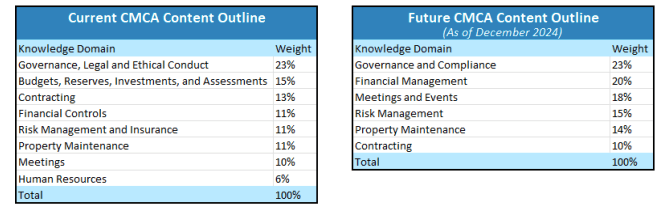
The updated content outline will condense the eight current exam domains into six broader categories, offering a more streamlined approach to understanding and preparing for the exam.
One notable shift is the increased emphasis on the meetings and events domain, which will now represent 18% of the exam, up from 10%. This change underscores the importance of event planning, board meetings, and elections, which are essential aspects of a community manager’s role.
Three closely related content areas — budgets, reserves, investments, and assessments; financial controls; and risk management and insurance — will merge into the broader domains of financial management and risk management. While reorganized for clarity, the weight of these topics remains essentially unchanged and maintains the focus on financial stability and risk mitigation.
The emphasis on property maintenance will increase to mirror the growing importance of preserving property values and preventive maintenance. Meanwhile, governance and compliance remain the largest domain at 23%, reflecting the ongoing importance of legal accountability, rule enforcement, and transparency.
Notably, the human resources domain, which previously accounted for 6% of the exam, will be eliminated. This reflects the evolving scope of early-career managers’ responsibilities as HR tasks are increasingly managed by specialized staff or external providers.
Preparing for the Updated Exam
Candidates can review both the current and updated content outlines at camicb.org. Separate CMCA study guides are available for each version, allowing candidates to choose the guide that aligns with their planned exam date and preparation needs.
Both versions of the CMCA exam uphold the same rigorous standards and ensure credential holders are well-equipped for community association management. However, the revised outline will better reflect the profession’s evolving demands.
The upcoming changes allow candidates to align their skills with the latest industry developments. As the profession grows in complexity, the CMCA remains a hallmark of excellence and ensures credential holders are prepared to meet future challenges. With this updated exam, CAMICB reaffirms its commitment to maintaining the highest standards in community association management.
We had the privilege of gleaning many insights from Cathleen Dunn, CMCA, AMS, LSM, PCAM, into this particular topic. She is the community association manager for A Pocono Country Place, a 4,500 self-contained, private residential community located in the Pocono Mountains, in Monroe County, Pennsylvania and is a member of the CAMICB Board of Commissioners.
Managing vendors is a critical component of a community association manager’s role and is essential for maintaining the physical condition, financial health, and overall satisfaction of a homeowners association, which in turn reflects the professionalism and competence of the community association manager. Properly managing and overseeing vendors ensures quality of services, cost management, legal and contractual compliance, residence satisfaction and supports efficiency and problem resolution.
“In the ever-evolving landscape of community association management, the role of reliable and vetted vendors in homeowners associations (HOAs) cannot be overstated,” said Cathleen Dunn, CMCA, AMS, LSM, PCAM. “From maintenance and landscaping to public safety and technology services, vendors are pivotal in ensuring the smooth operation and enhancement of our communities. Further, the importance of thoroughly vetting and implementing the best vendors is both a strategic necessity and a fiduciary responsibility that falls to the community association manager.”
Quality of Services Has A Lasting Impact
When essential services such as landscaping, maintenance, security, and repairs are not carried out properly, the effects can have a lasting impact. Ensuring that these vendors perform their tasks effectively and to a high standard is crucial for maintaining the community’s appearance, safety, and functionality. Poor vendor performance can lead to dissatisfaction among homeowners and potentially costly repairs in the future. Said Dunn, “Vendors responsible for maintenance, repairs, or landscaping must deliver work that meets high standards to maintain the appeal and functionality of the association. Subpar performance can lead to dissatisfaction, decreased property values, an increase in complaints, with members feeling they are not getting their money’s worth.”
Legal and Contractual Compliance Matters
Vendors operate under contracts that define the scope of work, payment terms, and performance expectations. Community association managers must oversee these contracts to ensure vendors meet their obligations. This includes handling disputes, ensuring compliance with local laws and regulations, and protecting the association from potential legal issues. “Choosing vendors with a proven track record and proper certifications minimizes the risk of legal issues, accidents, or compliance violations,” said Dunn. “The reputation of your homeowners association is influenced by the vendors you employ. High-quality vendors contribute positively to the community’s image.”
Efficiency, Problem Resolution And Risk Management
Vendors must be well-managed to ensure they are responsive to the community’s needs. Whether it’s addressing an emergency repair or completing routine maintenance, community association managers coordinate with vendors to resolve issues quickly and efficiently, minimizing disruption to residents. Further, poorly managed vendors can pose risks to the association, such as safety hazards, liability issues, or financial losses. By carefully selecting, monitoring, and managing vendors, community association managers help mitigate these risks and ensure the community operates smoothly and safely.
Ensuring Resident Satisfaction
The services provided by vendors directly impact the quality of life for residents. For example, well-maintained common areas, timely snow removal, and responsive repair services all contribute to a positive living environment. Effective vendor management ensures these services meet residents’ expectations, which helps maintain high levels of resident satisfaction as well as property values.
Cathleen Dunn’s Tips For Properly and Thoroughly Vetting Vendors
Always establish comprehensive criteria for evaluating potential vendors. This should include not only cost but also experience, references, reputation, compliance with industry standards, financial stability, and licenses (if appliable). A well-defined set of criteria ensures that all vendors are assessed on a level playing field and helps in making informed decisions.
Solicit detailed proposals and quotes from multiple vendors. This not only provides a clearer picture of the costs involved but also offers insight into the vendors’ understanding of your needs and their approach to fulfilling them. You can then compare them – apples to apples – on a spreadsheet.
Craft clear, comprehensive contracts that outline the scope of work, performance expectations, deadlines, and payment terms. Include clauses for accountability, dispute resolution, impact fees, and termination conditions. A well-drafted contract protects both the association and the vendor, ensuring mutual understanding and agreement.
Engaging with unreliable or underperforming vendors can result in hidden costs, such as the need for frequent repairs, and additional oversight expenses. Conversely, high-quality vendors, while sometimes more expensive, often provide long-term savings through durability, efficiency, and fewer complications. A thorough vetting process helps to identify vendors who offer the best value and fit for your association’s budget.
Once a vendor is engaged, establish a system for monitoring their performance and documenting satisfaction or dissatisfaction. Open communication and addressing issues promptly will ensure a high level of standard is maintained.
While vendor management can be a challenging part of the job for a community association manager, when done correctly and effectively it’s a mutually-beneficial relationship with material results for all parties involved – the vendors, community association manager, and residents who reside in these condominiums, housing cooperatives, resort communities, and commercial tenant associations.
In the community association management industry, the selection and management of vendors are integral to operational success and community member satisfaction. By implementing a rigorous vetting process and engaging with high-quality vendors, the community association manager can ensure that their communities receive the best possible service, manage risks effectively, and uphold the association’s reputation.
Added, Dunn “As industry leaders, it is our responsibility to prioritize vendor excellence and to continuously strive for improvement in all aspects of community association management and oversight.”
Resource Corner
Making use of the wide variety of professional development resources available to managers is critical to staying on top of industry news, trends, best practices and any changes arising in the profession. Below is a sampling of industry resources.
CAI’s Research Library – a CAI members-only library that contains over 3,000 articles on community and homeowner association, and condominium and cooperative issues https://www.caionline.org/LearningCenter/ResLib/Pages/default.aspx#k=vendor%20management. For example a search for “vendor management” retrieves an article that ran in Community Manager entitled Playing Matchmaker by Shirley Haskew, CMCA, AMS with a helpful preview that states the following: Matching up vendors with the various communities in your portfolio can be a little like playing Cupid: “Five-member board seeks caring, reliable landscaping company for long-term relationship.” While some managers recommend using the same vendor to do similar work at multiple communities, sometimes at discounted prices, I’ve received the best results when I was able to match communities with complementary vendors.
and VendorSmart, https://vendorsmart.com/vs/#/public/home. Note: some of these companies provide free blogs with relevant articles that offer tips on a wide variety of topics from preparing your HOA for Spring, to determining the best time to explore snow removal vendors.
CAI Exchange – An online forum that allows members to collaborate and connect with colleagues. These informal discussions are extremely helpful in sharing innovative approaches to common and uncommon situations as well as best practices and advice. Additionally, this forum is often helpful when managers need a quick question answered: For example, this recent question was answered within hours of its posting: Q: “We hired a painter. We didn’t know he was going to use a sub-contractor(s) painter. Should we ask for lien waivers from the sub-contractor(s)?” A: “Yes, always get a lien waiver from both the contractor and subs before you make your (final) payment.”
Proper Vendor Management – A Strategic Necessity is the fifth in a series of articles, produced by CAMICB staff, that delve into the important issues and topics affecting community association managers.
Lydia Pelliccia is a freelance writer.Matthew Green is executive director of Community Associations Managers International Certification Board.
Washougal, WA — The City of Washougal is excited to announce the launch of its Homeowners Association (HOA) and Neighborhood Registry, aimed at fostering stronger community connections and enhancing local communication. Washougal is comprised of roughly 200 neighborhoods with their own unique character and appeal.
The registry allows HOAs and neighborhood associations to officially register with the city, providing a centralized resource for residents to access information about community organizations. Residents are encouraged to register their associations online to stay informed about city programs, initiatives, and opportunities for collaboration. The city is committed to supporting neighborhoods and strengthening community ties through this new initiative.
“Woven together to create a distinct tapestry, each neighborhood brings its own beauty, its own charm, and identity to the overarching community,” said Sherry Montgomery, Community Aesthetics Program Coordinator. “This registry is a fantastic opportunity for neighborhoods to connect and collaborate. We believe that by working together, we can enhance the beauty and spirit of our community.”
Some employees are misleading fakers. They conceal the truth or lie outright while giving you incomplete or wrong information. They palm off one thing as another, present data as accurate without bothering to verify it, or assure you they have taken care of a matter when they have yet to lift a finger.
It may be surprising that some of these subordinates who lie and cheat are actually obsessive worriers who fear they cannot handle the task and, therefore, keep putting it off. Some might use stalling tactics because they are afraid if they do what they are supposed to do, they will be trespassing on a coworker’s turf.
Other misleading subordinates are simply lazy and irresponsible. They lie to get out of work. Some, out for revenge, invent “busy” work to delay work on the actual required deliverable. If you are plagued by an employee who bluffs, you may have trouble communicating effectively.
What You Are Thinking
Henry told me the new training workshop was all taken care of when it really was incomplete. Now his team is scrambling to adjust their schedules to fit the newly announced times. His staff is frustrated, and I am, too. Why didn’t Henry just tell me he was having trouble? We could have made other arrangements.
What He’s Thinking
My boss forgets that I am a person and feeds me directions as though I am a robot. She doesn’t listen or even care about what I’m saying. How frustrating! I never really understand exactly what she wants me to do. If I guess wrong, I must fib about having done something until I can get back to it and straighten it out.
Strategy
Your goal is to have everyone on the same page while reinforcing expectations of honesty and candor.
Clarify instructions. You can eliminate a lot of the bluffing and stalling by asking workers to restate assignments in their own words, to be sure you are both on the same page. Have them send this to you by email so that you both have an electronic paper trail. Talk about concerns they may have and about any discrepancies between your respective expectations or understanding of the task at hand.
Devise a better feedback plan. Feedback should be more frequent, more specific, more helpful, and less threatening. With those you regard as irresponsible, keep the tone constructive instead of critical by concentrating on consequences instead of threats.
Focus on building individual and team morale. Recognize your important role as the leader and make sure each member of your team understands their value. Clearly outline your expectations for honest, respectful relationships. Model the way by being open to feedback and clear in your communication.
Subordinates bluff for many reasons. More direct, face-to-face communication will help allay their fears, assure them that you are on their side, and encourage them to accept responsibility for their own actions.
Indiana lawmakers took their first steps this week in exploring whether changes are needed in the ways homeowners associations operate.
A study committee took testimony that was prompted by concerns from lawmakers like Rep. Julie Olthoff (R-Crown Point).
Homeowners associations must file their rules — known as covenants, conditions and restrictions — with their local county. But Olthoff said her county recorder told her only about 40 percent of HOAs are up to date on that requirement.
“They’re not even doing what they’re required to do and there’s nobody watching,” Olthoff said.
The Indiana Builders Association told lawmakers no changes are needed to the system.
But Kelly Elmore from the Community Associations Institute — which advocates for HOAs — said HOAs need more options to enforce their rules.
“That allows community associations, when there are violations or other issues in communities, to assess a penalty,” Elmore said.
Elmore suggested legislation could also include limits on certain fees and penalties.
Join the conversation and sign up for the Indiana Two-Way. Text “Indiana” to 765-275-1120. Your comments and questions in response to our weekly text help us find the answers you need on statewide issues.
Rebecca Richter is the head of a condominium association in Hamilton County. She said organizations like hers need more power, not less.
“People buy into these associations because they like the look, the general look,” Richter said. “And if we can’t enforce the general look with effective tools at our disposal that don’t clog up the courts, it just makes our jobs that much more difficult.”
The study committee likely won’t make any recommendations about potential HOA legislation.