CAMICB is a more than 25 year old independent professional certification body responsible for developing and delivering the Certified Manager of Community Associations® (CMCA) examination. CAMICB awards and maintains the CMCA credential, recognized worldwide as a benchmark of professionalism in the field of common interest community management. The CMCA examination tests the knowledge, skills, and abilities required to perform effectively as a professional community association manager. CMCA credential holders attest to full compliance with the CMCA Standards of Professional Conduct, committing to ethical and informed execution of the duties of a professional manager.
The CMCA credentialing program carries dual accreditation. The National Commission for Certifying Agencies (NCCA) accredits the CMCA program for meeting its U.S.-based standards for credentialing bodies. The ANSI National Accreditation Board (ANAB) accredits the CMCA program for meeting the stringent requirements of the ISO/IEC 17024 Standard, the international standards for certification bodies. The program's dual accreditation represents compliance with rigorous standards for developing, delivering, and maintaining a professional credentialing program. It underscores the strength and integrity of the CMCA credential.
Privacy Policy: https://www.camicb.org/privacy-policy
It doesn’t matter to most workers if you’re going to be late for an appointment — so long as you communicate your situation clearly.
Those were among the takeaways from a new survey of workers by career website Monster.com, which found that only 14% of workers identify being punctual as the most important workplace manner. Just 2% said dressing professionally is most important.
The most important workplace manner? Respectful communication, with 50% of workers agreeing it’s most important.
That’s really a sign of the times post-pandemic, said Vicki Salemi, a career expert at Monster.com.
“[The pandemic] has changed priorities when it comes to workplace etiquette,” Salemi said in an email. “For example, with so many workers in fully remote or hybrid situations, professional dress codes have become less important on their etiquette list whereas communication in all forms is of utmost importance.”
Monster.com also asked workers to list the rudest workplace behaviors, allowing them to choose more than more. Atop the list were:
(88%) Not cleaning up after oneself
(81%) Gossiping
(78%) Using inappropriate language
(77%) Being unresponsive to messages
And when workers don’t follow proper etiquette, their colleagues’ perception of them is impacted, with these impacts most frequently cited among the survey respondents:
(24%) Think less highly of them
(23%) Are less likely to collaborate with them
(18%) Actively try to avoid them when possible
(17%) Are less likely to recommend them for a promotion or raise
So how should businesses and owners deal with etiquette issues?
“They can establish rules, communicate them and lead by example,” Salemi said.
Owners and leaders also should shine a spotlight and prioritize etiquette, Salemi said, since there are turnover risks for businesses that don’t have any rules in place. The survey found that 69% of workers would consider leaving their job if their employer did not have any policies around workplace etiquette. Among respondents, 31% said they don’t feel their workplace is a respectful environment where manners are valued.
Salemi said owners and managers can reinforce potential consequences for breaches of etiquette, such as praising those who show up on time but warning employees who don’t. They also can implement more drastic consequences for workers who habitually break office rules around etiquette.
Business casual fades as dress codes relax
Job listings and search firm Adzuna last year analyzed thousands of job postings across the United States to determine how many listed casual, business or formal dress codes. It found a steep drop-off in those mentioning business casual as a requirement.
It’s a widely supported change, with 63% of respondents saying the shift to less formality is positive, and more than 70% saying the decrease in formality has improved their productivity.
As for why the change is happening, 66% said casual dress was becoming more common, 59% pointed to changes in societal norms and values — and 54% attributed it to the influence of younger generations on the workplace.
An Express Employment Professionals-Harris Poll survey found similar trends.
Silencing mobile phones at work and refraining from making personal calls are also less important today than they were five years ago, according to the survey.
For managers and business owners who are unsure about how to approach a new dress code — or how to relax an existing one — we have gathered advice from experts on how to make it happen without a hitch.
Andy Medici covers small-business finance, remote work, the future of work and small-business trends. He has covered the SBA’s Paycheck Protection Program, Economic Injury Disaster Loan program and other Covid-19 relief programs.
Story by Ron Hurtibise, South Florida Sun-Sentinel
Property insurance costs in Florida continued to rise between the first and second quarters of the year, and condo associations have been hit hardest during that time.
The average cost of a commercial condo association policy — the kind that covers common properties like roofs, structures, and irrigation systems — jumped 6.6% in the second quarter, and over the past two years has more than doubled, increasing by 103% from $72,570 to $147,381, according to newly released data by the Florida Office of Insurance Regulation.
Smaller condominiums are paying less than the average and larger ones are paying more. But in each case, the increases are added to the monthly assessments paid by condo unit owners who are also facing higher assessments from inflation, as well as state-mandated requirements to undergo structural inspections and to fund reserves to make repairs.
Bryan Brooks, owner of a condo unit in Aventura, said the recent increases boosted assessments for owners of some of the larger units in his condominium by around $300 a month.
He said the association’s insurer gave no reason. “Just said everyone is getting an increase,” he said.
Roxana Dorigo, executive vice president of finance for the community association division of KW Property Management and Consulting, said the increased insurance costs caused monthly assessments to increase from around $750 to more than $1,000 over the past few years at a typical older mid-priced condominium managed by the firm.
Dulce Suarez-Resnick, an agent at Miami-based Acentria Insurance whose clients include condominium associations across the region, calls 2024 a “stabilizing year” after a rapid rise of rates that began in 2021.
Still, she said, older condominiums built before building codes were strengthened in the wake of Hurricane Andrew continued to see insurance costs rise while some associations that oversee newer concrete buildings with impact windows got a break.
One of her associations, in a building from the 1980s with a 13-year-old roof, saw an increase of 15% to 20%, while another association with a 2005-built concrete structure, impact windows and a two-year-old roof is paying a lower premium.
“It went down 4%,” she said. “Not an astronomical amount, but it’s going in the right direction.”
Dorigo concurred: “Newer associations that we manage have seen either their property insurance staying the same or going down slightly, so we’re seeing a little bit of a relief.”
Figures in this report come from the South Florida Sun Sentinel’s analysis of statewide property insurance market share data that the Florida Office of Insurance Regulation has been releasing since the second quarter of 2022 as required under a provision of insurance reform laws enacted that year.
The averages are derived by dividing the number of policies into the total premiums paid. Each insurance company regulated by the state is required to submit its totals, plus other information, every quarter.
Average costs of insurance for 13,841 condo associations in Florida were calculated by combining the four types of commercial condominium insurance identified in the state’s report: multiperil coverage that covers structural issues and liability, dwelling/fire coverage that covers buildings and common elements from fire and severe weather, wind-only coverage that only covers damage from hurricanes, and allied lines policies that cover damage from a variety of perils.
The Community Association Institute, a trade group representing condo associations and affiliated industries, estimates that three million Floridians live under more than 27,500 condominium associations throughout the state. That means nearly half of condo associations either have no property insurance or purchase from the surplus market that’s not regulated by the state.
Increases in homeowner insurance costs slowing
The same reports show that homeowners are still seeing their insurance costs rise, even as state officials tout an improving insurance market.
The average cost of insuring an owner-occupied single-family home increased by 1.3% in the second quarter, the same rate as during the first quarter.
The average cost to insure a condo unit — which owners must pay in addition to association insurance if they want to cover what’s inside their walls — also increased by 1.3%. That was the lowest rate of increase since the office began releasing the reports in 2022.
The average annual premium to insure an owner-occupied single family home in the state increased between the first and second quarters from $3,511 to $3,558 while the average cost to insure a condo unit increased from $1,692 to $1,715.
Insurance costs for owner-occupied houses and condo units in Florida have increased this year at the lowest rate of any state in the nation, said Mark Friedlander, director of corporate communications for the industry-funded Insurance Information Institute, a consumer-focused nonprofit organization.
“Most states are seeing double-digit increases,” he said.
In Florida, “rising replacement costs still play a role in determining the price of coverage, which is why the average premium has increased slightly,” he said.
Friedlander added that legislative reforms enacted in 2022 and 2023 have resulted in fewer “frivolous lawsuits filed by billboard attorneys.” As a result, 12 Florida residential insurers have sought rate decreases and 24 filed for no rate change this year, he said.
“These cost improvements will be passed down to policyholders over the next year,” he said.
Cost increases for homes and condo units since June 2023 look reasonable compared to the 103% hike for condo association coverage during that time.
Since June 2022, average premiums for owner-occupied houses have increased by a total 27.1% — from $2,798 to $3,558. Average costs to insure privately owned condo units similarly increased by 27.7% — from $1,342 to $1,715.
The two 1.3% average increases of costs to insure owner-occupied homes over the first two quarters of this year followed much higher quarterly cost hikes since June 2022, including 3.5% in the third quarter of 2022, followed in succession by 4.1%, 4.0%, 4.8%, 2.9% and 2.6% to end 2023.
Costs stemming from rate increases that occurred prior to 2022 were not available for this analysis because insurers previously delivered market share reports to the state labeled as ‘”trade secret.”
Inspection and reserve requirements could further drive up costs
Suarez-Resnick blamed higher reinsurance costs for the surges of both homeowner and condo association insurance costs. Reinsurance is insurance that insurers in Florida pay to guarantee they can pay all claims after disasters.
Reinsurance costs rose sharply while the state’s insurance market coped with rising claims from hurricanes Irma, Michael and Ian while absorbing increased costs of litigation prior to the reforms of 2022 and 2023.
Another cost driver was the 2021 collapse of the Champlain Towers South in Surfside, according to the CEO of Heritage Property Insurance Corp.
Average costs of more than 2,400 dwelling/fire policies sold by Heritage Property Insurance Corp. increased from $52,613 in June 2022 to $103,433, according to the state market share data.
In a statement to the Sun Sentinel, Heritage CEO Ernie Garateix said 20% of the increase was due to inflation.
“Additionally, after the Surfside building collapse the Southeastern United States saw an estimated 80% cost increase for reinsurance … in just 2022 and 2023,” Garateix said.
But since the beginning of 2024, reinsurance costs have decreased, according to Suarez-Resnick.
Condo owners are waiting for their costs to come down, particularly as they brace for additional increases in monthly assessments thanks to heightened inspection and reserve requirements enacted after the tower collapse.
Those laws require associations to complete Structural Integrity Reserve Studies of common elements no later than Dec. 31. The inspections are required to evaluate the roof, load-bearing walls, the foundation, floors, plumbing, waterproofing and fireproofing, windows, electric systems and any other item affecting the structure of the building that would cost more than $10,000 to repair or replace.
The studies must identify remaining useful life of the structural elements and recommend annual reserves that associations must raise to repair or replace them.
Beginning Dec. 31, associations will no longer be permitted to waive or reduce funding for the reserve items or use reserve funds earmarked for the items for any other purpose.
Early last week, Gov. Ron DeSantis told lawmakers to suggest ways before the Dec. 31 deadline to ease the financial burden of complying with the requirements.
But some associations have already completed required inspections and levied special assessments to raise reserves necessary to fund repairs identified by the inspections.
Some associations have began budgeting for the reserve requirement by raising assessments 15% to 20% in recent years and might require another 15% to 20% increase when their structural inspections are finalized, Dorigo said.
So that typical monthly assessment that was increased to $1,000 by rising costs for condo association insurance could go up another $300 to $400, she said.
Some associations have made decisions to reduce their insurance burdens, including raising deductibles above 5% or even forgoing hurricane coverage, said Craig Garcia, president of Capital Partners Mortgage Services in Coral Springs.
When that happens, the associations no longer comply with minimum insurance requirements set by federal mortgage guarantors Fannie Mae and Freddie Mac.
Associations with older roofs might not be able to afford full replacement cost coverage and must settle for actual cash value coverage and that also can be something that lenders don’t like, he said.
That leaves unit owners who want to sell to require all-cash purchases, or to ask Garcia and his team to find alternative loan sources, he said. “They’re more expensive loans,” Garcia said. “Some of the options get eliminated, and they’re usually having to come up with a 20% to 25% down payment.”
Ron Hurtibise covers business and consumer issues for the South Florida Sun Sentinel. He can be reached by phone at 954-356-4071, on Twitter @ronhurtibise or by email at rhurtibise@sunsentinel.com.
We had the privilege of gleaning many insights from Cathleen Dunn, CMCA, AMS, LSM, PCAM, into this particular topic. She is the community association manager for A Pocono Country Place, a 4,500 self-contained, private residential community located in the Pocono Mountains, in Monroe County, Pennsylvania and is a member of the CAMICB Board of Commissioners.
Managing vendors is a critical component of a community association manager’s role and is essential for maintaining the physical condition, financial health, and overall satisfaction of a homeowners association, which in turn reflects the professionalism and competence of the community association manager. Properly managing and overseeing vendors ensures quality of services, cost management, legal and contractual compliance, residence satisfaction and supports efficiency and problem resolution.
“In the ever-evolving landscape of community association management, the role of reliable and vetted vendors in homeowners associations (HOAs) cannot be overstated,” said Cathleen Dunn, CMCA, AMS, LSM, PCAM. “From maintenance and landscaping to public safety and technology services, vendors are pivotal in ensuring the smooth operation and enhancement of our communities. Further, the importance of thoroughly vetting and implementing the best vendors is both a strategic necessity and a fiduciary responsibility that falls to the community association manager.”
Quality of Services Has A Lasting Impact
When essential services such as landscaping, maintenance, security, and repairs are not carried out properly, the effects can have a lasting impact. Ensuring that these vendors perform their tasks effectively and to a high standard is crucial for maintaining the community’s appearance, safety, and functionality. Poor vendor performance can lead to dissatisfaction among homeowners and potentially costly repairs in the future. Said Dunn, “Vendors responsible for maintenance, repairs, or landscaping must deliver work that meets high standards to maintain the appeal and functionality of the association. Subpar performance can lead to dissatisfaction, decreased property values, an increase in complaints, with members feeling they are not getting their money’s worth.”
Legal and Contractual Compliance Matters
Vendors operate under contracts that define the scope of work, payment terms, and performance expectations. Community association managers must oversee these contracts to ensure vendors meet their obligations. This includes handling disputes, ensuring compliance with local laws and regulations, and protecting the association from potential legal issues. “Choosing vendors with a proven track record and proper certifications minimizes the risk of legal issues, accidents, or compliance violations,” said Dunn. “The reputation of your homeowners association is influenced by the vendors you employ. High-quality vendors contribute positively to the community’s image.”
Efficiency, Problem Resolution And Risk Management
Vendors must be well-managed to ensure they are responsive to the community’s needs. Whether it’s addressing an emergency repair or completing routine maintenance, community association managers coordinate with vendors to resolve issues quickly and efficiently, minimizing disruption to residents. Further, poorly managed vendors can pose risks to the association, such as safety hazards, liability issues, or financial losses. By carefully selecting, monitoring, and managing vendors, community association managers help mitigate these risks and ensure the community operates smoothly and safely.
Ensuring Resident Satisfaction
The services provided by vendors directly impact the quality of life for residents. For example, well-maintained common areas, timely snow removal, and responsive repair services all contribute to a positive living environment. Effective vendor management ensures these services meet residents’ expectations, which helps maintain high levels of resident satisfaction as well as property values.
Cathleen Dunn’s Tips For Properly and Thoroughly Vetting Vendors
Always establish comprehensive criteria for evaluating potential vendors. This should include not only cost but also experience, references, reputation, compliance with industry standards, financial stability, and licenses (if appliable). A well-defined set of criteria ensures that all vendors are assessed on a level playing field and helps in making informed decisions.
Solicit detailed proposals and quotes from multiple vendors. This not only provides a clearer picture of the costs involved but also offers insight into the vendors’ understanding of your needs and their approach to fulfilling them. You can then compare them – apples to apples – on a spreadsheet.
Craft clear, comprehensive contracts that outline the scope of work, performance expectations, deadlines, and payment terms. Include clauses for accountability, dispute resolution, impact fees, and termination conditions. A well-drafted contract protects both the association and the vendor, ensuring mutual understanding and agreement.
Engaging with unreliable or underperforming vendors can result in hidden costs, such as the need for frequent repairs, and additional oversight expenses. Conversely, high-quality vendors, while sometimes more expensive, often provide long-term savings through durability, efficiency, and fewer complications. A thorough vetting process helps to identify vendors who offer the best value and fit for your association’s budget.
Once a vendor is engaged, establish a system for monitoring their performance and documenting satisfaction or dissatisfaction. Open communication and addressing issues promptly will ensure a high level of standard is maintained.
While vendor management can be a challenging part of the job for a community association manager, when done correctly and effectively it’s a mutually-beneficial relationship with material results for all parties involved – the vendors, community association manager, and residents who reside in these condominiums, housing cooperatives, resort communities, and commercial tenant associations.
In the community association management industry, the selection and management of vendors are integral to operational success and community member satisfaction. By implementing a rigorous vetting process and engaging with high-quality vendors, the community association manager can ensure that their communities receive the best possible service, manage risks effectively, and uphold the association’s reputation.
Added, Dunn “As industry leaders, it is our responsibility to prioritize vendor excellence and to continuously strive for improvement in all aspects of community association management and oversight.”
Resource Corner
Making use of the wide variety of professional development resources available to managers is critical to staying on top of industry news, trends, best practices and any changes arising in the profession. Below is a sampling of industry resources.
CAI’s Research Library – a CAI members-only library that contains over 3,000 articles on community and homeowner association, and condominium and cooperative issues https://www.caionline.org/LearningCenter/ResLib/Pages/default.aspx#k=vendor%20management. For example a search for “vendor management” retrieves an article that ran in Community Manager entitled Playing Matchmaker by Shirley Haskew, CMCA, AMS with a helpful preview that states the following: Matching up vendors with the various communities in your portfolio can be a little like playing Cupid: “Five-member board seeks caring, reliable landscaping company for long-term relationship.” While some managers recommend using the same vendor to do similar work at multiple communities, sometimes at discounted prices, I’ve received the best results when I was able to match communities with complementary vendors.
and VendorSmart, https://vendorsmart.com/vs/#/public/home. Note: some of these companies provide free blogs with relevant articles that offer tips on a wide variety of topics from preparing your HOA for Spring, to determining the best time to explore snow removal vendors.
CAI Exchange – An online forum that allows members to collaborate and connect with colleagues. These informal discussions are extremely helpful in sharing innovative approaches to common and uncommon situations as well as best practices and advice. Additionally, this forum is often helpful when managers need a quick question answered: For example, this recent question was answered within hours of its posting: Q: “We hired a painter. We didn’t know he was going to use a sub-contractor(s) painter. Should we ask for lien waivers from the sub-contractor(s)?” A: “Yes, always get a lien waiver from both the contractor and subs before you make your (final) payment.”
Proper Vendor Management – A Strategic Necessity is the fifth in a series of articles, produced by CAMICB staff, that delve into the important issues and topics affecting community association managers.
Lydia Pelliccia is a freelance writer.Matthew Green is executive director of Community Associations Managers International Certification Board.
When a condo or co-op resident runs for a seat on their board, the decision to do so generally comes from a desire to ‘step up’ and participate in the governance of the place they call home, and the building or association community as a whole.
Often, the residents willing to serve on their board aren’t necessarily those with finely-honed skills and formal education in law, finance, and practical business management. And they don’t have to be—with competent management, legal, and accounting professionals on their side, a board composed of ‘civilian’ members can absolutely meet its oversight responsibilities and run a solvent, functional building or association.
But having said that, it’s also worth considering that a solid, practical base of knowledge in law, finance and management can be invaluable to a board, enabling them to interact more confidently with contractors and other professionals, make prudent financial decisions, and understand the implications of legislation and legal decisions impacting their community.
A Little Knowledge…
Given that, what base of knowledge does a board member—especially a newly elected one—need in order to contribute most effectively to the administration of their community? Most experts agree that understanding financial reporting, and to a slightly lesser extent, the laws and regulations governing shared interest communities in their area are the biggest help.
“Every board member needs to develop a basic skill set,” says Steve Silberman, a CPA and partner with PBG, a financial services firm located in Glenview, Illinois. “At a minimum, they need to learn to read and understand a financial statement, rather than just relying on the treasurer. The board has a fiduciary responsibility over the financial information of the association or corporation, so all the board members need to understand their finances.
“Revenue, minus expenses, equals net income,” says Jayson Prisand, an accountant and principal with Prisand Mellina Unterlack & Co, an accounting firm located in Plainview, New York. “That’s pretty much the starting point. The primary goal of maintenance or common charges is always to pay for expenses. It seems obvious, but if you don’t have the revenue, how can you pay for the expenses? Board members have a clear need to understand these basic processes. Cash and reserves and their differences are also important concepts in terms of short-, medium-, and long-term planning. Board members must know short-term concepts and goals for operating, and long-term concepts for capital projects. Especially in the current environment, they should understand inflation, and in New York City (and everywhere really), local regulations. It’s not an easy task.”
“The other concept they need to understand is fund accounting,” Silberman continues. “Operating accounts are based on fund accounting. They must also understand what a reserve fund is. A major issue for boards is the possible co-mingling between operating accounts and reserves. That requires understanding the difference between accrual versus cash-basis accounting. Most board members, regardless of their overall knowledge of accounting, understand ‘cash-basis’ accounting, as that’s how a personal checkbook works; income is accounted for when received, and expenses accounted for when paid. By contrast, accrual is more true to [a community’s] current financial position, because it records income when earned and expenses when incurred.”
“Financial literacy,” says Mark Love, principal of M. Love & Associates, CPA, with three offices in Massachusetts, “requires knowledge of matters involving finance, accounting, budgeting, taxes, investments, insurance, debt, financial planning, capital planning, and even economics.”
Michael S. Simone, an attorney and principal of The Simone Law Firm, based in Cinnaminson, New Jersey, focuses in a little more: “Board members must ensure that their association has a budget, and then make certain to run a monthly budget variance report to monitor the progress of the budget throughout the year. Understandably, everyone wants dues to be as low as possible, but an association needs to avoid having too many special assessments. Having special assessments every year is a red flag indicating that the budget is not properly funded. Furthermore, given the current stricter mortgage regulations, an association that does not have a properly funded budget might result in a potential buyer not being able to obtain a traditional mortgage.” Understanding basic accounting and financial principles is necessary for this.
Are All Board Members Equal?
Do all board members require the same level of knowledge of financial, management, legal and accounting issues? In a word, no.
However, according to Prisand, “Those board members who don’t have the most in-depth financial knowledge shouldn’t necessarily be the treasurer. The treasurer should have a solid grounding in financial data in their background. That’s not to say they couldn’t otherwise do the job, but you’re managing money—everybody’s money. There is always reliance on the management company, but don’t give them carte blanche. Overall, at least one person on the board needs to have a more complete, more complex understanding of finances and financing.”
Love concurs. “To be sure, at least one board member, generally the treasurer or the president, should have a moderate to semi-high level of understanding and awareness of these financial matters.”
Another area about which board members should have basic technical understanding is what their governing documents say and require relative to the financial management and maintenance of the property. “The first thing every board member should look at and understand are the bylaws and declarations of their association,” says Silberman. “The bylaws, etc., hold information about financial audits, what to do with excess cash from operations, and other details of financial management under the laws and regulations governing the association.” A law degree is not necessarily required for this, but as with the treasurer’s position, it certainly doesn’t hurt to have an attorney on the board. If that’s not possible, the community’s legal counsel can be tapped to provide any needed clarification.
Training Available
There are several organizations whose mission it is to help educate board members in the unique aspects of governing a building or HOA—including this publication, and its companion annual and biannual Expos, which offer rosters of free educational seminars, expert panel discussions, and legal advice booths. (Visit coopexpo.com for more information, registration, and descriptions of seminars.)
Another valuable resource —and the largest U.S. organization devoted to board education—is the Community Associations Institute (CAI). “CAI has over 40,000 members,” says Simone. “Their courses are offered both online and in-person, and are an excellent way to learn more about the role of being a board member. Further there is a web forum group where associations post problems and issues they are being confronted with, which is another way to learn from other potentially similar association’s issues.”
Along with these, “Boards should avail themselves of all manner of tutorials, workshops, seminars, and education courses on financial, operational, and management of an HOA,” says Love. “There are hundreds available at many organizations dedicated to the shared-interest sector.”
Spreading the Knowledge
In cases where a building or association is fortunate enough to have an accountant, attorney, financial or real estate professional as a board member—or even as a non-board resident—is it advisable for that person to help board members understand what can often be complex matters? The answer might depend on the community.
One co-op shareholder on Manhattan’s Upper West Side who is a professional commercial mortgage broker shares anonymously that in the 30 years he’s lived in his building, the corporation has refinanced its underlying mortgage twice. On both occasions, while not serving on the board, this shareholder offered his expertise to review the refi and advise the board in their decision making. The board turned down his offer both times—and in his opinion, they made serious mistakes, including the prepayment clause on the original refinance some 20 years ago, which precluded the corporation from taking advantage of lower interest rates when they had the chance.
On the other hand, Silberman says, “Boards could and should take advantage of members’ knowledge base. Depending on the size of the community, they might also have a finance committee or subcommittee apart from the board that would allow those with financial background but not on the board to serve on that committee, thereby bringing more people with knowledge into the equation.”
Prisand cautions that sometimes a little knowledge can cause friction. “I work with all types of people on boards. Senior fortune-500 types to housewives. Sometimes those with knowledge can present a different kind of problem; they think at too high a level. It’s not plain vanilla—every building is different—but it’s important to keep it fairly simple.” In the end it ‘takes a village’ to effectively run a village.
A Pressing, if Not-so-New Issue
Another issue has come to the fore for boards in the aftermath of the deadly Surfside, Florida, building collapse in 2021: reserves, and reserve studies. The high dollar amounts—and high stakes—make this yet another area where board members need to have at least a working knowledge and basic understanding of both their building’s physical condition, and the financial planning needed to properly maintain it.
According to Silberman, “Boards should plan for a reserve study, and a plan for investment of those funds. They need an investment policy, and should understand the financial and accounting principles underpinning that policy, including why and how reserve money is invested, its safety and liquidity, and yield. If you’re funding a reserve project, you’ll have a better idea of why the money is invested the way it is.” That knowledge of investment strategy is a good partner to understanding the financial principles relating to your regular operations as well.
It all boils down to boards and board members being as informed as possible about what goes into governing and administering their community from day to day, from its physical upkeep to financial decision-making and long-term planning. Reading—and understanding—your governing documents, consulting your legal and financial professionals when necessary, and taking advantage of educational and training opportunities are all great ways to make the most of your tenure, and make your board the best it can be.
A J Sidransky is a staff writer/reporter for CooperatorNews, and a published novelist. He can be reached at alan@yrinc.com.
Community association managers who hold and retain the CMCA credential demonstrate they’re accomplished professionals committed to developing their skills and knowledge by participating in ongoing continuing education (CE) coursework and professional development opportunities year-round.
Recertification, the process through which CMCAs retain their credential, is not just a requirement but a valuable opportunity for promoting and demonstrating continued competency in the association management profession. Over the last ten years, an impressive 88 percent of CMCAs, on average, successfully finished the recertification process.
By participating in CE opportunities that pertain specifically and primarily to community association operations or management, CMCAs contribute to their own professional growth and the development of the CMCA as a recognized standard for experienced managers.
The types of professional development CMCAs participate in encompass a variety of facilitated learning opportunities, ranging from college degrees and coursework, conferences, professional coaching, community workshops, seminars, symposiums, and webinars. In addition, courses may include accounting, human resources, and public administration.
A Sampling of CE Opportunities
The following are some examples of the many different types of programs in which CMCAs participate, including CAMICB’s newest opportunity, volunteer service credits.
The CAMICB Continuing Education Review Committee must review and approve any in-house training management companies provide to qualify for CE credit.
CMCA prerequisite coursework is also approved for continuing education. It’s important to note that CMCAs may not use the coursework to meet examination eligibility and continuing education requirements. For example, if a CMCA used CAI’s M100: The Essentials of Community Association Management as their prerequisite education to sit for the CMCA examination, they may not submit it for CMCA recertification continuing education credit. Coursework that meets the standard criteria may be submitted for review and approval to CAMICB. If the proposed coursework meets the requirements, it will be approved for a two?year cycle.
Volunteer service credits: Credit hours may be earned for volunteer service to organizations advancing community associations or the management profession. Credit hours for advocacy work supporting community associations and management professionals may also be granted. CAMICB must approve the organization and service hours before a credential holder submits their recertification application. The maximum total hours allowed for volunteer service during the two-year recertification cycle is 8 hours. Credential holders must provide objective evidence of their participation to receive continuing education credit for volunteer service.
CAI: CAI’s website (www.caionline.org) and local CAI Chapters offer an array of resources, networking, and professional development opportunities. To find a local chapter, go to: https://www.caionline.org/Chapters/Pages/Find-A-Chapter.aspx. Your local chapter will also offer specific opportunities to impact your community, specifically your state. For example, in California, opportunities may be state-specific to drought, wildfires, the Davis Stirling Act, etc.
Coursework that supports the operations of a community: Credit may be awarded for attendance at local law seminars and local college or university courses about accounting, business practices, computers, or foreign languages. CAMICB calculates CMCA credit on an hour?for?hour basis (e.g., one hour of class attended equals one hour of CMCA credit). Courses related to buying and selling real estate are not acceptable.
Self-study: Self-study credits are limited to no more than four hours every two years and must be pre?approved by CAMICB. A written request for approval should include a description of the course or activity (including outline, syllabus, or summary, as applicable) and the estimated length of time. Institute of Real Estate Management (IREM) home study courses are not considered self?study.
Teaching credits: Teaching a course related to community association management can qualify for continuing education credit. Two credits are earned for each class hour the first time the course is taught. When the same course is re?taught, one hour of credit is earned for each class hour.
Authorship Credits: An article for a regional or national community association publication may qualify for continuing education credit. A copy of the published work and the total number of words written must be submitted to CAMICB. The determination of the number of hours depends upon the word length of the article; the longer the article, the more credits. Please note that copies of publications must be submitted within ample time for review before the recertification due date.
If you have questions about whether a particular course or activity is eligible for CE credits, please visit www.camicb.org or contact CAMICB at info@camicb.org—we’re here to help!
A recent RedFin analysis of MLS data in 43 of the most populous cities found median monthly condo HOA dues are up more than 15% over the year in Tampa, Orlando and Fort Lauderdale compared to a 6% increase overall. In Miami, dues jumped 5.7% over the year.
When we first introduced you to Thereza Teixeira, she talked about the impact of an $81,000 special assessment that was imposed by her condo HOA last year.
“It’s a huge hit,” she told us.
A financial hit she’ll be dealing with for 20 years. But that’s not the only reason why what she pays for her condo has soared since she bought her unit in Aventura 14 years ago.
“The regular maintenance, which started when I lived here at $700 or $600, now it’s $980,” she said.
A recent RedFin analysis of MLS data in 43 of the most populous cities found median monthly condo HOA dues are up more than 15% over the year in Tampa, Orlando and Fort Lauderdale compared to a 6% increase overall.
In Miami, dues jumped 5.7% over the year, the analysis found. RedFin said that was partly because the median monthly HOA due there was $835, which was higher than any other metro area they analyzed. The cost of insurance for a condo building is typically included in its monthly dues.
“We’ve been seeing a trend the last few years of average increases in cost for a master condo association policy of 100% to 500% year over year,” said Mark Friedlander, spokesperson for the Insurance Information Institute.
But Friedlander said there was reason to be hopeful, as the market for policies that cover condo buildings expands.
“Citizens is offering more coverage for master condo associations than before,” he said. “One of the new entrants into the Florida market is a specialized insurer in master associations, so there are some new companies coming into the market or expanding their presence to offer master condo coverage.”
“That’s a good thing and that’s really what we need,” he added.
This week, Miami-Dade Mayor Daniella Levine Cava urged the state legislature to make condo reform a priority this upcoming session. On Monday, the mayor sent a letter to the leaders in the Florida Senate and House that said, in part, “Residents across our state are feeling the pressure, and we are deeply concerned that these challenges will intensify the affordability crisis…”
Last week, the Florida Senate leader ruled out a special session. After the Surfside tragedy, state lawmakers passed a series of reforms to enhance condo safety. The mayor said the legislation was well-intentioned but many owners can’t keep up with the costs.
Thereza said she has had to make adjustments to her budget to make up for the rising costs.
“We just have to make it work,” she said. “It’s worth it for the quality of the building. It’s a great location.”
Friedlander said you want to make sure you have enough coverage, in case there’s a major loss. He suggested having your insurance agent take a look at your master condo association’s insurance policy, to see if there are any gaps you may need to fill with your own individual property policy.
To be clear, there are many causes of burnout—from excessive workload to lack of autonomy to poor communication. However, there are also proven organizational strategies for mitigating burnout and creating a sustainable culture of productivity and retention. For starters, employee incentives and performance milestone rewards are great strategic tools to keep employees motivated and engaged, which ultimately reduces the risk of burnout.
UNDERSTANDING THE BURNOUT CRISIS
Employee burnout is not merely about working long hours; it’s about the sustained stress that employees experience from feeling undervalued, overburdened, and disconnected from the workplace. According to a 2020 Gallup survey, nearly 76% of employees experience burnout at least sometimes, with 28% reporting that they feel burned out “very often” or “always” at work. This should be an urgent wake-up call for businesses to rethink the way that they approach workforce management and motivate their employees.
INCENTIVES AS A PREVENTIVE MEASURE
Leveraging well-structured employee incentive programs is one of the most effective ways to combat employee burnout. While monetary and non-monetary incentives have their place as motivators when implemented appropriately, they work best as complementary tactics. When you take the time to recognize employees’ hard work, they’re more likely to feel valued and less likely to experience the emotional exhaustion that leads to burnout.
Monetary incentives such as bonuses, raises, and profit-sharing directly tie an employee’s performance to their financial well-being, creating tangible motivators. But these are rarely effective in isolation. Other incentives, such as non-cash rewards programs, flexible work hours, or opportunities for professional development, can actually be even more effective in sustaining or improving productivity, while boosting company culture and helping employees maintain a healthy work-life balance.
CONSIDER IMPLEMENTING MILESTONE REWARDS
While incentives are a crucial foundation, layering milestone rewards into a workforce engagement or recognition strategy provides the most effective structure for celebrating employee progress. Unlike traditional incentive programs that often reward year-end achievements, milestone rewards recognize employees at various stages of their journey. This approach is particularly effective in preventing burnout because it breaks down large goals into smaller, more manageable tasks. And each of them comes with the potential for recognition.
For example, an employee working on a long-term project might receive recognition or a small reward after completing key phases of the project. Not only does this keep the employee engaged, it also reduces the pressure and dread of a looming deadline or final outcome. Celebrating small victories keeps employees’ spirits high, giving them the encouragement to push forward without feeling drained.
CULTIVATING A CULTURE OF RECOGNITION
Beyond individual incentives and rewards, cultivating a culture of recognition is essential for preventing burnout. When recognition becomes a regular part of the work culture, employees are more likely to feel appreciated by peers and supervisors alike. This can go a long way in preventing feelings of insignificance that sometimes accompany burnout.
Regular feedback, peer-to-peer recognition, and transparent communication about company goals are essential in any effective recognition culture. When employees understand how their work contributes to the broader success of the organization, they are more likely to feel a sense of purpose and connection.
PRIORITIZE BALANCE AND AUTONOMY
Incentives and milestone rewards are the first two puzzle pieces. However, to be effective, you need to implement this in the context of some level of employee autonomy and predictable workload. Consistently overloading employees with work only exacerbates burnout, regardless of what incentives you offer. Handcuffing them to immovable deadlines or restricting their options in accomplishing their work only makes matters worse.
If managers expect timely, high-quality deliverables, they need to ensure that employees know what to expect, can plan for manageable workstreams, and have the flexibility to control how they achieve their goals.
Autonomy in the workplace empowers employees to take ownership of their tasks, which leads to increased job satisfaction and reduced stress. When employees feel they have control over their work and the ability to make decisions, they’re more likely to be engaged and productive, while being less likely to experience burnout.
It’s important to note that no strategy or tactic is singularly capable of effectively addressing employee burnout. Burnout occurs for a variety of reasons, so it’s imperative that employers attack it from a variety of angles that we’ve explored in this article.
In the end, reducing burnout isn’t just about minimizing stress; it’s about creating a workplace where employees feel valued, motivated, and connected to their work. By investing in incentives and milestone rewards, companies can take a significant step toward achieving this goal, leading to happier employees, significant cost savings, and a more successful organization.
By Madeline Hay, CAMICB’s Director of Exam Administration
The Community Association Managers International Certification Board (CAMICB) is poised to usher in a new era for the Certified Manager of Community Associations (CMCA) exam, offering a revamped blueprint that mirrors the dynamic landscape of association management across the globe. These changes, stemming from a thorough job analysis study conducted between 2021 and 2022, reflect an evolution in the core competencies required by community association managers worldwide.
Job Analysis
Job analysis is the cornerstone of ensuring that the CMCA exam remains an authoritative assessment tool, reflecting the contemporary roles and responsibilities of association managers. This comprehensive study involved a multifaceted approach, dissecting the complexities of association management to chart a revised course for the credential.
The task of redefining the blueprint through job analysis was a colossal undertaking spanning 18 months. The comprehensive study involved 13 project phases, including reviews of over 100 primary source documents, survey responses from 3,000 managers around the world, and more than 90 hours of collaborative meetings with 55 subject matter expert volunteers. Notably, 20 of these experts were sourced internationally, reflecting the global significance and diverse perspectives encompassed in this endeavor. This validation process ensured that the CMCA exam blueprint aligns with the real-world experiences and challenges faced by professionals in the field.
Updated Blueprint
The job analysis study resulted in an updated blueprint that encapsulates the requirements of modern community association management. Notable changes include a reorganization of job tasks and knowledge into six principal categories compared to the previous eight, allowing for a more cohesive representation of the industry’s nuances.
For instance, content previously segregated into distinct categories, such as “Budgets, Reserves, Investments, and Assessments” and “Financial Controls,” will now be consolidated under broader headings like “Financial Management” and “Risk Management.” This streamlined approach better reflects the multifaceted nature of association management, presenting a more cohesive and holistic assessment framework for aspiring CMCA candidates.
One of the findings of the job analysis study was a significant emphasis on meetings and events in the daily responsibilities of early-career managers. Consequently, the exams will see an expansion of the “Meetings and Events” domain from 10% to 18%. Furthermore, “Property Maintenance” and “Risk Management” will increase by 3% and 4% respectively, while “Contracting” reduces from 13% to 10%.
Notably, the human resources domain, constituting 6% of the current exam content, will no longer feature in the revised blueprint.
Current Blueprint (Remains Until December 2024)
Topic Area
% of Exam
1. Meetings
10
2. Governance, Legal and Ethical Conduct
23
3. Budgets, Reserves, Investments, and Assessments
15
4. Financial Controls
11
5. Risk Management and Insurance
11
6. Property Maintenance
11
7. Contracting
13
8. Human Resources
6
Total
100
Updated Blueprint (Starting in December 2024)
Topic Area
% of Exam
1. Meetings and Events
18
2. Governance and Compliance
23
3. Financial Management
20
4. Risk Management
15
5. Contracting
10
6. Property Maintenance
14
Total
100
The CMCA Candidate Handbook and the CMCA Study Guide have been updated to reflect the revised blueprint. The current Handbook and Study Guide – valid through December 2024 – will remain on www.camicb.org through the end of December. The updated Study Guide and Handbook are also now available on the website. After December 2024, only the updated Study Guide and Handbook will be available.
Managers planning to test before December 2024 should refer only to the current Handbook and Study Guide. Managers planning to test after December 2024 should utilize only the updated Handbook and Study Guide.
Looking Ahead
The redefined CMCA exam blueprint, meticulously curated through a comprehensive job analysis study, embodies CAMICB’s commitment to elevating industry standards.
These changes are not merely cosmetic but serve a foundational purpose—to ensure that the CMCA exam genuinely reflects the essentials of community management worldwide. The blueprint revisions align the exam content with the ever-evolving needs of the profession, encapsulating the industry’s best practices, irrespective of geographic nuances.
Stay tuned as CAMICB offers more in-depth exploration of the blueprint throughout the next year leading up to the December 2024 change, symbolizing a leap forward in certifying the finest professionals in community association management.
Questions regarding the launch of updated forms of the CMCA examination may be forwarded to info@camicb.org or call 703-970-9300.
At the heart of volunteerism is the notion of doing something for the common good. For many, choosing to live in a co-op or condo community is also choosing to volunteer for board service, helping to guide and govern the community they call home. But with that impulse to serve the common good lurks the possibility of liability – a concern that stops many from wanting to participate in the governance of their building or association. Fortunately, that’s where directors and officers —commonly called simply D&O – insurance comes in.
What’s D&O?
In a nutshell, directors and officers insurance is a form of liability coverage that protects board members of a corporation or association against losses or advancement of defense costs in the event that a decision made in good faith results in damages of some sort.
“Directors and Officers insurance coverage is a type of insurance coverage available to cooperative, HOA and condominium boards generally intended to cover claims against board members and/or officers for alleged errors and omissions and/or breach of fiduciary duties. It’s a type of coverage that’s purchased in addition to the other insurance normally carried,” says Mark Hakim, an attorney with New York City-based law firm Schwartz Sladkus Reich Greenberg Atlas.
However, Hakim is quick to note that D&O is not carte blanche for boards to act with impunity. That bit about ‘decisions made in good faith’ is very much key. “Each such officer or board member may be held personally liable for actions not taken in good faith, or taken outside the scope of their duties,” says Hakim, “including but not limited to discrimination, self-dealing, retaliation, etc. D&O insurance coverage is generally only afforded if the alleged conduct of the board member or officer was within the scope of their duties, performed in good faith, and without gross negligence.”
Within those parameters, Hakim continues, “The importance of D&O insurance cannot be overstated. The presence of such insurance permits members or officers, each of whom are unpaid volunteers, to freely participate in corporate governance without fear of personal liability for merely exercising their jobs in good faith. It is difficult at times to get people to serve on boards, and absent this protection, it would be even more difficult. D&O is not a luxury—it’s a necessity when serving on a board.”
Wayne Dow is vice president for Preferred Property Programs, a Baldwin Group partner based in Rhode Island. The insurance company is based in Holmdel, New Jersey and writes policies nationally. “The easiest way to describe D&O insurance when I’m explaining it to board members is that it’s ‘sleep insurance.’ It gives them the ability to sleep at night. D&O coverage protects their personal assets if they are sued and claims made against them as volunteer board members for their community association. D&O is there to protect the volunteer board members. If there is a suit, you as a board member can only be sued in your capacity as a board member. Your personal assets are protected.”
Jay Dixon, a senior director with OnePoint Insurance, a national insurance brokerage with offices in New York City, says, “Directors and Officers Insurance and Employment Practices Liability Insurance (EPLI) are crucial parts of the insurance plan for boards of cooperatives and condominiums. These coverages provide financial protection for board members, officers, and volunteers against claims and financial risk if they are sued for decisions made and/or actions taken while performing their official duties. D&O encourages participation in the community, because board members and prospective board members know they are protected.
What’s Covered & What’s Not
Almost any decision made by a board can potentially lead to allegations of breach of fiduciary duty, mismanagement, or employment practices violations. For example, decisions such as not approving a potential buyer in a cooperative, terminating a contract with a vendor, or an employee’s dismissal can expose the board to legal liabilities and lawsuits. “D&O insurance helps mitigate the financial risks when lawsuits do arise,” says Dixon. “Legal defense costs, settlements, and judgments can be financially devastating, and D&O insurance covers these expenses, protecting the co-op or condo’s financial health.”
Coverage Amounts & Other Pertinent Points
Much like other types of insurance, premiums for D&O coverage are determined by various factors, including the corporation or association’s past claims history, the number of units in the community, the number of board members, the average value of units in the building, the condition of the community’s finances, and whether the association operates at a profit or a deficit. Given how variable all those factors are from community to community, there is no ‘average’ premium; the premium is specifically underwritten according to the individual characteristics of the exposure.
Policy premiums and retention amounts also vary by state and jurisdiction. For example, “The premium for a D&O policy on a 200-unit co-op in Manhattan is more than it would be for a suburban 200-unit HOA in Dallas, Texas,” says Dow. “Pricing is governed by the nature of risk. Also, limits are provided and can be guided by a community’s governing documents.”
According to Dixon, “Every board should have D&O insurance; the governing documents of the association normally mandate it. We typically advise our clients to secure $1 to $2 million in D&O coverage with ‘defense costs outside the limits.’ This means the costs of defending a claim do not reduce the actual limit available to pay the claim. Some excess liability and umbrella policies can include D&O coverage, providing additional limits for D&O claims.”
D&O insurance is critical for all shared interest communities, and serves more than one purpose. While there to protect decision makers, it’s also there to mitigate the concerns of those same decision makers about their personal liability when stepping forward to volunteer. It’s the peace of mind that makes volunteer service possible.
A J Sidransky is a staff writer/reporter for CooperatorNews, and a published novelist. He may be reached at alan@yrinc.com.
From the employer side, the number of jobs offering “a little flexibility” more than tripled between June 2024 and the same time last year, Flexa’s data showed.
By Laurel Kaiser for HR Drive
Dive Brief:
Employers may have found a compromise for staff resisting return-to-office mandates: Offering them a little flexibility over when they have to be at work, according to an analysis released Aug. 4 by U.K.-based Flexa, a global job platform focusing on flexible workplaces.
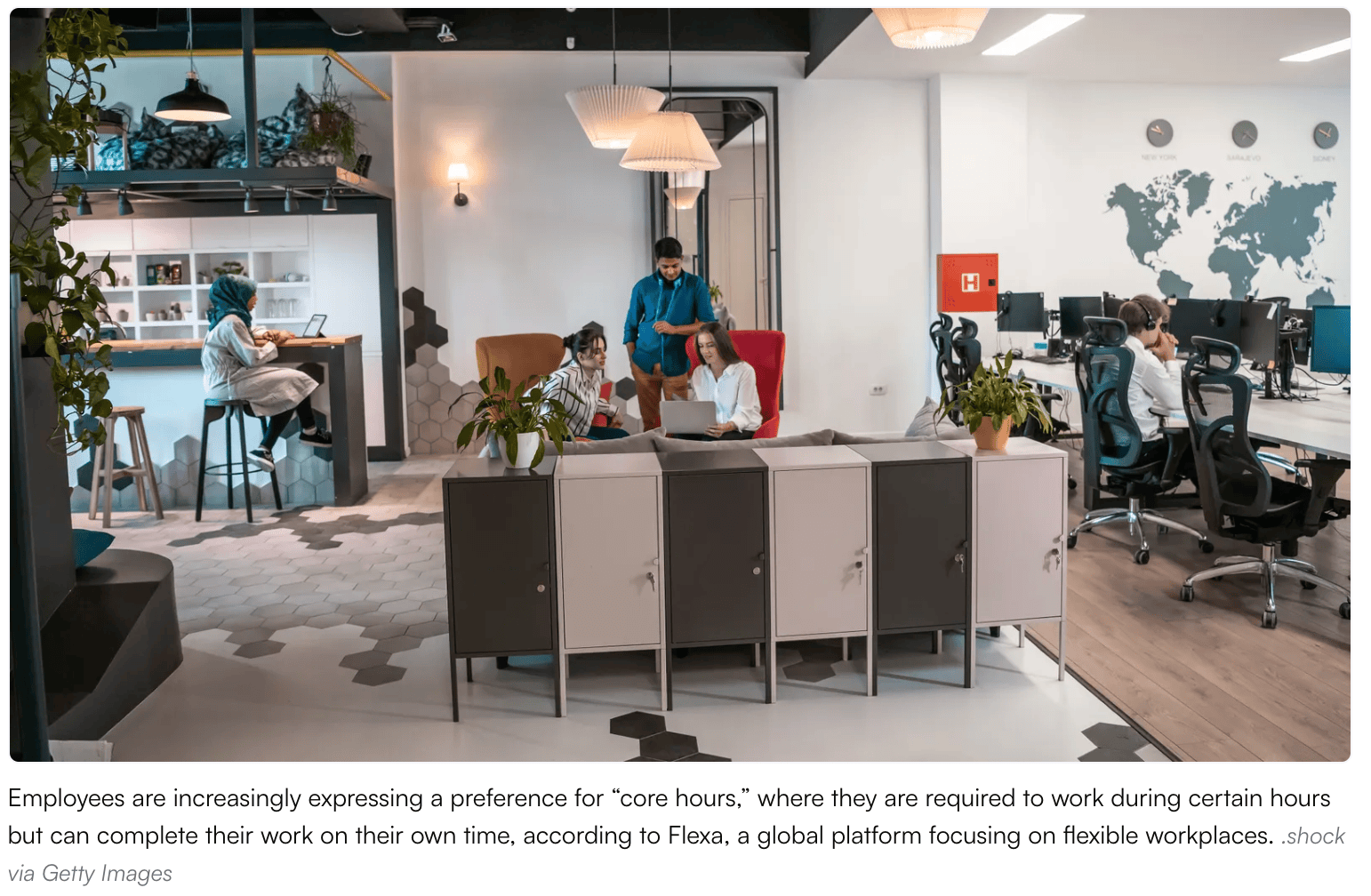
The analysis found that in June, 14% of job seekers, up from 11% in April, expressed a preference for roles offering “core hours” — where employees are required to work during certain hours, such as 11 a.m. to 3 p.m., but may complete their work in their own time.
From the employer side, the number of jobs offering “a little flexibility” more than tripled between June 2024 and the same time last year, Flexa’s data showed. “A little flexibility” means employers can start or finish their work a little early or a little late, but otherwise work regular hours, according to the platform. In June, nearly 8 in 10 job postings mentioned the benefit, a steep increase from 50% two months earlier, Flexa found.
Dive Insight:
Workers’ post-pandemic preference for job flexibility isn’t limited to where they work, according to Flexa data from more than 4,000 job posts and preferences expressed by 9,473 job seekers in the U.S. and Europe between April and June 2024.
Employees are also looking for flexibility over when they work, the data showed. “Demand for core hours is not a million miles away from current levels of supply, but is increasing by contrast,” Flexa said.
In June, 39% of workers said they didn’t mind whether they had flexible hours or not (as opposed to it being something they sought specifically). But that’s a rapid downturn from April, when 49% said they didn’t mind, and it’s the lowest amount since December 2021, the platform pointed out, meaning employees increasingly seek it out.
Fortunately, “flexible working hours are something that far more employers agree with them on, thanks to the trend towards asynchronous work and output-led management,” Flexa CEO and co-founder Molly Johnson-Jones stated in the report.
For now, employers seem reluctant to offer anything more than “a little flexibility,” according to the data. In June, the number of job vacancies that offered core hours plummeted to 8%, down from 15% in April.
According to a 2022 survey from digital payroll solutions firm Deluxe, some employees may even prefer flexible working hours to the flexibility of working from home. One in five employees at small-to-mid-size businesses said the No. 1 action their employer should take to improve their working environment is to offer flexible scheduling that lets them adjust their work hours.
Notably, if employer support for flexible scheduling lags behind employee demand, employer support for hybrid working arrangements remains strong. Nearly two-thirds of employers who responded to the Society for Human Resource Management’s 2024 annual benefits survey, released in June, offer a hybrid work model.
Even so, most employers have yet to adapt their practices to support the shift to hybrid arrangements, a March report by TechSmith Corp., Global Workplace Analytics and Carytid Workplace Consultancy pointed out.
Leaders and managers need hybrid-related skills, such as establishing team or meeting norms, the report explained, but 3 out of 4 workers said they haven’t received training on these skills.
Employees’ current focus is on flexible working hours, Flexa indicated. “Not since the pandemic have workers cared as much [about this],” Johnson-Jones said. That could be for several reasons, such as staff wanting a better work-life balance or seeking a flexible schedule to balance out having less influence over their working location, she explained.
“Ultimately, flexible working hours meet many different needs for many different workers. And having even just ‘a little flexibility’ around work start and finish times can make a big difference,” Johnson-Jones added.