Unknown's avatar

About CMCA ~ The Essential Credential

CAMICB is a more than 25 year old independent professional certification body responsible for developing and delivering the Certified Manager of Community Associations® (CMCA) examination. CAMICB awards and maintains the CMCA credential, recognized worldwide as a benchmark of professionalism in the field of common interest community management. The CMCA examination tests the knowledge, skills, and abilities required to perform effectively as a professional community association manager. CMCA credential holders attest to full compliance with the CMCA Standards of Professional Conduct, committing to ethical and informed execution of the duties of a professional manager. The CMCA credentialing program carries dual accreditation. The National Commission for Certifying Agencies (NCCA) accredits the CMCA program for meeting its U.S.-based standards for credentialing bodies. The ANSI National Accreditation Board (ANAB) accredits the CMCA program for meeting the stringent requirements of the ISO/IEC 17024 Standard, the international standards for certification bodies. The program's dual accreditation represents compliance with rigorous standards for developing, delivering, and maintaining a professional credentialing program. It underscores the strength and integrity of the CMCA credential. Privacy Policy: https://www.camicb.org/privacy-policy

Deadlines Loom to Offset Renovation Costs With New J-51

Emily Myers in Bricks & Bucks HABITAT Magazine

The clock is ticking for boards hoping to take advantage of the newly passed J-51 rules to offset their co-op and condo renovation costs. With the mayor’s signature on December 18 setting the new legislation into law, boards face a tight timeline: applications must be filed within four months of either the law’s effective date or a project’s completion. “If your work is already done, the application filing deadline is April 18, 2025,” explains attorney Benjamin Williams, head of the property tax department at Rosenberg & Estis.

For buildings seeking eligibility, several key criteria must be met. The property’s average assessed valuation needs to fall under $45,001 per apartment, with this value determined at construction’s start rather than its completion, says Williams. He emphasizes this timing distinction as particularly crucial for buildings near the threshold. Additionally, properties must have at least three apartments and have a valid Certificate of Occupancy.

The timeline requirements create a specific window of opportunity. Eligible work must have commenced no earlier than December 30, 2019, with completion falling between June 29, 2022, and June 30, 2026. Projects cannot exceed 30 months in total construction time. For those contemplating future renovations, Williams advises careful consideration of timing, noting that “certain advance notifications and filings may be required to obtain eligibility.”

While NYC Housing Preservation and Development (HPD) has yet to release a comprehensive list of qualifying projects, several categories are expected to make the cut. Energy efficiency improvements and projects aimed at Local Law 97 emission compliance are likely to qualify, encompassing everything from boiler and HVAC system upgrades to facade repairs. Window and roof replacements, plumbing and sewer line repairs, elevator and fire safety upgrades, and environmental hazard removal projects are also anticipated to be eligible. However, the certified reasonable cost must exceed $1,500 per dwelling unit for consideration.

The program won’t cover everything, though. Cosmetic changes and luxury amenity additions likely won’t qualify for the abatement. This means upgrades to lobbies, gyms, or roof decks won’t be eligible unless specifically identified in the final rules. HPD plans to open applications on their website soon, even as they finalize the rule making process.

The financial benefits can be substantial for qualifying properties. The program allows eligible owners to offset 70% of their capital improvement costs against their NYC property tax bill, with benefits spread over time. The maximum annual benefit caps at 8.3% of the improvement costs, meaning a building receiving a $120,000 tax credit could see around $10,000 in annual tax reductions over 12 years.

Real-world applications of the program are already taking shape. At 221 East 18th Street, a 60-unit prewar co-op in Brooklyn’s Prospect Park South, board president Dan Winckler is hoping to use the tax abatement to offset costs associated with electrification. “Our boiler’s old and it would be great to replace it with heat pumps but that requires at least some electric changes if not a full retrofit,” he explains. While engineering studies initially put the cost beyond their available capital funds, Winckler says the tax abatement, which the co-op is eligible for, makes the project “within reach in a much nearer term.” Certain co-ops with regulatory agreements may also qualify for the program even if they exceed the average assessed value threshold. For example Penn South, a limited equity co-op comprising 15-buildings in Chelsea, was explicitly added to the rules as eligible for J-51 in 2013.

The program’s complexity demands careful attention to compliance. “About one-third of the law is dedicated to compliance and penalties,” Williams notes, highlighting how property owners face not only fines but potentially even 90-day jail terms for rule violations. This underscores the importance of thorough due diligence and proper legal guidance throughout the application process.
The Dying Art of Listening Inward: What We’re Missing Out On

Rediscover inner clarity amid a world of endless noise.

Psychology Today

]

In today’s world, we are constantly listening—but often not in the ways that truly matter. We listen to each other, to the endless hum of information around us, and to the curated voices of influencers and commentators. Yet, there’s one form of listening that we routinely neglect: the act of turning inward.

Each of us carries a wealth of insight within ourselves, yet we’ve become conditioned to tune outward. The ceaseless noise of our hyperconnected world has drowned out our inner voices, leaving us at risk of losing touch with who we are. Listening inward is not just an exercise in self-reflection—it’s a necessity in an age when the external clamors for our attention at every turn.

Why Listening Inward Is Hard

In a world flooded with input, staying connected to our inner selves requires deliberate effort. Here are some of the systemic pressures that make listening inward so challenging:

  1. The Overload of Input: We live in an age of information surplus. Decades ago, the nightly news provided a concise summary of the day’s events. Now, we’re bombarded by a 24/7 torrent of updates spanning social media, email, newsletters, and streaming platforms. The flood of information demands that we filter, process, and react at an unprecedented pace—leaving little room for introspection.
  2. The Illusion of Connectivity: Our ability to connect with others has expanded exponentially through platforms like LinkedIn, Instagram, and countless messaging apps. Ironically, this increase in connectivity often deepens our disconnection from ourselves. The lines between meaningful engagement and empty interactions blur, creating noise that obscures our own thoughts and desires.
  3. The Weight of Opinions: The voices of others dominate our feeds: opinions, advice, and curated snapshots of success. This avalanche of external input makes it harder to discern our inner truths. The more we consume the perspectives of others, the more distant our own voices become.
  4. The Push for Our Attention: The digital economy thrives on keeping us engaged. Notifications, algorithms, and content are all designed to hook us, often at the cost of our inner clarity. Without practices to counterbalance this external push, we risk becoming overwhelmed and disconnected from our core.

The Cost of Ignoring Our Inner Voice

The true cost of constant connectivity is not just mental fatigue; it’s the erosion of our ability to hear ourselves. When we lose this connection, we struggle to make decisions grounded in our values, lead with authenticity, or find clarity amidst the chaos. Recognizing this cost is the first step toward reclaiming balance.

How to Reconnect: Practical Steps to Listen Inward

Reconnecting with ourselves requires more than fleeting moments of mindfulness. It demands intentional practices that reawaken our ability to listen inward. Here’s how to start:

  1. Recognize the Imbalance. Begin by noticing the effects of constant input on your mental, emotional, and physical state. Take stock of how often you feel overwhelmed or disconnected. This awareness is the foundation for change.
  2. Disconnect to Reconnect. Create intentional blocks of time to unplug. Whether it’s a tech-free morning, a weekend retreat, or a solo walk in nature, these moments of stillness allow your inner voice to emerge. For example, during a silent meditation retreat, I felt my mind “deflate” like a tire, softening and slowing. Only then did I notice a deep, spacious calm I hadn’t realized I was missing.
  3. Embrace the Discomfort. Listening inward isn’t always easy. Silence can bring up tension, restlessness, or the pressure of unresolved thoughts. Resist the urge to fill this space. Instead, lean into the discomfort and notice what arises—both the distractions and the truths.
  4. Feel the Cost of Disconnection. Experiencing the impact of constant connectivity firsthand can be transformative. Observe your behavior when distracted—perhaps during a conversation with a loved one or while attempting to focus on a task. How does it feel to be pulled away from the present? This lived understanding can motivate meaningful change.

Build the Muscle of Inner Listening

Listening inward is like building a muscle; it requires consistent practice. Here are some simple ways to incorporate this into daily life:

  • Start your day with a few moments of silence.
  • Journal to process your thoughts and feelings.
  • Take device-free walks and notice where your mind drifts.
  • Reflect on your dreams or create quiet rituals, like stretching or meditating, to center yourself.

These practices help you tune out the noise and tune in to the whispers of your inner voice.

Why Inner Listening Matters for Leaders

Leaders, in particular, have a responsibility to cultivate inward listening. The ability to connect with your inner clarity isn’t just about personal well-being—it shapes how you show up for others. When leaders listen inward, they lead with authenticity, presence, and purpose. They create space for others to do the same.

As the pace of the world accelerates, the capacity to listen inward is no longer a luxury—it’s a vital skill for navigating complexity and uncertainty. By reclaiming this art, we can approach our lives and work with intention, resilience, and clarity.

An Invitation to Begin

The act of listening inward is both a return and an opening. It invites us to reconnect with the wisdom we already hold and to approach the world not as passive recipients of endless input but as grounded and purposeful individuals.

What might you discover if you truly listened to yourself?

CMCA Exam Updates: What Candidates Need to Know

By CAMICB Director of Credential Services, Madeline Hay, CAE

Significant updates to the Certified Manager of Community Associations (CMCA®) exam went into effect on Dec. 9. These changes stem from CAMICB’s 2021-2022 job analysis study that assessed the key tasks and knowledge areas required of community managers to ensure the exam content aligns with current professional standards.

Exam Changes

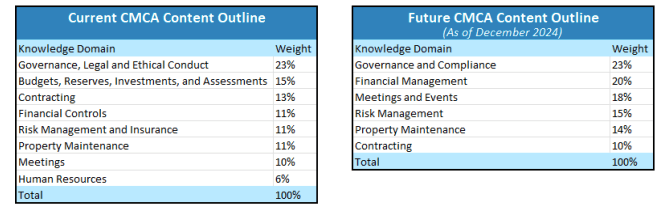
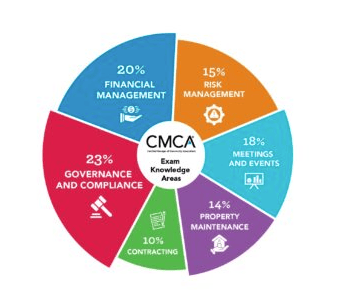
The updated content outline condenses the eight current exam domains into six broader categories, offering a more streamlined approach to understanding and preparing for the exam. 

One notable shift is the increased emphasis on the meetings and events domain, which will now represent 18% of the exam, up from 10%. This change underscores the importance of event planning, board meetings, and elections, which are essential aspects of a community manager’s role.

Three closely related content areas — budgets, reserves, investments, and assessments; financial controls; and risk management and insurance — merged into the broader domains of financial management and risk management. While reorganized for clarity, the weight of these topics remains essentially unchanged and maintains the focus on financial stability and risk mitigation.

The emphasis on property maintenance increased to mirror the growing importance of preserving property values and preventive maintenance. Meanwhile, governance and compliance remain the largest domain at 23%, reflecting the ongoing importance of legal accountability, rule enforcement, and transparency.

Notably, the human resources domain, which previously accounted for 6% of the exam, was eliminated. This reflects the evolving scope of early-career managers’ responsibilities as HR tasks are increasingly managed by specialized staff or external providers.

Preparing for the Updated Exam

Candidates should review the updated content outline at camicb.org as well as the updated CMCA study guide.

These changes allow candidates to align their skills with the latest industry developments. As the profession grows in complexity, the CMCA remains a hallmark of excellence and ensures credential holders are prepared to meet future challenges. With this updated exam, CAMICB reaffirms its commitment to maintaining the highest standards in community association management.

Holiday stress is killing your employees — here’s how to help them

By Tony Case for WorkLife

With another holiday season in full swing, employers face a familiar challenge: helping their workforce navigate the complex blend of year-end pressures and holiday expectations.

The stakes are higher than many leaders realize. Recent data from employee recognition program Workhuman shows that while the season brings joy and celebration, it also generates significant stress for employees, particularly around finances, work-life balance and performance expectations.

That stress has a well-documented impact on individual employees as well as the business overall. Recent research from the Society for Human Resource Management (SHRM) found that 44% of 1,405 U.S. workers surveyed feel burned out at work — feelings that only intensify this time of the year. In fact, more than half of us say we’re experiencing more holiday stress than ever.

“It’s important to make sure employees feel appreciated and supported during the holiday season,” said Traci Pesch, practice lead and strategist at Workhuman. “Whether it’s work-related stressors or something personal going on in the life of an employee that makes this time extra difficult, leaders need to make a concerted effort to celebrate what makes those people such valuable contributors to their organization.”

The cost of stress

According to Workhuman’s survey of 3,000 full-time employees across the U.S., U.K. and Ireland, financial concerns are the primary source of holiday stress for 64% of employees, with 35% depending on year-end bonuses to cover their holiday expenses.

Meanwhile, one-third of workers report feeling more stressed during the holiday season due to increased workloads and pressure to meet year-end goals.

The situation is particularly acute for working parents. A survey of 500 working parents in the U.S. by Bright Horizons and Opinium Research found that nearly half of parents with children aged 0-12 experience more stress during the holidays, mainly due to juggling work and childcare.

The survey determined that mothers are significantly more likely to experience increased stress (55%) compared to fathers (30%).

Charlotte Anderson, head of people experience at design platform Canva, emphasizes that recognition should be a year-round priority, though it takes on special urgency around the holidays. “Developing a strategy for recognizing employees at the end of the year is especially important as the holiday season often brings heightened stress, fatigue and burnout,” she said. That observation is supported by Canva’s recent workplace survey, which found that three-quarters of respondents wish they felt more appreciated.

The impact of recognition cannot be understated. Canva’s research, based on responses from 1,500 employees in the U.S. and Australia, indicates that recognition boosts motivation (among 87% of employees), confidence (85%) and productivity (84%).

However, Anderson warns against taking a one-size-fits-all approach. “Team members want to feel seen as individuals,” she said, stressing that just half of those surveyed felt their bosses recognized their unique qualities.

What truly matters

Rather than traditional perks or awards, Anderson suggests focusing on what truly matters to employees: flexibility, inclusion, work-life balance and opportunities for growth. Some practical approaches include:

  • Offering heartfelt notes or “hype reels”
  • Fostering two-way communication and feedback
  • Embedding “surprise and delight” moments throughout the employee lifecycle
  • Tying recognition to core values
  • Creating meaningful celebrations with visual communication

Those strategies align with what Sandra Moran, chief customer experience officer at WorkForce Software, advises, noting that what matters most to many employees is having control over their schedules. That is particularly critical for deskless and shift-based workers, who often face greater scheduling challenges around the holidays.

Technological Proficiency In Community Association Management

By Lydia Pelliccia and Matthew Green, CAE

We had the privilege of speaking with Candace Lewis, CMCA, AMS, PCAM, into this particular topic. She is the Director of Marketing for Cardinal Management Group, LLC, a privately held, locally founded firm in Woodbridge, VA.

It’s crucial for professionals in every industry to stay up to date on new technologies and the community association management profession is no different. Managers are embracing a variety of tools to improve efficiency, productivity, communication, resident satisfaction and better collaboration with Boards and business partners. From selecting the right device (phone, tablet, app, etc.) to choosing the appropriate software that suits their needs, these tools help make managers’ lives and jobs more rewarding. 

Technology in Action: Streamlining Processes, Maximizing Efficiency 

“There was a time when information about communities was kept in a binder and, as a manger, you had to lug that binder to meetings so you had the information you needed at your fingertips,” said Candace Lewis. CMCA, AMS, PCAM. “Now, having it digitally accessible on your phone, tablet or computer allows for easier access and searchability. Most documents have Optical Character Recognition (OCR), which makes finding specific language or keywords much easier in a litany of governing documents. For example, I was at an Architectural Review Committee appeal hearing with a Board of Directors questioning what the rule stated about the height of a retaining wall; I was able to quickly find the answer on my tablet. Instead of delaying their decision to the next meeting, the Board was able to quickly move forward.”

Candace further explains that tasks like violation reporting and tracking have significantly improved with technology. “Instead of using a clipboard, pen and paper to log violations, we now have community management software, such as CINC, SmartWebs or FrontSteps, that help managers efficiently handle these issues by quickly uploading photos while sending the violation notice in real-time,” said Candace.  “Homeowners receive an email about the violation and, in turn, more swiftly remedy the issue. Depending on the platform used, homeowners can also log-in to see their outstanding violations and any photos the manager has uploaded.”

Digitizing resales in HOAs helps modernize the process, making it faster, more efficient, and more transparent. It provides significant benefits in terms of operational efficiency, cost savings, enhanced communication, and compliance. Candace explains, “There was a time when a potential buyer had to wait for a large package of documentation to arrive in the mail before they could review the association’s governing documents, prior to moving to settlement. Hard copies required an individual in an office to print, organize and mail to the potential buyer. Now, services like CondoCerts, HomeWise and others offer a digital delivery of these documents making it less time consuming with minimal paperwork. “For both homeowners and managers, the transition to a digital system creates a smoother, more convenient experience while also improving the long-term management and oversight of the community,” added Candace.

The pandemic fueled the rise of virtual meetings and the use of Zoom, Microsoft Teams, or Google Meeting platforms to host these events.  As a result, many Board and Annual Meetings are now hybrid or fully virtual. Further, what has also become an option for many managers is the opportunity to continue working remotely. “In the past, when homeowners or homeowner volunteers wanted to meet with us, we’d convene at the office or onsite,” said Candace. “Now, we can quickly arrange a virtual meeting, which is helpful when having difficult conversations that are easily misinterpreted via phone or email. In addition, regularly scheduled virtual team meetings have also enhanced collaboration and meaningful “in-person” dialogue.”

Artificial Intelligence Supporting Communications Efforts 

Candace offered one of the most popular uses of technology, as a manager, is the thoughtful use of AI platforms to help managers craft email responses, homeowner notices, newsletters, email blasts, requests for proposals, policy resolutions, bid comparisons, and more. “I use ChatGPT and Grammerly, like many others; however, some software companies have developed their own AI add-ons, such as MicroSoft’s Azure AI,” said Candace. “AI is also a great tool to use on most mobile devices when communicating with a homeowner whose first language is not English.”

Are there challenges in convincing homeowners to use newer technology? Absolutely. “Most people need another login credential like they need a crack in their foundation,” quipped Candace. “Urging anyone to download an app or create a new sign-in, isn’t always easy.”

Candace notes, more importantly, as data and operations go digital, cybersecurity becomes a critical concern. Managers must stay updated on best practices for protecting resident data and ensuring that functions such as online payment systems, communications channels and other digital tools are secure from breaches.

Staying abreast of new technology helps community association managers improve operational efficiency, reduce costs, enhance resident satisfaction, maintain compliance, and stay competitive in a changing market. “It’s not just about keeping up with trends – it’s about using technology to create a more streamlined, responsive, management approach,” said Candace.

Candace expressed that information about new technology is often in mainstream media; however, technology specific to community associations is best discovered at the CAI Annual Conference or local chapter conferences and expos. Additionally, she finds “ads and articles in CAI publications have been a great help in spreading the word about the many options available.”

Technological Proficiency In Community Association Management is the sixth in a series of articles, produced by CAMICB staff, that delve into the important issues and topics affecting community association managers. 

Lydia Pelliccia is a freelance writer. Matthew Green is executive director of Community Associations Managers International Certification Board.

Are Co-op Board Members Required to Live in the Building?

HABITAT Magazine

At a large housing cooperative in Lower Manhattan, one of the nine board members sold his apartment and moved to another state, while a second board member is living in a foreign country and subletting his apartment. Both continue to serve on the co-op board. Is this legal? What recourse do shareholders have?

The law does not dictate that co-op directors must be residents of the building, or even shareholders in the corporation, replies the Ask Real Estate column in The New York Times. As with so many disputes in housing co-ops, the solution to this one could lie in the cooperative’s governing documents.

Start with the bylaws. Do they allow people who don’t live in the building to serve on the board of directors? Do they require shareholders who have sold their shares to relinquish their board seats?

It’s possible the bylaws are silent on these issues. But if residency is required, shareholders could compel the resignation of the nonresident directors, says Leni Morrison Cummins, chair of the condominiums and cooperatives practice at the law firm Cozen O’Connor.

The question about absentee members raises a larger issue facing some co-ops: Is the board serving the interests of the residents, or of investors? Over time, cooperatives have allowed shareholders not just to have their primary residence elsewhere or rent to a subletter, but to buy shares as investors. “This,” Cummins says, “has led to many cooperatives having split populations: one of residential shareholders and one of investor shareholders.”

Typically, she adds, resident shareholders want to invest to make their daily lives better and to maintain restrictions on occupancy and sublets. Investor shareholders, on the other hand, often prefer to keep costs down and to loosen restrictions on occupancy and sublets. Conflict is inevitable when interests diverge in this way.

Shareholders can vote to create a residency requirement, but if your building has many investors, this could be difficult. (Amendments to bylaws frequently require approval by a super-majority of shares, commonly two-thirds, a high bar.)  “If the shareholders don’t amend the bylaws to restrict board membership, try to develop a meaningful relationship with the nonresident board members and share your concerns,” advises Andrew I. Bart, senior counsel at the law firm Kagan Lubic Lepper Finkelstein & Gold.

And remember that a co-op is a democracy, so shareholders can run for a board seat in the next election. “Campaigning and collecting proxies can take some effort,” says William Geller, counsel with the firm Braverman Greenspun. “But if the (shareholder) wants to change the direction of the building, that can be a very effective way to get things done.”

Leadership in a world gone mad: An ode to fewer, better meetings

Thinkers 50 Blog

How could you become a better, more efficient and collaborative leader? Anne Morriss and Frances Frei provide a persuasive and time-saving strategy in the first in a series looking at the practice of leadership in a mad, mad world.

One way that organizations have responded to the combination of unprecedented uncertainty and a more distributed workforce is to drag more people into more meetings during more hours of the workday. Researchers now estimate that workers are spending about a third of their time in meetings, and much of that time is unproductive. One study from meeting software company Doodle estimated that across the United States, the United Kingdom, and Germany, 24 billion hours will be lost to pointless meetings in the next year. 

All this time together is creating the illusion of progress while inhibiting the kind of deep work, true collaboration, and creativity needed to solve our increasingly complex problems. In response, some leaders have simply banned this toxic substance (no-meeting Fridays!), but a more effective remedy is to create a gathering culture defined by fewer, better meetings. Treat your people’s time as the most strategic resource you have. If you’re going to use it, use it wisely. 

One company we recently worked with leaned into this philosophy, reducing its employees’ time in meetings by fifty percent in just a few months. Early indicators of outcomes from this shift include reduced burnout and stronger customer relationships without any reduction in team connectivity. Tactics that worked well for this organisation: embracing old-school meeting agendas, using AI for notetaking, and sharing audio recordings with people who weren’t in the meeting, who could then listen to the proceedings on their own time (often at 2x speed).  

On our podcast Fixable we interviewed Claire Hughes Johnson about how to run a great meeting. As the former COO of Stripe, Claire helped grow the company from fewer than 200 employees to more than six thousand – and from millions in revenue to billions. A casual talk she once gave on how to run an effective staff meeting at Google, her former employer, immediately went viral. (Claire is now a corporate officer and adviser to Stripe, in addition to writing great books). 

Claire’s principal advice is to prepare. Before you have the audacity to convene people, make sure you have clear answers to these questions: 

  • Why are we meeting? What are our objectives? 
  • Who needs to be there to achieve these objectives? 
  • How are we going to spend our time together? 

Circulate materials in advance so that everyone has the runway to contribute effectively, which some people need more than others. “Extroverts talk to think,” Claire explained. “Introverts think to talk.” And, yes, she’s on board with agendas, which signal where you’re going and keep everyone on track. 

Once the meeting begins, the objective is to surface unique information and ideas from your fellow gatherers. Our favourite prompt is, “Can someone articulate a different point of view?” which is a lower-stakes variant of “Who has a different point of view?” This will also help you resist the temptation to converge too quickly on a less-than-optimal solution. In our experience, fast convergence typically leads to a false optima (also known as not our best idea) and a higher chance that people will hold back additional ideas, even when they’re better. 

Finally, stick the landing. Before your meeting ends, summarise key decisions and action items. Make sure everyone knows what they’re responsible for delivering and the deadlines they need to hit. Claire likes to use a “check-out” at the close of meetings – a rapid-fire prompt to help reinforce commitments and get a pulse check on the group’s experience. A standard check-out she relies on is: “Use one or two words to describe what you’re thinking as we close this meeting – it could be a feeling, an idea, a topic you want more of.” 

When it comes to meetings, we urge you to get into the organisational sandbox and play with new approaches. Are you meeting to ideate or execute? To learn from what happened or prepare for what’s coming? Adapt your meeting’s structure, style, and pace to your goals. The only truly universal meeting rule is that if you’re gathering in person for any significant amount of time, then you need to feed people. 

Make the experience of work feel a little less crazy by committing to fewer, better meetings. We’ve seen companies go from sixty-minute meetings to thirty-minute meetings, thirty-minute meetings to twenty-minute meetings, using our favourite intervention profile: no new people, no new technology, just a healthy dose of intention. 

Emotional Intelligence Enables Community Managers To Swiftly Address And Resolve Conflicts

By Lydia Pelliccia and Matthew Green, CAE

A smart, skilled and well-rounded community association manager is critical to a community’s success. The profession is known for its daily variety as each day brings new opportunities, challenges and rewards. A key component of a managers’ job is the ability to collaborate and solve problems.

According to Opportunities Knock: Opening the Door to Careers in Community Association Management, published by Community Associations Institute (CAI), the Foundation for Community Association Research (FCAR), and Community Association Managers International Certification Board (CAMICB) having multiple responsibilities, among other factors, is significant in community association managers’ overall sense of satisfaction.

According to an FCAR manager survey, cited in the January 2022 publication noted above, “Solving problems is listed as the main contributor to job satisfaction by 84% of community managers, followed by variety in their tasks each day (73%), and helping people (72%).”

“A community manager’s job is multi-faceted and being a moderator/conflict resolution specialist is an important role,” said Kayte Comes, MBA, MNML, who is the Executive Director of the CAI-Arizona Chapter.  “Any time you have to deal with someone’s most valued possession and money, people become uneasy.  If a community manager wants to be successful in their job, they must learn to not shy away from conflict but embrace it as a challenge.  Comes went on to explain that understanding human nature and body language goes a long way.  “Being aware of your own triggers and behaviors when confronted – and how to control your emotions – helps a manager gain strong conflict resolution skills.”

Comes notes, situations that require these skills can arise when a manager is communicating with their Board – or homeowner – on a variety of topics. For example,  questions about assessments, potentially fines or collections, architectural designs and the proper way to submit information, as well as neighbor to neighbor issues that have been brought to the manager’s attention.

Finetuning Emotional intelligence (EI) Skills

The CAI-Arizona chapter provides community managers the opportunity to participate in emotional intelligence courses. Joelle Hadley, the founder and president of The Culture Coaches, and the co-founder of The Southwest Institute for Emotional Intelligence, describes emotional intelligence in the following way: Balanced emotions are contagious. Emotional Intelligence is a professional and personal skill-set using the self and social awareness of emotions and understanding their impact on those around us. It’s the ability to manage the negative emotions of ourselves and others while motivating positive and effective emotions needed for performance. EI is rooted in the neuroscience of how our brain interacts with outside influences and with our neo cortex, otherwise known as the thinking brain. 

Comes has been participating in these types of classes since she began supervising staff nearly 35 years ago. “This is the best way to understand your communication style and to recognize the many different styles of personalities that a community manager might interact with on a daily basis,” said Comes. “Understanding how you react in certain situations will ensure you are always prepared and professional,” Comes added. She also notes that developing these skills is not something that happens overnight and one can never get enough EI training.

Comes observed that her managers continually express how much they get out of these courses and how it helps them grow both personally and professionally. Afterall, EI skills are needed every day in the community association management industry. A manager who has strong EI skills will succeed.

Resource Corner

Making use of the wide variety of professional development resources available to managers is critical to staying on top of industry news, trends, best practices and any changes arising in the profession.  Below is a sampling of industry resources.

Chapter Mediation Services – CAI chapters often offer mediation services. For example, the CAI AZ Chapter offers these services, for a fee https://www.cai-az.org/Mediation. 

The Culture Coaches – Master certified and accredited trainers and coaches who deliver effective and impactful speeches, workshops, and individual coaching in the EI arena. Visit www.theculturecoaches.comto view the different options in emotional intelligence.

CAI Publications – CAI offers a number of publications covering the topic of conflict resolution, including Perfect Phrases for Conflict Resolution: Phrases for Encouraging a More Productive and Efficient Work Environment and Conflict Resolution: How ADR Helps Community Associations, which can be found here: https://cai.caionline.org/eWeb/DynamicPage.aspx?site=CAI&WebCode=storeCatList&catKey=bcfed0fd-1ce2-4ecd-8cd2-42507b8c36bd&catName=Conflict+Management.  CAI also offers webinars on the topic, https://cai.mycrowdwisdom.com/diweb/catalog?q=conflict+resolution

Management Company Websites – Many management companies have blogs, case studies and other articles available to the public that cover conflict resolution strategies.

CAI Exchange – An online forum that allows members to collaborate and connect with colleagues. Topics range from emergency notification systems to budgeting for insurance in the coming year to managing board member actions, neighbor disputes and everything in between. 

Emotional Intelligence Enables Community Managers To Swiftly Address And Resolve Conflicts is the fourth in a series of articles, produced by CAMICB staff, that delve into the important issues and topics affecting community association managers.

Lydia Pelliccia is a freelance writer. Matthew Green is executive director of Community Associations Managers International Certification Board.

CMCA Exam Updates: What Candidates Need to Know — Changes Go Into Effect December 9

By CAMICB Director of Credential Services, Madeline Hay, CAE

Significant updates to the Certified Manager of Community Associations (CMCA®) exam take effect on Dec. 9. These changes stem from CAMICB’s 2021-2022 job analysis study that assessed the key tasks and knowledge areas required of community managers to ensure the exam content aligns with current professional standards.

Exam Changes

The updated content outline will condense the eight current exam domains into six broader categories, offering a more streamlined approach to understanding and preparing for the exam. 

One notable shift is the increased emphasis on the meetings and events domain, which will now represent 18% of the exam, up from 10%. This change underscores the importance of event planning, board meetings, and elections, which are essential aspects of a community manager’s role.

Three closely related content areas — budgets, reserves, investments, and assessments; financial controls; and risk management and insurance — will merge into the broader domains of financial management and risk management. While reorganized for clarity, the weight of these topics remains essentially unchanged and maintains the focus on financial stability and risk mitigation.

The emphasis on property maintenance will increase to mirror the growing importance of preserving property values and preventive maintenance. Meanwhile, governance and compliance remain the largest domain at 23%, reflecting the ongoing importance of legal accountability, rule enforcement, and transparency.

Notably, the human resources domain, which previously accounted for 6% of the exam, will be eliminated. This reflects the evolving scope of early-career managers’ responsibilities as HR tasks are increasingly managed by specialized staff or external providers.

Preparing for the Updated Exam

Candidates can review both the current and updated content outlines at camicb.org. Separate CMCA study guides are available for each version, allowing candidates to choose the guide that aligns with their planned exam date and preparation needs.

Both versions of the CMCA exam uphold the same rigorous standards and ensure credential holders are well-equipped for community association management. However, the revised outline will better reflect the profession’s evolving demands.

The upcoming changes allow candidates to align their skills with the latest industry developments. As the profession grows in complexity, the CMCA remains a hallmark of excellence and ensures credential holders are prepared to meet future challenges. With this updated exam, CAMICB reaffirms its commitment to maintaining the highest standards in community association management.

Upholding High Ethical Standards

CAMICB Updates Its CMCA Standards of Professional Conduct and Enforcement Procedures

By CAMICB Executive Director, Matthew Green, CAE

A key component of CAMICB’s Credentialing Program requires a Certified Manager of Community Associations (CMCA) to adhere to a high standard of ethical conduct. This means CMCA credential holders must comply with the 10 CMCA Standards of Professional Conduct, which are designed to ensure that managers uphold their fiduciary responsibilities and comply with laws, governing documents, and professional integrity.?

CAMICB recently conducted a thorough review of the CMCA Standards of Professional Conduct as part of its regular cycle to ensure these critical elements of the CMCA certification program continue to align with industry standards and best practices. In addition, the review was designed to ensure that the standards remain relevant and applicable to the evolving demands of the community association management industry, both domestically and globally. While some changes were made to the standards themselves, the most significant updates are found within the accompanying clarification document. This document provides detailed guidance on the practical application of the standards, ensuring they are interpreted and enforced consistently. By modernizing the standards and clarifications, CAMICB ensures that CMCAs are held to up-to-date ethical standards while addressing global applicability and evolving industry standards. 

Said Greg Smith, CMCA, AMS, PCAM, Chair of the CAMICB Board of Commissioners, “These revisions reflect a commitment to maintaining high ethical standards and professionalism for CMCA credential holders while incorporating more explicit guidance on fiduciary responsibilities, conflict-of-interest disclosures, and data security practices.”

A summary of the key changes and updates follows:

Standard 1: Global Applicability and Compliance

The changes to Standard 1 make the policies globally applicable by removing jurisdiction-specific references.

Standard 6: Gratuities, Compensation and Disclosure

The changes to Standard 6 strengthen the requirements for disclosure of gratuities and compensation to enhance transparency while reducing the likelihood of conflicts of interest.

Standard 7: Continuing Professional Education

The updates to Standard 7 further emphasize the need for continuous education aligned with CMCA recertification. 

Standard 8: Fiduciary Duty

The changes to Standard 8 clarify the expectations around fiduciary duty by detailing what constitutes a breach.

Standard 9: Professional Conduct and Violations

The revisions to Standard 9 shift the focus from defining what constitutes a breach of due diligence to emphasizing the expectation of maintaining professional conduct at all times.

Standards 10: Records, Confidentiality, and Data Security

The updates to Standard 10 focus on the handling of client records, particularly the secure management of electronic data, in line with current data security practices. 

“These updates ensure that CMCA credential holders are equipped to meet the evolving demands of the community association management industry, reinforcing the value and trust associated with the CMCA credential,” added Smith.

CMCAs are encouraged to review the updated standards and the clarification document thoroughly to ensure their practices continue to align with CAMICB’s expectations for ethical conduct and professionalism. By staying informed on these updates, CMCAs can confidently uphold the high standards required for maintaining their credential and serving their communities effectively.

About The Standards Of Professional Conduct

The Standards of Professional Conduct, detailed at https://www.camicb.org/standards/, range from understanding laws applicable to community association management, to being knowledgeable on association policies and procedures, to carrying out fiduciary responsibilities, and participating in continuing education coursework. A violation of any of these Standards of Professional Conduct may be grounds for administrative action and possible revocation of the CMCA certification by CAMICB.  Abiding by these Standards of Professional Conduct help protect consumers and associations that hire or contract with community association managers. 

Enforcing the Standards of Professional Conduct

In order to maintain and enhance the credibility of the CMCA Certification Program, the CAMICB Board of Commissioners follow strict procedures that allow consumers and others to bring complaints concerning CMCAs to the Board. Similar to a regular review of the Standards of Professional Conduct, CAMICB also reexamined the procedures for suspending and revoking certification every two years. 

Through this process, CAMICB enhanced its procedures for reviewing, suspending, and revoking certifications to ensure they reflect the latest industry standards. These improvements underscore our commitment to maintaining the highest level of professional conduct and ensuring our processes remain transparent, fair, and aligned with global best practices.

More information, including a set of Frequently Asked Questions, a list of the 10 clearly outlined Standards of Professional Conduct, the procedures for enforcing the standards, and other pertinent documents, can be found at https://www.camicb.org/standards/.