CAMICB is a more than 25 year old independent professional certification body responsible for developing and delivering the Certified Manager of Community Associations® (CMCA) examination. CAMICB awards and maintains the CMCA credential, recognized worldwide as a benchmark of professionalism in the field of common interest community management. The CMCA examination tests the knowledge, skills, and abilities required to perform effectively as a professional community association manager. CMCA credential holders attest to full compliance with the CMCA Standards of Professional Conduct, committing to ethical and informed execution of the duties of a professional manager.
The CMCA credentialing program carries dual accreditation. The National Commission for Certifying Agencies (NCCA) accredits the CMCA program for meeting its U.S.-based standards for credentialing bodies. The ANSI National Accreditation Board (ANAB) accredits the CMCA program for meeting the stringent requirements of the ISO/IEC 17024 Standard, the international standards for certification bodies. The program's dual accreditation represents compliance with rigorous standards for developing, delivering, and maintaining a professional credentialing program. It underscores the strength and integrity of the CMCA credential.
Privacy Policy: https://www.camicb.org/privacy-policy
Let tech assist you, but never override the wisdom of your body and soul.
By Kyle Emanuel Brown for Psychology Today
We’re living in the age of outsourced thinking. From GPS telling us where to go to ChatGPT offering answers in milliseconds, we’ve grown used to reaching out before we reach in. But in the rush for faster, smarter, more “optimized” everything, many are unknowingly trading their greatest evolutionary gift for convenience. Your intuition.
Intuition isn’t magic. It’s a subtle, scientifically supported form of non-linear knowing; what researchers call implicit learning or somatic markers. In short, it’s your nervous system, your subconscious, and your stored lived experience whispering wisdom faster than your logical brain can compute. It’s that gut feeling when something’s off. That inner pull to say yes before the facts make sense. That quiet nudge you can’t quite explain and shouldn’t need to.
But here’s the trap. When AI speaks with confidence and speed, it’s easy to assume it knows better. And that’s dangerous.
The Rise of the Algorithmic Overlord
AI is brilliant. It can analyze vast amounts of data, generate poetry, build business plans, or summarize psychological studies in seconds. I use it daily and I think it’s one of the most powerful tools of our time.
But AI doesn’t have a heart.
It doesn’t feel the weight of a decision in the gut. It doesn’t carry ancestral trauma or spiritual resonance. It doesn’t know what lights up your soul or what haunts your dreams. That’s your job.
We’ve confused intelligence with wisdom. But wisdom requires more than pattern recognition. It requires context, embodiment, and alignment.
AI is like a sharp scalpel. In skilled hands, it can heal. But you better make sure the one holding it is you.
In writing this, I asked ChatGPT its opinion: “Should people ever outsource their intuition to AI?”
Here’s what it said:
“Intuition is a deeply personal synthesis of emotion, experience, and subconscious intelligence. While AI can support decision-making with information, it cannot replicate or replace the wisdom that comes from within. Outsourcing your intuition to AI is like using a compass for matters of the heart. It may offer direction, but only you can feel what’s truly north.”
Well said, friend.
Your Body Is Smarter Than Your Browser
Harvard research shows that the gut-brain connection is real. Your enteric nervous system, sometimes called your “second brain,” is deeply wired to signal when something is aligned or not. The vagus nerve, the pathway between heart, gut, and brain, plays a critical role in intuitive awareness, decision-making, and emotional regulation.¹
That feeling in your chest or drop in your stomach isn’t just emotional fluff. It’s biofeedback: real, physiological data your body is giving you in real time. Ignore it long enough, and the consequences add up. Burnout. Regret. Illness. Misalignment.
Use AI Like an Aligned Teammate
I’m not telling you to ditch AI. I’m telling you to use it consciously, because if you don’t, you’ll most likely be left in the dust like Blockbuster clinging to DVDs instead of partnering with Netflix. Let it support your process, not become your compass. Bring your discernment to the table. Ask better questions. Check in with your nervous system after you get an answer. Don’t just ask, “What should I do?” Ask, “Does this feel like truth in my body?”
Imagination is key here, too. AI can help you imagine possibilities, generate ideas you hadn’t considered, give you language to articulate the unspoken. But it’s still you who must feel the resonance, make the call, walk the path.
In the same way you wouldn’t let a therapist make your life decisions for you, don’t let AI become your inner compass. Your soul didn’t come here to follow prompts. It came to lead.
Total Self-Trust Is the Real Upgrade
As the world gets noisier, faster, and more automated, what becomes rare becomes sacred. And the most sacred thing you can reclaim? Your ability to trust yourself.
Not because you have all the answers. But because you’re willing to pause long enough to listen. Because you’re learning to read the signals of your body. The resonance in your heart. The aliveness in your decisions. Because you remember that real wisdom lives within you. Not in the cloud.
Let AI be a partner in your process. But don’t let it make you forget that your intuition was never artificial.
At a large co-op in Lower Manhattan, one of the nine board members recently sold his apartment and moved to another state. A second member is living in a foreign country with his family and subletting his apartment, saying he will eventually return to the building. Both are still serving on the board of directors. Is this legitimate? What can shareholders do if they’re unhappy with the arrangement?
The law does not dictate that co-op directors must be residents of the building, or even shareholders in the cooperative, replies the Ask Real Estate column in The New York Times. However, a cooperative’s governing documents could contain such qualifications and requirements.
Start with the bylaws. Do they allow people who don’t live in the building to serve on the board of directors? Do they require shareholders who have sold their shares to relinquish their board seats?
It’s possible that the bylaws are silent on these questions. But if residency is required, shareholders could compel the resignation of the nonresident directors, says Leni Morrison Cummins, chair of the condominiums and cooperatives practice at the law firm Cozen O’Connor.
The situation at this Lower Manhattan co-ops raises a larger issue facing many co-ops: Is the board serving the interests of the residents, or of investors? Over time, cooperatives have allowed shareholders not just to have their primary residence elsewhere or rent to a subletter, but to buy shares as investors.
“This,” Cummins says, “has led to many cooperatives having split populations: one of residential shareholders and one of investor shareholders.” Typically, she adds, resident shareholders want to invest to make their daily lives better and to maintain restrictions on occupancy and sublets. Investor shareholders, on the other hand, often prefer to keep costs down and to loosen restrictions on occupancy and sublets.
Shareholders can vote to create a residency requirement, but if your building has many investors, this could be difficult. “If the shareholders don’t amend the bylaws to restrict board membership, try to develop a meaningful relationship with the nonresident board members and share your concerns,” advises Andrew Bart, senior counsel at the law firm Kagan Lubic Lepper Finkelstein & Gold.
And remember that a housing cooperative is a democracy, so disgruntled shareholders can participate in the next election. “Campaigning and collecting proxies can take some effort,” William Geller, counsel at the firm Braverman Greenspun. “But if the (shareholders) wants to change the direction of the building, that can be a very effective way to get things done.”
Zach Mercurio is a researcher who specializes in purposeful leadership, mattering, meaningful work, and positive organizational psychology. He works with hundreds of organizations worldwide, and some his clients include the U.S. Army, USA Wrestling, J.P. Morgan, Delta Airlines, Marriott International, The Government of Canada, and the National Parks Service. He also serves as one of Simon Sinek’s “Optimist Instructors.”
What’s the big idea?
When we think about what makes an impressive leader, we often color it in terms like inspiring, courageous, or even heroic. But research shows that, when asked about great leaders in their own lives, people don’t talk about grand actions or noble qualities. More likely than not, people point out small interactions—moments—when a leader helped them feel seen or heard, illuminated gifts they didn’t know they had, or provided affirmation. Psychologists call this sense of significance mattering, and the best leaders have trained and practice the skill of showing people their value.
Below, Zach shares five key insights from his new book, The Power of Mattering: How Leaders Can Create a Culture of Significance.
1. We’re facing a mattering deficit.
Let me take you back ten years to a hospital room. I was meeting my newborn son. I remember looking down at this tiny crying human, and he tilted his head, locked eyes with mine, and reached his arms out frantically. When I reached back, he gripped my index finger and wouldn’t let go. His crying stopped, and his whole body calmed.
I was experiencing six million years of fine-tuned programming. Scientists call that grip I felt the “grasp reflex”—an automatic action we take to secure our first caring relationship. From your first breath, survival depended on mattering to someone. None of us would be listening to or reading this if, at some point, we hadn’t mattered enough to someone so they’d keep us alive.
As we grow up and go to work, the survival instinct to matter evolves into the psychological need to feel seen, heard, valued, and needed. When this need is met, we experience mattering. Mattering is distinct from belonging or inclusion. Belonging is feeling part of and connected to a group. Inclusion is being able to contribute to a group. Mattering is knowing you’re significant to individual members of that group.
When we experience mattering, we flourish. We’re more motivated and grittier and experience greater well-being. But when we feel that we don’t matter, we languish and either act out in desperation or withdraw.
Imagine the absolute panic of a child reaching out and finding no one. In a way, that’s what’s happening today. Too many of us are experiencing the same stress of feeling insignificant. In January 2025, Gallup reported that employee engagement is at a ten-year low. If we were an organization, seven out of ten of us would be emotionally uninvested in our work. That’s despite services to improve engagement becoming a $1 billion industry.
“The average adult sends 30 to 40 text-based messages daily and spends more time in meetings than ever—yet we’re still lonely.”
So, what’s going on? Two data points stand out: Just four out of every ten employees in the Gallup sample group felt that someone at work cares about them as a person, and only 30 percent believe their potential is invested in. Last year, a different poll showed that 30 percent of people felt invisible at work, and repeated surveys reveal that six out of ten people feel underappreciated.
We’re not facing a disengagement crisis. We’re facing a mattering deficit. The most glaring symptom of this deficit is loneliness. The advice to solve this has been to connect more. The result has been that we’re in more meetings and on more platforms. The average adult sends 30 to 40 text-based messages daily and spends more time in meetings than ever—yet we’re still lonely.
Research shows that the quantity of interactions doesn’t matter much when it comes to reducing loneliness. The quality does. To have a quality interaction, people need to experience what researchers call companionate love—receiving the interpersonal behaviors of attention, respect, and affirmation.
The opposite of loneliness isn’t having more people around you; it’s feeling like you matter to the people around you. That’s why just putting down our phones won’t reduce disconnection; what we do after we put down our phones will. The solution isn’t to connect more; it’s to relearn the skills to connect better by showing people they matter to us.
2. Mattering happens in moments.
Think about when you most feel that you matter to others. How many of you are thinking about getting your direct deposit, or when you won Employee of the Month? If you’re like most people we posed this question to, you’re thinking about small interactions. Mattering happens in moments.
Jane is a custodian at the university where I do research. She was part of a study we did on how frontline service workers experience meaning. She told me she only took the job because she was nearly homeless and needed to put food on the table. Her friends kept telling her cleaning was a “dirty job,” and she started internalizing that. She told me that during her first month, she would clock in, clock out, and continually think: Why couldn’t I have done something more with my life? She said, “I felt useless and worthless.”
But then, she described to me how a couple of minutes changed everything. A supervisor noticed she was struggling. He invited her into a training room, handed her a dictionary, and asked her to read the definition of custodian: “A person responsible for looking after a building and everyone in it.”
“That’s you,” he told her.
She looked at me and said, “That was the first time in my life someone made me feel worthy and important.” Realizing she was responsible for a building and its people changed her beliefs about herself and her job. She’s been there for 18 years. That’s the power of a moment of mattering. The best leaders tend to turn regular interactions into moments of mattering.
3. There’s a difference between knowing someone and noticing them.
There’s a difference between knowing someone and noticing them. You can know your best friend but not notice that they’re struggling. You can know a team member but not notice that they feel unheard. Jane’s supervisor noticed she was struggling and took action.
Noticing is the deliberate act of paying attention to the details, ebbs, and flows of others’ lives and offering an action to show them we’re thinking of them. Noticing takes time, attention, and practice.
“You can know a team member but not notice that they feel unheard.”
In one distribution center where I worked, there were 20 teams that all scored low on employee engagement surveys, with one extreme outlier that consistently showed high engagement. When I met with that team, they all told me some version of: “It’s our supervisor. She just gets us. We’d do anything for her.” So, I asked her what she did. She pulled out a black Moleskine notebook. Every Friday, she wrote down one thing she noticed about each team member—nerves about a meeting, a struggle on a task, a child starting a new sport. Then on Monday, she reviewed her notes and scheduled micro-check-ins, starting with, “I remember last week…” She said to me, “You know, Zach, there’s magic in being remembered.”
We’ve come call it her “noticing notebook.” She also asked her team two questions every week: “What would you do if you were me?” and “What are you struggling with and how can I help?”
Leaders who are great noticers tend to do these three things:
They have a process and practice for observing the details of people’s work and lives.
They note those details, which is a powerful way to retrain our attention.
They share back what they observed.
Noticing others creates understanding and understanding creates trust.
4. Affirmation can be more powerful than appreciation or recognition.
When Jane’s supervisor defined custodian, he provided her with indisputable evidence of her significance. That’s what makes affirmation different and more powerful than appreciation or recognition. Appreciation is a form of gratitude for who someone is. Recognition is a form of gratitude for what someone does. Affirmation reveals how someone’s uniqueness makes a unique difference.
One way to affirm someone is to give more meaningful gratitude. Any time you say, “Thank you” or “Good job,” go one step further and show people the difference they make and exactly how they make it.
First, name people’s unique gifts. Everyone offers us four unique gifts every day:
Strengths: what they love and they’re good at Purpose: the impact they make Perspective: how they see the world Wisdom: what only they can teach us from living their life
Second, show them vividly the unique impact they make. For example, a facilities manager I worked with at the National Park Service would take photos of park visitors using projects his team worked on. He had a process of emailing them every Friday and attaching the pictures. He simply wrote: Look what you did. Thank you.
He gave them indisputable evidence of their significance.
5. When people feel replaceable, they will act replaceable.
To feel that we matter, we must feel needed. In 1913, the French agricultural engineer Max Ringelmann had groups of students pull on a rope as hard as possible. The rope was attached to a device called a dynamometer to measure force. Then, he had the same students pull the rope as hard as they could as individuals. He added up the force readings. Who do you think exerted the most total force, groups of individuals? It was the individuals. Why? Because they knew they and their effort were indispensable.
“To feel that we matter, we must feel needed.”
When people feel replaceable, they act replaceable. But when people feel irreplaceable, they tend to act irreplaceable. When I interviewed people and asked them when they most felt that they mattered, people frequently mentioned some version of these five words being said to them: “If it wasn’t for you…”
Think of someone you rely on. Now think of the last time you’ve told them, “If it wasn’t for you…” If you say these words to them, you’ll see and feel the power of mattering, and you’ll be putting into practice a skill that sets great leaders apart from the rest: showing people how they matter.
By Kelly G. Richardson, Esq. CCAL, HOA Homefront Column
Determining which type of management services is best for the HOA is a very important HOA board decision. Even the smallest associations need some form of professional management assistance.
What is a “Manager”? Managers oversee the association’s day to day operations, advising and informing the board and following its policies and instructions regarding association property and funds. A manager may be an unpaid volunteer or may be paid. The paid manager may be an association employee, a consultant, or an employee of an outside company. California requires no license to manage HOAs.
Volunteer management. Many associations use volunteers for their management functions. The motivation for volunteer management is primarily to save cost. As unpaid managers, volunteers take on all the risks and stresses of management, with no reward, and are also more vulnerable to accusations of favoritism. Volunteer-managed associations often have difficulty finding board candidates, since directors work so much harder when they are also managers.
Financial Management. This involves collecting assessments, paying bills, and preparing monthly and annual financial reports, disclosures, and budgets. A financial manager typically does not visit the property. Management companies often prefer financial management because it is more predictable and less prone to the extra work of managing the property. Some accountants also offer financial management services. Associations struggling with the cost of full association management may wish to consider at least financial management.
Property Management. Property management involves responsibility for keeping up the condition of the buildings and grounds and may include routine inspections for architectural violations, maintenance items, and repair needs. The plumbing leak on a Sunday afternoon and the broken window on Tuesday evening are all part of the routine for property managers.
Full Management. Property management coupled with financial management services is called “full management.” Some associations choose to hire one company for financial management and another for property management services. Full management services normally cost significantly more than “financial-only” management.
Off-site/On-site. Most associations are managed by people working at off-site locations in a management firm office. Some companies provide managers working at the association property, at a greater cost. On-site managers typically provide a higher level of service, which can merit the greater cost.
Portfolio vs. General Manager. Portfolio managers simultaneously work for multiple associations, while general managers work for just one. Most associations cannot afford general managers. An important question to the portfolio manager is “how many other associations will you handle along with ours?” A lower management fee can result from a company overloading its managers. For some HOAs, cost is the only concern, but level of service, experience, and management credentials should also be considered. Ask questions and make sure your association understands what it is receiving. HOAs normally get what they pay for.
In-house management. Larger associations may choose to hire managers and staff as direct employees. This gives the association more control of its management at less cost than the rates charged by management companies for the staff they provide. The drawback is the opposite side of the coin – the association takes on the responsibility of finding, screening, and supervising the manager and dealing with personnel issues.
Choose the management style best serving the community’s interests and needs, rather than automatically selecting the cheapest.
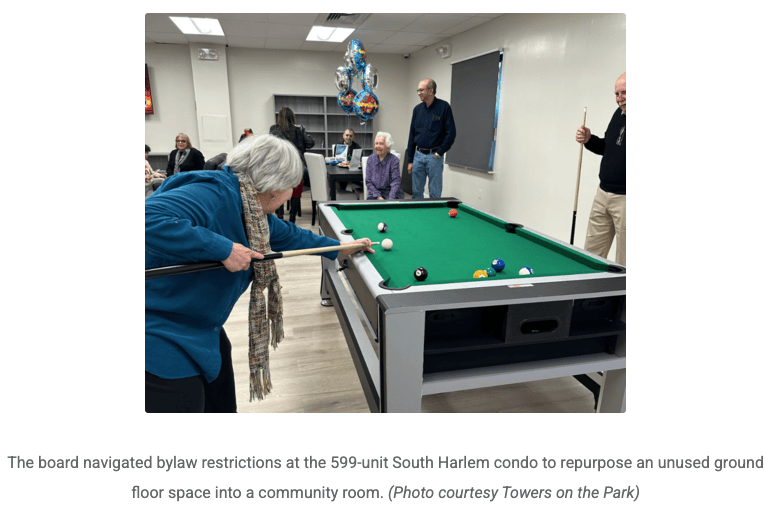
For nearly a decade, a 1,150 square-foot space on the ground floor at Towers on the Park, a 599-unit South Harlem condo, sat empty. Efforts to convert the vacant space — adjacent to the laundry room — into a gym or storage facility stalled. This was largely because the condo’s bylaws require any spending above $25,000 to be approved by a majority of unit-owners. With 15% of apartments being sublet — and many owners not living in the building or enthusiastic about a gym — it was difficult to get the necessary votes. “We just got stuck with a vote that remained open,” says Ilene Cruz, the condo’s property manager, with Argo Real Estate.
Towers on the Park comprises three buildings and was constructed in 1988 as a mixed-income building. One challenge in repurposing the space at the complex’s 220 Manhattan Ave. location was that it only had one door, which meant capacity could not exceed 83 people according to city fire codes. To complicate matters, it wasn’t feasible to install an additional door needed for code compliance, because the only available location for it was blocked by a staircase. “A second door was not going to be an option,” says Carl Leibowitz, who was voted in as board president last December.
As the new board began weighing options for the space, it became clear that converting it into a lounge had multiple benefits: it could be installed at a cost that didn’t require approval from a majority of unit-owners; it avoided the need to add another door because capacity would not exceed 83; and it would foster community. “One of the things we kept hearing from people over and over again was they wanted a place where they could hang out,” Leibowitz says.
The board allocated $10,000 from the operating budget to make the upgrades. This involved installing furniture, a TV, piano, pool table, a soft play area, and shelving for a library. “So far we’ve spent less than $6,000,” says board secretary Shari Siegel. Flooring and an accessible bathroom and kitchenette have also been added with funds allocated in a previous budget for community improvements throughout the three buildings at Towers on the Park.
Work on the lounge began in late January and the space was complete in early April. To keep costs down, building staff did some of the work, including the painting. Siegel was involved in writing the guidelines for the community room, including restrictions on alcohol, unsupervised minors, sleeping overnight, and using candles. “We didn’t want the staff having to clean up,” she says. Fines will be imposed if residents break the rules.
A fob system controls access and a second fob is available for $25. As a way of recouping some of the costs, renters can get access to the lounge for an annual $100 fee. “That way, tenants will have ownership in this,” Leibowitz says. With residents given a space to get to know each other, various clubs have emerged, including a knitting group, sewing group and book club. “A lot of people are excited about the new space,” Cruz says. “They didn’t realize they wanted a lounge until it appeared.”
Community association managers who hold and retain the CMCA credential demonstrate they’re accomplished professionals committed to developing their skills and knowledge by participating in ongoing continuing education (CE) coursework and professional development opportunities year-round.
Recertification, the process through which CMCAs retain their credential, is not just a requirement but a valuable opportunity for promoting and demonstrating continued competency in the association management profession. Over the last ten years, an impressive 88 percent of CMCAs, on average, successfully finished the recertification process.
By participating in CE opportunities that pertain specifically and primarily to community association operations or management, CMCAs contribute to their own professional growth and the development of the CMCA as a recognized standard for experienced managers.
The types of professional development CMCAs participate in encompass a variety of facilitated learning opportunities, ranging from college degrees and coursework, conferences, professional coaching, community workshops, seminars, symposiums, and webinars. In addition, courses may include accounting, human resources, and public administration.
A Sampling of CE Opportunities
The following are some examples of the many different types of programs in which CMCAs participate, including CAMICB’s newest opportunity, volunteer service credits.
The CAMICB Continuing Education Review Committee must review and approve any in-house training management companies provide to qualify for CE credit.
CMCA prerequisite coursework is also approved for continuing education. It’s important to note that CMCAs may not use the coursework to meet examination eligibility and continuing education requirements. For example, if a CMCA used CAI’s M100: The Essentials of Community Association Management as their prerequisite education to sit for the CMCA examination, they may not submit it for CMCA recertification continuing education credit. Coursework that meets the standard criteria may be submitted for review and approval to CAMICB. If the proposed coursework meets the requirements, it will be approved for a two?year cycle.
Volunteer service credits: Credit hours may be earned for volunteer service to organizations advancing community associations or the management profession. Credit hours for advocacy work supporting community associations and management professionals may also be granted. CAMICB must approve the organization and service hours before a credential holder submits their recertification application. The maximum total hours allowed for volunteer service during the two-year recertification cycle is 8 hours. Credential holders must provide objective evidence of their participation to receive continuing education credit for volunteer service.
CAI: CAI’s website (www.caionline.org) and local CAI Chapters offer an array of resources, networking, and professional development opportunities. To find a local chapter, go to: https://www.caionline.org/Chapters/Pages/Find-A-Chapter.aspx. Your local chapter will also offer specific opportunities to impact your community, specifically your state. For example, in California, opportunities may be state-specific to drought, wildfires, the Davis Stirling Act, etc.
Coursework that supports the operations of a community: Credit may be awarded for attendance at local law seminars and local college or university courses about accounting, business practices, computers, or foreign languages. CAMICB calculates CMCA credit on an hour?for?hour basis (e.g., one hour of class attended equals one hour of CMCA credit). Courses related to buying and selling real estate are not acceptable.
Self-study: Self-study credits are limited to no more than four hours every two years and must be pre?approved by CAMICB. A written request for approval should include a description of the course or activity (including outline, syllabus, or summary, as applicable) and the estimated length of time. Institute of Real Estate Management (IREM) home study courses are not considered self?study.
Teaching credits: Teaching a course related to community association management can qualify for continuing education credit. Two credits are earned for each class hour the first time the course is taught. When the same course is re?taught, one hour of credit is earned for each class hour.
Authorship Credits: An article for a regional or national community association publication may qualify for continuing education credit. A copy of the published work and the total number of words written must be submitted to CAMICB. The determination of the number of hours depends upon the word length of the article; the longer the article, the more credits. Please note that copies of publications must be submitted within ample time for review before the recertification due date.
If you have questions about whether a particular course or activity is eligible for CE credits, please visit www.camicb.org or contact CAMICB at info@camicb.org—we’re here to help!
Have you ever had a conversation at work take a turn you weren’t expecting—suddenly, voices rise, arms fold, and you feel the tension? Maybe you walked away wondering, “What just happened? How did we get here?” In those moments, you might feel like defending your position, explain your point more clearly, or even disengage completely. But any of these reactions will only damage your relationships at work.
How can you prevent these conflicts from blowing up?
You can transform those tough conversations into opportunities for connection and understanding with one straightforward communication skill.
It’s called Reflect to Connect, and it’s one of the most powerful tools you can add to your leadership toolkit to build stronger relationships at work. In fact, it is one of our twelve GOAT (Greatest of All Time) powerful phrases for dealing with workplace conflict.
Reflect to Connect for Better Relationships at Work
Reflect to Connect means to share your sense of what a person’s feeling and ask if your understanding is correct.
It sounds simple, but it requires intentional practice. Here’s how it works:
Pay Attention to Emotional Cues: Notice the other person’s tone of voice, body language, and word choice.
Name the Emotion: Identify what you think they’re feeling. For example, “It sounds like you’re frustrated” or “I’m sensing that you might be feeling overwhelmed.”
Check for Accuracy: Ask for confirmation. “Am I understanding you correctly?” or “Is that how you’re feeling?”
This technique has several powerful effects:
It helps the other person feel seen and heard—a fundamental human need.
It slows down the conversation, giving both of you a chance to process emotions before reacting.
And finally, it lessens the intensity of powerful emotions, opening the door to continued conversation.
Why Reflect to Connect Works
At its core, Reflect to Connect works because it addresses the emotional undercurrent of any conversation. Most workplace conflicts have more going on than the surface-level issue you’re discussing.
That conversation about customer support priorities or data-sharing could have emotional needs in play: feeling disrespected, unheard, or undervalued.
When you acknowledge someone’s emotions, you meet these needs head-on and improve relationships at work.
Consider this scenario:
You’re in a meeting, and a team member snaps, “I’m sick of these last-minute requests!”
If you’re like us, your instinct might be to defend yourself with logic or facts: “It wasn’t last-minute. I sent that request two days ago.” But even if that’s true, saying so won’t help the conversation move forward.
Instead, try Reflect to Connect:
“It sounds like you’re feeling frustrated with how things are coming to you. Is that right?”
Nine times out of ten, this approach will diffuse the tension. The person will likely respond, “Yeah, I am frustrated. It feels like I never have enough time to do my best work.”
Now you’re able to address the actual issue—their need for better planning and communication—rather than escalating the conflict.
Practical Tips to Use Reflect to Connect
1. Start with Curiosity
Approach every conversation with the mindset that you don’t fully understand what the other person is experiencing (because you can’t – you’re not them). Curiosity opens the door to empathy and stronger relationships at work.
Instead of assuming you know why someone is upset, ask yourself, “What might they be feeling right now?”
2. Be Comfortable with Discomfort
Reflecting emotions can feel awkward at first. You might worry you’ll get it wrong or that it’s too personal for a professional setting.
But here’s the truth: People crave connection, even at work. It’s better to try and miss the mark than to ignore the emotional reality of a conversation. And caring enough to ask gives the other person a chance to clarify how they feel.
If you’re unsure, you can soften your language:
“I might be off here, but it sounds like you’re feeling…”
3. Practice in Low-Stakes Situations
Before using Reflect to Connect in high-stakes meetings, practice it in everyday interactions.
For example, if a colleague seems excited, you could reflect, “You seem really energized about this project. Is it exciting?”
Common Pitfalls and How to Avoid Them
Even with the best intentions, it’s easy to make mistakes when using Reflect to Connect. Here are a few common pitfalls and how to avoid them:
1. Misreading the Emotion
This isn’t actually a pitfall. It’s okay to get it wrong. If you reflect an emotion and the other person corrects you, that’s progress and you cared enough to ask. Maybe they respond:
“Actually, I’m not frustrated; I’m more disappointed.”
This gives you valuable insight. Don’t be afraid of being corrected—it deepens the conversation and builds better relationships at work.
Reflect to Connect isn’t a manipulative trick. It only works if you genuinely care about understanding the other person’s experience and improving your relationships at work.
The Ripple Effect of Reflect to Connect
When you use Reflect to Connect, you don’t just reduce unnecessary conflict—you’ll build a culture of empathy and understanding. People will feel safer sharing their thoughts and feelings, knowing they won’t be dismissed or misunderstood.
Over time, this technique can:
Improve team morale
Build stronger relationships at work
Increase trust and psychological safety
Imagine a workplace where people don’t have to raise their voices to be heard—where conflicts are resolved through understanding, not argument. That’s the power of Reflect to Connect.
Your Turn to Build Better Relationships at Work
The next time you find yourself in a tense conversation, pause. Take a breath. Reflect back what you think the other person feels and ask if you’re right.
You might be surprised at the doors it opens.
Because here’s the truth: everyone wants to feel seen and heard. When you meet that need, you transform conflict into connection—and create a workplace where people truly want to work together.
They’re called whisper listings — co-ops and condos and other homes available for sale only to those in the know, before they’re added to a public multiple listing service, known as an MLS.
One brokerage, Compass, has taken the concept to a new level, Crain’sreports. The brokerage has rolled out a curated, Compass-brokers-only website that potentially allows the brokerage to keep the buyer- and seller-side brokers’ fees in-house. Compass says the program is intended to give homebuyers and -sellers a lift in a tight housing market. Prospective buyers can bid without being muscled aside by as many competitors, while sellers can tweak pricing without coming across to the general public as desperate.
Critics see whisper listings a bit differently.
“Let’s be clear,” Brown Harris Stevens CEO Bess Freedman writes in the website Inman. “Any brokerage that advocates for only marketing listings internally is not putting the client’s interests first, but rather it is an attempt to pad its own pockets. Private listings minimize competition for the client.”
But Rory Golod, president of growth and communications at Compass, says the program helps ensure fairness for sellers by preventing them from having to combat the impression that if the asking price for their home has been lowered, or if the property has been on the market for a long time, then it is of low quality or somehow less desirable.
According to a recent Compass filing with the Securities and Exchange Commission, the so-called private exclusives program is designed to test prices, obtain industry insights and generate early buzz before a property is added to an MLS. The brokerage contends that private listings help sellers avoid having “negative insights” about their homes, namely data on price drops and days on the market, published online and available to prospective buyers.
Of the roughly 2,300 listings in New York City for which Compass alone was the marketing agent, about 500 were cordoned off in mid-March as private exclusives, according to a Crain’s analysis of the brokerage’s data. Of those, 370 involved co-ops, condos or townhouses in Manhattan, the borough Compass focuses on the most.
Among the opponents to whisper listings, unsurprisingly, is StreetEasy, the popular Zillow-owned data service that relies on open listings. “StreetEasy believes in fair, transparent and equal access to real estate information, and is staunchly against anything that prevents it,” says StreetEasy General Manager Caroline Burton. “Hiding listings from the public — especially in a market like New York, which faces the biggest housing shortage in the country — not only exacerbates this issue, but puts buyers, sellers and agents at an extreme disadvantage.”
Over the years, the various condo boards at a small converted loft building commissioned several facade engineering studies. All of them discovered noticeable cracking and recommended remediation. Each board apparently believed that a long-standing brick building was safe — and they apparently were unwilling to pay for repairs that were not absolutely necessary — and so they never moved forward with the suggested fixes.
Big mistake.
After hiring a new management company, the board brought in another team of engineers to take a fresh look at the facade. During the walk-through, the structural engineer saw that the building’s bearing walls were leaning, and immediately notified the Department of Buildings. A few days later, residents of the condominium were given the worst possible news.
They had five days to evacuate the unsafe building.
Compounding the enormous logistical challenges the condo faced was a cash problem. “The question was how to raise the capital to remediate a project projected to cost between $2 [million] and $3 million,” says Carl Cesarano of Cesarano & Khan, the condo’s accountant. The remediation cost was a moving target, he adds, and the big spread made raising capital all the more challenging.
If this were a co-op, he says, the building could be leveraged as collateral and it could get a line of credit. In the condominium structure, however, unit-owners own their units, so leveraging the building isn’t possible. The kind of loan a condominium can get is called a common interest realty association, or CIRA, loan. There are only a few lenders who will make such loans, and the condo’s unsafe condition made the search that much more difficult.
“We went to different lenders, and when they heard that this was a potential building collapse, just about all of them said it didn’t meet their underwriting criteria,” Cesarano says. “One lender said to me, ‘We wouldn’t touch this with a 10-foot pole.’” Finally, though, a lender was found, but the loan came with conditions attached. “The lender said it was willing to give us a loan with all the shortcomings of the property,” Cesarano says, “but the owners must also have a chip in the game.” That chip was an immediate assessment of $1.6 million.
The high cost of doing things on the cheap was beginning to come into focus.
The assessment was only one part of the lender’s requirement; the second was the creation of a long-term assessment to fund the loan. Cesarano says the lender wanted the condo to create a line item in its budget specifically dedicated to paying back the loan.
This immediate assessment to unit-owners averaged around $65,000, depending on their ownership percentage. The lender’s $2 million loan, which was a revolving line of credit, was spread out over a six-year payback period, which meant that each unit-owner was assessed, on average, another $77,000 over the six years. Meanwhile, of course, the unit-owners had to continue to pay their common charges while the condo was undergoing repairs.
Because the cost of the project wouldn’t be certain until the remediation began, Cesarano took on a new role. “The condo board wanted somebody to watch the contractors and almost act as an owner’s rep for financial affairs,” he says. “Not only to track the financial outlay of the project but to augment how the ongoing assessments needed to be structured.” The loan was a revolving line of credit, so the condo didn’t have to draw it at once, only as needed. That made tracking the financials all the more important.
There’s a lesson here for all co-op and condo boards.
“From my perspective,” Cesarano says, “boards should embrace their engineers and have an accountant by their side. A lot of boards feel engineers come in and overstate what’s needed.” As a result, he adds, boards frequently fail to include the engineer’s findings in a building’s financial statement. “If they did, it would show that the building is underfunded.”
Failing to admit that reality, Cesarano adds, “is a double-edged sword.”
It’s a lesson this condo board learned the hard way.
CAMICB Updates Its CMCA Standards of Professional Conduct and Enforcement Procedures
By CAMICB Executive Director, Matthew Green, CAE
A key component of CAMICB’s Credentialing Program requires a Certified Manager of Community Associations (CMCA) to adhere to a high standard of ethical conduct. This means CMCA credential holders must comply with the 10 CMCA Standards of Professional Conduct, which are designed to ensure that managers uphold their fiduciary responsibilities and comply with laws, governing documents, and professional integrity.?
CAMICB recently conducted a thorough review of the CMCA Standards of Professional Conduct as part of its regular cycle to ensure these critical elements of the CMCA certification program continue to align with industry standards and best practices. In addition, the review was designed to ensure that the standards remain relevant and applicable to the evolving demands of the community association management industry, both domestically and globally. While some changes were made to the standards themselves, the most significant updates are found within the accompanying clarification document. This document provides detailed guidance on the practical application of the standards, ensuring they are interpreted and enforced consistently. By modernizing the standards and clarifications, CAMICB ensures that CMCAs are held to up-to-date ethical standards while addressing global applicability and evolving industry standards.
Said Greg Smith, CMCA, AMS, PCAM, Chair of the CAMICB Board of Commissioners, “These revisions reflect a commitment to maintaining high ethical standards and professionalism for CMCA credential holders while incorporating more explicit guidance on fiduciary responsibilities, conflict-of-interest disclosures, and data security practices.”
A summary of the key changes and updates follows:
Standard 1: Global Applicability and Compliance
The changes to Standard 1 make the policies globally applicable by removing jurisdiction-specific references.
Standard 6: Gratuities, Compensation and Disclosure
The changes to Standard 6 strengthen the requirements for disclosure of gratuities and compensation to enhance transparency while reducing the likelihood of conflicts of interest.
Standard 7: Continuing Professional Education
The updates to Standard 7 further emphasize the need for continuous education aligned with CMCA recertification.
Standard 8: Fiduciary Duty
The changes to Standard 8 clarify the expectations around fiduciary duty by detailing what constitutes a breach.
Standard 9: Professional Conduct and Violations
The revisions to Standard 9 shift the focus from defining what constitutes a breach of due diligence to emphasizing the expectation of maintaining professional conduct at all times.
Standards 10: Records, Confidentiality, and Data Security
The updates to Standard 10 focus on the handling of client records, particularly the secure management of electronic data, in line with current data security practices.
“These updates ensure that CMCA credential holders are equipped to meet the evolving demands of the community association management industry, reinforcing the value and trust associated with the CMCA credential,” added Smith.
CMCAs are encouraged to review the updated standards and the clarification document thoroughly to ensure their practices continue to align with CAMICB’s expectations for ethical conduct and professionalism. By staying informed on these updates, CMCAs can confidently uphold the high standards required for maintaining their credential and serving their communities effectively.
About The Standards Of Professional Conduct
The Standards of Professional Conduct, detailed at https://www.camicb.org/standards/, range from understanding laws applicable to community association management, to being knowledgeable on association policies and procedures, to carrying out fiduciary responsibilities, and participating in continuing education coursework. A violation of any of these Standards of Professional Conduct may be grounds for administrative action and possible revocation of the CMCA certification by CAMICB. Abiding by these Standards of Professional Conduct help protect consumers and associations that hire or contract with community association managers.
Enforcing the Standards of Professional Conduct
In order to maintain and enhance the credibility of the CMCA Certification Program, the CAMICB Board of Commissioners follow strict procedures that allow consumers and others to bring complaints concerning CMCAs to the Board. Similar to a regular review of the Standards of Professional Conduct, CAMICB also reexamined the procedures for suspending and revoking certification every two years.
Through this process, CAMICB enhanced its procedures for reviewing, suspending, and revoking certifications to ensure they reflect the latest industry standards. These improvements underscore our commitment to maintaining the highest level of professional conduct and ensuring our processes remain transparent, fair, and aligned with global best practices.
More information, including a set of Frequently Asked Questions, a list of the 10 clearly outlined Standards of Professional Conduct, the procedures for enforcing the standards, and other pertinent documents, can be found at https://www.camicb.org/standards/.