CAMICB is a more than 25 year old independent professional certification body responsible for developing and delivering the Certified Manager of Community Associations® (CMCA) examination. CAMICB awards and maintains the CMCA credential, recognized worldwide as a benchmark of professionalism in the field of common interest community management. The CMCA examination tests the knowledge, skills, and abilities required to perform effectively as a professional community association manager. CMCA credential holders attest to full compliance with the CMCA Standards of Professional Conduct, committing to ethical and informed execution of the duties of a professional manager.
The CMCA credentialing program carries dual accreditation. The National Commission for Certifying Agencies (NCCA) accredits the CMCA program for meeting its U.S.-based standards for credentialing bodies. The ANSI National Accreditation Board (ANAB) accredits the CMCA program for meeting the stringent requirements of the ISO/IEC 17024 Standard, the international standards for certification bodies. The program's dual accreditation represents compliance with rigorous standards for developing, delivering, and maintaining a professional credentialing program. It underscores the strength and integrity of the CMCA credential.
Privacy Policy: https://www.camicb.org/privacy-policy
The condo crisis in Florida is worrisome, to say the very least. Aging properties, stricter structural and cash reserve funding laws due to the Surfside collapse, and skyrocketing association fees have made life harder for condo owners in the Sunshine State.
Speaking of cash reserve funding laws, if you’re thinking of buying a condo anywhere in the U.S., you should be aware that only 12 U.S. states, including Florida, legally require condo/HOA associations to maintain formal cash reserve plans or studies—and even fewer require full funding.
But what exactly does this mean? Well, some condo owners in those states may be better protected against surprise assessments. Others, however, may face painful dues hikes or special assessments that could make living in an HOA financially unattainable.
What is an HOA cash reserve—and how does it differ from a special assessment?
Put simply, a cash reserve is a fund that an HOA is legally required to maintain in order to cover future maintenance, repairs, and emergency costs.
“These reserves are based on projections of future needs and are meant to ensure the long-term upkeep and safety of the community,” says Raul Gastesi, attorney and partner at Partner & Gastesi Lopez Mestre & Cobiella in Miami.
In contrast, a special assessment is an unplanned, additional charge levied on homeowners when unexpected issues arise that the reserves can’t cover. These typically occur when major repairs are needed—like roof replacements or structural fixes.
“Special assessments tend to create homeowner dissatisfaction because they often involve large, sudden out-of-pocket costs that were not originally budgeted for,” explains Gastesi.
Which 12 states require reserve funds—and what makes each law unique?
“Association directors/members who elect to fund reserves, whether by choice or requirement, are better positioned to manage future repair costs, avoid special assessments, and maintain the long-term financial stability and property values of their communities,” says Danielle Blake, chief of residential and advocacy for MIAMI REALTORS® in Florida.
While reserve funds do come with benefits, including the ones described by Blake, they’re not perfect. They can often lead to higher HOA fees and other issues, such as overspending. Currently, only these 12 states mandate reserve funding:
First, there’s Florida
Following the Champlain Towers collapse, Florida enacted a law requiring condominium associations to conduct structural reserve studies every 10 years and fully fund those reserves by the end of 2024.
“While this regulation is a critical step for life safety and long-term property value, it can be painful for current owners,” says Gastesi. “Many associations, especially those that historically deferred maintenance to save costs, now face steep financial catch-ups.”
Properties that fall behind on reserves not only risk safety but can suffer significant financial consequences. After all, disrepair affects a unit’s resale value, refinancing options, and the association’s ability to borrow.
“In extreme cases, banks may refuse to lend for purchases in underfunded buildings, limiting sales to all-cash buyers and dramatically reducing market value,” explains Gastesi.
The other 11: Hawaii, Delaware, Maryland, Oregon, Nevada, Connecticut, Illinois, Massachusetts, Michigan, Minnesota, Ohio
These states require reserve funds—and some also mandate formal reserve studies that are used to assess funds and ensure they’re at optimal levels. Maryland and Oregon, for example, require reserve studies every five and three years, respectively. Also, Hawaii, like Florida, requires significant reserves for structural problems due to safety or housing pressures.
Can homeowners negotiate reserve levels—or special assessments?
“In states where reserves are mandated by statute, there’s no negotiation—complying with them is required by law. Rarely, an association might request a payment plan from regulators to catch up, but this is generally discouraged,” says Gastesi.
For special assessments, negotiation may be possible, especially at the implementation level. As a homeowner, you can attend budget and board meetings to gain a better understanding of the necessary maintenance and repair projects.
“Ask whether the association is using a straight-line or pooled method for funding reserves, as a pooled method may provide more flexibility,” Blake advises. “Also, explore financing options, such as the use of a line of credit, bank loan, government-backed programs that may help to reduce the financial burden on owners.”
By Kelly G. Richardson, Esq. CCAL, HOA Homefront Column
Mr. Richardson: I really enjoy your HOA Homefront column. Here’s a question: Is it appropriate for board members to use homeowner time to make speeches? We have a board member who likes to do that — often disparaging owners who have different opinions from hers. Thank you, A.M., San Diego
Dear A.M.: Open forum is not the time for the board members to talk, but is their time to LISTEN. They should be noting any questions or action items that need to be answered or directed to management or a committee. The Open Meeting Act prohibits directors from discussing (or orating) on matters not disclosed on the agenda, per Civil Code Section 4930(a). However, subparts (b) and (c) of Section 4930 allow directors to answer questions or request matters be referred to management, staff, or a committee, which should happen AFTER open forum ends. Board members who abuse open forum by interrupting members cannot fairly insist that homeowners in the audience not interrupt board deliberations. Finally, it’s bad form to use one’s board seat as a platform to bully or criticize other members. Sounds like someone should gently rein this person in a bit. Best, Kelly
Dear Kelly: In an attempt to make board meetings brief, they have taken to voting the “consent calendar” as one agenda item, without any prior members’ knowledge, discussion or even speaking the items on it. This month these include: approve the minutes; acknowledgement that board members have reviewed the financials; treasurer’s report; and manager’s report. These reports are provided to the board by the treasurer and manager prior to the meeting. They are then adopted by the Board at the meeting always without discussion or disclosure of the contents. The reports are then attached as separate PDFs to the minutes of the meeting which are provided to the members a few days after the meeting. Should not these reports be seen by the members before the Board votes on them? How can this square with the open meeting rules or intent? R.S., Solana Beach
Dear R.S.: Consent calendars are a powerful tool to dispose of items not expected to require any discussion – such as the items you list- in one quick vote without deliberation. The consent calendar items still must be listed on the posted agenda, and any director can without explanation ask for an item to be removed and handled as a separate motion. Since consent calendar items are not discussed, it is another reason to conduct open forum at the beginning of the meeting. However, reports the board receives in their “board packets” are not normally shared with the rest of the HOA unless those reports are accepted and added to the minutes. Sometimes the board packet has confidential information such as multiple bid proposals, or incident reports, or delinquency lists, which should not be shared with the community at large.
Consent calendars are valuable because they preserve time and energy for the items which might be controversial and need board focus. Even the smallest HOAs would benefit from their use. One caution – don’t overuse consent calendars as a technique to avoid discussing matters which are not truly routine or non-controversial, because that can quickly destroy a board’s credibility. Nothing is more important than the HOA’s trust in their board.
We had the privilege of speaking with Candace Lewis, CMCA, AMS, PCAM, into this particular topic. She is the Director of Marketing for Cardinal Management Group, LLC, a privately held, locally founded firm in Woodbridge, VA.
It’s crucial for professionals in every industry to stay up to date on new technologies and the community association management profession is no different. Managers are embracing a variety of tools to improve efficiency, productivity, communication, resident satisfaction and better collaboration with Boards and business partners. From selecting the right device (phone, tablet, app, etc.) to choosing the appropriate software that suits their needs, these tools help make managers’ lives and jobs more rewarding.
Technology in Action: Streamlining Processes, Maximizing Efficiency
“There was a time when information about communities was kept in a binder and, as a manger, you had to lug that binder to meetings so you had the information you needed at your fingertips,” said Candace Lewis. CMCA, AMS, PCAM. “Now, having it digitally accessible on your phone, tablet or computer allows for easier access and searchability. Most documents have Optical Character Recognition (OCR), which makes finding specific language or keywords much easier in a litany of governing documents. For example, I was at an Architectural Review Committee appeal hearing with a Board of Directors questioning what the rule stated about the height of a retaining wall; I was able to quickly find the answer on my tablet. Instead of delaying their decision to the next meeting, the Board was able to quickly move forward.”
Candace further explains that tasks like violation reporting and tracking have significantly improved with technology. “Instead of using a clipboard, pen and paper to log violations, we now have community management software, such as CINC, SmartWebs or FrontSteps, that help managersefficiently handle these issues by quickly uploading photos while sending the violation notice in real-time,” said Candace. “Homeowners receive an email about the violation and, in turn, more swiftly remedy the issue. Depending on the platform used, homeowners can also log-in to see their outstanding violations and any photos the manager has uploaded.”
Digitizing resales in HOAs helps modernize the process, making it faster, more efficient, and more transparent. It provides significant benefits in terms of operational efficiency, cost savings, enhanced communication, and compliance. Candace explains, “There was a time when a potential buyer had to wait for a large package of documentation to arrive in the mail before they could review the association’s governing documents, prior to moving to settlement. Hard copies required an individual in an office to print, organize and mail to the potential buyer. Now, services like CondoCerts, HomeWise and others offer a digital delivery of these documents making it less time consuming with minimal paperwork. “For both homeowners and managers, the transition to a digital system creates a smoother, more convenient experience while also improving the long-term management and oversight of the community,” added Candace.
The pandemic fueled the rise of virtual meetings and the use of Zoom, Microsoft Teams, or Google Meeting platforms to host these events. As a result, many Board and Annual Meetings are now hybrid or fully virtual. Further, what has also become an option for many managers is the opportunity to continue working remotely. “In the past, when homeowners or homeowner volunteers wanted to meet with us, we’d convene at the office or onsite,” said Candace. “Now, we can quickly arrange a virtual meeting, which is helpful when having difficult conversations that are easily misinterpreted via phone or email. In addition, regularly scheduled virtual team meetings have also enhanced collaboration and meaningful “in-person” dialogue.”
Candace offered one of the most popular uses of technology, as a manager, is the thoughtful use of AI platforms to help managers craft email responses, homeowner notices, newsletters, email blasts, requests for proposals, policy resolutions, bid comparisons, and more. “I use ChatGPT and Grammerly, like many others; however, some software companies have developed their own AI add-ons, such as MicroSoft’s Azure AI,” said Candace. “AI is also a great tool to use on most mobile devices when communicating with a homeowner whose first language is not English.”
Are there challenges in convincing homeowners to use newer technology? Absolutely. “Most people need another login credential like they need a crack in their foundation,” quipped Candace. “Urging anyone to download an app or create a new sign-in, isn’t always easy.”
Candace notes, more importantly, as data and operations go digital, cybersecurity becomes a critical concern. Managers must stay updated on best practices for protecting resident data and ensuring that functions such as online payment systems, communications channels and other digital tools are secure from breaches.
Staying abreast of new technology helps community association managers improve operational efficiency, reduce costs, enhance resident satisfaction, maintain compliance, and stay competitive in a changing market. “It’s not just about keeping up with trends – it’s about using technology to create a more streamlined, responsive, management approach,” said Candace.
Candace expressed that information about new technology is often in mainstream media; however, technology specific to community associations is best discovered at the CAI Annual Conference or local chapter conferences and expos. Additionally, she finds “ads and articles in CAI publications have been a great help in spreading the word about the many options available.”
Technological Proficiency In Community Association Management is the sixth in a series of articles, produced by CAMICB staff, that delve into the important issues and topics affecting community association managers.
Lydia Pelliccia is a freelance writer.Matthew Green is executive director of Community Associations Managers International Certification Board.
By Kelly G. Richardson, Esq., CCAL, HOA Homefront Column
Mr. Richardson: Is homeowner open forum a requirement in California or just handy for everyone involved? Or, should I speak with each board member individually to ask for that time in the monthly board meetings? Or, is that only an agenda item at the yearly membership meeting? S.L., El Centro.
Dear S.L.: An open forum opportunity is required by Civil Code Section 4925 in all open board meetings and in membership meetings. This is mandatory. The board “shall” establish a reasonable time limit for members to speak. A common limit is 3 minutes per speaker, with many boards allocating up to 30 minutes for the open forum session portion of the meeting. It’s also a good idea to establish some reasonable open forum policies so attendees know what is expected.
Open forum is not only required but is a valuable opportunity for boards to hear from their members; their neighbors. It’s an important aspect of healthy HOA governance, showing that members are heard. Best, Kelly
Dear Kelly: I learned that our board authorized themselves to approve non-emergency expenses up to a stated amount between meetings if two or more directors agree to it. Isn’t this a violation of the Open Meeting Act? There have been items such as holiday lighting that never appeared on the agenda or reflected in minutes due to this self-imposed power. L.C., Anaheim Hills.
Dear L.C: The board should avoid granting directors blanket authority to spend funds outside of official board meetings. If the board does so, then decisions are being made outside of board meetings. Corporations Code Section 7210 allows the board to delegate certain activities to the manager, a committee, or other persons but the board still must ultimately be in control. So, at minimum those decisions should be disclosed and ratified by the board in its next open meeting. I suspect many of your neighbors may agree with you that your board’s current practice is not transparent. I can understand the practice if your HOA does not have a professional manager, but otherwise I think it’s a bad idea. Sincerely, Kelly.
Kelly: Our HOA board members have discussions and decide who will serve as president, VP, etc prior to a board meeting. This occurs annually in preparation for the new term and in some cases, before the election of board members and/or after the election of board members but before their first meeting. Should these discussions and decisions be part of the open meeting and should these discussions and decisions occur outside of board meetings? Thank you, L.O., Nipomo.
Dear L.O.: The selection of officers is not a topic permitted for executive session under Civil Code Section 4935(a). Some boards mistakenly refer to officer discussions as “personnel” (one of the few topics allowed to be handled in closed sessions) but “personnel” refers to HOA employees. Officer appointments are decisions of the board and must be made in open session. A common mistake after annual meetings is to forget to announce four days before that after the election there will be a short board meeting to elect officers. If the board does not wish to have a meeting (with agenda notice and open forum opportunity) right after the membership meeting, then it should hold off on electing officers until its next announced meeting. Best, Kelly.
Charisma and credentials aren’t enough. In the pressure cooker of leadership, it’s the subtle, often invisible factors that determine who lasts—and who doesn’t.
Leadership isn’t just about making decisions and steering the ship anymore. It’s about being the kind of person others will follow into uncertainty — especially in the world of new ventures, where uncertainty is guaranteed. And yet, even the most intelligent, well-prepared leaders often fail. Why?
Not because they lack drive or knowledge. But because they underestimate the invisible forces that shape how leadership actually works.
These forces — call them X-Factors — operate in the margins: between vision and execution, between public wins and private choices. Most leadership breakdowns aren’t dramatic implosions. They happen slowly.
Here are five X-Factors that separate enduring leaders from those who burn out, blow up, or simply fade away.
1. Timing Is Everything (and You Don’t Control It).
Leaders love to believe that hustle beats luck. But the truth is, even perfect execution won’t compensate for poor timing. Vision alone doesn’t make a business work — readiness does. That includes market readiness, team readiness, and even emotional readiness. Poor timing often shows up in two ways: launching too early (before demand exists) or holding back too long (and missing the window). Great leaders aren’t just builders — they’re pattern recognizers. They learn to sense when to pause, when to push, and when to pivot. It’s like being a racecar driver — braking 50% of the time and accelerating 50% of the time.
How to apply it: Cultivate strategic patience. Look for signals, not just plans. Build a culture that reads the environment as well as it executes a strategy.
2. It’s Not Just Business — It’s Always Personal.
Many leaders try to separate their “professional” decisions from their personal lives — and from the lives of their team. That’s a myth. Just walk down the hallway and you’ll see it: framed snapshots of kids, partners and pets on employees’ desks. For them, it’s not just a job — it’s livelihood, identity and pride.
The same is true for you. Whether you admit it or not, every major decision you make is filtered through personal bias, emotional wiring or past experience. That doesn’t mean you should indulge every instinct, but ignoring the personal undercurrents is dangerous. Leaders who don’t do the internal work—understanding their patterns, triggers and motives—end up reacting, not leading.
How to apply it: Build an inner circle that helps you lead from the inside out. Not just advisors, but truth-tellers — coaches, therapists, or mentors who challenge your blind spots and help you lead with clarity and empathy.
3. Know How You’re Built (DNA v. Destiny).
Some leaders are visionaries. Others are operators. Some are driven by mission, others by challenge. The problem? Many first-time leaders try to become someone else—chasing a style that doesn’t fit their wiring because that’s what they think is expected by investors, boards, or peers. Growth is possible, of course. But self-awareness isn’t a luxury—it’s foundational. Great leaders build systems that match their strengths, and they hire for their gaps.
How to apply it: Ask: “Am I leading in a way that reflects how I’m built — or how I think I’m supposed to act?” Invest in assessments, reflection, and feedback loops that clarify your design.
4. If Everyone Thought Like You, You’d Have No Employees.
Uniform thinking feels good—especially in early teams. But high-alignment cultures can unintentionally punish dissent or diversity of thought. Leaders who surround themselves with clones end up with fragile companies. Real leadership means cultivating disagreement without disconnection. It means creating safety for pushback and resisting the ego-need to always be right.
How to apply it: Hire people who challenge you. Celebrate different lenses. Pair individuals who are exceptional at problem solving with those who possess a go-get-it spirit to work on the same project. Yes, it can be a guessing game—but educated guessing within these parameters beats trying to compile a team of the “smartest” people.
5. Build Your Own Core Leadership Team (Not Just a Company).
Most CEOs obsess over their team. Few invest in their own core team—the personal scaffolding that keeps them grounded. That might include a performance coach, therapist, peer group or spiritual guide. Whatever the form, the principle is the same: leadership is lonely, and self-reliance isn’t a strategy.
How to apply it: Design a long-term support system that keeps you grounded—especially when things get chaotic. Think of it like a personal board of directors—people who help you stay calibrated, focused, and resilient.
Leadership isn’t a set of tactics—especially in today’s fast-moving, information-at-your-fingertips world. It’s a relationship: with yourself, with your people, and with the moment you’re in. The leaders who endure—the ones who build resilient teams and companies—aren’t the ones who never falter. They’re the ones who understand and manage the subtler forces at play.
These five X-Factors won’t show up in an MBA course. But they are the difference between short-term control and long-term trust. Between burnout and balance. Between leading a company—and becoming the kind of leader others will choose to follow.
Story by Robyn A. Friedman For The Wall Street Journal
That beautiful Miami Beach penthouse with the fabulous ocean views comes with more than a high price tag. It also comes with the risk that the condominium association may levy a special assessment against your unit that can run into the thousands, or even hundreds of thousands, of dollars, a factor that is having a chilling effect on sales of older condominiums not only in Florida, but nationwide.
According to the Community Associations Institute, an industry group, special assessments are charges levied by a condominium or other community association to pay for expenses that cannot be covered by the existing budget or cash reserves. These expenses can result from a fire or other disaster, unplanned maintenance or repairs.
Nowhere is the issue of special assessments more pressing than in Florida, where new legislation was enacted after the June 2021 collapse of Champlain Towers South, a 12-story condominium in Surfside, that left 98 dead. That legislation requires so-called “milestone inspections” of certain condo and cooperative buildings to ensure they are structurally sound, and to verify the adequate funding of association reserve accounts. In response, condo and coop boards have been levying special assessments against unit owners to cover necessary repairs so their buildings will pass the inspections and to cover reserves.
Janet Stone bought a two-bedroom condominium in Ormond Beach, Fla., in November 2021 for $379,000. The retired special-education teacher finished up her last class in Las Vegas and then drove to Florida to begin her retirement. Less than a year later, in the fall of 2022, she was hit with a $102,000 special assessment, payable in seven payments over two years, in amounts varying from $3,529.60 to $23,310.58.
Stone went back to work, and every cent she earned went toward paying her assessment. She made her last payment in January 2025. “I hope that the building is now structurally and fiscally sound,” she said.
Stone had reviewed the governing documents of the condo association, but not the minutes of board of directors meetings, where there was talk of the coming assessment. That is why prospective condo buyers should review all relevant documentation before they buy, including the association budget and reserve schedule, and talk with residents of the building.
According to Mark F. Grant, a partner at Greenspoon Marder in Fort Lauderdale, Fla., and a certified specialist in condominium and planned-development law, condo-unit buyers routinely obtain an estoppel letter from the association before closing. In Florida, that document details any outstanding fees due by the condo-unit seller, as well as any actual or pending special assessments, to give buyers notice of their potential liabilities. Stone said she received an estoppel letter that referred to the possibility of concrete-restoration work but that there was no dollar amount included.
If you’re hit with a special assessment, here are some things you can do.
Contest it.
Every state has strict legal requirements that a condo’s board of directors must follow to levy a proper special assessment. If they fail to follow either the statutes or any requirements set forth in the condominium’s governing documents, that may present the chance for an owner to contest the assessment because it wasn’t adopted correctly, according to Grant. Florida law, for example, requires that unit owners be provided with at least a 14-day notice before a board meeting at which a special assessment will be considered. Some condo documents require even more notice. After the meeting, the board is required to send out a resolution confirming the amount of the special assessment, how much each owner owes and when the payments are due, Grant said.
Explore financing options.
Borrow the funds to pay the special assessment from friends or family, or consider asking the board for a payment plan. If you have sufficient equity, you could also get a home equity line of credit. Chantel Bonneau Stewart, a certified financial planner at Northwestern Mutual in San Diego, recommends establishing a Heloc even before you need it. “It can be a way to finance a very large expense, such as an assessment, over a number of years, rather than having to deliver a very significant amount of cash sooner,” she said. Stewart said that condo owners might also be able to borrow from their 401(k) plan. While distributions from a 401(k) can trigger taxes or penalties, a loan paid back with interest isn’t considered a taxable distribution, she said. The plan dictates the term and other provisions, so read the fine print.
Check your insurance policy.
Condo owners typically carry a homeowners insurance policy called an HO6. Check to see if it has loss-assessment coverage—most do. That coverage can protect condo owners from paying out of pocket for a special assessment when the costs exceed the association’s master insurance policy limits, said Loretta L. Worters, a vice president at the Insurance Information Institute. But there are limitations: The assessment must be from a loss that would have been covered by your individual policy, such as a fire or hurricane, so it won’t help cover the cost of assessments done solely for repairs needed to satisfy inspection requirements.
Leaders may not realize it — they’re not just being watched, they’re being interpreted, filtered, and judged, frame by frame.
We are entering a predominantly post-literate era, where communication is less about deep reading and more about immediate visual recognition, visual credibility, and emotional resonance with what and who we see. More leaders find they are now operating in a mediascape where memes, emojis, and short-form videos often carry more weight than traditional written reports.
We are entering a predominantly post-literate era, where communication is less about deep reading and more about immediate visual recognition, visual credibility, and emotional resonance with what and who we see. More leaders find they are now operating in a mediascape where memes, emojis, and short-form videos often carry more weight than traditional written reports.
This shift toward the visual favors intuitive, right-brain communication, making it harder to rely on rational argument and easier to connect through shared symbols and emotional cues. This is an evolution that calls for contemporary leadership to master an essential new skillset — visual literacy.
Visual literacy calls on one’s ability to critically interpret the images used in communication, especially relevant with the rise of AI imagery (some estimates suggest that by 2050, 75% of what we will see will be AI-generated). While the concept of visual literacy has been with us for fifty years, we are far behind in developing it, and it’s time to catch up.
Visuals in the business arena are all-pervasive, from our slide and video presentations to communications and multimedia branding initiatives. Short-form video platforms like TikTok and Instagram have become the primary stage for executive visibility — with business-oriented LinkedIn catching up fast. Not only did video creation on LinkedIn increase 100% in 2024, but CEOs are also more active than ever on the site: 85% of CEOs from the FTSE100 are now posting on LinkedIn, up from just 12% two years ago.
Casual-looking, home-recorded business videos are more frequent than ever in these post-pandemic years and show executives speaking to us about the state of the market and corporate earnings as they walk their dog, run on the treadmill, or show off their homes. Leaders may not, however, be conveying the right message to the people who matter most. They might not even realize that they aren’t fully in control of the effects they are creating.
So, how can leaders develop and refine their visual literacy and direct consumers’ attention more precisely where they want it to go?
#1 Familiarize yourself with “visual thinking”
Up to 65% of us may be visual thinkers: people who predominantly think and learn, discern and interpret the world, through picturing things in the mind. When we are not thinking analytically about those visuals, we tend to believe that “what we see is more trustworthy than what we hear.” Yet we are not quite able at this point — as leaders and companies publishing them, nor as a public consuming them — to comprehend the impact that images have on us. We cannot read them: we memorize about 15% of what we read as opposed to 60% or more of what we see. So it’s crucial to be visually literate (to know what it is that you are memorizing) in a world that is overtly visual.
In The Visual Detox, I break down visual categories such as color, composition, angles, perspectives, and distance. These are just some of the components of what we see, and how these components are assembled can affect how we interpret what we see. Marketers, advertisers, political strategists, and creatives choose each component carefully to trigger a new consumer behavior, a political vote, and other responses.
#2 Take a quick audit
To develop your visual critical thinking, take an audit. Assess your current visual information, and absorb your sector’s visual trends in terms of positioning yourself and your company. What are the current visual conversations on various outlets? How do you, as a leader, fit into them? And your company? Simply go online and Google whatever is available about your C-suite executives. Analyze the imagery of other leaders and businesses within and outside of your sector, then audit your company’s visual presence in a similar manner. Get a team involved and record all the ways you appear. Look at social media, news feeds, images, reviews, videos, and LinkedIn profiles of your C-suite, along with your corporate website. Have your team note the misalignments: What you are telling yourselves the business represents may not correspond with what your consumers and stakeholders perceive. That means it is time to build a new visual strategy.
#3 Establish your visual identity
Business leaders’ visual literacy is crucial to making the desired impact. Using visual critical thinking and analyzing visual trends among your clients and partners, you can better evaluate the impact your visual story-telling has on those you wish to persuade. Since COVID the lines between the visual identity of your private persona and your visual identity as a leader have become increasingly blurred. A business leader’s videos are a consumer’s first approach to the business; they visually position the company, and you as leader. But one size doesn’t fit all. It would not be suitable, for example, to create the same visuals for a local startup seeking funding as for an established corporation with a global presence. The former has to convey more visual excitement and look more impressive than its size, whereas the latter needs to be more visually relatable.
Leaders now need to add images to their analyses and funding pitches — and they need a visual strategy for that. Gone are the days of suit-and-tie pitches, and long written reports published for shareholders and customers. We now expect the more viral, informal, short videos of CEOs speaking about the state of the market and corporate earnings — resilience, drive and determination now have to be visualized. Businesses and CEOs must be visually aware, consistent, and understand the context and perceptions of their audiences. That is the only strategic way to convey the right message, in the right setting, at the right moment, to the audiences you wish to convince.
#4 Fine-tune your visual strategy
It cannot be over-emphasized: Your visual presence is wordless communication. You have performed a visual audit with your team. Now you can develop your new or revised visual strategy. Define a timeline for the implementation and testing of new actions. Determine the different places you wish to be seen in (retail, digital, social media, press, presentations, products). Draw the visual trends and demands from each space and the visual thread/narrative you therefore need to weave as a company. Make sure that your values and the feel of the brand are represented in it. Pick each still and film image with intention and continue to work with your creative team to analyze outcomes. Develop, test, and fine-tune your visual strategy, and you’ll control your visual story.
Rest assured that consumers are not only watching, they are “seeing.”
#5 Beware of biases
While we may all equally strive to put our visual narratives out there, it’s worth understanding that we still live in a world where leadership is visually praised and seen in a certain way: white, male and over 50 years old. AI-based image generators have been “caught” mainly depicting a CEO or leader from this bias. Rest assured that consumers are not only watching, they are “seeing.” Your consumers know that only 6 CEOs in the FTSE 100 come from ethnic minorities, and that only 11 of the 100 are women. Those leaders must insist on projecting images that convey their personal identity so that it’s perceived to be credible, authentic, and authoritative. Behind the best visual strategy is the awareness that we live in a world that is visually biased about what leadership should look like and hence the need for those in roles of influence and leadership to help diversify it.
#6 Research the origin of images
Beware of visual misinformation as well as the ethics behind the images you use. Always make sure you and your business are not promoting or republishing fake imagery — one-third of manipulated images go undetected — or AI-generated images that are not compensating those creating or shown in them. (Note that this is not just about AI but any image that has been changed from its original context/source). Do not repost images so quickly that you do not understand the source of the image and the hidden messaging it carries. The way to start is by knowing the origin of images and the context of their capture. It is notable that the BBC takes such an approach with BBC Verify.
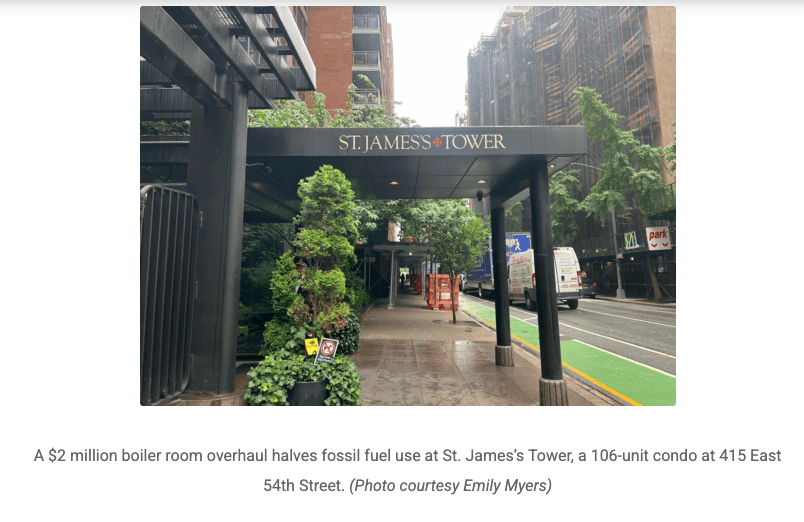
Keen to comply with emission rules under Local Law 97, the board at St. James’s Tower Condo, a 106-unit highrise in Sutton Place, has halved the building’s fossil fuel use with a $2 million boiler room overhaul. The 31-story condo ditched steam for a water-based — or hydronic — boiler system and also added a cogen plant. A steam heat system operates at much higher temperatures than one circulating hot water, so a move to a hydronic circuit makes a big dent in gas usage.
Cogen equipment, also known as clean heat and power or CHP, uses gas to generate electricity via a turbine, which creates reusable exhaust heat. “The cogen was black and white to us,” says board president Donald Epstein. It not only boosts efficiency but also means the condo has extra security if there are issues with the grid. “In the event of a blackout we would have service to run our elevator and hot water,” says building manager John Faldetta.
The board began reevaluating the building’s energy use in 2022. At the time, the condo had two gas-fired boilers to create steam for heating and hot water. Robert F. Germain Jr., owner of the engineering firm R. Germain Inc., led the redesign, and says the “beauty” of the new configuration at St. James’s Tower is that “the building was already piped for hot water.” This means that even though the building moved from a steam to water-based circuit, the work was largely contained in the boiler room. “We are just supplying the pipes differently and more efficiently,” Germain says.
The new system uses a single gas boiler to heat water, which is then circulated through a heat exchanger and around the building. Recirculating the waste heat from the cogen keeps the boiler from cycling on too frequently. “The boiler really only fires when it’s very cold out,” Germain says. So in warmer months it is barely used. The savings are dramatic. “They will cut their bills in half,” Germain says, explaining how gas usage from the new boiler configuration has fallen from 100,000 therms (a measure of heat energy) per year to a little over 50,000 therms.
The domestic hot water at the condo is supplemented by an electric hot-water boiler with storage tanks on the roof. One of the challenges with the project was sizing the equipment correctly. The condo’s demographic includes many international owners who come and go. “The building is 65% occupied at any one time,” Faldetta says. This can make it difficult to estimate energy needs.
To support the new system, variable frequency drives (VFDs) were added to the pumps to allow for adjustments to motor speeds. Without a VFD, a pump is typically on or off, but once they are added, the pump speed can be tweaked automatically to improve efficiency. “The building is saving money on electricity with the pumps and no one knows the difference,” Germain says. “That’s why VFDs are good on any type of system.”
The work was funded with a $3.8 million special assessment, which included money raised for facade repairs and a new fire-alarm system. Over the past two years, shareholders contributed around $40,000 in quarterly payments to fund the projects. The new system became operational in February, concluding the two-and-a-half year project, with installation completed by Controlled Combustion. The project also qualified for $48,000 in incentives.
Based on data from 2023, St. James’s Tower is facing annual Local Law 97 emission penalties of $44,400 starting in 2030. “We expect that to be removed completely with the 50% reduction in gas,” Germain says. This is welcome news for the board. “We knew energy efficiency was a requirement and there would be fines imposed if we didn’t comply,” Epstein says.
Whether it’s earnings calls, media interviews, board presentations or company-wide meetings, CEOs often encounter high-pressure speaking opportunities. These tools can help you use your voice more confidently.
Senior executives frequently encounter high-stakes communication scenarios—earnings calls, media interviews, board presentations and company-wide meetings. Yet, even at the highest levels, preparation often involves generic advice like “don’t upspeak,” “slow down” or “sound more confident.” While well-intentioned, such guidance typically leads to self-conscious delivery rather than measurable improvement.
The core issue is that most coaching addresses the symptoms of ineffective communication rather than the underlying habits. In my work with Fortune 500 executives, presidential candidates and high-growth founders, I’ve found that sustainable improvement requires a shift from superficial fixes to a deeper understanding of how leaders use their voice—and why it matters.
To strengthen vocal presence, we need to move beyond vague guidance and examine its components with greater precision. One critical element is vocal variety. Below, I outline tools to help you recognize effective use of vocal variety and share targeted exercises to enhance your own performance.
What Is Vocal Variety?
Vocal variety is the music of the voice. Often referred to as tone, inflection or energy, none of these terms fully capture its nuance and importance. Vocal variety can be evaluated by examining five distinct dynamics:
Pace: The speed at which you speak.
Pitch: The highness or lowness of your voice.
Pause: The intentional use of silence.
Power: The volume or loudness.
Placement: Where the sound resonates in your body.
I developed this alliterative framework to help clients remember these components. However, when communicating fluidly, speakers don’t need to consciously recall them; vocal variety becomes an integral part of effective communication.
Vocal variety is essential—not a mere embellishment. It serves to:
Convey meaning: Emphasizing different words can alter a sentence’s meaning entirely. For instance, repeating the sentence “This essay I wrote focuses on vocal variety,” while shifting emphasis to each subsequent word, changes its implication each time.
Express emotion: Misinterpreting the emotional intent of a text message illustrates our reliance on vocal cues to assess feelings.
Guide the audience: Inflection indicates chronology, hierarchy, preference and priority.
Maintain engagement: Variations in vocal delivery keep audiences attentive and interested.
Speakers who effectively use vocal variety are often perceived as more credible, thoughtful, persuasive and trustworthy.
Pace: What Does “Good” Sound Like?
What constitutes an effective speaking pace? Many resources suggest an ideal speed of 120 to 180 words per minute. However, aiming for this range without understanding the factors influencing it can result in robotic communication. Striving for a generic “Goldilocks” pace—neither too fast nor too slow—may lead to a monotonous delivery.
Pace naturally varies based on intuitive factors, such as:
Word choice: Selecting the right words takes time.
Enunciation: Clearly articulating words requires deliberate pacing.
Audience comprehension: Allowing listeners time to absorb information is crucial.
When speakers focus on these aspects—thinking, enunciating and ensuring understanding—they naturally fall within the optimal pace range.
Kinesthetic Exercises to Improve Vocal Variety
Varying pace—and all elements of vocal variety—is not just a mental adjustment; it’s a physical skill. I’ve developed kinesthetic drills to address common delivery challenges, such as speaking too quickly. These exercises leverage embodied cognition to help speakers adopt new communication patterns that can be practiced and refined.
The Wiffle Ball Exercise
Purpose: To cultivate deliberate pauses before speaking.
How It Works: During practice sessions, I pose a question and slowly toss a Wiffle ball to the speaker. They must wait to respond until catching the ball. This enforced pause allows time to gather thoughts, leading to more considered and concise answers.
Andrew Yang, a presidential candidate I coached during the 2020 election cycle, reduced his speaking speed from 7.2 words per second to approximately 3 words per second using this technique.
The Lego Block Exercise
Purpose: To encourage speaking one idea at a time with intentional pauses.
Materials Needed: 5 to 8 Lego or Duplo blocks.
How It Works:
Select a section of your presentation.
Pick up the first block and speak your first thought.
Place the block down in silence.
Repeat the process for each subsequent idea, interlocking the blocks as you go.
This exercise naturally integrates pauses into speech, allowing time to consider and improve subsequent thoughts, fostering a virtuous cycle of clarity and intentionality.
Finger Walking
Purpose: To slow down speech within individual thoughts.
Materials Needed: A flat surface and your fingers.
How It Works:
As you speak, “walk” your index and middle fingers across the surface, one deliberate step per word.
After completing a thought, reset your hand and begin again.
If you use a filler word, pause your fingers until you regain clarity.
This tactile method transforms speech into a physical act, anchoring words in movement. It sharpens word selection and slows delivery without forcing artificial restraint.
Transforming communication through habits
These drills are designed for solo practice but can eventually be employed subtly during actual communication situations. With consistent use, speakers can develop new pacing habits within six to twelve weeks.
By treating vocal variety as a skill rooted in both physical and mental execution, you can cultivate greater intentionality and accuracy in your speech. Over time, these methods help transform rushed, haphazard delivery into purposeful, precise communication.
Executives who master vocal variety don’t just “sound more confident”—they become more compelling, persuasive and effective leaders.
By Kelly G. Richardson, Esq., HOA Homefront Column
California HOA managers are unregulated, with no required license or minimum education. Rental managers must have real estate broker licenses, but not HOA managers. There is a wide range of qualification and experience in the profession, so finding indications of superiority is important.
California has a purely voluntary designation from Business and Professions Code 11502, which defines a “Certified Common Interest Development Manager” as one who received 30 class hours in designated topics from a professional association of HOA managers. Section 11504 requires managers to annually disclose whether they are “Certified” and prohibits false claims of “certified” status.
Four organizations educate and credential California managers: Institute of Real Estate Management (“IREM”); California Association of Community Managers (“CACM”), Community Association Manager International Certification Board (“CAMICB”), and Community Associations Institute (“CAI“).
IREM is a national organization, with about 20,000 manager members, offering education and various property management credentials. Its managers are mostly non-residential, but over 300 California managers hold the “Accredited Residential Manager (ARM)” credential. The ARM requires 45 class hours in either rental property management or CID management and passing a half-day examination. The ARM does not qualify for “Certified” status in California.
CACM is a California organization which was founded in 1991 by a group of veteran HOA managers. Presently 1,437 of CACM’s 1,893 active manager members hold its Certified Community Association Manager (“CCAM”) credential. The CCAM requires 36 class hours and qualifies managers as “Certified.” CACM has a more advanced credential, the Masters of Community Association Management (“MCAM”), which involves 5 years minimum of CCAM status, an extensive written exam, a written case study analyzing an HOA and oral presentation, and 28 more class hours. Six managers are CACM MCAMs.
CAMICB administers the “Certified Manager of Community Associations (CMCA”)” credential. Originally affiliated with CAI when formed in 1995, the organization is now an independent credentialing body. Attaining the CMCA requires either two and a half days of instruction, five years’ experience, or the CCAM credential, and passing a 120-question exam. California currently has 1,270 CMCA managers.
The Community Associations Institute consists of 64 chapters, including 8 in California. Founded in 1973, CAI trains managers in the United States, Canada, Australia, South Africa, and United Arab Emirates. CAI offers three credentials: “Association Management Specialist (AMS)”, “Professional Community Association Manager (PCAM)” and the “Large-Scale Manager (LSM)”. The AMS credential requires attaining the CMCA credential, two years’ experience, and two additional days of classes. Currently, 770 California managers hold this credential. Managers holding the AMS designation qualify as “Certified” in California after taking CAI’s 8-hour California law course.
The highest widely-established general management credential is CAI’s PCAM designation. This requires five years’ experience, almost 100 total class hours, and preparation of a 100–200-page exhaustive study of a large HOA. About 80% of applicants achieve the PCAM on their first attempt. 281 California managers currently hold this credential. Larger or higher profile properties may prefer PCAMs or those working toward it. The LSM credential requires a PCAM and additional education regarding large associations.
Ask about designations, and make sure YOUR manager holds an earned credential (not just anyone in their office). Demonstrated achievement in professional education is helpful in evaluating prospective managers.
[Information: www.irem.org, www.cacm.org, and www.caionline.org.]