CAMICB is a more than 25 year old independent professional certification body responsible for developing and delivering the Certified Manager of Community Associations® (CMCA) examination. CAMICB awards and maintains the CMCA credential, recognized worldwide as a benchmark of professionalism in the field of common interest community management. The CMCA examination tests the knowledge, skills, and abilities required to perform effectively as a professional community association manager. CMCA credential holders attest to full compliance with the CMCA Standards of Professional Conduct, committing to ethical and informed execution of the duties of a professional manager.
The CMCA credentialing program carries dual accreditation. The National Commission for Certifying Agencies (NCCA) accredits the CMCA program for meeting its U.S.-based standards for credentialing bodies. The ANSI National Accreditation Board (ANAB) accredits the CMCA program for meeting the stringent requirements of the ISO/IEC 17024 Standard, the international standards for certification bodies. The program's dual accreditation represents compliance with rigorous standards for developing, delivering, and maintaining a professional credentialing program. It underscores the strength and integrity of the CMCA credential.
Privacy Policy: https://www.camicb.org/privacy-policy
There’s excitement surrounding the holidays and anticipation for the start of the new year. But also regret and disappointment about goals that may have faltered. The good news is that it’s never too late to pursue your dreams and make headway on your goals. Just because the year is ending, doesn’t mean you have to say goodbye to what you truly desire.
In fact, you can use the end of the year to your advantage and finish strong. One path you can take is to start laying the foundation for your big, ambitious goal so that you can start off the new year with a bang. Another approach you can take is to pursue a bunch of micro goals or habits—those small, but impactful wins—so you can finish the year with a huge sense of accomplishment.
We’ve outlined ways that you can support your big goal or micro goal to help you end the year on a high note. Regardless of the path you take, you’ll be guaranteed to end the year in fighting shape and ready to take on 2022 with confidence.
Get a head start on a big, dream goal
Big goals are intense and intimidating because they force us to look deep within ourselves, examine our weaknesses and insecurities, and quiet those debilitating voices that ask us, “Who do you think you are?”. Even Olympic athletes struggle with these same insecurities.
If you are feeling these big, overwhelming emotions, that’s okay. It means you’re taking your goal seriously. No one climbs Mount Everest thinking it’s going to be a breeze. Our big goals will test our will power, motivation, and skills—that’s why they are considered big goals in the first place.
Big goals can also be powerful and fulfilling. By putting ourselves through a series of tests and challenges, we reveal a side of ourselves that we didn’t know we had. We will come out stronger and more confident in ourselves and our abilities.
Another reason to set big, ambitious goals? Even if you don’t meet your expectations, you will achieve a lot more than you originally thought was possible. Think about it: Let’s say your current writing routine is to write 500 words a day. But then you set a big goal to write 1,000 words every day. Even if you only end up writing 800 words a day, that’s still more than what you would’ve written if you had stayed at your previous goal.
Another thing to keep in mind is to accept the reality that big, ambitious goals will not be fulfilled overnight. They take time and patience. If you can accept that timeline and embrace the process, starting a big goal at the end of the year can be a good strategy. You’ll start developing good habits to support your goal and lay down a strong foundation to launch you into 2022.
Accomplish micro goals
Another way you can finish the end of the year strong is to concentrate on micro goals. These are goals that are so small and easy, you’ll be able to achieve them. Micro goals can be related to personal development or your career or health.
According to this Harvard Business Review article writer Sabina Nawaz says: “It’s great to dream big, but the way to achieve big is to start small — through micro habits. Micro habits are small components of a larger habit. By breaking down an ambitious job into smaller, more achievable ones that you build over long periods of time, micro habits help you complete big goals.”
Examples of micro goals include:
Developing a morning routine
Updating your website
Brushing and flossing teeth before bed
Meditating for 10 minutes a day
Reading a book a month
Cooking a new recipe a week
Making your bed every morning
Walking 10,000 steps a day
Writing in a journal every day
Micro goals are incredibly appealing because those small changes can generate big results. Making your bed every morning may not seem like a big deal in the grand scheme of things, but the positivity you yield from that small act will encourage you to do another small act, then another, until you score a succession of wins.
Also, micro goals can help you achieve big goals. Waking up early every morning may seem like a mundane goal at first glance, but it is significant if you’re trying to wake up early to train for a marathon or write your novel. With micro goals, it’s about the cumulative effect and the long game. And the positivity and confidence you gain from these small wins will motivate you to keep going and go for the next big thing.
If you’re looking to end the year on a positive note, but don’t necessarily have the emotional energy to expend on big, ambitious goals, micro goals are a great option. And the pride and achievement you feel will sustain you into the next year and fuel your growth moving forward.
Up next, we’ll take a look at how to create an action plan for your goals, big or small.
Creating an action plan
Whether you’re looking to pursue an ambitious goal or a series of micro goals, you’ll need a solid strategy to support your vision. Here are steps you can take to create a solid plan.
Define your goal
What is the goal that you hope to achieve? Write it down in your planner. You’re more likely to commit to a goal if you take the time to write it and record it in your memory.
Some people like to visualize what it will feel like after they achieve a big goal. These positive feelings help remind them what it is that they’re working so hard for. Others like to put post-it notes and messages around their workspace to remind them of their goal.
Choose a strategy that works for you and helps you feel positively about your goal.
Identify your obstacles
Another tactic to help strengthen your game plan is to write down a list of potential obstacles you may encounter.
According to this article in the Mental Game of Tennis, it’s helpful to plan for potential challenges so that you’re not thrown off guard when they arise, and can better prepare for potential setbacks.
Being honest about your obstacles is also essential if you’re setting out to achieve micro goals. Incorporating new, positive habits takes discipline and self-awareness. After all, progress doesn’t happen overnight.
So if your micro goal is “go for a run in the morning” make a list of potential obstacles. Then, have a back up plan in place so that you can stay on track. So if your obstacle is “feeling tired in the morning” make a list of things that will motivate you to get out of bed. Maybe it’s a pot of coffee or a breakfast treat. Or maybe place your workout clothes on your bedside table so it’s easier to put them on and go.
Make a list of targets you want to reach before the end of the year
Create weekly and daily goals to help you stay on track and keep you accountable.
So if your goal is to run 5K by the end of the year, then create a 4-5 week plan and set weekly goals. Maybe it means starting out by running for 10 minutes in Week 1 and then working your way up and building your endurance.
Having regular targets will help you stay on your path towards your goal. And by measuring your progress from week-to-week, you’ll know if you need to catch up or dial back or if you’re right on track.
Create a schedule
Add your tasks to your planner or calendar so that you’re more likely to do it. Also, by having a visual representation of your schedule, you’ll be able to see what days you’ll be busy and rearrange your schedule as necessary. This will come in handy during the holiday season. So if you want to schedule a run a few days before the holidays, look for free blocks of time on your calendar. This way, you won’t feel overwhelmed, and you’ll have the energy to work towards your goal.
Relish your winsIt’s important to acknowledge your progress every single day. Record your wins in your planner and decorate the entry with a sticker or fun, colorful washi tape. Taking pride in your work will help you see how much you truly accomplished at the end of the year, and set you up for success in the new year.
The fallout from a massive lawsuit over inflated broker commissions is roiling the New York real estate market. It started in October, when a Missouri jury ruled that the National Association of Realtors and two brokerages had kept commissions artificially high, setting damages the defendants must pay at $1.78 billion. Then earlier this month, Monty March filed a civil case in the U.S. District Court for the Southern District of New York, alleging that the system of having the seller pay the fee for the buyer’s broker “increases a seller’s transaction cost, and artificially inflates Manhattan residential real estate broker commissions paid by residential real estate sellers,” according to the complaint.
The fallout, according to Crain’s, is that brokers are paralyzed — along with people trying to buy and sell co-op and condo apartments.
“They feel like there’s this tidal wave of change coming and they’re sort of frozen, they don’t know quite how to react,” says John Walkup, co-founder of real estate analytics company UrbanDigs. “It’s just a bundle of uncertainty for them.”
Typically in Manhattan, the broker on a listing could make an offer for compensation to the buyer’s broker, with money often coming from the proceeds of the home sale. Brooklyn’s system is slightly different. As lawsuits started to pile up this year, the Real Estate Board of New York tweaked its policy. Starting next year, the group requires that buyer’s agents will be compensated directly by sellers or will need to negotiate their potential pay with their buyers.
A Consumer Federation of America report in 2022 showed that the median rates paid to buyer agents ranged from 1% in Brooklyn — which doesn’t require listing brokers to offer any compensation to the buyer’s agent — to 3% in Manhattan.
UrbanDigs’ Walkup says Manhattan real estate deals could soon look more like those in Brooklyn, where buyer and seller agent commissions are decoupled. Moving forward, agents will have to adjust their approach and learn to communicate the change to buyers. Walkup thinks the transition will be rough at first, but agents will adapt. “It’s just going to be a little rocky before we redefine how those payments are structured,” he says.
Meanwhile, the market remains sluggish. Mortgage rates hovering above 7% have pushed some would-be buyers to the sidelines. Manhattan home sales were down about 23% in the third quarter from the same period a year earlier, according to data from appraiser Miller Samuel and brokerage Douglas Elliman Real Estate.
Co-op and condo boards struggling to reduce their buildings’ carbon emissions have recently faced some disheartening news. Major clean-energy projects are facing severe economic headwinds, and there has been speculation that massive offshore wind projects might be abandoned. Such projects are critical to shifting the electric grid from fossil fuels to renewable energy-supplied power — and helping boards cut their carbon emissions enough to satisfy Local Law 97, which goes into effect in 2024.
Not only do those offshore wind projects remain in the works, but two other clean-energy projects worth $17 billion have announced that they will move ahead without additional subsidies from the state, Crain’s reports.
The two projects are: the Champlain Hudson Power Express (CHPE), a 339-mile transmission project that is scheduled to bring energy from Quebec’s hydroelectric generating stations to the five boroughs, beginning in 2026; and the Clean Path New York (CPNY) projects, which will build a series of solar and wind developments that funnel energy to the city via a 175-mile transmission line, beginning in 2027.
In the wake of the refusal by state regulators to give an additional $12 billion in subsidies to the offshore wind projects, the CHPE and CPNY have abandoned their requests for additional state subsidies. Instead, they’ll move forward under their existing contracts. Their decision bodes well for the state’s existing pipeline of clean-energy projects, according to Robert Freudenberg, vice president of energy and environment at the Regional Plan Association. “There’s a lot of factors driving this challenging time for renewable energy,” Freudenberg says, “so I think the good news is that the projects haven’t been canceled, because we have seen projects canceled in other places.”
The CHPE will provide 20% of New York City’s electricity needs when it’s up and running. The New York Independent System Operator, which monitors the state’s power systems, has repeatedly warned that if CHPE fails to stay on track, New York City could face electricity shortages and be forced to rely longer on highly polluting “peaker” power plants, which are used during times of peak energy demand.
Chris Casey, senior attorney at the Natural Resources Defense Council says keeping both projects on course — especially in light of fresh uncertainty in the renewable energy sector — are essential to the build-out of New York’s green economy. He adds: “The timely completion of CHPE and CPNY will be massive steps forward for New York’s clean-energy transition that will enhance reliability while stabilizing energy prices made volatile by fossil fuels.”
And that’s good news for co-op and condo boards that are seeking to ditch fossil fuels and power their buildings with clean electricity.
Three members of the CAMICB Board of Commissioners – Rob Felix, CMCA, PCAM, RS, Jim Magid, CMCA, PCAM, and Michael Hurley, Sr. – will complete their term as Commissioners at the end 2023 after many years of significant contributions to CAMICB and the profession, all of whom were critical to the growth and expansion of CAMICB.
Rob Felix has been an integral part of CAMIB for over four decades serving in many different roles and capacities including three tenures on the Board of Commissioners, including the inaugural Board beginning in 1997. During this time he has filled numerous roles including Vice Chair, Chair and for the past six years he has served as Secretary/Treasurer. In addition, Rob has been a key contributor to the Exam Development Committee since its inception serving as its Chair in 1999. Over the years, Rob has taught countless CAI courses and was the first to teach the M-100 course in Dubai. He has been recognized over the years with prestigious CAI awards including the Excellence in Designations, Educator of the Year and Distinguished Service Awards.
After more than 30 years of service to the profession, Jim Magid recently retired. He was among the first to earn the CMCA credential and has been an integral part of CAMICB since its inception. Jim currently serves as Vice Chair of Bord of Commissioners and will continue to lend his expertise on the Complaint Committee.
Michael Hurley has served on the Exam Development Committee since 2015. His deep knowledge and global perspective were invaluable to the Oversight Panel during the 2021-2022 Job Analysis, a massive undertaking that will result in an updated CMCA examination into the field in 2024.
CAMICB 2024 Board of Commissioners
CAMICB welcomes three new members to its 2024 Board of Commissioners, each of whom is elected to a three-year term, beginning in January: Jennifer Andal, CMCA, AMS, PCAM, who is the Director of Better Communities in Dubai; Michael Darby, CMCA, who is the founder of the Australia-based Quantum CM Solutions, an HOA management company and Quantum United Management, a facilities management company; and, Cathleen Dunn Toryak, CMCA, AMS, who is the on-site manager for A Pocono Country Place, POA in Pennsylvania.
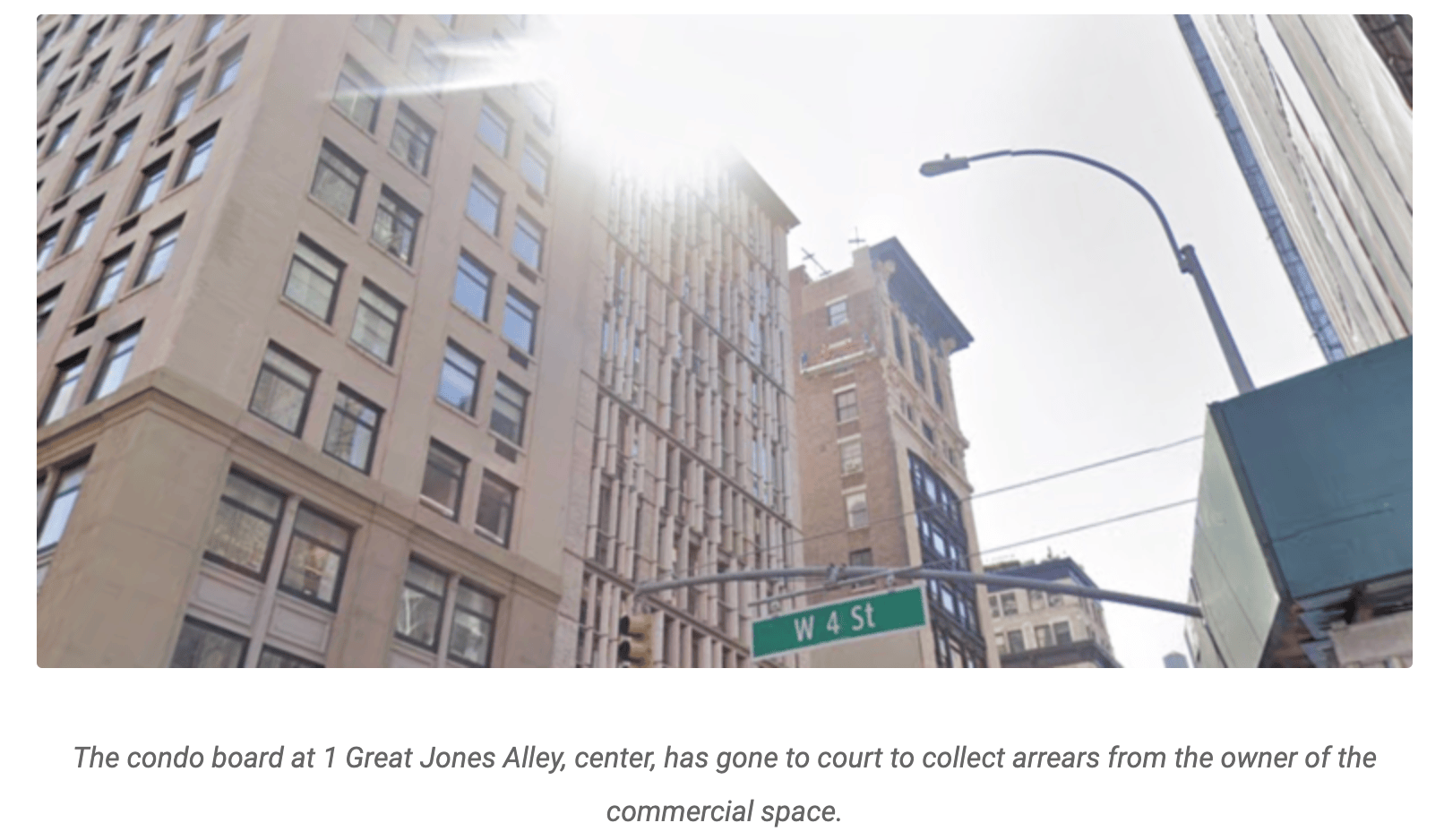
When a unit-owner fails to pay common charges in a condominium, there’s a right way and a lot of wrong ways to go about collecting the arrears. The board at the recently constructed, 16-unit luxury condo known as 1 Great Jones Alley, located on Broadway near East Fourth Street, is doing things the right way.
The five-year-old building’s developer, a shell company known as Downtown RE Holdings LLC that’s led by Madison Realty Capital, is the owner of the 7,000-square-foot, three-level commercial space. Since January, the space has been rented to a veterinarian and a coffee shop, but in July the developer stopped paying common charges to the condo board. On Nov. 1 the board slapped a lien on the developer, and on Wednesday, in keeping with the condo’s bylaws, the board filed a suit in state Supreme Court seeking to wrest control of the commercial space from the developer so a new owner can take it over, Crain’s reports.
“Plaintiff is entitled to foreclosure in connection with the unit and the appointment of a temporary receiver for the unit during the pendency of this proceeding,” says the lawsuit, which was filed by the condo board’s law firm, Cozen O’Connor. The lawsuit states that the developer’s arrears have climbed to $21,000.
This isn’t the condo board’s first legal rodeo with the developer. In September the board also went after the developer in court for construction defects “affecting nearly every facet of the building,” including plumbing systems, fire-proofing and the swimming pool. The board is seeking $20 million in that case. In January Madison Realty sued BKSK Architects and other firms that helped design the condo, claiming they’re responsible for defects, including leaks in the pool area. BKSK and the other defendant have denied all the charges.
When you’re facing a $20 million lawsuit, $21,000 in unpaid common charges must seem like small change. Crain’s speculates that this might be a motive for the arrears: “The larger legal cloud hanging over the building may explain the developer’s reluctance to pay.”
Nonetheless, the condo board is fulfilling its fiduciary duty in seeking to collect every dollar it is owed.
How you craft a message, and the power of certain words, make all the difference.
By Bobby Hoffman, Ph.D. for Psychology Today
Maybe you are writing a memo or planning a Zoom meeting. Perhaps even more intriguing and potentially stressful, you are charged with communicating unwanted news to your staff or need to address a lingering performance issue with a team member.
Regardless of the circumstances or your communication medium, your message should be understood, relevant, persuasive, and include a call to action if you hope to achieve desired results. However, leaders are often faced with a dilemma: They don’t know how to inspire motivated performance in others without instilling resentment or being perceived as inflexible and insensitive.
Ultimately, the goal of effective leadership is to promote organizational prosperity by coaching, influencing, and recognizing individual performance and giving people the tools to optimize growth while meeting strategic organizational goals. While most articles on leadership espouse what leaders should do to inspire an effective team, minimal research exists on how leadership goals can be accomplished from a behavioral perspective (Goleman, 2017; Newstead et al., 2021). Especially lacking is information on what leaders should verbalize to achieve results.
Optimal persuasion starts with consciously determining how to match your message with the intended audience. Motivational messaging (Joyal-Desmarais et al., 2022) means that your message is customized based on the situation and context and includes an appraisal of the values, beliefs, and dispositions of your audience–in other words, for the message to reach maximal effectiveness, it must resonate with the individual.
The messaging evaluation should include cultural considerations such as a group-focused appeal vs. a personally targeted message. The message purpose should distinguish between efforts directed toward compliance or increases or decreases of certain behaviors. Benefits or liabilities to individuals should be clearly outlined. Optimally, the most powerful messages indicate either advantages to the person for supporting the leader’s suggestions or consequences for lack of support, but not both.
However, research from psychology and education reveals that messages of all kinds must also help individuals satisfy some basic needs. I previously posted about how to empower individuals to enhance leadership effectiveness. Now it’s time to discuss how to actually get the job done.
What should you say?
Across cultures and contexts, communication should satisfy the basic human needs of autonomy and competence. Autonomy means the message recipient does not feel coerced or controlled by the request and believes they have some choices when implementing a message. Competence suggests that the person will feel a sense of personal accomplishment and satisfaction when executing a persuasion effort. The probability of successful persuasion is enhanced by using “invitational language” (Reeve & Cheon, 2021), a label used to describe directives that consider the perspectives, desires, and emotions of others.
Communicating Unwelcome News
This situation is the perfect time to stress transparency and provide explanatory rationales. Instead of sidestepping the reality of undesirable communication with buzzwords and indirect language, tell exactly what is happening, but do so by explaining the decision-making process and what alternative outcomes were considered.
Don’t defend the choice or action but explain why the decision was made and who was ultimately responsible for it. Don’t forget to express your willingness to support the decision, even if it may not be your first choice. Say things such as “you can use this experience to…” and “this is the first step toward…” so others can see you have considered their perspective when describing the next steps.
Acknowledging Leadership Errors
The guideline here is complete accountability. Troublesome situations like unethical behavior, corporate irresponsibility, or just plain bad decisions happen to most organizations at one time or another. Error resolution can be made in need-satisfying ways by using the situation to do better next time. Express that these kinds of events are part of the learning process and do not focus on punitive aspects but instead emphasize how the person making the error might feel.
Acknowledge the severity of the situation and don’t minimize the consequences of the mistake. Say things such as “sometimes work is frustrating” or “feeling this way is expected” to show empathy and understanding that reflect the emotions of embarrassment or shame.
Confronting Performance Issues
Addressing potential conflict is one of the toughest jobs for any leader. Do not approach the situation as a confrontation, but instead focus on the issue as a team by outlining individual actions that can be assumed to correct any deficiencies. Avoid any “you” vs. “me” perceptions. Emphasize autonomy by asking, “In what ways do you think we can change the situation,” or “if you had a choice, what would you do?” Once the individual responds, first say, “if I understand you correctly, then…” followed by asking, “how can we make this work?” before giving your opinion or decision.
Implementing Leadership Decisions
One hallmark of the best leaders is making correct decisions based on limited evidence, which often means asking people to do what they might not want to do. First, acknowledge any resistance by saying, “I understand this may not be your first choice,” then carefully reflect on how you will communicate expectations. Avoid mandates and do not use the words “must” or “have to,” as these phrases cultivate controlling feelings, which thwart the basic need for autonomy. Instead, encourage initiative by saying, “you may want to consider,” or “what do you think about…” followed by describing the desired outcome without overemphasizing precise methods to achieve the outcome. Whenever possible, let the person exercise choice as to how the outcome is achieved.
Overall, being a persuasive communicator means avoiding the tendency to exercise power as the means to foster compliance. The most successful leaders realize that cultivating autonomy and competence in others is the key to mutual success, and the entire process starts and ends with the words you use when you open your mouth.
With Florida legislation shifting frequently, condo and HOA boards should be aware of the various new laws adopted by the State of Florida that are likely to impact how their communities function or otherwise operate. The following is a short summary of several of the recently adopted bills that focus on governance in associations:
House Bill 919
Effective October 1, 2023, House Bill 919, also known as the “Homeowners Association Bill of Rights,” introduces several provisions to the normal operations of an HOA. Board meeting notices must now include specific agenda items, except in the case of emergencies. Deposits that are collected from a member for construction purposes must be kept separately and returned within 30 days after completion of the project, looking much more like the requirements for security deposits in the rental of real property. Broad protections have been added such as officers, directors and managers are prohibited from soliciting or accepting anything of value without providing consideration in return, except for minor food expenses or trade fair-related goods or services. The immediate removal from office is now mandated for officers or directors charged with specific crimes, including forgery, theft/embezzlement, destruction of records and obstruction of justice. Disclosure of conflicts of interest are required annually for developer-appointed board members and officers, as well as for all directors and officers before voting on matters that are influenced by the conflict. HOAs that exercise their long-standing right to impose reasonable fines for violations must hold mandatory hearings before the independent hearing committee before the fine may be made due and owing. Additionally, a new section, Section 720.3065, has been added to address fraudulent voting activities and associated penalties, classifying them as first-degree misdemeanors. These provisions aim to enhance transparency, accountability and fairness within homeowners’ associations in Florida.
House Bill 437
Effective July 1, 2023, House Bill 437 introduces provisions that limit the ability of HOAs in Florida to restrict the installation, display or storage of certain items on parcels. Regardless of any association rules or covenants, associations cannot prohibit parcel owners or tenants from installing, displaying or storing items that are not visible from the frontage or adjacent parcels, such as artificial turf, boats, flags and recreational vehicles. This is likely to cause a lot of problems in HOAs, especially for communities that have homes that abut a body of water and are visible from the other side of the water. Finally, homeowners have the right to display up to two flags, including the United States flag, the official flag of Florida, military branch flags, the POW-MIA flag and first responder flags, in a respectful manner, including on freestanding flag poles. While the right to fly these flags is not new, its expansion to two flags and the expanded list of flags that may be flown are substantial changes that every HOA needs to be aware of.
Senate Bill 154
Senate Bill 154 introduces several changes and requirements for condominiums and cooperatives in Florida. Several of the key provisions is the mandatory structural inspection, now referred to as a “milestone inspection,” which assesses the life-safety and adequacy of a building’s structural components that have been changed or clarified in some way. The inspection must be conducted by a licensed architect or engineer and identifies necessary maintenance, repairs or replacements. Milestone inspections are required every 10 years for buildings that are three stories or higher and reach 30 years of age. Additionally, the bill establishes deadlines, exemptions and provisions for proximity to saltwater and acceptance of previous inspection reports.
The bill also introduces updates to the definitions and requirements for the Structural Integrity Reserve Study (SIRS) in condominiums and cooperatives. The SIRS is a mandatory study conducted for buildings that are three stories or higher as defined in the Florida Building Code, focusing on evaluating various components related to the building’s structural integrity and safety. The study identifies necessary repairs, replacements or maintenance tasks for components such as the roof, structure, fireproofing, plumbing and more. It establishes guidelines for reserve funding based on the findings of the study and sets deadlines for completing the study. Certain components are now exempt from the SIRS requirements while the limitation on waiving SIRS funding has not changed. “Traditional” reserves (roof, painting and paving) now require a majority vote of the total voting interests to reduce or waive. The bill also addresses official records requests and the distribution of inspection reports to unit owners. Finally, disclosure guidelines have been added to ensure potential buyers of units are fully apprised of the integratory of the building and provide the prospective buyer with the opportunity to cancel or void the contract.
Overall, Senate Bill 154 introduces much needed clarification to the regulations adopted last year as a means of ensuring the structural integrity and safety of buildings in Florida. The requirement of milestone inspections and SIRS to identify, address and ensure funding for necessary repairs and maintenance for condominiums and cooperatives clearly remains at the forefront of Florida politics.
By Lydia Pelliccia and CAMICB Executive Director, Matthew Green, CAE
Knowledgeable, committed community association managers are the professional mainstay of the communities they serve, providing the skills and expertise that are essential to the effective management of their homeowner associations. ?These managers are dedicated to their career and take specific paths to further their professional knowledge and skill sets. For example, holding the Certified Manager of Community Associations (CMCA) credential – offered by the Community Associations Managers International Certification Board (CAMICB), is a mark of proficiency and high quality and is the only internationally accredited certification program in the world for managers of homeowner and condominium associations and cooperatives.
CMCA credentialed managers show their commitment to professionalism and staying on top of industry issues and changes in the field by complying with continuing education requirements in order to maintain their credential. This is done through a process called recertification and is the cornerstone of best practices in the credentialing industry. Recertification is an ongoing process designed to promote and prove continued competency in the community association management profession. This competency is demonstrated through participation in continuing education in the field of community association management by participation in at least 16 hours of continuing education coursework every two years.
Further, community association professionals may also choose to bolster their careers and expand their level of expertise in certain areas by earning a “specialty designation.” A “designation” is recognition of professional knowledge and expertise in a given subject matter or job skill. Certain specialty designations are offered through the Community Associations Institute (CAI) including, the Association Management Specialist (AMS), Large Scale Manager (LSM), Professional Community Association Manager (PCAM), Community Insurance and Risk Management Specialist (CIRMS) and Reserve Specialist (RS). This allows a community association professional to drill down into a specialized aspect of the business. In some cases, passing the CMCA examination is a prerequisite to applying for these designations, for example the PCAM and AMS.
Understanding the Role of a Community Association Manager
In broad strokes, the job of the CAM is part financial management, urban planning, facilities maintenance, community development, volunteer management, and project management.
Their role is to implement the policies set by the board of directors, oversee operations, services, and programs as laid out in the contract with the association, and provide information and advice to assist board members in their decision-making. Particularly, managers must be well-steeped in the details and nuances of guiding and advising their boards in specific areas that include meetings; governance, legal and ethical conduct; budgets, reserves, investments and assessments; financial controls; risk management and insurance; property maintenance; contracting; and, human resources.
Further, a strong credentialed manager must understand contracts and real estate documents to clearly explain the materials and answer questions raised by residents or board members.
“The role of an effective community association manager is a complex position that requires a unique blend of skills and characteristics,” said Australia-based Michelle Cummins, who is the Chief People & Client Support Officer at MaxSoft Group as well as Director at Strata Community Association Australasia and Director at Strata Community Association Victoria. Cummins went on to describe some of the essential characteristics and traits that an HOA manager must possess including optimism, kindness, good presentation skills and being “other-person focused.”
“An optimistic outlook can be a game-changer when dealing with challenging situations. It helps you focus on solutions rather than problems, which is crucial when you’re responsible for multiple stakeholders,” said Cummins. “Kindness fosters a positive environment, making it easier to work with vendors, Boards, and homeowners. Good presentation skills and
effective communication is key; from running annual general meetings to explaining financial statements, a good manager must be clear and engaging.”
Cummins describes “other-person focused” as being empathetic and focused on the needs of others which is critical to building strong relationships. And similarly, she noted that “intelligence isn’t just about IQ; it’s also about emotional intelligence and the ability to adapt and learn.”
In addition, an effective and compassionate CAM must have an expansive skill set that includes an array of “soft” skills. It’s imperative CAMs have excellent people and interpersonal skills, strong customer service and communications skills, and the ability to listen and collaborate in order to solve problems between residents, homeowners and Board members.
“Credentialed managers demonstrate excellent communication skills and customer service with the ability to perform the duties set forth by their Boards or residents with promptness, accuracy and integrity,” said Jennifer Andal, CMCA, AMS, PCAM, who is the Director of Better Communities in Dubai. “It’s so important for managers to be able to negotiate and understand the laws and be able to find middle ground for their stakeholders. Trusted managers are transparent with their Boards and admit when they make a mistake while offering a solution as they need the support of their Board to carry out their duties.”
Enhancing Soft Skills
Each year, Rhonda Drews, PCAM, who is a Vice President with Premier Community Management, spearheads the CAI-Coachella Valley (CAI-CV) Chapter Community Association Manager Day event for its Chapter managers. Drews shared the seven categories that provide the basis of the skills and knowledge managers need to be effective; these categories rely heavily on having strong “soft” skills. The following outline these important areas and are excerpted from the CAI-CV Chapter Committee’s CAM Day materials:
Leadership – A good HOA manager must be confident enough to discuss best practices and not let others intimidate them. Some Board members will be very opinionated, and you as the manager should know how to respond to them in a helpful and constructive way. A manager should be able to act as the HOA’s leader as well as know when to delegate responsibilities to others.
Professionalism – Professionalism means more than putting on a business suit every morning. Professionalism includes written, verbal, and physical presentation of yourself. A professional manager will remain calm in tense circumstances, won’t raise their voice, or show frustration as this will typically escalate situations. Having conflict resolution skills is a plus too, as it will help you resolve issues without needing legal intervention. Additional traits are: being accountable and taking responsibility for yourself as well as displaying emotional intelligence, accepting feedback, criticism, and building interpersonal relationships.
Communication – Communication is key, especially when it comes to community association management. A strong manager must communicate daily with their Board, residents, and business partners, and must be able to properly listen and respond to others and clearly articulate their thoughts. Additional communication skills include using proper email etiquette, punctuation, vocabulary, proactively communicating, and responding in a timely manner. A strong manager should be able to interact well with all types of individuals, including residents, the Board, and business partners, despite any differences in background, opinions, or beliefs. If a manager has conflicting thoughts, they can still explain their side — but in a way that is neutral and respectful to all parties involved.
Managers must also be prepared to say no to something without making it sound negative and/or spinning a bad light on management and/or the Board. It’s crucial that managers be good listeners. After all, communication is one of the biggest components of community management. Many people will come to you with their concerns (sometimes angry concerns), and you should have the patience to listen and try to understand each member’s situation so you can help effectively find solutions.
Community Association Governance – Managers must be well-versed in the workings of their HOA(s), and its governing documents. This includes staying up to date on Federal and State laws regarding HOA communities, which is so important for ensuring the HOA is running according to the law, their governing documents, and the management contract. A good manager will be proactive and aim to serve their client to their fullest ability and take pride in the work they produce. An HOA manager doesn’t need to be a professional accountant, but it’s necessary to have a general understanding of accounting. This goes a long way when maintaining the monthly, quarterly, and yearly HOA budgets. Your Boards should be able to rely on your recommendations when it’s time to make important financial decisions for the community.
Business Partner Relations – Business partners are your allies. A community association manager should respect their business partners and rely on their expertise. It’s not necessary to have the specific knowledge of the various trades, but it helps to have general understanding of the work or service being provided and to be able to effectively communicate the needs of the project/community to the business partner. A strong manager should get to know the general process of each service or maintenance component which will make communication more successful between you and your business partner. RFP’s should be requested to allow for appropriate response times and not burden the tradesperson. The manager will be able to understand the expected time period and rate for projects and respond timely and appropriately to ensure the RFP is received in good order. A good manager will prepare bid comparisons for the Board upon the completions of the bidding process.
Conflict Management – When running an HOA, managers will have to deal with a diverse group of people. There will be disagreements and opposing views on correct procedures. You may have neighbor to neighbor disputes and there are other multiple situations that may arise that will require a manager to mediate a situation. Dispute resolution is an integral part of HOA community management duties.
A successful HOA manager will know how to negotiate between parties and help them all come to a compromise. No one will get everything they desire, of course, but proper mediation can leave people happy enough with the results and feel like their opinion has been heard and considered. The relationship between the manager and the Board members is crucial to the success of the community. Apart from that, it’s important to be a manager that they can trust. When there is trust, the Board and manager become more productive and efficient. Through this collaboration, good managers are able to meet the needs of their community and its residents; confidentiality and neutrality are important traits as well.
Time Management – Having many tasks can be overwhelming for anyone. However, a good manager will be able to handle multiple HOA responsibilities and tasks at the same time. Attending to one matter at a time is ideal, but often times unrealistic. Situations or certain periods of time, such as “in-season,” will arise that will require managers to multitask in order to meet everyone’s needs. There will always be a never-ending list of tasks, and managers need to find ways of handling them. Time management also involves setting boundaries that allow a manager to have a better quality of life and hopefully less stress. Understanding and practicing work life balance is key for any successful manager.
Resource Corner
Making use of the wide variety of resources available to managers is critical to staying on top of industry news, events, and any changes arising in the profession. The Community Associations Institute (CAI), its website (www.caionline.org) and local CAI Chapters also offer an array of resources and networking and professional development opportunities. To find a local chapter go to: https://www.caionline.org/Chapters/Pages/Find-A-Chapter.aspx
Below is a sampling of industry resources.
SmartBrief – Stay on top of industry news by subscribing to the Community Association SmartBrtief, a free, weekly e-mail newsbrief specifically designed for community association managers. CAMICB offers this complimentary resource aimed at bringing readers a quick, two-minute read that will help managers keep up-to-date with the latest news and trends in the profession. Similarly, be sure to follow the CMCACorner Blog, a platform to read about the intersections of business, industry trends, continuing education, and professional development in community association management.
Management Company Websites – Many management companies have blogs, case studies and other articles available to the public that cover a wide-range of topics and often showcase real life examples of managers in action.
CAI Exchange – An online forum that allows members to collaborate and connect with colleagues. Topics range from emergency notification systems to budgeting for insurance in the coming year to managing board member actions and everything in between.
Common Ground – CAI’s flagship magazine that provides in-depth information and examples on how volunteers and professionals can improve their communities. Select content available to nonmembers.
Community Manager – CAI’s bi-monthly newsletter for community association managers that covers topics like technology, condominium and portfolio management, and professional development. Select content available to non-members.
The Foundation for Community Association Research – The Foundation supports research and develops publications on a variety of topics that can help managers develop more effective and harmonious community associations. FCAR produces publications that include the Community Association Fact Book, Best Practices Reports, Catalyst, the Foundation’s newsletter, and more.
CAI Chapter Newsletters – CAI has 63 chapters worldwide, including Canada, the Middle East and South Africa. Managers should visit their local chapters’ website as many of these chapters produce newsletters, blogs and other forms of communication that can be valuable resources.
HABITAT – is an independent publication that mixes storytelling and service articles to cover issues of co-op/condo living and management concerns from the perspectives of board directors, community association managers and property managers. Per its website, “HABITAT provides credible, objective, substantial coverage – readable, informative, human-interest stories to illustrate and educate our readers on how people effectively govern and manage their associations and successfully contend with the complex issues of co-op/condo living.”
HOAleader.com – HOAleader.com was created to support the dedicated community of association managers and other professionals who work to realize the potential of their association—Board and committee members, property managers, attorneys, financial professionals, insurance professionals, developers, vendors, and homeowners. Among other things, it offers legal compliance help, advice on best practices, and practical tips, tools and sample forms.
A Growing Career For A Growing Industry
Community association management is a young profession that has experienced staggering growth since its beginning just over 40 years ago. According to U.S. government reports, in 1970, there were approximately 10,000 community associations. By 2020, that number has grown to more than 350,000 community associations, home to nearly 74 million people. Housing construction statistics show common interest developments are the fastest-growing segment of residential home construction, and rapid growth is expected to continue.[1]
The nearly 74 million people in the United States who live in covenant-protected communities rely largely on CMCA certification as proof of ethical, knowledgeable, professional community association management and CAMICB is proud to support the highest level of professionalism in the field.
What It Means And What It Takes To Be An Effective Community Association Manager is the first in a series of articles, produced by CAMICB staff, that delve into the important issues and topics affecting community association managers.
[1] Opportunity Knocks – Opening the Door to Careers in Community Association Management, a guide from the Foundation for Community Association Research, Community Associations Institute, and the Community Association Managers International Certification Board https://www.caionline.org/LearningCenter/CareerCenter/Pages/Excel.aspx
After a year of intense grassroots efforts, the board at New Hampshire House, a 139-unit condo in Rego Park, Queens, finally succeeded in persuading owners to take out a $3 million loan to repair the building’s facade. The board’s success means the condo will finally be able to perform the necessary repairs mandated under the Facade Inspection Safety Program (FISP), something it had been unable to do previously.
The building’s last facade inspection in 2018 revealed the need for an estimated $1.5 million in repairs. Without the funds available, the building needed to take out a loan. The condo’s bylaws require the board to secure approval for any loan above $100,000 from a supermajority of the owners, but it could not secure the votes. Unable to make the repairs, the board didn’t file the report required by FISP, and maintenance of the exterior brickwork was neglected. Some apartments are now seeing interior water damage during heavy rains because of the deferred maintenance. “Problems don’t go away because you don’t do repairs,” says David Cohen, an account executive at Kaled Management and the condo’s managing agent. “They just get worse.” The condo’s noncompliance has also resulted in more than $60,000 in penalties for the building over the past six or seven years.
Since the last inspection, five more freeze-thaw cycles have taken their toll on the building’s brickwork. Factoring in a 30% increase in the costs of materials and labor, the estimated repair costs now stand at $3 million. Feeling the urgency, the board called a combined annual and special meeting in 2022, seeking the required 66.7% affirmative vote of a loan to cover the costs. It faced two large challenges that unfortunately it couldn’t overcome: a lot of apartments are sublet and the building has 70% absentee owners. “A lot of these people aren’t at the building and think of the apartments as an asset they can make rental income from,” Cohen says.
Not to be deterred, Helene W. Hartig, owner of Hartig Law and the condo’s attorney, says a decision was made to keep the meeting open for a year to allow people who didn’t participate to send in their votes. That gave the board and condo’s property management team an opportunity to intensify their grassroots efforts to get the votes. “During that year we bombarded the owners with information,” Cohen says. That included knocking on doors, writing letters, organizing meetings, sending memos and emails, and posting notices in the building.
The unit-owners needed education on FISP compliance, the impact of rising interest rates and the link between Fannie Mae’s new lending guidelines and capital repairs. “Not being able to do building repairs can hit people in many ways, including their ability to refinance, and their ability to sell,” Hartig says. Another key to unlocking votes was making sure literature was accessible to people without English as a first language. Multilingual members of the board translated the communications into Mandarin and Russian to reflect the diversity of languages spoken by owners.
In February, two weeks before the 2022 meeting formally closed, the board managed to get 70.95% of the owners to approve a $3 million loan, and it closed a month later. Only 2.5% of unit-owners voted against the loan and 26% did not vote at all.
For buildings with similar challenges, Cohen says it’s important to communicate early and make sure your communications are getting through. Unfortunately, the delay in securing the loan meant the condo lost out on a more favorable interest rate. “When we started this, the rates for loans were in the 3% range,” Cohen says. The $3 million loan, secured from the National Cooperative Bank, has a rate of 6.49%. It will be paid off with a 10-year assessment, which ranges between $200 and $400 per unit per month depending on the ownership interest. The good news is there’s no prepayment penalty, so if the cost of the work is less than $3 million, funds can be repaid with no penalty and the assessment can be reduced.
While technology has enabled unprecedented connectivity and collaboration, a multilingual workforce remains vital to succeed in our increasingly globalized world. But unfortunately, language remains a critical hurdle businesses still need to overcome. Research has shown that full literacy in another language brings substantial economic benefits. Nine out of 10 U.S. employers report reliance on US-based employees with language skills other than English.
Despite this, many employers report that their employees are unable to meet foreign language needs, resulting in lost opportunities and business. But companies that can overcome these challenges can gain a competitive advantage in a competitive market. Here’s why.
Benefits of multilingualism in the workforce
A multilingual workforce means that a company employs individuals proficient in more than one language. Working at a Spanish language teaching school in the US, I’ve seen firsthand how being multilingual can be a game-changer.
Cognitive development/problem-solving skills
Polyglots have greater cognitive flexibility, enhancing their creative thinking and problem-solving abilities. Research shows that people fluent in multiple languages tend to make more rational and impartial decisions, highlighting their objective decision-making approach, which can be a tremendous asset in a professional setting. For instance, having a multilingual human resources team can enhance recruitment decisions.
Moreover, multilingual employees have better communication skills overall and can understand the intentions and perspectives of others. Suppose accountants can fluently discuss financial reporting in various languages. In that case, they can effectively communicate with potential investors and stakeholders from different countries, paving the way for new opportunities and increased growth.
The ability to navigate programming languages with English keywords like “if” and “function” as a non-English speaker demonstrates how being multilingual can influence cognitive development. Furthermore, as a Spanish speaker, I can access programming content in Spanish, communicate and exchange ideas with Spanish-speaking programmers, and read code in Spanish with variable and function names such as “crearUsuario($usuario1).”
Greater diversity in the workspace
The perks of speaking multiple languages don’t just lie in the ability to communicate but also represent a unique culture, way of thinking and set of values. With employees fluent in more than one language, companies can tap into this wealth of knowledge and experience to create innovative products and services that cater to different cultural preferences and needs.
Imagine having numerous Spanish speakers on your team. In that case, you could tap into the Latin American market more easily than other companies. Your employees would be a great help in creating innovative products that could satisfy the region’s needs.
Improved employee retention
Fostering a multilingual workforce can improve employee retention; enabling employees to speak their mother tongue makes them feel valued, understood and included, encouraging a sense of comfort and engagement among employees and increasing job satisfaction and loyalty. Several companies are now integrating multilingual support into their recruitment and training processes by training employees in their native language, offering interpreters for business meetings and ensuring that all materials distributed to employees are translated into the appropriate languages.
How businesses can encourage multilingualism
By implementing the following tips, you can showcase your dedication to nurturing a more inclusive and diverse workplace and promoting language and personal development among your staff.
Online language training tools: Popular examples that employees can access to learn or improve their language skills are Duolingo, Coursera and FluentU. These tools can be especially beneficial for remote employees.
Language classes as an employee benefit: This is an effective way to incentivize and support employees in their language-learning journeys. These classes can be conducted in person or online. They can be particularly beneficial for remote workers who live in a country where a different language is spoken from the company’s primary language.
Encourage the use of multiple languages in the workplace: Employers can offer language support for those who need to become more fluent in the language of the workplace, such as language training or translation services.
Language exchange programs: Language exchange programs can pair employees who speak different languages to practice and converse in their respective languages. Another approach is establishing language exchange groups, which offer opportunities for employees to regularly practice their language skills and engage in conversations in a supportive environment.
Rewards: Rewarding employees who hit learning milestones can motivate them to use and improve their language skills.