
East Village, Manhattan HABITAT Magazine
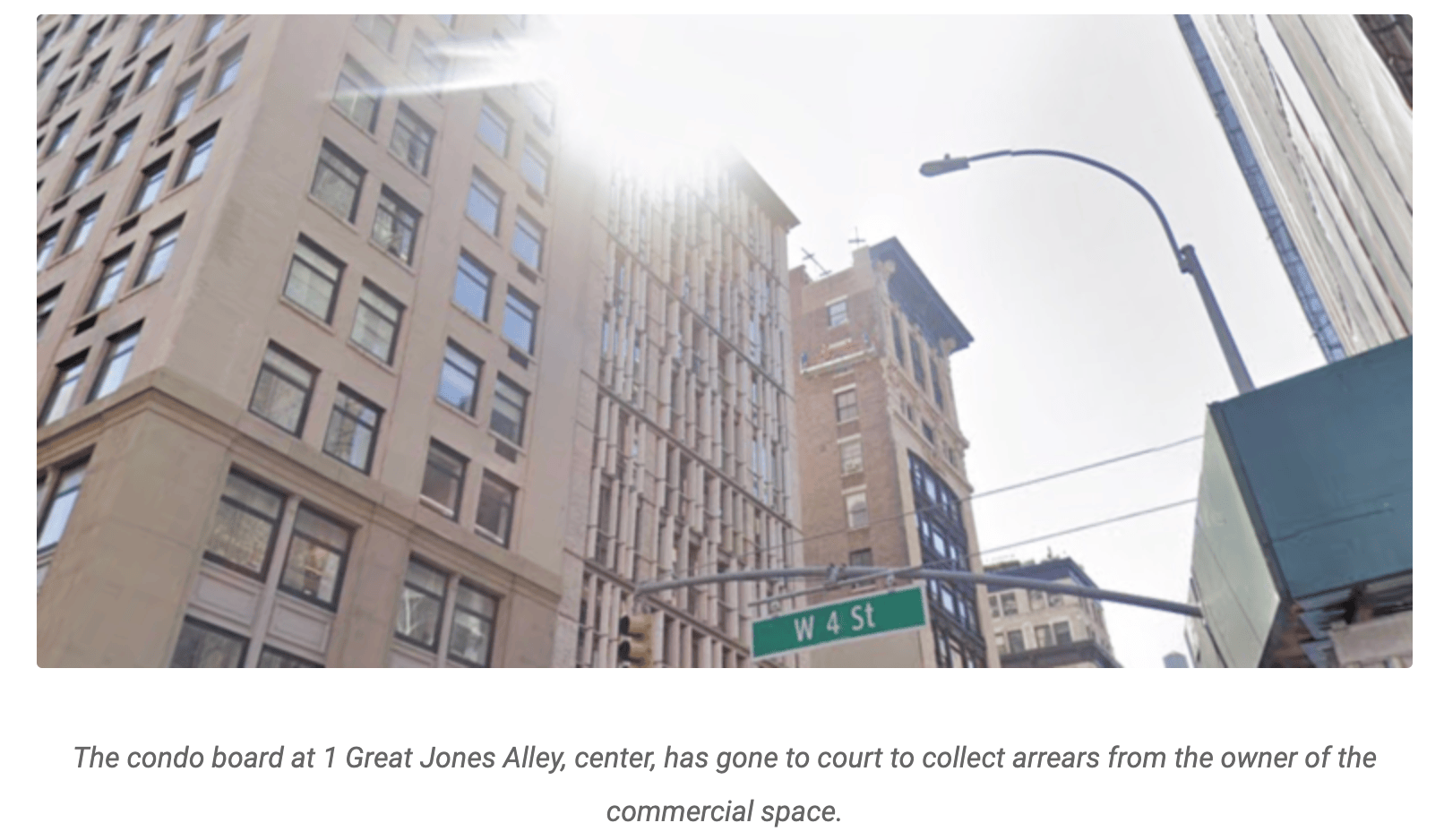
When a unit-owner fails to pay common charges in a condominium, there’s a right way and a lot of wrong ways to go about collecting the arrears. The board at the recently constructed, 16-unit luxury condo known as 1 Great Jones Alley, located on Broadway near East Fourth Street, is doing things the right way.
The five-year-old building’s developer, a shell company known as Downtown RE Holdings LLC that’s led by Madison Realty Capital, is the owner of the 7,000-square-foot, three-level commercial space. Since January, the space has been rented to a veterinarian and a coffee shop, but in July the developer stopped paying common charges to the condo board. On Nov. 1 the board slapped a lien on the developer, and on Wednesday, in keeping with the condo’s bylaws, the board filed a suit in state Supreme Court seeking to wrest control of the commercial space from the developer so a new owner can take it over, Crain’s reports.
“Plaintiff is entitled to foreclosure in connection with the unit and the appointment of a temporary receiver for the unit during the pendency of this proceeding,” says the lawsuit, which was filed by the condo board’s law firm, Cozen O’Connor. The lawsuit states that the developer’s arrears have climbed to $21,000.
This isn’t the condo board’s first legal rodeo with the developer. In September the board also went after the developer in court for construction defects “affecting nearly every facet of the building,” including plumbing systems, fire-proofing and the swimming pool. The board is seeking $20 million in that case. In January Madison Realty sued BKSK Architects and other firms that helped design the condo, claiming they’re responsible for defects, including leaks in the pool area. BKSK and the other defendant have denied all the charges.
When you’re facing a $20 million lawsuit, $21,000 in unpaid common charges must seem like small change. Crain’s speculates that this might be a motive for the arrears: “The larger legal cloud hanging over the building may explain the developer’s reluctance to pay.”
Nonetheless, the condo board is fulfilling its fiduciary duty in seeking to collect every dollar it is owed.