Is this glass half full or half empty? For New York City co-op and condo boards scrambling to reduce their buildings’ carbon emissions enough to comply with Local Law 97, the answer is: a little bit of both.
The half-empty part: global carbon dioxide emissions hit another record high in 2023. The half-full part: the increase was smaller than the year before due to the strong expansion of such renewable energy sources as solar, wind, hydroelectric and geothermal, according to a new report from the International Energy Agency (IEA).
Forbesreports that between 2019 and 2023, the growth in clean energy was twice as large as fossil fuels, the IEA said. Without this expansion, the global increase in CO2 emissions would have been three times larger. As it was, energy-related carbon dioxide emissions hit a record level of 37.4 billion tons in 2023, a rise of 410 million tons from the previous year. Thanks to strong growth in clean energy sources, the 2023 increase was down from the 490 million tons from 2021 to 2022. Emissions from coal, the dirtiest fossil fuel, accounted for 65% of the increase.
“The clean energy transition has undergone a series of stress tests in the last five years – and it has demonstrated its resilience,” says Fatih Birol, executive director of IEA. “A pandemic, an energy crisis and geopolitical instability all had the potential to derail efforts to build cleaner and more secure energy systems. Instead, we’ve seen the opposite in many economies.”
Extreme droughts across the world were key contributors to the rise in carbon emissions last year, as they led to a shortfall in hydropower output and caused countries like the U.S. and China to turn to fossil fuels to cover the gap. The report notes that without this shortfall in clean electricity, emissions from electricity generation would have fallen in 2023.
For New York’s co-op and condo boards, this report may serve as a reminder to follow the old mantra: think globally, act locally. While keeping in mind the enormous challenges of reducing the planet’s carbon emissions to fight climate change, co-op and condo boards can — and must — do their part by reducing their buildings’ carbon emissions. And they need to remember that switching building systems from fossil fuels to renewable energy is key to cutting those emissions.
In today’s hard insurance market, co-op and condo board members and their property managers should be rigorously scrutinizing their claim-filing procedures. Insurance carriers are becoming ever more choosy about the risks they decide to insure, and claims are one of the main things carriers evaluate when deciding whether to take on a new risk or renew an existing policy. Here are six questions all boards should ask before filing a claim:
Has this property had a lot of claims in the recent past? Claim history is a big factor when underwriters are scrutinizing your property for coverage renewal. In short, the fewer claims you have, the more favorable your risk appears to insurers. Most insurers even view one large “shock loss” that’s in the six-figure range — a major fire, say — as more favorable than five small losses that pay out a few thousand dollars each. Recurring issues are also looked at unfavorably by carriers. If you have five claims for broken pipes, the carrier will likely conclude there is an issue with the building’s plumbing and/or maintenance practices, and the carrier may choose to either substantially increase your premium or get off the risk altogether.
Should we file a claim if the damages exceed the deductible by just a few thousand dollars? While this is an internal decision for the board and management, it may be prudent in this hard insurance market to avoid filing a claim for a payout of less than $5,000. Why? Because any claim that gets paid out, regardless of the amount, is a negative mark and could have a negative effect on future premiums. It might be wiser not to file that small claim.
Is the damage a covered loss? Insurance is designed to cover sudden and accidental losses. Damage that is a result of long-term wear and tear, deterioration and/or lack of proper maintenance is excluded on every insurance policy that I have ever seen. Typically, if you cannot pinpoint the exact time of the damage, there will likely to be coverage issues.
Can we ask our agent if a claim is covered before filing? The only way to know for certain if a claim is covered is to file a claim and have a representative from the carrier come out, investigate and make a coverage determination. We can give our OPINION on whether or not we think the claim is covered, based on the policy language and our experience. But the only way to know for certain is again to file a claim. If we are told to file a claim in writing, we are obligated to report it to the carrier at that point.
When should we definitely not file a claim? If the damages do not exceed the policy’s deductible, there is no reason to file a claim. The deductible essentially says that the association is responsible for the first X amount of damages under the policy. If the policy has a $10,000 deductible and you only have a water stain on a ceiling, the carrier is not likely to make any payments on this claim — and you have added an unnecessary claim to your history.
How do I know if the damages are under the policy’s deductible? It is perfectly acceptable to call in a contractor you trust to evaluate and give you an estimate for the damages, then use that estimate to decide whether or not the damages will exceed the deductible — and whether or not it makes sense to file a claim.
Donald Schatzle is claims director at the insurance brokerage Mackoul Risk Solutions.
Your managers need to be prepared for this year’s unique challenges. Here’s how small businesses can think about impactful — and cost-effective — manager training.
By Sarah Lynch
There’s an oft quoted adage: employees don’t quit jobs, they quit managers. And this year, having well-equipped managers could be even more crucial.
Managers play a critical role in the success of companies, solely determining 70 percent of the “variance in team engagement,” according to Gallup. But these valuable players are currently overburdened: 51 percent are now reporting more responsibilities than they can manage, according to a Gartner report in 2023.
On top of helping attract and retain talent, in this new era of work, managers are expected to take on additional responsibilities, like ensuring employee well-being and enforcing return-to-office mandates, says Brent Cassell, vice president, advisory, in the HR practice at Gartner:
“You’ve got this perfect storm, where HR’s expectations of managers have increased at a time when employees’ expectations of their managers to be a coach, a mentor, a project manager … have increased.”
The solution? Many leaders are looking toward trainings: leader and manager development ranked as a top priority for HR leaders in 2023, with 59 percent planning to increase their investment in manager development programs over the next two years, according to another Gartner report.
But this can be time-intensive and costly for smaller companies—leadership trainings cost anywhere from around $2,000 to upwards of $4,000 in some cases. Fortunately, there are ways to invest in manager training that are both simple and effective. Here’s what you can do:
Know what you need from managers
Before rushing into developing or paying for training sessions, company leaders should first consider if they have the right expectations of managers, says Emily Field, partner at McKinsey: “Do we know what makes a great manager in our organization? Do we know the skills and capabilities that we expect?”
In doing this, company leaders might discover that they have some warped or under-communicated expectations–which could be contributing to manager burnout, with the recent increase in responsibilities.
“If we want our managers to be really dedicated people developers who coach their teams, but they’re spending a third of their time or more on individual contributor tasks and that’s what they get rewarded for, no surprise that they’re not going to have as much time for people leadership,” Field says.
Thus, aligning on expectations should be the first step, and that will elucidate where further training would be the most targeted and valuable. “Rethink the design of the role such that it is more focused, scalable, and executable,” Cassell adds. “Make it easier for managers to do the things that we need them to do.”
Focus on microlearning
To get the most out of manager training, eschew “splashy classroom trainings” and multi-day long sessions for “bite-sized investments in habit building,” Cassell says. He says this approach can be an “effective, a quicker, and a cheaper alternative to building the habits that managers need to be more effective in their roles,” even if that’s just 30 minutes per week.
One (cost-effective) method might be peer learning. “What are the challenges that they’re experiencing today? Who in my organization is doing it particularly well?” Cassell says. In today’s work environment, those challenges might include how to talk to employees about mental health or how to mentor employees in a remote work environment.
Then, consider: “How do I tee up an opportunity, how do I create a forum, where that manager can speak to his or her peers about those shared challenges and what it is that’s working for them?” Cassell adds.
The more customized and applicable the training is for your organization, the better, says Jessica Burkland, assistant professor of practice in organizational behavior at Babson College and the owner of a consultancy to help mid-sized businesses create training programs: “I’m going to learn a specific skill … and then I’m going to be able to put it into practice right away as a manager.”
Track the results
If you’re investing in manager training, with time and/or money, you want to make sure that it’s sticking the landing. And business leaders can play a key role here in ensuring the fulfillment of these training goals, Burkland says.
For instance, she says, companies might want to train managers on how to instilla sense of purpose within the employee base: Gallup recently found that connection to the company’s mission and purpose is declining for remote employees.
In this case, Burkland says the company leader could check in with those employees weeks after the training and ask questions about their understanding of the company’s purpose.
“If we’re hearing back from the employees, ‘I’m not sure,’ then obviously our managers need more work,” she says. That could mean more training or a stronger goal–or that there is a deeper problem with particular managers. “The leaders probably need to have some reflection themselves and say: what are we missing?”
Q: We have two rooftop lounges on top of our Hell’s Kitchen condominium building, where I serve on the board. There are maximum capacities for the lounges listed in the building’s offering plans, but they seem too low — the spaces have double doors and double exits for easy evacuation in case of emergency. How do we find out how many people can legally be in these lounges at the same time?
A: For a rooftop lounge or patio to be legal, it must be listed on the building’s certificate of occupancy, along with the purpose of the space, the maximum number of people allowed and load limits, replies the Ask Real Estate column in The New York Times. You can find your building’s certificate of occupancy on the Department of Buildings’ (DOB) website under Building Information System, or on DOB NOW for certificates issued as of February 2021.
(If your building was built before 1938, the year New York City began requiring the certificates, you could check with the DOB to see if it is legal through a Letter of No Objection.)
The city determines maximum occupancy using a number of factors. These include dividing the square footage by the occupant load factor listed in chapter 10 of the city’s building code. The formula typically yields a smaller capacity for a rooftop space compared to a similar indoor space, for safety reasons. Another factor is the width of the stairs, for speedier exits during emergencies.
Having a rooftop capacity that exceeds 74 people most likely triggers a requirement for a place of assembly certificate, which involves additional fire safety requirements and potentially greater insurance costs, says David Maggiotto, deputy press secretary for the DOB.
It’s possible that the listed limits in your offering plans are indeed lower than what city code allows. Perhaps the board, years ago, wanted to keep activity and noise on the roof to a minimum, or avoid the costs associated with the city’s place of assembly requirements. “The board has a right to be restrictive,” says Bruce Cholst, a partner at the law firm Herrick Feinstein.
If your rooftop lounge is not permitted, you can hire an architect or engineer to draw plans for the space, then have those approved by the city. After construction, your building can be issued a new certificate of occupancy that includes the rooftop lounge. Then you’ll know exactly how many people can go up on the roof.
Business leaders in the United States have revealed that they are more satisfied with their jobs thanks to artificial intelligence, according to a new report.
Tech.co’s survey among 1,047 business leade3rs found tat 59% who are using AI in their roles said it has improved their job satisfaction.
Another 30% of the respondents said AI has had a “strong” or “significant” impact on their work processes.
The findings come amid recent research that only 22% of employees across the world are satisfied with their jobs in 2023.
According to Tech.co, their new findings suggest that “artificial intelligence could be the key to increasing the amount of gratification employees receive from their job in 2024.”
Easily accessible AI tools
Aaron Drapkin, Tech.co’s lead writer and AI expert, attributed AI’s impact to its easily accessible nature.
“ChatGPT and co. wouldn’t be impacting job satisfaction in quite the same way if they were more complicated to configure, cost lots of money, or became so intelligent that they rendered workers redundant,” Drapkin said in a statement.
He noted that while it may cause major economic change in the future, its current capacity to support employees now makes it a “significant net benefit” for most workplaces.
“Right now, we’re living in a proverbial sweet spot. The tools are free, easy to use and not powerful enough to work independently and replace the humans using them,” he said.
“This is great – but none of these things are absolutes. AI clearly has the capacity to completely transform how we work – but ensuring this transformation continues to be gradual, manageable and beneficial will be no easy task.”
Uses of AI at work
According to the report, the top uses of AI in their workplace are data analysis (32%) and writing tasks (26%). Other uses include:
Scheduling and calendar management (21%)
Automated data entry (20%)
Quality control (20%)
Cybersecurity (20%)
Running customer support chatbots (19%)
Design tasks (19%)
Document classification and management (17%)
Inventory management (16%)
Drapkin said this shows how freely available AI tools are helping with a huge range of tasks, especially ones that employees find repetitive, boring, and time-consuming.
“We’ve never had tools this capable at our fingertips before, and the data suggests it’s making a tangible difference to the lives of people using them,” Drapkin said.
By Madeline Hay, CAMICB’s Director of Exam Administration
The Community Association Managers International Certification Board (CAMICB) is poised to usher in a new era for the Certified Manager of Community Associations (CMCA) exam, offering a revamped blueprint that mirrors the dynamic landscape of association management across the globe. These changes, stemming from a thorough job analysis study conducted between 2021 and 2022, reflect an evolution in the core competencies required by community association managers worldwide.
Job Analysis
Job analysis is the cornerstone of ensuring that the CMCA exam remains an authoritative assessment tool, reflecting the contemporary roles and responsibilities of association managers. This comprehensive study involved a multifaceted approach, dissecting the complexities of association management to chart a revised course for the credential.
The task of redefining the blueprint through job analysis was a colossal undertaking spanning 18 months. The comprehensive study involved 13 project phases, including reviews of over 100 primary source documents, survey responses from 3,000 managers around the world, and more than 90 hours of collaborative meetings with 55 subject matter expert volunteers. Notably, 20 of these experts were sourced internationally, reflecting the global significance and diverse perspectives encompassed in this endeavor. This validation process ensured that the CMCA exam blueprint aligns with the real-world experiences and challenges faced by professionals in the field.
Updated Blueprint
The job analysis study resulted in an updated blueprint that encapsulates the requirements of modern community association management. Notable changes include a reorganization of job tasks and knowledge into six principal categories compared to the previous eight, allowing for a more cohesive representation of the industry’s nuances.
For instance, content previously segregated into distinct categories, such as “Budgets, Reserves, Investments, and Assessments” and “Financial Controls,” will now be consolidated under broader headings like “Financial Management” and “Risk Management.” This streamlined approach better reflects the multifaceted nature of association management, presenting a more cohesive and holistic assessment framework for aspiring CMCA candidates.
One of the findings of the job analysis study was a significant emphasis on meetings and events in the daily responsibilities of early-career managers. Consequently, the exams will see an expansion of the “Meetings and Events” domain from 10% to 18%. Furthermore, “Property Maintenance” and “Risk Management” will increase by 3% and 4% respectively, while “Contracting” reduces from 13% to 10%.
Notably, the human resources domain, constituting 6% of the current exam content, will no longer feature in the revised blueprint.
Current Blueprint (Remains Until December 2024)
Topic Area
% of Exam
1. Meetings
10
2. Governance, Legal and Ethical Conduct
23
3. Budgets, Reserves, Investments, and Assessments
15
4. Financial Controls
11
5. Risk Management and Insurance
11
6. Property Maintenance
11
7. Contracting
13
8. Human Resources
6
Total
100
Updated Blueprint (Starting in December 2024)
Topic Area
% of Exam
1. Meetings and Events
18
2. Governance and Compliance
23
3. Financial Management
20
4. Risk Management
15
5. Contracting
10
6. Property Maintenance
14
Total
100
The CMCA Candidate Handbook and the CMCA Study Guide have been updated to reflect the revised blueprint. The current Handbook and Study Guide – valid through December 2024 – will remain on www.camicb.org through the end of December. The updated Study Guide and Handbook are also now available on the website. After December 2024, only the updated Study Guide and Handbook will be available.
Managers planning to test before December 2024 should refer only to the current Handbook and Study Guide. Managers planning to test after December 2024 should utilize only the updated Handbook and Study Guide.
Looking Ahead
The redefined CMCA exam blueprint, meticulously curated through a comprehensive job analysis study, embodies CAMICB’s commitment to elevating industry standards.
These changes are not merely cosmetic but serve a foundational purpose—to ensure that the CMCA exam genuinely reflects the essentials of community management worldwide. The blueprint revisions align the exam content with the ever-evolving needs of the profession, encapsulating the industry’s best practices, irrespective of geographic nuances.
Stay tuned as CAMICB offers more in-depth exploration of the blueprint throughout the next year leading up to the December 2024 change, symbolizing a leap forward in certifying the finest professionals in community association management.
Questions regarding the launch of updated forms of the CMCA examination may be forwarded to info@camicb.org or call 703-970-9300.
Some 50,000 large New York City buildings, including thousands of co-ops and condos, will be required to comply with the city’s sweeping climate law, Local Law 97, which went into effect on Jan. 1 of this year. And how many inspectors does the Department of Buildings (DOB) have on staff to make sure those buildings are meeting their carbon-emission caps?
Eleven.
Watchdogs and experts say that’s not nearly enough to implement the rules, Gothamist reports. The 11 staffers have a daunting workload that will only grow as Local Law 97’s requirements are phased in over the coming years. The bulk of the work done by the DOB team dedicated to Local Law 97 involves reviewing and auditing reports filed by co-op and condo boards and landlords, then pursuing enforcement when necessary.
The good news: under the carbon emission caps that went into effect on Jan. 1, only 10% of large buildings are out of compliance, according to the DOB. But analysis by the city found that the majority of buildings are not in compliance with benchmarks that go into effect in 2030, when the rules become more stringent.
“When you look at the number of buildings and all the paperwork and substantive work that needs to be done, it could take a small army to make sure that we get this done,” says Raya Salter, an environmental lawyer on the state’s Climate Action Council. “We’ve got a climate bomb that’s ticking, and we’ve got billions of dollars coming out of the federal government and that clock is ticking too. We need for our local officials to be focused on this.”
Don’t hold your breath. The DOB has been understaffed for years, and there are currently seven unfilled positions on the squad dedicated to carrying out Local Law 97, according to a DOB spokesperson. But the agency says competition from the private sector has made it difficult to fill certain positions requiring architects and engineers with backgrounds in sustainability.
Pete Sikora, climate and inequality campaigns director at New York Communities for Change, is not feeling optimistic. “I don’t know how they seriously plan to evaluate, judge and then watchdog the implementation of all of those [decarbonization] plans that would also take a lot of talented staffing and follow up,” Sikora says. “I think they’ll just rubber stamp the plans they get and not be able to seriously evaluate them.”
The business judgment rule often serves as a perceived safety net for boards, shielding them from legal scrutiny. However, this rule is not an impenetrable shield and boards should be aware of the nuances. Simply put, the business judgment rule states that, with four exceptions, a court cannot overrule a co-op, condo or HOA board-issued rule or policy no matter how strongly the judge may disagree with it. However, there’s a fifth consideration when it comes to the business judgment rule, and that is the political impact of a particular policy. Boards should not only focus on meeting the four legal requirements for business judgment rule protection but also be aware of potential community backlash.
The four exceptions. The first exception to the broad protection of the business judgment rule arises if a rule or policy is inconsistent with the building’s governing documents. Boards must adhere to the authority granted by these documents, and any deviation could lead to legal challenges and the voiding of the regulation. Second, the proposed policy or rule must comply with all statutory requirements and all aspects of existing case law. If it’s illegal, then a court is going to invalidate it. Third, the regulation cannot in its application constitute a breach of the board’s fiduciary duty to shareholders or unit-owners. And finally, the courts impose a requirement that any board regulation must be in furtherance of a legitimate corporate purpose. That’s a very easy test to pass. Anything that even smacks of valid corporate purpose is going to pass that test.
A fifth consideration. Even if a board’s rule satisfies the legal requirements of the business judgment rule, it may face opposition from residents if it is unpopular with the community it serves. Boards need to tread carefully even when a rule or policy satisfies each of those four legal requirements for protection under the business judgment rule. It may be so unpopular with the community that the board runs the risk that the residents at the next board election are going to challenge the board, overthrow it in a proxy fight, and then reverse the policy.
A case study. Recently, we represented a Suffolk County HOA where the board banned the use of pickup trucks anywhere within the community’s property grounds. The board thought pickup trucks were contrary to the upscale image it was trying to promote for the community. Discrimination, while subjective, is not illegal unless it falls within the 19 protected categories, and social class is not one of them. The ban faced strong opposition from residents and a group of them challenged the rule legally. Because it passed all four of the business judgment rule tests, the court upheld the regulation. However, the judge told the plaintiffs and the owners challenging the regulation that they had political remedies rather than legal ones. Residents picked up on the hint. They staged a proxy fight at the next annual meeting. They won, threw out the entire board and replaced it, and immediately repealed the ban. So the board’s purpose, because it was out of line with the community’s thinking, was undermined and defeated. The case perfectly illustrates that fifth principle, which is to make sure regulations are not too far out of line with the pulse of the community.
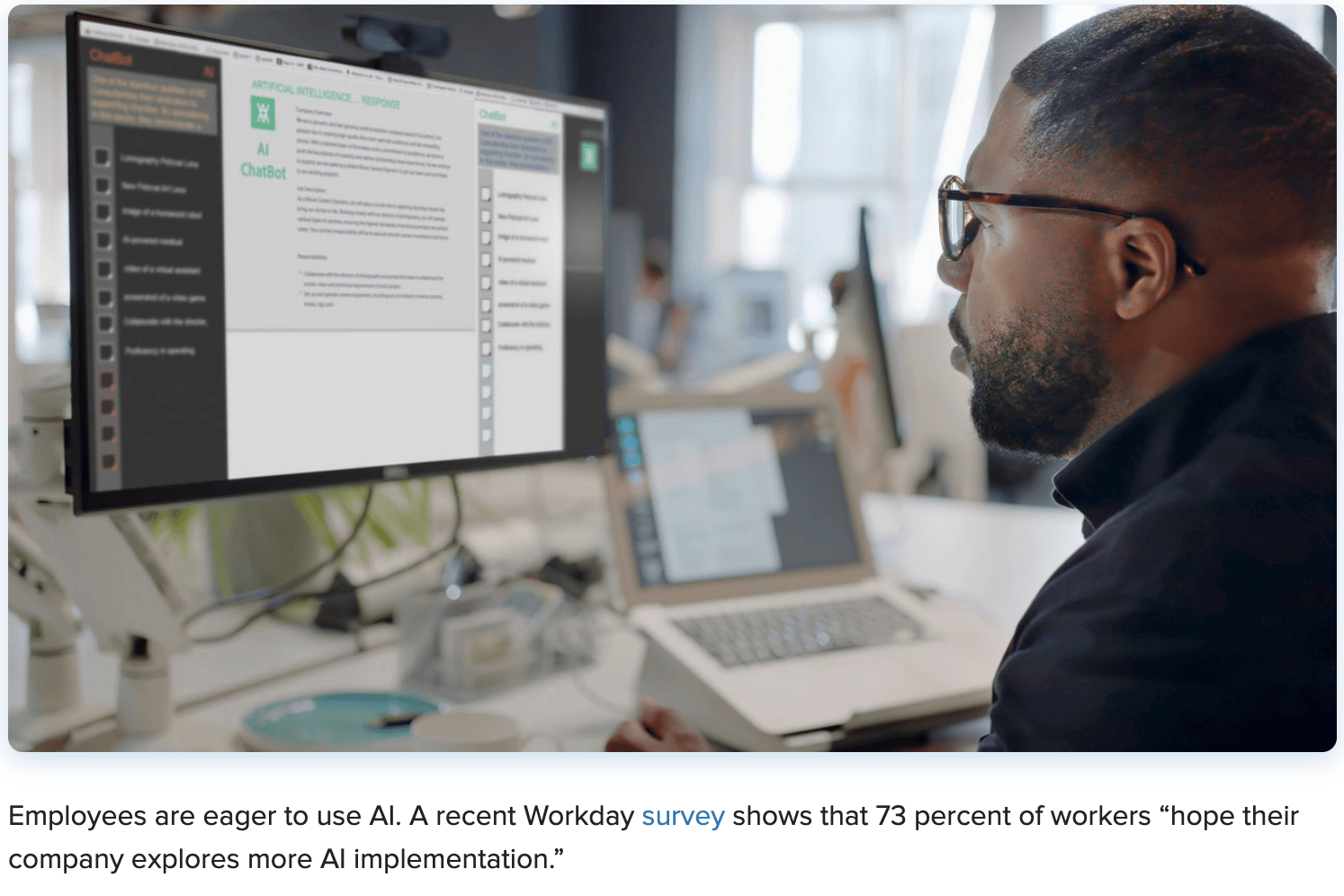
Employees are eager to use AI. A recent Workday survey shows that 73 percent of workers “hope their company explores more AI implementation.”
“At Insight, the groundswell of interest around generative AI has been high,” said Carm Taglienti, chief data officer and distinguished engineer at Insight Enterprises. “People have been genuinely curious about it, which we have wanted to encourage and incentivize.”
In response to employee enthusiasm, the Arizona-based information technology company developed a private, secure generative pre-trained transformer (GPT) solution and made the tech available to its workforce. Fostering companywide participation and friendly internal competition has been the key to success, according to Taglienti.
“Our teammates have felt empowered to test, learn and explore the tool, uncovering use cases that we have been able to replicate internally and bring to market for clients,” he said.
But not all organizations have the resources to launch a private or “in-house” tool. With the right strategy and vetting, third-party tools can be just as effective in satisfying employees’ curiosity about AI.
ChatGPT and Beyond
Using ChatGPT has cut the time needed to write a job description from an hour to, in some cases, roughly 10 minutes, according to Priti Patel, chief people officer at G2, a business software and services company headquartered in Chicago.
Her team is actively using ChatGPT to conduct performance reviews, write job descriptions, and glean themes and insights from quarterly employee survey comments. But while ChatGPT is the most widely recognized AI tool, it’s far from the only one available.
“There are other helpful AI time-saving tools and features, including Zoom’s AI assistant for transcribing interviews and intake calls our team has with hiring managers,” Patel said.
Jessica Blodgett, SHRM-CP, director of people, culture and community at the New York-based CMMB, an international nongovernmental organization, relies on Google’s Bard because it provides different drafts to review and tweak. She also uses LinkedIn’s AI tool to help build a pipeline of passive candidates for open roles. Blodgett sees her HR peers using more AI tools in recruitment, general HR administration, and learning and development.
“This includes tools such as AI coaches to help develop employees,” she said. “In recruitment, you will see HR leaning into automated resume screening, scheduling, predictive interview outcomes, skill matching, or even LinkedIn that uses AI to identify and reach out to passive candidates.”
Tips for Assessing and Integrating AI Tools
Listening to and considering employees’ requests about adopting AI tools is crucial. Employees who feel their input is valued are more engaged and may have outside experience with specific tools that can benefit the organization. However, adopting the use of an AI tool should be strategic.
“At the end of the day, regardless of how they’re doing it, leaders should not invest in AI just for the sake of it,” Taglienti said. “There has to be a clear ‘why’ and business imperative that’s driving any of these decisions.”
Here are four things to consider when an employee expresses interest in implementing an AI tool.
1. Understand the risks. Blodgett said it’s essential to know the risks associated with any AI tool up for consideration. That includes knowing how transparent the vendor is about updating and training its models. In graduate school, Blodgett and her capstone partner researched the risk mitigation capabilities of over 140 AI tools. They found that the average AI tool scored 1.5 on a scale of 7.
Blodgett and her research partner generated a list of questions to help understand the risks, and they encouraged HR leaders to consider at least these two:
Does the AI tool have the ability to expose current biases?
Can a human understand the tool without additional training?
2. Establish guidelines. It’s crucial to have an organizational AI policy before moving forward with vetting or implementing an AI tool. Governance is central to making any effort successful, Taglienti said.
3. Evaluate and adapt. Eser Rizaoglu, a senior analyst in Gartner’s HR technology strategy and management team based in London, said the organization recommends:
Evaluating generative AI use cases and broader AI use cases, with business value and feasibility as drivers for prioritization.
Working with HR technology leaders on guidance for when to buy or build generative AI capabilities, based on each individual use case.
Monitoring the market as new use cases and lessons emerge.
4. Understand where it saves time. “It’s important to be aware of where your team is spending their time to determine where AI can be most effective,” Patel said. “However, don’t stop at your department. Marketing, sales or product [development] might be using AI in ways that HR can adopt, too—such as automated slide content creation for internal meetings or summarizing employee survey data.”
Many New York City co-op and condo boards are understandably anxious about the potential costs of complying with the city’s ambitious Climate Mobilization Act, especially Local Law 97, which sets strict limits on building carbon emissions. Buildings now account for about two-thirds of the city’s carbon ouput. One group of co-ops and condos in Queens grew so anxious, in fact, that it filed a lawsuit to block the law from going into effect on Jan. 1 of this year. The suit was dismissed.
New projections from the New York City Panel on Climate Change (NPCC) confirm that the city will be hotter, rainier and wetter in the coming years — with major shifts hitting the city within a decade. The NPCC’s latest estimates, as reported by The City, project sea levels around the city to continue to rise between half a foot and just over a foot in the 2030s. Annual precipitation is expected to increase by up to 10% in those years, while the city could experience temperatures between 2 and 4.7 degrees warmer.
The estimates, which have not been previously reported, are part of a forthcoming paper from the NPCC Climate Science Working Group and were reviewed during a presentation to a northeast climate consortium earlier this month.
First convened in 2008, the NPCC is a group of 20 climate experts who advise policymakers on the latest science and strategies to address hazards facing the boroughs. The panel has come out with four comprehensive reports since 2010, and is expected to release its fifth in April.
“The direction of the change and the general magnitude of those changes are very constant,” says Luis Ortiz, a climate scientist and professor at George Mason University, who worked on the report. “Things are going to get hotter and relatively wetter… We need to prepare, and we need to adapt now to get ready for those changes.”
Given the changes that are on the way, the work can’t happen fast enough, says Klaus Jacob, a Columbia University geophysicist who previously served on the NPCC. “The city is moving in the right direction,” he says, apparently referring to Local Law 97 and other initiatives. “But compared to how the weather and climate is changing, it’s a snail’s pace, and the climate is a rabbit.”
In other words, reducing carbon emissions, from buildings and all other sources, is no longer a luxury but is now a necessity for New York.