Q: We live in a small, no-pets Westchester County co-op. Our upstairs neighbors were recently allowed to acquire an emotional support dog. The dog runs back and forth for 30 minutes at a time, and it frequently scratches a bedroom rug, waking us up throughout the night. We have shared our concerns with the neighbors, and they seemed receptive, but the problem persists. How can we balance the rights of people to have emotional support animals with our right to live peacefully?
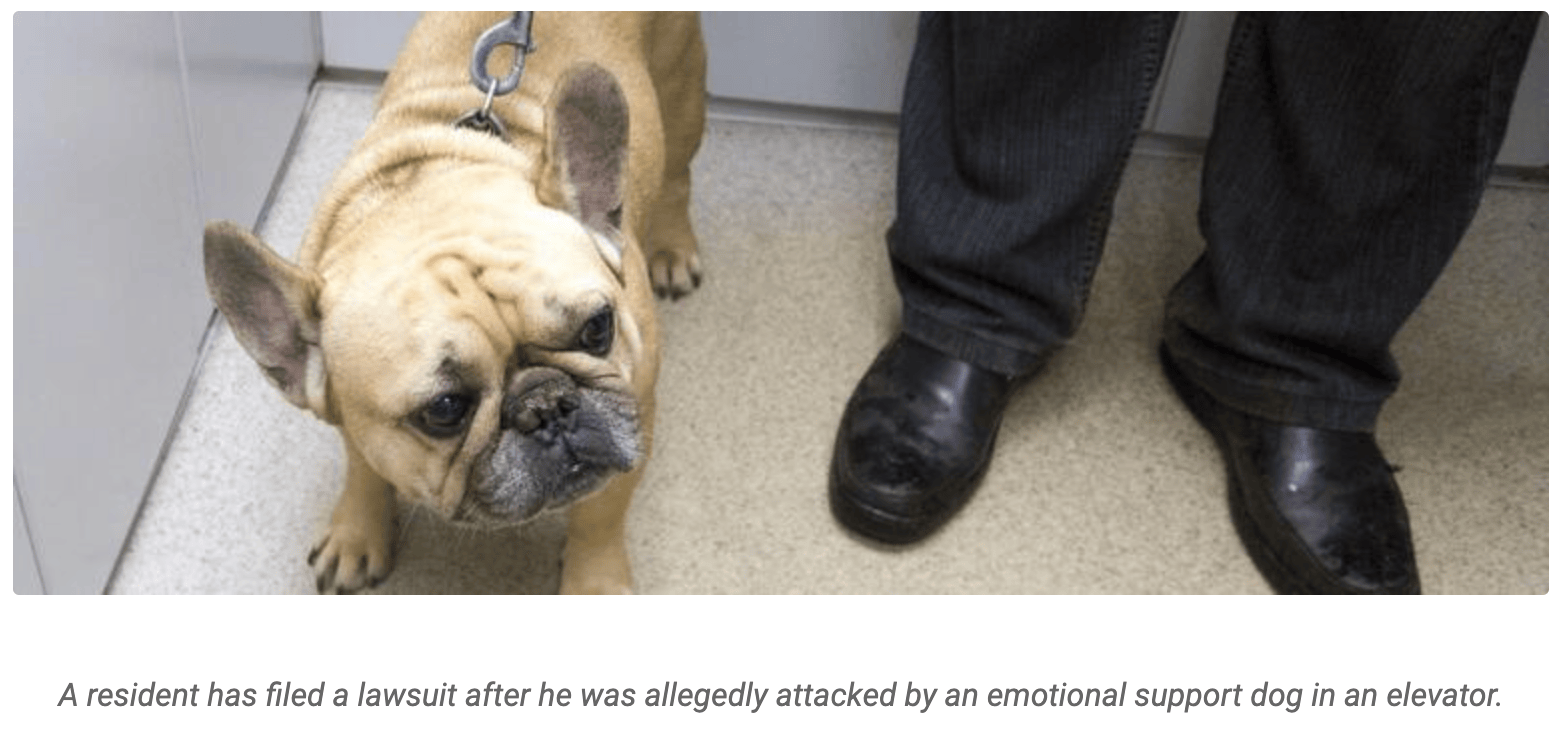
A: As long as this dog isn’t biting people, it’s probably not going anywhere, replies the Ask Real Estate column in The New York Times. This is borne out by recent events in an Upper West Side rental building, where a tenant has sued two of his neighbors after their emotional support dog allegedly attacked him the building’s elevator — and was involved in altercations with a dozen other residents, staffers and delivery workers. If the lawsuit succeeds, the support dog will surely be living elsewhere.
Support animals are protected accommodations under county, state and federalfair-housing laws. Your co-op board could be liable for discrimination if it is found to be hostile to this dog owner, and so could you. So tread lightly.
“A neighbor can be sued in Westchester,” says Andrew Lieb, a New York housing discrimination lawyer, noting that the law allows your neighbor to sue you for emotional distress and attorneys fees. “If I was the neighbor and wanted to do something (about the support animal’s behavior), I would go on a nice campaign.”
Legally, the building cannot charge extra fees to this resident or limit the dog’s size or breed. Focus any complaints you have on elements of the situation that violate your building’s rules, such as unreasonable noise. You could use a decibel reader to show how loud the noise is and how long it lasts, to establish that it is unreasonable. Then make a complaint to your co-op board so the sound can be mitigated.
You can also check the building’s bylaws to see if your neighbor has sufficient carpeting. Some buildings require residents on upper floors to have 80% of the floor carpeted.
Support animals require no special training, and they’re different from service animals, such as seeing-eye dogs that assist blind people. And despite widespread reports of people seeking approval of emotional support animals in order to circumvent no-pet policies, the laws are loaded in favor of people who seek an accommodation from their co-op or condo board. Yet, there are limits.
“Emotional support animals are protected,” says Jonathan Roman, a real estate lawyer who practices in Westchester, “but they still need to obey any house rules.“
CARROLLWOOD — Dick Woltmann will be at the tennis courts.
Or with his grandkids in St. Petersburg.
Or riding a bike in Portugal this summer.
But his heart will always be in Carrollwood Village.
Woltmann, who will turn 80 this year, is ready to enjoy retirement — from the two jobs to which he’s dedicated the past 40 years.
First, as president and chief executive of Bay Area Legal Services — a nonprofit law firm that provides free civil legal services to low-income Tampa Bay area residents. And secondly, as president of the Carrollwood Village Homeowners Association Board of Directors — which he was for the past 35 years.
“I don’t know if I’ll miss it,” Woltmann said, “but I have three grandkids, I’m going to play tennis, I’m going on a bike ride in Portugal in the summer, so I want to do some things I haven’t done, so I’m freeing my time up with the HOA and my job.
“The job of the president of the homeowner’s association is to lead the board and get a decision made on a topic or an issue or opportunity — the object is to get the discussion going and they make the decision.
“All you can do is identify the opportunities and options, get to a consensus of the board that suits the majority of the community, but do it in a civil, cordial way.
“I tried to help make the best decisions and I thoroughly enjoyed it.”
Carrollwood Village has three phases of the large community, each with thousands of houses encompassing different aspects of the neighborhood. Woltmann spent 37 years on the Phase I board after moving to Carrollwood Village in 1985.
In that time, he has overseen a multitude of changes and improvements to Carrollwood Village, some under Phase I’s purview and others in the nearby adjoining phases.
For Woltmann and Phase I, with its approximately 1,300 homes, some of the things they have undertaken is installing pickleball courts at Dan Ruskiewicz Field or working on aesthetics of Carrollwood Village Drive by planting oak trees that will eventually give the road a canopy effect.
He tackled issues such as safety along the streets and sidewalks, including overseeing the initiative of the community raising money to connect all the sidewalks and fill in the gaps. While on the board, they worked to get the Florida Highway Patrol to monitor the roads and get speedy drivers to slow down, as well as get cameras installed to help with incidents along the roads.
In that time, he also saw the installment of amenities such as the Carrollwood Cultural Center, Carrollwood Village Park and VISTA Gardens, though none of these falls under Phase I.
“Without safety,” he added, “all other aspects of what, I think, a board should be about fail. Without all the subcommittees, like the Safety Committee, we wouldn’t have been able to do what was necessary for Carrollwood Village, to improve the neighborhood, to keep it great so people want to continue to live here.”
One of the most significant parts to his HOA career was when the now Carrollwood Village Country Club was going through multiple owners and disarray through the 2000s and into early 2010s.
The course, which was Carrollwood Village Country Club when built in 1972, kept seeing owners switch hands quickly, to the point where the course was very close to being fenced in. However, it was the Phase I board’s work with the current owner, the California-based Concert Golf Partners, which kept the course open, running and thriving.
Woltmann, the board, and Concert Golf chief executive Peter Nanula, a Tampa Jesuit graduate, worked together on the sale, which would need county commission approval. Those leaders would spearhead making sure all Phase I residents’ concerns and questions were addressed before the purchase was finalized, with overwhelming approval from both the community and county commission, in 2013.
“What we have tried to do is improve, continuously, the quality of life of people who live in the Village,” Woltmann said. “The big job of a leader, anywhere, is to look for threats and opportunities.
“In the case of (the golf course), it was both a threat and an opportunity that needed addressing and could improve the Village. The commission had never seen a community and a company work so well together, but it worked out to the benefit of all.”
Woltmann, however, will be missed, as other longtime board members and influential leaders in Carrollwood Village praised his leadership style.
“Dick’s style has always been cool, calm, supportive, reflective,” Phase I VP and president of VISTA Gardens Jennifer Grebenschikoff said. “He encouraged all of us board members to follow our interests and passions, on behalf of our homeowners. Carrollwood Village would not be what it is today without his years of leadership.
“Going forward, newer board members will be able to pick up and continue to build upon the foundation that Dick has laid for us.”
Woltmann, added Grebenschikoff, leaves a legacy of improvements and implementing assets such as “area landscaping and lighting, maintaining the soccer fields and installing pickleball courts,” which gives the community “the energy to thrive and grow.”
But, in the end, Carrollwood is still where one will find Woltmann.
“I won’t give (the new board) unsolicited advice, but if someone asks me, I’ll let them know what I think — I’ll still be around, but I just won’t be someone who is hanging around,” he said with a laugh.
“I’m going to enjoy retirement, but a rocking chair just isn’t part of that equation.”
Silence may be golden, but sometimes it comes at a cost. When you stay quiet, you can’t effect change. Holding your tongue means internalizing your feelings. Silence also keeps you from building meaningful relationships. From physical, emotional, and productivity standpoints, silence can undercut your ability to do things and do them well, says Elaine Lin Hering, author of Unlearning Silence: How to Speak Your Mind, Unleash Talent, and Live More Fully.
“It’s ‘suffering in silence,’” she says. “The feeling of not being able to say something keeps our nervous systems on chronic high alert, which our bodies were not meant to do. You get compromised immune systems or some tangible health impacts.”
Staying silent also keeps you isolated. You internalize the message that you’re the problem. “If we’re staying silent, there is no opportunity for connection,” says Hering. “There is no opportunity for course correction. There is no opportunity for good intentions to translate into positive impact. Until we solve for silence, we’re not actually going to reap the benefits of all that other work and investments around our skills.”
WHY STAY SILENT?
So, why many of us tend to keep quiet? Silence is a control technique, says Hering.
“We learned it far too early,” she says. “From the time you were sitting at the dinner table, and someone shot you a look that said, ‘That’s not appropriate’ or, ‘We don’t do that around to here.’ Some of that is warranted, and other times it teaches you to edit out parts of yourself because they’re not welcome in the context that we’re doing.”
In adulthood, silence can be taught in the workplace, often subconsciously. For example, you may learn to keep your ideas to yourself if you offer them during a meeting and they go unacknowledged. Another way silence is valued at work is if your boss or your boss’s boss never pushes back on the CEO.
“It’s what organizational psychologists call ‘organizational silence,’” says Hering.
UNLEARNING SILENCE
The first step is to understand that silence is a learned behavior. Then you can start to challenge your assumptions and figure out which are operating as norms, says Hering. Ask yourself, “What assumptions do I hold about when it’s okay to use my voice or whether I even have a voice?” Also ask, “What behavior around speaking up is allowed or valued here?”
Once you call attention to the assumptions that have been driving your actions, ask yourself, “How well do these assumptions suit the person I want to be? The leader I want to be? And the workplace team I want to create?”
“What am I perpetuating?” asks Hering. “In what ways am I actually silencing myself that I might not have realized? What requests might I make of the people around me to build more of a culture of voice rather than silence? Then, make intentional choices going forward from there.”
LEARNING TO SPEAK UP
Speaking up involves courage, but courage alone is not sufficient. “Traditional speak-up advice says, ‘Be more courageous. Be more confident,’” says Hering. “I’d argue it is also a matter of calculation. Does it make sense for me to speak up? Is it worth it? To me, that is the power of unlearning silence.”
Hering says you can determine if it’s worth it by asking yourself three questions: What are the costs of choosing voice? What are the benefits of staying silent? What makes sense for me?
“As we look at the cost of choosing voice, we often overprioritize the immediate short-term discomfort,” she says. “We think, ‘I don’t like the feeling of that awkwardness or that potential discomfort, therefore, I’m not going to have the conversation.’ What we fail to realize in that calculation is, what are the costs if I don’t have the conversation now? Because usually problems don’t go away by themselves, and things get worse over time.”
Instead of just weighing short-term costs, Hering suggests looking at long-term costs, too. There are times when silence makes sense, such as preserving your own peace, energy, self-care, and survival.
“All of that is legitimate,” she says. “Each of us gets to have agency to make our own choices, because only we know all that we’re carrying.”
Whether you choose to speak up or make a calculated decision to stay quiet, understanding and challenging the silence you’ve been taught is an ongoing process. But it’s a worthy one. By learning your unconscious patterns, you can make a intentional decision about how you want to show up at work and at home.
If inflation continues to cool, the Federal Reserve could cut interest rates again this summer. While that might persuade some co-op and condo owners to get off the sidelines and put their apartments up for sale, the shortage of inventory will probably persist for years, according to Jonathan Miller, president and chief executive at the appraisal firm Miller Samuel.
“Interest rates can’t fall low enough for inventory to flood into the market,” Miller tells Brick Underground. “Because rates will be lower, there’s going to be an increase in demand. We’re running at such a deficit that in terms of supply, I think this is going to take years for existing inventory [to catch up].”
New York City’s sales market slumped in 2023 as increased mortgage rates limited financing options for buyers and encouraged sellers to stick with their lower rates. Those factors are still at play today, even as the 30-year fixed mortgage rate has dropped, sinking below 7% this week to 6.95%, Bankrate reported.
“There’s already more inventory coming in because rates are lower,” Miller says. “But at the same time that rates are falling and enticing more sellers to come in, there’s more buyers because rates are lower. It’s offsetting.”
There were 14,740 homes available for sale in January of this year, well below the 15-year peak in October 2020 of 22,153 units, according to StreetEasy data cited by the New York City Comptroller Brad Lander. Over the same period, the median home price has risen from $675,000 to $785,000.
As Miller sees it, the good old days of historically low interest rates are history — the kind that’s unlikely to repeat itself. “It’s a better year in the sense that rates are coming down or have come down from 2023 highs,” he says, “but it seems wildly optimistic to think that they’re going to go anywhere near where they were during the pandemic, in the neighborhood of 3% or 4%.”
The bottom line of the city’s chronic shortage of apartments for sale?
“Housing is, in the near term, going to be more expensive than it has been over the last decade or so,” Miller says.
Community association managers wear many hats and have to be well-versed in a wide range of skills, all of which are equally important. One component of a manager’s role is to completely understand the financial aspects of running a business – this means knowing and interpreting the financial pieces as well as the nuances that come along with the decisions being made.
“As an agent for our clients, a manager’s duty includes providing advice and direction to those clients regarding their financial health and trends,” said Rob Felix, CMCA, PCAM, RS, Owner of The Felix Reserve Group. “Without such action by a manager, there can be a disconnect between what a client wants, and what they’re willing to spend to get it. Matching a client’s expectations with their willingness to raise the money to do so prevents financial paralysis in communities.”
The financial element of a manager’s job include the following actions:
Develop and implement accounts payable/receivable procedures;
Analyze and interpret the financial statements and report significant variances from the budget;
Manage association operations within the budget;
Assist in the development of the reserve study;
Assist the board in identifying funding sources for reserve expenditures;
Implement the reserve funding model approved by the board;
Provide regularly scheduled financial statements and reports to the board and members;
Provide the association financial records to the independent auditor and/or accountant;
Distribute audited financial statements to the membership and the board;
Implement investment policies of the board;
Identify investment products; and,
Document transfer of funds.
“Knowing how the money works is one of the most important services a manager provides to a Board,” said Cat Carmichael, PCAM who is the CEO of Strategy 123. First, she suggests the manager ask the Board to describe the type of community they want to have and provide the manager with a budget that is adequate to meet the mandatory and discretionary expenses to achieve the Board’s goals. Paying close attention to the monthly financial reporting tells the manager and the Board whether the plan they created when they developed the budget is working. “If the monthly income and expense statement has large variances to the budget, the manager should investigate why and report to the Board,” said Carmichael. “That way, the Board can make decisions to reduce or change expenses to align with the expected budget. In some cases, there could be a good reason why a variance exists, and the Board may decide to do nothing to change its plan. That’s OK too. It’s their community.”
Ron Duprey, CMCA, AMS, PCAM, who is a Senior Vice President at Associa explains a strong understanding of an association’s financial information is particularly important for the portfolio manager. “The portfolio manager, working with several different community associations, will likely work with many different financial situations for each of the associations in their portfolio,” said Duprey. “Each may experience different financial challenges and require multiple solutions to solve those problems. The ability to grasp and understand the financial problems, suggest solutions and help the Board reach the best outcome can impact the financial stability and value of the properties in a community association well into the future.” Duprey noted that he believes the most important situation impacting community associations falls under the budgeting assessments for owners.
Demonstrating Financial Acumen
Budgets are the business plan for the year, but Boards can amend their plans throughout the year. For example, an association may want to host social events and lifestyle programs, but none have been provided for in the budget. Carmichael says, “It’s incumbent on the manager to help the Board understand how to achieve their goals, while assuring that the association is financially viable. For example, some solutions a manager might suggest are to reallocate funds from other discretionary expenses, or determine if ticket sales and sponsorships can cover the costs of the events.”
Felix adds, “If a client determines they’ll be short in operating income for the year and are determined to withhold funding of their reserves instead of raising the assessment, a professional manager should be able to point out the potential pitfalls of taking such action and make a recommendation to the Board to avoid the negative impact.” Further, Felix explains, “Or, should a Board decide to add a costly program mid-financial year without considering how it may impact other programs, a professional manager must be able to interpret how the community is currently spending its funds, and make recommendations on how to achieve their goals and what areas may need to be adjusted accordingly.”
Enhancing These Critical Skills
Carmichael, Felix and Duprey all offer excellent advice and insight into how professional managers can enhance their financial management skills. In their words:
Cat Carmichael: Managers should begin reviewing their management agreement and understand specifically what financial services the management company provides to its clients. If you’re self-managed, discuss the scope of work that your finance department provides. Staff accountants are seldom recognized for the work they do for a community; to the observer, financial management is less visible than strictly property management. Financial professionals really like to understand how their work benefits communities, because they rarely see their efforts translate to outcomes. Ask the accounting team to describe all aspects of the financial management services they provide, including explaining how they actually do the work. How are duties separated? What other internal controls do they implement? How does that desktop check scanner actually turn a paper check into a deposit? Ask about the accounts receivable process and to show you the life of a homeowner payment, from billing to receipt to posting. Then, ask about accounts payable from the receipt of an invoice, coding to the proper general ledger accounts, and the many ways payments to vendors are made. Ask the accountants to walk you through the financial report so you can clearly understand how the results are presented, and how the different reports relate to one another. It is also very important to understand how the primary banking relationship works, from operating accounts to reserve and investment accounts.
Rob Felix: Be sure to read and fully understand each financial report a Board receives. Often times, managers are unaware of the financial position of their client because they don’t take the time to fully understand the financial reports presented to them. Ask questions of your financial manager. Prepare a variance report to the financials to explain the differences between what they’re actually spending versus what they budgeted, and why! Also, thoroughly read the last audit (if any) that was performed on the client’s financials and pay close attention to the notes section of the audit. It’s imperative that a professional manager know more than their client – that’s the value add. Nearly every manager is working with a non-profit entity, so understanding the language associated with the appropriate financial information being tracked and presented is critical, as many clients are not trained in this area.
Ron Duprey: Not everyone is a “numbers person,” which is why it’s so important to really understandbalance sheets and income statements. For a pragmatic approach to really grasping the basics I suggest a manager, not comfortable with spreadsheets or financial statements in general, first sit down and prepare a balance sheet and income statement for their own “business” of life. Thinking about their own assets or what they own that has value and liabilities of what they owe to others is a great way to understand a balance sheet. Assets less liabilities equals net worth. Net worth plus liabilities balances with assets. Hence a balance sheet. The income statement is simply the income or revenue they bring in from all sources deposited into the checking account. The check book identifies all that they spend. The difference is net income. Mentally referencing their personal financial situation is a great start to understanding business balance sheets and income statements.
Resource Corner
Making use of the wide variety of professional development resources available to managers is critical to staying on top of industry news, events, and any changes arising in the profession. Below is a sampling of industry resources.
CAI’s Education for Managers – CAI offers a series of courses specific to financial management, risk management and other topics which are covered in detail in the following courses M-100, M-200, M-205, M-206 and others. Upcoming offerings and dates can be found here: https://www.caionline.org/LearningCenter/Education-for-Managers/Pages/default.aspx
Foundation for Community Association Research (FCAR) – The Foundation supports research and develops publications on a variety of topics that can help managers develop more effective and harmonious community associations. For example, its Best Practices Reports on Financial Operations and Reserve Studies can be downloaded for free here: https://foundation.caionline.org/publications/best-practices-reports/
HOAleader.com – HOAleader.com was created to support the dedicated community of association managers and other professionals who work to realize the potential of their association—Board and committee members, property managers, attorneys, financial professionals, insurance professionals, developers, vendors, and homeowners. A free, downloadable white paper entitled HOA Finances: Best Practices For Getting Your Homeowners Association Through Difficult Economic Times is available on HOALeader.com in addition to a special report on HOA Reserves, Special Assessments, Loans & More: A Homeowners Association Board Member’s Guide To HOA Funding Options.
CAI Exchange – An online forum that allows members to collaborate and connect with colleagues. These informal discussions are extremely helpful in sharing innovative approaches to common and uncommon situations as well as best practices and advice. Financial topics range from issues arising from unexpected major expenses, to the misappropriation of funds, to reserve studies using component method funding.
Community Managers With Strong Financial Management Skills Drive Sound Decision Making For Associations And Boardsis the third in a series of articles, produced by CAMICB staff, that delve into the important issues and topics affecting community association managers.
Lydia Pelliccia is a freelance writer.Matthew Green is executive director of Community Associations Managers International Certification Board.
The National Association of Realtors (NAR), a powerful organization that has set the guidelines for home sales for decades, has agreed to settle a series of lawsuits by paying $418 million in damages and by eliminating a bedrock of the industry: the 6% sales commission.
Housing experts say the deal, and the expected savings for homeowners, could trigger one of the most significant jolts in the U.S. housing market in 100 years, The New York Timesreports. “This will blow up the market and would force a new business model,” says Norm Miller, a professor emeritus of real estate at the University of San Diego.
Americans pay roughly $100 billion in real estate commissions annually, and real estate agents in the United States have some of the highest standard commissions in the world. In many other countries, commission rates hover between 1 and 3%. In the United States, most agents specify a commission of 5 or 6%, paid by the seller. If the buyer has an agent, the seller’s agent agrees to share a portion of the commission with that agent when listing the home on the market.
The original lawsuit, filed in April 2019 by a group of Missouri home sellers, ended in a verdict of $1.8 billion in October. It spawned a flurry of related lawsuits, which argued that NAR, and brokerages who required their agents to be members of NAR, had violated antitrust laws by mandating that the seller’s agent make an offer of payment to the buyer’s agent, and setting rules that led to an industrywide standard commission. Without that rate essentially guaranteed, agents will now most likely have to lower their commissions as they compete for business. Economists estimate that commissions could now be reduced by 30%, driving down home prices across the board.
“The forces of competition will be let loose,” says Benjamin Brown, co-chairman of the antitrust practice at Cohen Milstein and one of the lawyers who hammered out the settlement. “You’ll see some new pricing models, and some new and creative ways to provide services to home buyers.
In a related article, The Times predicts four major changes in the way homes are bought and sold: the 6% commission will cease to be he norm; as a result, housing prices and consumer costs will come down; the practice of brokers “steering” buyers to pricier homes will be less common; and the ranks of real estate agents, which swelled during the pandemic, could be reduced by as many as 1 million.
“The reset button on the sale of homes was hit today,” says Michael Ketchmark, the Kansas City lawyer who represented the home sellers in the main lawsuit. “Anyone who owns a home or dreams of owning one will benefit tremendously from this settlement.”
Question: The Florida Condominium Act, Section 718.112, limits condominium board member terms. Why are HOA boards not included in this statute? Signed, R.B.
Dear R.B.,
Because HOAs are governed by the HOA Act, Chapter 720, while Chapter 718 governs only condominium associations, and so its rules and restrictions apply only to condominiums.
The real question is why the HOA Act does not also contain a term limit provision. To that end, you could ask why there are separate statutes for the separate types of communities, and why they differ in the first place. The fact is that the rules are not consistent, and you can’t apply logic to the legislative process. The statutes vary in many ways, and not just with this term limit provision.
As I’ve always said, and it’s particularly true in HOAs, but the lack of owners willing to serve as board members, or the lack of owners willing to participate in the election process, is a much bigger problem than properly elected board members staying on past their welcome. Frankly, the term limit provision is a solution to a problem that isn’t all that common. Popular board members will continue past the term limit because they get a supermajority vote, and unpopular board members would usually lose an election if there were eligible candidates willing to serve.
Question: What can be done if the board either refuses to allow owners to speak to items on the agenda, or only permits comments at the end of the meeting after agenda items have been voted on? Signed, L.L.
Dear L.L.,
The Condominium, HOA and Cooperative Acts all state that owners have the right to speak with reference to all designated agenda items — presumably, while that item is being discussed. However, there is no governing body, including the Division of Condominiums, that has jurisdiction over this issue. So, the only way to address this problem would be to bring your own legal action against the association — and due to the time and expense involved, almost nobody ever does so.
Question: I am on the board of a condominium. Since our insurance premium was so high this year, we had to finance the full amount, and the finance charges are very high. Could we instead borrow the funds from our reserve, which is totally funded, and pay it back within the year? Signed, P.S.
Dear P.S.,
The use of reserve funds for non-reserve purposes requires the approval of a majority of the entire membership. Borrowing reserve money to pay your insurance premium, even if you intend to pay it back, is using such funds for non-reserve purposes, and so it would require membership approval. So, you can do what you describe, but only after a membership vote.
Question: My HOA recently came into a windfall of money (close to $50 million) due to settlements for construction defects. In my opinion, the HOA is ill prepared to protect the funds. Only a single signer is required on the settlement bank account, key documents like bank statements and general ledgers are not being included in the monthly financials shared with board members, other board members have been discouraged from conducting oversight, and the association only has crime and fidelity insurance on a small fraction of the funds in the association’s custody.
What can we do to convince the board to make changes so that our funds are not at risk? Signed, J.G.
Dear J.G.,
That is a huge amount of money. It’s the biggest construction defect settlement I’ve ever encountered, and I am having trouble imagining what went wrong in your community that resulted in $50 million in damages. It seems that you could build a community from scratch for that amount.
Having that kind of money creates all kinds of problems, because it’s effectively impossible to put the funds in FDIC-insured accounts without a tremendous amount of financial management.
Any reasonable board member would be concerned about the association keeping so much money with so few controls. If your board truly doesn’t seem to care, I would suggest you work to motivate other owners to either change the board’s opinion, or to replace the board.
In the meantime, consider that Chapter 720 requires HOAs to maintain a fidelity bond or insurance that covers the maximum funds that will be in the association’s custody at any one time. So, the Association is obligated to maintain a huge fidelity bond — but I suspect the cost, and the effect on your assessments, will be gigantic. This is a problem that I’ve simply never encountered at this level.
Ryan Poliakoff, a partner at Poliakoff Backer, LLP, is a Board Certified specialist in condominium and planned development law. This column is dedicated to the memory of Gary Poliakoff. Ryan Poliakoff and Gary Poliakoff are co-authors of “New Neighborhoods — The Consumer’s Guide to Condominium, Co-Op and HOA Living.” Email your questions to condocolumn@gmail.com. Please be sure to include your location.
(KSTP) – If you live in a condo or townhome in Minnesota, you may notice your fees are going up.
One insurance expert says this is a trend he’s been seeing for the last several months.
Helen Mitchell recently found out it will be more expensive to live in the Coon Rapids townhome she’s called home for the last 20 years.
“I was like, ‘This can’t be right,’” Mitchell said. “We just had questions.”
That’s because her homeowners association management company sent her a letter referencing a “very troubling trend” with property insurance. It says their “total premium more than doubled.” For Mitchell, that means more money out of her pocket.
“When it goes from $240 and they add another $130, that’s more than a 50% increase,” Mitchell said.
“This is something we’re seeing far and wide,” said Aaron Cocking, president and CEO of the Insurance Federation of Minnesota.
Cocking says the reason this may be happening is fewer insurance companies want to get involved with HOAs or condos.
“I think the part where we’re at with the HOA/condo marketplace right now is that enough insurers have kind of taken it on the chin and they’re looking and saying, ‘This isn’t really the business we want to be in,’ or, ‘That’s not a risk we want to take right now,’” Cocking said.
One of the biggest factors he cites is that Minnesota sees the second most extreme weather of any state behind only California, according to the National Centers for Environmental Information.
“As we see more severe storms that are more frequent coming through and doing more damage, that becomes really problematic,” Cocking said.
A letter sent from Mitchell’s HOA management company to residents references an “industry-wide” issue, saying insurance companies are “dictating the market” and “declining to bid based on the number of units in an HOA as well as the age of the buildings.” It goes on to say this is something that “could get worse in the years ahead.”
“More entrants into the market that are willing to compete will, we believe … drive those premiums down,” Cocking said.
For Mitchell, she doesn’t know what the future holds for her.
“Three of us have all talked about moving,” Mitchell said. “This used to be an affordable option, but if not, it’s time to move on.”
Exhausted. Frayed. Languishing. Burned out. These are common words people use describe how they feel in their professional and personal lives. And it’s only getting worse. “Burnout is the primary driver pushing workers to look for relief in the forms of a new job, opportunities for advancement, more pay, and above all else, continued flexibility,” according to 2021 research from the Institute for Corporate Productivity, or i4cp. A staggering 67% of people surveyed at larger organizations (employing >1,000 people) cited burnout as the most significant driver of potential talent loss for their organizations.
It might be easy to blame both pace and volume of work, but our research suggests the real culprit often is a little more insidious. It is not so much the workload that has gone up but the collaborations required around our work that have exploded. This has created a new form of stress that we documented in our recent book, The Microstress Effect: How Little Things Pile Up and Create Big Problems — and What to Do About it. “Microstress” is the relentless accumulation of unnoticed small stresses from routine interactions with people in our lives that are so brief that we barely register them. Individually, these microstresses might seem manageable, but cumulatively they take an enormous toll.
In our research, we identified 14 sources of microstress which we grouped into three different categories: microstresses that drain your capacity to get things done (e.g., a surge in responsibilities), microstresses that deplete your emotional reserves (e.g., managing others), and microstresses that challenge your identity (e.g., pressure to pursue goals out of sync with personal values).
Our research initially focused on 300 high performers in multi-national organizations, but in the past year, we’ve also assessed a global sample of more than 11,000 individuals to further understand the most common sources of microstress. What’s become abundantly clear through this research is that microstress is not just the result of having a particularly bad manager or being part of a high-pressure workplace culture.
And the problem is just getting worse. All of the advances in technology and shifts in organizations to become more agile and less hierarchical have caused even more microstress that threatens not only your productivity, but also your overall well-being. Making matters more challenging is that microstress is just as likely to come from the people in our personal lives as those in our professional lives. But our research suggests that if you can identify a range of these stresses, you can take corrective action that can make a material impact on your life.
Where Microstress Takes the Biggest Toll
What became clear through our follow-up research is that microstress affects all of us, at work and at home. But some people suffer more than others. Our research shows a statistically significant relationships between education, hierarchical level, and age and all forms of microstress. At work this makes sense: as we rise in our organizations, we are exposed to microstress-inducing interactions — for example, misalignment with colleagues, responsibility for managing the performance of teams, and confrontational conversations. But just as notably, we found that these peoples’ personal lives were also more stressful as a product of escalated expectations of the provider role, negative interactions with family and friends, and challenges to identity in what it means to be a “good” child or sibling helping family members.
Women in particular experienced greater stress across 13 of the 14 forms of microstress. (The exception was that men report experiencing more stress from disruptions in their networks.) Particularly notable gaps for women existed in draining or negative interactions with family and friends, confrontational conversations, and the volume and diversity of collaborative demands. Respondents who were ethnic minorities also experienced greater stress in certain areas: pressure to pursue goals out of sync with personal values, political maneuvering, and uncertainty about others’ reliability.
Notably, draining or negative interactions with family or friends was selected as the first microstressor almost three times as often as the next two most selected (confrontational conversations and collaborative demands that are diverse and high in volume). As one participant in a subsequent learning experiment at a major retail organization shared with us:
“I love my eldest daughter in a way you can’t describe. She is a core source of joy and meaning in my life. But I also worry about her. She has a low threshold to stress and often faults herself for or frets about whatever is happening in her life with her husband, sons, socially. Thankfully, she does talk to me about what she is going through at the time. I try my best to be helpful, however, it leaves me with the residual concern. There is no doubt in my mind that I carry that stress over to work. I am at times distracted or lack engagement because I am worried about her and whatever she is going through.”
Experiences like this pose a challenge to the conventional wisdom on well-being, which urges us to focus more on building close, high-quality relationships in our lives as a source of long-term happiness. Yes, family, friends, and colleagues are an important source of purpose, but they’re also simultaneously a source of significant stress.
What are we to do? So many of us choose to endure microstresses because we can’t simply walk away from the most important relationships in our lives. The key is understanding that it’s not necessarily the relationships that need to change, but the interactions we have within them.
A Practical Approach to Fighting Back
People need to become intentional in managing their interactions on a day-to-day basis to create a habit of addressing microstress over time. To test how to successfully build this capability, we worked with several Fortune 100 organizations that each invited 20 high performers (balanced across men and women) to engage in a six-week experiment to reduce their microstress.
At the start of week one, we asked people to select a single source of microstress that they would focus on addressing during the upcoming week and share with us a written plan for acting on it. People would commonly select issues such as altering interactions with siblings around caring for aging parents, approaching a leader who was rapidly shifting expectations, addressing misalignment in goals with colleagues on a cross-functional team, or counseling a team member on how their stress propagates unnecessarily to others. We partnered them with others inside their organization who were also taking part in the experiment as a source of peer support for navigating any challenges. Then on Friday, we asked them to email the steps they took and the results. Our job during the week was to offer support and ideas for how to approach the source of the microstress when issues or questions popped up. (If you’d like to try this experiment yourself, our free app, “The Microstress Effect,” can help.)
Initially, people were nervous to take action. The tone of their first Monday email was consistently one of anxiety about pushing back. Yet by Friday, the feedback emails we received were almost all positive and the world had not tilted on its axis — people had taken steps to reduce microstress from an interaction baked into their lives by, for example, talking to a sibling about how they are creating guilt around caring for parents or pointing out to a leader how their shifts in expectations cascade to others.
Community association managers who hold and retain the CMCA credential demonstrate they are accomplished professionals committed to developing their skills and knowledge by participating in ongoing continuing education coursework and professional development opportunities year-round. There are numerous and varied opportunities for CMCAs, ranging from college degrees and coursework to conferences, professional coaching, community workshops, seminars, symposiums, and webinars.
These offerings cover a wide range of topics, including community association management operations, administration, legal requirements, accounting, human resources, and public administration, which ensure community managers are up to date on all aspects of this growing profession that undergoes frequent shifts in laws, regulations, and best practices.
“The commitment to continuous learning is a testament to a manager’s dedication to professional growth and excellence,” said CAMICB Board of Commissioners member Jennifer Andal, CMCA, AMS, PCAM, who is the Director of Better Communities in Dubai. “This commitment enhances their credibility within the community, as residents and board members recognize the value of a manager who remains current in their knowledge and skills. Professional credibility facilitates more effective communication and a greater capacity to positively influence community dynamics.”
Andal explained that managers are essential in creating and sustaining harmony within residential communities. “In a profession characterized by evolving legal frameworks, dynamic interpersonal relations, and a demand for effective leadership, the continuous pursuit of knowledge is paramount.”
The more managers pursue professional development opportunities, the easier it is to adapt to change. “Continuous learning ensures that managers stay updated, allowing them to align their strategies with the latest standards,” added Andal. “This adaptability is vital for effective communication, enabling managers to speak with authority and relevance, thereby enhancing their credibility.”
Steven Shuey, PCAM, CCAM, who is a retired Management Consultant, explains that ethics is an important issue for managers. “The best way to understand the ethics of the profession is to stay educated in all aspects of our work,” said Shuey. “New laws are emerging state by state. Staying current helps keep managers ethical by knowing – and following – what laws and procedures are changing.”
Don’t Overlook Opportunities That Hone Soft Skills
Effective communication skills, leadership, crisis management, and conflict resolution are all skills that require flexibility and nuanced approaches. Seeking out and embracing ongoing learning opportunities in these areas position CAMs as experts and leaders capable of fostering a positive and thriving community environment.
“Polished communication skills empower managers to interact with residents, board members, and external vendors, conveying information clearly, resolving conflicts diplomatically, and fostering community unity,” said Andal.
Andal explained that continuous learning equips managers with tools for crisis management and conflict resolution. Mastering these skills enables managers to navigate challenging situations gracefully, preventing the escalation of issues and maintaining a healthy community atmosphere.
“Continuous learning, including leadership training, empowers managers to positively influence others within the community,” said Andal. “Acquiring knowledge about leadership styles, motivation strategies, and team-building techniques allows managers to cultivate an environment that encourages collaboration and growth.”
In addition, it’s important that managers take advantage of more informal learning opportunities, such as networking and social events. These are excellent opportunities where colleagues share ideas and innovative approaches to solving common and uncommon problems. These gatherings often allow managers to connect with others who are particularly steeped in specific topics, such as the latest use of technology or legal happenings on the ground.
Finally, Andal noted, “In the dynamic landscape of community association management, the pursuit of knowledge emerges as the pathway to success and a lasting impact for these dedicated professionals.”
Resource Corner
Making use of the wide variety of professional development resources available to managers is critical to staying on top of industry news, events, and any changes arising in the profession. Below is a sampling of industry resources.
CAI – The CAI website (www.caionline.org) and local CAI Chapters also offer an array of resources, networking and professional development opportunities. To find a local chapter go to: https://www.caionline.org/Chapters/Pages/Find-A-Chapter.aspx. Your local/state chapter will also offer specific opportunities that will impact your community and specifically your state. For example, in California opportunities may be state-specific to drought, wildfires, the Davis Stirling Act, etc.
CAMICB – CAMICB recognizes a variety of Continuing Education (CE) opportunities for CMCA credential renewal, including webinars, courses, and conferences. CAMICB also value the contributions made through volunteer work in the community association sector. Volunteer hours, such as serving on association boards or engaging in advocacy efforts, are accepted as part of a manager’s continuing education. CAMICB’s website offers guidelines on the types of CE activities that qualify for renewal. For inquiries about the eligibility of a particular course or activity for CE credits, please visit www.camicb.org or contact CAMICB at info@camicb.org.
CAI Exchange – An online forum that allows members to collaborate and connect with colleagues. These informal discussions are extremely helpful in sharing innovative approaches to common and uncommon situations as well as best practices and advice.
Other Formal Training Programs – Companies like Adamen, Inc. (https://community-association-management-101.thinkific.com/), a national consulting and employment firm specializing in the community management industry, offer online training programs for managers that range from topics specific to managers, boards, and accounting staff.
SmartBrief – SmartBrief is a free resource exclusive to CMCA credential holders. This weekly snapshot of both industry and CAMICB news will more informally keep you up to date on trends and changing laws in the field of community association management: https://www.camicb.org/Pages/Smartbrief.aspx
Continued Professional Development and Growth Ensures Homeowners, Employers and Colleagues of Managers’ Ability to Provide Exceptional Service is the second in a series of articles, produced by CAMICB staff, that delve into the important issues and topics affecting community association managers.
Lydia Pelliccia is a freelance writer.Matthew Green is executive director of Community Associations Managers International Certification Board.