CMCA Recertification

NBC-CAM will be sending reminder notices next week to individuals who need to recertify by April 1, 2013. Here are a few helpful links:

A few things to note:

  1. It is the responsibility of each CMCA to provide documentation of their 16 hours of continuing education at the time of recertification. NBC-CAM does not track your CEs. If you took a class with CAI, please log into their website (caionline.org) to print out a certificate of completion.
  2. Only courses completed between April 1, 2011 and present will count as continuing education.
  3. If you have held an active AMS, PCAM, FL CAM, NV CAM or NAHC-RCM for at least a year, this will satisfy your CMCA continuing education requirement.
  4. Credit hours may be earned only for education that meets either of the following criteria: It pertains to community association operations or management and/or it contributes to the professional development of the CMCA.
  5. The CMCA Annual Service Fee is $105.00.  Oftentimes this fee is confused with CAI’s individual manager membership.  Recently, CAI increased the rate of the individual manager membership from $130.00 to $134.00.  While NBC-CAM maintains an affiliate relationship with CAI, we are an independent credentialing body: separately incorporated, governed by an independent Board of Trustees, and guided in the administration of our program by the standards of our accrediting body, the National Commission for Certifying Agencies.  We are not a membership organization; we do not collect membership dues.  We assess our credential holders an annual maintenance fee which is used to support the development and delivery of our core exam and the operation of our program in accordance with best practices in professional credentialing.

NBC-CAM recently hired Roland Richardson to assist with the recertification process. Contact Roland at rrichardson@nbccam.org with any questions.

Community Association Management Smartbrief

NBC-CAM is now offering a Community Association Management Smartbrief. The Smartbrief will bring the most important and timely stories directly to your inbox weekly. Sign up, read the latest edition, or browse the archives.  See what you missed this week:

In the News

New Jersey homeowners wary of town taking over dune rebuilding project
More than a dozen residents in Toms River, N.J., are refusing to sign easements that would give the town a strip of their land so it can rebuild necessary protective dunes that were destroyed by Hurricane Sandy. The homeowners say they are worried they might be obligated to open their beaches to the public if parts of it now belong to the town. “We know we need to put in dunes. Dunes are definitely a lifeline for any beach community,” says Patricia Suriani, member of the Surf Cottages HOA board. “What we have wanted up to this point is more clarification of giving this easement.” New Jersey Online (1/5)

HOA evicts homeowner for past due fees
A homeowners association foreclosed and evicted a resident from his house in Jacksonville, Fla., after racking up $532 in unpaid fees. Ken Baxley, who owned the home for four years, admitted he refused to pay the HOA for two years. “I didn’t think they were that threatening,” says Baxley. “I basically blew them off. That was my mistake. I blew off the homeowners association.” WTLV/WJXX (1/4)

Should HOAs base fees on a resident’s income?
A blog reader recently raised the issue of association boards who charge fees for certain community services but only against owners who, in the board’s estimation, “can afford it” while discounting or writing off those fees for others. While there is no reasonable debate that such a practice would be contrary to both the shared ownership statutes and most associations’ governing documents, this begs the question just how often volunteer boards engage in the typical exercise of trying to figure out who are the “haves and have nots” in a community. Sun-Sentinel (Fort Lauderdale, Fla.) (12/31)

Retirement community doesn’t want to pay HOA for youth activities
The homeowners association in the age-restricted Sonora community in Rancho Sahuarita has filed a lawsuit saying the community-wide HOA fees are too high in part because they support youth activities. Sonora residents pay their own HOA fees for an exclusive pool, landscaping, clubhouse and other items in addition to paying fees to the larger association. They claim the fees for the larger Rancho Sahuarita Village Program Association have increased at nearly twice the rate of inflation in the past nine years while the Sonora fees have not risen at all. Green Valley News and Sun (Ariz.) (1/2)

Leadership

It’s time for leaders to get real
Leadership should be about facing up to uncomfortable realities, not about burying your head in the sand, writes George Ambler. Only reality-based leadership can inspire employees or bring long-term strategic success. “Convincing ourselves that things are better or different from reality is never a good idea,” he writes. George Ambler blog (1/4)

7 tips for becoming a better interviewer
If you’re getting ready to interview candidates for a job opening, start by reading over their applications and developing a list of questions, Karen Axelton writes. “Instead of questions that can be answered with ‘yes’ or ‘no,’ ask questions that require an explanation or call on the candidate to elaborate,” she advises. Also, don’t use your computer or engage in any other activity that could distract you during the interview. NetworkSolutions.com (1/3)

Doing Good in the Community

HOA board member on a mission to make neighborhood road a ‘scenic route’
A Lucas Valley Estates Homeowners Association board member is leading an effort to have nine miles of Lucas Valley road deemed an official state scenic route in Marin County, Calif. Liz Dale says if her petition passes, billboards and high-density development will be prohibited. “People who live there come there for the views,” Dale says. “We have a gold mine of scenery.” Marin Independent Journal (San Rafael, Calif.) (1/4)

Professional and Ethical Conduct

Get started on becoming a better leader in 2013
There are plenty of ways to improve your leadership in the new year, writes Daniel McCarthy. A few ideas: Improve your presentation skills, seek out better feedback, pledge to hold yourself more accountable or simply reach out to and thank your mentors. “Don’t
overdo it — just pick one and commit to it,” McCarthy advises.  SmartBrief/SmartBlog on Leadership (1/1)


A Reporter Calls

Frank Rathbun, VP of Communications and Marketing at CAI put together an excellent set of guidelines for when you’re contacted by the media. Use these helpful tips:

  • First things first: Get the full name of the reporter and get his or her phone number and e-mail address. Make sure you identify the news outlet.
  • Be friendly and respectful. Don’t convey a tone that indicates defensiveness, anger or guilt.
  • Ask: What’s your deadline? What’s the story about? Don’t hesitate to probe if the initial answer is vague. What prompted your interest in this story? Have you interviewed others for the story or do you plan to do so? Who? Have you covered community association issues before?
  • Once you have a sense of the particulars, especially if you think this could be a difficult interview, tell the reporter you will call him or her back—even if that’s in 10 minutes. Take whatever time you have to gather your thoughts, anticipate questions, collect information, talk to others, and develop a few basic message points. Have your key points in front of you when you call the reporter back.
  • Be sure to get the person most qualified to address this particular topic. Don’t hesitate to ask an “expert” to join you, e.g., an attorney for legal issues or your accountant for financial questions.
  • Make sure the reporter knows whether you’re speaking for yourself, on behalf of the association or the board or some other entity.
  • Never lie or mislead, and don’t try to answer a question for which you don’t know the answer. Don’t be afraid to say you don’t know the answer, and don’t speculate. Offer to try to find the answer and promise to get back to the reporter.
  • If you think you’ve misstated something, don’t hesitate to say so and clarify the point.
  • Don’t assume the reporter knows anything. For instance, reporters who haven’t covered associations may not know that board members are elected by their fellow homeowners.
  • Not matter how knowledgeable the reporter seems to be, speak slowly in short and concise sentences. Remember, the reporter is taking notes and will write the story based on those notes. Also remember that you’re really talking to the reader or listener. Avoid industry jargon.
  • Don’t get sidetracked or ramble. Answer each question, convey the points you need to make and stop. Some reporters will use the discomfort of silence to keep you talking.
  • Without being evasive, use the reporter’s questions to “bridge” to the messages you need to convey. Don’t hesitate to restate your key points.
  • As a general rule, do not go “off the record,” and definitely don’t do so unless you know and trust the reporter. If you feel the need to do so, always ask if that’s acceptable and make sure the reporter acknowledges that before you divulge that information. State when you’re back on the record.
  • Send an email to the reporter following the interview, restating your key points and providing other background information that reinforces your key points.R

How to Avoid Fraud and Financial Missteps

Steer clear of sticky situations failure-success-300x225

Your board president wants you to delay this year’s expenses until next year to put HOA finances in the black. A friendly vendor has offered you tickets to see your favorite sports team, plus dinner at a steakhouse.

Should you say yes to both and walk on squishy ethical ground? Say no to both and risk isolating yourself from clients and partners? These not-so-uncommon scenarios can put your reputation at risk.

CMCAs serve many masters – You might work for a management company, while serving client communities. Your bosses are also the board members that hired your company. You work with vendors each day.

Still, your most important commitment is to the CMCA code of ethics and to the industry knowledge that brought you this far.

Good CMCAs keep this in mind as they manage and communicate about HOA finances. Here are some ways working with different “masters” can pose financial dilemmas, and what to do about them.

 Working with boards — Although it’s rare, a board member may ask a manager to falsify financial documents by recording expenses in the wrong month or by otherwise moving money around. The board member might also ask you to reduce the association’s bad debt allowance to make the books look better, a step that should never be taken without board approval.

When in doubt, turn to generally accepted accounting principles or call your association’s accountant. Don’t be afraid to stand up for what’s right; it will pay off down the road.

Protect your reputation — Transparent, timely and thorough are the three T’s of financial management. When communicating with boards, make sure to:

  • Provide boards all the information they ask for.
  • Provide financial statements on a timely basis.
  • Provide to board members copies of invoices paid.
  • Never pay yourself, but have your payments come from a third party.
  • Get dual signatures on all checks.

Working for a management company — More common are situations in which a manager is caught between their company and the HOA board, said Kevin Cavanaugh, CPA, with Cavanaugh & Co., a firm that specializes in HOA finances. “Usually, managers want to side with their company.”

Cavanaugh has seen several cases in which managers were lied to by their bosses. Their bosses were, in turn, misappropriating funds.

“Usually, the manager has a hunch something is wrong but no concrete evidence to prove it. They’re also getting negative feedback from clients,” he said. “The solution may be to get the information you need, and, if necessary, resign.”

Working with vendors — While it’s okay to accept tickets to a ball game, it’s not okay to accept an all-expenses-paid trip to Las Vegas, plus gambling money.

“There’s no hard line on vendor relations,” Cavanaugh said. “It’s more of the smell test. Remember, you can’t have any dealings that either are or appear to be a conflict of interest.”

Better yet, refer to your company’s policy on vendor gifts. Don’t have one? Suggest it to your manager.

Your turn: What are your best internal controls? What is your company’s policy on gifts? Have you ever found yourself in a sticky financial situation? What did you do?

Questions from the Listserv

NBC-CAM hosts a listserv for community association managers. The listserv is intended to create a powerful, on-line community for community management professionals to share information. Recently, some questions have been sent to the listserv. Are you able to help? Leave and answer in the comment section below and NBC-CAM staff will post your answer to the listserv.

Question 1: Karen from California

I am working with an Association in the process of amending the Restrictions and the Board is trying to institute a rental cap and we are running up against major opposition from the membership. We have tried to explain the benefits of a rental cap i.e.: Clearly, the imposition of a rental cap has both benefits and burdens. We are not experts in real estate valuation but understand that a community which is primarily non owner occupied is viewed as less desirable, i.e., of a lesser value. Where the residences are occupied by owners, there is typically a pride of ownership. Landscaping and other components are often better maintained, violations of the use restrictions are less frequent, etc. Perhaps the most important factor to consider is the ability of a buyer to obtain financing to purchase a unit. If the ratio of non owner occupied units is too high, FHA will not guaranty a loan and/or a lender will not provide financing.  Do any of us have any guidance to assist us in this endeavor?

Question 2:  John from Florida

How often do you audit your properties? Full audit or financial statement audit only? Our bylaws are not clear whether to full audit every 3 years, yearly, full audit or only financial statement.

Question 3: Lillian from North Carolina

My association’s bank notified me that a homeowner’s check was returned for NSF. The Homeowner claims their bank paid it and debited their account.  The Homeowner’s bank claimed, in a letter, that the check was paid.  The Homeowner’s bank has not responded to my emails/phone messages asking for a copy of the transaction showing they honored the check. My association’s bank also has not provided me with a copy of the transaction being rejected other than their standard form for Returned Checks with a copy of the rejected check.  We are at a stalemate.  I have never had this happen before, in 26 years.  Has anyone else had this experience?  I’m not sure where to go from here.


How to disconnect from work and enjoy your vacation

By Joel Garfinkle

Last month, I did something I’ve never done before. I spent two weeks 100% disconnected from my work. No cell phone, computer, e-mail or iPhone.

This was a difficult decision to make. I might miss a potential executive coaching client, speaking opportunity or interview with the media. I was hesitant to completely unplug, disconnect and disengage from work. At the end of the two weeks, I was rested, relaxed and rejuvenated because I was able to slow down and decompress.

Vacations give you a chance to unwind, to enjoy life, and to keep your work-life balance from swinging too far toward work. They allow you to take a step back from your normal, stressful routine and enjoy a bit of rest and relaxation — that is, if you actually take them.

Unfortunately, too many Americans skip their vacations. Some are afraid of falling behind and having to work extra hard to get caught up when they return. Others worry that company leaders will decide they can do without them. Whatever the reason for skipping your vacation, you are depriving yourself of more than a trip to the beach or the mountains.

Skipping vacations can lead to a loss of productivity and creativity, negatively impact the quality of your work, and eventually cause burnout. On top of that, it is bad for your health. Both men and women who take infrequent vacations have a higher mortality rate, especially from coronary heart disease (Framington Heart Study, 1992, Journal of Psychosomatic Medicine, 2000).

When you do take your vacation, make sure you disconnect completely. Forget working smarter while you’re away, as suggested in a recent Fast Company article. You won’t get the full benefits of taking a vacation if you’re still working. Instead, take the following steps to ensure that you are able to fully enjoy your time off and come back to work refreshed, recharged, and ready to put your heart into your work again:

1. Train your replacement well in advance. Take a cue from McDonald’s CEO Jim Skinner, who requires each executive to train two potential replacements. For many, the idea of having someone ready to take over their job at a moment’s notice can be scary — after all, the company wouldn’t be faced with a long hiring process if they decided to fire you. But the benefits far outweigh the risks. If there is someone else who can do your job, you can take your vacation without worrying about whether your work is getting done. In addition, you are prepared for unexpected time off. If you need to take a few sick days or some time off for bereavement, you’ll know you are covered.

2. Don’t spend the whole time traveling. Too often, vacations are a harried, nonstop flurry of activity. You have your bags packed ahead of time, leave right after work on Friday or first thing Saturday morning, and go, go, go the whole time, arriving home the day before you’re due back to work. Leave a two-day cushion at the beginning and end of your vacation, and spend some time at home resting, reading and allowing yourself to truly recharge.

3. Don’t answer your phone. If work calls, resist the urge to pick up the phone. You’re on vacation. True emergencies are rare. You’re unlikely to be missing anything that can’t wait, and chances are, if you’ve properly trained your replacement, he or she can handle whatever crises arise in your absence.

After taking a real vacation — without bringing my work along — I am returning with renewed enthusiasm, ready to tackle new projects and challenges. Next time you take time off work, consider turning your cell phone off and resist the urge to check your e-mail several times per day. You’ll enjoy your vacation a lot more, and you’ll enjoy your work more when you return.

Joel Garfinkle, author of “Getting Ahead: Three Steps to Take Your Career to the Next Level,” is an executive coach who has worked with executives from many of the world’s top companies. Garfinkle has been featured on National Public Radio, ABC News, The New York Times, Forbes, and many other media outlets. He is recognized as one of the top executive in America and has written over 300 articles on leadership.

NBC-CAM Year End Updates

This holiday season, we find ourselves reflecting on our successful year and want to thank you for your commitment to the CMCA certification program.  Here are some of the highlights from 2012:

Online CMCA network

NBC-CAM has developed a robust online network for CMCAs to discuss ideas, communicate concerns and connect in a meaningful way.  The CMCA listserv, LinkedIn group, Facebook community and blog have increased in size noticeably this past year.

  • The CMCA LinkedIn Group has 1,471 members.  Join here.

  • The CMCA Listserv is a powerful, on-line community for community management professionals to share information.  There are 996 members.  Join here.

  • CMCAcorner averages over 40 views a day.

  • The CMCA Facebook has had 588 post views since its launch. Like us here.

CMCA certifications awarded

As of December 4, 2012 NBC-CAM has certified 12,434 CMCA individuals.

 CMCA certs awarded 2012

CMCA Examination

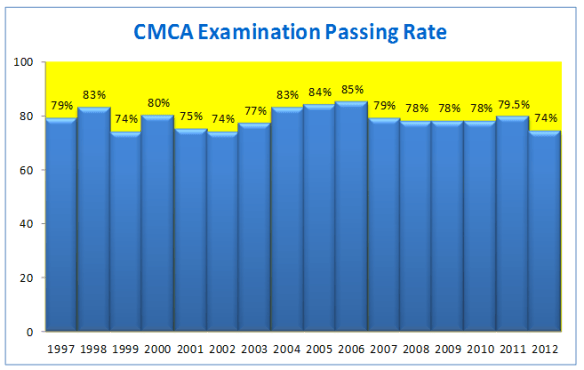
As of December 4, 2012 the overall CMCA passing rate is about 79%.

 CMCA passing rate

CMCA Retention

CMCA Retention remains steady for 2012 at 81%.

 CMCA retention rate

We look forward to sharing more progress and exciting developments in 2013, and wish you and your loved ones a happy holiday season.

Does your board communicate how it spends its time?

by: Donna DiMaggio Berger, Esq.

At every one of our Board Member Boot Camps, I ask those board members in attendance whether they advised their members that they were spending the better part of their Saturday at an intensive board member training session. In a packed room, only one or two hands typically are raised.

We often surmise why boards don’t communicate the less than positive things they do but why wouldn’t board members share with their members the amount of time they spend performing their duties on behalf of the community?

Boards often assume incorrectly that their members know about the number of hours they spend fulfilling their board duties. Discussions that take place at a meeting don’t often reveal the hours of preparation that led up to that meeting. Moreover, as many of you already know, far too many members don’t attend meetings and even fewer read the minutes of those meetings. How then can most association members have any sort of realistic idea of the time their board spends (or doesn’t spend) to actually operate and administer the community? Why do most boards overlook the power of consistent and timely communication?

There is probably little harm and much benefit that could be accomplished in advising your members about time spent in the following manner:

-Hours spent attending a board member certification class
-Hours spent attending other educational classes designed to give you tools to assist your community
-Hours spent reviewing status reports and communicating with legal staff for matters being handled by association counsel
-Hours spent vetting service providers and managing those relationships to ensure continuing good service
-Hours spent responding to member and resident complaints, inquiries, etc.
-Hours spent directing professional management
-Hours spent researching various repair, improvement, maintenance, security and insurance items
-Hours spent overseeing various repair, improvement and maintenance projects
-Hours planning community events
-Hours spent maintaining the community website, newsletter and other communications portals.

Some boards do choose to send out a year-end summary and have been criticized for “electioneering activity”. My recommendation is that boards should be communicating how they spend their time year-round and not just when elections are around the corner. Serving on a highly functioning board of directors requires quite an outlay of time and energy. Boards shouldn’t assume that members know the amount of time being spent on their behalf. The fact is that most members don’t spend much time thinking about the board or its activities unless something is terribly amiss in the community or the members are being asked to write a check.

Of course, if your board does start communicating about time spent, it goes without saying that your communications must be factual rather than boastful and designed to keep your members informed rather than simply to keep you on the board.

Community Associations and Identity Theft

by: Donna DiMaggio Berger, Esq.

ID

The Federal Trade Commission estimates that as many as nine million Americans have their identity stolen each year. Yes, you read that correctly…nine million and that number is growing!

None of us are truly insulated from the possibility of having our identities stolen unless we refuse to purchase items or pay bills by check or credit card and never venture out of the house to the doctor’s office or other location where our private information may be required. However, for those of us living in community associations, the threat may be even greater, particularly if sensitive information was gathered during the approval process and such information is not destroyed or, at a minimum, safeguarded.

Some but not all associations do run background and even credit checks on potential purchasers and renters in their communities. Often, a social security number, date of birth and enough other information to effectively steal an identity is requested on the application. The association uses this information to presumably undertake its due diligence and determine if the renter or purchaser poses any sort of real or financial threat to the community.

Assuming the association’s governing documents provide the board with the authority to perform such scrutiny, the real concern then becomes what happens with that sensitive information provided by the purchaser or renter? Is it immediately shredded or is it tossed in the garbage where it can possibly be retrieved by an identity thief? If it is not destroyed, where is it stored and who has access to it? Is the information kept under lock and key with only limited access by a defined group of people or is it tossed in a drawer and no further thought given to its existence?

As the identity theft crisis continues to grow, boards and managers who come into contact with sensitive information must start asking the foregoing questions and creating useful protocol to ward off a potential problem. Individuals applying to live in or rent in a community association should inquire about how their personal information will be handled both during the approval process and aftewards.

Victims of identity theft spend countless hours and real dollars trying to clear their credit history and correct their financial resources. Horror stories abound about the steps needed to pick up the pieces in the most drastic identity theft scenarios. As a result, many insurance companies are now offering relatively inexpensive identity theft endorsements to standard homeowners’ and renters’ policies. Homeowners should ask their insurance agents about the benefits of this coverage and the costs. Boards who collect sensitive information should similarly speak to their insurance agents about what they can do to protect themselves and their residents from an identity theft incident.

It’s never too soon to start thinking about ways to protect yourself and your community from this insidious problem.

Should You Bother Using Social Media to Serve Customers?

by Matt Dixon and Lara Ponomareff

social-media

“I’m telling everyone I know about how rude your customer service people are.”

If you were browsing Facebook or Twitter and you saw a comment like this about your company, we’d bet you’d instinctively want to respond to that customer to try to fix the relationship. Comments like these put us on the defensive — we want to prove to both this customer and everyone else that will see this post that our companies deliver high-quality service. It’s this instinct that has led to the growth of social media as a customer service channel.

Here at CEB, we regularly field questions from customer service leaders about social media, including how to develop policies and strategy, staff and train teams, and measure success. And we find that most companies make one fatal assumption: that social media is an effective service channel to resolve customer issues.

In the rush to help vocal customers via social media, many have jumped into implementation without taking a step back to ask themselves four critical questions:

Why is this important to customers?
Social media usage has exploded over the past few years, and provides many benefits to users. But what about specifically resolving customer service requests? Turns out people value social media to connect with friends, find jobs, and evaluate brands/products, but their opinion changes for post-sales support. Our research finds that 84% of customers have never used social media platforms to contact customer service and 83% do not expect to resolve customer service issues on social media platforms. So, ask yourself: Is this important to the vast majority of our customers, or are we serving a small (but vocal) minority?

What are we trying to achieve?
When customers do use social media for service, they often feel forced to go there to ‘vent’ — as a last resort because the company was “ignoring my issues in other channels.” Only 1.8% of customers go to social media first for customer service. If we want to achieve resolution for customers, shouldn’t our first priority to be to fix the gaps in traditional service channels like phone and web self-service — the channels customers tend to prefer?

What makes this solution work?
If issue resolution is the goal, then we have to look at social media’s ability to fully resolve service issues. 84% of customers don’t necessarily care what channel their issues are resolved in, just as long as it is fast and easy. That’s what makes the solution work for them. Unfortunately, social media can require back and forth messages to gather required details (and often ends up in an e-mail or phone call to gather personal information). If we know resolution for a particular issue in social media will be a frustrating process for customers, shouldn’t we guide them away from social media and towards a channel that will provide a better experience?

Am I prepared for it to work?
Companies who have nailed customer service in social media often tell us that they should have been more careful with what they wished for. By successfully handling customer service requests in social media, they teach their customers not only that they can get resolution in social media, but inadvertently show them that to ‘jump the line’ and get immediate attention, they should just publicly complain. Some even wonder if they have taught their customer bad habits. So, if it ends up working, are you ready for the potential implications?

Of course, social media can effectively be used for certain types of customer service. We’ve seen vibrant online customer communities for technical products where customers solve each other’s problems, instances of avoiding customer churn by reaching out to complaining customers via Twitter, and times when customers get information on Facebook that teaches them about their product.

But, before you jump the gun and start a social media team, stop for a moment. Ask yourself these four questions, and you might come to a very different conclusion about how to serve customers via social media.

Matt Dixon is an Executive Director of CEB’s Sales and Service Practice. Lara Ponomareff is the Practice Manager of CEB’s Customer Contact Council.