CAMICB: New Name for NBC-CAM

CAMICB_LOGO_RGB

The National Board of Certification for Community Association Managers (NBC-CAM), the organization that administers the Certified Manager of Community Associations (CMCA) credential, was recently renamed Community Association Managers International Certification Board (CAMICB). The name change reflects a strategic commitment to professionalism, knowledge and sound business practices in community association management throughout the world.

The organizational name change is effective immediately. The new organizational name will be phased in over the coming weeks online and in all print materials.

In discussing the rational for the name change, Rob Felix, CMCA, LSM, PCAM, RS, chair of the NBC-CAM board of commissioners, has noted, “In recent years we have partnered with organizations in Australia, Dubai, South Africa and elsewhere to instill high standards of professionalism in our industry across international boundaries. As we expand the use of the CMCA to international audiences, a name change became appropriate.”

It is important to note that the policies, procedures and processes in place for the administration of the CMCA credentialing program are not impacted by the change in organizational name. The CMCA application process will not change, nor will delivery of the CMCA exam. The CMCA examination will continue to be developed and maintained in full compliance with the standards linked to the examination’s accreditation through the National Commission for Certifying Agencies (NCCA).

The CAMICB Board of Commissioners and staff look forward to increasing both the reach and the recognition of the CMCA credential –“The Essential Credential” in the field of professional community association manager.

For more information, e-mail info@camicb.org.

Home prices keep soaring

home prices

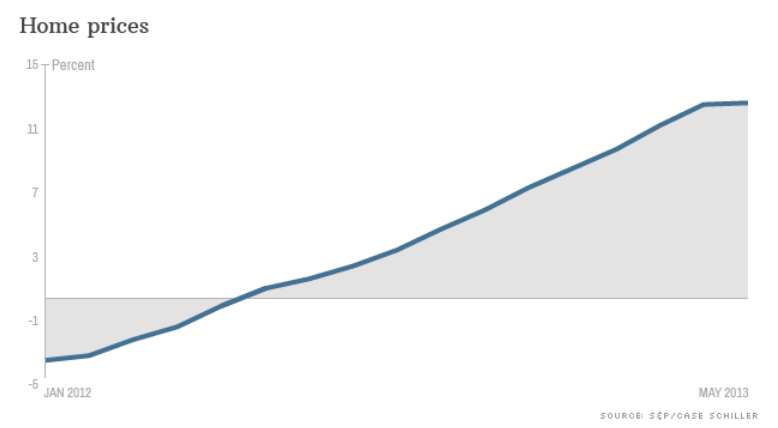
Home prices continued to gain steam in May according to a closely-watched reading, even as mortgage rates climbed.

The S&P/Case-Shiller home price index was up 12.2% compared to a year ago, slightly better than the 12.1% rise in April. It was the biggest year-over-year jump in prices since March 2006, near the peak of the housing bubble.

Just a year ago, the index showed a 12-month decline in prices. But they have increased every month since June 2012, and each month the increase has been greater than the month before.

Home values have been rising due to a combination of factors, including a drop in foreclosures that had been putting downward pressure on prices, and a tight supply of houses available for sale. But the record low mortgage rates of earlier this year have risen significantly since then, crimping the purchasing power of potential home buyers.

Still, at least in this May reading, the mortgage rates have not slowed the rapid increase in prices.

“Home prices continue to strengthen,” says David M. Blitzer, Chairman of the Index Committee at S&P Dow Jones Indices. All 20 markets measured in the index have higher prices than they did in April. And two cities – Dallas and Denver — now have prices that are even higher than they were at the height of the bubble.

Many of the markets with the biggest year-over-year changes in prices are those that were hit hardest by the collapse of housing. Prices in San Francisco, Las Vegas, Phoenix and Atlanta are all up more than 20% from a year ago. New York had the most modest rise with a 3.3% increase.

But the rapid price gains over the last year are at a level that no expert thinks can be sustained. Some had even suggested it was unhealthy for the market, raising the risk of a new housing bubble, at least in some regions. The rapid rise of housing prices in the middle of the decade eventually sparked the crisis in the financial markets and the Great Recession.

In the News: Pool Rules

By David Thackham

Citing the safety of South Carolina Legacy Park residents, the Indian Land community’s Homeowner’s Association Board of Directors has said it will operate its swimming pool according to the state’s proposed lifeguard standards.

The standards from the state Department of Health and Environmental Control typically govern public municipal pools, known as Type A. But the standards are being temporarily used to regulate other pools across the state, including those known as Type E, as of July 2.
Because Legacy Park’s pool has two slides, it is considered a Type E swimming pool and falls under the state regulations. It also has a variance to operate as a Type B structure if the slides are closed and secured.

One concerned resident, Laura Bain, had expressed public opposition to the board’s willingness to work within DHEC’s ruling. Because it is a private homeowner’s association pool, she felt it should not be run under public pool guidelines.

Board of directors president Melvin Stroble said safety is the chief concern.

“I’d rather not have the slides at all than for someone to get hurt,” Stroble said Wednesday.
Earlier this swim season, Legacy Park could only run its slides on the weekends, when they had enough staff to watch swimmers in the 4,252-square-foot pool.

DHEC and Legacy Park’s HOA Board of Directors have been working together to make sure the slides are operational throughout the week, on limited hours.

The law regulating Type E swimming pools was amended by the S.C. General Assembly in 2012, requiring such pools to submit a plan for lifeguard coverage to DHEC for approval.

Legacy Park complied and sent three separate lifeguard coverage plans to the state. The latest plan was approved, but then rescinded days later.

The reason DHEC said it could not approve the plan was because the state laws “do not provide a definitive standard for lifeguard coverage at Type E pools” and that they have yet to identify a national standard for such pools. In the meantime, Legacy Park will effectively operate under Type A rules.
“DHEC has been very cooperative with us,” said Troy Guild, vice president of the Board of Directors. “They’ve said flat out in both letters, ‘We’ve been given this issue for the first time, but unfortunately, we haven’t figured out how to handle it for safety reasons, but we’re working through it.’”

As DHEC searches for that standard, all other Type E pools across the state will also need to either comply with Type A rules or submit a pool-specific plan.

In a July 2 letter sent to all Type E water facilities, DHEC indicated that a pool the size of Legacy Park’s would need to staff three lifeguards if there are 26 to 50 swimmers in the pool.
Bain had appealed to Legacy Park’s pool committee to convince the Board of Directors that they should fight DHEC on its decision. But the Board decided it was best to work with DHEC.

“If we become adversarial with a government entity, they’re going to drag their feet and no one wins,” said board member John Maroney. “Our focus and influence is in the community and doing what’s best for them.”

Does your community have pool regulations? Share what you know in the comments.

Message from CAI

FHA Relents on Condo Transient Leasing Restrictions

The Federal Housing Administration has announced that condominiums providing bank owned properties limited flexibility from transient leasing prohibitions are now eligible for FHA approval. CAI applauds FHA’s decision, which will make it easier for more condominiums to be certified by FHA.

Under FHA’s new policy, condominium associations in violation of FHA prohibitions on transient leasing are offered two compliance options:

1) The association may amend governing documents to remove bank owned property exemptions from transient leasing prohibitions, or

2) The association board may provide a dated and signed statement on association letterhead affirming that no units within the condominium project are leased for a term of less than 30 days and tenants are not provided services commonly associated with a hotel.

To read the entire announcement, please visit CAI’s government affairs blog, which can be found here.

For more information please contact CAI’s Government & Public Affairs Department at 888.224.4321 or government@caionline.org.

Lunch at your Desk

By Anne Fisher in FORTUNE Magazine

Eight out of ten employees now gulp a quick lunch at their desks, says a new survey. But not taking a breather during the day, even for just a few minutes, is a recipe for burnout.

Lunching al desko again today? You’ve got lots of company. Only 21% of people now regularly leave their workstations for a midday meal, according to a poll of 1,023 U.S. employees by talent development consultants Right Management.

These days, “far fewer employees are feeling comfortable enough with their work loads to take time away” for a quick bite, notes Michael Haid, a senior vice president at the firm.

Haid adds that many companies’ cultures make people feel they need to apologize for stepping away from the grindstone even for 30 minutes. “One has to ask if such pressure, without any let-up, actually benefits the individual or the organization,” Haid says. “I mean, does it really improve performance? We are definitely not talking about a return to the days of the three-martini lunch, but have we gone too far in the other direction?”

He thinks so. Employees fearful of being seen as slackers “begin to sacrifice their own break times in order to keep up with their workloads. So, whether the organization is imposing unrealistic workloads or whether employees are progressively giving up their own break times, leaders need to pay close attention and understand the early warning signs” of burnout, Haid says.

Tony Schwartz, head of New York City-based productivity consulting firm The Energy Project, says more and more companies are starting to recognize the problem. “What’s at risk, when employees are overworked and stressed out, is their capacity to do great work,” he says. The Energy Project’s clients — including Bristol Myers Squibb (BMY), Apple (AAPL), PwC, Google (GOOG), Sony (SNE), Ford (F), and Ernst & Young — “see a clear link between exhausted employees and poor performance. Avoiding burning people out is critical to success, both for companies and for individual bosses.”

A big part of keeping burnout at bay: Encouraging employees to take a break now and then. “When demand in our lives intensifies, we tend to hunker down and push harder,” Schwartz observes. “The trouble is that, without any downtime to refresh and recharge, we’re less efficient, make more mistakes, and get less engaged with what we’re doing.”
The paradox here, he says, is that “by pushing people too hard, you actually make them less productive. But if employees learn to manage their energy better,” partly by taking short respites from work throughout the day, “they get far more done, and add much more value, in far less time.”

Curious about how well (or how badly) you, or your employees, are managing energy? The Energy Project has devised a quick 20-question quiz, administered to thousands of employees over the past decade, to help people pinpoint whether they might be headed for burnout. The results, Schwartz says, are usually “depressing but eye-opening. The average score is 14, meaning that, out of 20 behaviors people regularly engage in, 14 are energy-depleting.”

One of those behaviors is — you guessed it — skipping lunch breaks. “Letting employees recharge at midday is a tremendous competitive advantage,” Schwartz says. “Look at Google. Everyone goes to lunch there. The food is great, and it’s free. And people are having terrific conversations in the dining room.

“Facebook and Twitter now offer the same thing, that chance to connect with colleagues and share ideas over a relaxing meal,” he adds. “Obviously, these are highly successful companies, with forward-thinking management. Look at what’s happening there, and you’re seeing the future.” One can only hope.

Second-hand Smoke

Guest post by Lisa A. Magill

Condominium board members that are feeling pressure from members to address the issue of second-hand smoke will be pleased to learn that there is a combined effort on the part of the U.S. Department of Housing and Urban Development (HUD), the U.S. Department of Health and Human Services (HHS) and others to advocate and encourage multifamily housing owners and operators to adopt smoke-free policies to protect residents from the dangers of second-hand smoke and to reduce property maintenance costs. A new 63 page manual for owners or management agents of federally assisted public and multi-family housing has been published that provides eye-opening facts for community leaders, managers and operators. Smoke Free Housing is a 63 page compilation of material that includes specific information that can be helpful in limiting or eliminating smoking on multifamily buildings, as well as links to additional resources.

From the manual:
1. Over 140,000 fires were started by cigarettes, cigars and pipes in the U.S. causing $530 million in property damage, according to the National Fire Protection Association.
2. Twenty-five percent of people killed in smoking-related fires are not the actual smokers, with many being children of the smokers, neighbors or friends.
3. Smoke-free housing saves on property maintenance costs from cleaning and painting stained walls and ceilings and repairing burn marks; and
4. Secondhand smoke is also associated with Sudden Infant Death Syndrome (SIDS).

As courts across the country are addressing nuisance claims brought by non-smokers, with more and more ruling in the non-smoker’s favor, smokers have been required to install air ventilation systems and extra insulation to prevent smoke from entering other units. Some communities are voluntarily becoming “smoke free” through amendments to their governing documents and some municipalities have adopted ordinances prohibiting smoking in private residential buildings altogether – even if confined within the unit!

The issue of second-hand smoke is not going to go away. There are options to consider if residents are pressuring the board to do something about the odor, adverse health impacts, costs and annoyances caused by second-hand smoke and resources such as the Smoke Free Housing manual are available to assist in the effort.

How to Get Everything You Want

By Dave Kerpen

Getting what you want in your career and in life isn’t as difficult as it may seem. I mean it.

I’ve been very fortunate, both professionally and personally, and along the way learned seven key ways to help make it happen. In essence, I work to put others first, and to be more likeable, to end up with what I want in everything I do. I’ll be writing about this in far more detail in my third book next year.

In the meantime, here’s a sneak peak at how you can be successful in everything you do, too:

Listen First and Never Stop Listening
Listening is the single-most important skill in professional and personal relationships. Ernest Hemingway said, “When people talk, listen completely. Most people never listen.” It’s sad, but true: Most people have their own agenda and are too busy talking (or waiting to talk) to listen to you. So here’s the paradox: If you, unlike most people, can truly listen with empathy, then people will like you–and eventually help you get what you want.

Help Others
It’s perhaps another paradox, but it works: When you want something from someone, instead of asking for it, help that person get what he or she wants. If you don’t know what he or she wants, then simply ask, “How can I help you?” Since so many people are out to only help themselves, when you genuinely seek to help others succeed in their goals and dreams, you’ll stand out. And those people you genuinely help will in turn fight to help you succeed and give you everything you want. Help others first, without expecting anything–and the returns will be enormous.

Be Yourself: Authentic, Transparent, and Vulnerable
Oprah Winfrey stated, “I had no idea that being your authentic self could make me as rich as I’ve become. If I had, I’d have done it a lot earlier.” Professionals, especially of an older generation, tend to have a tough time with authenticity and transparency in the workplace. People, especially men, tend to have a tough time being vulnerable, especially with people they don’t know well. Many also aren’t sure how much to reveal online, or at work, or to people they’ve just met. But, hard as these choices may be, authenticity, transparency, and vulnerability all breed trust. And when people trust you, they’ll do anything for you. Open up to people, and take a chance, and you’ll be rewarded.

Tell, Don’t Sell
As important as it is to listen and help others, in order to get what you want, eventually you’ve got to tell people what that is. But nobody wants to be sold to. So whether it’s a product, service, idea, or yourself that you’re trying to sell–give up on “selling.” Instead, focus on telling a great story–captivating your audience, bringing to life what the future will bring, and painting a great picture of what will happen if you get what you want. When you get good at storytelling, people want to be part of that story–and they want to help others become part of that story too.

Inject Passion Into Every Interaction
Passion is contagious, but so is lack of passion. If you’re not passionate about what you’re talking about, why should someone else care? If you want something, you must be more excited and dedicated to it than anyone else. If you’re not passionate about it, maybe it’s not really that important to you. Not everyone is super high-energy and extraverted, though these qualities can help convey passion in many cases. Passion and energy alone put me through college with my first job. But ultimately, you don’t need to be bouncing off the walls to convince someone of something. You just need to reveal your true passion, in the way that’s genuine for you.

Surprise and Delight Others
You know how when you walk into a casino, there’s always a slot machine going off somewhere in the background, telling the world that another person just hit a jackpot? This is what social psychologists call variable rewards. You don’t know when you’re going to win; you just have enough positive experiences that you feel excited, even when you’re not winning. When you surprise and delight others, not only do you make them happy–you remind them that you’re the type of person who might surprise and delight them soon again. Some classic examples: bringing home flowers to your wife for “no reason”; telling a customer his order will arrive next week but then overnighting it; and now, tweeting to a random prospect that she’s won a free prize. If you go out of your way to make an experience with you special, especially when people least expect it, you will get huge results over time.

Use The Four Most Important Words in Business and Life
Say “I’m sorry” when you make a mistake and “thank you” as much as you can. These words are so simple, yet so often people overlook the importance of saying them. Everyone makes mistakes, and everyone knows that. It’s not when you make a mistake that’s a problem; it’s when you make a mistake and are too proud or embarrassed to be vulnerable, fess up, and apologize. Just say “I’m sorry” and let another person forgive you, so you can move on, and eventually get what you want. Conversely, sincere gratitude to people is a powerful emotion to convey, and opens up many doors. I send three hand-written thank you cards every morning. I send them to staff, customers, vendors, the media, and friends, and not only do I find people love receiving cards, but writing “thank you” puts me in an incredible mindset to start my day. This is not just about sending cards, though. It’s about having a deep appreciation for and wonder about the people and world around you.

Dave Kerpen is the CEO of Likeable Local. He is also the cofounder and chairman of Likeable Media and the New York Times bestselling author of Likeable Social Media and Likeable Business.

Out of Town

Do you manage a community comprised of second homes? Do you have a timeshare or condo you only frequent seasonally? Here are some tips to keep a home safe for those who are away for extended periods. Do you have additional tips for your homeowners? Write them in the comments below.

1. To minimize damage caused by mold and mildew, air conditioners should be set at 70 degrees with the humidistat at 55 percent. Be sure the control remains on the “Cool” setting.

2. Water damage is a major concern, and main water valves should be shut. Open all water faucets to relieve pressure in the lines.

3. Unplug all electrical appliances.

4. If you have an alarm, let your alarm company know that you are going to be away and give them your very nice friend’s contact information.

5. Make sure the smoke detector batteries are in good condition.

6. Check all faucets and make sure they are not dripping.

7. Either put a vacation stop on your mail delivery or notify the post office for mail forwarding. This includes your newspaper and magazine subscriptions.

8. If you have storm shutters, put them in place, unless your association does not allow them to be in place if a storm is not approaching.

9. Remove all items from porches and patios.

10. Remove hidden keys from under the mat, rock or planter near the door.

11. Be careful of what you post on your social networking sites. Tweeting about packing your house for two months is not the brightest thing you should do. If your children are old enough to be online and they are going with you, set some rules about what not to post online.

12. Set up automatic payments or pay your bills in advance.

13. Open closet doors, cabinet doors and furniture drawers to allow for air circulation.

14. Keep appliance doors open. This means you will have to toss food in the refrigerator and freezer.

15. Close drapes and blinds.

Door-to-Door Recruiting

The Chestnut Hill Community Association in New York plans to reverse a downward trend in membership.

In order to generate more revenue, the Chestnut Hill Community Association will undertake several new measures to attract new members in the upcoming months the organization announced at its June monthly meeting.

“We’ve had a ten percent decrease in membership over the last three years,” said board member Mike Chomentowski. “We’re not doing a good job of getting new members or keeping the ones we have.”

The new membership push comes as part of multi-pronged strategy to generate more revenue for the organization.

At the end of 2012, the Chestnut Hill Community Association faced a $20,000 budget gap that it closed by borrowing revenue from the Chestnut Hill Local.

The association is now seeking to find new revenue streams to repay that money.

“We need to focus on new resident outreach,” Chomentowski said. “There have been 250-300 new residents in the area in the last 12 months.”

Chomentowski said that he and several other board members will be going door to door to try to recruit new members.

“We’re going to give them a temporary membership card, so that they can see the benefits of belonging,” Chomentowski said.

Chomentoski added, “We’ve been neglecting new people, and that needs to change.”

How does your association recruit?  Add your thoughts in the comment section.


CMCAs Only – Information and Resources

As a CMCA, you have shown a commitment to your profession by staying informed about current community association issues and holding yourself to a high standard of professional conduct.

Check out the updated “CMCAs Only” section on our website. You’ll find

  • Resources to assist you in your career, including: CAI Professional Management Development Program (PMDP) course schedules,
  • Links to CAI chapters and the Job Market,
  • The Directory of Credentialed Professionals,
  • A sample press release you can use to spread the word about your certification,
  • Information you can share with your employers in order to gain support for your professional development,
  • Application and dates for recertification, so you can keep your CMCA certification current—and keep your homeowners and employers confident in your ability to provide quality service, and
  • How to stay connected to other CMCAs by joining the Listserv or subscribing to Community Association Management Smartbrief, the CMCA weekly e-newsletter.