CAMICB is a more than 25 year old independent professional certification body responsible for developing and delivering the Certified Manager of Community Associations® (CMCA) examination. CAMICB awards and maintains the CMCA credential, recognized worldwide as a benchmark of professionalism in the field of common interest community management. The CMCA examination tests the knowledge, skills, and abilities required to perform effectively as a professional community association manager. CMCA credential holders attest to full compliance with the CMCA Standards of Professional Conduct, committing to ethical and informed execution of the duties of a professional manager.
The CMCA credentialing program carries dual accreditation. The National Commission for Certifying Agencies (NCCA) accredits the CMCA program for meeting its U.S.-based standards for credentialing bodies. The ANSI National Accreditation Board (ANAB) accredits the CMCA program for meeting the stringent requirements of the ISO/IEC 17024 Standard, the international standards for certification bodies. The program's dual accreditation represents compliance with rigorous standards for developing, delivering, and maintaining a professional credentialing program. It underscores the strength and integrity of the CMCA credential.
Privacy Policy: https://www.camicb.org/privacy-policy
Roberto Noce looks at what a board needs to do get its financial house in order for The Calgary Herald
Question: I am the president of my condo board. Our condominium complex has just under 100 units. We are struggling financially, and have some major repairs ahead of us. We have no money in our reserve fund. We are dissatisfied with our current property management company, and half the board wants to self-manage in an effort to save money. I disagree. Is self-management a wise decision given the number of units? Please help!
Answer: The Condominium Property Act does not require condominium corporations to hire a property/condominium management company. Condominium corporations can decide to self-manage. The board of the condominium corporation can directly manage the corporation.
The reason that self-managed condominium corporations are not that common is because most board members do not have the time to take care of the many administrative responsibilities of a condominium corporation, such as collecting condominium fees and dealing with complaints.
Before deciding, the board should determine what things the property/condominium management company does, and who on the board would take on those responsibilities in the event that you terminate your property/condominium management company.
As well, you stated that you are struggling financially as a condominium corporation. Why? Is this the fault of your property/condominium management company, or is it because the board (and previous boards) failed to make important financial decisions about the future of your condominium corporation? Are your condominium fees too low? Have you not budgeted properly to deal with the day to day responsibilities and future needs of the condominium corporation?
Your question cannot be answered with a simple yes or no. Rather, you should hire an accountant and a lawyer to assist you in understanding how you can get your financial house back in order. Finally, the board needs to fully grasp its responsibilities if you decide to self-manage.
Helpful Hint: Living in a condominium complex requires patience. Condominium managers play a vital role in condominium living. The right condominium manager will significantly lower board members’ workloads, and provide service to owners on timely basis. You should shop around and interview prospective condominium managers if you are not currently satisfied.
Roberto Noce, Q.C. is a partner with Miller Thomson LLP in both the Edmonton and Calgary offices. He welcomes your questions at albertacondolaw@millerthomson.com. Answers are not intended as legal opinions; readers are cautioned not to act on the information provided without seeking legal advice on their unique circumstances. Follow Noce on Twitter at @RobertNoce.
HOAs usually charge fees that add to monthly housing costs.
There are benefits of HOA living despite the fees and restrictions.
When you are buying a house, you’ll likely come across many neighborhoods where there is a homeowners association. HOAs often impose rules about what you can do with your home, and they also charge fees you’ll have to pay each month on top of your mortgage payment.
While the added cost of an HOA may seem undesirable, there are actually a few big benefits of living in a neighborhood with an association. In fact, here are some of the biggest upsides of living someplace with an HOA.
1. The HOA protects your property values
Your property values are affected by the quality of your neighborhood and by how your neighbors maintain their houses. After all, no matter how nice your own property is, no one will want to buy it if it’s next to a slum.
Homeowners associations set and enforce rules related to the upkeep of property in the neighborhood. They may also set other restrictions such as requiring approval before painting a house or adding lawn ornaments. These rules help keep the neighborhood looking nice, which in turn keeps property values higher.
2. The HOA maintains the neighborhood and amenities
HOAs usually maintain common areas, and some neighborhoods with strong associations have lots of amenities such as pools or golf courses.
These features can add value to your home since they are desirable to buyers, and they can also make it nicer for you to live in your neighborhood since you can take advantage of them.
3. Fees may include common utilities and maintenance tasks
In some cases, HOA fees include things like internet service, pool maintenance, or lawn care. When that is the case, it’s convenient to pay one common fee to get many different services rather than having to arrange for them individually and contract with companies to pay for them separately.
In some situations, you may actually end up saving money because it can be cheaper for internet companies or landscaping companies to provide their services to an entire neighborhood rather than to just individual households. The fees you’re paying could actually be a better value than paying for these services privately.
4. The HOA can deal with neighborhood disputes
When people live in close proximity to one another, it’s often inevitable that disputes arise. There could be issues for a huge number of reasons, from barking dogs to lawns that aren’t maintained to loud music playing and more.
When you live in an HOA neighborhood, you don’t have to directly deal with a neighbor who is causing you problems in your enjoyment of your own home. The HOA most likely has regulations related to common nuisances or issues that come up regularly. They’ll take care of addressing the issues that arise among neighbors so you don’t have to sour your relationship with those living near you or cope with the stress of a confrontation.
For all of these reasons, it’s worth considering an HOA neighborhood when you buy a property. Just remember you need to be comfortable with the rules the association sets as you’ll have to live by them too.
The 2021 Community Association Manager Compensation and Salary Survey, conducted by the Foundation for Community Association Research, is now available for purchase as a digital book from CAI Press. This survey is a valuable tool for benchmarking compensation and benefit levels in the community association industry. The 2021 survey provides an interesting snapshot of the field, and enhances our understanding of this growing and dynamic profession. The information in this seventh edition of the survey represents the most comprehensive, accurate, and current data on compensation received by management professionals. It is designed to allow a company or manager to compare their pay with peers.
In addition to providing basic company and manager profile and salary information, the survey also includes the following:
Compensation outlook for the community association industry
Compensation by job title, presented by regions and states, for management company CEOs, company executives, high-rise managers, onsite managers, portfolio managers, and assistant community managers
Compensation by job title, presented by regions and states, for large-scale managers and employees at large-scale communities including the assistant general manager, architectural review manager, business/finance manager, communications/member services/marketing manager, events manager, facilities manager, fitness center manager, grounds manager, human resources manager, IT/computer systems manager, public safety/security chief, and recreation/lifestyle manager
Salary differences between managers with and without professional credentials
Data based on community association size, in addition to management company size
Information on employee benefits, health coverage, and retirement plans
Community managers who completed the salary survey receive complimentary access to the data and reports (not the digital book). For more information on how to access the survey findings, go to https://foundation.caionline.org/research/salary_survey/
By Matthew Green , CAMICB Associate Executive Director
If you love the idea of a job that offers opportunity, stability, and growth, community association management provides an excellent career path. It’s a great job choice for people who previously worked in the leisure and hospitality industries. Those sectors continue to lead U.S. job losses amid COVID-19, with experts predicting slow growth until at least 2023.
It wasn’t so long ago the hospitality industry was one of the most promising fields. It set people up for a successful career in people-facing jobs at hotels, restaurants, conference centers, major event venues, and more. Unfortunately, a boom in hiring came to a halt in mid-March 2020, as events were cancelled, and many restaurants and hotels closed their doors.
The good news is that though the coronavirus has dashed a lot of hopes for hospitality grads and veterans, the world of community association management is a bright spot. The field continues to grow and offers excellent opportunities for anyone who wants to continue in a people-oriented career.
Community Association Management Stats
The Community Associations Institute (CAI) reports that as of 2019, there were approximately 351,000 community associations in the United States. They house nearly 74 million residents, over 11 million more than just a decade ago. Twenty-six percent of people in the U.S. live in a community association.
It’s estimated there are about 8,000 community association management companies in the U.S. and up to 55,000 off and on-site community association managers. As the number of people living in community associations continues to rise, so does the number of jobs for community association managers. If you’re a people person who’s skilled in handling multiple tasks, a career in community management can be an incredibly rewarding career choice.
Community Association Management Career Outlook
Job prospects in the community association management sector are excellent. Though a college degree and professional designation are not necessary to land a position in the field, those who do command a higher salary when starting out. As of May 2020, the median wage for community association managers was $59,660 per year. In 2019, there were 367,900 jobs in the field. Employment in the industry is projected to grow seven percent from 2018 to 2028.
Job prospects and projected wages vary from state to state and community to community, so it’s a good idea to check out your area’s particulars.
CMCA – The Essential Credential
The key to building a successful community association management career is the Certified Manager of Community Associations (CMCA) credential. Holding the certification lets employers know you’re educated and competent in certain management practices. It also indicates your dedication to professional excellence, ethical business standards, and continuing education. Community management employers are continually looking for committed professionals. The CMCA certification can often make the difference between whether or not you land a first interview.
The CMCA credential is relatively easy to obtain and:
Is relatively low-cost for such a valuable investment in your career and future.
Earning the CMCA credential opens the door to earning additional credentials and up to 20% higher earnings than community association managers who are non-credentialed.
Is a Certified Manager of Community Associations Career Right for You?
If you were previously employed in the hospitality sector but were furloughed or had your job eliminated due to the pandemic, a community association management position could be an excellent career pivot for you. The work is interesting, varied, and highly satisfying. Your daily tasks can see you:
Working closely with residents and Board members.
Making visits to the community.
Interacting with community leaders.
Hiring and supervising outside vendors.
and a whole lot more.
Requisite skills align well with those that people in the hospitality sector possess, such as attention to detail, flexibility, and good organizational skills. Top-tier community association managers also have excellent interpersonal skills and can effectively communicate with a diverse range of people.
All Work and No Fun?
A community association manager has a busy job, but it can also be a lot of fun. Along with the potential of receiving a great salary, you get to constantly learn new things and meet interesting people. The likelihood of ever being bored on the job is slim—there are just too many interesting things to do and people to meet!
While community association management is not for everyone, if you’re a real people person who possesses a positive and enthusiastic attitude towards life, gets excited about staying current with the industry’s regulatory changes, and can remain calm when others around you are stressed, you can’t ask for a more engaging and exciting career!
Becoming a certified manager of community associations isn’t merely a designation. It can truly be the journey of a lifetime. It elevates your credibility and assures employers they’re making the right hire.
Finally, it offers you a wealth of possibilities and growth in an exciting career that shows no sign of slowing down.
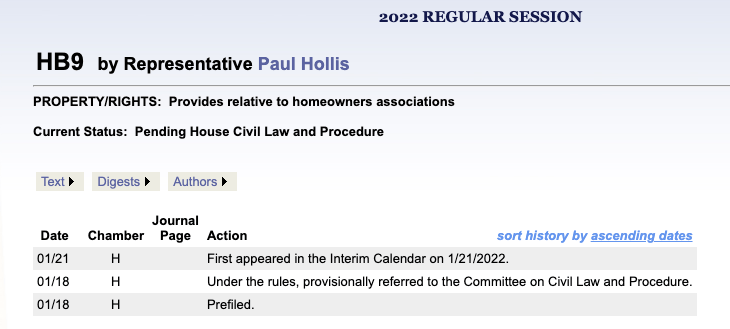
A Louisiana lawmaker wants to limit the authority of homeowners associations to ensure contracts respect constitutional rights.
State Rep. Paul Hollis, R-Mandeville, has filed House Bill 9 for the upcoming legislative session to insert language in state law in reference to “community documents” between homeowners associations and lot owners.
“Any provision of a community document which restricts a constitutional right of a lot owner or a person residing in a residential planned community shall be null and void,” the addition reads.
Currently, community documents of residential planned communities have “the force of law,” though provisions exist that ensure the Louisiana Homeowners Association Act doesn’t violate state or federal constitutional rights.
Hollis said the legislation was inspired in part by a dispute with his neighbor, who installed a camera peering onto his property and taunted him about it on social media. Hollis put up an 8-foot fence to block the invasion, and his homeowners association is threatening him with fines if he doesn’t take it down.
“They didn’t do anything to help our family,” Hollis said.
Hollis pointed to another example of a family in northern Louisiana that was banned from posting a sign in support of their military son, despite others in the same neighborhood displaying flags the same size.
In conversations about the issue, “I’ve just continued to hear horror stories” about homeowners associations selectively enforcing rules and the families they apply to, he said.
“They pick and choose which ones they’ll enforce,” Hollis said.
“I think HOAs while they can do some good, there are a lot of bad actors out there that are unchallenged, inconsistent and need more oversight.”
Hollis said he expects the House Civil Law Committee to weigh in on the proposal, but he is encouraged “at least the conversation is going right now.”
Hollis estimated 90% on the feedback he has received about homeowners associations has been negative, and he is compiling the complaints to illustrate the need for HB 9.
“It’s just putting a spotlight on the antics that have occurred,” he said.
Hollis said that while state law does include protections for constitutional rights as they pertain to the Louisiana Homeowners Association Act, he felt compelled to spell out the protections explicitly to ensure courts properly interpret legislative intent.
“I want to bring clarity by being specific and citing that in statute,” he said. “The more clarity you bring the better off you are.”
Jeffrey Sadow, an associate professor of political science at Louisiana State University, wrote an op-ed for The Hayride on Thursday blasting Hollis’ bill, which he claims “misunderstands property rights.”
Sadow encouraged Hollis and others in his situation to either work to change the rules of homeowners associations or to sell and move.
Hollis said he also is considering companion legislation to create an opt-out provision for folks who would prefer to leave their homeowners association.
“Most HOA benefits disappear under HB 9, and Hollis’ promised companion bill makes the concept entirely moot,” Sadow wrote. “With people buying in and later deciding the rules don’t suit them or never agreeing to them at all, the dissidents become free riders on the backs of those who want to make the tradeoff, creating an environment where nobody has any incentive to pursue HOA intended benefits which then disappear.”
The 2022 general session for the Louisiana Legislature begins March 14.
Greg Smith Named Vice Chair; Board Elects Three New Members
By Matthew Green, CAMICB Associate Executive Director
CAMICB is delighted to announce its 2022 Board of Commissioners welcoming Sandy Denton, CMCA, LSM, PCAM, to the role of Chair and Greg Smith, CMCA, AMS, PCAM to serve as Vice Chair. Denton has been a commissioner on the CAMICB Board since 2017. She has previously served CAMICB as a member of the CAMICB Exam Development Committee and Continuing Education Review Committee.
“Sandy brings a tremendous amount of experience and passion to the role of Chair,” said outgoing Board Chair, Drew Mulhare, CMCA, LSM, PCAM. “She is deeply committed to our profession, has a profound understanding of all facets of our business and has been integral to raising awareness of the CMCA credential.” Denton is a former President of the Board of Trustees of Community Associations Institute (CAI) and a past chair of the Foundation for Community Association Research (FCAR). She currently serves as a member of CAI’s Large Scale Committee, the CAI Government and Public Affairs Committee and is a faculty member for CAI.
Sandy Denton
“I’m honored and excited to serve as Chair of the Board of Commissioners,” said Sandy Denton. “Chief among our priorities this year is completing a job analysis to examine the current state of community association management – the responsibilities of a professional manager and the knowledge and skills required to fulfill those responsibilities. The process we use is rigorous, systematic and in strict compliance with best practices in the credentialing industry, serving as the cornerstone of the exam development process.”
Added Mulhare, “Greg, too, brings a wealth of industry experience to the Board. In particular, his understanding of – and deep interest in – the international community association management landscape.”
Greg Smith
“I look forward to learning from, and working alongside, this talented Board of Commissioners,” said Greg Smith. “In this role, I’m eager to apply my experiences from various positions in community association management, my perspectives as a practitioner in California, as well as an employee of one of the largest management firms in North America.”
Sandy Denton is currently the General Manager for the Sienna Plantation Associations in Missouri City, Texas. Sienna is a 10,000-acre mixed-use community, with more than 10,000 current units (residential and commercial) and another 4,000 to be built over the next 10-12 years. Prior to joining Sienna in 2005, Denton was the Executive Director for First Colony Community Association (FCCA) in Sugar Land, Texas, a large master planned community consisting of over 10,000 acres and approximately 12,500 units (residential and commercial). Denton was with FCCA for over 15 years.
Greg Smith has nearly 20 years of community management experience and has served in several positions including portfolio manager, vice president, and president. Smith has been a valued member of Associa, the industry’s largest community management company, since 2010. He currently serves as Director of Leadership Development where he is responsible for the training and development of Associa’s branch leaders, community managers, and board members across North America. Smith is a former CAI President and a current faculty member and has spoken at numerous CAI Annual Conferences and Chapter events.
Three new members of the Board of Commissioners, each elected to a three-year term, begin their term this month:
Kate Bushey, Esq. is a partner at Kaman and Cusimano, LLC where she oversees a full-time community association practice group. Bushey has attended and presided over hundreds of associations’ annual and special meetings. In addition, Bushey actively lobbies Ohio State legislators regarding pending community association bills and serves on the Board of the CAI Northern Ohio Chapter. She is also a member of the CAI Government and Public Affairs Committee as well as the Complaint Committee of the CMCA Professional Conduct Enforcement Committee.
Noelle Hicks, Esq. is an Associate at Roberts Markel Weinberg Butler Hailey (RMWBH) PC and practices in the firm’s Real Estate Section as a member of the Community Association team, based in the firm’s Houston office. Hicks assists single-family residential, townhome, condominium, and some commercial associations with various aspects of property owners’ association law including the collection of delinquent assessments, complex deed restriction enforcement issues, developing and interpreting governing documents, and drafting and reviewing contracts. In addition, she works with her association clients on various issues such as ensuring compliance with state and federal laws, attending administrative hearings and board meetings on behalf of her clients.
Michael Traidman is Chairman of the Desert Cities HOA Council (DCHC), a group of 600 HOA board members in the Coachella Valley who meet monthly to discuss and share best practices for how to manage their HOAs. He has served in this role for more than a decade. In 2019, while Traidman was president of the CAI Coachella Valley Chapter, the DCHC became affiliated with the Homeowner Leaders Council of CAI where the two organizations worked in tandem on projects relating to the education of board members as a top priority.
Board of Commissioners
CAMICB is governed by a nine-member Board of Commissioners. Eight commissioners are community association managers or industry stakeholders. One public interest member represents the interests of the constituencies served by the community association management profession. In addition to Denton, Smith, Traidman, Hicks, and Bushey other CAMICB Board of Commissioners include:
Rob Felix, CMCA, PCAM, LSM, RS (Secretary/Treasurer); Michael Hurley; Lori Loch-Lee CMCA, AMS, PCAM; and, James Magid, CMCA, PCAM.
As CAMICB celebrated its 25th anniversary, we reached out to CMCAs who’ve held the credential for 25, or more, years. Many CMCAs graciously offered to share their experiences, highlights, career paths and advice with us.
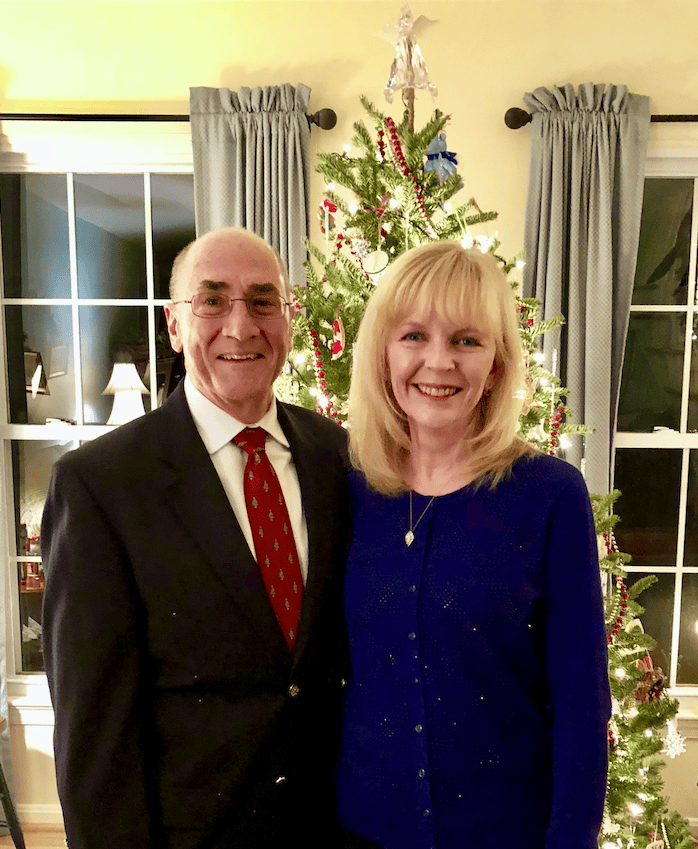
Paul and his wife Cynthia reside in Locust Grove, VA where they enjoy working around their home and floating on the lake.
Paul Orlando, CMCA, LSM, PCAM, began his career in 1974 when he moved to Virginia from Connecticut to manage community facilities and direct recreation programs for the Reston Homeowners Association (RHOA, now Reston Association, RA). He was awarded his CMCA in 1996, earned his PCAM in 2001, and LSM in 2011. In 2003, Paul was appointed to CAI’s Virginia Legislative Action Committee (VALAC) and later in 2012 became a member of the CAI National Faculty. Now retired after a career that spanned 45 years, Paul reflects back on a profession where he greatly enjoyed the interaction he had with fellow professionals and when clients (and even homeowners) expressed gratitude and recognition for the job he and his colleagues did for them.
Said Paul, “Early in my career, I felt having the CMCA credential and other designations demonstrated a very high level of professionalism to my future employers and clients.
“My first job as a community manager was on-site at a large scale homeowners association in Loudoun County, Virginia for two years. From there I went into portfolio management for both condos and HOAs. Condo management is very challenging but I’m glad I had that experience. The turning point in my career came when I returned to on-site management at a very large, developing community, earned my PCAM, was welcomed to the CAI National Faculty and became increasingly involved with CAMICB and CAI activities on a National level. I served on the CAMICB Exam Development Committee for several years; I currently serve on the CAMICB Continuing Education Review Committee, the VALAC and CAI National Faculty teaching M-100 courses.”
Paul’s advice for those entering the community association management profession is, “Be prepared for long hours, evening meetings (perhaps less challenging now in our virtual world), juggling many balls at once and learning a lot with the expectation to be knowledgeable in the many areas of association management. Make time management and task prioritization the focal point of each and every day, and be disciplined about this! When you do so – and you recognize that you did the best you could do – the results are very satisfying both personally and professionally. Finally, do things others are not willing to do and you will have what others don’t have: professional and financial rewards and the respect of your colleagues and peers.”
Paul’s outstanding career includes, serving for more than four years (January 2015-December 2019) on the Virginia Common Interest Community Board (CICB, a gubernatorial appointment), and prior to that he served on two CICB committees to write regulations for management companies and their employees. Paul is currently serving on a CICB committee that is reviewing and updating those same regulations.
A website is a handy tool for any homeowners association. It defines how a community interacts with its residents and eases communication. What’s more? An HOA website makes it easy to access community rules and improves transparency between the residents and the management. Are you seeking ideas for the best HOA and condo website? Well, every association has unique needs, but there are must-have features to look out for.
What features define the best HOA websites?
The features matter a lot when it comes to the choice of website. Although all associations are different, the site should make it easier to manage your community. To build a website with the best features, seek help from an HOA Website company, and consider the following characteristics.
1. Dedicated domain
The website should feature a dedicated domain. This makes it easy for others to locate it, thus the need to choose something straightforward.
2. Resident portals
The HOA website should also have portals to serve both existing and potential homeowners. The current members should access account balances, file service requests, and retrieve vital documents with ease.
3. Online payment options
Online payment options are also vital. Collecting dues using conventional means is inconvenient and time-consuming. The best websites integrate an online payment option, allowing homeowners to settle dues using their user accounts.
4. Calendar& Communication channels
The site should also feature a community calendar for events, communication channels, and polling abilities. Lastly, it should be mobile-friendly and easy to use.
What are the best HOA& Condo websites?
1. The Towers Of Channelside
This is a perfect choice for people seeking to build a condo association website. The site features an easy-to-use interface with clear and professional images of both the building and neighborhood. Still, it provides basic information about the community, and the clickable links appeal to all visitors. A vital feature of the website is the resident portal. You can include private access with logins assigned to all members.
2. Kensington Glen
Kensington Glen website is one of the best HOA & Condo websites. It’s renowned for its crisp, clear images on the landing page and all over the site. Moreover, it features a call to action, which prompts user interaction among members. The site is easy to use and very inviting, and you can use it to list the homes for sale in the neighborhood. This is an impressive bonus that allows residents to learn more about the house on sale.
3. Islands of Cocoplum
This HOA website is excellently designed and features professional photos and an aerial view of the property. It includes features like property information, contact information, excellent imagery, and private resident portals.
4. Waterfall South Jacksonville Beach Condos
Waterfall South Jacksonville Beach Condos makes a great association website due to its intuitive features. It presents simple clickable links on the homepage directing users to useful information and services. It also features information and contact details, making it easier for visitors to get an idea of the property.
Final Thoughts
An HOA website is a great way to organize and automate responsibilities. It acts as a central spot where all members can access information and build better relationships. It also helps board members to keep residents posted on any initiatives and events. However, the best HOA website incorporates various features to enhance communication and ease payments.
At every organizational level, finding the right level of motivation has always been the key to successful employee development.
By Ron Karr for Training Magazine
At every organizational level, from new hires to senior management, finding the right level of motivation has always been the key factor in expanding competence and achievement. Since a company cannot achieve its ideal objective without such individuals, the main questions for effective development have always been:
What is true motivation?
How can it be cultivated?
How can we gain buy-in from employees on whose efforts our success depends?
The answers come in part from an unexpected source: neuroscience. The chemistry of the human brain, having ensured our species’ survival over the past 300,000 or so years, has a profound effect on our behavior today. That behavior can help individuals and groups succeed, but it also can de-motivate them, making the achievement of personal and professional goals all but impossible.
In a nutshell, there are three key hormones involved in gaining buy-in and increasing motivation. Cortisol (sometimes called the stress hormone) does many things for us. Most of them are good, like engagement and memory formation, but if cortisol levels rise sharply in response to interruptions, demands, or other outside stimuli, then our automatic, fight-or-flight mode kicks in and we become impervious to reflection and change.
Two other hormones, oxytocin and dopamine, are also part of our evolutionary heritage and have profound effects on motivation. The former is our bodies’ unconscious response to others’ genuine signals of friendliness, interest, and support. It stimulates feelings of trust and connection. The latter, dopamine, is known as the pleasure hormone. It’s our bodies’ way of rewarding ourselves for accomplishing activities that meet a real need. It also boosts our attention and regulates our movement, learning, and emotional responses.
This doesn’t mean training and development programs should start retaining neuroscience experts. But if we become more aware of these hormones and their effects, then we can significantly alter our approach when dealing with employees. In doing so, we will increase the possibility of greater buy-in and enable our people to attain greater competence and self-motivation.
A Case in Point
Some time ago, an industrial client of mine demonstrated a typical, management-employee impasse—one that was creating mutual frustration and de-motivation. As I was talking with the CEO, a line supervisor walked in, utterly flabbergasted over a welder who was “always on his damn cell phone!” The job was late, and the employee would not comply with repeated demands to get off the cell phone and get back to work.
As a result of the supervisor’s demands, the employee’s cortisol level invariably would have shot up, making him feel he needed to defend his actions. He was not interested in solving the issue but rather in defending himself from attack.
So with the CEO’s permission, I asked the supervisor to do a little role-playing exercise—with me as supervisor and him as the employee. I asked what he wanted to achieve professionally. The answer: Become a master welder. So the discussion centered on the employee’s aspirations, the quality of his work (which was good), and what it would take to make up for delays.
After this impromptu coaching session, the supervisor tried the approach and had a much different reaction. The subject of cell phone use was never mentioned. Instead, they discussed the master welder objective and ways to meet it. Cortisol levels went down, as the employee now was actively engaged and motivated to help find the solution for getting the job back on time.
Out of evolutionary necessity, our fight-or-flight response automatically conserves energy by shutting down unnecessary systems. Unfortunately, those “unnecessary” systems often include empathy, reflection, and reasoning. Under those conditions, no amount of explaining the rules can get through.
However, a genuine expression of empathy and interest often triggers an oxytocin-based response of trust and connection. The parties also experience a greater sense of control—which itself provides a dopamine-based reward. Emotionally, they feel a greater connection and an intrinsic motivation to achieve a mutually desirable outcome.
Implications for Training and Development
As I said, it does not take a neuroscience expert to take full advantage of these principles. Training and development, whether in formal settings or informal ones, can only benefit when the principals are aware of unconscious responses and can take steps to deal with them.
First, an instructor or mentor is also a human being. They, too, are subject to hormone-induced stress responses that limit their ability to think and act in everyone’s best interests. So the first exercise for a trainer or Human Resources professional in a stressful situation is to master what I call “The Art of the PAUSE.” When disruptions occur, always stop and ask questions such as, “What is really happening here? Am I simply reacting to an unwelcome disruption?”
Then ask, “Am I seeing all the objectives—not just mine but others’, as well?” Then, knowing it’s not your job to meet every single need, ask, “What can I actually do right now?” By practicing this yourself, you’ll be better able to apply it to your strategy for employee development.
Second, always recognize that emotional, hormonal responses cannot be artificially manipulated. Sincerity cannot be faked. If you express genuine friendliness, interest, and support for an employee’s objectives, then the likely result will be a sense of trust and connection triggered by a rise in oxytocin. However, people are usually well aware of counterfeit empathy, which will only produce elevated cortisol levels and resistance.
In coaching parlance, the ability to connect with employees on an empathetic level is known as being present. For trainers and development professionals, that means developing the ability to PAUSE, take responsibility, and maintain a mindset focused on accomplishing shared objectives.
Champlain Towers South’s deterioration over decades led to one of the deadliest building failures in U.S. history
By Arian Campo-Flores and Scott Calvert | Photographs by Marco Bello for The Wall Street Journal
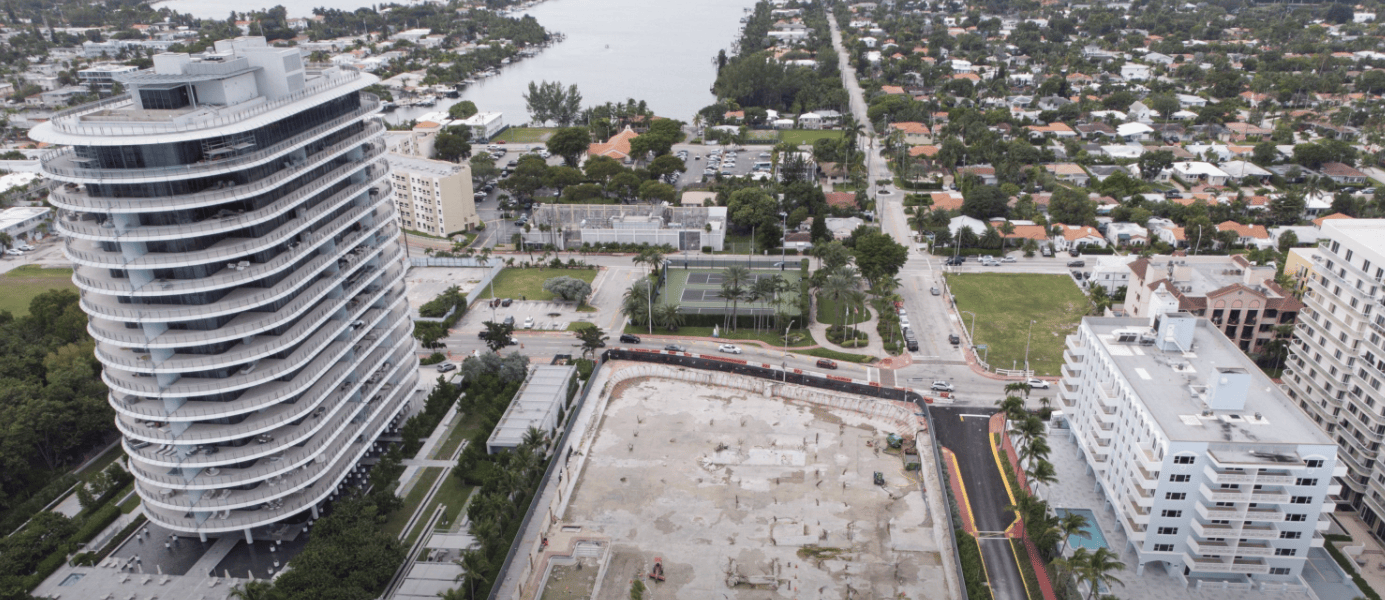
An aerial view of the site where Champlain Towers South once stood in Surfside, Fla. The causes of the June collapse, which killed 98 people, remain under investigation.
SURFSIDE, Fla.—In 2017, Abraham Topp and his brother took over the Champlain Towers South condo where their parents had lived happily for two decades on an idyllic stretch of beach—and quickly found signs of trouble.
Water persistently leaked into the underground garage below the pool deck, Mr. Topp said. Workers regularly pulled up pavers on the deck to perform repairs. The amount of work the tower needed was piling up, triggering talk among residents of a looming assessment in the millions of dollars to foot the bill.
Mr. Topp told a maintenance worker in the building that he and his brother planned to sell the unit, which eventually they did in 2019. He said the man replied: Good call.
“I don’t like the way the building is holding up,” Mr. Topp, 61 years old, said the worker told him. “One of the columns in the garage looks like it’s leaning.”
Once classy and cutting edge, Champlain Towers South deteriorated over decades to a corroded, leaky and unstable structure that crumpled this year in one of the deadliest building failures in U.S. history. The causes of the collapse, which killed 98 people, remain under investigation. A combination of problems likely were at fault, including design flaws, poor construction and delayed maintenance, engineers say.
Beyond the loss of life, the building’s demise illustrates all that can go wrong with the joint ownership model at the heart of the condo-building waves that have helped fuel American real-estate development. Once a builder finishes a project, unit owners must take responsibility for the building’s upkeep, usually through elected condo boards. As the maintenance tab swells over time, getting scores of ever-changing unit owners to pay can become increasingly difficult, leading to deferred repairs.
Champlain Towers South was born with great promise and sold to buyers beckoned by the allure of owning a piece of beachfront property.
As the shine wore off the building, it showed signs of distress. Some owners sought to address the problems, while others resisted or sold their units to avoid responsibility. Squabbles broke out among residents. By the time the board united behind a plan, it was too late.
Apiece of paradise’
When Champlain Towers South opened in 1981, Mayor Mitchell Kinzer saw it as an asset that promised to launch a new era of luxury development in the town. After a ribbon-cutting, the developers invited the mayor up to one of the high-floor units for a look around. “It was amazing up there. The water was crystal clear,” said Mr. Kinzer, now 70.
The developers marketed Champlain Towers South as an elegant escape, but they priced the units across a wide range, making smaller ones with less-alluring views affordable for middle-class buyers.
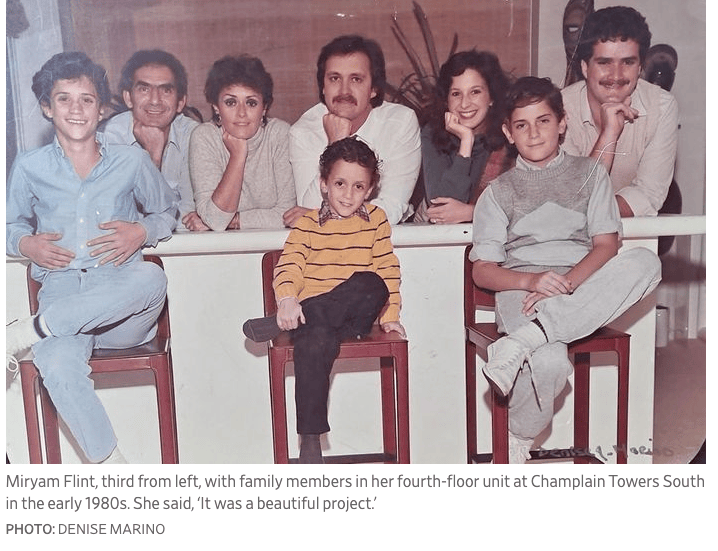
When Miryam Flint moved into Champlain Towers South in 1981, she felt she had secured a piece of paradise, she said.
The building offered saunas, a heated pool and valet parking.
“It was a beautiful project,” said Ms. Flint, now 72, who sold her fourth-floor unit after three years to buy a bigger place.
In 1984, Judit and Horacio Groisman bought a sixth-floor unit after he landed his first job as a doctor. The couple paid $186,500, county records show, or about $492,000 in today’s dollars.
The couple hosted birthday parties for their two children in the recreation room and barbecues beneath thatched huts near the beach. “It was such an ‘it’ building,” said Ms. Groisman, 68.
Cascading assessments
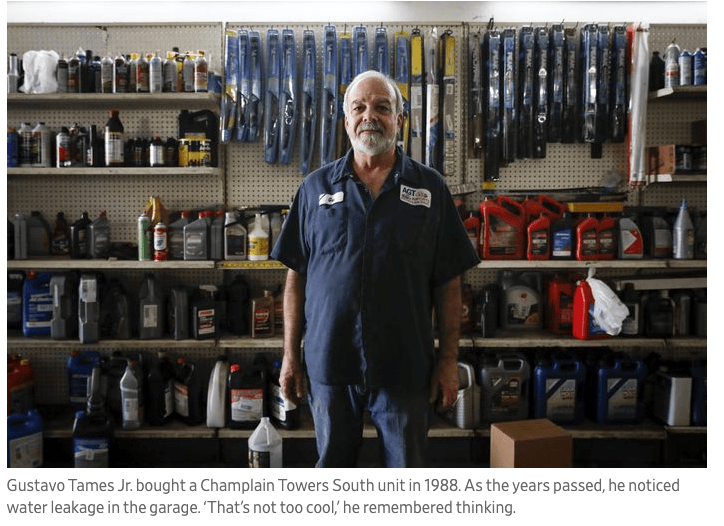
In 1988, the Groismans sold their unit, 611, to Gustavo Tames Jr., for $180,000, or about $418,000 in today’s dollars. Returning home from his work as owner of an auto-repair shop specializing in European vehicles, he would pour himself a glass of scotch and head to the hot tub to unwind.
As the years passed, he noticed that sometimes water dripped from the ceiling of the underground garage, below the pool deck. Because the seepage would stain residents’ cars, maintenance workers installed aluminum gutters below the areas that leaked, directing water to fall between vehicles.
“That’s not too cool,” Mr. Tames, 63, remembered thinking. But “it didn’t alarm me.”
When he and his wife at the time went through a divorce in 1994, they sold the unit for $200,000, or $377,000 today. Around then, Mr. Tames learned that the building’s condo board was planning to charge owners an assessment that would result in an additional monthly payment of roughly $400 for their unit, on top of the $400 or so they paid in monthly maintenance fees.
Water was siphoning through the pool deck to the garage below, he said.
The $156,000 repair took place in 1996 and 1997, according to documents filed with the town. Workers installed a layer of waterproofing and pavers on the pool deck, and they removed loose concrete and treated steel rebar with rust-inhibiting coating in the garage. They refurbished about 20 square feet of cracked concrete in the garage ceiling, the documents said.
Magda and Jose Pelaez, who bought Mr. Tames’s unit in 1994, were disgruntled about the assessment for that work but concluded it was worthwhile.
The couple, who lived in nearby Hialeah, used the condo unit for weekend getaways.
Around 2001, they learned that the board planned to make another assessment, this time to reinforce the building’s balconies.
The looming bill prompted the couple to sell unit 611 in 2002. “We said, ‘No, no, this is getting out of control with the assessments,’ ” said Ms. Pelaez, 72.
The project, which took place mostly in 2002, involved chipping balconies down to the rebar to see whether it had rusted and needed to be sandblasted and recoated, according to documents filed with the town. Notes by the contractor said some balconies were cracked, and in a few instances workers had to completely replace the decks.
Substantial restoration work on the building languished over the next decade and a half, according to some residents. That worried Albert Eskenazi, a contractor who bought a sixth-floor unit in 2004 for about $473,000 in today’s dollars and sold it two years later for 73% more, after upgrading to a larger ninth-floor unit.
Ego battles and mistruths
What residents at the time didn’t know is that the tower’s troubles were far deeper than the visible signs of deterioration suggested, according to an earlier Wall Street Journal investigation. The structural slabs of the building rested on thin columns without the support of beams in some areas. Special heavy walls used to reinforce structures were also deficient. Some parts lacked sufficient rebar, while in others builders put too little protective concrete over rebar.
In early 2018, as the building neared the end of its fourth decade, the condo board began preparing for a Miami-Dade County requirement that buildings undergo an inspection when they reach 40 years and that any needed repairs be performed. That July, the board hired an engineering firm, Morabito Consultants, to conduct structural and engineering inspections.
The firm’s report in October 2018 delivered sobering findings. Failed waterproofing below the pool deck and entrance drive had caused major structural damage to the concrete slab—a problem that would “expand exponentially” if not addressed, the report said. It called the design of the slab, which was flat rather than sloped to allow water to drain, a “major error” and found that many columns in the garage were cracked and needed to be repaired soon.
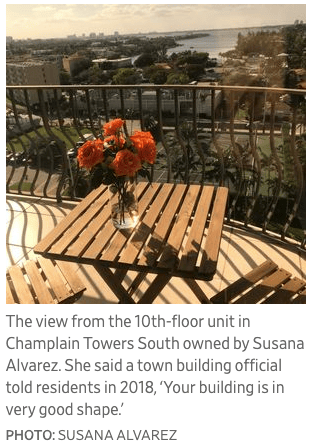
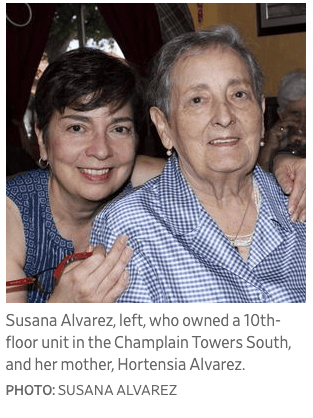
At a board meeting in the building’s recreation room a month later, Rosendo Prieto, a town building official, addressed concerned residents, said Susana Alvarez, who owned a 10th-floor unit. “He said, ‘I wouldn’t worry too much. Your building is in very good shape,’” she recalled.
Ms. Alvarez said she gave a relieved look to a friend and thought, “This is no big deal. Great.”
The board made little progress the following year as its members became consumed with personal conflicts, said Ms. Alvarez, 63, who regularly attended meetings.
In September 2019, board President Anette Goldstein —the daughter of one of the building’s developers—resigned, citing “ego battles, undermining the roles of fellow board members, circulation of gossip and mistruths,” according to a letter she sent to residents. Ms. Goldstein declined to comment.
Over the next two weeks, four other board members resigned, and a new group took control at a contentious board meeting Oct. 3.
A woman who became the new board president barreled through a speech she had written in which she accused an existing board member of unethical conduct.
“I was totally in shock,” Ms. Alvarez said. “That was the lowest point of that building.”
‘Earthquake, earthquake’
In February 2020, residents elected a new board, led by Jean Wodnicki. At a board meeting that October, she presented an overview of the renovation plan, whose estimated cost initially was about $9 million.
Ms. Wodnicki told those who dialed in that the lack of waterproofing over portions of the garage had exposed it to water intrusion for nearly 40 years. Inspections had found 131 areas of balconies with potentially deteriorated rebar. Two months later, the building manager said the estimated cost of repairs had climbed to about $15 million.
As 2021 began, the board pressed ahead. In a letter to residents four days ahead of an April 13 vote on the assessment, Ms. Wodnicki wrote, “A lot of this work could have been done or planned for in years gone by. But this is where we are now.”
Some residents signed a petition seeking to lower the assessment to $12 million. But on the day of the vote, board members approved the $15 million assessment.
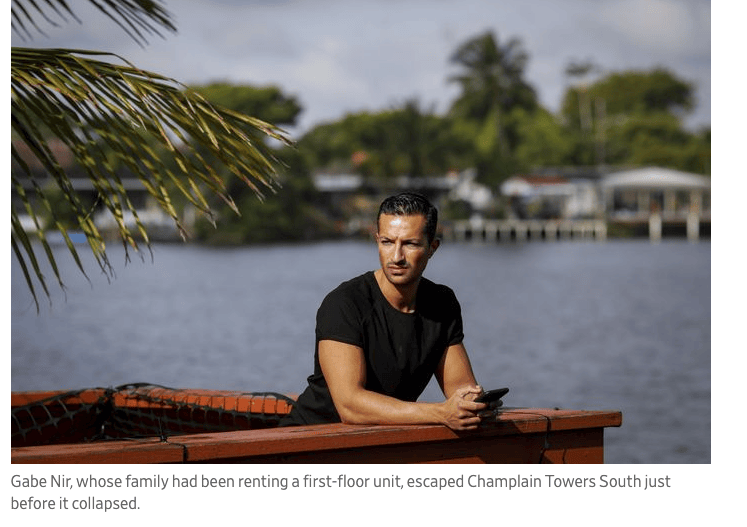
A little before 1 a.m., June 24, Gabe Nir, whose family had been renting a first-floor unit since January, was baking salmon when he noticed a knocking noise, he said. His mother, Sara Nir, heard it too and remarked that she hoped it would soon stop.
After a while, the banging grew louder.
Mr. Nir, 25, recalled his mother taking a short walk to the lobby to alert the security guard. Mr. Nir heard an even louder rumble and a big splash. Though he didn’t realize it at the time, the pool deck had crashed into the garage below. His mother screamed from the lobby, “Earthquake, earthquake!”
Mr. Nir said he grabbed his 15-year-old sister, and they rushed out as their unit filled with dust. Just outside the condo building’s front entrance, he saw that a street-level parking area near the pool deck was gone.
At 1:22 a.m., county records show, Mr. Nir spoke with a 911 operator. About 20 seconds in, a thunderous noise is audible on a recording of the call. A large section of Champlain Towers South, including their unit, had just tumbled.
“Holy shit!” Mr. Nir shouted.
As the Nirs ran, the 911 operator asked what he was seeing. “I heard Miami Beach say something about a bridge collapse,” the operator said.