Unknown's avatar

About CMCA ~ The Essential Credential

CAMICB is a more than 25 year old independent professional certification body responsible for developing and delivering the Certified Manager of Community Associations® (CMCA) examination. CAMICB awards and maintains the CMCA credential, recognized worldwide as a benchmark of professionalism in the field of common interest community management. The CMCA examination tests the knowledge, skills, and abilities required to perform effectively as a professional community association manager. CMCA credential holders attest to full compliance with the CMCA Standards of Professional Conduct, committing to ethical and informed execution of the duties of a professional manager. The CMCA credentialing program carries dual accreditation. The National Commission for Certifying Agencies (NCCA) accredits the CMCA program for meeting its U.S.-based standards for credentialing bodies. The ANSI National Accreditation Board (ANAB) accredits the CMCA program for meeting the stringent requirements of the ISO/IEC 17024 Standard, the international standards for certification bodies. The program's dual accreditation represents compliance with rigorous standards for developing, delivering, and maintaining a professional credentialing program. It underscores the strength and integrity of the CMCA credential. Privacy Policy: https://www.camicb.org/privacy-policy

The Future of Work Is a 60-Year Career

Humans may soon live to be 100, which likely means more years on the job. That could be a good thing, if we take the opportunity to redesign work.

By Joe Pinsker, The Atlantic

If 5-year-olds could read academic research reports, they might be alarmed by what they’d find in a recent one from the Stanford Center on Longevity.

It opened with a bit of promising news: “In the United States, demographers predict that as many as half of today’s 5-year-olds can expect to live to the age of 100.” But that was followed, several pages down, by a haunting prediction: “Over the course of 100-year lives, we can expect to work 60 years or more.”

In the U.S., the average retirement age is 62, according to Gallup polling. For most people, 40 or so years of work is more than enough, so the idea of an additional 20 is disconcerting. But if a 60-year career sounds like a nightmare, perhaps that’s because we’re imagining 60 years of work as it is for many people today: inflexible, all-consuming, poorly matched to the rhythms of life. For the sake of the 5-year-olds and the rest of us, as humans live longer and longer, we should redesign work.

The researcher who oversaw the report thinks we should start with the frenzy of midlife. “We work increasingly harder through the years where we’re having children [and] often taking care of older relatives—having lots of people dependent on us,” Laura Carstensen, the director of the Stanford Center on Longevity, told me. Work and family responsibilities both commonly peak in mid-adulthood, which can be really stressful, especially for women, who bear a disproportionate caregiving burden.

To address this, Carstensen proposes allowing workers to scale their hours up or down throughout their careers, based on their responsibilities outside of paid work. She imagines two parents being able to temporarily reduce their full-time jobs to 20 hours a week when caring for their young children, and then ratcheting their hours back up later on. Under this model, people would work the same amount overall as they do now, but make up for periods of reduced hours with periods of longer hours and/or by spreading work out over more years of their (longer) lives.

A model where people could smoothly adjust their hours could introduce some inefficiencies: Businesses would still have to pay the fixed costs of employing workers, such as investing in training, but then get less out of that investment if those workers work fewer hours. Plus, if workers pause their jobs entirely, they could fall behind on the latest technology and practices in their industry during a long leave.

That said, the current model has its own inefficiencies—when people are overstretched, they probably aren’t doing their best work. Ellen Ernst Kossek, a management professor at Purdue University, told me that at companies she’s studied, reducing workloads has led workers to “be more creative [at work] because they weren’t slogging along, not being able to do the job that they wanted as a parent or elder caregiver and also not doing well in their job.”

Moreover, Kossek said, working less during life’s “peak periods” would allow people to spend more time on hobbies and friends, which could help ward off burnout. At some point in their 20s or 30s, many workers enter a season of life when jobs and families siphon time away from friendships, but temporarily reducing workloads could mitigate that shift and let people live fuller, more varied lives.

Retirement is another chapter of our working lives that we could rewrite. In its current incarnation, it is regarded as a time free of obligations, which leaves the shape of life a bit lopsided: “We’re overutilized in midlife and underutilized after 65,” Carstensen said. This imbalance will become only more pronounced as people don’t just live longer but stay healthier for longer as well.

In this sense, the design flaw is that retirement is too rigid of a binary—you’re either working a lot or not at all. Phyllis Moen, a sociologist at the University of Minnesota, told me in an email that the older workers she’s interviewed “often want to work less and more flexibly, but find they have two options—continue to work full-time (or more) or else retire completely.”

Carstensen and her Stanford colleagues have more suggestions to improve retirement. Their report proposes a “glide path” to retirement that would allow workers to ??scale back their hours before leaving the workforce entirely. It also mentions “returnships”—brief, internship-like periods when people could temporarily come out of retirement to assist with a project or mentor younger workers.

This flexibility—throughout people’s working lives as well as at the end of them—is part of a more fluid blueprint for life that Carstensen favors. Instead of a prescribed march through education, work, and retirement, the report imagines people zipping in and out of those phases, and stitching in time dedicated to leisure and to caregiving as well. The idea is to work until later in life, but with stretches of working less (or not at all).

This vision sounds nice—it could even, miraculously, make a 60-year career feel manageable. But there are significant barriers to redesigning work in this way. “When we started having dual-earner households, that translated into people buying more stuff” rather than working less, Louis Hyman, a historian at Cornell University and the author of Temp: How American Work, American Business, and the American Dream Became Temporary, told me. “So if we had more time [in life] to work, would we maintain a steady level of consumption or would we just buy more things? Unless culture changes, we’d probably just [work more in order to] buy more things.” Hyman thinks that when people live longer, it’s unlikely that they’ll be able to opt out from working more, whether because of culture, their employment options, or both.

That said, the duration of Americans’ working lives has changed before. In fact, retirement as we know it didn’t use to exist. Until the late 19th century, people typically worked until they were no longer physically able to, and then hoped that their family could take care of them. Dora Costa, an economist at UCLA, told me that a 20-year-old worker in 1880 was likely to work, on average, up until fewer than two years before they died.

What’s changed between then and now, as Costa explained in her book The Evolution of Retirement, is that retirement became financially feasible: People’s incomes rose as productivity increased and, in the 1930s, the government started distributing Social Security payments to support people in old age. In other words, people stopped working because they could afford to.

Maybe financial security is also what could bring about a more flexible, less demanding vision of work in the future. Yes, escalating standards of consumption might prod people to work ever more as they live longer, but many other people might take breaks from work if they could afford to. (This possibility could emerge from higher pay, affordable-housing policies, decoupling health insurance from employment, or any number of other measures that have been proposed for increasing people’s financial security and job flexibility.)

It might be difficult to imagine that widespread financial stability and a more humane style of work could become a new norm. But the world we’re living in now would have been just as hard to imagine for our predecessors who worked practically until they died.

Joe Pinsker is a staff writer at The Atlantic, where he covers families and relationships.

Is your community association manager certified?

Are you putting your most valuable assets in the hands of the most qualified professionals?

As a homeowner, it’s in your best interest to protect one of the biggest investments you’ll ever make. Therefore, it’s critical to know if your community is managed by a Certified Manager of Community Associations (CMCA). CMCAs manage condominium & homeowner associations, housing cooperatives, resort communities and commercial tenant associations.

If you serve as a board member, trustee, or volunteer leader working with your homeowner’s association, condominium association, or cooperative, your decisions have a profound ?nancial impact on your community. There are more than 20,000 quali?ed community association managers who hold the CMCA credential. Hiring one of them to manage your association ensures you have the best resources available to make important decisions about reserves, maintenance, insurance, budgets, governance, contracts, the law, rules enforcement, and more. Receiving professional, accurate advice and guidance on such issues can mean the difference between prosperity and disaster.

What a difference a credential makes!

About the CMCA Credential

The Certi?ed Manager of Community Associations (CMCA) credential is the only international certi?cation program developed solely for managers of homeowner and condominium associations and cooperatives. The CMCA is awarded to individuals who have demonstrated core competency in the knowledge areas required to perform effectively as a community association manager and who have made a commitment to continuing education and the highest standards of professional conduct.

Governing board members and homeowners are encouraged to seek committed, quali?ed professionals to manage their communities. Hiring a CMCA ensures expert management by someone who has demonstrated the specialized skills required to lead a community association successfully.

The CMCA program is dual accredited. The National Commission for Certifying Agencies (NCCA) accredits the CMCA program for meeting its U.S.-based standards for credentialing bodies. The ANSI National Accreditation Board (ANAB) accredits the CMCA program for meeting the stringent requirements of ISO/IEC 17024 Standard, the international standards for certification bodies. The program’s dual accreditation represents compliance with rigorous standards for developing, delivering, and maintaining a professional credentialing program. It makes the CMCA credential one of a small number of dual-accredited credentialing bodies and the only accredited certification for community association management professionals around the world. It is a great source of pride and a strong testament to the strength and value of the CMCA credential.?

Do you know if your manager is CMCA-certi?ed? Search our Directory of Credentialed Professionals at www.camicb.org/?nd-a-cmca.

Talk to Your Manager Today

We encourage you to learn more at www.camicb.org and share this information with your manager. Information about the certification process can be found at https://www.camicb.org/get-certified. You can also email us with any questions at info@camicb.org.

Privacy Policy: https://www.camicb.org/privacy-policy

CAMICB’s CMCA Exam Preparation E-Learning Course Helps Candidates Get A Head Start

Free Online Resource Helps Candidates Successfully Prepare For The CMCA Exam

By Madeline Hay, CAMICB’s Manager of Exam Administration

Underscoring a quarter century of commitment to professionalism and excellence in community association management, CAMICB is excited to continue to celebrate the organization’s 25th Anniversary with the launch of a free, interactive online CMCA Exam Preparation e-Learning course. 

The three-hour course, featuring a series of eight modules, is divided into two components. The first component features four learning modules focused on creating an examination review and preparation plan. The second component includes three scenario-based learning modules that are designed to put several of the knowledge areas tested on the CMCA examination in context using real-life scenarios. The three modules address knowledge areas that are challenging for many CMCA candidates: Risk Management & Insurance; Financial Controls; and Governance, Legal & Ethical Conduct.  A final module is intended to offer some perspective on the exam preparation process and next steps.

Said Chair of the CAMICB Board of Commissioners Drew Mulhare, CMCA, AMS, LSM, PCAM, “CAMICB is always working to identify new tools to help CMCA candidates succeed on the exam. We’re excited to launch the CMCA Exam Prep e-Learning course – a free resource intended to put candidates on the path to the CMCA credential.”

The Course Modules

The exam preparation modules offer constructive test taking tips, discuss the composition of examination questions, give preparation advice, and provide an interactive self-assessment tool to help a candidate develop a study plan specific to that candidate’s needs and goals. The content-based modules ask the candidate to solve problems and answer questions using downloadable sample documents. 

Each module takes approximately 10-25 minutes to complete. The course is designed to accommodate busy schedules and to allow candidates to work at their own pace, so they may stop and resume the modules as their schedule permits. Below is a brief description of the different modules and what candidates can expect.

Module 1: An Introduction

Learn what it takes to pass the CMCA exam. Get advice from working CMCAs about what worked for them as they were preparing for the test – and what didn’t. Find out some common misconceptions about the CMCA exam and uncover the key for understanding how to approach the exam questions.

Module 2: Devising a Study Plan, Part 1 – Prioritizing Topics 

Discover how to establish and follow a solid study routine that’s tailored to your experience level. Get an in-depth look at the topic areas covered on the test and participate in a self-assessment exercise to determine which topics should be prioritized in your study plan. 

Module 3: Devising a Study Plan, Part 2 – Strategies and Tips 

Find out how to put your study plan into action. Learn practical tips and tricks to make the most of your prep time and take a closer look at some of the study resources available to you. 

A recent course participant shared, “The study resources provided in the CMCA exam prep course are excellent. It gave me a much better understanding of what material to really focus on.”

Module 4: Test-Taking Strategies

Learn how to maximize your potential on exam day. Find out how taking practice tests can improve your performance on the exam, get some guidance on strategies to overcome test anxiety, and see what to expect when you go to the testing center. 

Modules 5 and 6 use real-life scenarios that help you learn from detailed feedback. They also make use of downloadable sample files including Lakeside Terrace’s insurance declaration and financial documents to inform your decisions. 

Said one course participant, “For me, the CMCA exam prep course was so much more effective than simply reading different texts.”

Module 5: Risk Management & Insurance – Refresher Content 

Apply your knowledge of risk management and insurance topics by putting yourself in the shoes of the community association manager for Lakeside Terrace Condominiums. 

Module 6: Financial Controls – Refresher Content 

Revisit your role as Lakeside Terrace’s community association manager as you encounter some scenarios that test key knowledge about financial controls.

Module 7: Governance, Legal & Ethical Conduct – Refresher Content

Another real-life scenario allows you to visit Willow Grove Estates, where you have been hired as the association’s first community manager. 

Module 8: Looking Back and Looking Forward

An opportunity to recall what you’ve learned and consider what you want to keep working on. 

At CAMICB, we’re committed to offering a combination of study tools to enhance candidate performance.  Therefore, we encourage exam candidates to develop a personal study plan incorporating a wide range of resources and reference materials. CMCA preparatory materials are all available online – most at no cost – to managers employed anywhere in the world. We’re thrilled to add our newest offering, the CMCA Exam Prep E-Learning Course, to our portfolio of resources. 

Earning and maintaining this internationally-recognized credential propels a manager’s career forward, allowing for more advanced career opportunities and salaries that, on average, are 20 percent higher than non-credentialed managers. To get started and to learn more about the CMCA Exam Prep E-Learning course, visit www.camicb.org.

Finishing Your Goals Before the End of the Year

There is still time to accomplish your best work in the final weeks of the year

By JiJi Lee for Ink & Volt

Can you believe it’s almost the end of the year?

How are you feeling about your progress on your goals? We know the end of the year can be a complicated mix of emotions.

There’s excitement surrounding the holidays and anticipation for the start of the new year. But also regret and disappointment about goals that may have faltered. The good news is that it’s never too late to pursue your dreams and make headway on your goals. Just because the year is ending, doesn’t mean you have to say goodbye to what you truly desire.

In fact, you can use the end of the year to your advantage and finish strong. One path you can take is to start laying the foundation for your big, ambitious goal so that you can start off the new year with a bang. Another approach you can take is to pursue a bunch of micro goals or habits—those small, but impactful wins—so you can finish the year with a huge sense of accomplishment.

We’ve outlined ways that you can support your big goal or micro goal to help you end the year on a high note. Regardless of the path you take, you’ll be guaranteed to end the year in fighting shape and ready to take on 2022 with confidence. 

Get a head start on a big, dream goal

Big goals are intense and intimidating because they force us to look deep within ourselves, examine our weaknesses and insecurities, and quiet those debilitating voices that ask us, “Who do you think you are?”. Even Olympic athletes struggle with these same insecurities.

If you are feeling these big, overwhelming emotions, that’s okay. It means you’re taking your goal seriously. No one climbs Mount Everest thinking it’s going to be a breeze. Our big goals will test our will power, motivation, and skills—that’s why they are considered big goals in the first place.

Big goals can also be powerful and fulfilling. By putting ourselves through a series of tests and challenges, we reveal a side of ourselves that we didn’t know we had. We will come out stronger and more confident in ourselves and our abilities.

Another reason to set big, ambitious goals? Even if you don’t meet your expectations, you will achieve a lot more than you originally thought was possible. Think about it: Let’s say your current writing routine is to write 500 words a day. But then you set a big goal to write 1,000 words every day. Even if you only end up writing 800 words a day, that’s still more than what you would’ve written if you had stayed at your previous goal. 

Another thing to keep in mind is to accept the reality that big, ambitious goals will not be fulfilled overnight. They take time and patience. If you can accept that timeline and embrace the process, starting a big goal at the end of the year can be a good strategy. You’ll start developing good habits to support your goal and lay down a strong foundation to launch you into 2022.

Accomplish micro goals

Another way you can finish the end of the year strong is to concentrate on micro goals. These are goals that are so small and easy, you’ll be able to achieve them. Micro goals can be related to personal development or your career or health. 

According to this Harvard Business Review article writer Sabina Nawaz says: “It’s great to dream big, but the way to achieve big is to start small — through micro habits. Micro habits are small components of a larger habit. By breaking down an ambitious job into smaller, more achievable ones that you build over long periods of time, micro habits help you complete big goals.”

Examples of micro goals include:

  • Developing a morning routine
  • Updating your website
  • Brushing and flossing teeth before bed
  • Meditating for 10 minutes a day
  • Reading a book a month
  • Cooking a new recipe a week
  • Making your bed every morning
  • Walking 10,000 steps a day
  • Writing in a journal every day

Micro goals are incredibly appealing because those small changes can generate big results. Making your bed every morning may not seem like a big deal in the grand scheme of things, but the positivity you yield from that small act will encourage you to do another small act, then another, until you score a succession of wins. 

Also, micro goals can help you achieve big goals. Waking up early every morning may seem like a mundane goal at first glance, but it is significant if you’re trying to wake up early to train for a marathon or write your novel. With micro goals, it’s about the cumulative effect and the long game. And the positivity and confidence you gain from these small wins will motivate you to keep going and go for the next big thing.

If you’re looking to end the year on a positive note, but don’t necessarily have the emotional energy to expend on big, ambitious goals, micro goals are a great option. And the pride and achievement you feel will sustain you into the next year and fuel your growth moving forward.

Up next, we’ll take a look at how to create an action plan for your goals, big or small.

Creating an action plan 

Whether you’re looking to pursue an ambitious goal or a series of micro goals, you’ll need a solid strategy to support your vision. Here are steps you can take to create a solid plan. 

Define your goal

What is the goal that you hope to achieve? Write it down in your planner. You’re more likely to commit to a goal if you take the time to write it and record it in your memory.

Some people like to visualize what it will feel like after they achieve a big goal. These positive feelings help remind them what it is that they’re working so hard for. Others like to put post-it notes and messages around their workspace to remind them of their goal.

Choose a strategy that works for you and helps you feel positively about your goal.

Identify your obstacles

Another tactic to help strengthen your game plan is to write down a list of potential obstacles you may encounter. 

According to this article in the Mental Game of Tennis, it’s helpful to plan for potential challenges so that you’re not thrown off guard when they arise, and can better prepare for potential setbacks. 

Being honest about your obstacles is also essential if you’re setting out to achieve micro goals. Incorporating new, positive habits takes discipline and self-awareness. After all, progress doesn’t happen overnight.

So if your micro goal is “go for a run in the morning” make a list of potential obstacles. Then, have a back up plan in place so that you can stay on track. So if your obstacle is “feeling tired in the morning” make a list of things that will motivate you to get out of bed. Maybe it’s a pot of coffee or a breakfast treat. Or maybe place your workout clothes on your bedside table so it’s easier to put them on and go.

Make a list of targets you want to reach before the end of the year

Create weekly and daily goals to help you stay on track and keep you accountable. 

So if your goal is to run 5K by the end of the year, then create a 4-5 week plan and set weekly goals. Maybe it means starting out by running for 10 minutes in Week 1 and then working your way up and building your endurance. 

Having regular targets will help you stay on your path towards your goal. And by measuring your progress from week-to-week, you’ll know if you need to catch up or dial back or if you’re right on track. 

Create a schedule

Add your tasks to your planner or calendar so that you’re more likely to do it. Also, by having a visual representation of your schedule, you’ll be able to see what days you’ll be busy and rearrange your schedule as necessary. This will come in handy during the holiday season. So if you want to schedule a run a few days before the holidays, look for free blocks of time on your calendar. This way, you won’t feel overwhelmed, and you’ll have the energy to work towards your goal.

Relish your winsIt’s important to acknowledge your progress every single day. Record your wins in your planner and decorate the entry with a sticker or fun, colorful washi tape. Taking pride in your work will help you see how much you truly accomplished at the end of the year, and set you up for success in the new year.

What Do the People Around You Need from You Heading into the New Year?

Leaders know that every person needs something a little different from their supervisors. Great leaders adjust their leadership approaches to customize to what their people need.  Some people need more encouragement, while others need to be left alone.

Some people need frequent feedback, while others don’t like or need much direction.

Some people need public appreciation and recognition, while others prefer to work unnoticed.

Great leaders are smart enough to know that people are individuals, and needs differ by the person and can vary by the day.

What EVERYONE needs from their leadership right now:

  1. Crystal clear vision. Everyone needs to know where we are going.  Leaders need to clearly define the vision so everyone understands where the organization is going in the new year.  The vision should be clear enough to be understood and exciting enough to get people enthused about the idea.
  2. Clarified expectations. Every person must know what they need to do to be successful in the organization. Make sure everyone in the organization knows their roles and responsibilities.  Everyone should realize that if they are late on a deadline or don’t do what they are supposed to do, it affects other people.  This is a common problem.  Even the best leaders sometimes hold up their teams because they left a report unsigned, or they didn’t make a decision in a timely manner.
  3. Use of deadlines. People not only need to know what they need to do, they need to know when it needs to be done. We have all had situations where we needed a report, some information, or some project-specific numbers by a certain time and date, such as before a big meeting with a new client.  If we don’t have the information before that  specific meeting,  we just don’t need it.  If deadlines are not clear, we either lost the client, and therefore the time preparing the information was wasted, or the time was wasted because we couldn’t use the project.  Great organizations use deadlines to manage work flow.  Leaders help their teams stay on track by implementing systems that include deadlines, and those deadlines are promulgated, known, and adhered to by everyone involved.
  4. More consistent information. Any time there is confusion or uncertainty people need more information on a more consistent basis. Uncertainty and fear, left alone, leads to speculation, assumptions, and unproductive behaviors.  Leaders can mitigate these problems by communicating more frequently.  Daily emails, social media blasts, and newsletters need to reinforce the message the lead is conveying.  Many people need more than one message to pay attention to the message, so repeating the message more than once is usually necessary.
  5. Guidance and direction. No one likes working for an arrogant boss, but people do like working for a confident boss. Great leaders have the ability to be calm in a crisis and provide the right guidance to help others move forward.  People want to know that their leadership has a plan to move forward.  To make sure leaders are considering a variety of options, they can hold town halls and focus groups and to encourage ideas.  Once they consider ideas and they make decisions, leaders can increase trust and motivation by making their plans for the future clear and letting people know that they have considered other input.
  6. Path for Success. People want to do a good job, and they need to have milestones and feedback to help them along the way. People need to know what they need to do so that both they and their supervisors view the milestones as accomplishments.
  7. Quick wins. Anytime people have stress, they need quick wins. Leaders can help by breaking down large projects into smaller chunks to make the finish line seem closer.  If a project is going to take 40 hours, people procrastinate because they don’t have 40 hours right now.  Leaders can help by constructing the 40 hour project into 10 four-hour blocks.  Completing one block gives people a win.  Especially during times of stress, people need to feel a sense of accomplishment.  It helps them stay focused, on track, and motivated. 

People take their cues from their leadership.  When leaders are transparent, motivated, and goal-oriented, their people will be as well. 

As The Year Comes To A Close Are You Looking For Online CEC Opportunities?

CAMICB offers a number of online continuing education opportunities. Be sure to regularly check out our helpful list of On-Demand webinars available here for managers to view that are free or low-cost, and CAI Headquarters has an entire library dedicated to webinars available for continuing education credit available here. All of CAMICB’s continuing education opportunities can be found here. 

CAMICB also offers the option for managers to seek out online opportunities that work best for them, and unapproved online options can be e-mailed to info@camicb.org for approval consideration.

For any questions, please reach out to CAMICB at info@camicb.org. 

What inspires Gen Zers to stay or quit? These clues put loyalty in a new light

By George Anders for LinkedIn

Hurray for Gen Z, the youngest — and most idealistic — generation in the U.S. workforce. A new edition of LinkedIn’s Workforce Confidence survey finds a lot to admire in this cohort of people ages 24 and under. They’re the most likely to love their jobs, and the most insistent on finding employers that share their values.

But don’t take Gen Z for granted.

When things aren’t going right, Gen Z can head for the exits in a hurry. Plenty of Gen Zers are looking to switch industries, according to the Workforce Confidence survey. And three of the top four reasons involve some version of “what’s in it for me?” Among those factors are the hunt for higher pay, faster advancement or better benefits.

Making sense of society’s newest entrants into adulthood has kept commentators busy since at least 400 B.C., when Socrates berated ancient Greece’s youth for their “contempt for authority.” 

Such mutterings amuse experts like British public policy professor Bobby Duffy, who recently wrote that younger people’s eagerness to change jobs “has always been true,” even if each older generation discovers it afresh.

Still, big parts of Gen Z’s coming-of-age journey veer into new territory. The big recent dislocations associated with COVID-19 and associated lockdowns are one example, as is the nonstop hyper-connectedness of growing up as digital natives. Such factors invite a closer look at Gen Z’s distinctive blend of impatience and idealism, as seen in the world of work.  

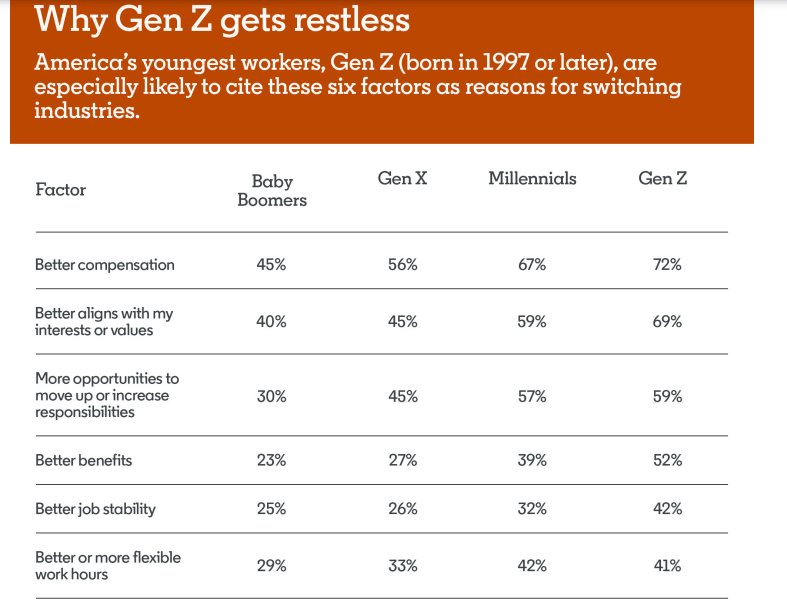
Some 65% of Gen Z job seekers have either switched industries or are considering doing so, according to the Workforce Confidence survey. That restlessness is matched only by the next youngest generation, millennials (ages 25 to 40.) Rates are noticeably lower for baby boomers (ages 57-75) and Gen X (41 to 56).

Dig deeper — as the chart above shows — and the reasons why Gen Z job seekers are ready for a big change can be split into three main categories.

Earning more (72%) and moving up in the organization (59%) are two of the most commonly cited factors for Gen Z. That’s a hallmark of career starters in any era, who treat their first few years in the labor market as an exercise in job hopping. The search for advancement may be especially urgent for Gen Z now — given the big mismatches between job openings and under-utilized talent. 

Values matter a lot, too. Some 69% of Gen Z respondents in the Workforce Confidence survey say that a key factor in their desire to switch industries is the hunt for better alignment with personal interests or values. Big employers are listening, too. Recent articles in Forbes and Quartz have highlighted ways that companies such as Procter & Gamble and Ford Motor are adjusting their recruiting strategies to be more in step with Gen Z’s habits and priorities.  

Finally, Gen Z’s job seekers care about quality-of-life factors such as better benefits (52%), better job stability (42%) and better or more flexible hours (41%). 

One issue that isn’t a big deal for Gen Z is a more flexible work-from-home policy (24%). That’s actually a far greater concern for millennials (42%), who are somewhat farther along in life’s journey now — and are more likely to be juggling the demands of both work and parenting.

Even with so much attention focused right now on the record numbers of people who are quitting their jobs or switching industries in favor of something new — there’s no reason to ignore people who already like what they’ve got. That includes the 35% of Gen Z job seekers who are determined to stick with their current industries.

What’s keeping them loyal? The top three factors are: enjoying the nature of the work I do (86%), building more expertise in my industry (80%) and continuing to apply, hone or grow the skills I have (70%). 

It’s also worth noting that 63% of Gen Z respondents in this group (job seekers who aren’t switching industries) say they are staying the course because of the opportunity to form and strengthen relationships in their current industry. That factor doesn’t register nearly as much with older generations — but that shouldn’t be a surprise.

Given Gen Z’s status as the first digital natives, it makes sense that this cohort would want to keep making the most of those formidable networking skills.  

Methodology

LinkedIn’s Workforce Confidence Index is based on a quantitative online survey distributed to members via email every two weeks. Roughly 5,000 U.S.-based members respond to each wave. Members are randomly sampled and must be opted into research to participate. Students, stay-at-home partners and retirees are excluded from analysis so we can get an accurate representation of those currently active in the workforce. We analyze data in aggregate and will always respect member privacy. Data is weighted by engagement level, to ensure fair representation of various activity levels on the platform. The results represent the world as seen through the lens of LinkedIn’s membership; variances between LinkedIn’s membership & overall market population are not accounted for.

Alexandra Gunther and Adam Cohen from LinkedIn Market Research contributed to this article.

Voices & Vignettes From CMCAs 

As CAMICB continues to celebrate its 25th anniversary, we reached out to CMCAs who’ve held the credential for 25, or more, years. Many CMCAs graciously offered to share their experiences, highlights, career paths and advice with us. 

When Bruce Nahon, CMCA, AMS, a Managing Agent based in Kirkland, Washington, started down this career path, he firmly believed he would be best served by belonging to a community of professionals who promoted the CMCA credential and its importance. “Passing a rigorous, internationally recognized exam and earning the CMCA credential was a great way to grow my career as an HOA portfolio manager and it gave me the confidence I needed to pursue this work,” said Bruce, who went on to earn the AMS designation in 2002.

Added Bruce, “As I took on additional properties to manage, the CMCA credential assured HOAs they could rely on my background, experience and the fact that I regularly participate in continuing education opportunities.”

Bruce continues to find satisfaction in helping HOA owners and Boards with their individual and varied needs. “Owners tell me they enjoy contacting me to address their questions and concerns and Boards rely on my knowledge of the governing documents and how they affect all operational aspects of the association. I find this work extremely rewarding,” said Bruce.

Added Bruce, “To all new managers I say, become CMCA certified as soon as possible and find a mentor to help you navigate the joys and sometimes perils of community association management.”

Voices & Vignettes From CMCAs 

As CAMICB continues to celebrate its 25th anniversary, we reached out to CMCAs who’ve held the credential for 25, or more, years. Many CMCAs graciously offered to share their experiences, highlights, career paths and advice with us. 

Barbara E. Saxton, CMCA, AMS, PCAM, is the Regional Community Manager, for The Galman Group, in Jenkintown, PA.  Barbara has been with The Galman Group for more than 16 years.  Prior to that, she was a Regional Community Manager in New Jersey.  Barbara has been  managing community associations for more than 30 years and has been a CAI member for almost as long. Barbara also serves on the Board of CAI’s Keystone Chapter in Pennsylvania.

According to Barbara, “Regardless of your profession, I strongly believe in professional credentials. Earning the CMCA encouraged me to pursue my AMS and PCAM designations. Having these credentials tells my associations that I value my career and I’m prepared to guide them in the right direction.”

Barbara’s advice for managers entering the field, “Earn your credentials. Learn and continuing learning; this will make you the best manager possible.”

As a longtime credential holder, one professional moment proudly stands out in Barbara’s mind: “Receiving the Robert H. Wise, Sr. President’s Award from the Keystone Chapter of CAI (formerly the Pennsylvania Delaware Valley Chapter) in 2016.  My name and credentials are prominently displayed on the plaque,” said Barbara. 

The Robert H. Wise, Sr. President’s Award for Lifetime Achievement was established in 1996 to honor former chapter president Robert Wise, principal and owner of Wise Management Company and who was an active member of this chapter for many years. The award is presented each year by the president of the board to a chapter member who has shown outstanding service and dedication to the chapter.

Barbara’s favorite aspect of community association management are the people. “In this profession, there are so many different perspectives, and so many informed colleagues. This leads to a tremendous amount of satisfying relationships,” added Barbara. 

Looking to take your career to the next level? Here’s what you should know about the CMCA credential!?

The field of community association management offers great potential for professionals who have experience in people-centric roles. If you’ve worked in the hospitality or service industry, this might be a career path to consider. And whether you’re new to the field or have been working as a community association manager for some time, it’s worth learning about how the Certified Manager of Community Associations (CMCA) credential can help you take your career to the next level. 

The Community Associations Institute (CAI) estimates that as of 2018, there are approximately 355,000 community associations in the United States housing over 74 million residents. That’s 11 million more residents than just a decade ago. In fact, one in four people in the U.S. lives in a community association. There are approximately 8,000 community association management companies and up to 60,000 off and on-site community association managers in the U.S. alone. As the number of people living in community associations increases, so too does the need for community association managers. 

Job prospects are excellent, especially for community association managers who hold a professional designation. It’s estimated that up to 26 percent of all ownership housing is in one of the three basic types of community associations. As of May 2020, the median annual wage for community association managers was just over $59,500. As job prospects and wages vary from state to state, it’s a good idea to check out your area’s particulars.

CMCA – The Essential Credential

The Certified Manager of Community Associations (CMCA) credential key to building a successful career in community association management. It signifies to employers you’re competent in specific management practices and are committed to professional excellence, ethical business standards, and continuing education. Employers are always on the lookout for dedicated professionals, and the CMCA credential after your name often makes the difference between whether or not you land the all-important first interview.

The CMCA credential is highly accessible:

  • It can be achieved with a limited investment of time and money on your part.
  • It takes a few days of prerequisite course work, some time for study, and one day for the exam.
  • Its relatively low cost is a great investment in your future.

Earning the CMCA credential opens the door to higher earnings—on average 20 percent more—than non-credentialed community association managers. It is also a great way to build your professional expertise and image.

The CMCA program is dual accredited. The National Commission for Certifying Agencies (NCCA) accredits the CMCA program for meeting its U.S.-based standards for credentialing bodies. The ANSI National Accreditation Board (ANAB) accredits the CMCA program for meeting the stringent requirements of ISO/IEC 17024 Standard, the international standards for certification bodies. The program’s dual accreditation represents compliance with rigorous standards for developing, delivering, and maintaining a professional credentialing program. It makes the CMCA credential one of a small number of dual-accredited credentialing bodies and the only accredited certification for community association management professionals around the world. It is a great source of pride and a strong testament to the strength and value of the CMCA credential.?

An Exciting Career Path with A lot of Potential

Life as a community association manager can vary day-to-day. Managers work closely with residents and Board members, make site visits to the community, hire and supervise vendors, interact with community leaders, and so much more. Not only do you earn a decent living, but you’re constantly learning new things and meeting interesting people from all walks of life. The odds of becoming bored on the job are slim—there are just too many different and interesting things to do!

Becoming a Certified Manager of Community Associations is not merely a designation; it can lead to the career journey of a lifetime. It elevates your credibility as a community association manager and makes employers more confident in hiring you. Finally, it offers you a wealth of opportunity, stability, and growth potential in an exciting career that currently shows no sign of slowing down.

For further information, please visit camicb.org or email us with any questions at info@camicb.org.

Privacy Policy: https://www.camicb.org/privacy-policy