CAMICB is a more than 25 year old independent professional certification body responsible for developing and delivering the Certified Manager of Community Associations® (CMCA) examination. CAMICB awards and maintains the CMCA credential, recognized worldwide as a benchmark of professionalism in the field of common interest community management. The CMCA examination tests the knowledge, skills, and abilities required to perform effectively as a professional community association manager. CMCA credential holders attest to full compliance with the CMCA Standards of Professional Conduct, committing to ethical and informed execution of the duties of a professional manager.
The CMCA credentialing program carries dual accreditation. The National Commission for Certifying Agencies (NCCA) accredits the CMCA program for meeting its U.S.-based standards for credentialing bodies. The ANSI National Accreditation Board (ANAB) accredits the CMCA program for meeting the stringent requirements of the ISO/IEC 17024 Standard, the international standards for certification bodies. The program's dual accreditation represents compliance with rigorous standards for developing, delivering, and maintaining a professional credentialing program. It underscores the strength and integrity of the CMCA credential.
Privacy Policy: https://www.camicb.org/privacy-policy
By Matthew Green, CAMICB Associate Executive Director
If you love the idea of a job that offers opportunity, stability, and growth, community association management provides an excellent career path. Community association managers work with homeowners and service providers to take care of the many aspects and operations of condominiums, HOAs, and cooperatives. It’s a great job choice for people who previously worked in the leisure and hospitality industries. Those sectors continue to lead U.S. job losses amid COVID-19, with experts predicting slow growth until at least 2023. The good news is that though the coronavirus has dashed a lot of hopes for hospitality grads and veterans, the world of community association management is a bright spot. The field continues to grow and offers excellent opportunities for anyone who wants to continue in a people-oriented career.
Community Association Management Stats
The Foundation for Community Association Research reports that as of 2020, there were approximately 355,000 community associations in the United States. They house over 74 million residents, over 12 million more than just a decade ago. Twenty-six percent of people in the U.S. live in a community association. More than 60 percent of new housing completed and over 75 percent of new housing sold is in a community association.
There are over 8,000 community association management companies in the U.S. and up to 60,000 community association managers. Further, there is an additional 100,000 individuals employed by management companies and onsite for associations with staff. As the number of people living in community associations continues to rise, so does the number of jobs for community association managers. If you’re a people person who’s skilled in handling multiple tasks, a career in community management can be an incredibly rewarding career choice.
Community Association Management Career Outlook
Job prospects in the community association management sector are excellent and growth is stable. Though a college degree and professional designation are not necessary to land a position in the field, those who do command a higher salary when starting out. As of May 2020, the median wage for community association managers was $59,660 per year. In 2019, there were 367,900 jobs in the field. Job prospects and projected wages vary from state to state and community to community, so it’s a good idea to check out your area’s particulars.
CMCA – The Essential Credential
The key to building a successful community association management career is the Certified Manager of Community Associations (CMCA) credential. Holding the certification lets employers know you’re educated and competent in certain management practices. It also indicates your dedication to professional excellence, ethical business standards, and continuing education. Community management employers are continually looking for committed professionals. The CMCA certification can often make the difference between whether or not you land a first interview.
The CMCA credential is relatively easy to obtain and:
Is relatively low-cost for such a valuable investment in your career and future.
Earning the CMCA credential opens the door to earning additional credentials and up to 20% higher earnings than community association managers who are non-credentialed.
Studying for the Exam and Earning the Credential
Several resources are available on the Exam Preparation Resources page of the CAMICB website. You’ll find these items and more:
CMCA Handbook
CMCA Study Guide
CMCA Exam Preparation E-Learning Course
Community Association Management Best Practices Reports?
Community Association Institute’s M-100: Essentials of Community Association Management Course Material Information
Community Association Institute’s Guides for Association Practitioners (GAPs)
CMCA Practice Exam
CMCA Examination Quizlet
Becoming a Certified Manager of Community Associations is not merely a designation; it can lead to the career journey of a lifetime. It elevates your credibility as a community association manager and makes employers more confident in hiring you. Finally, it offers you a wealth of opportunity, stability, and growth potential in an exciting career that currently shows no sign of slowing down.
Privacy and Data Security is the body of law that addresses how an organization can collect, handle, and use personally identifiable information and how that information needs to be protected.
Community Associations quite often have and maintain the names, addresses, and financial information of their residents and homeowners. Many criminal groups find this kind of information valuable for identity theft. Such groups often encrypt the data so the Community Association cannot access it to gain leverage and force an organization to pay a “ransom” for its return. Because of this and in reaction to how much sensitive information is held on everyday people in the broader economy, all fifty states have laws on the books that require most organizations to disclose when an unauthorized party has accessed the information. Community Associations—just like any other North Carolina organization—always must act reasonably when the organization makes decisions to do something with personal information or risk negligence lawsuits and class actions.
Unfortunately, North Carolina does not provide statutory guidance on how Community Associations can act reasonably with respect to residents’ personal data, but the federal government has provided frameworks that it recommends. The National Institute of Standards and Technology has published a Privacy Framework and a Cybersecurity Framework that, when followed, allow organizations to identify the data they have, protect that information, control and manage the data, govern the data with set rules within the organization, communicate the roles of each member of the organization, detect malicious or unauthorized activity, respond when an incident occurs, and recover from the incident.
There are a number of practical steps that organizations can take that can avoid or reduce the severity of common compliance pitfalls. The first is to review vendor contracts regularly—at least once a year—to make sure that they reflect an organization’s risk tolerance. Often, a trusted service provider or another vendor can have a breach that impacts the privacy and security of the data entrusted to a Community Association. Without contractual protections, the organization might incur significant costs remediating the problem with little legal recourse to have those costs covered by the party at fault.
Additionally, encrypting data, which is a mathematical process to transform data from readable text to nonsense and back again when a code (called a key) is used, can be an important tool in the compliance toolbox for Community Associations. Under North Carolina law—and the law of many other states—a breach only triggers reporting obligations when the information that was stolen was also unencrypted or when the encryption key was stolen with the data. This is not a silver bullet but, encryption is a practical technology that will be an important part of any compliance strategy.
Cyber insurance can also be an effective means of covering risk. However, insurance is not as simple as buying a policy and calling it a day. Insurers are increasingly raising premiums and lowering caps on organizations that do not take a proactive approach to mitigate privacy and security risks. So while insurance can act as a hedge against devastating effects, it should not be seen as a substitute for a compliance strategy.
We also recommend getting community input on the Community Association’s Privacy and Data Security efforts. Community Associations are necessarily accountable to their residents and homeowners, so understanding stakeholders’ risk tolerance can inform the leadership on how to move forward with a compliance strategy. The laws at issue obviously do not change based on the community’s sentiments, but discussing the matter at an annual meeting can be a good way to communicate what expectations the stakeholders in your community have of leadership.
Challenges and risks of liability and unmet stakeholder expectations are everywhere for Community Associations that do not take a proactive approach to the Privacy and Data Security of their residents’ and homeowners’ information.
As CAMICB continues to celebrate its 25th anniversary, we reached out to CMCAs who’ve held the credential for 25, or more, years. Many CMCAs graciously offered to share their experiences, highlights, career paths and advice with us.
John Schick, CMCA, AMS, PCAM, is a Management Executive with Hawaiiana Management Company, Ltd. in Honolulu. He was a member of the Beta Test Group for the original CMCA examination. Prior to entering the field of professional community association management, John spent 20 years in the United States Air Force and then two decades in motion picture exhibition and theatre building – clearly many talents and interests!
Now with 29 years of community association work in his vast professional repertoire, John finds what he likes most about this profession is assisting home owners and helping them understand the system and how it works, including training board members and helping them make the best decisions to benefit their properties.
He also enjoys the networking offered at industry-related events. Accepting his PCAM designation at a CAI convention in Ft. Lauderdale in a room full of CAI members was a highlight of his community association management career.
John offers important advice for new managers entering the field, “This is a unique industry. Call on all the life experiences you’ve had to help you come up with solutions. Do not assume you know or understand it all. And, be sure to ask your co-workers questions; someone has certainly been there before you.”
Retirement insecurity and rising housing costs prompt more older adults to move in together
By Soo Youn For The Washington Post
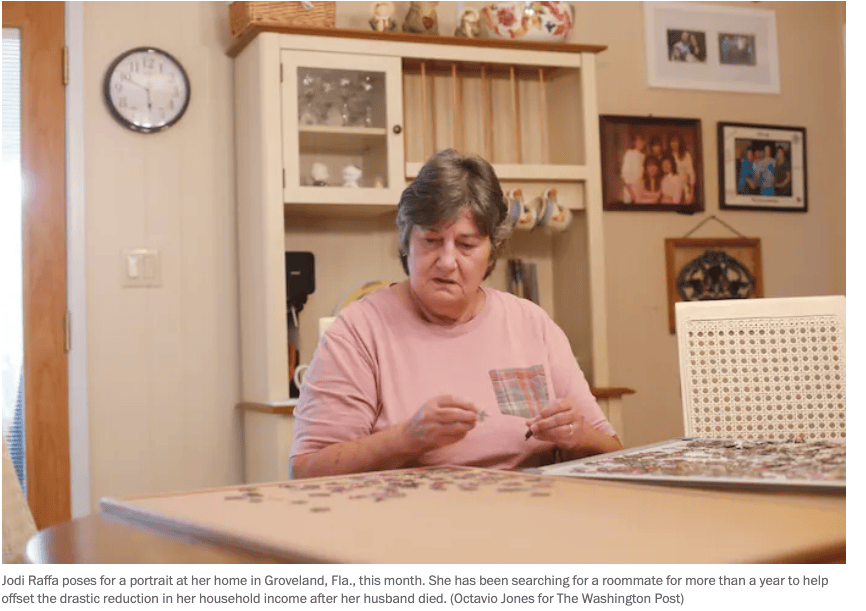
Jodi Raffa has been searching for a roommate for over a year. Her husband passed away five years ago, and compounding her loss was a 75 percent reduction in her household income.
The 76-year-old lives in a sunny three-bedroom, two-bathroom home overlooking a lake in a 55-and-over community in Groveland, Fla. The sunsets from her back porch are “stunning.” However, the homeowners association fees just went up again and inflation has left her “flabbergasted.”
“I live on a very strict budget and am not able to indulge in any extras at all,” said Raffa, who worked in administrative jobs before she and her late husband retired in 2010. Raffa now views that move as a “hasty decision” in light of her financial circumstances. “I am a worrier and a planner, so logic suggested getting a roommate.”
When she takes out ads specifying women over 55, she gets responses mostly from men in their 60s or adults in their 20s, 30s or 40s. Raffa hopes for an easier way to find and vet potential sharers of her home. “I’m very frustrated,” she said.
Like so many boomers, Raffa wants to continue to live in her house and find a job working remotely, either in data entry or editing. Faced with escalating home prices and rents in tight housing markets, as well as careers or earnings curtailed by age or the pandemic, some boomers are looking to share their homes. Enter the boommates.
“With the boomers aging, you see higher and higher numbers in shared housing,” said Rodney Harrell, vice president of family, home and community at AARP, pointing out that boomers are more open than previous generations to trying alternative solutions to the traditional aging trajectory.
In an 1987 interview with NPR, the late Betty White noted that the four women who lived together in “The Golden Girls” did so for social reasons rather than financial necessity. “All that I think we have accomplished is to show that there is an alternative lifestyle,” White told “Fresh Air” about the success of the show. “If you notice, ‘The Golden Girls’ are not together for economic reasons. They’re together for sociological reasons. It combats the loneliness.”
Four decades later, the idea of housemates late into adulthood is experiencing a revival, but with financial factors front and center. As boomers live longer and retire without the financial safety net of employer-sponsored pensions, covering the rising costs of food, housing and insurance become major considerations. Linda Hoffman, president and CEO of the New York Foundation for Senior Citizens, which runs a home-sharing program, noted an increasing number of applications as finances become more of a stressor.
“When we started the home-sharing program in 1981, relieving feelings of isolation and loneliness was the primary need,” Hoffman said. “Now, an affordable place to live is the number one need. Hosts need help in meeting their housing expenses.” Even for housemates who entered into the arrangement for social reasons, the extra money has become more important as their financial picture changed with the pandemic.
Debbi Campbell, 70, a retired copywriter, met Loretta Halter, a retired manager from the Kroger grocery chain, in 2018 at a Czech cultural event in New York City. Campbell was mourning the loss of her live-in boyfriend of almost 20 years to cancer. Halter had moved to New York City from Appling, Ga., several years earlier. She had used the NYFSC home-sharing program earlier to find an affordable apartment but was unhappy in her situation, which is when she decided to become housemates with Campbell.
The two went through the NYFSC program to handle the background checks, vetting and administrative details before Halter moved into Campbell’s rent-stabilized one-bedroom apartment in Greenwich Village. Before the pandemic, the two lived somewhat separate lives. Campbell lived mostly in the bedroom and Halter lived mostly in the living room. But when the city shut down, they developed a strong friendship.
“First, we started with the crossword and the jigsaw puzzles, and the TV, and it turned out well,” Campbell said. The ease of the later-in-life roommate-as-friend experience surprised her. “I mean, I’m one of those people who’s spent a good time of my life in therapy, mostly complaining about people I knew.”
After initially being furloughed from her job as a long-term temp at the Department of Education in March 2020, Campbell retired in October 2020, at 68, more than a year earlier than she expected. She also opted to take Social Security benefits at that time, instead of waiting until 70 as she had planned.
“I had not been desperate over money, but having a pandemic come, suddenly you have company where you wouldn’t have. And suddenly there is extra money for you from home sharing, which I wouldn’t have had. It was just a bonanza. I feel like the luckiest person of the pandemic,” she said.
While the dozen home sharers interviewed for this article insisted their parents would have found the idea outlandish, having housemates later in life seems to be finding more acceptance. In 2021, 70 percent of adults over 50 reported being open to sharing their home with a family member who was not a spouse, 51 percent said they would be willing to share with a friend and 6 percent would share a home with a stranger, according to a survey from AARP. Of those who reported they would not share their home at all, 23 percent said they would change their mind if they needed extra income.
“The majority of people considering home sharing with a friend or family member tells me that there’s an opportunity there for more people to take advantage of that excess housing stock that we already have within our own homes, and that perhaps meet your needs, and those of a friend or neighbor,” Harrell said. “Or maybe companionship that may help with costs, such as caregiving. There’s just so much advantage there. And we’re just not necessarily taking advantage of it. It’s nowhere near its potential.”
The growing interest in home sharing, especially for those boomers who are house-rich and cash-poor in expensive housing markets, is being cultivated by nonprofit and commercial programs as well as municipalities. Since 2015, New York, Seattle, Denver, Tucson, Northern California and the metro Washington area all have established or are launching programs.
“From what we’ve seen, attitudes are loosening toward home sharing,” Riley Gibson, president of Denver-based home sharing service Silvernest, which pairs older adults with housemates. The service is particularly active in tighter housing markets such as San Francisco, Phoenix, Tampa, Miami and Los Angeles. Silvernest recently partnered with Montgomery County in Maryland to start a pilot program and plans to launch in a few more cities later this year.
Renters and homeowners can fill out profiles on the site, which supports services including lease templates, insurance and background checks. A similar service, Boston-based Nesterly, matches older adults with younger ones to promote intergenerational home shares. Senior Homeshares, another service, has enrolled nearly 70,000 members across the country since its inception in 2015.
Even before the pandemic, demographics were shifting toward nonfamily households. In 1960, 85 percent of households were composed of families, according to the Population Reference Bureau. By 2017, that figure had fallen to 65 percent of households.
As Americans continue to age, Harrell and others expect growing demand for more housing options. “As a society, we’ve been building and thinking about younger families and building housing and communities for younger people,” he said.
“But that need has been shifting as community leaders, builders and designers” are “starting to think more and more about what happens to us as we age. And covid has given momentum to those conversations,” Harrell said.
For Kim Bolding, 61, home sharing enabled her to stay in the five-bedroom Colorado Springs home where she had raised her biological, adopted and foster children after being diagnosed with a form of muscular dystrophy in 2012.
Bolding, a former social worker, was able to keep working from home until 2017. But after she was forced to go on Social Security disability, the payments weren’t enough to keep up with her housing costs. “I did not want to have to go into just affiliate-type living. I wanted to keep my home,” she said.
First, a longtime neighbor moved in downstairs, where he could have his own bathroom. With the help of Denver-based nonprofit Sunshine Home Share Colorado, Bolding found two more housemates. Since then, she has mostly lived with three other housemates at a time: two men on one floor sharing a bathroom and a woman on her floor. “It’s allowing me to be able to maintain my own individuality. I can say what I want when I set my own needs and rules,” she said.
All of the housemates are on disability, but collectively able to live independently. Bolding is able to host her adult children when they visit, but they don’t feel obligated to move in with her to manage her illness. Instead, she is building a new community with her housemates, holding regular dinners together.
“We run it like a family and we have space for others,” Bolding said. Having housemates is “a great alternative to being stuck in some place where you don’t have a lot of choices: who your neighbors are, who you interact with, or you lose a lot of autonomy and that’s part of the problem with aging,” she added.
Bolding has already had several housemates who have moved out because of a change in their fortunes. Two have received government-subsidized housing, one has gotten married and another inherited a house and cars from an uncle who recently passed away. She thinks of her house as a harbinger of good luck and said she has received many calls asking for information or guidance on doing something similar.
“It’s becoming more and more popular, especially for my age group for people in similar situations. We need each other. We get blessed and they get blessed,” Bolding said.
Construction defects are nothing new to the buyers of New York City condominiums. What is new is that New York State recently revised its century-old rules on what’s known as fraudulent conveyance. The new Uniform Voidable Transactions Act, which went into effect on April 4, 2020, has just produced its first court ruling — and it’s good news for condo boards and unit-owners battling to recoup the cost of fixing construction defects.
In the recent decision, Justice Andrea Masley of the Commercial Division of New York State Supreme Court ruled that the sponsor of the condo conversion at 11 Beach St. in Tribeca must set aside $1.1 million — what’s known as a “pre-judgment attachment” — to satisfy any future awards to the condo board in an ongoing lawsuit over defects in the renovation work. The 11-story building was built in 1900 as offices, and the sponsor, HFZ Capital Group, began the condo conversion in 2014, with prices starting at $5.3 million.
“This decision was very good for us,” says Jeffrey Schwartz, a partner at the law firm Schwartz Sladkus Reich Greenberg Atlas, which is representing the condo board in the ongoing litigation. “Our clients still have to show that they’re entitled to the money, but the purpose of the pre-judgment attachment is to preserve a share of the proceeds from the sale of apartment 3-B. If the sponsor had been allowed to get rid of that apartment, that would have resulted in us not having any money to pursue. That asset would have been gone.”
Diversity in leadership helps organizations grow and develop at a faster rate than leadership with no diversity. Bringing a broader array of background and experience to the table results in a larger pool of creativity, innovation, and insight. However, women and minorities still face many barriers in attaining leadership roles.
Pinsight’s latest research study, “Repairing the Broken Rung,” focuses on fairness in how organizations identify and prepare the next generation of leaders. To conduct our study, we collected data from 129 organizations that together employ more than half-a-million people and span most industries. We studied how these organizations identify high-potential employees (employees who show potential for a leadership role) and select successors for executive positions. We found that men are three times more likely to be identified as high-potentials than their equally capable women colleagues, and we found unintentional discrimination in succession planning in two-thirds of the companies.
As a solution, we have identified five steps organizations can take to ensure fairness in the selection and development of future leaders. These include:
1. Get the data. Start by obtaining data about your current practices for identifying high-potential employees, emerging leaders, and succession pools. Monitor the balance in these programs with the same rigor you apply to hiring decisions. Calculate adverse impact against any protected group periodically, after talent review cycles or managerial ratings. Review industry trends and best practices, as well as legal cases to ensure you are aware of risks and trends in this space.
2. Roll out bias training for all. Bias training is a good starting point, but understand that it is meant to increase awareness of the issue, not solve it—you can’t train bias out of people. All humans use biases to save time and energy when making decisions. Training can increase awareness of what biases exist; how they can affect organizational decision-making; and where to look for them in talent reviews, high-potential selection, and succession decisions. Because most people are reluctant to see their own biases, use data from your organization as evidence that even your managers show bias.
3. Turn up the rigor. Apply rigor to your existing processes for identifying high-potential employees and successors across the entire leadership pipeline, from front-line managers all the way to senior executive roles. Examine not just how those decisions are made, but exactly how the processes are executed: Do managers write down names and submit them in a sealed envelope? Or is there a transparent assessment in place? Are nomination criteria clearly defined? Do you have a validated list of the characteristics and attributes needed for employees to access high-potential programs?
4. Identify selection criteria. Formulate the criteria for high-potential and successor selection based on science, and insist that managers use these during the nomination process. What characteristics best predict success in leadership roles at your company? Educate managers on the criteria and what potential performance looks like for future leaders. Use the criteria in the nomination and selection process, and ask managers to provide evidence that their candidates meet the criteria. Communicate the criteria to all employees to reinforce a culture of fair and consistent standards in selection to high-potential programs and succession plans.
5. Introduce blind auditions. Help managers make better decisions by giving them more objective data about employees’ readiness and future potential. Similar to our case study, you can set up a simulation of a leadership role and invite trained assessors who have no prior relationship to the candidates to observe their performance. Seeing all employees in the same standardized situation and using a validated set of criteria, you will arrive at a more objective evaluation of their leadership potential and readiness.
By taking action and implementing these five steps, organizations can move toward practices that are diverse, inclusive, and fair, ensuring that the most capable and most qualified individuals are given a fair opportunity based on their qualifications, potential, and merits rather than unrelated criteria such as gender or race. These practices set standards that are objective and quantifiable, removing subjectivity and human bias. In doing so, organizations can cast out a broader net when identifying high-potential employees while minimizing talent being left on the table.
Martin Lanik is the lead author of “Repairing the Broken Rung: Overcoming Bias in the Leadership Pipeline,” as well as the author of the bestseller, “The Leader Habit.” He serves as CEO of Pinsight, a Denver-based consulting firm that helps companies bring fairness to leader selection, development, and succession.For more information, visit: www.pinsight.com or www.repairtherung.com.
CAMICB offers a number of online continuing education opportunities. Be sure to regularly check out our helpful list of On-Demand webinars available here for managers to view that are free or low-cost, and CAI Headquarters has an entire library dedicated to webinars available for continuing education credit available here. All of CAMICB’s continuing education opportunities can be found here.
CAMICB also offers the option for managers to seek out online opportunities that work best for them, and unapproved online options can be e-mailed to info@camicb.org for approval consideration.
For any questions, please reach out to CAMICB at info@camicb.org.
By Matthew Green, CAMICB Associate Executive Director
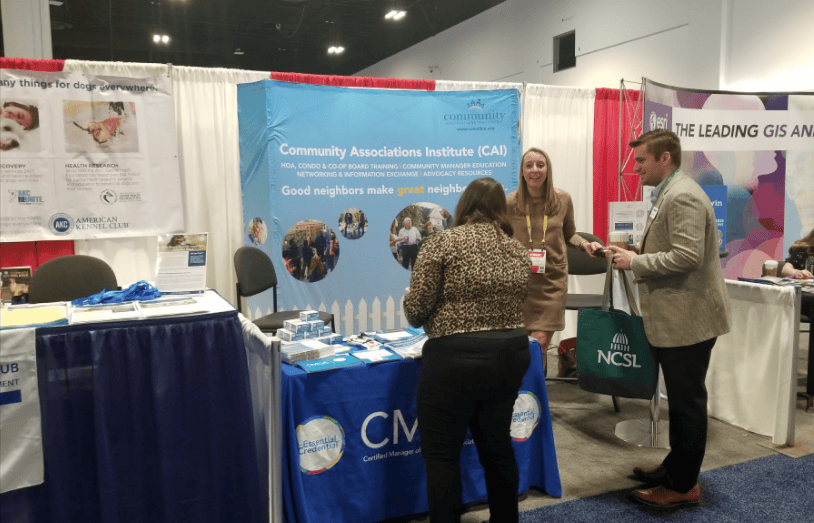
At the end of 2021, it was fantastic to be back in person at the National Conference of State Legislatures (NCSL) Legislative Summit in Tampa, Florida. This annual meeting gives the nation’s state legislators and staff a rare opportunity to connect, dive into policy issues and prepare for the legislative sessions in 2022.
The annual Summit is an important opportunity for CAMICB to educate – and update – state and international lawmakers about the community association management profession. CAMICB has partnered with CAI and exhibited at the Summit for more than 10 years. Since then, our team has had thousands of face-to-face conversations with lawmakers about HOA and condominium laws. We also exhibit annually to reinforce the CMCA credential be considered a primary certification option should legislatures pursue licensing the association management profession.
This year nearly 2,400 people registered for the Summit, with almost a thousand legislative staff and policymakers from across the world attending. Our booth bustled with the conversation about the CMCA credentialing program’s recent international accreditation by the ANSI National Accreditation Board (ANAB) and emphasizing the CMCA credential meets the global benchmark for certification programs. Earning the prestigious international accreditation is proof the CMCA credential serves community association management in a consistent, comparable, and reliable manner worldwide.
Are you putting your most valuable assets in the hands of the most qualified professionals?
As a homeowner, it’s in your best interest to protect one of the biggest investments you’ll ever make. Therefore, it’s critical to know if your community is managed by a Certified Manager of Community Associations (CMCA). CMCAs manage condominium & homeowner associations, housing cooperatives, resort communities and commercial tenant associations.
If you serve as a board member, trustee, or volunteer leader working with your homeowner’s association, condominium association, or cooperative, your decisions have a profound ?nancial impact on your community. There are more than 20,000 quali?ed community association managers who hold the CMCA credential. Hiring one of them to manage your association ensures you have the best resources available to make important decisions about reserves, maintenance, insurance, budgets, governance, contracts, the law, rules enforcement, and more. Receiving professional, accurate advice and guidance on such issues can mean the difference between prosperity and disaster.
What a difference a credential makes!
About the CMCA Credential
The Certi?ed Manager of Community Associations (CMCA) credential is the only international certi?cation program developed solely for managers of homeowner and condominium associations and cooperatives. The CMCA is awarded to individuals who have demonstrated core competency in the knowledge areas required to perform effectively as a community association manager and who have made a commitment to continuing education and the highest standards of professional conduct.
Governing board members and homeowners are encouraged to seek committed, quali?ed professionals to manage their communities. Hiring a CMCA ensures expert management by someone who has demonstrated the specialized skills required to lead a community association successfully.
The CMCA program is dual accredited. The National Commission for Certifying Agencies (NCCA) accredits the CMCA program for meeting its U.S.-based standards for credentialing bodies. The ANSI National Accreditation Board (ANAB) accredits the CMCA program for meeting the stringent requirements of ISO/IEC 17024 Standard, the international standards for certification bodies. The program’s dual accreditation represents compliance with rigorous standards for developing, delivering, and maintaining a professional credentialing program. It makes the CMCA credential one of a small number of dual-accredited credentialing bodies and the only accredited certification for community association management professionals around the world. It is a great source of pride and a strong testament to the strength and value of the CMCA credential.?
Do you know if your manager is CMCA-certi?ed? Search our Directory of Credentialed Professionals at www.camicb.org/?nd-a-cmca.
Business leaders see the need to provide hybrid and remote work options as important.
By Allison Murray for ZDNet
As it becomes more apparent that a hybrid work environment is here to stay, companies need to prepare to be flexible in 2022, and business executives agree.
According to PricewaterhouseCoopers’ (PwC) Executive Views on Business in 2022 Pulse Survey published on Thursday, 43% of business leaders plan to keep hybrid work options for employees, and 30% plan on making remote work a permanent option. In addition, 77% of executives see hiring and retaining employees as the two most important factors to consider in 2022.
“As employers look to attract and retain critical talent, they’re shifting their investment into their employees — creating meaningful work opportunities, investing in learning and upskilling, and creating career advancement opportunities — all while providing new flexible working options to meet employee personal needs,” said Julia Lamm, PwC Workforce Transformation Principal, in a statement. “2022 will be an important year for employers to build trust between employers and employees, as they seek to stabilize their teams and position for growth.”
The survey — which included 678 C-suite executives — also found that leaders plan to keep several initiatives to focus on this retainment and attracting talent. These include increasing career advancement and upskilling opportunities (36%), increasing compensation for employees (31%), and improving benefits for employees (30%).
Even though executives have a positive outlook on focusing on their employees, they are still concerned about the state of the current labor market. The survey shows that only 36% believe that voluntary turnover will return to pre-pandemic levels by year-end. In addition, only 31% believe that the talent shortages will ease.
Other recent reports echo PwC’s findings that executives prioritize their talent in 2022. For example, a recent Fortune/Deloitte CEO survey showed that nearly half of participants say talent will be the biggest challenge they face this year. Similarly, PwC reports that almost half (48%) of executives see the ability to hire and retain talent as the biggest risk in reaching their organizations’ goal growths.
But retaining talent is as simple as listening to employees’ needs, and Lamm said that will be essential for businesses to do this year.
“Building trust between employers and employees means listening and responding to employee needs — this is an incredibly unique time to take bold steps forward and implement new ways of working that are aligned to the expectations and needs of your people,” Lamm told ZDNet.