Unknown's avatar

About CMCA ~ The Essential Credential

CAMICB is a more than 25 year old independent professional certification body responsible for developing and delivering the Certified Manager of Community Associations® (CMCA) examination. CAMICB awards and maintains the CMCA credential, recognized worldwide as a benchmark of professionalism in the field of common interest community management. The CMCA examination tests the knowledge, skills, and abilities required to perform effectively as a professional community association manager. CMCA credential holders attest to full compliance with the CMCA Standards of Professional Conduct, committing to ethical and informed execution of the duties of a professional manager. The CMCA credentialing program carries dual accreditation. The National Commission for Certifying Agencies (NCCA) accredits the CMCA program for meeting its U.S.-based standards for credentialing bodies. The ANSI National Accreditation Board (ANAB) accredits the CMCA program for meeting the stringent requirements of the ISO/IEC 17024 Standard, the international standards for certification bodies. The program's dual accreditation represents compliance with rigorous standards for developing, delivering, and maintaining a professional credentialing program. It underscores the strength and integrity of the CMCA credential. Privacy Policy: https://www.camicb.org/privacy-policy

HOA Homefront – Which type of management Is best for your HOA?

BY KELLY G. RICHARDSON For the San Diego Union Tribune

Determining which type of management services is best for the HOA is a very important HOA board decision. Even the smallest associations need some form of professional management.

What is a “manager”? Managers oversee the association’s day to day operations, advising and informing the board and following its policies and instructions regarding association property and funds. A manager may be an unpaid volunteer or may be paid. The paid manager may be an association employee, a consultant, or an employee of an outside company. California requires no license to manage HOAs.

Volunteer management. Many associations use volunteers for their management functions. The motivation for volunteer management is primarily to save cost. In volunteer management, volunteers place themselves in the role of an unpaid manager, with all of the risks and no reward. Volunteer-managed associations often find it difficult to find board candidates, since directors work so much harder when they are also managers.

Financial management. This involves collecting assessments, paying bills, and preparing monthly and annual financial reports, disclosures, and budgets. A financial manager typically does not visit the property. Management companies often prefer financial management because it is more predictable and less prone to the extra work of managing the property. Some accountants also offer financial management services. Associations struggling with the cost of full association management may wish to consider at least financial management.

Property management. Property management involves responsibility for keeping up the condition of the buildings and grounds and may include routine inspections for architectural violations, maintenance items, and repair needs. The plumbing leak on a Sunday afternoon and the broken window on Tuesday evening are all part of the routine for a property manager. Property management, when coupled with financial management, is called “full management.” Some associations choose to hire one company for financial management and another for property management services. Full management services normally cost significantly more than “financial-only” management.

Off-site/On-site. Most associations are managed by persons working at a location at a management firm office. Some companies provide managers working at the association property, at a greater cost. However, on-site managers typically a higher level of service, which can offset the greater cost.

Portfolio vs. General Manager. Portfolio managers simultaneously work for multiple associations, while general managers work for just one. Most associations cannot afford general managers. An important question to the portfolio manager is “how many other associations will you handle along with ours?” A lower management fee can result from a company overloading its managers. For some HOAs, cost is the only concern, but level of service, experience, and management credentials should also be considered. Ask questions and make sure your association understands what it is receiving. HOAs normally get what they pay for.

In-house management. Larger associations may choose to hire their manager and staff as direct employees. This gives the association more control of its management at less cost than the rates charged by a management firm for the staff it provides. The drawback is the opposite side of the coin – the association takes on the responsibility of finding, screening, and supervising the manager and dealing with personnel issues.

Choose the management style best serving the community’s interests and needs, rather than automatically selecting the cheapest.

Kelly G. Richardson is a Fellow of the College of Community Association Lawyers and Partner of Richardson Ober DeNichilo LLP, a California law firm known for community association advice. Send questions to Kelly@RODllp.com. Past columns – www.HOAHomefront.com.


Ducey signs bill eliminating HOA restrictions on artificial grass

Arizona Business Magazine

Supporting the need to preserve water and protect private property rights, today Governor Doug Ducey signed into law HB2131. The bill was sponsored by Rep. John Kavanagh – Fountain Hills, after he was contacted by valley resident Sherry Lund. The need for such a law was recognized when Ms. Lund and her son Bradford Lund, who lives next door were served with a lawsuit by their HOA after installing artificial grass to reduce their water consumption. Ms. Lund and her son were being assessed a fine of $250 a day each for everyday they failed to remove the artificial turf and replace it with natural grass.

On the signing of the bill into law, Ms. Lund said, “We should all thank Gov. Ducey and Rep. Kavanagh for using common sense in the passage of this bill into law. Arizona is facing a serious drought, and every responsible citizen should be looking to see what we can do to decrease our use of water.  It never occurred to me that anyone would be so shortsighted as to infringe on personal property rights and demand water guzzling grass over a high-quality artificial turf. This law fixes that problem.”

The effort to provide protection for water conservation and private property rights in HB2131 received bipartisan support in the legislature and from community management organizations, property rights advocates, and water conservation groups.

Since the early 1990s, the use of synthetic grass in the more arid western states of the United States has moved beyond athletic fields to residential and commercial landscaping. New water saving programs, as of 2019, which grant rebates for turf removal, do not accept artificial turf as replacement and require a minimum of plants.

The use of artificial grass for convenience sometimes faces opposition: Legislation frequently seeks to preserve natural gardens and fully water permeable surfaces, therefore restricting the use of hardscape and plantless areas, including artificial turf. In several locations in different countries, homeowners have been fined or forced to remove artificial turf or had to defend themselves in courts. Many of these restrictions can be found in local bylaws and ordinances, and are not always applied in a consistent manner.

GREEN IDEAS ?

HOW NYC CO-OPS/CONDOS SAVE ENERGY

Co-op and Condo Boards Can Lead the Charge on Electric Cars

A co-op shareholder in Woodside, Queens, is facing a dilemma. He has sole access to a dedicated garage, and he wants to buy an electric car. However, the co-op board will not give him permission to install an electric car charger, even though Con Edison has agreed to connect the charger to the grid. Can a condo or co-op board refuse such a request?

The answers are, respectively, no and yes, says the Ask Real Estate column in The New York Times. Because of changes made to state property laws in 2019, a condo board cannot impose unreasonable restrictions on the installation or use of charging stations on an owner’s property or deeded space. Co-op boards, however, are not subject to the rule, and most co-op buildings were obviously not designed with electric vehicles in mind.

“You’re dealing with buildings that could be from 1910 — they were using horses when that building went up,” says Mitchell Karasik, director of business development at En-Power Group, a mechanical-engineering firm that is in the process of installing around 2,000 charging stations in 200 residential and commercial buildings around the city. “The infrastructure upgrades that are needed can often be significant.”

But older buildings can — and are — installing charging stations. Mr. Karasik says he’s noticed a sharp uptick in interest from buildings over the past year. That shareholder at the Woodside co-op is not going to be able to force his board to do this, but he might persuade it to think differently. Charging stations could increase property values — any buyer who already owns an electric vehicle, or wants to, will not want to purchase an apartment in your co-op. The key is to get the co-op board to view charging stations as an investment, not an expense.

Because electric cars are coming. In September, New York State passed a law banning the sale of combustion engines for cars and light trucks by 2035. Co-op and condo boards need to prepare for the inevitable changes ahead — by leading the way on installing charging stations.

“I know 2035 is a long time from now, but the state is going electric,” says Leni Morrison Cummins, a member at the law firm Cozen O’Connor. “It’s happening, it’s just a matter of when.”

HOW LEGAL/FINANCIAL PROBLEMS ARE SOLVED BY NYC CO-OPS AND CONDOS Luxury Condo Unit-Owners Benefitting from 421-a Tax Break

Hudson Yards, Manhattan

Habitat Magazine


YeIn March, we reported that numerous state legislators want to exclude Gov. Kathy Hochul‘s proposed overhaul of the 421-a tax break from the upcoming state budget. Instead, they want time to debate the merits of the governor’s overhaul of the controversial tax break that was intended to increase the stock of affordable housing. Some say it should be scrapped altogether. Today The New York Times reports that developers have reaped billions in tax breaks under 421-a, but many developments feature “affordable” units that are priced beyond the reach of average New Yorkers.

The Times reports: “In buildings with condos, the tax break extends to individual (unit-)owners, an exemption available in some of the most prominent residential projects in Manhattan, including 35 Hudson Yards, a luxury condo tower. Whoever buys the full-floor penthouse on the 90th floor, currently for sale for $49.5 million, would pay just $27,500 in annual property taxes because of a 421-a exemption that lasts 20 years. Without the tax break, the yearly property taxes would be $342,000.”

First introduced in the 1970s, the tax break for builders of multifamily housing was meant to promote new residential construction when New York City was facing a fiscal crisis and few developers were building anything. After the economy rebounded, the subsidy remained and started to evolve, slowly adding various affordability requirements to qualify for the tax break.

Among the opponents of the 421-a tax break — and Hochul’s proposed modifications of it — is city Comptroller Brad Lander, who has issued a report stating that the tax break costs the city nearly $1.8 billion in lost tax revenue yearly, while it has failed to produce enough affordable units to stem the city’s housing crisis. Instead of modifying the 421-a break, which is due to expire in June, Lander has urged the state Legislature to set a Dec. 31 deadline to overhaul the city’s antiquated and unfair system of levying property taxes.

Another example cited in the Times report is Jackson Park in Long Island City, Queens, a 1,871-unit luxury development in three towers where penthouses rent for $8,500 a month. The developer, Tishman Speyer, legally navigated loopholes in the tax exemption to win an annual reduction of $21 million that nearly eliminates the development’s property tax bill. Since it was built before a provision of 421-a expired, Tishman Speyer was able to include zero below-market units. Meanwhile, co-op and condo boards fret that their soaring property taxes are threatening their buildings’ viability.

Critics say too many apartments marketed as “affordable” are only within reach to families making well over $100,000 a year — far higher than the city’s median household income — and that loopholes in the program’s different versions have allowed some rental and condominium buildings to not include any low-cost units.

Paula Crespo, a senior planner with the Pratt Center for Community Development, which has criticized the program, said she considers the tax break program “a missed opportunity to require something back from the developer for these decades of tax exemptions.”

Hochul’s proposed tweaks to 421-a have won the backing of Mayor Eric Adams and the Real Estate Board of New York.

‘Self-interested’ homeowners board must defend assessment, Md. court says

By Steve Lash for Maryland’s Daily Record

A North Bethesda homeowners association’s board composed entirely of townhouse owners must defend its decision to raise landscaping assessment fees on apartment dwellers against a claim the board members were self-interested, Maryland’s second-highest court ruled Thursday.

In its reported decision, the Court of Special Appeals said the Cherington Condominium Association will have to show in an administrative proceeding that it was “fair and reasonable” for the board to charge apartment residents for groundskeeping that would seemingly benefit townhouse owners more than above-ground apartment residents.

The controversial assessment was levied against the both the association’s 87 townhouses and the 12 “garden style” apartment units, according to court papers.

The Court of Special Appeals decision was a victory for apartment dweller Heather Kenney in her ongoing challenge to the assessment.

In its 3-0 ruling, the court applied to the association’s board the “interested director” rule that judges generally apply to corporate boards embroiled in conflict of interest allegations.

The rule, as annunciated by Maryland’s top court 114 years ago, holds that a conflicted board can defend a controversial decision by showing it was “just and proper, and that no advantage was taken of the stockholders.” The 1908 Court of Appeals decision, Francis v. Brigham Hopkins Co., involved directors voting for their own salaries.

As in Francis, the homeowners association’s board consisted of “interested directors” in that they stood to gain from the landscaping assessment by having those not represented on the board – apartment owners – pay a share, the Court of Special Appeals said.

The appellate court rejected the association’s argument that the board’s decision was protected by the “business judgment rule,” which shields corporate governing bodies from liability for decisions made within their authority. The association cited its bylaws, which enable the board to maintain the landscaping “of the community grounds as well as the readily accessible yards of the townhouse units.”

But the Court of Special Appeals said the business judgment rule does not apply when the directors are shown to have had a personal interest in their decision.

“The business judgment rule creates a presumption that directors are acting in accordance with their fiduciary duties of care and loyalty,” Judge Andrea M. Leahy wrote for the court, citing Maryland corporate law. “The interested director transaction rule operates as a brake on that presumption when conflicted director transactions are present, requiring that either the conflicts be disclosed and approved, or the transactions implicating those conflicts be shown to be fair and reasonable to the corporation.”

The appellate court sent the case back to the Commission on Common Ownership Communities for Montgomery County to determine if the landscaping contract and related assessment was fair and reasonable.

The association’s attorney, J. Bradford McCullough, expressed concern with the court’s decision and stated via email Friday that he and his client are “weighing our options” and have not decided whether to seek review by the Court of Appeals.

“I fear that the opinion could encourage litigation that challenges community associations’ budgeting decisions,” added McCullough, of Lerch, Early & Brewer Chtd. in Bethesda.

Kenney’s attorney, Matthew D. Skipper, did not immediately return a telephone message Friday seeking comment on the decision. Skipper is with Skipper Law LLC in Crofton.

The case began in January 2019 when Kenney filed an administrative complaint with the commission, alleging the landscaping assessment violated the bylaws by requiring non-townhouse owners to pay. The commission dismissed the complaint, agreeing with the association that the assessment was authorized.

On appeal, however, the Montgomery County Circuit Court held that the board members were self-interested and remanded the case to the commission for further factfinding regarding the fairness and reasonableness of the assessment.

The Court of Special Appeals agreed.

“To be clear, our opinion does not make or mandate a finding that the board acted improperly,” Leahy wrote. “Ms. Kenney made a sufficient showing that the board has a conflict of interest under the interested director transaction rule, but on remand to the CCOC, the association may satisfy the interested director transaction rule by presenting evidence that the … assessment was fair and reasonable to the association and its members.”

Leahy was joined in the opinion by Judges Terrence M.R. Zic and J. Frederick Sharer, a retired jurist sitting by special assignment.

The Court of Special Appeals issued its decision in Cherington Condominium v. Heather Kenney, No. 157, September Term 2021.

Best HOA & Condo Websites for your Association

By Charlie Wilson for Loop21

A website is a handy tool for any homeowners association. It defines how a community interacts with its residents and eases communication. What’s more? An HOA website makes it easy to access community rules and improves transparency between the residents and the management. Are you seeking ideas for the best HOA and condo website? Well, every association has unique needs, but there are must-have features to look out for.

What features define the best HOA websites?

The features matter a lot when it comes to the choice of website. Although all associations are different, the site should make it easier to manage your community. To build a website with the best features, seek help from an HOA Website company, and consider the following characteristics.

1. Dedicated domain

The website should feature a dedicated domain. This makes it easy for others to locate it, thus the need to choose something straightforward.

2. Resident portals

The HOA website should also have portals to serve both existing and potential homeowners. The current members should access account balances, file service requests, and retrieve vital documents with ease.

3. Online payment options

Online payment options are also vital. Collecting dues using conventional means is inconvenient and time-consuming. The best websites integrate an online payment option, allowing homeowners to settle dues using their user accounts.

4. Calendar& Communication channels

 The site should also feature a community calendar for events, communication channels, and polling abilities. Lastly, it should be mobile-friendly and easy to use.

What are the best HOA& Condo websites?

1. The Towers Of Channelside

This is a perfect choice for people seeking to build a condo association website. The site features an easy-to-use interface with clear and professional images of both the building and neighborhood. Still, it provides basic information about the community, and the clickable links appeal to all visitors. A vital feature of the website is the resident portal. You can include private access with logins assigned to all members.

2. Kensington Glen 

Kensington Glen website is one of the best HOA & Condo websites. It’s renowned for its crisp, clear images on the landing page and all over the site. Moreover, it features a call to action, which prompts user interaction among members. The site is easy to use and very inviting, and you can use it to list the homes for sale in the neighborhood. This is an impressive bonus that allows residents to learn more about the house on sale.

3. Islands of Cocoplum

This HOA website is excellently designed and features professional photos and an aerial view of the property. It includes features like property information, contact information, excellent imagery, and private resident portals.

4. Waterfall South Jacksonville Beach Condos

Waterfall South Jacksonville Beach Condos makes a great association website due to its intuitive features. It presents simple clickable links on the homepage directing users to useful information and services. It also features information and contact details, making it easier for visitors to get an idea of the property.

Final Thoughts

An HOA website is a great way to organize and automate responsibilities. It acts as a central spot where all members can access information and build better relationships. It also helps board members to keep residents posted on any initiatives and events. However, the best HOA website incorporates various features to enhance communication and ease payments.

Real estate Q&A: How can HOA enforce smoking ban in common areas?

Gary M. Singer, South Florida Sun Sentinel

Q: At our annual meeting, our condominium community passed a “No Smoking” resolution into our bylaws. It encompassed the entire club area, including the outdoor facilities. We now have a small group of new owners who vocally oppose this ban and continue to smoke at our community pool despite numerous requests to stop. How can we enforce the ban? — Jerry

A: Smoking has been banned indoors in condominium common areas for a while. The recent trend is to ban smoking in outdoor common areas, like the pool, and in limited common elements, such as balconies.

To see if your association has the right to do this, you must review the condominium’s declaration. If allowed, it will need to be voted on by a prescribed majority of the unit owners. As long as all of these hoops are jumped through, the ban goes into effect.

Generally, if a community rule is reasonable, it will be upheld if challenged in court. A smoking ban, even outside on a balcony or in the pool area, would likely be found to be reasonable because of the well-known health issues associated with secondhand smoke.

The logic would apply to similar activities, such as pipe smoking or vaping.

Your community can enforce the new rule the same way it would any other rule. First, a warning letter should be sent to the offending homeowner. If this does not work, they can be fined for breaking the rules.

This situation is becoming further complicated by the rising use of medical marijuana. If it were legal, it seems that recreational marijuana would be treated similarly to tobacco.

However, an argument can be made that prescribed marijuana might be accepted in some cases as a reasonable accommodation under housing and disability laws.

Are You Ready to sit for the CMCA Exam? Use This Step-By Step Process To Adequately Prepare

A variety of study aids are available to CMCA exam candidates online at CAMICB.org. Because CAMICB recognizes that people have different learning styles, multiple resources are available in various formats. A quick glance at those resources can be overwhelming. Here, we offer a roadmap designed to help you select and properly use those resources towards a successful outcome.

STEP 1. CMCA Study Guide. Download this FREE guide for an overview of how the CMCA exam was developed and how it’s structured. This is important to developing a study strategy. Here, you will also find the key to your studying success: The CMCA Knowledge

cmca-study-graphic-2

8 Knowledge Areas

Areas. You will be evaluated on these 8 knowledge areas, and understanding your strengths and weaknesses in each area, as well as how each knowledge area is weighted, will help you properly prepare a solid study plan.

STEP 2. CMCA Handbook. Download the FREE handbook for an overview of the program, paying particular attention to:

  • Section 2: Taking the CMCA Exam highlights the policies and procedures of the exam.
  • Section 3: CMCA Examination Content and Study Materials offers just that, as well as strategies for standardized test-taking.

STEP 3. If you took CAI’s M-100: The Essentials of Community Association Management, you are not fully prepared to sit for the CMCA exam. The M-100 will provide you with concrete knowledge (i.e., terms and definitions) but will not give you the knowledge to apply those terms and definitions to concepts. For example, What is a Quorum? is not a question you will see on the CMCA exam. You may, however, see a question like this, Quorum requirements conflicts are resolved by which of the following? That doesn’t mean you can skip this step. It’s still important to know the definitions in order to be able to apply them.

CMCAExamPrepSTEP 4. Quizlet is a FREE online tool that uses fun games and exercises to test your concrete knowledge. If after reviewing the M-100 course material, you find that your knowledge of terms and definitions is lacking, Quizlet is an excellent way to help you master those key terms and phrases, and prepare you for the next step in your study plan.

STEP 5. Best Practices Reports are FREE resource guides courtesy of the Foundation for Community Association Research. These Reports will help you gain applied knowledge in key areas found on the exam. Each report also contains case studies to help you understand how best practices are applied in real life situations, which is key to grasping an applied knowledge of these topics. If you’re a seasoned manager, spend a little extra time here. What you’ve learned on the job, may not be deemed best practices in the industry.

STEP 6. The CMCA Study Kit is available for purchase from the CAI Bookstore. A great tool for developing applied knowledge, you may purchase individual titles or the entire package depending on your needs.

STEP 7. CMCA Practice Exam is available online at a cost of $25 for one attempt and $40 for two. The Practice Exam includes questions that have been rotated off the exam and offers real time feedback on whether you were right or wrong on a question and why, offering real-world insight into the CMCA exam experience.

All of these materials to prepare you for the CMCA Exam can be found at CAMICB.org on the Exam Preparation web page. We encourage you to spend at least 6-8 weeks preparing for the Exam, and if you have any questions you can contact us at 866-779-CMCA or info@camicb.org.

We’d like to hear from managers who are studying for the exam. What’s working for you? What’s not? Please use the Comments section to let us know how you’re doing!


Could XR tech redefine workplace culture?

By ALEXANDER YOUNG for Talent Management & HR

In what seems like the blink of an eye, traditional workplace events – chats by the water-cooler; chill-out meets or Friday drinks – have, for many employees, become things of the past. ‘Workplace culture’ as we once knew it is undergoing a seismic shift. As employment increasingly becomes remote or hybrid, HR professionals must get to grips with what this means for their own organizations.

Emerging from the fall-out of the pandemic however, is technology that some may not yet have heard of – technology which has the potential to supercharge organizations and employee cultures once more. It’s called XR (or ‘Extended Reality’) technology. If you haven’t yet looked at it, it’s probably time you should. It could be just the answer HR professionals have been looking for.

What is XR?

XR is often referred to as the coming together of virtual reality (VR) technology and augmented reality (AR) technology – where any human-to-PC screen interface is modified by either 1) immersing the user in a virtual environment; 2) adding to, or augmenting, the user’s surroundings (AR); or 3) both of those. As with most VR-type tech, it began in gaming. But today it’s increasing having B2C use (such as ‘try before you buy experiences’, where you can see how furniture, for example, might look in your own room), and inevitably, it’s developing business-to-employee uses too.

Why XR? 

Cloud-based XR platforms can now provide employees with easy and on-demand access to a variety of immersive content. This includes 360-degree bespoke video, virtual spaces for collaboration and interaction with colleagues, live streaming of events and webinars, and even AI-powered virtual humans that facilitate employee soft-skills training. The key attraction of the technology is that it is cost-efficient, but also the process of creating bespoke content is pretty easy. It’s also scalable, and the impact can be much better measured and quantified.

But exactly how is XR tech being used to redefine culture in the new workplace? Let’s find out…

1) XR facilitates truly flexible hybrid working

For most employees, the ability to work from home, on their own schedule, is now a ‘must’. But without the right technologies and systems in place, remote work can turn into a remote nightmare of miscommunication, isolation and low productivity. XR tech is an excellent solution to the most common problems faced by remote workers. For example, by running immersive virtual meetings (where employees interact as avatars), XR technology can support collaboration in hybrid teams. Setting up virtual offices is also becoming popular, as these XR-mediated spaces can replicate the creative energy of the in-person office without any of the distractions or inconveniences of traveling to a physical location. They can be equipped with breakout rooms, classrooms, deep-work spaces and even XR gyms!

2) XR supports skill building 

Managing employee training is an oft-cited headache for HR professionals. That’s because traditional (in-person or online) skills training and onboarding is expensive, can be boring, and is invariably time-consuming. But in 2022, the status quo is changing. Organizations can now create their own XR training and onboarding content that is interactive, engaging and scalable. Complex technical skills – including equipment operation – can be practiced repeatedly in a zero-risk virtual environment. Soft skills – such as communication – can be honed with the help of a never-tiring virtual human. Built-in AI-powered feedback also provides in-depth analysis of performance, helping HR accurately identify areas where colleagues need extra support to improve. XR up-skilling is more impactful too. Studies have shown that learners who use a virtual platform can improve their performance by up to 230% and reduce skill fade by 52%. This means that team members can spend less time training and more time on the work that matters.

3) XR creates strong communities

While we all know flexible work and training are part of workplace culture, it’s the interactions between colleagues that arguably have the biggest impact on culture overall. Connection matters to teams. Recent data revealed 48% of employees complained they felt isolated from their coworkers during the pandemic; while 56% wished they had a community where they could get advice and 64% wished they had a way to ask questions of industry peers. If HR teams are to orchestrate a supportive community, colleagues need opportunities for non-work related interaction in informal contexts. And it’s virtual and hybrid events that are soaring in popularity, thanks to them offering of a more inclusive and flexible approach to workplace socializing. From coffee mornings to live music streaming and games nights, there are limitless possibilities when it comes to delivering impactful virtual events. Chats and breakout spaces support organic relationship building, and interactive quizzes or competitions can help boost engagement and break the ice. And as an added bonus, no one is at risk of missing that last train home.

Be the future you want to be

Yes, future workplaces will look and feel very different to the workplaces of old. But this means HRs’ approach to building and maintaining workplace culture needs to evolve and adapt. With the correct thought however, XR technology could be the next big opportunity to explore. The power of new immersive technologies really does have the capacity to drive business (and employee) success.

Maintaining High Ethical Standards

CMCAs’ Commitment to Following Strict Standards of Professional Conduct

An important – yet often overlooked – component of CAMICB’s Credentialing Program 

requires a Certified Manager of Community Associations (CMCA) to adhere to a high standard of ethical conduct. This means Certificants must comply with the 10 CMCA Standards of Professional Conduct, which govern their professional activities.  

These Standards of Professional Conduct, detailed at www.camicb.org/standards, range from understanding laws applicable to community association management, to being knowledgeable on association policies and procedures, to carrying out fiduciary responsibilities, and participating in continuing education coursework. A violation of any of these Standards of Professional Conduct may be grounds for administrative action and possible revocation of the CMCA certification by CAMICB.  Abiding by these Standards of Professional Conduct help protect consumers and associations that hire or contract with community association managers. 

“When a community association manager earns the CMCA, they’re pledging to uphold a strict code of professional conduct which is critical to the profession,” said Ron Perl, Esq., a Partner at Hill Wallack LLP, who leads the firm’s community association practice group. “This is more than understanding the many facets of community association management and troubleshooting challenging situations, it brings about accountability, responsibility and trust to the individuals the profession serves.”

Enforcing the Standards of Professional Conduct

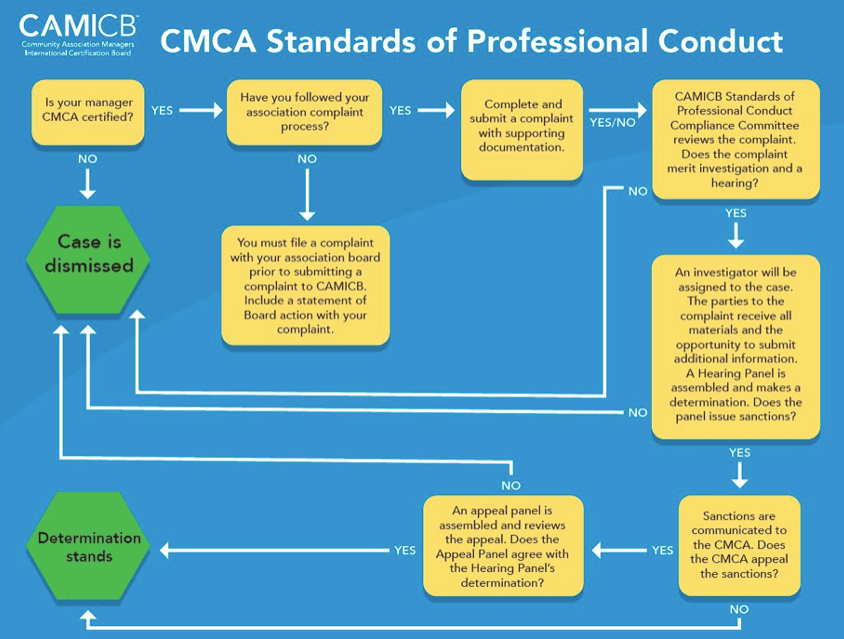
In order to maintain and enhance the credibility of the CMCA Certification Program, the CAMICB Board of Commissioners adopted strict procedures that allow consumers and others to bring complaints concerning CMCAs to the Board. 

The CAMICB Chair of the Board appoints members of the Standards of Professional Conduct Compliance Committee which oversees the process and procedures for enforcing the Standards of Professional Conduct. Once a complaint – received in writing – is deemed valid and actionable by the Committee, it will be brought before a Review Panel for investigation and a determination of whether there has been a violation of the Standards. If the Review Panel determines a violation has occurred, an appropriate sanction will be imposed. This process, including the internal investigation, hearing, and timeline of activities, is clearly detailed in the Procedures for Enforcement of the Standards of Professional Conduct document available on the CAMICB website. 

The grounds for sanctions under these Procedures range from conviction of a felony, to gross negligence or willful misconduct in the performance of professional services, to fraud or misrepresentation and, where applicable, loss of state license required to practice community association management.

“These Standards of Professional Conduct are the foundation of the CMCA credentialing program,” added Marilyn Brainard, a public interest member of the CAMICB Board of Commissioners.  “We take them very seriously and are proud of the work our colleagues and managers do to uphold them.”

More information, including a set of Frequently Asked Questions, a list of the 10 clearly outlined Standards of Professional Conduct, complaint form and other pertinent documents can be found at https://www.camicb.org/for-cmcas/standards-of-professional-conduct.