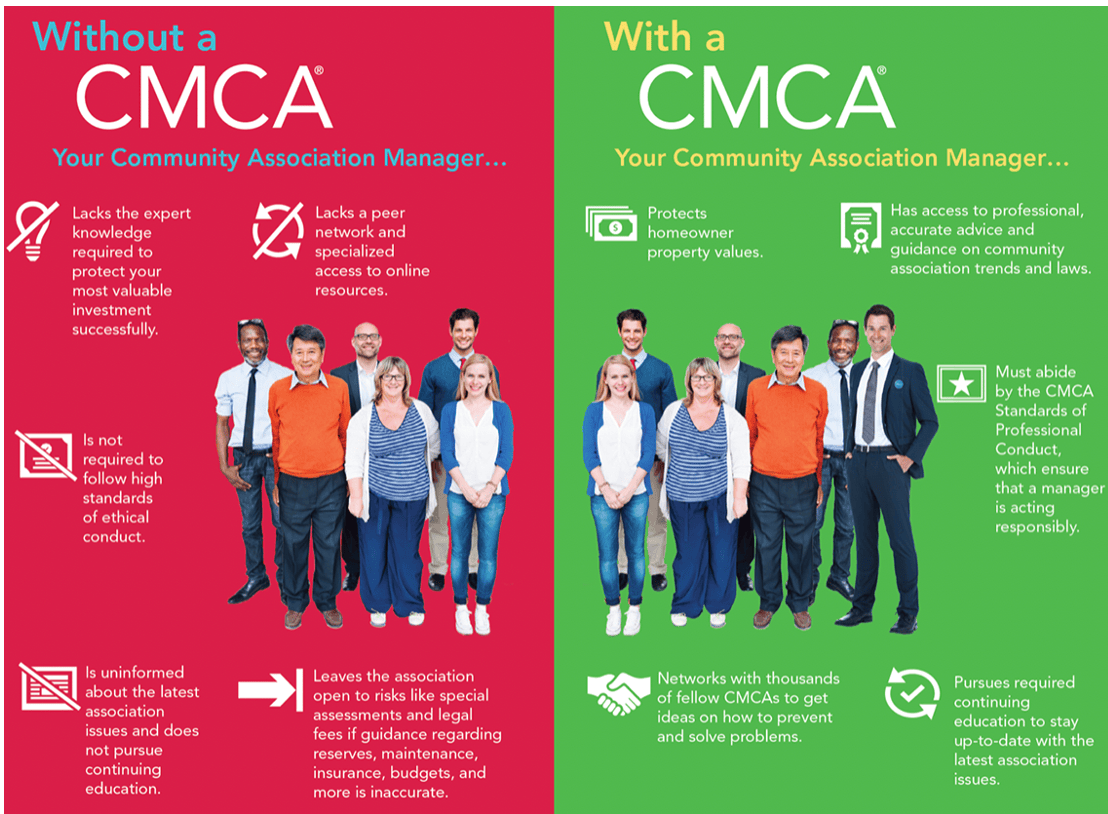
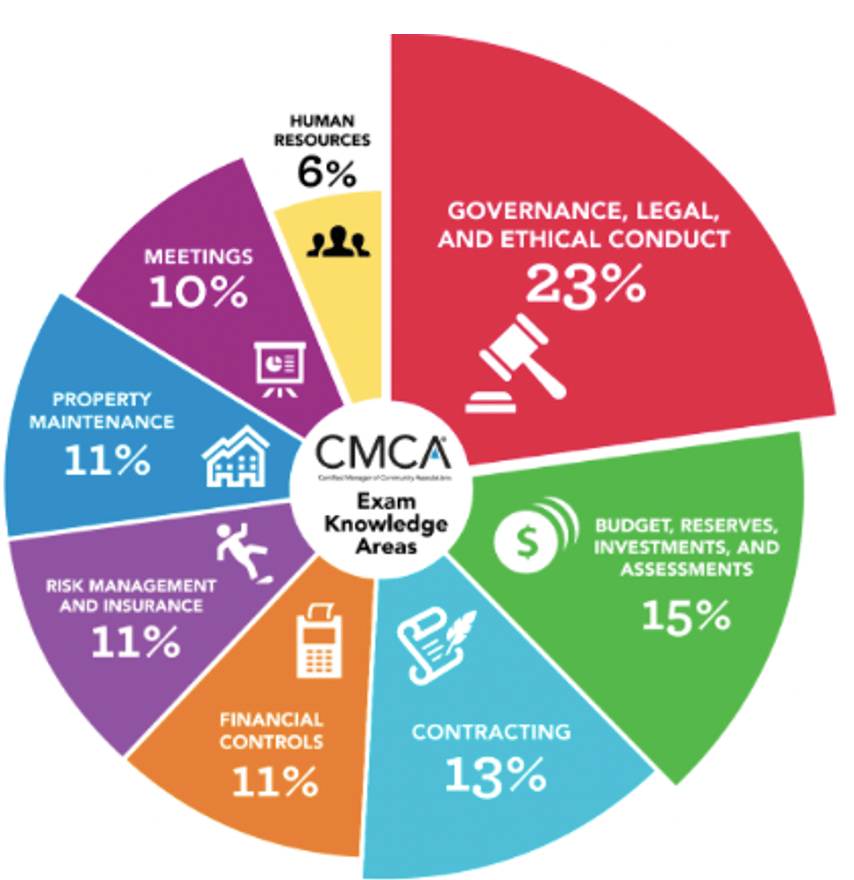
CAMICB is a more than 25 year old independent professional certification body responsible for developing and delivering the Certified Manager of Community Associations® (CMCA) examination. CAMICB awards and maintains the CMCA credential, recognized worldwide as a benchmark of professionalism in the field of common interest community management. The CMCA examination tests the knowledge, skills, and abilities required to perform effectively as a professional community association manager. CMCA credential holders attest to full compliance with the CMCA Standards of Professional Conduct, committing to ethical and informed execution of the duties of a professional manager.
The CMCA credentialing program carries dual accreditation. The National Commission for Certifying Agencies (NCCA) accredits the CMCA program for meeting its U.S.-based standards for credentialing bodies. The ANSI National Accreditation Board (ANAB) accredits the CMCA program for meeting the stringent requirements of the ISO/IEC 17024 Standard, the international standards for certification bodies. The program's dual accreditation represents compliance with rigorous standards for developing, delivering, and maintaining a professional credentialing program. It underscores the strength and integrity of the CMCA credential.
Privacy Policy: https://www.camicb.org/privacy-policy
Floridian master gardener Steve Turnipseed has converted 7,000 square feet of bare lawn into a thriving garden full of native plants, despite the restrictive rules of his HOA, Dwell reports.
According to Dwell, Turnipseed is the founder and president of his local chapter of the Florida Native Plant Society. When he moved to the Villages planned retirement community, he was disappointed with the landscaping around his new home.
He immediately began looking for ways to incorporate beautiful native plants without breaking his HOA’s rules — including the rule that he needed to maintain a “lawn-like” appearance with plants under a foot tall.
Even with those restrictions, Turnipseed says, “I knew I could create something stunning.”
To start with, he chose the native ground cover frog fruit, whose flowers attract three species of butterflies and many other insects. His garden also includes clump grasses, trees, and shrubs — almost 100 native species in total.
“Sometimes people will ask why I’m sitting out in my garden,” he told Dwell. “I’ll tell them, ‘This is where the butterflies come.’”
Commenters on Reddit are impressed with his results. “Just gorgeous, within the guidelines, and indigenous to the area!” wrote one user. “God bless him, I wish he could come help me do the same, plus there’s no HOA.”
While Turnipseed may not be making house calls, he does offer Dwell advice for those who want to replace their lawns.
First, he recommends killing the existing grass and its seeds — ideally, leaving the dead grass in the ground to return nutrients to the soil. There are several ways to achieve this, including smothering the lawn with cardboard or plastic.
Then, plant something low-maintenance in its place. If possible, homeowners should choose a native plant that supports pollinating insects and birds, but he says other hardy plants like Asiatic jasmine are still better than a lawn. This is because they use less water, which is good for your utility bill and the environment.
Turnipseed had been following his HOA’s rules from the beginning and doesn’t report any trouble from the organization. But other homeowners starting eco-friendly home improvement projects sometimes run into resistance.
The good news is that it’s possible to win a legal battle against a restrictive HOA, like the Maryland couple that planted native flowers and the Reddit user who cited state law to defend their solar panels.
By Marlena Weisbrot, CMCA®, Aperion Management Group, LLC, AAMC®, Bend, OR
No one will ever forget the Summer of 2020…the orange sky that hung over us for days. The stench of what remained of a destroyed landscape…the ash falling like snow in the 100-degree heat.
This was too close to home. This was real.
For the Board of Directors and Homeowners of Awbrey Butte Owners Association in Bend, Oregon, the achievement of obtaining a Firewise Designation had been a long-term goal which was sought in order to increase attraction to the Community, boost property values and decrease insurance dues. And of course, to increase fire safety. The Single-Family home Community performed the standard requirements of designation by encouraging all owners to clean up their properties by enticing them with free green waste disposal and providing them some education on how to increase defensible space by inviting local Firewise representatives to do presentations during Annual Meetings. Everything went splendidly- the needles from the thousands of pine trees covering “The Butte” were cleaned up, unsightly bitterbrush and other noxious weeds were pulled or trimmed, and people just felt better…
Until the Summer of 2020 when over 1 million acres burned in Oregon, pulling at least 500,000 of our fellow Oregonians out of their homes to seek safety. One day we were gazing out the window admiring the natural beauty of our Central Oregon forests…the next day we gazed out the same window and recognized the intense power of our Central Oregon ecosystem.
It was time to step up our efforts.
The Board of Directors, Firewise Committee and the Architectural Committee banded together for brainstorming sessions: the goal- keep our community and our homes safe and still beautiful at the same time. Deschutes County Forestry, representatives of local Firewise agency and Bend Fire Department were enlisted in the meetings to help sculpt a plan for long-term fire prevention efforts.
The Plan:
In the Spring of 2022, we had a group of 25 passionate members of the community come together to help the cause. The goal was to ultimately perform individual assessments of each of the 778 homes/lots within the community, render recommendations to the owners for modifications to their landscape and homes, while protecting the CC&R’s requirement for thorough review and approval by the Architectural Committee and keeping the high aesthetic standards of the Community. The Volunteers dedicated their time to training under the Forestry Dept and Fire Department, on what to look for when performing assessments. The trainings are designed to be continual and offered by vetted professionals in the fields of fire safety, and civic agents on a rolling basis. The Team also banded with fellow Firewise Designated HOA’s on their experiences for Home Assessment programs (albeit on a smaller scale.) The Association hired a Wildfire Consultant to join the Architectural Committee who began reviewing all plans with an eye on defensible space and ladder fuel reduction. Ultimately the Association’s Architectural Guidelines and Rules & Regulations were revised to ensure that homes were being built and maintained in a way that would aid in the safety of their structures and their neighbors’ properties. The assessments include checklists and custom notes sections per the Immediate Zone (0-5 feet from home) which covers the fire resistance of the home materials including roofing, siding, windows as well as seemingly insignificant items such as the size of mesh vent screening to ensure that embers are unable to pass through. The Intermediate Zone 2 (5-30 feet from home) checklist includes trees/tree limbs adjacent to the home, flammable plant material and debris and firewood storage. Next is the Extended Zone 3 (30-100 feet from home) which focuses on trees and other potential flammable materials in this native landscape zone. And finally, Zone 4, which covers curbside and Fire Department access.
The Assessors are put into pairs and are assigned to a group of addresses. They schedule their own inspections at theirs and the homeowner’s convenience and perform the assessment right alongside the owner to ensure they can answer any questions that may arise. At the end of the Assessment, a copy of the form is sent to the owner and to Management, who keeps a detailed database of all assessments, photos, owner, and assessor contact details, etc. When an owner submits an Architectural Modification application, Management pulls any assessment reports on file to send to the Arc Committee along with their plans. The plans are reviewed by the Arc Committee’s Wildfire Consultant who then drafts and presents a review to the Committee. Upon approval, the owner is notified. Upon completion of work, Management is notified, and their Fire Assessment files are updated reflecting the action taken. What may seem like a very tedious procedure, we have developed quite a groove where the process is streamlined and semi-automated using task management software.
The Progress:
In the Spring of 2022, during the span of just 3 months the Team had already received over 200 requests for Fire Assessments and have completed over 150 of them. No one had imagined how popular this program would be, but the Team has been at the top of their game in ensuring their assignments are completed as promptly as possible.
The members of the Association have grown more inquisitive about Fire Prevention and, in response- “The Firewise Bugle”, was created. This monthly newsletter shares news and tips for Firewise efforts, as well as links to helpful articles and impactful videos to “Remember our Why”.
The amount of flammable debris and hazardous trees that were removed in May 2022, during the Free Disposal event was double the amount of the year prior- all while maintaining the healthy, natural Central Oregon aesthetic beautifully.
And, of course, the people…the sense of community has strengthened as the neighbors working together have fostered friendships. The Association’s Annual Meeting this year has been moved up to the Summer to allow for greater attendance and to be able to host an in-person dinner for all, rather than a Zoom link in a lost email. We look forward to breaking bread in celebration of our progress while still ensuring adequate preparation for what we are working so hard to avoid.
Over my 8 years in this industry, I have never been prouder of a team as I am of Awbrey Butte Owners Association, their Board, Arc, Firewise Committee and Assessment Team. Additionally, I am in awe of the assistance received by the County, City, Fire Department and local experts by means of grants and training opportunities. By all means, we have a long road to go- but the great strides we have taken have proved the strength in our owners. Surely, I will never forget the ashy Summer of 2020, but it will also serve as a reminder of strength and hard work shown by this group of outstanding homeowners in Spring, 2022.
Co-op Advocate Is Elated by City’s Mandatory Organics Recycling Program
By Bill Morris for HABITAT Magazine
Jacquelyn Ottman persuaded her fellow co-op board members to participate in the city’s voluntary organics recycling program six years ago. “The real challenge to organics recycling starts with co-op and condo boards,” Ottman says. “They need to be convinced that this is not going to attract rats and bad smells. In fact, quite the opposite.”
Next came the hurdle of convincing shareholders in her 120-unit high-rise on the Upper East Side to participate in a program even though it was voluntary. A first step was pointing out that New York City sends a million tons of residential waste to landfills every year, and more than a third of it is biodegradable organic matter — egg shells, coffee grounds, chicken bones, food-smeared paper, grass clippings and such. Only a fraction of the city’s organic waste is now being recycled. In a landfill, that matter generates methane, a greenhouse gas. Recycling converts it into compost or biogas, which can power cars and buses or be turned into electricity or heat. But residents of high-rise buildings need more than an environmental lecture to overcome deeply ingrained misgivings about handling organic waste.
“We held a launch event in our lobby,” Ottman recalls. “We distributed literature, recycling pails and breathable green bags to people who wanted to participate. The key is to make it easy for people. We put four latching brown bins in the basement. The room is kept clean. The real trick is what happens inside apartments. People in our building figured out pretty quick that they’re not going to get cockroaches in their kitchen. That’s a big hurdle in New York City. The program was a big hit.”
Today, after clearing those hurdles, Ottman and her fellow organics recycling advocates are facing their biggest challenge yet. On June 8, the city council, after years of vacillating, finally agreed to make curbside organics recycling mandatory citywide, just like the recycling of glass and plastic, paper and cardboard. The rollout of the program will begin in the fall and be fully operational by October 2024. Department of Sanitation trucks will make curbside pickups between once and three times a week.
Which brings us to another hurdle. Ottman served for more than five years on the Manhattan Solid Waste Advisory Board, a group of citizen volunteers devoted to helping the city reach its goal of zero waste by 2030. Ottman was the principal author of two informational Residential Recycling Guides. One of them, which is an invaluable resource for co-op and condo boards, is titled “Engaging Residents of NYC Multifamily Buildings in Organics Collection.”
The guide walks readers through six steps that will help boards, property managers and building staffs develop a smoothly functioning organics recycling program — while, critically, getting residents to buy in. The steps include recruiting volunteers, training staffs, identifying and correcting errors, and communicating regularly with residents about the amount of waste being recycled and the amount of money being saved.
“Some buildings have a green committee, and you absolutely have to have a committed board,” Ottman says, speaking from experience. “As the citywide rollout approaches, I’m very optimistic because residents of other cities have figured out how to do this.” (Organics recycling is mandatory in San Francisco, Seattle and Los Angeles.) “When the government enacts laws that require behavioral change — wearing seat belts, not smoking indoors — New Yorkers adapt. Eventually it becomes normal.”
BY WOODS LONERGAN PLLC for BRICK UNDERGROUND Real Estate. Real Life. Real New York.
How a condo board can handle common charge arrears will be governed by the bylaws.
Q: Several owners in our condo building are in arrears on their common charges. What’s the best way to collect the money they owe?
A: Common charges are important revenue for condos and are necessary in order for the condo to meet operating expenses, maintain common areas, and pay employees.
“If apartment owners fail to pay common charges, it can deplete the building’s reserve fund and could result in higher common charges or assessments for owners who are paying their obligations,” says James Woods, Esq., a partner at Woods Lonergan PLLC, who is a litigation attorney with a concentration in representing condo and co-op boards, as well as other corporate and business entities.
Woods recommends boards be proactive when a condo owner defaults on their common charges.
“A responsive board signals to residents that the board will remain diligent and vigorously pursue payment when there is this type of delinquency,” he says.
If owners don’t keep up with their payments, there are substantial penalties and the default could ultimately result in unit owners losing their home, says Lauren Tobin, Esq., an associate attorney at Woods Lonergan PLLC, who specializes in representing condo and co-op boards, as well as buyers and sellers.
The specific steps the board takes will be determined by the building’s bylaws. Boards should refer to them for information on notices of arrears, debt collection, late fees, and interest.
“Actions by the condo board are governed by the bylaws, so any actions taken to collect arrears must be consistent with the governing documents,” Tobin says.
Impose late fees and issue a notice of collection
Usually the first step is to issue a notice of arrears or notice of debt collection to the defaulting owner and advise them that late fees will be imposed for non-payment of common charges.
Late fees typically range from $50 to $100. The notice of debt collection should provide the amount owed including a breakdown of any late fees, assessments, parking fees, common charges and other fees. Tobin says this is important because it can help a unit owner understand the statement and that they are in arrears.
“We’ve seen situations where the autopay for common charges wasn’t working—payments were bouncing on the bank’s end or the management company changed—and the unit owner thinks they are paying but in fact they are not,” Tobin says. Advising the unit owner could rectify a simple mistake and solve this problem.
A notice might provide an amicable solution, she says. The notice should also advise them they have 30 days before the board imposes a common charge lien—the next step which would put a claim on the title to their apartment.
File a common charge lien
If the notice of collection is ignored, the next step is to file a common charge lien against the condo unit.
A publicly filed lien serves two important functions. It is an avenue that allows the board to later foreclose on the unit if the lien is not paid in a timely manner and it prevents the owner from selling or refinancing the apartment without first paying the debt owed to the condo.
Banks will not approve a buyer’s loan if there is a lien on the apartment.
“If the unit owner understands the implications of the lien—that it’s the first step to starting a foreclosure action—they are often incentivized to pay what is owed,” Tobin says.
If the bylaws provide for it you can also include late fees, interest and other costs as part of the lien. This means you can add the expenses incurred by the board to the total sum owed by the condo owner.
This might include attorneys fees incurred in the process of collecting the debt—which will include any work involved in issuing notices as well as the process of filing the lien. This could amount to several thousand dollars. There are also recording costs which the bylaws may entitle the board to include in the lien.
“This means these additional amounts will be paid back to the board whether from the condo owner directly or in a foreclosure action,” Woods says.
Take the rent from a tenant in the condo
In a situation where the condo is being rented out to tenants, the board has the statutory right to take rent payments directly from the residents of the apartment if the condo owner is in default.
“The board management must provide notice to the tenant and the condo owner that due to the default in common chargers future rent payments must be made directly to the condo. Payment to the condo will satisfy the tenant’s obligation to pay rent under the lease,” Tobin says.
This can continue until the owner is current with common charges. If the unit owner is living there and it is not rented out, this avenue is not open to the board.
Foreclose on the common charge lien
The next step would be to start a foreclosure action in court to sell the condo owner’s apartment and recoup the funds. Getting the advice of an attorney with expertise in this area is helpful when commencing this type of litigation.
In most circumstances, the first mortgage, if there is one, will take priority and must be satisfied before a lien for common charges can be paid to the condo. Additionally, “more often than not, a default in paying common charges constitutes a default in the mortgage agreement with the bank,” Tobin says.
So in some situations it will be a case of which entity—the bank or the board—begins the foreclosure action. If the amount of the debt owed to the lender is substantial then it may be advantageous for the board to monitor the bank’s foreclosure, as the condo’s lien will be subordinate to the bank’s mortgage.
Pursue a money judgment
Another option is to direct your condo attorney to bring a lawsuit for a money judgment.
“Depending on the amount of the common charge arrears, it can be in civil court or even in a small claims court in lieu of a foreclosure action,” Woods says.
This is a less common route, because if the condo owner doesn’t have the money to pay the common charges, the money judgment won’t carry much weight and the condo board will therefore not receive the money owed.
“The cost to pursue the money judgment will depend on whether the condo owner challenges it in court. “Even in a scenario when it is not contested, the board may expend $5,000 or more in filing action and obtaining the judgment,” Woods says.
Whether it’s inflation, rising interest rates, supply-chain disruptions, geopolitical tensions — there is a lot happening in the global economy. And on top of those forces, consumer expectations are increasing, competition is intense and investors are raising the bar. There’s never been a more challenging time to be a CEO or member of senior management.
Given the complexities, it is no surprise that some companies are performing exceptionally well, a lot are doing just ok and there are others struggling to keep up. Based on my latest discussions with more than 100 clients across industries, what I’ve seen is that the outperforming companies have leadership teams with the following seven factors in common:
They create a “company-first” culture.
Senior leadership teams are typically made up of individuals who are highly skilled in their domain — but what’s different at high-performing companies is these leaders embrace a company-first culture. This means doing what’s right for the business and your people, instead of driving individual agendas or objectives. One CEO of a high-performing industrial company shared that being part of his leadership team is like being on a sports team: “The team comes first, not the star individual.”
They think and act across the enterprise.
High-performing teams recognize that their role extends beyond the individual unit they manage, and they operate across silos. One CEO of a leading digital bank shared with me that his team’s enterprise-focused mindset drove a reimagined customer experience resulting in industry-leading efficiency ratios. They achieved this by sharing data across the enterprise and committing to one set of data governance rules.
They maintain a relentless focus on reinventing the business.
Too often CEOs and senior leadership focus the majority of their time on running the business, while the portfolio and business-model reinvention takes a back seat. Strong companies are putting the bold reimagining of their business at the top of the agenda.
Bold actions include running the business with unparalleled discipline, managing costs, simplifying wherever you can, and pulling on every lever to win. Taking bold action also involves reshaping portfolios while reinventing the back, middle and front offices—with a sense of urgency.
One CEO of a pharmaceutical company, who was looking to innovate and disrupt their industry, implemented a bold new business model powered by a cutting-edge commerce and marketplace platform in a matter of months. This resulted in a direct, better way to reach customers, increased margins, and greater trust and transparency across their entire value chain.
They free up the right people for the hard stuff.
Reinventing your business is a full-time job and needs dedicated minds who aren’t also focused on managing other day jobs. High-performing leadership teams find the time to focus on the hard stuff and delegate the day-to-day operations to others.
A CEO of a major energy company put one of his top business leaders in charge of their enterprise-wide business model transformation to both enable its success and send a clear message to all stakeholders of the importance of the transformation. While it’s difficult to have a leader step away from the work they are doing to take on a transformation effort, the dedicated focus makes all the difference. The energy company’s transformation leader has since positioned the company for significant value accretion and cost optimization through standardization and simplification, all while driving leadership commitment, organizational readiness and business outcome sustainability.
They’re inclusive of different backgrounds and skills.
High-quality teams are inclusive in all ways. This means inclusive of genders and ethnicities, but also of diverse views, backgrounds, and skill sets. It’s critical to have a breadth of leaders in your C-suite that bring forth differentiated expertise and perspectives to enable an organization to innovate more robustly and accelerate transformations. It’s why top leadership teams have a chief technology officer, chief people officer and chief communications officer at the table.
In one instance, a CEO of a major technology company shared with me that too many companies lack a diversity of skills in the C-suite, particularly when it comes to technology. As a result, senior management might not be able to identify what the “art of the possible” is when transforming their business and how different tools, like emerging technologies, could help. In these cases, leadership teams focus on building a “faster horse and buggy”’ rather than reimagining what’s next.
They encourage healthy debate but avoid undermining fellow leaders.
Good teams have healthy debates, transparently talk about pros and cons and explore alternatives together. Before transformation efforts begin, they spend a lot of time agreeing on the desired outcomes and business requirements of the effort.
Getting leadership teams to engage in open, honest discussions is critical. One CEO of a major industrial company shared with me that she never imagined the amount of time she needed to spend helping her team “get along.” What I took from her comment is that leadership is about coaching the team to share their various points of view, challenge each other with healthy debate, and come together once a decision is made to row in the same direction.
They strive to be humble and objective.
Humility is critical at the CEO and senior levels of any company because it filters down to every level of the organization. It helps fight complacency. Most companies have a lot to be proud of, but if the focus is always on the success of the past instead of the opportunity for the future, other companies will quickly pass you by.
Similarly, some leaders struggle with objectively assessing their current performance and where their company and results truly stand. Leading companies are constantly challenging themselves and use objectivity to both drive performance, keep the competition in the rearview mirror and shareholder activists at bay.
I recently spoke with a CEO from a consumer technology company about the importance of having the right people on your company’s board and the critical role the board plays in bringing an outside-in perspective. Board members are in the advantageous position to help the C-suite look around corners, prepare for potential challenges, and discover blind spots.
While we don’t know what the rest of the year will bring, it’s reasonable to assume that the headwinds we’re experiencing will continue. This is an environment that will demand — and reward — high-performing leadership teams. They’ll drive outsized growth, increase shareholder value, and likely have a little more fun along the way — working together and sharing the successes of a team that is creating more value for their customers, employees, and communities.
Tim Ryan is the U.S. chair and senior partner of PwC and the founder of the Trust Leadership Institute, an initiative that convenes a diverse community of executives to explore the evolving world, navigate its complexities, and embrace new opportunities with trust.
It takes vision and determination to drive successful organizations forward and it’s not just one area of focus that creates a success story. From the very beginning, CAMICB has been the certification body with oversight responsibility for developing and delivering the CMCA examination, including the maintenance and promotion of the CMCA credential. In fulfilling that role for more than 25 years, the organization supports homeowners living in community associations by recognizing managers who’ve demonstrated an operational understanding of the tasks essential to performing the job of a community association manager.
But supporting the community association management profession is far more than ensuring the CMCA credential is maintained at the highest possible standard. CAMICB must also make sure that homeowners, employers, the businesses that support community associations, legislative and regulatory bodies, and professional peers understand the value of the CMCA credential and the many benefits a credentialed manager, versus a non-credentialed manager, brings to your association.
A Behind The Scenes Look At CAMICB Operations
The CAMICB office is located in Northern Virginia and is comprised of a seven-member professional staff who execute operational matters. Staff members manage exam development, certification applications, credential renewal and recertification, the delivery of direct customer service to candidates and credential holders, and the conduct of all CMCA activities in full compliance with the rigorous standards of the CMCA’s domestic and international accrediting bodies.
Volunteers are at the heart of CAMICB’s work starting with a nine-member volunteer Board of Commissioners who govern the organization and are charged with representing the interests of the constituencies served by professional managers. To ensure a wide-range of talent and expertise are represented, the Board includes a minimum of five CMCA credentialed managers, up to three members drawn from a field serving the profession, and a public member.And, we are fortunate that the contributions of volunteers’ time, talent and expertise goes beyond the Board of Commissioners. For example, the CMCA exam is developed by a broad and diverse team of volunteer Subject Matter Experts (SMEs). Subject Matter Experts work under the direction of the CAMICB Director of Examination Administration and the exam development process is overseen by our test development partner, Human Resources Research Organization (HumRRO).
Additionally, a group of volunteer leaders oversee compliance with the CMCA Standards of Professional Conduct, a professional and ethical roadmap for CMCA credential holders. Full compliance with the Standards ensures the highest level of professionalism – and accountability – in working with boards and associations.
CAMICB Supports Managers From The Start Of Their Professional Careers Through Retirement
It’s important to note that while CAMICB is not an educational entity, it’s deeply committed to offering resources and guidance to CMCA candidates that will position them for success on the exam. In doing so, CAMICB offers a number of free tools to help candidates prepare for the CMCA exam including a comprehensive candidate handbook and study guide, an online preparatory course, an exam “Quizlet” tool and webinars focused on exam preparation. Further, staff work daily to offer individual support to candidates and credential holders.
A broader suite of resources and programs help support managers and the profession, including the following:
CAMICB offers managers who earn the CMCA credential a CMCA Digital Badge that credential holders can use as an easily shareable online “resume,” highlighting the value of earning and maintaining the CMCA credential. Credential holders are also offered several resources to assist them in promoting their credential.
CAMICB maintains a robust bank of approved continuing education programs – many offered at no cost – to assist credential holders with ongoing professional development and to assure that credential holders have access to the continuing education required to maintain their CMCA credential.
CAMICB maintains a public-facing directory of credentialed professional managers so that homeowners and potential employers can quickly confirm a credential holder’s active status. Interested parties can search by entering key terms such as last name, city, company, state, etc.
CAMICB offers the CMCA (ret.) program for retired professional managers. The program is for individuals who want to stay connected to an expanding group of committed professionals with no obligation to meet continuing education requirements.
The more than 73.5 million people in the United States who live in covenant-protected communities rely largely on CMCA certification as proof of ethical, knowledgeable, professional community association management and CAMICB is proud to support the highest level of professionalism in the field.
Hearing about what you’re not doing well at work can feel bad. That doesn’t make you “defensive” or “shut down to feedback.” It just means you’re human and that you care about your performance — both good things.
Even when you receive kind, clear feedback from a manager, peer, or employee, it can still be difficult to learn what you could be doing better. Say to yourself: “This is uncomfortable, and that’s okay. My reaction will pass.” And then do something that allows you to sit with the discomfort for a while. Meditate, take a walk, or journal. Remind yourself that the person is giving you feedback because they care about helping you.
But what happens when the person doesn’t care about you, or when the feedback is poorly delivered? What if the person was rude, insensitive, or unclear? Now is not the time to criticize the criticism. But how can you navigate your own emotional responses to different types of feedback? The only way out of feeling bad about critical feedback is through.
Mollie and Liz are experts in emotions at work and Kim is an expert in feedback at work. Kim’s radical candor framework explains the three most common ways people deliver feedback in a way that causes harm and elicits strong emotions: obnoxious aggression, manipulative insincerity, and ruinous empathy. Together, we’ve identified five key steps to take when you get poorly delivered feedback:
Name your emotion. Figure out how you’re feeling and don’t judge yourself.
Separate the wheat from the chaff. Look for something helpful in the feedback even if it wasn’t delivered well.
Reward the candor — even if you disagree. Note that this doesn’t mean pretending to agree. Sometimes the best reward for feedback you disagree with is a respectful explanation of why.
Offer feedback on feedback. Talk to the person about the impact of their delivery.
Fish or cut bait. Figure out if you can continue to improve the relationship or if this is someone you need to avoid.
As with most advice, this is much easier said than done. Here’s how to apply these steps in the face of three common types of poorly delivered feedback.
Obnoxiously Aggressive Feedback
What should you do when someone is yelling or using disparaging language? For example, a person once gave Kim some feedback by jabbing his finger in her face as he yelled, “You are the most aggressive woman I ever met!”
This type of feedback usually makes us feel a mix of anger, fear, defensiveness, and anxiety. In addition to the steps below, if you feel that you’re being bullied or verbally abused at work, it’s important to escalate that to a trusted leader or HR rep if you feel safe doing so. If there’s nobody you feel safe going to at work, it’s a sign to start looking for a new job.
1. Name your emotion.
Give yourself a minute. If you find your emotions are overwhelming, try to create space for yourself or remove yourself from the situation entirely. You might say something like, “I’d like to come back to this later” or “I’m having a strong reaction to your feedback, and I need a moment.” Liz has learned to evaluate her emotions on a scale from 1 (okay) to 10 (enraged or panicking). She aims to wait until she’s settled down to a 3 or 4 before taking action or even responding.
2. Separate the wheat from the chaff.
Once you’re calm, think about what was said, not how it was said. Is there some information, no matter how terribly imparted, that can be useful to you or help you succeed? Some people will never tell you what they’re thinking until they’re so angry that they aren’t able to communicate it well.
It may be the case that you disagree with the content of the feedback as well as the way it was delivered. That’s okay. But challenge yourself to find one thing the person said, or even one aspect of what they said, that you can agree with. There may be a whole bushel of chaff and only one grain of wheat. Find that grain, and use it to your advantage!
3. Reward the candor.
If you agree with any of the feedback, make changes and update the person on what you’re doing differently. If you disagree with it, offer a respectful explanation of why.
4. Offer feedback on feedback.
Is there a way to relay how their words and actions impacted you? In some situations, it may be effective to share how an overly harsh delivery affects your ability to perform well on the job. In a workshop Liz and Mollie led, for example, a participant shared that her boss used to yell at her frequently. One day she finally said to him, “I know that you’re upset right now, but when you yell at me, I’m not able to focus on my work.” Her boss apologized and realized that he was inadvertently hurting her performance. His outbursts became much less frequent.
5. Fish or cut bait.
Of course, sometimes when you talk to the person about how what they said impacted you, you’ll learn the person is trying to upset you. In those cases, telling them how they made you feel won’t work. Why tell them they succeeded in upsetting you?
Instead, limit how much you interact with the person. Once Kim told her boss he was being disrespectful; he replied he was offended that she didn’t genuflect enough, or appreciate how superior he was to her. She quit. As TV writer Elizabeth Craft advises, “If someone handed you a literal glass of poison, you would not drink it — so don’t drink the verbal poison. If someone’s coming at you negatively at work, just don’t ingest.”
Manipulatively Insincere Feedback
When people are worried about their own reputation more than helping you improve, they may say things they don’t really mean. Sometimes people say things to you that feel passive aggressive, or they praise you to your face but criticize you behind your back.
We all do this sometimes. Kim confesses that she had a direct report to whom she gave manipulatively insincere feedback. His work was riddled with careless mistakes. And he was popular and very sensitive. What if he started to cry when she pointed out the mistakes? Worried about her reputation as a leader rather than her direct report’s performance, she’d say something to him along the lines of, “Oh, Alex, this is a great start. You are so incredible. Maybe you can make this a little better.”
What can you do if someone is giving you praise that feels more like an ego salve than something real? How can you encourage them to say what they really think?
1. Name your emotion.
When confronted with this behavior, it’s easy to feel confused. If you find out the person is saying nice things to your face and bad things behind your back, you may feel angry, betrayed, or mistrustful. Take a deep breath. Figure out how you’re feeling.
2. Separate the wheat from the chaff.
Remember, you’re trying to get feedback that will help you grow. Try asking the person making the comment to clarify what they meant. You might say, “Can you share a bit more about what you mean by that?” or “What would you recommend I do differently?” By asking for more detail, you help prevent miscommunication and give yourself an opportunity to address any underlying issues.
It might be that the person is simply conflict avoidant. You might make them feel more comfortable sharing if you say something like: “I feel like you have valuable feedback for me, but I’m not sure what you’re trying to communicate. Can you tell me what you’re thinking more directly?”
Another tactic is to tell the person that you’re working on improving something, and ask them to help you: “I’ve been told I interrupt a lot. Can you help me by passing me this pen if you notice me interrupting someone during the meeting?”
3. Reward the candor.
When a well-intentioned person has a hard time giving feedback, it’s especially important to prove to them that not only is it safe to give you feedback, but that they’ll be rewarded richly if they do. When their feedback results in your action, the risk they took has paid off. Saying thanks is never enough — you need to fix the problem.
But when a person praises you to your face and criticizes you behind your back, it’s really hard to reward that kind of passive aggression because you’re not supposed to know what they think. You could ask: “Is there something I could do differently so next time you can tell me what you really think? You told me you thought the presentation went well, but I heard you told others it was terrible. I promise not to bite your head off if you tell me when I’m not hitting the mark. In fact, I’ll be grateful because your feedback is exactly what I need in order to do better.”
4. Offer feedback on feedback.
Now that you’re talking, you can ask the person if they can commit to talking to you directly rather than behind your back in the future.
5. Fish or cut bait.
If the person apologizes and seems sincere, you can begin to rebuild trust. But if they respond in a way that erodes trust further, aim to regulate your emotions so that their behavior affects you less. Try an imaginary time-travel technique called temporal distancing. “Imagine it is a day, a week, or a year later,” says Bob Sutton, author of books including The No Asshole Rule. “And you are looking back on it, and it really didn’t last that long or wasn’t nearly as bad as it seemed at the time.”
Ruinously Empathetic Feedback
Sometimes you get the sense the person is so worried about hurting your feelings or offending you that they won’t tell you what they really think. They care, but they’re not challenging you.
The part of Kim that was reluctant to tell her popular and sensitive employee Alex when his work wasn’t good enough because of her concern for her reputation as a leader was manipulative insincerity; the “too nice” part of her that was reluctant to tell Alex what he needed to know because she was afraid of hurting his feelings was ruinous empathy.
1. Name your emotion.
When someone is overly nice about their feedback, you may feel unsure about their intentions, or frustrated that they’re not telling you what you need to know to improve. You may wonder if they think you can’t handle the feedback. Maybe that makes you angry. Maybe their ruinous empathy makes them seem weak to you, and maybe that makes you feel disgusted. Emotional responses to ruinous empathy vary widely.
2. Separate the wheat from the chaff.
You might say, “While I appreciate that you think I’m doing a great job, I know that there is always room for improvement. When I repeatedly don’t get any constructive feedback from you, it makes me feel like you’re holding back. The only way I can improve is if you give me candid feedback.”
You may then need to sit through the other person’s discomfort. Many people who give overly nice feedback will try to wriggle out of saying anything critical. They might repeat, “No really, you’re doing great.” Their discomfort might make you feel that you should let them off the hook.
Push back against this instinct and stick with the conversation until you get a genuine response. One technique Kim recommends is to count to six before saying anything else. This forces the other person to endure the silence. After six seconds, if they still can’t come up with anything else in the moment, suggest finding a time to meet again.
3. Reward the candor.
This is really important if you ever want to get more feedback from the person. Be effusive in your thanks. If you agree with the feedback, fix the issue, and then ask if you over or under-corrected. If you disagree, first look for something they said that you can agree with. Then, respectfully explain why you disagree with the rest. If possible, agree to do it their way — even if you disagree. Maybe they’re right and you’re wrong. Even so, explaining your reasoning and still deferring to them is a sign of respect.
4. Offer feedback on feedback.
Having demonstrated how helpful their feedback was, tell them you’ll be asking for more. Let them know that while you appreciate their concern for your feelings, when they fail to tell you things that would help you do better work, it hurts your ability to succeed, and it doesn’t improve your relationship. Reassure them that you really do want them to be candid with you, and that you not only can take it, but will appreciate it.
5. Fish or cut bait.
Encouraging others to give you feedback often demands patience and takes work. But not everyone will offer it to you. If you’ve taken all the steps suggested above, and the person still will not share any direct feedback, look to others for candor. If your boss seems constitutionally unable to give real performance feedback and their boss is not holding them accountable, start looking for a new boss.
It’s difficult to manage your feelings when getting feedback that feels too harsh, overly nice, or somehow dishonest. We all struggle with feedback, so extend a little grace to yourself for having strong emotions, and to the other person for initiating a difficult conversation.
SF’s Millennium Tower now tilting more than ever to the west after early recovery
While the tower appears stable on the Mission side, new rooftop-based monitoring data shows the tower is now tilting a half inch more to the west than before being supported on the north side.
By Jaxon Van Derbeken for NBC Bay Area News
Despite initial progress in the first phase of the so-called fix earlier this year, the sinking and leaning Millennium Tower in San Francisco is now tilting more to the west than ever, according to monitoring data reviewed by NBC Bay Area’s Investigative Unit.
The tower is currently leaning more than 29 inches at the northwest corner of Fremont and Mission streets, much of the added tilt occurring during the digging needed to prepare to support the tower along two sides.
But earlier this year, fix engineers saw signs of progress when the building was partially supported by six piles sunk along the base of its north side along Mission Street. While the tower appears stable on the Mission side, new rooftop-based monitoring data shows the tower is now tilting a half inch more to the west than before being supported on the north side.
“As far as remedial work goes, this is just a mess,” said veteran geotechnical engineer Bob Pyke, a long time skeptic of the $100 million plan to fix the troubled tower. “You spend all this money, but you still have an uncertain result long term.”
In responding to questions about the tower, engineers in charge of the project cast doubt on the reliability of the rooftop-based data they had cited when they declared some early success.
The engineers have relied on two types of measurement to determine lean. One reflects rooftop measurements, the other, foundation-based determinations.
Back in January, fix engineer Ron Hamburger pointed to rooftop-based monitoring data as reflecting early success with the reversal of some of the tower’s western tilt following the transfer of the some of the tower’s load onto piles along Mission Street to the northwest corner.
But in recent weeks, the rooftop data is reflecting the loss of the improvement and a trend of worsening tilt. As a result, the tower is now leaning about a half-inch more to the west than before it was first supported along Mission.
In a statement, Hamburger indicated that the rooftop data is prone to weather fluctuations. He pointed to foundation-based data as being more reliable.
Foundation-based monitoring data fluctuated less when the tower was partly transferred to six piles in January.
It currently shows the tower is tilting more than ever to the west, but only by about a quarter of an inch. Hamburger said he considers that amount of added tilt “negligible.”
“We are fully confident that following transfer of the remaining design load to the piles,’’ Hamburger told us in a statement, “there will be no further …. movement of the roof to the west.”
But Pyke says the monitoring data proves the tower is once again defying fix engineers’ expectations. At the moment, Pyke says, there’s no way to know if the tower will work as hoped and stop tilting after some of the load is shifted to piles rooted to bedrock on the west side.
“The design team has always claimed that there is going to be some rebound after they connect the perimeter piles,” Pyke said. “So far the evidence seems to suggest that’s not going to happen.”
The tilting trend comes as fix engineers are moving forward with securing the foundation to the dozen piles sunk along Fremont Street. The plan is to have the building load partly shifted to those piles in a matter of days.
Get suggestions on how to best integrate AI into people’s everyday work.
By Francesca Di Meglio for HR Exchange
Artificial intelligence (AI) is creating a swirling sense of anxiety, depression, excitement, and joy all at once. Many people want to use AI to make their work easier, to become more efficient. However, they are also fearful that the robots may replace them.
Human Resources professionals have an obligation to prepare the workforce for a future in which AI is at the center. At the moment, the job requires calming people about their concerns and devising a clear and credible game plan for AI as tool and threat.
Recently, HR Exchange Network asked respondents on Terkel.io to share how they are working with their teams to understand AI’s role in the workplace. Here is what business and HR leaders had to say:
Create a Culture of Continuous Learning
“To prepare employees for the more extensive use of ChatGPT and other AI and automation tools that may replace some of their work, I focus on encouraging them to become lifelong learners.
I also intentionally use language about adaptation versus replacement, clarifying that my team’s jobs will evolve rather than disappear. I want to arm them with the skills they need to stay current in this ever-changing world.
For instance, I firmly believe in providing courses about advanced analytics, machine learning algorithms, and data science so employees can understand what is happening under the hood of new technology. This helps our team develop a better understanding of how these systems operate and may help them gain more meaningful roles as the development of artificial intelligence grows.”-Carly Hill, Operations Manager, Virtual Holiday Party
Integrate AI into Work Functions
“The extensive use of ChatGPT and other AI and automation tools is inevitable in the future of work. We, as a company, have been proactively preparing our employees through continuous learning and development programs.
We have integrated AI tools into our workflows to reduce manual workload and make operations more efficient. Our employees are encouraged to learn and explore these tools, and we have offered training sessions to upskill them on how to use AI tools and automation software.
We emphasize that AI and automation do not necessarily replace their job functions, but rather enhance their productivity and efficiency. We assure our employees that we are committed to their growth and will support them in adapting to the latest technologies to build a better future for our company.”-Jefferson McCall, Co-founder and HR Head, TechBullish
Use AI as a Tool
“We believe that the rise of AI and automation tools like ChatGPT represent an evolution of work rather than a replacement of human effort.
We make it clear to our employees that while AI is powerful, it doesn’t replace the unique human skills they bring to the table. Creativity, critical thinking, emotional intelligence, and nuanced understanding of complex issues are irreplaceable human strengths.
We’re also investing in training programs to help our employees understand and work alongside AI tools. The goal is to upskill our workforce, enabling them to use AI to augment their capabilities and improve productivity, rather than viewing it as a threat.
We see AI as a tool that can take over routine tasks, thereby freeing up our team members to focus on more complex, creative, and strategic aspects of their roles.”-Bowen Khong, CEO, GameDayr
Use AI to Enhance Efficiency
“We are training our employees to use ChatGPT and other AI and automation tools and to take advantage of these new technologies to increase their productivity. We are emphasizing to employees that these tools represent an opportunity to do more meaningful work and to improve their skills.
We are also emphasizing that these tools are not a replacement for employees, but rather an enhancement that can help them be more successful in their roles.”-Ranee Zhang, VP of Growth, Airgram
Be Honest: Robots Will Replace Some
“To prepare for the possible effects of AI and automation on their workforce, businesses should anticipate potential job losses because of automation and develop strategies for relocating affected workers.
To help workers adjust to shifting work requirements and schedules, businesses can consider offering alternatives like job sharing, flexible schedules, and remote work.
However, AI might also be investigated for its potential to supplement and improve the job of existing employees rather than replace them.
Data research, AI development, and automation engineering are just a few of the fields where AI is spawning new employment opportunities. These positions call for expertise in great demand, yet may be hard to fill.”-Aleksandar Ginovski, Career Expert, Resume Expert, and Product Manager, Enhancv
Consider Tools to Simplify AI
“While we are preparing our team for the inevitable integration of ChatGPT’s AI, we also want them to understand that companies are bringing out easier-to-use tools that make ChatGPT significantly easier to use.
Right now, many of those tools are glitchy and not all that helpful, but some are proving to be extremely powerful. So at our company, we are paying attention to the integration tools as much as the AI.”-Jason Vaught, Director of Content, SmashBrand
Embrace Artificial Intelligence
“For years, I have said to my students and employees to embrace technology and keep up with it. I have seen the difference that being tech-savvy (and the efficiency that comes with it) makes in hiring and layoff selections.
ChatGPT, AI, and automation are fascinating to me, not just for what they do but for the conflicting emotions they bring—fear and excitement. I see them more as how they help us leverage the unique skills our employees bring and let these tools enable us in our work. I contend that a core competency for the future of employees’ work will (it already does) require and demand a mindset for change.
Taking a less fatalistic view of technology, understanding and learning how it can help us, and using it helps diminish that anxiety, helps employees learn the technology, and start or continue their journey to embrace it.”-Patty Hickok, SPHR, GPHR, SHRM-SCP, Sr. Director Employee Relations, HRIS and HR Operations, NANA Regional Corporation
Be Transparent
“If you’re establishing a position for AI in your workplace, then it’s important that you let your employees know about AI and how it could affect their current positions. This is especially important for older employees who might need to be more adaptable to this type of technology.
Talk to your employees about the fact that AI and the range of automation tools are here to stay—and it’s only going to get bigger in the future. If your employees may find their positions at risk in the long run, tell them and be honest. This would allow employees to make important decisions, such as whether they want to stay in the career path they are in right now or rather want to move to a different career line.
At the same time, empower employees and show them how AI can be used alongside them in the workplace.-Joe Flanagan, Founder, 90s Fashion World
Stay on the Cutting Edge
“While AI and automation can replace some marketing tasks, they will not replace marketing employees altogether. Instead, AI and automation will free up marketing employees to focus on more creative and strategic tasks.
We are working on educating employees about the benefits of AI and automation. AI and automation can help marketing employees to be more productive, efficient, and effective.
Then, we move to help employees develop new skills. As AI and automation take over some marketing tasks, employees will need to develop new skills to stay relevant in the workforce. Some skills that will be in high demand include data analysis, creativity, and strategic thinking.
And finally, we are creating a culture of continuous learning. The marketing landscape is constantly changing, so creating a culture of continuous learning within your organization is important. This will help employees to stay up-to-date on the latest trends and technologies.”-Brenton Thomas, CEO, Twibi
Get Smarter with AI
“In the SEO industry, we’re preparing for AI tools like ChatGPT by integrating AI literacy into our training programs. Our teams are learning to use AI for deeper keyword research, smarter content optimization, and predictive SEO analytics.
We also encourage employees to develop soft skills like strategic thinking and creativity, which are vital in interpreting and leveraging AI-driven insights.”-Jaya Iyer, Marketing Assistant, Teranga Digital Marketing
Embrace Humanity
“I think it’s important that we don’t frame AI as the enemy; rather, it is going to be helpful across all industries and help with all sorts of tasks. But AI will not replace the human experience, and we need to set the understanding with employees that at the end of the day, AI can help increase the greater good in a business setting.
Given the value ChatGPT has already brought, AI will continue to present itself as intelligence that can be used universally. Rather than creating stigmas, managers should be continuously trying to answer the question: ‘What can AI do to help my current business processes, and how can my employees make AI-driven processes the best they can be?'”.-Ryan Igo, Revenue Marketing Manager, Surety Systems
Think of AI as an Ally
“Our message is clear: AI is not here to replace our employees but to assist and enhance their work. We emphasize that staying ahead means embracing these advancements. We encourage employees to view AI as a powerful ally that can streamline tasks and create new opportunities for growth and innovation.
By fostering a culture of continuous learning and reskilling, we empower employees to harness AI’s potential while emphasizing the irreplaceable value of their unique skills, creativity, empathy, and problem-solving abilities.”-Marco Genaro Palma, Co-founder, TechNews180
CAMICB offers a number of online continuing education opportunities. Be sure to regularly check out our helpful list of On-Demand webinars available here for managers to view that are free or low-cost, and CAI Headquarters has an entire library dedicated to webinars available for continuing education credit available here. All of CAMICB’s continuing education opportunities can be found here.
CAMICB also offers the option for managers to seek out online opportunities that work best for them, and unapproved online options can be e-mailed to info@camicb.org for approval consideration.
For any questions, please reach out to CAMICB at info@camicb.org.