Unknown's avatar

About CMCA ~ The Essential Credential

CAMICB is a more than 25 year old independent professional certification body responsible for developing and delivering the Certified Manager of Community Associations® (CMCA) examination. CAMICB awards and maintains the CMCA credential, recognized worldwide as a benchmark of professionalism in the field of common interest community management. The CMCA examination tests the knowledge, skills, and abilities required to perform effectively as a professional community association manager. CMCA credential holders attest to full compliance with the CMCA Standards of Professional Conduct, committing to ethical and informed execution of the duties of a professional manager. The CMCA credentialing program carries dual accreditation. The National Commission for Certifying Agencies (NCCA) accredits the CMCA program for meeting its U.S.-based standards for credentialing bodies. The ANSI National Accreditation Board (ANAB) accredits the CMCA program for meeting the stringent requirements of the ISO/IEC 17024 Standard, the international standards for certification bodies. The program's dual accreditation represents compliance with rigorous standards for developing, delivering, and maintaining a professional credentialing program. It underscores the strength and integrity of the CMCA credential. Privacy Policy: https://www.camicb.org/privacy-policy

6 Actions CEOs Must Take During a Cyberattack

By Tim Maurer for Harvard Business Review

On May 7, 2021, a fateful Friday morning, Colonial Pipeline, the company running a critical fuel supply conduit for the eastern United States, experienced a ransomware attack. Unknown to the government, the company decided to shut down pipeline operations as they tried to determine what had happened and how bad the damage was. This move had severe consequences, transforming a cyber incident into a broader crisis within a few short days. Several thousand gas stations ran out of fuel and gas prices increased to their highest levels in nearly a decade.

The halt of operations disrupted fuel supply chains, leading to panic buying and subsequent shortages at gas stations across multiple states. Reports of long lines and soaring prices at gas pumps illustrated the real-world implications of cyber threats, underscoring the interdependence of our physical and digital infrastructures. It also reinforced the public’s run on gas stations.

In response to the escalating situation, the U.S. government took a series of decisive actions.

To calm the public’s reaction, the Secretary of Homeland Security, Alejandro N. Mayorkas, and the Secretary of Energy, Jennifer Granholm, addressed the American public from the White House podium on May 11, 2021. The press briefing room is a small room in the West Wing brimming with about 50 reporters, television cameras running in the rear. This is where media outlets gather to hold the U.S. government accountable for the American public by asking piercing questions of the most important issues that day — forming a formidable stage where essentially the entire world tunes in. The two secretaries outlined what the government was doing to mitigate the impact of the ransomware attack. They also appealed to the American public that “there should be no cause for hoarding gasoline, especially in light of the fact that the pipeline should be substantially operational by the end of this week and over the weekend.”

Lasting Implications

The geopolitical implications of the Colonial Pipeline ransomware attack were profound. In its aftermath, President Biden engaged directly with Russian President Vladimir Putin, underscoring the severity of the incident. This crisis also underscored the urgent need for more robust cybersecurity measures, particularly for critical infrastructure like Colonial Pipeline. It served as a stark reminder that cyber threats are not confined to the digital world; they can quickly spill over, causing widespread disruption and societal impact. Ultimately, the Colonial Pipeline incident was a watershed moment.

This single incident is still having ripple effects today, redefining the roles that CEOs and industry leaders play, and will shape how we think about cybersecurity for years to come. It also points to some important questions business leaders need to ask themselves and highlights how a cyber incident can escalate quickly to a national security crisis requiring the attention of the U.S. president. Just imagine what could have happened if another, similarly impactful ransomware attack would have occurred in the U.S. in late February or early March 2022, only days after Russian troops further invaded Ukraine.

One ripple effect is how CEOs are thinking about their roles and responsibilities. The CEO of Colonial Pipeline, Joseph Blount, told members of Congress that paying the roughly $4.3 million in Bitcoin as ransom was “the hardest decision made in my 39 years in the energy industry.” Whether to pay the hackers and further fuel the criminal cycle of ransom demands or risk significant disruption or even bankruptcy is an impossible choice.

CEOs have clearly taken notice. Few would enjoy the Road to Canossa to Washington and being in the Congressional and media spotlight. What have we learned from this and other key incidents over the past two years? Here are six recommendations for CEOs:

1. Be careful how you communicate with the public.

A run on banks is the classic example how the public’s reaction and group psychology can make a crisis worse. The run on toilet paper during the Covid-19 pandemic and the run on gas stations following the ransomware attack highlight that this problem is not limited to financial institutions.

Being careful how and what you communicate to the public does not mean avoiding communications with the public; on the contrary, it is a necessity. However, companies need to take a thoughtful approach. As the Colonial Pipeline incident illustrates, this includes companies that rarely have to engage with the public as part of their day-to-day operations but may need to unexpectedly from one day to the next.

2. Coordinate with the government.

Colonial Pipeline’s decision to shut off its pipeline system needed to happen fast, but there was arguably enough time to consult with U.S. government experts. Taking the pipeline system offline meant that, regardless of whether it was infected, it would take days to restart, disrupting the actual fuel supply with all of its consequences that required government action. Coordination with the government is key to avoid a crisis becoming worse unintentionally.

3. Know whom to contact.

To make informed decisions quickly and coordinate with the right people, CEOs need to know who in the government is the right contact. Contacting NATO or the military, as some anecdotes over the years suggest, is not the right answer.

With that said, sometimes the government doesn’t make it easy for external parties to identify the appropriate person or agency, so the government has a responsibility to provide clarity.

4. Have a plan in place and exercise it.

This is perhaps the most crucial point as it provides a vehicle for accomplishing the others. In addition to developing and having a plan — ideally overseen by the CEO — the plan should be practiced at least once a year. Regular tabletop exercises will help company leadership and staff to build the “muscle memory” needed to respond effectively in a real crisis.

5. Know your networks.

A CEO should ideally have a high-level understanding of how a company’s business IT networks and operational technology (OT) networks interact. If systems are air-gapped, there is no need to shut down the OT network if the compromise is limited to the IT network.

With that said, the ransomware attack against Colonial Pipeline has demonstrated that even the paralysis of business IT networks can have significant impacts. If a company can no longer issue invoices, does not know who its customers are, or how to contact them, the actual impact can be as disruptive as actually bringing production to a halt. For any reader who has been stranded at an airport because an airline’s IT system was suffering an outage, you have experienced the disruptive impact first-hand.

6. Be humble and seek expert assistance.

Cybersecurity is a broad term covering a highly complex problem set. While there are commonalities and some software is used across sectors, the cybersecurity of pipelines is vastly different from cybersecurity in the context of the financial sector, hospitals, schools, or railways. One key insight after years of cyber incidents spanning sectors is to acknowledge the limits of everyone’s knowledge, including cybersecurity experts’ knowledge. CEOs should therefore not hesitate to seek help from outside a company to help develop, test, or refine a plan or review existing processes and policies.

Beyond these high-level recommendations, there are plenty of other resources, including guides and checklists for CEOs, board members, and CISOs that are more detailed. The U.S. government, namely its Cybersecurity and Infrastructure Security Agency (CISA), also provides Stopransomware.gov and Shields Up as resources designed for companies to use depending on their level of cybersecurity maturity.

Business Leaders as Guardians of Trust

Beyond strengthening a company’s cybersecurity out of self-interest and to avoid a national security crisis, business leaders also play a bigger role and can be considered guardians of trust in technology overall. Fundamentally, cybersecurity revolves around trust. Ransomware and numerous other cyberattacks exploit this trust. They leverage instances where someone clicks on an untrustworthy link, downloads an attachment from an unknown email address, or receives a malicious software update.

This principle extends to a company’s trust in the technology underlying its systems, drawing geopolitics back into the discussion. The role of Chinese companies with respect to the 5G network has been a central topic for several years now. It marked the beginning of a broader debate about how to consider risk when investing in, purchasing, and using technologies. The U.S. government’s concerns over some technologies emanating from the People’s Republic of China are well known. Simultaneously, in Brussels and other European capitals, an active debate is underway about “de-risking,” influenced by the lessons learned from Russia’s invasion of Ukraine and Europe’s dependence.

Business leaders are at the center of this debate because they are the most important guardians of trust in technology. What technology companies decide to invest in and how they weigh cost against other benefits such as greater security and trust will determine a society’s overall resilience at large.

A Self-Check for CEOs

Many have warned over the years of the growing cyber threats and some have offered thoughtful advice for how to strengthen an organization’s protection and resilience. Three questions can help determine whether enough has been done complementing the aforementioned recommendations:

  • Have you participated in a cyber tabletop exercise recently?
  • Do you have the contact information of your chief information security officer saved somewhere other than your work phone or computer? (Remember, if your company’s networks suffer a ransomware attack, your work devices may be inaccessible.)
  • Do you know your point of contact in government in case of a cybersecurity incident?

If the answer is “no” to any of these, then reading this article will hopefully inspire some follow-up action — it will help better protect your organization and may prevent a future national security crisis.

The Psychology of Time Management and 5 Strategies

The answer isn’t more time or efficiency, but managing your natural tendencies.

By Michael Wiederman, Ph.D. For Psychology Today

Do you feel as though you don’t have enough time to get everything done? It’s natural to think, “If I just had a little more time, or had less to do, or could get caught up, it wouldn’t be a problem.” Because time is the one “thing” that everyone has the same amount of, regardless of wealth or status, what varies is how much is expected (or demanded) from each of us during a designated span of time. Because time itself cannot be managed, it comes down to what you do in that designated span of time (behavior management), and this is where psychology comes into play. A suite of psychological phenomena work in concert to undermine our sense of accomplishment and satisfaction with our time management.

Beware of Task Completion Bias

Let’s start with considering the large set of possible behaviors during our hypothetical span of time. We have our presumed large to-do list of things that need to get done now, soon, or at some future point. What do you tackle first? Chances are, smaller, easier tasks rise to the top. After all, you may be able to knock off the list several tasks in a relatively short period of time, so why not get those out of the way?

Psychologists refer to this tendency as task completion bias. Uncompleted tasks create psychological discomfort, and completing task provides relief, as well as a sense of accomplishment and a little hit of neurotransmitters that are reinforcing. It’s like scratching an instant lottery ticket and scoring a small prize – not going to change your life but provides a jolt of pleasure for the moment. So what’s the harm in starting with small tasks?

Much has been written about the daily flood of email, text, and other instant messages experienced by most people who work in offices. Responding to messages is just one example of small tasks that seem as though they have to be done, but a common and never-ending one. When you prioritize small tasks, the larger ones are delayed, sometimes indefinitely if there are no deadlines. The small tasks frequently seem urgent, and grab your attention, yet it is the larger tasks that are typically the most important for your success and satisfaction (though less urgent until a deadline looms).

The result is that we often fail to achieve the goals that most align with our values and sense of meaningful work (and recognition). Stuck on the treadmill of task completion bias, when the deadline for a larger, more complex task is soon approaching, we experience increased stress and the sense that there is never enough time.

Multitasking and the Enemy of Deep Work

The most important aspects of our work frequently require sustained attention or thought, which psychologists refer to as deep work. However, when stressed by too much to do, it is easy to be lured into multitasking. Unfortunately, a growing body of research consistently demonstrates the inefficiency and increased experience of stress that multitasking engenders. Perhaps even more troubling is that frequent multitasking and focusing our attention on small tasks trains the brain to function accordingly, making deep work more difficult over time.

Enter the Planning Fallacy

In addition to task completion bias and multitasking, other psychological factors may undermine prioritizing and successfully completing our important tasks. One is the human tendency to be overly optimistic in estimating how much time we have to work on something, as well as how long a task will take, a phenomenon psychologists refer to as the planning fallacy.

How many hours do you have to get work done at your job? A likely reply is “8 hours.” However, we know from experience that there will be interruptions, distractions, needed breaks, and so forth. Of the actual available work time, how much would you have available to work on something you prioritize? Whatever you answer, it is very likely too generous. One reason is that we tend to underestimate the nonproductive factors just mentioned, as well as unanticipated tasks and problems that pop up over the course of the day. And we tend to underestimate how long something will take to get done for the same reasons.

What Can You Do?

  1. Start each day articulating the truly important things(s) to get done that day. Ask yourself, “If I could only work on one thing today, what should it be?” In this context, how do you define “important”? Consider nontraditional definitions such as, “most personally or professionally meaningful,” or “most likely to bring a sense of relief or a reduction in anxiety,” or “having the largest or longest lasting impact.”
  2. Break down larger tasks into defined achievable steps. Instead of planning time to “work on X,” specify a goal that can be identified as having been achieved. This way you are using task completion bias to your advantage. Reward yourself for completing that daily step.
  3. Avoid the lure of multitasking and getting pulled into distractions and task completion bias. Schedule and protect blocks of time set aside for specific deep work, and alter your surroundings to minimize distractions and interruptions. This may include a sign on your door or cubicle, wearing headphones, and setting auto-replies that indicate when others might be able to expect a response to their messages.
  4. Fight the planning fallacy. Estimate how much time you have for working on your designated task today, and how long it will take. Then cut the first one in half and double the second estimate. These revised estimates will not feel realistic, but track your actual experience during the course of the day and compare. Another fruitful strategy is to imagine that a coworker has the same designated task, and perform both estimates for that other person. These may still be overly optimistic, but they tend to be less so than personal estimates.
  5. Anticipate interruptions and delays, and form simply behavioral responses. Psychologists refer to these little plans as implementation intentions, and they are highly effective at facilitating goal achievement. For example, “If a coworker interrupts my scheduled time to work on my priority task, I will explain and ask that we set a time to resume whatever they brought up.” Or, “While working on X, I will turn off my device notifications and not look at messages.”

In the end, time management is not an all-or-nothing, or one-magic-strategy type of problem to be solved. Instead, like our other behaviors and life experiences, it is an ongoing dilemma to be managed. The process starts with raising awareness of your own tendencies, and experimenting with what works best for you. Hopefully the few psychological phenomena and strategies introduced here provide a fruitful starting place on your time management professional development path.

New Rules Define “Good Faith” Efforts to Comply With Local Law 97

By Bill Morris for HABITAT Magazine

The other shoe has finally dropped. After issuing a first round of rules late last year on how co-op and condo boards can comply with Local Law 97, the city has now released a second round of proposed rules. The new rules will be welcome news to boards that are worried about the high cost of reducing their buildings’ carbon emissions under the law’s prescribed caps — and the stiff fines they will face for failing to comply, beginning next year.

Most notably, the new rules clarify what constitutes a “good faith” effort by building owners — and how the Department of Buildings (DOB) will use it to mitigate fines for non-compliant buildings. The rules, available here, cover the first compliance period, which runs from 2024 to 2029. The city council is expected to approve final rules by the end of the year.

“The new rules are good news on a number of levels,” says William McCracken, a partner at the law firm Moritt Hock & Hamroff. “First, now we know what we have to do. And second, the criteria for getting fines mitigated are achievable. You don’t have to spend seven figures; you don’t have to replace your boiler right now. But you’re going to have to hire consultants to put together a solid plan showing that you’re making a good faith effort to reduce your carbon emissions.”

The definition of a “good faith” is complex. First, boards must prove that they have complied with laws that require energy and water usage benchmarking (Local Law 85), energy audits and retro-commissioning work (Local Law 87), and lighting upgrades and submetering (Local Law 88). If those criteria are met, the board must also meet at least one of an additional six criteria. They include: securing permits from the DOB for retrofit work that is sufficient to meet 2024 carbon caps, but is not yet complete; signing contracts with Con Edison for electric service and panel upgrades that are sufficient to support building-wide electrification; submitting a plan for zero carbon emissions by 2050.

This last option relieves boards of penalties until 2026, but in exchange prohibits the use of renewable energy credits (RECs) during the first compliance period. Those credits allow building owners to purchase energy from renewable sources and send it into the grid. Critics feared that unlimited use of RECs would allow building owners to buy their way into compliance with Local Law 97 without actually reducing their building’s carbon emissions. This compromise attempts to address those concerns. 

There’s also good news on the funding front. The city estimates that the federal Inflation Reduction Act makes available $625 million in tax credits and subsidies that buildings will be able to use to comply with Local Law 97. The New York State Public Service Commission recently directed utilities and the New York State Energy Research and Development Authority (NYSERDA) to propose a total of $5 billion in programs across the state in 2025-2030; the city will seek to collaborate with NYSERDA, Con Edison, and National Grid to align those programs to support buildings that have to do significant work to comply with Local Law 97, especially in disadvantaged communities where compliance is lagging. Additionally, the city will seek to develop a federal grant proposal targeting the $40 billion allocated for financing support or credit enhancement for eligible clean-energy projects. That funding will be available for Local Law 97 compliance projects, particularly for buildings that struggle to access market-rate loans.

Finally, while the new rules don’t change the fines for noncompliance, they do offer the possibility of a “mediated resolution” between a board and the DOB when good faith compliance efforts fall short.

The new rules are open for public comment leading up to a public hearing at 11 a.m. on Oct. 24.

How a Madison Avenue Co-op Finally Got a Flip Tax Passed

By Carol Ott for Habitat Magazine

It’s a tricky dilemma for co-op and condo boards. A healthy reserve fund has always been a high priority, and in the wake of the Florida condominium collapse, lenders are scrutinizing those funds like never before. Yet a primary means for replenishing reserves — a flip tax on apartment sales — usually requires approval by a two-thirds super majority of shareholders or unit-owners, a dauntingly high bar.

Case in point: the board at a 118-unit co-op on Madison Avenue tried to pass a flip tax, also known as a transfer fee, four times without success. One of the main reasons the board continued to fail, says president Kathy Kahng, was the makeup of the building’s residents. More than half of the apartments were studios, and the average shareholder stayed about five years.

“If you know you’re only going to be here for a couple of years, what do you care about a transfer fee?” Kahng says. “Residents said, ‘Just charge me the assessment. I’m not voting for a transfer fee. I’m moving soon.’”

But in 2018, a confluence of events encouraged the board to try again. These included a mandatory building facade project growing in scope; more studio apartment owners buying neighboring apartments and combining them with their own, thus becoming more invested in the co-op’s long-term prospects; and the anticipation of an upcoming million-dollar elevator modernization project.

“We sent out letters, held meetings, knocked on doors and all that stuff,” Kahng recalls. But at the annual meeting the vote fell slightly short of the two-thirds of shares necessary for approval. With that result, the board changed its strategy. “We decided to focus on the 25 or 30 apartments that didn’t vote,” Kahng says

The board crafted a new message that carried a stick and a carrot. It told the shareholders that it was going to have to impose a hefty assessment to pay for the facade and elevator work, but if it could secure the votes of a few more apartments to approve the flip tax, the board would be able to reduce the assessment by 25%.

HOA Homefront: Court ruling affirms HOA board emails don’t violate Open Meeting Act

By Kelly Richardson for The Orange County Register

A longtime piece of civil code that kept many HOAs in California from governing via email has been upended by an appellate court ruling.

Within the Davis-Stirling Act, there is the “Open Meeting Act,” which contains requirements regarding transparency in HOA government.

For years, many HOA lawyers have discouraged client boards from deliberating HOA issues via email because it seemed to violate the Open Meeting Act.

Civil Code Section 4910 specifically bars taking action outside of board meetings except for emergencies, and bars conducting meetings via electronic mail. This seemed to also ban board email discussions. Now much of that has changed.

On Aug. 25, 2023, an appellate court in San Diego County upheld a trial court’s decision in favor of Alta Del Mar Coastal Collection Community Association, which was sued by two property owners who alleged that business conveyed by the board using emails violated the Open Meeting Act.

The court ruled that exchanging emails is outside the Civil Code 4090’s definition of a board meeting since the definition includes in-person or teleconference gatherings, and because the directors were not “congregating” when they sent the emails.

The court further ruled that discussing HOA business via email is not barred under Civil Code 4910’s prohibition of taking action outside of board meetings and that action, which means voting, is different.

Despite the ruling, HOA boards and managers should avoid email deliberations for several reasons.

First, this case presents a new interpretation of the term “board meeting.” The subject also could be taken up by the state Supreme Court, which could weaken or overrule the appellate court decision.

Second, email deliberations are not subject to member review, and such emails are not included in the documents, which homeowners may request to review. Consequently, the board’s transparency suffers, as it could prove all too easy to pre-discuss matters on upcoming agendas. Homeowners will trust the board more if they know the board has the discipline to wait until meetings to discuss things.

Third, emails are evidence. Emails are not privileged unless legal counsel is involved. They can be forced to be disclosed by a subpoena or litigation disclosure demand. Emails, unlike oral remarks, are a permanent record of what someone says. Therefore, directors must be far more restrained in their written comments – what would a judge or jury say if they read that email?

Fourth, and not least, do directors want to be on duty 24 hours, 7 days a week? Strict compliance with the Open Meeting Act helps to protect directors’ off-duty time. I often receive emails from client directors feeling intimidated or even harassed by other directors who bombard their board colleagues with email suggestions, ideas and opinions at all hours.

Often clients tell me they minimize open meeting discussions due to member disruption. My response is that the HOA needs to get its meetings in order, and should avoid the temptation to avoid open discussion.

This new judicial interpretation should not encourage opening the floodgates for boards to discuss anything and everything by email and then wait for the formality of a board vote in the board meeting. Consider using email only to relay information and not to relay opinions, saving the discussions for the board meeting.

Kelly G. Richardson, Esq. is a Fellow of the College of Community Association Lawyers and Partner of Richardson Ober LLP, a California law firm known for community association advice. Submit column questions to kelly@roattorneys.com.

Are You Studying For The CMCA Exam? Get a Head Start with CAMICB’s CMCA Exam Preparation E-Learning Course

Free Online Resource Helps Candidates Successfully Prepare For The CMCA Exam

By Madeline Hay, CAMICB’s Manager of Exam Administration

Underscoring a quarter century of commitment to professionalism and excellence in community association management, CAMICB is excited to continue to celebrate the organization’s 25th Anniversary with the launch of a free, interactive online CMCA Exam Preparation e-Learning course. 

The three-hour course, featuring a series of eight modules, is divided into two components. The first component features four learning modules focused on creating an examination review and preparation plan. The second component includes three scenario-based learning modules that are designed to put several of the knowledge areas tested on the CMCA examination in context using real-life scenarios. The three modules address knowledge areas that are challenging for many CMCA candidates: Risk Management & Insurance; Financial Controls; and Governance, Legal & Ethical Conduct.  A final module is intended to offer some perspective on the exam preparation process and next steps.

Said Chair of the CAMICB Board of Commissioners Drew Mulhare, CMCA, AMS, LSM, PCAM, “CAMICB is always working to identify new tools to help CMCA candidates succeed on the exam. We’re excited to launch the CMCA Exam Prep e-Learning course – a free resource intended to put candidates on the path to the CMCA credential.”

The Course Modules

The exam preparation modules offer constructive test taking tips, discuss the composition of examination questions, give preparation advice, and provide an interactive self-assessment tool to help a candidate develop a study plan specific to that candidate’s needs and goals. The content-based modules ask the candidate to solve problems and answer questions using downloadable sample documents. 

Each module takes approximately 10-25 minutes to complete. The course is designed to accommodate busy schedules and to allow candidates to work at their own pace, so they may stop and resume the modules as their schedule permits. Below is a brief description of the different modules and what candidates can expect.

Module 1: An Introduction

Learn what it takes to pass the CMCA exam. Get advice from working CMCAs about what worked for them as they were preparing for the test – and what didn’t. Find out some common misconceptions about the CMCA exam and uncover the key for understanding how to approach the exam questions.

Module 2: Devising a Study Plan, Part 1 – Prioritizing Topics 

Discover how to establish and follow a solid study routine that’s tailored to your experience level. Get an in-depth look at the topic areas covered on the test and participate in a self-assessment exercise to determine which topics should be prioritized in your study plan. 

Module 3: Devising a Study Plan, Part 2 – Strategies and Tips 

Find out how to put your study plan into action. Learn practical tips and tricks to make the most of your prep time and take a closer look at some of the study resources available to you. 

A recent course participant shared, “The study resources provided in the CMCA exam prep course are excellent. It gave me a much better understanding of what material to really focus on.”

Module 4: Test-Taking Strategies

Learn how to maximize your potential on exam day. Find out how taking practice tests can improve your performance on the exam, get some guidance on strategies to overcome test anxiety, and see what to expect when you go to the testing center. 

Modules 5 and 6 use real-life scenarios that help you learn from detailed feedback. They also make use of downloadable sample files including Lakeside Terrace’s insurance declaration and financial documents to inform your decisions. 

Said one course participant, “For me, the CMCA exam prep course was so much more effective than simply reading different texts.”

Module 5: Risk Management & Insurance – Refresher Content 

Apply your knowledge of risk management and insurance topics by putting yourself in the shoes of the community association manager for Lakeside Terrace Condominiums. 

Module 6: Financial Controls – Refresher Content 

Revisit your role as Lakeside Terrace’s community association manager as you encounter some scenarios that test key knowledge about financial controls.

Module 7: Governance, Legal & Ethical Conduct – Refresher Content

Another real-life scenario allows you to visit Willow Grove Estates, where you have been hired as the association’s first community manager. 

Module 8: Looking Back and Looking Forward

An opportunity to recall what you’ve learned and consider what you want to keep working on. 

At CAMICB, we’re committed to offering a combination of study tools to enhance candidate performance.  Therefore, we encourage exam candidates to develop a personal study plan incorporating a wide range of resources and reference materials. CMCA preparatory materials are all available online – most at no cost – to managers employed anywhere in the world. We’re thrilled to add our newest offering, the CMCA Exam Prep E-Learning Course, to our portfolio of resources. 

Earning and maintaining this internationally-recognized credential propels a manager’s career forward, allowing for more advanced career opportunities and salaries that, on average, are 20 percent higher than non-credentialed managers. To get started and to learn more about the CMCA Exam Prep E-Learning course, visit www.camicb.org.

The Art of Clear Thinking

IGHTER PILOTS must make thousands of decisions, often with incomplete information during each flight. U.S. Air Force fighter pilot and Chief of Training Systems Hasard Lee helped develop a program to boost pilots’ critical thinking skills and mental toughness to skew the odds in their favor when making these critical decisions. He passes the lessons learned on to us in The Art of Clear Thinking.

Understanding how our decisions are made and how they can be improved going forward is essential with high-stakes decisions, but it is also important in our business and personal lives.

The right approach to decision-making can save us a lot of regret down the road. He organizes his experience and training into a concept they call the ACE Helix. It has three parts: Access, Choose, and Execute. It is designed to bring out the best options while remaining flexible in ever-changing circumstances.

1. Assess the Problem

Lee spends a lot of time explaining this step as the foundation for the success of the other two steps. “Developing a proper understanding of the problem is the first step to solving it. Our instinct is often to bypass this critical step and begin acting.” If we aren’t solving the right problem, we can make the right decision.

It is important to keep the big picture in mind and not focus on just one piece of information. This is the ability to “make sense of a chaotic environment while simplifying and structuring information. This requires judgment, and judgment requires non-linear thinking.

Often, our actions don’t result in a single outcome. Instead, they can lead to outsized outcomes that go beyond our imagination. They are non-linear outcomes. “For a multitude of reasons, people consistently fail to account for them, which often leads to a skewed assessment of the problem they’re facing and results in a poor decision.”

These non-linear relationships are governed by power laws that can lead to exponentially greater or encompassing outcomes than we anticipated, which Lee explains in the book. “We become accustomed to how our actions are affecting a system, and then suddenly, the outcome is much different from what we were expecting.

It helps if we have a broad understanding of the probable consequences of our decisions. We can adapt more quickly and accurately to changing circumstances. We can move our thinking beyond a narrow set of conditions.

Lee talks about the approach they have during fighter training that all too often goes against the approach we have and certainly have experienced throughout our life. He says, “Our job wasn’t to weed them out but to coach them throughout each training event so that they could leave as the best possible pilots.” We tend to eliminate to try to cultivate the best and brightest. He adds, “We found that almost everything is coachable and correctable if identified early enough. Even supposedly intangible attributes, such as attitude, work ethic, and flying instinct, can be significantly improved if coached properly.”

2. Choose the Correct Course of Action

To find the best solution, simplify.

They use a technique called fast-forecasting. It is designed to build a mental model of the problem focusing on the few variables, due to strong power laws, that drive the system. This allows you to quickly approximate a ballpark solution. “We’re starting with the big-picture concept and slowly adding in detail until we have a good enough resolution to make a decision.”

The key to fast-forecasting is to not get overwhelmed by the details—logic and reason are what drive the technique. Precision is often the enemy of conceptual thinking. What we’re trying to do is bring to bear the mental framework that we’ve accumulated over our lifetimes to estimate the expected value of a decision. If we instead make the problem overly complex, we lose the ability to quickly manipulate the relevant information through the lens of our concepts, principles, heuristics, and facts.

Lee writes, “Creativity is one of the few resources that can provide an exponential advantage to those who are able to harness it.”

Encourage creative decision-making with an effects-based approach. Start with the desired outcomes and work backward. “Breaking down the requirement into effects needed gives us at least an opportunity to explore alternative solutions.” Our desire to quickly find an answer or solution can lead us to jump to a solution that we are familiar with that might have worked in the past but is not really relevant to the current circumstance.

3. Execute

Good execution requires the management of stress and, emotional control – and resilience in the face of failure. “While stress exposure can slightly increase performance for simple, well-rehearsed tasks, it severely reduces performance for tasks that require complex or flexible thinking.” Mental toughness is a skill that can be learned and improved.

In fighter training, they incorporate a number of concepts into their training. Preparation is key. Mental toughness needs to be practiced until it is a subconscious reflex. They also include focus-based training. “The key to maximizing our mental resources is to focus only on what we have control over, which is the next decision to make.”

Part of the training involves systematically building confidence. Confidence is not something you have, or you don’t. “Confidence is a skill that can be improved, primarily through our internal dialogue—how we talk to ourselves.” Perfectionism and focusing on our mistakes creates self-doubt, which is detrimental to high-stakes decision-making. Trainees are taught to reframe and replace negative self-talk with a successful counterexample from their past.

In stressful and uncertain moments, it is important to keep your priorities your priorities. Focus on and prioritize what is important. “If there isn’t a clear vision, our minds will default toward urgent tasks.” At some point, you have to be decisive. You’ll never make the perfect decision. You can remove all uncertainty from your decision-making. When making decisions, “we’re just trying to remove the choices that are clearly not optimal.”

Lee says that “when there are multiple seemingly equal choices,” he has found that “going with the riskiest viable option usually provides the greater return in value. Most people hate uncertainty, particularly when it’s combined with risk. As humans, we are biologically programmed to overestimate risk. If you’re able to overcome that mental hurdle, it becomes easy to differentiate yourself and greatly increase your odds of success.”

The Art of Clear Thinking is full of great stories to illuminate the concepts and makes this business book read like a gripping novel. He shares a lot of information, so you will need to go back and reflect on how it can best be applied to your tough decisions.

Maintaining High Ethical Standards

CMCAs’ Commitment to Following Strict Standards of Professional Conduct

An important – yet often overlooked – component of CAMICB’s Credentialing Program requires a Certified Manager of Community Associations (CMCA) to adhere to a high standard of ethical conduct. This means Certificants must comply with the 10 CMCA Standards of Professional Conduct, which govern their professional activities.  

These Standards of Professional Conduct, detailed at www.camicb.org/standards, range from understanding laws applicable to community association management, to being knowledgeable on association policies and procedures, to carrying out fiduciary responsibilities, and participating in continuing education coursework. A violation of any of these Standards of Professional Conduct may be grounds for administrative action and possible revocation of the CMCA certification by CAMICB.  Abiding by these Standards of Professional Conduct help protect consumers and associations that hire or contract with community association managers. 

“When a community association manager earns the CMCA, they’re pledging to uphold a strict code of professional conduct which is critical to the profession,” said Ron Perl, Esq., a Partner at Hill Wallack LLP, who leads the firm’s community association practice group. “This is more than understanding the many facets of community association management and troubleshooting challenging situations, it brings about accountability, responsibility and trust to the individuals the profession serves.”

Enforcing the Standards of Professional Conduct

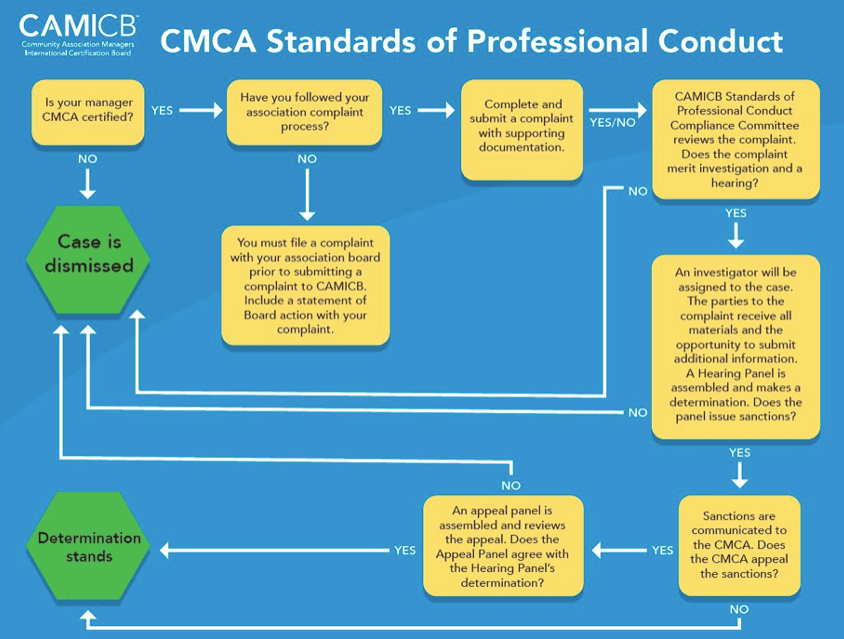
In order to maintain and enhance the credibility of the CMCA Certification Program, the CAMICB Board of Commissioners adopted strict procedures that allow consumers and others to bring complaints concerning CMCAs to the Board. 

The CAMICB Chair of the Board appoints members of the Standards of Professional Conduct Compliance Committee which oversees the process and procedures for enforcing the Standards of Professional Conduct. Once a complaint – received in writing – is deemed valid and actionable by the Committee, it will be brought before a Review Panel for investigation and a determination of whether there has been a violation of the Standards. If the Review Panel determines a violation has occurred, an appropriate sanction will be imposed. This process, including the internal investigation, hearing, and timeline of activities, is clearly detailed in the Procedures for Enforcement of the Standards of Professional Conduct document available on the CAMICB website. 

The grounds for sanctions under these Procedures range from conviction of a felony, to gross negligence or willful misconduct in the performance of professional services, to fraud or misrepresentation and, where applicable, loss of state license required to practice community association management.

“These Standards of Professional Conduct are the foundation of the CMCA credentialing program,” added Marilyn Brainard, a public interest member of the CAMICB Board of Commissioners.  “We take them very seriously and are proud of the work our colleagues and managers do to uphold them.”

More information, including a set of Frequently Asked Questions, a list of the 10 clearly outlined Standards of Professional Conduct, complaint form and other pertinent documents can be found at https://www.camicb.org/for-cmcas/standards-of-professional-conduct.

Reinventing the Way We Work—Again

Interview by Emily Gordon

The pandemic changed where we work and how we work, how we think about the place of work in our lives and vice versa—all against a backdrop of rapid technological change, economic upheaval, and a reckoning with racism. We talked with Heidi Brooks, who teaches leadership at Yale SOM and advises companies on everyday leadership and organizational culture, about how to have necessary conversations about a new experience of work.

The last time we talked about returning to the office, you suggested that we take this opportunity to think about the workplace—not just how to organize workers and cubicles, and whether we mask, and what the hybrid policy is, but to assess how our organization works, and how we‘re working together as a team. Now it’s 2023. Do you think that those conversations are still needed?

Absolutely. For the most part, business people and executives are interested in solving problems that are in their subject-matter expertise. And re-envisioning work is not an area of expertise for most of them.

So we are re-envisioning work and having some trouble with the process. Part of what has happened is that people have tried to make it a problem that they can solve with the tools available, the kind of questions we are used to asking. What days should we all be in the office? How can we have time when people encounter each other, have spontaneous collisions? How can we recapture some of the liminal, in-between space where there was creativity about our shared work and also bonding and building familiarity? More recently, I’m seeing more bids for empathy skills re-emerging. I’m listing those questions in a way where they get increasingly toward what I think is the real issue, which is, what does it mean to recraft being together in a world we have never quite visited before? It escalated the priority of the future of work that’s now here. And it turns out we’re not ready.

Why not?

We don’t even know if we’re ready for new technology. We’re confused, and agitated and worried and fascinated, about AI and ChatGPT. This is supposed to be humanity at its smartest and best, producing technical excellence—we‘re not even ready for ourselves.

On the other side of the equation, how do we ask questions that don’t use our very refined and familiar problem-solving mindset? We’re so ready to be a heat-seeking missile toward a problem we can solve and get our heads and hands around. But our problem-solving muscles are not equipped for a different set of questions, like people asking, who am I at work now? That’s not a problem to be solved. It’s a question to sit with and get curious about.

We were tragically disturbed by the pandemic. Our survival was threatened. We’ve also, in the last three years, faced very deep questions of racial equity in the workplace, and foundational questions about whether our planet is safe and whether we ourselves are the greatest threat. We are at war in certain ways, and we’re not quite sure what that means for each and all of us.

We have been and continue to be disturbed by fundamental questions of what it means to be human. We don’t know how to really be in a world where we don’t have the answers and we disagree about even how we see the issues. And these are the kind of questions that are coming up about what it means to work together. We think the question is, should we all be in the office on Friday? The question is actually more, do we even want to work? What is work? And why is work? How can we expand our experience of work to be simultaneously many things at once: be more meaningful, cultivate more belonging, unleash more potential and yet, cost less time, effort, energy and “human-ness”? How can work be better?

Just as wearing a mask became a political statement, talking about how we work together and what office culture is like is also considered a battle in a lot of workplaces. To even say out loud “Things aren‘t normal; let‘s confront that” is controversial in a lot of workplaces because a lot of people seem to want to get back to the way it was before.

That’s the human draw toward familiarity. But one of the funny things is that we have different versions of familiar. For some people, what has become familiar is staying at home. For other people, what is familiar is being in the office. Our reference points are different. And since we’re not great at understanding each other’s perspective, we might be picturing different parts of the elephant. I’m not even sure if we’re picturing the same mammal.

I don’t think we were great at this question before. But the conversation has gotten more demanding and more urgent. We were already bad at discussability of tensions, and coordinating our time and interactions together, and coordinating around productivity and individual wellbeing and sustainability in a meaningful way that promotes belongingness and unleashes potential. We were horrible at all of those things before. So why should we be better under duress? If you’re not great at running a marathon, you’re not going to be better just because there’s suddenly a hill. You’re going to be worse.

Some companies are probably better at this than others.

The marathon example is a nice analogy, because when you come to the hill, you can see the groups that are stronger get separated from the ones that are struggling. When you put a unit under stress, whether it’s a company or an individual, you see what’s strong and what’s weak.

What are the necessary components for workplaces? You mentioned those happenstance interactions and that sense of actually getting to know people. What else is important in terms of those micro-moments that you study and teach about?

Micro-moments have to connect to a bigger picture. They have to connect to values and strategy and purpose. One of the reasons to look at micro-moments is that we’re often misaligned—we’ve only looked at strategy, and have not held ourselves accountable to a clear line of enactment of those principles in our micro-interactions and people’s lived experience of the organization.

What does it mean to be a strong organization that can turn the corner? What does it mean to be robust and resilient? If I had to boil it down, I would point to the capacity for learning. This is a time of learning and adaptation. When people are saying, “Let’s get back to normal,” I sometimes hear that as, “Let’s not learn a new way. Let’s just try to do the old way.”

Well, new times are here. So it’s not appropriate to ignore adaptation opportunities—nor is it appropriate to only do new things. Agile learners don’t throw out what works. They use what works and build on that to adapt to the new demands. Individuals and organizations that are able to, with curiosity and openness, take this on as a learning challenge, and even enjoy it—I’m much more hopeful about those organizations and individuals than I am about the ones that say, “Close the doors. Don’t let in the new way. Let’s regress back to a yesterday that we’re comfortable with.”

If you’re talking to an organization that says, we have spent years or decades perfecting the way we do things around here and everyone’s working together functionally, what’s the incentive for them to do better?

Maybe they’re fine. I don’t have an agenda for them that they don’t have for themselves. A lot of the groups I’m speaking to are the groups that are saying, “We have outpaced the skills and mindsets and ways of thinking about leading our organization and especially our organizational culture that have always served us. We are now not able to keep up with the demands of a very diverse, not co-located, sometimes younger workforce that wants something a little bit different from work than they did not very long ago.”

Some people may not be able to express what they’re looking for.

Right. When we talk to people, there are people who haven’t articulated it, but they can feel the tensions. They have the sense that it used to be the case that managing people by assigning tasks and being a subject-matter expert got the job done. And somehow things are more complex now, and what’s being asked of me goes beyond that orientation of solving the problem.

Being a subject-matter expert of all things on your team is really no longer possible for many managers. So what you need to be able to do is to help people collaborate and grow and deal with pace and stress and volatility, and be curious about each other’s perspective, and be able to elicit information from other groups, and to collaborate across languages and disciplines and functions. And that’s very different than being a subject-matter expert in a straightforward kind of way. People often were not trained for it and haven’t thought about it.

I had someone say to me, “I’m known to be pretty good at what I do. I’m pretty senior in my field. I’ve been doing this for 30 years. And in the past few months I felt like I should have studied psychology. There are very different demands that are being asked of me—developing people and helping teams to be able to function and collaborate, dealing with social justice issues, questions about ESG. This is another job. What do I do now and how do I meet what’s being asked of me?”

So what’s the answer, if you can’t take a break and get a degree in psychology? What could you start doing next week to bridge this perhaps terrifying gap between what’s always worked for you and what the world has become?

There’s a way in which this is not a problem to solve, but a dilemma to navigate. We have to learn our way forward, and to be able to discern what of the challenges in front of you are things that you can meet with familiarity and calm and a sense of competence and what are the things that are new, where you don’t necessarily know the answer, and yet your leadership, your presence, is still quite central.

I’m not just talking about formal leadership. I’m talking about people who are influential in their settings—informal leaders. Those voices are very important now too. I consider that part and parcel of what I call everyday leadership.

We have to get more comfortable with being uncomfortable as part of valid and relevant leadership. Leading in the face of ambiguity and complexity is part of what’s so confusing. So if we insist on holding the frame that leadership is about knowing the answer and solving the problem, we’re going to stay confused and in a corner, because we’re at a place where we don’t know the answers and can’t solve all problems in readily available ways.

The type of leadership that might help at this point is one that can help people exist with the ambiguity of not knowing the answer and still feel like they are part of an organization that’s engaged in meaningful work. Where individual efforts contribute to the whole, they have a sense of meaningful belonging, and their interfaces with the organization unleash their potential rather than waste their time.

Then there’s the challenge of leading on questions of diversity. Often the leaders are White, and are reluctant to bring up issues like racially motivated violence. But it’s something we’re living through, especially people of color. If you, a manager, are afraid of talking about confronting the issues of how we create belonging and unity as a team working hybrid, it’s much harder to know how I, a White man, can lead this organization and try not to step into landmines but also be helpful and supportive to my workers.

Before we were talking about the example of the hill during the marathon; the hill is any source of stress or duress. That also applies to situations of perceived difference. We know we have a preference for familiarity and similarity. We have a similarity bias. When we are leading or working in a team with perceived bias, it can create some frictions over not being able to understand each other’s perspective. Now it turns out those same frictions can be very productive because if you figure out how to unearth more information, we have more data on the table.

But anything that presents a little bit of strife stresses a system that wasn’t in many cases very strong before. So if before we weren’t good at naming tensions in the workplace, or getting through difficult times that were out of the everyday routine of solving problems, then when problems are a little bit more complex and nuanced and demanding, it’s even more challenging.

I’ve read that people of color have benefited more from working remotely.

People have been saying that there is a benefit for people who are of a different demographic than most of their offices. So if they’re the only woman among many men, or the only person of color in a predominantly White organization, there can be so much everyday friction—just the cost of being different. Not having to navigate that constantly reduces a strain and stress from their life.

What’s a first step for a person reading this at an organization that could use some improvement, but there’s fear and anxiety around it? Change has come but they don’t know how to talk about it and how to deal with it.

One of the questions that I like to ask learners is starting with yourself first: What of your everyday experiences with your organization are enlivening and which of those things are depleting? That’s a basic question. Sometimes people who are in a role of leading, or serving their organization without a formal leadership role, forget to do a little check-in with themselves.

It’s a place to go for the sake of curiosity, but also for empathy for the next layer of questions, which is, what are the things that other people are experiencing in the organization, including things that I create with my impact, that are enlivening or depleting to people’s experience at work? And then sticking around to hear the answer with curiosity and learning and openness to really get where people are coming from and what they’re seeing and experiencing from their perspective. Especially if they’re different than you are in some way.

Your intention is not necessarily to fix these things immediately, because some of them you won’t be able to fix. Some of the things that are depleting are going to stay. And some of the things that are enlivening you might not be able to intentionally reproduce. But just listening and getting a sense of their experience of work, and then getting curious about what they want to be their experience of work.

Three Steps to Force a Co-op Board to Fix a Chronic Roof Leak

Habitat Magazine

Q: We’re shareholders living on the top floor of a co-op in Yorkville. Once or twice a year, the ceiling leaks during rainstorms. We always notify the super and the management company, and the super “finds” a problem and “fixes” it. But the leaks keep happening. What can shareholders do to pressure a co-op board to get a more thorough evaluation and make a permanent fix?

A: Ceiling leaks can lead to much bigger problems if they aren’t fixed, so they must be addressed properly and promptly for the good of your unit and your building, replies the Ask Real Estate column in The New York Times. As a first step, you need an evaluation by a professional who’s experienced in finding leaks, typically an engineer.

Reaching out to your managing agent was a good first step. Document the dates of contact, and the response you did or didn’t receive. Managing agents often have many buildings in their portfolio, and shareholders’ concerns aren’t always addressed promptly. If your engineer’s findings don’t produce results, here are three more steps to take to force the board into action:

1. Hire a lawyer. Then have the lawyer draft a letter to the co-op’s board of directors and managing agent. Tell them you are aware of the leak, make clear that it is a recurring problem, describe the damage it is causing, and note that your repeated efforts to address the issue have failed to result in a professional evaluation. “In many instances, a lawyer’s letter will get the attention of the building,” says Lawrence Chaifetz, a real estate lawyer with Chaifetz & Chaifetz.

The co-op board has a fiduciary responsibility to take care of the building, which is why the board must respond. “I think the most important thing is to impress upon the board their responsibility in addressing it,” says Lorraine Nadel, a lawyer with the firm Nadel & Ciarlo, who handles real estate disputes and litigation.

2. Call 311. If the board doesn’t respond to your lawyer’s letter, you can call 311 to report the leaks. If a city inspector visits, it could result in a building violation — or, if the inspector finds other problems, unrelated violations. Just be aware that this could damage your relationship with the board. It could also result in a building-wide maintenance increase if the property has numerous unaddressed violations that require major repairs.

3. File a lawsuit. Litigation is the nuclear option — after all, you’re suing the corporation in which you own shares — and it should be seen as the last resort. Despite the severity of this step, lawsuits are not uncommon, Nadel says, if the board is dysfunctional or if there is no money available for repairs.