Don’t Let Employees Pick Their WFH Days

By Nicholas Bloom, Harvard Business Review

As U.S. states and the federal government start to roll back Covid-19 restrictions, and companies and workers start to firm up their office return plans, one point is becoming clear: The future of working from home (WFH) is hybrid. In research with my colleagues Jose Maria Barrero and Steven J. Davis, as well as discussions with hundreds of managers across different industries, I’m finding that about 70% of firms, from tiny companies to massive multinationals like Google, Citi, and HSBC, plan to move to some form of hybrid working.

But another question is controversial: How much choice should workers have in the matter?

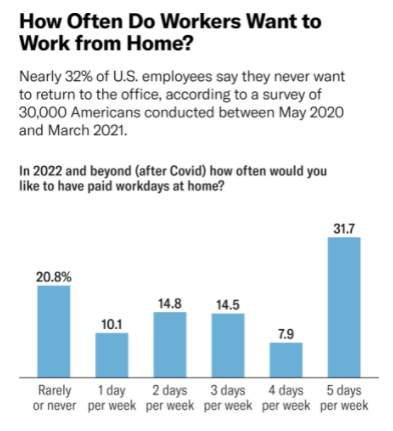
On the one hand, many managers are passionate that their employees should determine their own schedule. We’ve been surveying more than 30,000 Americans monthly since May 2020 and our research data shows that post-pandemic, 32% of employees say they never want to return to working in the office. These are often employees with young kids, who live in the suburbs, for whom the commute is painful and home can be rather pleasant. At the other extreme, 21% tell us they never want to spend another day working from home. These are often young single employees or empty nesters in city center apartments.
Given such radically different views it seems natural to let them choose. One manager told me “I treat my team like adults. They get to decide when and where they work, as long as they get their jobs done.”

But others raise two concerns — concerns, which after talking to hundreds of organizations over the last year, have led me to change my advice from supporting to being against employees’ choosing their own WFH days.

One concern is managing a hybrid team, where some people are at home and others are at the office. I hear endless anxiety about this generating an office in-group and a home out-group. For example, employees at home can see glances or whispering in the office conference room but can’t tell exactly what is going on. Even when firms try to avoid this by requiring office employees to take video calls from their desks, home employees have told me that they can still feel excluded. They know after the meeting ends the folks in the office may chat in the corridor or go grab a coffee together.

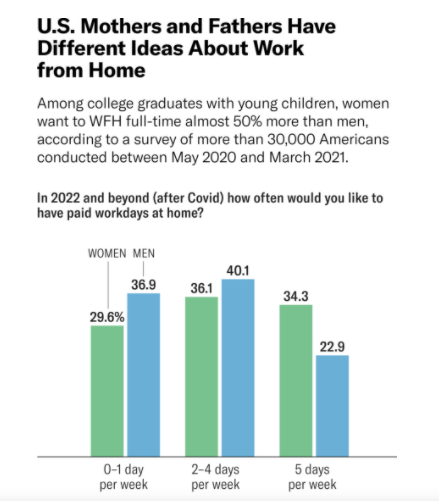
The second concern is the risk to diversity. It turns out that who wants to work from home after the pandemic is not random. In our research we find, for example, that among college graduates with young children women want to work from home full-time almost 50% more than men.
This is worrying given the evidence that working from home while your colleagues are in the office can be highly damaging to your career. In a 2014 study I ran in China in a large multinational we randomized 250 volunteers into a group that worked remotely for four days a week and another group that remained in the office full time. We found that WFH employees had a 50% lower rate of promotion after 21 months compared to their office colleagues. This huge WFH promotion penalty chimes with comments I’ve heard over the years from managers. They often confided that home-based employees in their teams get passed over on promotions because they are out of touch with the office.

Adding this up you can see how allowing employees to choose their WFH schedules could contribute to a diversity crisis. Single young men could all choose to come into the office five days a week and rocket up the firm, while employees with young children, particularly women, who choose to WFH for several days each week are held back. This would be both a diversity loss and a legal time bomb for companies.

So I have changed my mind and started advising firms that managers should decide which days their team should WFH. For example, if the manager picks WFH on Wednesday and Friday, everyone would come in on the other days. The only exceptions should be new hires, who should come in for an extra office day each week for their first year in order to bond with other new recruits.

Of course, firms that want to efficiently use their office space will need to centrally manage which teams come in on which days. Otherwise, the building will be empty on Monday and Friday — when everyone wants to WFH — and overcrowded mid-week. To encourage coordination, companies should also make sure that teams that often work together have at least two days of overlap in the office.

The pandemic has started a revolution in how we work, and our research shows this can make firms more productive and employees happier. But like all revolutions this is difficult to navigate, and firms need leadership from the top to ensure their work force remains diverse and truly inclusive.
Ten Things To Say Besides Yes

It seems like every week I speak with executives who tell me they’re burned out or exhausted. And why wouldn’t they be? Everyone has been on a full out sprint for the past year as we’ve run the biggest business social experiment in history. And now, after more than a year of 10 to 12 Zoom meetings a day (that’s the average I’m hearing), COVID vaccinations and the freedom they bring have unleashed a wave of pent-up demand to pack even more into our days.

Lots of folks are headed for a crash if they don’t master the art of answering the next request for their time and attention with something other than an unqualified, “yes.” In the interest of preserving your health, sanity and well-being, I’m offering ten things you can say besides, “Yes,” when someone asks you to attend their meeting, join their project or take on another commitment. Practicing these ten phrases and having them in your hip pocket to use when needed will enable you to collaborate with and support your colleagues without sinking yourself in the process.

Here’s the list organized by three categories of response:

The Yes, But Responses

A Yes, but response positions you to help but with conditions. Examples include:

  • Yes, but with these conditions. – This one helps in setting parameters and boundaries.
  • Yes, but not now. – This one is about prioritizing the request against other commitments.
  • Yes, but not me. – This is the one to use when someone on your team is better suited to follow through.

The Learn More Responses

Answering with a learn more response can help you clarify what the request is really about, how much it matters and what the options are for following through. Examples include:

  • Tell me more. – This response is almost always appropriate even when you’re inclined to say yes. The more context sharing and alignment up front the better. You’ll be better positioned to make a sound decision on whether to participate or not after you’ve heard more.
  • Why now instead of later? Like the, “Yes, but not now response,” asking, “Why now?” can help a lot in prioritizing your time and attention.
  • What about some alternatives that don’t require as much? This question can help in determining if a solution needs to be 100 percent perfect and optimal or if a good enough solution is good enough for now.
  • What else would work or help instead? This question casts a little broader net than the last one in that it can open up entirely new lines of thinking on options.

The No, But Responses

The “No, but,” response is the way to go when what’s requested of you isn’t the highest and best use of your time and attention but you still want to be supportive of the colleague making the request. Examples include:

  • No, but here’s what I can do. –  This one sets you up to make an offer of help that’s within your range of available resources.
  • No, but what if we tried this instead? – This response protects your boundaries while providing some alternatives that you could support and participate in.
  • No, but I wish you the best. – Sometimes, there’s nothing more you can do than to offer your good will and best wishes. It’s way better to do that than to commit yourself to something that you really don’t have the bandwidth to follow through on.

So, there you go. Ten things you can say besides, “Yes,” the next time you’re asked to take on an additional commitment of your time and attention. If you found value in this article, you may also like my recent post on How to Decide Which Meetings to Skip.

In the meantime, what’s been working for you in terms of staying engaged with and supportive of your colleagues’ initiatives without overcommitting yourself? Please share your advice in a comment if you’re reading this through LinkedIn or send me an email if you’re reading this on the Eblin Group blog.

CMCA Credentialing Program Earns Prestigious International Accreditation Through ANSI National Accreditation Board

By Matthew Green, CAMICB Credentialing Director

The Community Association Managers International Certification Board’s (CAMICB) CMCA credentialing program has been awarded international accreditation by the ANSI National Accreditation Board (ANAB) as complying with standard ISO/IEC 17024, a conformity assessment for personnel certification bodies. ANAB establishes the specialized system for worldwide standardization, setting the requirements and the framework, at a global level, for the operation of certification bodies. ANAB accreditation to the ISO/IEC 17024 Standard supports the increasing technological and global specialization of skills and personnel. 

Said Chair of the CAMICB Board of Commissioners, Drew Mulhare, CMCA, LSM, PCAM, “Earning this ISO/IEC accreditation is critical because it shows the CMCA credential meets the global benchmark for certification programs and assures the CMCA credential is serving the field of community association management in a consistent, comparable, and reliable manner worldwide.” 

Added Thomas M. Skiba, CAE, Community Associations Institute’s (CAI) Chief Executive Officer, “As the demand for education in community association management has grown considerably outside of the United States, so too has the need for an internationally accredited credentialing program. Earning this prestigious accreditation means the CMCA credential has achieved the highest standard in professional certification and stands alone in the community association housing profession.”

The CMCA credentialing program ISO/IEC accreditation came as a result of a rigorous evaluation conducted by ANAB, that included a thorough analysis of test data, and detailed audits of CAMICB’s management systems, test development and psychometric procedures. 

Setting The Stage

Over the past 25 years, the CMCA credential has been a catalyst in establishing community association management as a discrete profession. The common interest community housing model exists around the world and there has been consistent interest in the CMCA credential, the educational pathways to achieve the credential and the continuing education requirement to maintain the credential. As the credential grew within the United States it became an important tool to building professionalism in the field outside of the Untied States.

CAMICB has strong support from a number of community association managers outside of the United States including Pepe Gutierrez and Michael Hurley. Pepe serves CAMICB as an active International Subject Matter Expert. He’s an internationally recognized proponent of the CMCA credential and advocate for professionalism in the field of community association management. Pepe, a professor at Burgos University in Spain and the founder of Megafincas Alicante management company, is a frequent speaker at international gatherings of community association managers and has written extensively on the issues common to community association management around the world. 

“Earning ISO accreditation puts the CMCA credentialing program in a league of its own,” said Pepe Gutierrez, CMCA. “It’s the only accredited certification for community association management professionals around the world and it represents a baseline of professionalism, no matter where a manager is working.” 

Michael Hurley has been a consistent force in helping CAMICB ensure all international partners are working for the betterment of our profession and industry. He continues to serve CAMICB as an International Subject Matter Expert. His perspective on the profession of community association management as it is practiced in Australia and elsewhere in the world has been invaluable in guiding our efforts to expand international delivery of the CMCA exam in a way that is responsive to all candidates, no matter where they are practicing. 

Added Michael Hurley, Director of the Australian-based Strata Title Management Pty Ltd., “Gaining ISO/IEC accreditation is particularly important as recognition of the value of the CMCA credential has grown around the world. CAMICB already delivers the CMCA exam in Dubai, UAE, Australia, Canada, Panama and elsewhere outside of the United States; it’s particularly exciting to see the next phase of this expansion.”

A Major Milestone: Dual Accreditation

The CMCA credentialing program was first accredited in 2010 through the US-based National Commission for Certifying Agencies (NCCA), representing third-party validation of compliance with the highest domestic standards in professional credentialing. It has since been reaccredited twice by NCCA, most recently in 2020. 

Achieving both NCCA and ISO/IEC 17024 accreditation places the CMCA credential in an elite cohort of professional certification programs and speaks to the importance the CAMICB Board of Commissioners places on conducting the CMCA program in full accordance with best practices in professional credentialing. “We take this responsibility to the profession seriously and are extremely proud of this achievement as we continue to establish the credential as a baseline for building the profession worldwide,” added Mulhare.

Always Maintaining High Standards

Community managers from around the world report that the responsibilities of a professional manager for condominiums, homeowners associations, housing cooperatives and master-planned communities are comprised of the core competencies identified by the CAMICB Job Task Analysis, including governance, legal, budgeting and reserves, contracting, financial controls, risk management, facilities maintenance, meetings and human resources. Dawn M. Bauman, CAE, former Executive Director of CAMICB and CAI’s Senior Vice President for Government and Public Affairs said, “The ISO/IEC accreditation of the CMCA program provides assurances to homeowners, developers, regulators, and legislators that professional managers who have earned and maintained the CMCA credential have the comprehensive competency and ethical standards to serve their communities.”

Both NCCA and ISO accreditation require continued compliance with their respective standards. To maintain NCCA accreditation, the CMCA credentialing program must undergo a rigorous reaccreditation process every five years. Following the initial ISO/IEC accreditation, the CMCA credentialing program will be reexamined on an annual basis through an in-depth document review and on-site assessment of the program. 

To read more, go to: https://www.camicb.org/Pages/CMCA-Achieves-Dual-Accreditation.aspx

To learn more about the American National Standards Institute (ANSI), visit www.ansi.org.

ANNOUNCING – 2021 COMMUNITY ASSOCIATION MANAGER SALARY AND COMPENSATION SURVEY

The Foundation for Community Association Research (FCAR)’s Community Association Manager Compensation and Salary Surveyshows that managers who obtained CMCA certification earn, on average, 20% more than non-credentialed community association managers.

Please take a few minutes to complete the 2021 Community Association Manager Compensation and Salary Survey if you have not done so already. Participants receive FREE access to the results. (You will need to log in with your email address and CAI password.) 

The Foundation for Community Association Research is producing the survey—a valuable tool for benchmarking compensation and benefit levels in the community association management industry—for the seventh time. This will be the first report that provides access to real-time data through a dynamic, online platform.

The survey will include data on:

  • Annual wages paid to community managers, including large-scale, high-rise, on-site, portfolio, CEOs, management company executives, and many others. (Note: We highly encourage you to pass this survey along to your colleagues and team members.)
  • Employee benefits
  • Vacation and sick leave
  • Retirement, flex-spending, and more

The Foundation has commissioned Dynamic Benchmarking, an independent research firm, to host the survey, compile data, and produce reports. Strict confidentiality is maintained by Dynamic Benchmarking and the Foundation.

To participate in the survey, simply log in with your email address and CAI password and begin entering the data into the third-party website. You can enter and exit the survey as often as you like; the website will save your responses. You will need to complete the entire survey to receive free access to the results. That free access will be available once there is enough aggregate data for a meaningful comparison of compensation and salary data. We estimate free access will be available by May. 

If you have any questions about the survey or wish to learn more about it, please visit our website or email foundation@caionline.org.

Exploring a career change? The field of community association management is growing!

By Matthew Green , CAMICB Credentialing Director

If you love the idea of a job that offers opportunity, stability, and growth, community association management provides an excellent career path. It’s a great job choice for people who previously worked in the leisure and hospitality industries. Those sectors continue to lead U.S. job losses amid COVID-19, with experts predicting slow growth until at least 2023.

It wasn’t so long ago the hospitality industry was one of the most promising fields. It set people up for a successful career in people-facing jobs at hotels, restaurants, conference centers, major event venues, and more. Unfortunately, a boom in hiring came to a halt in mid-March 2020, as events were cancelled, and many restaurants and hotels closed their doors. 

The good news is that though the coronavirus has dashed a lot of hopes for hospitality grads and veterans, the world of community association management is a bright spot. The field continues to grow and offers excellent opportunities for anyone who wants to continue in a people-oriented career. 

Community Association Management Stats

The Community Associations Institute (CAI) reports that as of 2019, there were approximately 351,000 community associations in the United States. They house nearly 74 million residents, over 11 million more than just a decade ago. Twenty-six percent of people in the U.S. live in a community association. 

It’s estimated there are about 8,000 community association management companies in the U.S. and up to 55,000 off and on-site community association managers. As the number of people living in community associations continues to rise, so does the number of jobs for community association managers. If you’re a people person who’s skilled in handling multiple tasks, a career in community management can be an incredibly rewarding career choice.

Community Association Management Career Outlook

Job prospects in the community association management sector are excellent. Though a college degree and professional designation are not necessary to land a position in the field, those who do command a higher salary when starting out. As of May 2020, the median wage for community association managers was $59,660 per year. In 2019, there were 367,900 jobs in the field. Employment in the industry is projected to grow seven percent from 2018 to 2028.

Job prospects and projected wages vary from state to state and community to community, so it’s a good idea to check out your area’s particulars.

CMCA – The Essential Credential

The key to building a successful community association management career is the Certified Manager of Community Associations (CMCA) credential. Holding the certification lets employers know you’re educated and competent in certain management practices. It also indicates your dedication to professional excellence, ethical business standards, and continuing education. Community management employers are continually looking for committed professionals. The CMCA certification can often make the difference between whether or not you land a first interview.

The CMCA credential is relatively easy to obtain and:

  • Requires limited time and money investments.
  • Demands just a few days of prerequisite course work, some time to study, and one day for the exam. 
  • Is relatively low-cost for such a valuable investment in your career and future.

Earning the CMCA credential opens the door to earning additional credentials and up to 20% higher earnings than community association managers who are non-credentialed.

Is a Certified Manager of Community Associations Career Right for You?

If you were previously employed in the hospitality sector but were furloughed or had your job eliminated due to the pandemic, a community association management position could be an excellent career pivot for you. The work is interesting, varied, and highly satisfying. Your daily tasks can see you:

  • Working closely with residents and Board members.
  • Making visits to the community.
  • Interacting with community leaders.
  • Hiring and supervising outside vendors.
  • and a whole lot more.

Requisite skills align well with those that people in the hospitality sector possess, such as attention to detail, flexibility, and good organizational skills. Top-tier community association managers also have excellent interpersonal skills and can effectively communicate with a diverse range of people. 

All Work and No Fun?

A community association manager has a busy job, but it can also be a lot of fun. Along with the potential of receiving a great salary, you get to constantly learn new things and meet interesting people. The likelihood of ever being bored on the job is slim—there are just too many interesting things to do and people to meet!

While community association management is not for everyone, if you’re a real people person who possesses a positive and enthusiastic attitude towards life, gets excited about staying current with the industry’s regulatory changes, and can remain calm when others around you are stressed, you can’t ask for a more engaging and exciting career!

Becoming a certified manager of community associations isn’t merely a designation. It can truly be the journey of a lifetime. It elevates your credibility and assures employers they’re making the right hire. 

Finally, it offers you a wealth of possibilities and growth in an exciting career that shows no sign of slowing down.

For further information, please visit camicb.org or email us with any questions at info@camicb.org.

Privacy Policy: https://www.camicb.org/privacy-policy

As More and More Test Centers Open Up — Are You Ready to sit for the CMCA Exam? Use This Step-By Step Process To Adequately Prepare

A variety of study aids are available to CMCA exam candidates online at CAMICB.org. Because CAMICB recognizes that people have different learning styles, multiple resources are available in various formats. A quick glance at those resources can be overwhelming. Here, we offer a roadmap designed to help you select and properly use those resources towards a successful outcome.

STEP 1. CMCA Study Guide. Download this FREE guide for an overview of how the CMCA exam was developed and how it’s structured. This is important to developing a study strategy. Here, you will also find the key to your studying success: The CMCA Knowledge

cmca-study-graphic-2

8 Knowledge Areas

Areas. You will be evaluated on these 8 knowledge areas, and understanding your strengths and weaknesses in each area, as well as how each knowledge area is weighted, will help you properly prepare a solid study plan.

STEP 2. CMCA Handbook. Download the FREE handbook for an overview of the program, paying particular attention to:

  • Section 2: Taking the CMCA Exam highlights the policies and procedures of the exam.
  • Section 3: CMCA Examination Content and Study Materials offers just that, as well as strategies for standardized test-taking.

STEP 3. If you took CAI’s M-100: The Essentials of Community Association Management, you are not fully prepared to sit for the CMCA exam. The M-100 will provide you with concrete knowledge (i.e., terms and definitions) but will not give you the knowledge to apply those terms and definitions to concepts. For example, What is a Quorum? is not a question you will see on the CMCA exam. You may, however, see a question like this, Quorum requirements conflicts are resolved by which of the following? That doesn’t mean you can skip this step. It’s still important to know the definitions in order to be able to apply them.

CMCAExamPrepSTEP 4. Quizlet is a FREE online tool that uses fun games and exercises to test your concrete knowledge. If after reviewing the M-100 course material, you find that your knowledge of terms and definitions is lacking, Quizlet is an excellent way to help you master those key terms and phrases, and prepare you for the next step in your study plan.

STEP 5. Best Practices Reports are FREE resource guides courtesy of the Foundation for Community Association Research. These Reports will help you gain applied knowledge in key areas found on the exam. Each report also contains case studies to help you understand how best practices are applied in real life situations, which is key to grasping an applied knowledge of these topics. If you’re a seasoned manager, spend a little extra time here. What you’ve learned on the job, may not be deemed best practices in the industry.

STEP 6. The CMCA Study Kit is available for purchase from the CAI Bookstore. A great tool for developing applied knowledge, you may purchase individual titles or the entire package depending on your needs.

STEP 7. CMCA Practice Exam is available online at a cost of $25 for one attempt and $40 for two. The Practice Exam includes questions that have been rotated off the exam and offers real time feedback on whether you were right or wrong on a question and why, offering real-world insight into the CMCA exam experience.

All of these materials to prepare you for the CMCA Exam can be found at CAMICB.org on the Exam Preparation web page. We encourage you to spend at least 6-8 weeks preparing for the Exam, and if you have any questions you can contact us at 866-779-CMCA or info@camicb.org.

We’d like to hear from managers who are studying for the exam. What’s working for you? What’s not? Please use the Comments section to let us know how you’re doing!


Best HOA & Condo Websites for your Association

By Charlie Wilson for Loop21

A website is a handy tool for any homeowners association. It defines how a community interacts with its residents and eases communication. What’s more? An HOA website makes it easy to access community rules and improves transparency between the residents and the management. Are you seeking ideas for the best HOA and condo website? Well, every association has unique needs, but there are must-have features to look out for.

What features define the best HOA websites?

The features matter a lot when it comes to the choice of website. Although all associations are different, the site should make it easier to manage your community. To build a website with the best features, seek help from an HOA Website company, and consider the following characteristics.

1. Dedicated domain

The website should feature a dedicated domain. This makes it easy for others to locate it, thus the need to choose something straightforward.

2. Resident portals

The HOA website should also have portals to serve both existing and potential homeowners. The current members should access account balances, file service requests, and retrieve vital documents with ease.

3. Online payment options

Online payment options are also vital. Collecting dues using conventional means is inconvenient and time-consuming. The best websites integrate an online payment option, allowing homeowners to settle dues using their user accounts.

4. Calendar& Communication channels

 The site should also feature a community calendar for events, communication channels, and polling abilities. Lastly, it should be mobile-friendly and easy to use.

What are the best HOA& Condo websites?

1. The Towers Of Channelside

This is a perfect choice for people seeking to build a condo association website. The site features an easy-to-use interface with clear and professional images of both the building and neighborhood. Still, it provides basic information about the community, and the clickable links appeal to all visitors. A vital feature of the website is the resident portal. You can include private access with logins assigned to all members.

2. Kensington Glen 

Kensington Glen website is one of the best HOA & Condo websites. It’s renowned for its crisp, clear images on the landing page and all over the site. Moreover, it features a call to action, which prompts user interaction among members. The site is easy to use and very inviting, and you can use it to list the homes for sale in the neighborhood. This is an impressive bonus that allows residents to learn more about the house on sale.

3. Islands of Cocoplum

This HOA website is excellently designed and features professional photos and an aerial view of the property. It includes features like property information, contact information, excellent imagery, and private resident portals.

4. Waterfall South Jacksonville Beach Condos

Waterfall South Jacksonville Beach Condos makes a great association website due to its intuitive features. It presents simple clickable links on the homepage directing users to useful information and services. It also features information and contact details, making it easier for visitors to get an idea of the property.

Final Thoughts

An HOA website is a great way to organize and automate responsibilities. It acts as a central spot where all members can access information and build better relationships. It also helps board members to keep residents posted on any initiatives and events. However, the best HOA website incorporates various features to enhance communication and ease payments.

Is Now A Good Time To Change Careers? More Workers Are Feeling Good About It.

In an exclusive ‘Fast Company’-Harris Poll, 59% of middle-income workers said they’re thinking about changing jobs. Remote work continues to be a draw.

Last year changed everything for workplaces across America. But now that 2020 is finally behind us, changes are still afoot. They’re just more self-directed.

A new survey conducted by Harris Poll exclusively for Fast Company found that the majority (52%) of U.S. workers are considering a job change this year, and as many as 44% have actual plans in place to make the leap.

As for who’s contemplating a job hop, the most likely candidates were those whose annual household income is between $50,000 and $75,000 (the middle-income bracket). Fifty-nine percent of those individuals said they’ve thought about making a switch.

Prior to the pandemic in 2018, 51% of workers were planning to change jobs that year according to data from Statista.

But the poll indicated that even more managers and highly skilled workers are prepared to change jobs. Close to half (48%) of six-figure salaried workers are plotting their switches and as many as 66% of them are feeling more confident about their decision to change jobs than they did six months ago. Across the board, 21% of workers surveyed felt there were “better opportunities available to [them] at other companies.”

And those opportunities aren’t just found in steps up the corporate ladder. As the jobs market continues to rebound, it’s safe to say that the great remote work experiment thrust upon many American workers last March has changed perceptions about where they want to work. Flexibility is in high demand for workers looking for new positions.

Remote work and work-from-home options are valued by 68% of currently employed workers, and 43% of women asserted that these options are “very important,” versus 33% of men. Eighteen percent of workers said they’d prefer to have more flexible hours in a new job.

By Lydia Dishman for Fast Company

Employers brace for COVID’s mental health fallout as workers return

Arianne Cohen, Bloomberg News

From casual Fridays to after-work drinks, those weekly rituals once taken for granted are returning as Americans head back to the office. And while masks, plexiglass and empty conference rooms will alter the cubescape, employers are nevertheless invested in getting things back to normal—or at least as normal as possible.

But that won’t be easy. COVID-19’s damage may be felt in the workplace long after the disease has receded. That’s thanks to the mental and emotional toll the pandemic has taken on employees who, like everyone else, have spent the past year living in fear, isolation and sorrow. 

“We’re seeing pretty alarming numbers,” said Vaile Wright, senior director of healthcare innovation at the American Psychological Association (APA), who oversees its Stress in America survey. “People’s bodies and minds just aren’t in quite the fit place they were in a year ago.”

APA data shows extensive markers of unhealthy coping—including disrupted sleep, increased drinking and low physical activity. Moreover, some 61 per cent of adults are reporting undesired weight gain or loss—though mostly the former, with a typical increase of 15 pounds. “All the research coming out now is really aligned,” Wright said. “Rates of depression, anxiety, substance use and suicidality have all increased.”

To understand what this will mean for workplaces, it may help to understand what healthy coping looks like.

Generally, the APA and other experts encourage healthful eating, sleep and exercise, with abundant social connections, all of which combines to build a “strong foundation” that allows people to withstand everyday pressure—like that encountered in the office. This foundation typically depends on routines: a consistent bedtime and wake time, regular exercise and meal times.

For many, the pandemic has managed to blow all this up.

“We’re hearing, both from the data and anecdotally, that people just aren’t able to do those things,” said Wright. “Someone who isn’t coping effectively may be less present, even when they are ‘at work,’ and they’re more likely to not be as productive, to not show up—and to quit.”

And it’s not just the office where this malaise is manifesting itself. According to Professor Lawrence Katz, an economist at Harvard University, it’s on full display in classrooms, where he sees undergraduates performing in a different gear than usual.

“They want plain vanilla—you know, the sort of generic courses where you just do exams and don’t have to do anything much extra,” Katz said. Junior seminars that typically feature more expansive projects have seen enrollments drop by half, he said. “They seem to be less willing to do challenging things,” Katz said.

For employees, this dynamic could translate into lower work capacity than pre-pandemic times—making addressing it an economic imperative for companies.

So how should managers cope with this diminished ability to cope?

Cathleen Swody, an organizational psychologist at the consulting firm Thrive Leadership, said bosses need to be cognizant that many employees are—for the first time in their lives—facing a bout of overeating, anxiety, depression or even substance use.

“Know that it’s going to vary person-to-person, depending on their personal circumstances and pandemic experiences,” she said. “Some will be eager to come back to the office and [be] right back at it, and others will have a lot of resistance to it because they’re just not up for it.”

Parents may be in for a particularly rough time.

“I am always surprised by how many working parents will bring up that they’re physically in a really bad place, as well as their mental health—the guilt, the overwhelm and the stress,” said Daisy Dowling, a consultant and author of the upcoming book, “Workparent.”

“Any time they would spend attending to their health is spent attending to the health and safety of their children,” she said.

Wright, Swody and Dowling all agree that as workers come back, employers must make access to wellness resources easy. Companies should subsidize online exercise classes, gym memberships and mental health programs. These include stress management, therapists and employee assistance programs. New strategies unique to the pandemic can include outdoor video chats and “walk-and-talks” with mental health professionals.

However, such offerings may go unused if managers don’t explicitly normalize their use during the workday. This, the experts said, is a critical consideration for staff whose mornings and evenings are occupied with obligations such as elder or child care. 

For global companies, outfitting workers with additional physical and mental health resources can be complex, but Wright notes “employers have more power than they sometimes recognize in terms of negotiating and contracting with insurance providers.”

Mary-Alice Vuicic is chief people officer for business information company Thomson Reuters. She said her company has expanded its mental health and well-being resources. “We’re looking to make access easier for people around the globe, a lot of which can come through telehealth and the breadth of providers,” she said.

One ready-made option for employers looking to ease workers back into the office is making sure they take all the vacation they’ve accrued. Stuck at home with nowhere to go and nothing to do, Americans who were lucky enough to stay employed in 2020 invariably banked a lot of days. 

“You’re just basically penalizing people for having gone to the wall for you during the pandemic.”

“A lot of companies are going to find themselves in a really weird situation where they have gigantic vacation rollover issues,” said Dowling, with many employees sitting on eight-plus weeks off. “What do you do with that? If you’re an HR head, and you haven’t come up with a solution, you’re just basically penalizing people for having gone to the wall for you during the pandemic.”

Now with vaccinations, falling infection rates and reopenings, U.S. employees can actually do something fun with that time off. Dowling said companies that are worried about staffing issues might consider buying out vacation time, or allowing workers to apply it to flex time. “This really needs to come from the top, because vacation is very rules based,” she said.

Rue Dooley, a longtime HR knowledge adviser for the Society for Human Resource Management, said that beyond basic benefits or flexible vacation, simply listening to employees can guide organizations trying to smooth the post-lockdown transition: are workers gabbing about Peloton instructors? Nanny services? Their pandemic rescue pets?

“An employer could empathetically listen to that and say, ‘Hey, here’s this inexpensive benefit, we can subsidize your pet insurance,’” Dooley said. “Employees will tell you what they need if you listen.” Bloomberg LP, parent of Bloomberg News, competes with Reuters in providing financial news and services.

A Message To The CMCA Community From The CAMICB Board of Commissioners Chair

Community Association Managers International Certification Board (CAMICB) marked a milestone anniversary – 25 years – in 2020.  Like so many aspects of each of our lives, a celebration of that anniversary was overtaken by events.  But we want you to know that for our candidates and credential holders, 2020 was in no way a lost year. A committed corps of Certified Managers of Community Associations (CMCAs) adjusted and adapted to a working environment and to management challenges that no one could have anticipated. The health and wellbeing of the residents and communities we manage became a key priority in every action we took and every decision we made.  We were not confronted simply by a new way of doing business; we faced a new way of defining – and protecting – “community.” The COVID-19 pandemic is not behind us; there continues to be a need for care and vigilance.  But we – and our communities – are beginning to emerge from the most extreme constraints of our pandemic year, stronger and more aware of the profound value of community, in every way community manifests itself.  And it is time to begin to celebrate the success of your credentialing program. 

International Recognition

In March 2020 the CMCA examination was successfully reaccredited by the National Commission for Certifying Agencies (NCCA), recognition that the CMCA program is developed and delivered in accordance with the rigorous standards the Commission sets for United States-based professional credentialing bodies. Just over one year later, in early April 2021, the American National Standards Institute (ANSI) accredited the CMCA credential under the ANSI/ISO/IEC Standard 17024.  International Standards Organization (ISO) accreditation represents compliance with professional credentialing standards recognized and respected around the world. It makes the CMCA credential one of a small number of dual-accredited credentialing bodies, and the only accredited certification for community association management professionals around the world. Our accreditation standing is a great source of pride for CAMICB, and we hope it is a source of pride for our credential holders: a strong testament to the strength and value of the CMCA credential.   

Commitment to Professionalism

CAMICB awarded the CMCA credential to 650 managers in 2020; 88% of active CMCAs chose to renew their CMCA credential during a year marked by personal and professional uncertainty. 

In March 2021 we saw the highest volume of candidates taking the CMCA exam in a single month since 2015. CAMICB also approved a higher-than average volume of new CMCA applications, and we have a robust pool of candidates prepared to take the CMCA examination. The commitment to laying the foundation for a successful career in community association management remains strong. 

A Look Ahead

We believe it is appropriate to begin to plan the celebration of our milestone anniversary in ways that honor the professionalism that is at the core of the CMCA credential and look toward the future with renewed commitment and genuine optimism. Please be sure to follow us on Facebook and LinkedIn and visit https://www.camicb.org/25years for updates in the coming months as CAMICB celebrates 25 years of professionalism and growth in the field of community association management and – most of all – celebrates the individual credential holders who are the heart and soul of our credentialing program. 

Sincerely, Drew Mulhare, CMCA, AMS, LSM, PCAM , Chair of the CAMICB Board of Commissioners