Privacy and Data Security for HOAs: What Your Community Association Needs to Know

Privacy and Data Security is the body of law that addresses how an organization can collect, handle, and use personally identifiable information and how that information needs to be protected.

Community Associations quite often have and maintain the names, addresses, and financial information of their residents and homeowners. Many criminal groups find this kind of information valuable for identity theft. Such groups often encrypt the data so the Community Association cannot access it to gain leverage and force an organization to pay a “ransom” for its return. Because of this and in reaction to how much sensitive information is held on everyday people in the broader economy, all fifty states have laws on the books that require most organizations to disclose when an unauthorized party has accessed the information. Community Associations—just like any other North Carolina organization—always must act reasonably when the organization makes decisions to do something with personal information or risk negligence lawsuits and class actions.

Unfortunately, North Carolina does not provide statutory guidance on how Community Associations can act reasonably with respect to residents’ personal data, but the federal government has provided frameworks that it recommends. The National Institute of Standards and Technology has published a Privacy Framework and a Cybersecurity Framework that, when followed, allow organizations to identify the data they have, protect that information, control and manage the data, govern the data with set rules within the organization, communicate the roles of each member of the organization, detect malicious or unauthorized activity, respond when an incident occurs, and recover from the incident.

There are a number of practical steps that organizations can take that can avoid or reduce the severity of common compliance pitfalls. The first is to review vendor contracts regularly—at least once a year—to make sure that they reflect an organization’s risk tolerance. Often, a trusted service provider or another vendor can have a breach that impacts the privacy and security of the data entrusted to a Community Association. Without contractual protections, the organization might incur significant costs remediating the problem with little legal recourse to have those costs covered by the party at fault.

Additionally, encrypting data, which is a mathematical process to transform data from readable text to nonsense and back again when a code (called a key) is used, can be an important tool in the compliance toolbox for Community Associations. Under North Carolina law—and the law of many other states—a breach only triggers reporting obligations when the information that was stolen was also unencrypted or when the encryption key was stolen with the data. This is not a silver bullet but, encryption is a practical technology that will be an important part of any compliance strategy.

Cyber insurance can also be an effective means of covering risk. However, insurance is not as simple as buying a policy and calling it a day. Insurers are increasingly raising premiums and lowering caps on organizations that do not take a proactive approach to mitigate privacy and security risks. So while insurance can act as a hedge against devastating effects, it should not be seen as a substitute for a compliance strategy.

We also recommend getting community input on the Community Association’s Privacy and Data Security efforts. Community Associations are necessarily accountable to their residents and homeowners, so understanding stakeholders’ risk tolerance can inform the leadership on how to move forward with a compliance strategy. The laws at issue obviously do not change based on the community’s sentiments, but discussing the matter at an annual meeting can be a good way to communicate what expectations the stakeholders in your community have of leadership.

Challenges and risks of liability and unmet stakeholder expectations are everywhere for Community Associations that do not take a proactive approach to the Privacy and Data Security of their residents’ and homeowners’ information. 
A Job Analysis Survey Of Global Community Association Managers Is Critical To Validating The CMCA Examination

By Madeline Hay, CAMICB Manager of Exam Administration

Over the past 25 years, the Certified Manager of Community Associations (CMCA) credential has been a catalyst in establishing community association management as a discrete profession. The common interest community housing model exists around the world and there has been consistent interest in the CMCA credential, the educational pathways to achieve the credential and the continuing education requirement to maintain the credential. Passing the CMCA examination and maintaining the standards of the CMCA certification is proof that a manager is knowledgeable, ethical and professional. CMCA-certified managers have the skills to safeguard the assets of homeowners’ associations, giving homeowners peace of mind and protecting home values across the globe.

We, at the Community Association Managers International Certification Board (CAMICB), are incredibly proud that the CMCA credential is the only international certification for managers that is accredited by the US-based National Commission for Certifying Agencies (NCCA) and the globally recognized ANSI National Accreditation Board (ANAB). This dual accreditation underscores the strength and integrity of the CMCA credential. As we continue to celebrate our 25th anniversary year, we are reminded of our number one priority: maintaining, updating and validating the CMCA examination. 

The process we use is rigorous, systematic and in strict compliance with best practices in the credentialing industry. A crucial step in this process is completing a job analysis to examine the current state of community association management – the responsibilities of a professional manager and the knowledge and skills required to fulfill those responsibilities. We carry out this process approximately every five years to provide a benchmark for updating the CMCA exam. Our next job analysis cycle begins this year, concluding in 2022. 

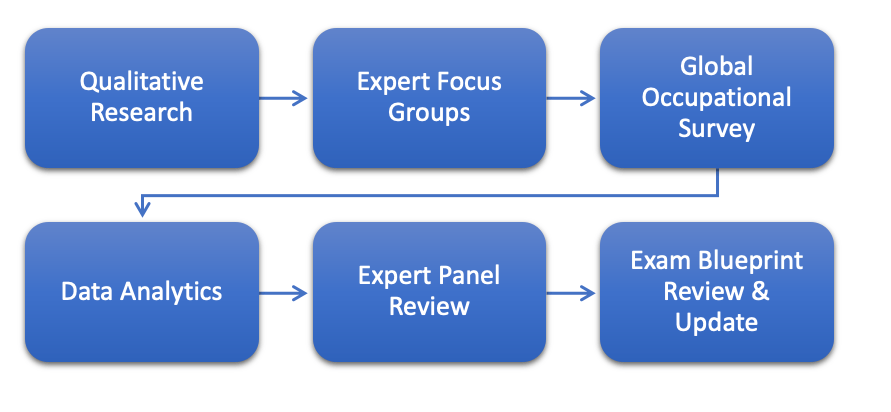
The job analysis approach we use involves collecting and aggregating information and insights from job incumbents and occupational experts to determine the content specifications for the CMCA exam. This process is illustrated in the graphic below. A significant component of the process is an electronic survey sent to thousands of association management professionals worldwide to gather information about their job duties and requirements. The survey results will be reviewed with the pool of subject matter experts comprising the CAMICB Exam Development Committee to obtain their input and judgments regarding current trends in the profession and the importance of the knowledge for competent performance in the field. 

As the CMCA credential has grown internationally, this upcoming study will build on that growth. Joseph Caramagno, MA, who leads the survey process and analysis and is a Senior Research Scientist for Human Resources Research Organization (HumRRO), CAMICB’s test development partner said, “While the job analysis survey has taken a global approach in the past, we’re making changes to the process to reach even more managers working around the world.”  Caramagno explained, “The focus for this survey cycle is to fully understand, at a global level, the essential tasks and duties that comprise a manager’s day-to-day work and what they must know to carry out those duties effectively. Additionally, this input will help shape our understanding of the profession.”

The survey will be available to managers all over the world in the second quarter of 2022, and managers at all levels of experience must participate to ensure we have broad representation and an accurate view of the profession.

Said Chair of the CAMICB Board of Commissioners, Drew Mulhare, CMCA, LSM, PCAM, “This process is a critical component to maintaining and validating the exam as the results guide the development of a new CMCA exam blueprint, which assures we are testing what we need to be testing. In addition, this comprehensive survey will help us emerge with a clear vision of what the field of association management around the world is today, how it has changed over the last five years, and what the minimum requirements for certification are when we take that global perspective.”

HR Tech Number of the Day: work communication tools

There are big differences in the tech used by younger employees and business leaders.

By Jen Colletta for Human Resource Executive

60: Percentage points separating “born digital” employees and business leaders who rely on instant messaging apps in a work setting

The role of technology in workplace communication has never been more clear than in the last year, as employees turned to tech tools to keep them informed, engaged and productive in newly remote settings. However, according to a new study, the type of tools that employees rely on could vary vastly based on employee age—setting up a unique challenge for HR leaders.

The Born Digital Effect from software company Citrix, parent company of Wrike, explored the future of work through the lens of “born digital” employees—Millennials and Gen Z workers primed to take on leadership roles in the coming decades. The report found some distinct differences between how born-digital employees and current business leaders work, including in the technology they utilize.

For instance, 81% of born-digital respondents rely on instant messaging apps for work purposes compared to just 21% of business leaders. Other large gaps existed in their use of technology they individually own for work (78% for born-digital and 21% for business leaders) and real-time document collaboration tools (used by 86% of leaders and 50% of born-digital employees).

What it means to HR leaders

The variations in work tech usage highlight a number of realities that HR leaders need to confront, says Andrew Filev, senior vice president and Wrike general manager at Citrix.

First, the pandemic, in many workplaces, has increased the reliance on synchronous communication tools favored by so many born-digital employees—but that constant connectivity can inhibit productivity and engagement and put workers at risk of burnout, Filev says. At the same time, business leaders need to be open to new tools, especially those which future leaders are inclined toward.

“Just as born-digital workers shouldn’t spend all day in Slack, business leaders shouldn’t avoid the instant messaging platform altogether,” he says.

Achieving that balance comes down to leadership from HR. HR leaders need to educate all employees, as well as executives, Filev says, about the benefits, drawbacks and appropriate use of both synchronous and asynchronous communication tools.

“Synchronous tools are meant for quick, real-time collaboration, but a majority of the work must be done via asynchronous platforms with fewer distractions, allowing for deep work,” he says. “HR needs to step in and provide the appropriate training and education to ensure that all employees—top to bottom—are using solutions for their intended purpose.

Jen Colletta is managing editor at HRE. She earned bachelor’s and master’s degrees in writing from La Salle University in Philadelphia and spent 10 years as a newspaper reporter and editor before joining HRE. She can be reached at hreletters@lrp.com.

THE GIFT OF NEGATIVITY: WHAT WE GAIN BY FAULTFINDING, NITPICKING, AND NAYSAYING

From LeadershipFreak Blog

Painful experiences teach you to protect yourself. The tools of self-protection are faultfinding, nitpicking, naysaying, and quibbling.

Experience gives birth to protective negativity.

The birth of negativity:

“If a cat sits on a hot stove, that cat won’t sit on a hot stove again. That cat won’t sit on a cold stove either. That cat just don’t like stoves.” Mark Twain

A painful experience with a hot stove makes you critical, skeptical, cantankerous and disagreeable.

Negativity bias:

The gift of negativity is about NOT DOING. But ‘not doing’ doesn’t get much done.

There are a few people who think of how something might work, but in my experience, they are the dodo birds in the crowd. Faultfinding is an Olympic Sport on average teams.

Avoiding is stronger than pursuing.

People have a stronger negative reaction to losing $20 than the positive feelings they have from gaining $20. (Kahneman – Thinking, Fast and Slow)

5 ‘advantages’ of faultfinding, nitpicking, and naysaying:

  1. Admiration: You seem wise when you explain why something won’t work.
  2. Time: You don’t waste energy on things that probably won’t work.
  3. Stability: You don’t need to change when you kill ideas before they grow legs.
  4. Power: You empower yourself by blocking other people’s ideas.
  5. Security: You protect the status quo, even if you complain about it.

Beyond negativity:

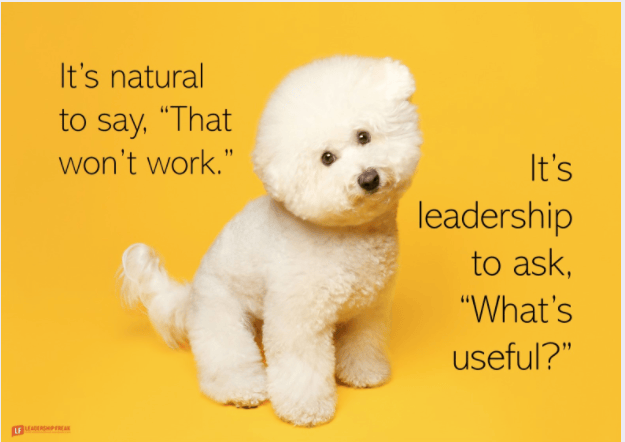
It’s natural to say, “That won’t work.” It’s leadership to ask, “What’s useful?”

  1. Define your goal.
  2. Engage in open conversation.
  3. Don’t silence reason givers – people who give reasons why something won’t work.
  4. Evaluate suggestions, reasons, and ideas by asking, “With our goal in mind, what’s useful about that?”

The “Usefulness” lens:

“How is this useful?” empowers people to explore, adapt, or eliminate suggestions or ideas.

“What’s useful?” treats all ideas equally.

Apart from “What’s useful?”, negative bias wins.

Bonus: The ‘useful’ lens enables learning. Nitpicking blocks learning.

What ‘advantages’ do you see in faultfinding, naysaying, and nitpicking?

How might leaders create future-building conversations?

U.S. workers are among the most stressed in the world, new Gallup report finds

By Jennife Liu for CNBC

U.S. workers are some of the most stressed employees in the world, according to Gallup’s latest State of the Global Workplace report, which captures how people are feeling about work and life in the past year.

U.S. and Canadian workers, whose survey data are combined in Gallup’s research, ranked highest for daily stress levels of all groups surveyed. Some 57% of U.S. and Canadian workers reported feeling stress on a daily basis, up by eight percentage points from the year prior and compared with 43% of people who feel that way globally, according to Gallup’s 2021 report.

This spike isn’t surprising to Jim Harter, Gallup’s chief workplace scientist, who tells CNBC Make It that rates of daily stress, worry, sadness and anger have been trending upward for American workers since 2009. Concerns over the virus, sickness, financial insecurity and racial trauma all contributed to added stress during the pandemic.

But stress spikes were especially acute for women in the last year: 62% of working women in the U.S. and Canada reported daily feelings of stress compared with 52% of men, showing the lasting impact of gendered expectations for caregiving in the household, ongoing child-care challenges and women’s overrepresentation in low-wage service jobs most disrupted by the pandemic. By contrast, the daily stress levels for women in Western Europe went down in the last year, which researchers attribute to social safety nets for parents and workers to prevent unemployment.

And while employee engagement dipped in the rest of the world, it rose to 34% in the U.S. The correlation of higher engagement but also higher stress can result in burnout and mental health challenges and indicates “the intersection of work and life needs some work,” Harter says.

Young people expect their workplace to improve their overall well-being

These sentiments come at a time when younger generations expect their workplaces to provide more value than just a paycheck, Harter says, drawing on previous Gallup research. And in turn, he says organizations have a responsibility to help improve employee well-being if they want to support a resilient workforce; improve learning and performance; and attract top talent.

He points to five elements workplaces can focus on to improve employee engagement and help individuals thrive: career well-being, social well-being, financial well-being, physical well-being and community.

Stress in any one of these areas, such as financial stress due to inequitable pay, or community stress due to an unsafe work environment, can negatively impact a worker’s mental health.

Leaders can do an audit, like through surveys and focus groups, to see if any of their company policies, structures, communications or programs negatively impact their employees’ overall well-being. And when leaders introduce new programs or benefits, Harter says, leaders should connect the value of them to “those five elements, so people understand why you’re providing various benefits, and why you’re trying to provide an overall culture of thriving.”

Who plays the biggest role in employee well-being

It’s crucial CEOs communicate this priority from the top, Harter says, but managers play the biggest role in actually helping improve worker well-being throughout all levels of an organization.

“The most important thing employers can do is to equip managers to have the right kinds of conversations with people,” Harter says. He says companies should be doing more to upskill their managers to facilitate meaningful and ongoing conversations. At least once a week, he says, managers should take the time to get to know their employees’ personal lives, in addition to what they have going on at work and how the two intersect.

“What dictates employee engagement and high well-being is very situational,” Harter says. “We have to equip them to have the right kinds of conversations so they can really impact people and help them find the resources they need.”

Manager training should also be inclusive to recognize workers who need the most flexibility and support, for example, a mom who needs flexibility to do her best work while also taking on child care. Managers can not only point their employees to the best resources, but also be an advocate to senior leaders about introducing new policies or benefits that their workers don’t have but need.

As Harter puts it, “managers are in the best position to understand their employees’ life situation well enough to adjust the work to accommodate them.”

Additionally, some organizations are investing in well-being coaches, seeing that employees who are fulfilled and secure in their personal lives can contribute to the business’s success.

“Having leaders in an organization who authentically believe in improving worker well-being, that’s important to culture,” Harter says.

Going back to the office? Don’t lose one of the most valuable aspects of remote work.

Whether your team is heading back to the office, will continue working remotely, or somewhere between, silence and space are critical leadership gifts to give your team.

Mixed Feelings about Going Back

Over the past month, as more U.S. citizens have access to vaccines, we’ve been talking with people whose teams have worked remotely about their thoughts on returning to in-person work. Conversations about going back to the office have included a wide range of feelings. Some are eager for the stimulation and energy of being around other people. Others are not. People who aren’t as excited about returning to fixed times and locations cite several concerns. Besides the benefits of flexibility, working across geography, and the ability to care for loved ones and life interests, at the top of the objection list is concern over lost personal productivity.

  • One team member said, “With no commute and without physical interruptions from other people, I’m getting way more done.”
  • Another person I spoke with said, “My manager was all about us working remotely until he realized that he’s an extrovert and now had no one to talk to. Now’s he’s been upfront that he wants us back in the office because he needs to talk. But that kills my productivity.”
  • One senior leader we spoke with talked about how, despite her preference for extroversion, she has enjoyed the fact that people aren’t interrupting her with “Just one thing real quick …” She worries that when they return to the office, her colleagues and team will abandon the productive batching communication habits they’ve developed.

There are pros and cons for every work arrangement – and they differ across industries. This isn’t an argument for any specific approach – they all have their place. But when people share a common concern about their improved ability to get things done, it’s an opportunity to build a better workplace than the one we left.

A Silent Surprise

As I’ve interviewed people and looked at data on going back to the office, the concern about time lost to talkative coworkers and bosses brought to mind a visit I made to a radio station several years ago.

Every Friday morning the most popular morning radio show in town hosted Live Audience Friday. A group of 12 people got to sit into the broadcast booth to watch the three show hosts do their thing, ask questions, and take part in on-air contests.

I’d listened to their show for years. Every morning the hosts reliably bantered for four hours, made me smile, laugh, reflect, and, a time or two, even cry. Between songs and commercials, they played games, shared trivia, commented on the events of the day, held contests, and shared observations they’d made about life and the oddities of human behavior.

The three of them had incredible chemistry. They were a joy during the years I drove my daughter to school and then drove myself to work. After years of listening to Live Audience Friday, my sister, her husband, and I decided it was our turn, so we applied to visit.

When our morning arrived, we met outside the studio in the chilly morning dark while most of the world slept, filed into the studio, and waited for the magic to happen.

The show was as enjoyable as I hoped, the hosts’ interaction with the audience was kind, fun, and uplifting. But what struck me most about watching these three create their on-air repartee – was the silence.

When the “on-air” sign lit up, they were full of energy, connected to one another, and poured energy across the airwaves into their hundreds of thousands of listeners. But when the sign went dark, they went silent. They studied notes, occasionally asked a quiet question of one another, and generally said very little.

It was the opposite of what I’d expected. My impression as a listener was that what we heard on our radios was the on-air continuation of an ongoing conversation. That somehow we’d just been allowed to listen in.

In hindsight, that sense of connection and the ongoing conversation resulted from the hosts’ craft and professionalism. They were good at what they did. They included those moments of silence where they gathered their energy, reviewed the content they’d prepared, and did the work to deliver a best-in-class show.

Because of the pandemic, Karin and I shifted our in-person delivery to 100% to live remote leadership training. Some days feature five or six hours on camera engaging leaders around the world in human-centered leadership practices and skills.

Over the many months of pandemic-enforced remote programs, I’ve thought of those radio hosts’ moments of silence many times. When we turn off our camera for a breakout session or pause between programs, Karin and I study our notes, return emails, and exchange a quiet question or two.

Silence can be craft and professionalism.

Bring the Gift of Space and Silence Back to the Office

I’ve read comments from a (thankfully) few cynical executives who say that people’s productivity concerns are packaging for the other benefits of working remotely.

I don’t think that’s true.

We’ve seen too many statistics citing the increased productivity over the past 15 months. It feels good to do well, and it makes sense that people don’t want to lose that.

If your work truly requires co-location, you can still give people the gift of productivity they’ve enjoyed over the past year with silence and space. Here are six ways to bring the gift of silence and space back to the office:

1. Don’t hold meetings for you.

Hold meetings only when they are the most productive use of time for the attendees (eg: to solve a problem or develop their abilities). Otherwise, leverage the communication infrastructure you’ve built over the past year.

2. Audit what you’ve eliminated.

You and your team have had to do things differently. What did you stop doing that doesn’t need to come back? It will be easy to fall back into location-based habits, but you don’t have to. Work with your team to keep unproductive habits you retired from popping up again.

3. Consolidate communication. 

The benefit of co-location can quickly become its bane if people fall back into the habit of interrupting one another for minor items. Once again, you can leverage the communication platforms. Help the team commit to batching discussion items so everyone has the best chance to do their best work.

4. Practice the pause. 

As I’ve watched meetings happen over Teams, Zoom, Chime, and Skype, I’ve noticed how people became more comfortable with a pause. A pause while someone reaches to unmute. A pause to ensure they’re not speaking over a colleague. Technology forced us to pause. We can bring that pause into our conversations and meetings. Give a question room to breathe. Don’t rush to fill the silence.

5. Consider quiet hours. 

Some organizations we’ve worked with introduced this practice even pre-pandemic. Carve out 90-120 minutes once or twice a day dedicated to deep work. Interruptions may only happen for emergencies (and define an emergency). Leverage the communication platforms you’ve used over the past 15 months to facilitate and protect these windows.

6. Communicate about quiet and communication.

The most effective hybrid and virtual teams take time to talk about how they work together. This practice is vital for in-person teams as well. Creating shared expectations and understanding will help everyone’s productivity. You can use the prior items on this list as starting points for your discussion.

By David Dye

Exploring a career change? The field of community association management is growing!

By Matthew Green , CAMICB Credentialing Director

If you love the idea of a job that offers opportunity, stability, and growth, community association management provides an excellent career path. It’s a great job choice for people who previously worked in the leisure and hospitality industries. Those sectors continue to lead U.S. job losses amid COVID-19, with experts predicting slow growth until at least 2023.

It wasn’t so long ago the hospitality industry was one of the most promising fields. It set people up for a successful career in people-facing jobs at hotels, restaurants, conference centers, major event venues, and more. Unfortunately, a boom in hiring came to a halt in mid-March 2020, as events were cancelled, and many restaurants and hotels closed their doors. 

The good news is that though the coronavirus has dashed a lot of hopes for hospitality grads and veterans, the world of community association management is a bright spot. The field continues to grow and offers excellent opportunities for anyone who wants to continue in a people-oriented career. 

Community Association Management Stats

The Community Associations Institute (CAI) reports that as of 2019, there were approximately 351,000 community associations in the United States. They house nearly 74 million residents, over 11 million more than just a decade ago. Twenty-six percent of people in the U.S. live in a community association. 

It’s estimated there are about 8,000 community association management companies in the U.S. and up to 55,000 off and on-site community association managers. As the number of people living in community associations continues to rise, so does the number of jobs for community association managers. If you’re a people person who’s skilled in handling multiple tasks, a career in community management can be an incredibly rewarding career choice.

Community Association Management Career Outlook

Job prospects in the community association management sector are excellent. Though a college degree and professional designation are not necessary to land a position in the field, those who do command a higher salary when starting out. As of May 2020, the median wage for community association managers was $59,660 per year. In 2019, there were 367,900 jobs in the field. Employment in the industry is projected to grow seven percent from 2018 to 2028.

Job prospects and projected wages vary from state to state and community to community, so it’s a good idea to check out your area’s particulars.

CMCA – The Essential Credential

The key to building a successful community association management career is the Certified Manager of Community Associations (CMCA) credential. Holding the certification lets employers know you’re educated and competent in certain management practices. It also indicates your dedication to professional excellence, ethical business standards, and continuing education. Community management employers are continually looking for committed professionals. The CMCA certification can often make the difference between whether or not you land a first interview.

The CMCA credential is relatively easy to obtain and:

  • Requires limited time and money investments.
  • Demands just a few days of prerequisite course work, some time to study, and one day for the exam. 
  • Is relatively low-cost for such a valuable investment in your career and future.

Earning the CMCA credential opens the door to earning additional credentials and up to 20% higher earnings than community association managers who are non-credentialed.

Is a Certified Manager of Community Associations Career Right for You?

If you were previously employed in the hospitality sector but were furloughed or had your job eliminated due to the pandemic, a community association management position could be an excellent career pivot for you. The work is interesting, varied, and highly satisfying. Your daily tasks can see you:

  • Working closely with residents and Board members.
  • Making visits to the community.
  • Interacting with community leaders.
  • Hiring and supervising outside vendors.
  • and a whole lot more.

Requisite skills align well with those that people in the hospitality sector possess, such as attention to detail, flexibility, and good organizational skills. Top-tier community association managers also have excellent interpersonal skills and can effectively communicate with a diverse range of people. 

All Work and No Fun?

A community association manager has a busy job, but it can also be a lot of fun. Along with the potential of receiving a great salary, you get to constantly learn new things and meet interesting people. The likelihood of ever being bored on the job is slim—there are just too many interesting things to do and people to meet!

While community association management is not for everyone, if you’re a real people person who possesses a positive and enthusiastic attitude towards life, gets excited about staying current with the industry’s regulatory changes, and can remain calm when others around you are stressed, you can’t ask for a more engaging and exciting career!

Becoming a certified manager of community associations isn’t merely a designation. It can truly be the journey of a lifetime. It elevates your credibility and assures employers they’re making the right hire. 

Finally, it offers you a wealth of possibilities and growth in an exciting career that shows no sign of slowing down.

For further information, please visit camicb.org or email us with any questions at info@camicb.org.

Privacy Policy: https://www.camicb.org/privacy-policy

Employers may relax COVID-19 measures in fully vaccinated workplaces, OSHA says

By Ryan Golden for HRDive

Dive Brief:
  • Most employers “no longer need to take steps to protect their workers from COVID-19 exposure in any workplace, or well-defined portions of a workplace, where all employees are fully vaccinated,” the Occupational Safety and Health Administration said in guidance updated Thursday.
  • The agency also published an emergency temporary standard for U.S. healthcare employers. Employers included in the emergency temporary standard’s definition must develop and implement a plan to protect employees from COVID-19 in the workplace, and they must designate one or more workplace COVID-19 safety coordinators to implement and monitor their plans. The document also lays out requirements for patient screening and management, personal protective equipment and physical distancing, among other subjects.
  • OSHA’s updated guidance for all industries, meanwhile, encourages employers to grant paid time off for employees to get vaccinated. Employers also should implement physical distancing for unvaccinated and other at-risk workers in communal work areas, including limiting the number of such workers in one place at any given time.
Dive Insight:

The updated guidance may help to resolve some of the questions employers had following a May update from the Centers for Disease Control and Prevention that, with some restrictions, fully masked individuals could resume activities without wearing a mask. Last month, OSHA directed employers to follow CDC’s guidance on mask use and social distancing for fully vaccinated workers.

OSHA’s June 10 announcement has drawn a range of reactions from observers. While praising the healthcare industry temporary emergency standard as a “step in the right direction,” House Committee on Education and Labor Chairman Robert C. “Bobby” Scott, D-Va., criticized the Biden administration for not providing other specific guidance for employers in other industries.

“This ETS is long past due, and it provides no meaningful protection to many workers who remain at high risk of serious illness from COVID-19,” Scott said in an email press release. “Workers in meat processing plants, prisons, homeless shelters, grocery stores, and many other workplaces will be forced to continue relying on voluntary safety guidance, which has failed to protect hundreds of thousands of workers and families from preventable infections throughout the pandemic.”

But OSHA has explained that one of the requirements for issuing such a standard is that the agency must determine that workers are exposed to a “grave danger” from new hazards or toxic substances or agents determined to be physically harmful, and that an emergency temporary standard is needed to protect them. In a summary of the emergency standard released Thursday, OSHA said employee exposure to SARS-CoV-2 “presents a grave danger to workers in healthcare settings” and that standard “is aimed at protecting workers facing the highest COVID-19 hazards—those working in healthcare settings where suspected or confirmed COVID-19 patients are treated.”

“It may be that OSHA can issue another ETS for industries where there is evidence of low vaccination rates or some other COVID-19 risk factor for fully vaccinated individuals, but the finding in the healthcare ETS suggests that OSHA does not believe the grave danger threshold can be met for other industries,” Charlie Morgan, partner at Alston & Bird, told HR Dive in an email. “Time will certainly tell, however.”

The agency had long faced pressure from advocates to publish emergency standards addressing how to protect workers’ health and safety from COVID-19 in the workplace. Following the release of the agency’s initial guidance on Jan. 29, an official at the National Council of Occupational Safety and Health said that “OSHA and our federal government has failed us,” citing insufficient workplace inspections and data recording practices, Construction Dive reported.

Attempts to get the agency to publish emergency standards even involved a lawsuit filed last year by the AFL-CIO, but a federal appeals court declined to compel OSHA to do so.

In addition to the guidance published by CDC and OSHA, the U.S. Equal Employment Opportunity Commission said in a technical assistance document updated May 28 that employers may implement policies requiring that all employees who physically enter a workplace receive a COVID-19 vaccination under federal equal employment opportunity laws, with some exceptions.

Condo Board Moves to Comply with the Climate Mobilization Act

By Bill Morris in Bricks & Bucks For Habitat Magazine

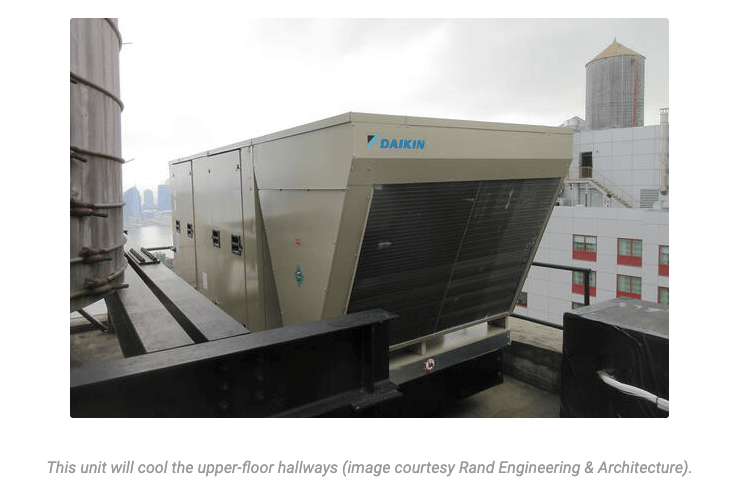
When the condo board at 88 Greenwich St. decided to replace rather than rehab the aging cooling units on the roof of its 38-story Art Deco tower in the Financial District, it was determined to kill three birds with one stone.

First, the job would put an end to the constant stream of violations from the Fire Department of New York over an improperly filed Certificate of Compliance when the units were installed in the 1990s. Second, the new units would be properly sized for the jobs of cooling the upper-floor hallways and the elevator machine room. And third, the new units would cut the building’s carbon emissions and push it toward compliance with the looming caps set by the Climate Mobilization Act.

The board brought in Ray Locicero, a mechanical engineer with RAND Engineering & Architecture, to evaluate the system and prepare a proposal. “The resident manager, Tom Calandra, and the property manager, Shana Essig of FirstService, insisted on having equipment that would work toward those goals,” Locicero says. “Electricity has a more favorable carbon footprint than fossil fuels, so the city is encouraging buildings to electrify – in hopes that the electric grid will become greener.”

After determining that the unit that cooled the hallways was undersized and the unit that cooled the elevator room was oversized, Locicero proposed installing a 100% outside-air conditioner for the former and an air-cooled condenser for the latter. He suggested installing electric Mitsubishi machines, but when the contractor announced it could get Daikin machines at a lower price, the board decided to go with Daikin. One problem: the board had insisted that the job had to be done without using a costly crane – which would have added $80,000 to the price tag – and there was concern that the larger Daikin machines might not fit in the elevators or on the tight roof space.

“The machines had to be broken down so we could get them in the elevator, then carried up two flights of stairs,” Calandra says. “The project was very smooth, considering the size of the job and the difficulty of getting everything up to the roof without using a crane. There were no change orders.” The only hiccup was that the delivery of some parts was delayed by the pandemic.

The project was completed in April, and Essig, the property manager, says it came in right on budget, at $168,000, which was paid out of the reserve fund. “This board is ahead of the game big-time,” she says. “They like to plan ahead so the unit-owners don’t get hit with big increases or assessments each year.” She adds that the board has already gotten approval to participate in the New York State Energy Research and Development Authority’s FlexTech program, which shares the cost of a building-wide study to identify ways to reduce energy costs.

The engineer also has kind words for the five-member condo board. “They were proactive,” Locicero says. “They didn’t wait until they had an emergency. They were a joy to work with because they made it possible for us to do the job right.” 

PRINCIPAL PLAYERS – PROPERTY MANAGER: FirstService Residential New York. CONTRACTOR: New York Cooling Towers. ENGINEER: RAND Engineering & Architecture.

What Your Future Employees Want Most

By Tim Minahan for Harvard Business Review

The past year has accelerated digital transformation across sectors. Along with a universal recognition that resilient employees are the true lifeblood of a company came an understanding that a company’s workforce is crucial to business recovery. This has prompted organizations to completely rethink how they attract, retain, and manage their talent.

My organization, Citrix, wanted to understand what the current attitudes of both HR managers and knowledge workers are with regard to their future workforce. We conducted a study, which we dubbed the Talent Accelerator, as part of Citrix’s Work 2035 project, a year-long examination of global work patterns and plans designed to understand how work will change, and the role that technology will play in enabling people to perform at their best. The Talent Accelerator study combines research from more than 2,000 knowledge workers and 500 HR directors in large, established corporations and mid-market businesses with at least 500 employees based in the United States. When the study was commissioned, both groups of professionals were working under permanent contracts and were currently or had recently been working from home as a result of Covid-19 restrictions.

Research Findings on the Future of Talent Management

When it comes to what talent management in the future might look like, our study pointed to three defining priorities among knowledge workers:

1. Employees overwhelmingly expect flexible options.

According to the study, 88% of knowledge workers say that when searching for a new position, they will look for one that offers complete flexibility in their hours and location. Also 83% predict that in response to the global skilled talent shortage, companies will leverage flexible work models to reach out to suitable candidates no matter where they live — yet, only 66% of HR directors feel the same. What’s more:

  • 76% of the workers polled believe that employees will be more likely to prioritize lifestyle (family and personal interests) over proximity to work, and will pursue jobs in locations where they can focus on both — even if it means taking a pay cut.
  • 83% of employees think that workers will be more likely to move out of cities and other urban locations if they can work remotely for a majority of the time, creating new work hubs in rural areas.

In order to position themselves to win in the future, companies will need to meet employees where they are.

2. Employees want to re-imagine how productivity is measured.

In the future, companies will need to rethink how they measure productivity because traditional metrics — and views that real work can’t get done outside the office — will no longer cut it. According to the study, today’s employees want to be measured on the value they deliver, not the volume. And they expect to be given the space and trust they need to do their very best work, wherever they happen to be.

  • 86% of employees said they would prefer to work for a company that prioritizes outcomes over output. What does this mean? New employees want to work for a company that cares less about the qualified work output they are able to produce, and more about the impact they can deliver to the business in a holistic sense.
  • But there is a gap here, with just 69% of HR directors saying that their company currently operates in this way, and only half of HR directors saying that their organization would be more productive as a whole if employees felt that their employer/senior management team trusted them to get the job done without monitoring their progress.

Forward-thinking companies will focus on closing this gap, and will design people-centric experiences that give employees the space they need to unlock their full potential and deliver transformative results.

3. Employees want to work with a diverse team.

One thing on which both employees and managers seem to agree? Employees want to work for a company that prioritizes diversity.

  • 86% of employees and 66% of HR directors assert that a diverse workforce will become even more important as roles, skills, and company requirements change over time.
  • Honest, accessible metrics around your diversity progress and remaining gaps are critical to ensuring that efforts to build a diverse team are measurable, targeted, and impactful.

Takeaway for Leaders

What should the major takeaways be for business leaders when it comes to the implications of these findings?

1. See the forest through the trees.

Without the restriction of location, business leaders must look at their recruiting from a broader lens and expand the potential to attract employees who can boost an organization’s creativity and productivity.

They might, for instance, dip into untapped pools of talent such as the “home force” and bring back parents who’ve put their careers on hold to care for children, or people who left jobs to tend to aging relatives. It could also mean looking to Baby Boomers who’ve retired, but who still want to work a few hours per week. And it could mean enlisting more part-time, contract, and gig workers — who make up a larger percentage of the workforce than ever — to take on more hours. And, of course, it means looking for global talent that may reside anywhere.

2. Prioritize learning and development.

New business models sparked by the pandemic and changes in customer preferences and needs have given rise to new roles and opportunities for companies — and their employees — to grow. Upskilling and reskilling will be critical factor in capitalizing on them. As the study found:

  • 82% of employees and 62% of HR directors believe that workers will need to hone their current skills or acquire new ones at least once a year in order to maintain competitive advantage in a global job market.
  • HR directors believe that ensuring that an organization has the latest collaborative technology in place to enable agile learning is the most important factor in recruiting and retaining the best talent, and 88% of employees confirm this notion, saying that they look for this when searching for a new position.

It bears repeating: Organizations will need to prioritize reskilling and upskilling to attract and retain the talent they need to make their businesses grow. Those that do will not only boost the motivation of their existing workers, but will gain the attention of the brightest new recruits and position themselves to emerge from the pandemic not just where they were, but in a stronger, better position to move forward.

The last year has forever changed the way employees view and approach work, but one thing holds true: Businesses that want to attract and retain the talent they need to move forward must understand the top priorities of their future workforce. They must embrace new, flexible work models and cultivate a workforce that can design their own careers. In doing so, they will not only boost the motivation and engagement of their existing workers, but will gain the attention of the brightest new recruits and take their business to new heights.