5 Steps for Ensuring Diversity in the Leadership Pipeline

A recent study found unintentional discrimination in succession planning in two-thirds of the responding companies.

By Martin Lanik, Ph.D.

Diversity in leadership helps organizations grow and develop at a faster rate than leadership with no diversity. Bringing a broader array of background and experience to the table results in a larger pool of creativity, innovation, and insight. However, women and minorities still face many barriers in attaining leadership roles.

Pinsight’s latest research study, “Repairing the Broken Rung,” focuses on fairness in how organizations identify and prepare the next generation of leaders. To conduct our study, we collected data from 129 organizations that together employ more than half-a-million people and span most industries. We studied how these organizations identify high-potential employees (employees who show potential for a leadership role) and select successors for executive positions. We found that men are three times more likely to be identified as high-potentials than their equally capable women colleagues, and we found unintentional discrimination in succession planning in two-thirds of the companies.

As a solution, we have identified five steps organizations can take to ensure fairness in the selection and development of future leaders. These include:

1. Get the data. Start by obtaining data about your current practices for identifying high-potential employees, emerging leaders, and succession pools. Monitor the balance in these programs with the same rigor you apply to hiring decisions. Calculate adverse impact against any protected group periodically, after talent review cycles or managerial ratings. Review industry trends and best practices, as well as legal cases to ensure you are aware of risks and trends in this space.

2. Roll out bias training for all. Bias training is a good starting point, but understand that it is meant to increase awareness of the issue, not solve it—you can’t train bias out of people. All humans use biases to save time and energy when making decisions. Training can increase awareness of what biases exist; how they can affect organizational decision-making; and where to look for them in talent reviews, high-potential selection, and succession decisions. Because most people are reluctant to see their own biases, use data from your organization as evidence that even your managers show bias.

3. Turn up the rigor. Apply rigor to your existing processes for identifying high-potential employees and successors across the entire leadership pipeline, from front-line managers all the way to senior executive roles. Examine not just how those decisions are made, but exactly how the processes are executed: Do managers write down names and submit them in a sealed envelope? Or is there a transparent assessment in place? Are nomination criteria clearly defined? Do you have a validated list of the characteristics and attributes needed for employees to access high-potential programs?

4. Identify selection criteria. Formulate the criteria for high-potential and successor selection based on science, and insist that managers use these during the nomination process. What characteristics best predict success in leadership roles at your company? Educate managers on the criteria and what potential performance looks like for future leaders. Use the criteria in the nomination and selection process, and ask managers to provide evidence that their candidates meet the criteria. Communicate the criteria to all employees to reinforce a culture of fair and consistent standards in selection to high-potential programs and succession plans.

5. Introduce blind auditions. Help managers make better decisions by giving them more objective data about employees’ readiness and future potential. Similar to our case study, you can set up a simulation of a leadership role and invite trained assessors who have no prior relationship to the candidates to observe their performance. Seeing all employees in the same standardized situation and using a validated set of criteria, you will arrive at a more objective evaluation of their leadership potential and readiness.

By taking action and implementing these five steps, organizations can move toward practices that are diverse, inclusive, and fair, ensuring that the most capable and most qualified individuals are given a fair opportunity based on their qualifications, potential, and merits rather than unrelated criteria such as gender or race. These practices set standards that are objective and quantifiable, removing subjectivity and human bias. In doing so, organizations can cast out a broader net when identifying high-potential employees while minimizing talent being left on the table.

Martin Lanik is the lead author of “Repairing the Broken Rung: Overcoming Bias in the Leadership Pipeline,” as well as the author of the bestseller, “The Leader Habit.” He serves as CEO of Pinsight, a Denver-based consulting firm that helps companies bring fairness to leader selection, development, and succession. For more information, visit: www.pinsight.com or www.repairtherung.com.

If You Need CECs — We’ve Got You Covered!

CAMICB offers a number of online continuing education opportunities. Be sure to regularly check out our helpful list of On-Demand webinars available here for managers to view that are free or low-cost, and CAI Headquarters has an entire library dedicated to webinars available for continuing education credit available here. All of CAMICB’s continuing education opportunities can be found here. 

CAMICB also offers the option for managers to seek out online opportunities that work best for them, and unapproved online options can be e-mailed to info@camicb.org for approval consideration.

For any questions, please reach out to CAMICB at info@camicb.org. 

Preparing for the legislative sessions in 2022

By Matthew Green, CAMICB Associate Executive Director

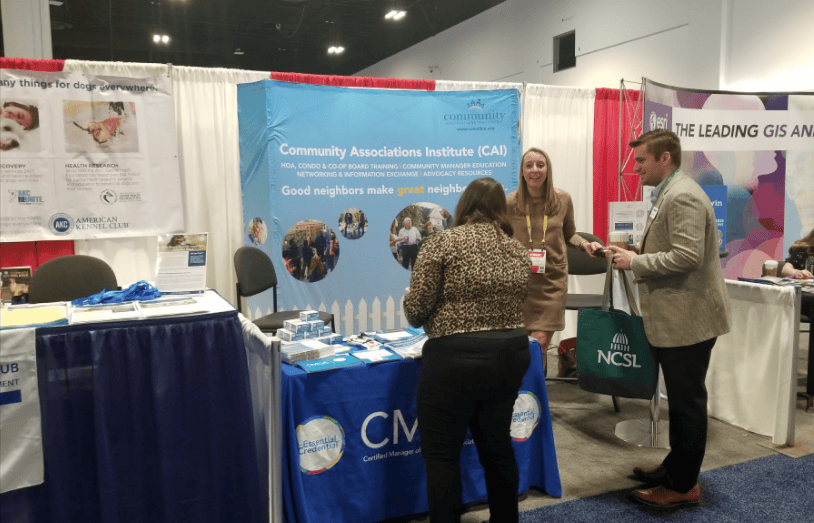
At the end of 2021, it was fantastic to be back in person at the National Conference of State Legislatures (NCSL) Legislative Summit in Tampa, Florida. This annual meeting gives the nation’s state legislators and staff a rare opportunity to connect, dive into policy issues and prepare for the legislative sessions in 2022.

The annual Summit is an important opportunity for CAMICB to educate – and update – state and international lawmakers about the community association management profession. CAMICB has partnered with CAI and exhibited at the Summit for more than 10 years. Since then, our team has had thousands of face-to-face conversations with lawmakers about HOA and condominium laws. We also exhibit annually to reinforce the CMCA credential be considered a primary certification option should legislatures pursue licensing the association management profession.

This year nearly 2,400 people registered for the Summit, with almost a thousand legislative staff and policymakers from across the world attending. Our booth bustled with the conversation about the CMCA credentialing program’s recent international accreditation by the ANSI National Accreditation Board (ANAB) and emphasizing the CMCA credential meets the global benchmark for certification programs. Earning the prestigious international accreditation is proof the CMCA credential serves community association management in a consistent, comparable, and reliable manner worldwide.

And if you want to catch up on some of the hottest policy topics – visit NCSL https://www.ncsl.org/meetings-training/2021-summit-livestreaming.aspx for many of the recorded sessions.

Is your community association manager certified?

Are you putting your most valuable assets in the hands of the most qualified professionals?

As a homeowner, it’s in your best interest to protect one of the biggest investments you’ll ever make. Therefore, it’s critical to know if your community is managed by a Certified Manager of Community Associations (CMCA). CMCAs manage condominium & homeowner associations, housing cooperatives, resort communities and commercial tenant associations.

If you serve as a board member, trustee, or volunteer leader working with your homeowner’s association, condominium association, or cooperative, your decisions have a profound ?nancial impact on your community. There are more than 20,000 quali?ed community association managers who hold the CMCA credential. Hiring one of them to manage your association ensures you have the best resources available to make important decisions about reserves, maintenance, insurance, budgets, governance, contracts, the law, rules enforcement, and more. Receiving professional, accurate advice and guidance on such issues can mean the difference between prosperity and disaster.

What a difference a credential makes!

About the CMCA Credential

The Certi?ed Manager of Community Associations (CMCA) credential is the only international certi?cation program developed solely for managers of homeowner and condominium associations and cooperatives. The CMCA is awarded to individuals who have demonstrated core competency in the knowledge areas required to perform effectively as a community association manager and who have made a commitment to continuing education and the highest standards of professional conduct.

Governing board members and homeowners are encouraged to seek committed, quali?ed professionals to manage their communities. Hiring a CMCA ensures expert management by someone who has demonstrated the specialized skills required to lead a community association successfully.

The CMCA program is dual accredited. The National Commission for Certifying Agencies (NCCA) accredits the CMCA program for meeting its U.S.-based standards for credentialing bodies. The ANSI National Accreditation Board (ANAB) accredits the CMCA program for meeting the stringent requirements of ISO/IEC 17024 Standard, the international standards for certification bodies. The program’s dual accreditation represents compliance with rigorous standards for developing, delivering, and maintaining a professional credentialing program. It makes the CMCA credential one of a small number of dual-accredited credentialing bodies and the only accredited certification for community association management professionals around the world. It is a great source of pride and a strong testament to the strength and value of the CMCA credential.?

Do you know if your manager is CMCA-certi?ed? Search our Directory of Credentialed Professionals at www.camicb.org/?nd-a-cmca.

Talk to Your Manager Today

We encourage you to learn more at www.camicb.org and share this information with your manager. Information about the certification process can be found at https://www.camicb.org/get-certified. You can also email us with any questions at info@camicb.org.

Privacy Policy: https://www.camicb.org/privacy-policy

Remote working is here to stay as managers try to keep staff loyal

Business leaders see the need to provide hybrid and remote work options as important.

By Allison Murray for ZDNet

As it becomes more apparent that a hybrid work environment is here to stay, companies need to prepare to be flexible in 2022, and business executives agree.

According to PricewaterhouseCoopers’ (PwC) Executive Views on Business in 2022 Pulse Survey published on Thursday, 43% of business leaders plan to keep hybrid work options for employees, and 30% plan on making remote work a permanent option. In addition, 77% of executives see hiring and retaining employees as the two most important factors to consider in 2022.

“As employers look to attract and retain critical talent, they’re shifting their investment into their employees — creating meaningful work opportunities, investing in learning and upskilling, and creating career advancement opportunities — all while providing new flexible working options to meet employee personal needs,” said Julia Lamm, PwC Workforce Transformation Principal, in a statement. “2022 will be an important year for employers to build trust between employers and employees, as they seek to stabilize their teams and position for growth.”

The survey — which included 678 C-suite executives — also found that leaders plan to keep several initiatives to focus on this retainment and attracting talent. These include increasing career advancement and upskilling opportunities (36%), increasing compensation for employees (31%), and improving benefits for employees (30%).

Even though executives have a positive outlook on focusing on their employees, they are still concerned about the state of the current labor market. The survey shows that only 36% believe that voluntary turnover will return to pre-pandemic levels by year-end. In addition, only 31% believe that the talent shortages will ease.

Other recent reports echo PwC’s findings that executives prioritize their talent in 2022. For example, a recent Fortune/Deloitte CEO survey showed that nearly half of participants say talent will be the biggest challenge they face this year. Similarly, PwC reports that almost half (48%) of executives see the ability to hire and retain talent as the biggest risk in reaching their organizations’ goal growths. 

But retaining talent is as simple as listening to employees’ needs, and Lamm said that will be essential for businesses to do this year.

“Building trust between employers and employees means listening and responding to employee needs — this is an incredibly unique time to take bold steps forward and implement new ways of working that are aligned to the expectations and needs of your people,” Lamm told ZDNet.  

Can self-management help a condo board climb out of a financial hole?

Roberto Noce looks at what a board needs to do get its financial house in order for The Calgary Herald

Question: I am the president of my condo board. Our condominium complex has just under 100 units. We are struggling financially, and have some major repairs ahead of us. We have no money in our reserve fund. We are dissatisfied with our current property management company, and half the board wants to self-manage in an effort to save money. I disagree. Is self-management a wise decision given the number of units? Please help!

Answer: The Condominium Property Act does not require condominium corporations to hire a property/condominium management company. Condominium corporations can decide to self-manage. The board of the condominium corporation can directly manage the corporation.

The reason that self-managed condominium corporations are not that common is because most board members do not have the time to take care of the many administrative responsibilities of a condominium corporation, such as collecting condominium fees and dealing with complaints.

Before deciding, the board should determine what things the property/condominium management company does, and who on the board would take on those responsibilities in the event that you terminate your property/condominium management company.

As well, you stated that you are struggling financially as a condominium corporation. Why? Is this the fault of your property/condominium management company, or is it because the board (and previous boards) failed to make important financial decisions about the future of your condominium corporation? Are your condominium fees too low? Have you not budgeted properly to deal with the day to day responsibilities and future needs of the condominium corporation?

Your question cannot be answered with a simple yes or no. Rather, you should hire an accountant and a lawyer to assist you in understanding how you can get your financial house back in order. Finally, the board needs to fully grasp its responsibilities if you decide to self-manage.

Helpful Hint: Living in a condominium complex requires patience. Condominium managers play a vital role in condominium living. The right condominium manager will significantly lower board members’ workloads, and provide service to owners on timely basis. You should shop around and interview prospective condominium managers if you are not currently satisfied.

Roberto Noce, Q.C. is a partner with Miller Thomson LLP in both the Edmonton and Calgary offices. He welcomes your questions at albertacondolaw@millerthomson.com. Answers are not intended as legal opinions; readers are cautioned not to act on the information provided without seeking legal advice on their unique circumstances. Follow Noce on Twitter at @RobertNoce.

These Are the Biggest Upsides of Buying a Home With a Strong HOA

by Christy Bieber | For Ascent, A Motley Fool Service

Key points

  • Many neighborhoods have homeowners associations.
  • HOAs usually charge fees that add to monthly housing costs.
  • There are benefits of HOA living despite the fees and restrictions.

When you are buying a house, you’ll likely come across many neighborhoods where there is a homeowners association. HOAs often impose rules about what you can do with your home, and they also charge fees you’ll have to pay each month on top of your mortgage payment.

While the added cost of an HOA may seem undesirable, there are actually a few big benefits of living in a neighborhood with an association. In fact, here are some of the biggest upsides of living someplace with an HOA.

1. The HOA protects your property values

Your property values are affected by the quality of your neighborhood and by how your neighbors maintain their houses. After all, no matter how nice your own property is, no one will want to buy it if it’s next to a slum.

Homeowners associations set and enforce rules related to the upkeep of property in the neighborhood. They may also set other restrictions such as requiring approval before painting a house or adding lawn ornaments. These rules help keep the neighborhood looking nice, which in turn keeps property values higher.

2. The HOA maintains the neighborhood and amenities

HOAs usually maintain common areas, and some neighborhoods with strong associations have lots of amenities such as pools or golf courses.

These features can add value to your home since they are desirable to buyers, and they can also make it nicer for you to live in your neighborhood since you can take advantage of them.

3. Fees may include common utilities and maintenance tasks

In some cases, HOA fees include things like internet service, pool maintenance, or lawn care. When that is the case, it’s convenient to pay one common fee to get many different services rather than having to arrange for them individually and contract with companies to pay for them separately.

In some situations, you may actually end up saving money because it can be cheaper for internet companies or landscaping companies to provide their services to an entire neighborhood rather than to just individual households. The fees you’re paying could actually be a better value than paying for these services privately.

4. The HOA can deal with neighborhood disputes

When people live in close proximity to one another, it’s often inevitable that disputes arise. There could be issues for a huge number of reasons, from barking dogs to lawns that aren’t maintained to loud music playing and more.

When you live in an HOA neighborhood, you don’t have to directly deal with a neighbor who is causing you problems in your enjoyment of your own home. The HOA most likely has regulations related to common nuisances or issues that come up regularly. They’ll take care of addressing the issues that arise among neighbors so you don’t have to sour your relationship with those living near you or cope with the stress of a confrontation.

For all of these reasons, it’s worth considering an HOA neighborhood when you buy a property. Just remember you need to be comfortable with the rules the association sets as you’ll have to live by them too.

The 2021 Community Association Manager Compensation and Salary Survey Is Now Available For Purchase As A Digital Book

The 2021 Community Association Manager Compensation and Salary Survey, conducted by the Foundation for Community Association Research, is now available for purchase as a digital book from CAI Press. This survey is a valuable tool for benchmarking compensation and benefit levels in the community association industry. The 2021 survey provides an interesting snapshot of the field, and enhances our understanding of this growing and dynamic profession. The information in this seventh edition of the survey represents the most comprehensive, accurate, and current data on compensation received by management professionals. It is designed to allow a company or manager to compare their pay with peers.

In addition to providing basic company and manager profile and salary information, the survey also includes the following:

  • Compensation outlook for the community association industry
  • Compensation by job title, presented by regions and states, for management company CEOs, company executives, high-rise managers, onsite managers, portfolio managers, and assistant community managers
  • Compensation by job title, presented by regions and states, for large-scale managers and employees at large-scale communities including the assistant general manager, architectural review manager, business/finance manager, communications/member services/marketing manager, events manager, facilities manager, fitness center manager, grounds manager, human resources manager, IT/computer systems manager, public safety/security chief, and recreation/lifestyle manager
  • Salary differences between managers with and without professional credentials
  • Data based on community association size, in addition to management company size
  • Information on employee benefits, health coverage, and retirement plans

Community managers who completed the salary survey receive complimentary access to the data and reports (not the digital book). For more information on how to access the survey findings, go to https://foundation.caionline.org/research/salary_survey/

Is 2022 The Year You Want To Explore A Career Change? The field of community association management is growing!

By Matthew Green , CAMICB Associate Executive Director

If you love the idea of a job that offers opportunity, stability, and growth, community association management provides an excellent career path. It’s a great job choice for people who previously worked in the leisure and hospitality industries. Those sectors continue to lead U.S. job losses amid COVID-19, with experts predicting slow growth until at least 2023.

It wasn’t so long ago the hospitality industry was one of the most promising fields. It set people up for a successful career in people-facing jobs at hotels, restaurants, conference centers, major event venues, and more. Unfortunately, a boom in hiring came to a halt in mid-March 2020, as events were cancelled, and many restaurants and hotels closed their doors. 

The good news is that though the coronavirus has dashed a lot of hopes for hospitality grads and veterans, the world of community association management is a bright spot. The field continues to grow and offers excellent opportunities for anyone who wants to continue in a people-oriented career. 

Community Association Management Stats

The Community Associations Institute (CAI) reports that as of 2019, there were approximately 351,000 community associations in the United States. They house nearly 74 million residents, over 11 million more than just a decade ago. Twenty-six percent of people in the U.S. live in a community association. 

It’s estimated there are about 8,000 community association management companies in the U.S. and up to 55,000 off and on-site community association managers. As the number of people living in community associations continues to rise, so does the number of jobs for community association managers. If you’re a people person who’s skilled in handling multiple tasks, a career in community management can be an incredibly rewarding career choice.

Community Association Management Career Outlook

Job prospects in the community association management sector are excellent. Though a college degree and professional designation are not necessary to land a position in the field, those who do command a higher salary when starting out. As of May 2020, the median wage for community association managers was $59,660 per year. In 2019, there were 367,900 jobs in the field. Employment in the industry is projected to grow seven percent from 2018 to 2028.

Job prospects and projected wages vary from state to state and community to community, so it’s a good idea to check out your area’s particulars.

CMCA – The Essential Credential

The key to building a successful community association management career is the Certified Manager of Community Associations (CMCA) credential. Holding the certification lets employers know you’re educated and competent in certain management practices. It also indicates your dedication to professional excellence, ethical business standards, and continuing education. Community management employers are continually looking for committed professionals. The CMCA certification can often make the difference between whether or not you land a first interview.

The CMCA credential is relatively easy to obtain and:

  • Requires limited time and money investments.
  • Demands just a few days of prerequisite course work, some time to study, and one day for the exam. 
  • Is relatively low-cost for such a valuable investment in your career and future.

Earning the CMCA credential opens the door to earning additional credentials and up to 20% higher earnings than community association managers who are non-credentialed.

Is a Certified Manager of Community Associations Career Right for You?

If you were previously employed in the hospitality sector but were furloughed or had your job eliminated due to the pandemic, a community association management position could be an excellent career pivot for you. The work is interesting, varied, and highly satisfying. Your daily tasks can see you:

  • Working closely with residents and Board members.
  • Making visits to the community.
  • Interacting with community leaders.
  • Hiring and supervising outside vendors.
  • and a whole lot more.

Requisite skills align well with those that people in the hospitality sector possess, such as attention to detail, flexibility, and good organizational skills. Top-tier community association managers also have excellent interpersonal skills and can effectively communicate with a diverse range of people. 

All Work and No Fun?

A community association manager has a busy job, but it can also be a lot of fun. Along with the potential of receiving a great salary, you get to constantly learn new things and meet interesting people. The likelihood of ever being bored on the job is slim—there are just too many interesting things to do and people to meet!

While community association management is not for everyone, if you’re a real people person who possesses a positive and enthusiastic attitude towards life, gets excited about staying current with the industry’s regulatory changes, and can remain calm when others around you are stressed, you can’t ask for a more engaging and exciting career!

Becoming a certified manager of community associations isn’t merely a designation. It can truly be the journey of a lifetime. It elevates your credibility and assures employers they’re making the right hire. 

Finally, it offers you a wealth of possibilities and growth in an exciting career that shows no sign of slowing down.

For further information, please visit camicb.org or email us with any questions at info@camicb.org.

Privacy Policy: https://www.camicb.org/privacy-policy

Louisiana lawmaker files legislation to fight homeowners associations

by Victor Skinner | For the Washington Examiner

A Louisiana lawmaker wants to limit the authority of homeowners associations to ensure contracts respect constitutional rights.

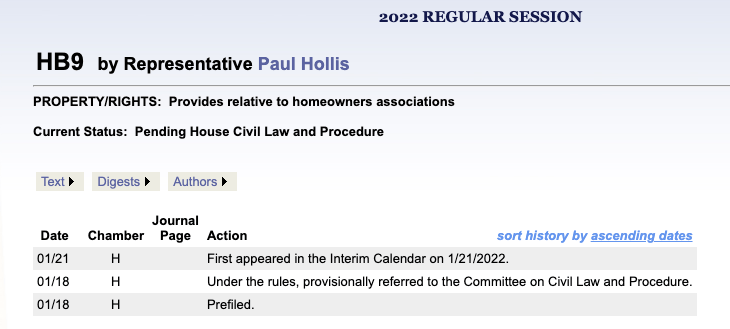
State Rep. Paul Hollis, R-Mandeville, has filed House Bill 9 for the upcoming legislative session to insert language in state law in reference to “community documents” between homeowners associations and lot owners.

“Any provision of a community document which restricts a constitutional right of a lot owner or a person residing in a residential planned community shall be null and void,” the addition reads.

Currently, community documents of residential planned communities have “the force of law,” though provisions exist that ensure the Louisiana Homeowners Association Act doesn’t violate state or federal constitutional rights.

Hollis said the legislation was inspired in part by a dispute with his neighbor, who installed a camera peering onto his property and taunted him about it on social media. Hollis put up an 8-foot fence to block the invasion, and his homeowners association is threatening him with fines if he doesn’t take it down.

“They didn’t do anything to help our family,” Hollis said.

Hollis pointed to another example of a family in northern Louisiana that was banned from posting a sign in support of their military son, despite others in the same neighborhood displaying flags the same size.

In conversations about the issue, “I’ve just continued to hear horror stories” about homeowners associations selectively enforcing rules and the families they apply to, he said.

“They pick and choose which ones they’ll enforce,” Hollis said.

“I think HOAs while they can do some good, there are a lot of bad actors out there that are unchallenged, inconsistent and need more oversight.”

Hollis said he expects the House Civil Law Committee to weigh in on the proposal, but he is encouraged “at least the conversation is going right now.”

Hollis estimated 90% on the feedback he has received about homeowners associations has been negative, and he is compiling the complaints to illustrate the need for HB 9.

“It’s just putting a spotlight on the antics that have occurred,” he said.

Hollis said that while state law does include protections for constitutional rights as they pertain to the Louisiana Homeowners Association Act, he felt compelled to spell out the protections explicitly to ensure courts properly interpret legislative intent.

“I want to bring clarity by being specific and citing that in statute,” he said. “The more clarity you bring the better off you are.”

Jeffrey Sadow, an associate professor of political science at Louisiana State University, wrote an op-ed for The Hayride on Thursday blasting Hollis’ bill, which he claims “misunderstands property rights.”

Sadow encouraged Hollis and others in his situation to either work to change the rules of homeowners associations or to sell and move.

Hollis said he also is considering companion legislation to create an opt-out provision for folks who would prefer to leave their homeowners association.

“Most HOA benefits disappear under HB 9, and Hollis’ promised companion bill makes the concept entirely moot,” Sadow wrote. “With people buying in and later deciding the rules don’t suit them or never agreeing to them at all, the dissidents become free riders on the backs of those who want to make the tradeoff, creating an environment where nobody has any incentive to pursue HOA intended benefits which then disappear.”

The 2022 general session for the Louisiana Legislature begins March 14.