CAMICB Announces Change In Leadership

John Ganoe To Retire As CAMICB Executive Director; Matthew Green Named Executive Director

Falls Church, Virginia – March 6, 2023 – The Community Association Managers International Certification Board (CAMICB) today announced its Executive Director, John Ganoe, CAE, will retire in April after 11 years in that role. Matthew Green, CAE was named Executive Director. 

“John has been a professional partner and personal friend for almost 30 years,” said Tom Skiba, CAE, CEO of the Community Associations Institute (CAI). “His decade leading CAMICB has seen not only dramatic growth in the number of professional community managers holding the CMCA, but the evolution of the program into THE global credential in the community association management profession. It’s the only credential recognized by ANSI/ISO, as well as industry professionals and governments around the world.”

Prior to joining CAMICB in 2012, John had an extensive career in professional credentialing, non-profit management, and consulting for non-profit organizations. 

“John has built, equipped and developed a talented staff,” added Greg Smith, CMCA, AMS, PCAM, Chair of the CAMICB Board of Commissioners. “He has created a legacy of care and consistency and is now ready to pass the reins onto Matthew and his capable staff.”

“The opportunity to lead CAMICB over the past 11 years as the organization worked to raise awareness of the value of the CMCA credential, expand delivery of the CMCA examination outside the United States, and earn international recognition of the credentialing program has been extraordinary,” said John Ganoe. “I have had the privilege of working with a corps of committed, intentional volunteer leaders and an enormously talented staff.  Matthew’s broad knowledge of the field of community association management and the processes needed to maintain the CMCA credentialing program at the highest level assure continued growth and success for CAMICB. I have the greatest confidence in the future of the organization.”

Prior to joining CAMICB in 2018, Matthew was the Director of State Affairs for CAI for eight years where he was the point person for legislation that addressed the regulation of community association managers. As CAMICB Associate Executive Director, Matthew has been instrumental in advancing the CMCA program in the NCCA reaccreditation process and he was the lead in the effort to secure accreditation for the credentialing program against ISO Standard 17024. 
 
“I knew the first day I worked with Matthew, nearly a decade ago, that he is a natural leader,” said Dawn Bauman, CAE, CAI’s Senior Vice President, Government and Public Affairs. “His operational and administrative skills are exactly what’s needed for an organization like CAMICB. Matthew is a wonderfully collaborative colleague who is decisive, self-aware and authentic. Matthew will take what he has learned under John’s leadership and shine brightly. I look forward to working with him in the years to come.”

“I’m fortunate to work with this incredible Board of Commissioners, many of whom I collaborated with in my previous role at CAI, prior to joining CAMICB,” said Matthew Green. “Working alongside – and learning from – John as he thoughtfully drove the organization forward while cultivating an extraordinary and dedicated staff was invaluable. Together with this remarkable team, I’m excited for the opportunity to keep up this momentum.”

“John’s tenure with CAMICB has been the primary reason for the growth and direction of this amazing program,” said Rob Felix, CMCA, PCAM, RS who serves as Secretary/Treasurer of the CAMICB Board of Commissioners. “His sincere and unwavering support of the CMCA program, the Board of Trustees, and his staff have catapulted the success of the program to international proportions and recognition. He will be missed.”

“With the help of his talented staff and the depth of their commitment to the program’s success, Matthew’s vision of this grand program will continue down the path set by his predecessor,” added Felix.

About CAMICB

Established in 1996, the Community Association Managers International Certification Board (CAMICB) is an independent board that sets the standards for community association managers worldwide. CAMICB (formerly NBC-CAM) administers the Certified Manager of Community Associations® (CMCA) examination, a rigorous  test that measures managers’ knowledge of community management best practices. Passing the CMCA examination and maintaining the standards of the CMCA certification is proof that a manager is knowledgeable, ethical and professional. CMCA-certified managers have the skills to safeguard the assets of homeowners’ associations, giving homeowners peace of mind and protecting home values.

The CMCA credential is the only international certification for managers that is accredited by the US-based National Commission for Certifying Agencies (NCCA) and the globally recognized ANSI National Accreditation Board (ANAB). This dual accreditation underscores the strength and integrity of the CMCA credential and is a mark of quality. For more information, go to www.camicb.org.


Keep Brainstorming—Your Best Ideas Are Still to Come

The common (and mistaken) belief that we generate our best ideas early can actually squash creativity.

Imagine a team brainstorming session. At what point in the meeting do you think you’ll come up with your best, most inventive idea?

Most people assume that lightbulb moment will arrive right away, when you’re feeling freshest. But according to new research, we’ve got it wrong.

Across several studies, Loran Nordgren, a professor of management and organizations at the Kellogg School, and Kellogg PhD alumnus Brian Lucas, now of Cornell University, discovered a widespread, persistent, and mistaken belief that creativity drops off with time. They dub this the “creative-cliff illusion.”

What’s more, they found, the illusion is self-defeating. The more people believe in it, the fewer creative ideas they generate. But with experience comes wisdom, Nordgren and Lucas learned: people who do lots of creative work do not fall victim as often to the myth of declining creativity.

“People think their best ideas are coming fast and early,” Nordgren says. In fact, “you’re either not seeing any drop-off in quality, or your ideas get better.” By giving up too soon, we risk leaving our best ideas on the table.

Nordgren believes bringing attention to the problem can help people unlock new ways of thinking. “People don’t maximize their creative potential, and part of that is because of these beliefs,” he says.

Creativity Increases as You Brainstorm

Nordgren and Lucas began by recruiting a group of 165 online participants, all of whom had previously worked at charitable organizations, to complete a five-minute brainstorming task. Before they got started, participants were asked to predict their creativity during each minute of the task.

Next, participants set to work generating ideas for how a charity could increase donations. As motivation to keep the juices flowing, the researchers told participants they would be entered in a lottery to win $50 for each idea they came up with.

Then, Nordgren and Lucas recruited a new group of online participants to rate the creativity of the ideas the first set of participants had generated.

Participants in the brainstorming task gave faulty predictions about their own creativity, the researchers’ analysis revealed. While people thought they would become less creative as the session went on, the opposite was true: their creativity—as rated by the second group of participants—actually increased.

Confusing Productivity with Creativity

Why do people so uniformly believe their creativity will decline the longer they tussle with a problem?

Nordgren and Lucas suspected people confuse creativity with the ease of generating ideas. For many of us, early ideas come quickly, while later ideas prove more elusive as the brainstorm slows to a brain drizzle. This experience of difficulty could easily be misinterpreted as a decrease in the quality of ideas.

To test the hypothesis, the researchers repeated the same study as before, recruiting 191 new participants. This time, however, participants predicted their creativity after they had already finished generating ideas.

It didn’t matter. Even after the brainstorming task was complete, participants incorrectly judged their later ideas as less creative—because, the researchers reasoned, those ideas were harder to access. Yet, as in the first study, the opposite was true: ideas that took longer to excavate were more likely to be truly innovative.

No Laughing Matter: False Beliefs about Creativity Make Us Less Creative

In another study, Nordgren and Lucas put the creative-cliff illusion to the test in a real-world setting. They recruited students and alumni of Second City’s training program to participate in a New Yorker–style cartoon-caption contest with the promise of a $150 first prize. The online competition was judged by three professional comedians, who rated the 91 submissions for novelty and funniness (a proxy for creativity).

Contest entrants were given 15 minutes to generate as many caption ideas as they could, but they weren’t required to use the full time. Participants also answered a series of questions about their beliefs about creativity, such as “People tend to generate their best ideas first.”

Those who believed good ideas come early submitted fewer jokes overall, the researchers found—and fewer of the jokes they submitted were rated as highly creative by the judges. In other words, the more people believed their funniness would fade over the 15-minute task, the less productive and funny they actually were.

Experience Can Counter the Creative-Cliff Illusion

Would experience cut through the creative-cliff illusion? The researchers suspected it might—perhaps people with many years of creative work under their belts might be less susceptible to the myth.

The researchers recruited a group of 163 online participants and asked them to rate how often they had to use creative skills in their work (not at all, occasionally, or frequently). The participants completed the same brainstorming task used in the first study—predicting their creativity during each minute of the five-minute task, then coming up with ideas to increase charitable donations.

Participants who never or only occasionally did creative work were much like the participants in the first study: they predicted their creativity would decline over the course of the brainstorming task, when in reality the opposite was true.

But participants with lots of creative experience didn’t make the same mistake. They predicted that creativity would remain relatively constant—a belief that is still overly pessimistic, but closer to correct than most other participants’ predictions. Experience helped them see the power of continuing to chip away at the problem.

“It’s really people who are in the trenches doing creative work that learn this lesson,” Nordgren says.

The Power of Persistence

What does this mean for your next brainstorming meeting? For Nordgren, there’s one very simple takeaway.

“If you’re struggling, keep going,” he says. This and his earlier research on creativity reveal that “our intuitions about how this process works are wrong, and that our best ideas are there. They just require more digging.”

This may mean resisting the temptation to select an idea just because a meeting is ending—a temptation rooted in the false belief that future ideas will be worse. Instead, “maybe you say, ‘I think there are still some better ideas we haven’t explored. Let’s all commit individually to putting another hour into this and come back next week.’”

It’s not easy to do—something Nordgren, who is currently at work on a book, knows firsthand. But he’s committed to taking his own advice. “These ideas are influential in those moments,” he says. “I’ll think, ‘this is a pretty good example, but is there a better one?’ It’s a nudge to keep going beyond what my intuition tells me to.”

Decoding the ABC’s of Credentials, Certificates & Designations

What do those letters behind your name mean?

By John Ganoe, CAE
Executive Director, CAMICB

Even for those deeply entrenched in the credentialing world, there’s a certain degree of confusion around some of the terminology used to describe specific paths professionals take to further their careers and skill sets. The field of community association management is no different so it’s important to educate managers, homeowners, and other community association professionals about the different options the profession has to offer and the value they hold.

According to the Institute for Credentialing Excellence (ICE), “credentialing” is an umbrella term used to refer to concepts such as professional certification, certificate programs, accreditation, licensure, and regulation.

ICE defines certification, licensure, assessment-based certificate, and accreditation in the following ways:

  • A certification program is designed to test the knowledge, skills, and abilities required to perform a particular job, and, upon successfully passing a certification exam, to represent a declaration of a particular individual’s professional competence, such as a community manager who has achieved the Certified Manager of Community Associations (CMCA®).  In some professions, certification is a requirement for employment or practice.
  • Similarly, licensure tests an individual’s competence but is a mandatory process by which the government grants time-limited permission for that licensed individual to practice his or her profession, such as a real estate salesperson or real estate broker.
  • In contrast to certification and licensure, an assessment-based certificate program is an educational or training program that is used to teach learning objectives and assess whether those objectives were achieved by the student.
  • Accreditation is the process by which a credentialing or educational program is evaluated against defined standards and is awarded recognition if it is in compliance with those standards. The Certified Manager of Community Associations (CMCA®) is such a program. ICE currently offers accreditation to professional certification programs through the National Commission for Certifying Agencies (NCCA).

The CMCA credential is accredited by the National Commission for Certifying Agencies (NCCA) confirming it complies with NCCA’s stringent standards for a professional certification program. Accreditation validates the integrity of the CMCA program and is a mark of quality.

Specialty Designations

Community association professionals may also choose to bolster their careers and expand their level of expertise in certain areas. This is where specialty designations come into play. A “designation” is recognition of professional knowledge and expertise in a given subject matter or job skill.  To earn designations, work experience is generally required.  Certain specialty designations are offered through the Community Associations Institute (CAI) including, the Association Management Specialist (AMS), Large Scale Manager (LSM), Professional Community Association Manager (PCAM), Community Insurance and Risk Management Specialist (CIRMS) and Reserve Specialist (RS). This allows a community association professional to drill down into a specialized aspect of the business.  In some cases, for example the PCAM and AMS designations, passing the CMCA examination is a prerequisite to applying for these designations.

I’ve experienced a wide disparity in the background and quality of the managers with whom I’ve worked,” said Ron Perl, Esq., a Partner at Hill Wallack LLP, who leads the firm’s community association practice group.  “A manager who holds the CMCA assures me they have an important foundation in place – the ongoing education and knowledge necessary to successfully manage millions of dollars worth of other people’s property and a serious commitment to high ethical standards.”

Stephen Castle, CMCA, AMS, PCAM agrees all committed community association managers should hold the CMCA certification. “The CMCA certification demonstrates to employees and new managers a commitment to professionalism,” said Castle. “Further, CMCAs show their support for established national and international standards of knowledge and professional conduct for community association managers.”

The Certified Manager of Community Associations – The only accredited certification program in the world for managers of homeowner and condominium associations and cooperatives.

The CMCA Goes Global

As CAMICB grew to be the premiere certification body in the United States for community association managers, it also gained international recognition for its established body of knowledge and strict ethical standards. Over the past two decades, the CMCA certification program crossed borders and oceans in Australia, Bermuda, Canada, Mexico South Africa, and the United Arab Emirates. This global expansion secured a high level of professionalism for association management and common interest communities worldwide. In 2017, CAMICB launched the international CMCA examination.

About ICE

The Institute for Credentialing Excellence, or ICE, is a professional membership association that provides education, networking, and other resources for organizations and individuals who work in and serve the credentialing industry.  ICE is a leading developer of standards for both certification and certificate programs and it is both a provider of and a clearing house for information on trends in certification, test development and delivery, assessment-based certificate programs, and other information relevant to the credentialing community.

The field of community association management is growing. Here’s what you should know about why and how to earn the Certified Manager of Community Associations (CMCA) credential!

By Matthew Green, CAMICB Associate Executive Director

If you love the idea of a job that offers opportunity, stability, and growth, community association management provides an excellent career path. Community association managers work with homeowners and service providers to take care of the many aspects and operations of condominiums, HOAs, and cooperatives. It’s a great job choice for people who previously worked in the leisure and hospitality industries. Those sectors continue to lead U.S. job losses amid COVID-19, with experts predicting slow growth until at least 2023. The good news is that though the coronavirus has dashed a lot of hopes for hospitality grads and veterans, the world of community association management is a bright spot. The field continues to grow and offers excellent opportunities for anyone who wants to continue in a people-oriented career. 

Community Association Management Stats

The Foundation for Community Association Research reports that as of 2020, there were approximately 355,000 community associations in the United States. They house over 74 million residents, over 12 million more than just a decade ago. Twenty-six percent of people in the U.S. live in a community association. More than 60 percent of new housing completed and over 75 percent of new housing sold is in a community association. 

There are over 8,000 community association management companies in the U.S. and up to 60,000 community association managers. Further, there is an additional 100,000 individuals employed by management companies and onsite for associations with staff. As the number of people living in community associations continues to rise, so does the number of jobs for community association managers. If you’re a people person who’s skilled in handling multiple tasks, a career in community management can be an incredibly rewarding career choice.

Community Association Management Career Outlook

Job prospects in the community association management sector are excellent and growth is stable. Though a college degree and professional designation are not necessary to land a position in the field, those who do command a higher salary when starting out. As of May 2020, the median wage for community association managers was $59,660 per year. In 2019, there were 367,900 jobs in the field. Job prospects and projected wages vary from state to state and community to community, so it’s a good idea to check out your area’s particulars.

CMCA – The Essential Credential 

The key to building a successful community association management career is the Certified Manager of Community Associations (CMCA) credential. Holding the certification lets employers know you’re educated and competent in certain management practices. It also indicates your dedication to professional excellence, ethical business standards, and continuing education. Community management employers are continually looking for committed professionals. The CMCA certification can often make the difference between whether or not you land a first interview.

The CMCA credential is relatively easy to obtain and:

  • Requires limited time and money investments.
  • Demands just a few days of prerequisite course work, some time to study, and one day for the exam. 
  • Is relatively low-cost for such a valuable investment in your career and future.

Earning the CMCA credential opens the door to earning additional credentials and up to 20% higher earnings than community association managers who are non-credentialed.

Studying for the Exam and Earning the Credential

Several resources are available on the Exam Preparation Resources page of the CAMICB website. You’ll find these items and more:

  • CMCA Handbook
  • CMCA Study Guide
  • CMCA Exam Preparation E-Learning Course
  • Community Association Management Best Practices Reports?
  • Community Association Institute’s M-100: Essentials of Community Association Management Course Material Information
  • Community Association Institute’s Guides for Association Practitioners (GAPs)
  • CMCA Practice Exam
  • CMCA Examination Quizlet 

Becoming a Certified Manager of Community Associations is not merely a designation; it can lead to the career journey of a lifetime. It elevates your credibility as a community association manager and makes employers more confident in hiring you. Finally, it offers you a wealth of opportunity, stability, and growth potential in an exciting career that currently shows no sign of slowing down.

For further information, please visit camicb.org or email us with any questions at info@camicb.org. 

Privacy Policy: https://www.camicb.org/privacy-policy

A Podcast Elevates the Image — and Expertise — of Resident Managers

Bill Morris in Building Operations for Habitat Magazine

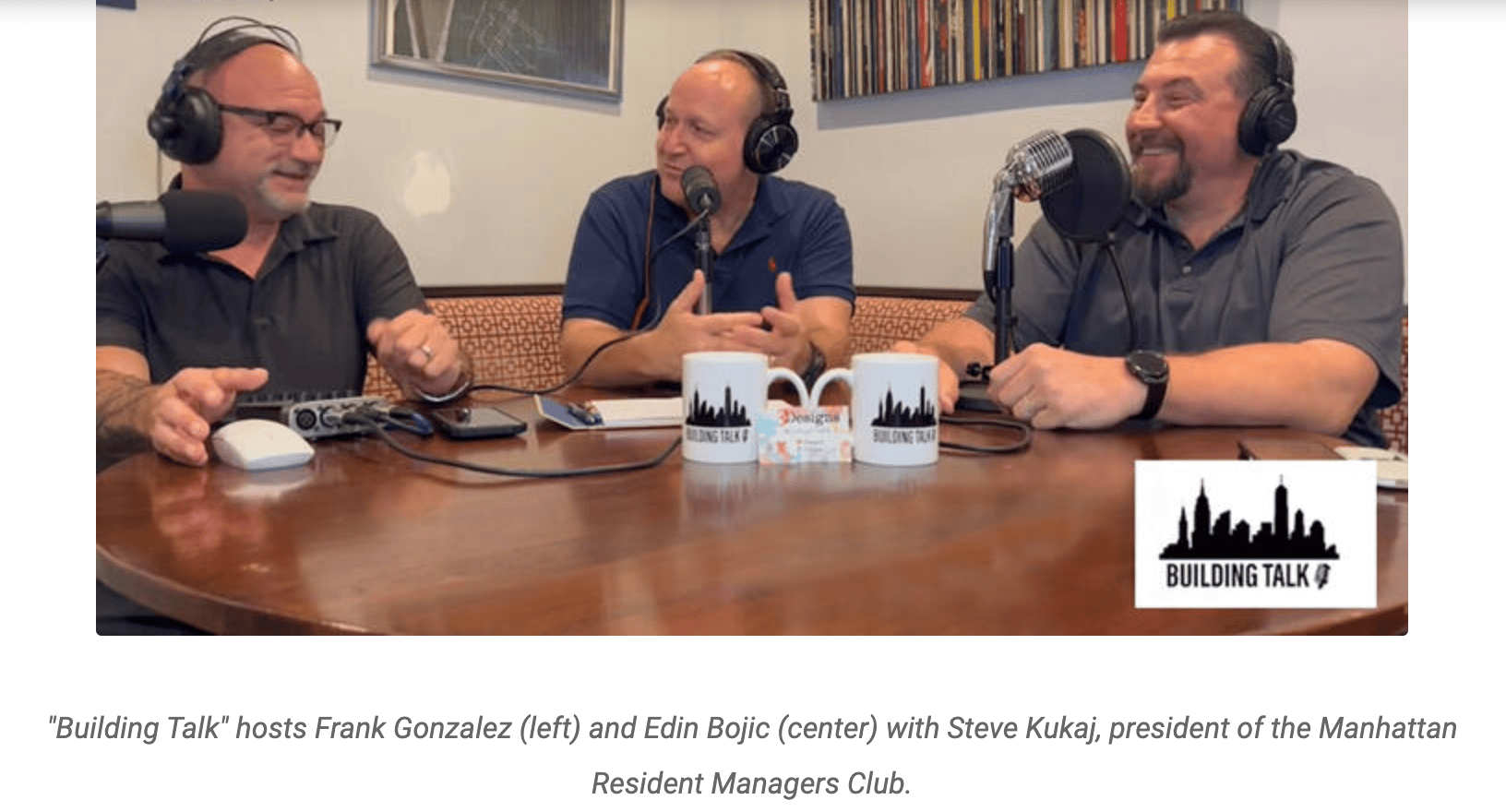
Frank Gonzalez and Edin Bojic first met at Aviation High School in Queens, and they’ve been resident managers in big New York City buildings for well over half a century combined. For the past year, they’ve been making their wealth of knowledge available to everyone — fellow resident managers, co-op and condo boards, property managers and other real estate professionals — through a popular weekly podcast called “Building Talk.” It’s posted on YouTube at 7 p.m. on Tuesdays and on Spotify at 5:30 a.m. on Wednesdays. Back episodes are available here.

“We’re trying to raise the image of the resident manager,” says Bojic, 58, a native of Montenegro (part of the former Yugoslavia) who goes by Bo. “We want to get rid of the old image of the super as a guy with a ring of 100 keys who lives in the basement.”

“Keeping up with the changes in the technology that come out every year requires that we’re always learning,” Gonzalez adds by way of explaining the podcast’s educational slant.

Gonzalez is now resident manager at a 625-unit condo and rental building in Greenpoint, Brooklyn, while Bojic runs a 600-unit Mitchell-Lama co-op on the Upper East Side of Manhattan. On the podcast they’ve offered advice to colleagues on everything from interviewing job candidates to resolving conflicts with residents and board members ; they’ve interviewed fellow resident managers and numerous vendors; and their conversations have ranged over landscaping, fire prevention, pest extermination, security systems, leak detection and improving a building’s energy efficiency.

Frank and Bo are an echo of Click and Clack from the popular NPR radio show, “Car Talk.” Like their predecessors, Frank and Bo mix avuncular banter with their hard-won insights, an appealing mix that caught the eye of Bobby Hodge, the resident manager at the Bay Club Condominium in Bayside, Queens. He tuned in to “Building Talk” one day when the guest was Jerry Kestenbaum, founder of BuildingLink. Kestenbaum was touting his spinoff company, Aware Buildings, which produces sensors that can detect leaks and alert staff before major damage occurs. Hodge was intrigued because Bay Club, with its large indoor swimming pool, 44 laundry rooms, water storage tanks and domestic hot water tank, has abundant potential for leaks. Hodge got in touch with Aware Buildings, which helped him install some test sensors. The very next day, one of them alerted him to a leak in an overhead pipe that ran to the domestic hot water tank. After the faulty pipe was quickly repaired, the condo board ordered 84 sensors, which Hodge has installed in potential trouble spots.

Much as co-op and condo board members bemoan their mushrooming work loads, Frank and Bo say resident managers are besieged by the city’s endless onslaught of new laws and regulations. “New York City is reactive, not proactive,” Bo says. “If there’s an accident where someone gets hurt, I know there’s going to be a new local law. There are new laws every year, and the resident manager has to interpret what’s going to work best for his building.”

The biggest change in the profession in recent years? “You have to be a psychotherapist, a psychologist and the customer service department,” Frank says with a laugh. “But mainly it’s the changing technology. Now everyone’s more energy conscious and they want to be more energy efficient. Technology changes every single day.”

Bo agrees: “Technology, definitely. There’s so much information that you’re constantly asking, is everything sealed properly? Is everything working properly?”

Is “Building Talk” working properly?

“This is the first podcast of its kind in New York City,” Bo says. “And yes, we’re getting a lot of positive feedback.”

Problem Solved: Turning Aging Infrastructure Into Cost-Efficient Systems

Upper East Side, Manhattan

(Clockwise from left): 333 E. 69th St., the new cooling tower, the new modular boilers (pictures courtesy of En-Power Group).

As part of our ongoing Problem Solved series, Habitat spoke with Michael Scorrano, managing director and founder of En-Power Group.

The problem of aging infrastructure. Like a lot of buildings that were built in the sixties, the one at 333 E. 69th St. was reaching the end of its infrastructure life. The building also had issues with its distribution system. They were experiencing leaks in the summertime when the air conditioning sent condensate through the old drains, and the leaks were ruining shareholders’ apartment floors. They were on Con Edison steam, which is the most expensive form of heating and cooling. This building was spending around $450,000 on utility costs, of which around almost $300,000 was just for heating and cooling and making domestic hot water. So they were looking to see how they could reduce costs and set the building up for the next 50 years.

We took a look at their Energy Star score, and their resulting letter grade for energy efficiency was a big fat D. So they were below current New York City energy standards. We did a feasibility analysis, and what we finally came up with was getting rid of Con Edison steam for heating, and instead connecting to the natural gas system and putting in very high efficiency, small, modular, hot water boilers to provide heating and domestic hot water. On the cooling side, we looked at upgrading the steam chiller or using gas for cooling. We also looked at putting in smaller modular equipment that eliminated a lot of the costs of hoisting a large piece of equipment up on the roof. So we’re really trying to maximize the infrastructure that was there and make it easy and cost effective when we went forward with construction.

One challenge after another. When they built the building, they installed a steam line from the basement all the way up to the roof. But fast forward 50 years, and we’re trying to find a way to bring a new electric line and a new gas line up to the roof in order to power the boiler and the electric chillers. Fortunately, this building had a open-well staircase in the middle, and we were able to design a fireproof chase and put the utilities in that — gas, electric and control wiring that sends signals to the equipment in the basement. It wasn’t easy to design, but it was the right way to go.

While we were doing the work on the distribution part, the pandemic hit and we had to shut the job down, which created a lot of turmoil. Then we had to restart it a year and a half later. So that was an added challenge.

Mission accomplished. In the end, they were able to reduce their heating and cooling costs by more than half. Their energy-efficiency letter grade went from a D to a nice solid B. They would’ve been facing a $66,000 a year penalty starting in cycle 2030 of the Climate Mobilization Act. By doing this project, they’re not going to have any penalties through the 2034 period.

Every building is unique. I think the first thing to do is to have somebody who’s familiar with New York City infrastructure and buildings come in and properly evaluate how your building is operating. It’s not one size fits all. After we do our analysis, we crunch all the numbers and look at various options and try to put together a nice, simple roadmap for the board to follow. Then the board can focus on what’s most cost effective for that particular building.


Why CEOs should lead with optimism—even in uncertain times

Optimism is easy in a bull market, but it is an even more important and impactful choice for leaders when it’s fashionable to be fearful and the path feels less certain.

By Sebastian Buck for Fast Company

In this year’s version of its annual CEO Survey, PwC showed the 4,400 CEOs interviewed to be a pessimistic bunch: 73% believe global economic growth will decline, only 42% are confident in their own company’s prospects for the next year, and 40% don’t think their companies will be economically viable in a decade, if they continue on their current path.

One way of reading these results is to marvel at the CEO herd mentality as last year, the results were completely different, with 77% believing in global growth. Perhaps the CEOs were overly optimistic last year, and overly pessimistic this year. Another way of reading the pessimism is as a self-fulfilling prophecy: Leaders’ attention turns to reducing operating costs, raising prices, reducing staff, and implementing hiring freezes—all of which reduces team morale and economic activity, and so realizes the pessimistic fears.

Is pessimism productive, and if not, how can we transcend it? At Enso, the future design company I help lead, we often see leaders wrestling between “pragmatic pessimism” and a desire to move—or leap—forward. So how should we think about navigating that tension? 

Does all this pessimism serve those CEOs, their companies, and us as a society? And if not, what might make them more optimistic?

WHY CHOOSE OPTIMISM?

Clearly, we are living through challenging times, and many people struggle for the basic life stability that is conducive to an optimistic outlook. After years of pandemic, inequality, war, inflation, stress, and division, perhaps it’s only fair to be a pessimist? And given the widespread hubris of Silicon Valley’s “change the world” mantra, has optimism been fundamentally discredited? Adopting a pessimistic mindset, especially today, might feel like “good stewardship,” “a pragmatic approach,” and “addressing issues rather than ignoring them.”

But while learning about what’s broken is important, we risk taking pessimism too far. As news producers and social media algorithms know, we are wired to pay attention to negative stories more than positive, so the average sentiment of popular news articles has become significantly more negative. We are susceptible to an availability heuristic, where we estimate the probability of an event based on the ease with which examples come to mind?—?for instance, the news of layoffs at a prominent company (say, 10,000 at Microsoft) may stick in CEOs’ minds and affect their decision-making more than the underlying data of historically strong job creation (over 10 million American jobs added in the past couple of years). As the Nobel-winning psychologist Daniel Kahneman says, “People tend to assess the relative importance of issues by the ease with which they are retrieved from memory?—?and this is largely determined by the extent of coverage in the media.”

As a result, humans are significantly more pessimistic when assessing the state of the world than when assessing their own experience: 85% of Americans are satisfied with their own lives, but only 17% are satisfied with how things are going in America. CEOs are surely prone to this same perception gap; but given the consequences of their decisions, it’s important they transcend the availability heuristic and make more objective decisions when determining the future of their companies and their employees. The livelihoods of millions of people depend upon it.

Optimism, or a hopefulness and confidence about the future, or specific future outcomes, is a powerful thing. Optimists typically experience better well-being, are more proactive with their health, have stronger immune systems, and live longer; they are more resilient and persistent in education. They have higher job performance and satisfaction, achieve higher incomes, are more likely to get promotions, and have been shown to sell 57% more than pessimists—optimism is a lucrative investment. Optimists seek challenges and take risks; it’s a core trait of entrepreneurs. Daniel Kahneman describes optimism as “the engine of capitalism” because it’s required to attempt success when faced with long odds.

While optimism doesn’t guarantee success, it at least creates space for magic. Rather than focusing on surviving or managing around the challenges, we can focus on moving forward. The legendary designer Bruce Mau sees optimism as fundamental to the design process: “Pessimism engenders a cynicism that closes the mind; only through optimism does opportunity become visible.”

Optimism is easy in a bull market, but it is an even more important and impactful choice for leaders when it’s fashionable to be fearful and the path feels less certain. When President Kennedy set America on course for the Moon, imploring the nation to “set sail on this new sea . . . for the progress of all people,” the path was not clear, easy, or obvious; the Soviet Union had already achieved a significant lead with Sputnik and Yuri Gagarin reaching space.

But Kennedy recognized that pessimism in that instance was to concede the future. We know that emotions are contagious; as a leader in precarious times, Kennedy could have sparked a contagion of fear, or of optimism. Choosing optimism led to one of America’s finest moments, including an enormous scientific and economic dividend, and the ripple effect of confidence in new possibilities.

Today, many think we are once again at the dawn of an age of technological optimism, with technologies like mRNA, generative artificial intelligence, and zero-carbon nuclear fusion just on the horizon. Leaders must not concede the future. But how?

HOW TO CREATE FROM OPTIMISM

Becoming aware of the heuristics that lead us to negativity can be a powerful shift: Once we observe them at work, we are then more free to choose whether our negative emotional reaction is valid, or not. For those CEOs who felt optimistic last year, but pessimistic this year, it’s possible that conditions around their businesses dramatically changed, or they may have been susceptible to the availability heuristic that clouded a more objective view. It’s curious that Meta, Amazon, Microsoft, and Google all chose to lay off 10,000 to 12,000 workers; maybe an objective analysis for these complex companies operating in different markets led to the exact same prescription for each business, or perhaps we can see the power of suggestion and a pessimistic herd mentality at play.

A core theme in Kahneman and other leadership professors’ advice to overcoming systemic bias (whether optimism or pessimism) could be distilled as: “Look more broadly, more critically.” They encourage leaders to have an expansive mindset about objectives (rather than settling for a few specific default goals); explore multiple potential futures rather than one; seek broader, long-run data to overcome the availability heuristic; and seek advice and external perspectives. “As a rule of thumb, it’s good to anticipate three possible futures, establish three key objectives, and generate three viable options for each decision scenario.”

As individuals, the most important optimism shift available is the power of cultivating our own mindset. We can choose to view current market and societal conditions as opportunities for progress, and we can look for what is working rather than focusing only on what is not. We can avoid asking “why is this happening to me?” (adopting a mentality of suffering), but rather ask, “why is this happening for me, and how can I learn and grow from it?” Choosing optimism can be difficult. In my own recent experience of navigating cancer treatment, the choice became vividly apparent: Dwell on all the negative outcomes possible, or focus on the learning opportunities available and the range of available positive outcomes.

Leaders facing challenging circumstances today can dwell on negative projections, likely depleting energy from their organizations, or they can choose to allocate their energy to, and inspire their organizations around, the possibilities ahead. Doing this requires letting go of the preconception that pessimism is “responsible stewardship”: The likelihood is that whatever innovation and success a company has had thus far was fueled by optimism, and effective stewardship may be to continue optimistically.

Of course, this may still involve making tough decisions, but those choices are made with a more constructive filter and plan in mind than just contracting for fear of a downturn. The future design process we use to move beyond the default future is to design multiple scenarios for the future of the company, ranging from more attainable to more ambitious, and use the freedom of that exploration to seek new ways of looking at the business.

One way forward is not to accept the apparently default future. It starts with asking the right questions, exploring what’s possible, and then developing a blueprint for the path ahead. Unlike spreadsheet-based, analytical forecasting, this process is not about extrapolating current trends, but discovering and designing leaps driven by optimism.

If CEOs’ mindsets become self-fulfilling prophecies, and if their emotions are contagious, maybe they owe it to their companies, and to society, to do all they can to move beyond the allure of pessimism, and to define a positive path forward. We can default into a future determined by fear, or we can design our way to a brighter future.

The Words That Successful Leaders Use

How you craft a message, and the power of certain words, make all the difference.

By Bobby Hoffman, Ph.D. for Psychology Today

Maybe you are writing a memo or planning a Zoom meeting. Perhaps even more intriguing and potentially stressful, you are charged with communicating unwanted news to your staff or need to address a lingering performance issue with a team member.

Regardless of the circumstances or your communication medium, your message should be understood, relevant, persuasive, and include a call to action if you hope to achieve desired results. However, leaders are often faced with a dilemma: They don’t know how to inspire motivated performance in others without instilling resentment or being perceived as inflexible and insensitive.

Ultimately, the goal of effective leadership is to promote organizational prosperity by coaching, influencing, and recognizing individual performance and giving people the tools to optimize growth while meeting strategic organizational goals. While most articles on leadership espouse what leaders should do to inspire an effective team, minimal research exists on how leadership goals can be accomplished from a behavioral perspective (Goleman, 2017; Newstead et al., 2021). Especially lacking is information on what leaders should verbalize to achieve results.

Optimal persuasion starts with consciously determining how to match your message with the intended audience. Motivational messaging (Joyal-Desmarais et al., 2022) means that your message is customized based on the situation and context and includes an appraisal of the values, beliefs, and dispositions of your audience–in other words, for the message to reach maximal effectiveness, it must resonate with the individual.

The messaging evaluation should include cultural considerations such as a group-focused appeal vs. a personally targeted message. The message purpose should distinguish between efforts directed toward compliance or increases or decreases of certain behaviors. Benefits or liabilities to individuals should be clearly outlined. Optimally, the most powerful messages indicate either advantages to the person for supporting the leader’s suggestions or consequences for lack of support, but not both.

However, research from psychology and education reveals that messages of all kinds must also help individuals satisfy some basic needs. I previously posted about how to empower individuals to enhance leadership effectiveness. Now it’s time to discuss how to actually get the job done.

What should you say?

Across cultures and contexts, communication should satisfy the basic human needs of autonomy and competence. Autonomy means the message recipient does not feel coerced or controlled by the request and believes they have some choices when implementing a message. Competence suggests that the person will feel a sense of personal accomplishment and satisfaction when executing a persuasion effort. The probability of successful persuasion is enhanced by using “invitational language” (Reeve & Cheon, 2021), a label used to describe directives that consider the perspectives, desires, and emotions of others.

Communicating Unwelcome News

This situation is the perfect time to stress transparency and provide explanatory rationales. Instead of sidestepping the reality of undesirable communication with buzzwords and indirect language, tell exactly what is happening, but do so by explaining the decision-making process and what alternative outcomes were considered.

Don’t defend the choice or action but explain why the decision was made and who was ultimately responsible for it. Don’t forget to express your willingness to support the decision, even if it may not be your first choice. Say things such as “you can use this experience to…” and “this is the first step toward…” so others can see you have considered their perspective when describing the next steps.

Acknowledging Leadership Errors

The guideline here is complete accountability. Troublesome situations like unethical behavior, corporate irresponsibility, or just plain bad decisions happen to most organizations at one time or another. Error resolution can be made in need-satisfying ways by using the situation to do better next time. Express that these kinds of events are part of the learning process and do not focus on punitive aspects but instead emphasize how the person making the error might feel.

Acknowledge the severity of the situation and don’t minimize the consequences of the mistake. Say things such as “sometimes work is frustrating” or “feeling this way is expected” to show empathy and understanding that reflect the emotions of embarrassment or shame.

Confronting Performance Issues

Addressing potential conflict is one of the toughest jobs for any leader. Do not approach the situation as a confrontation, but instead focus on the issue as a team by outlining individual actions that can be assumed to correct any deficiencies. Avoid any “you” vs. “me” perceptions. Emphasize autonomy by asking, “In what ways do you think we can change the situation,” or “if you had a choice, what would you do?” Once the individual responds, first say, “if I understand you correctly, then…” followed by asking, “how can we make this work?” before giving your opinion or decision.

Implementing Leadership Decisions

One hallmark of the best leaders is making correct decisions based on limited evidence, which often means asking people to do what they might not want to do. First, acknowledge any resistance by saying, “I understand this may not be your first choice,” then carefully reflect on how you will communicate expectations. Avoid mandates and do not use the words “must” or “have to,” as these phrases cultivate controlling feelings, which thwart the basic need for autonomy. Instead, encourage initiative by saying, “you may want to consider,” or “what do you think about…” followed by describing the desired outcome without overemphasizing precise methods to achieve the outcome. Whenever possible, let the person exercise choice as to how the outcome is achieved.

Overall, being a persuasive communicator means avoiding the tendency to exercise power as the means to foster compliance. The most successful leaders realize that cultivating autonomy and competence in others is the key to mutual success, and the entire process starts and ends with the words you use when you open your mouth.

Maintaining High Ethical Standards

CMCAs’ Commitment to Following Strict Standards of Professional Conduct

An important – yet often overlooked – component of CAMICB’s Credentialing Program requires a Certified Manager of Community Associations (CMCA) to adhere to a high standard of ethical conduct. This means Certificants must comply with the 10 CMCA Standards of Professional Conduct, which govern their professional activities.  

These Standards of Professional Conduct, detailed at www.camicb.org/standards, range from understanding laws applicable to community association management, to being knowledgeable on association policies and procedures, to carrying out fiduciary responsibilities, and participating in continuing education coursework. A violation of any of these Standards of Professional Conduct may be grounds for administrative action and possible revocation of the CMCA certification by CAMICB.  Abiding by these Standards of Professional Conduct help protect consumers and associations that hire or contract with community association managers. 

“When a community association manager earns the CMCA, they’re pledging to uphold a strict code of professional conduct which is critical to the profession,” said Ron Perl, Esq., a Partner at Hill Wallack LLP, who leads the firm’s community association practice group. “This is more than understanding the many facets of community association management and troubleshooting challenging situations, it brings about accountability, responsibility and trust to the individuals the profession serves.”

Enforcing the Standards of Professional Conduct

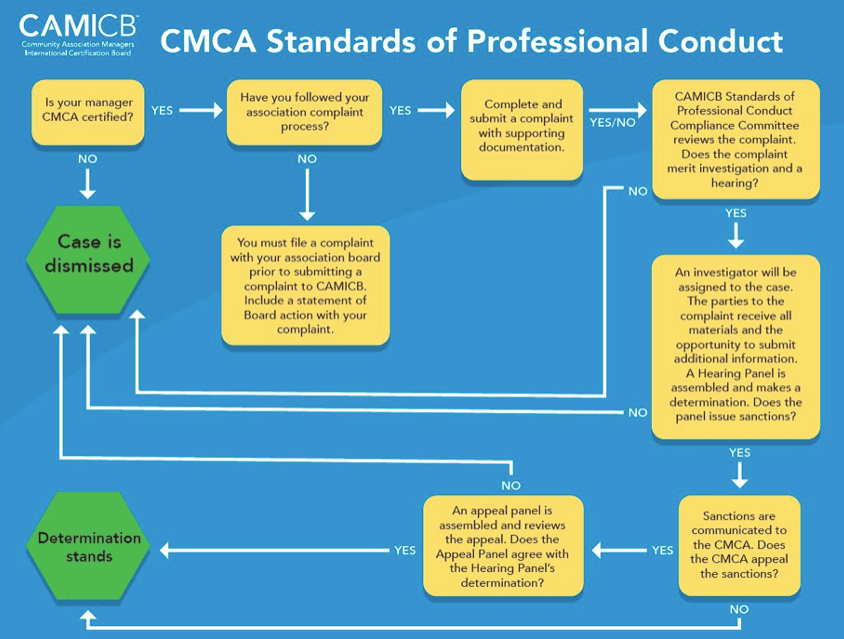
In order to maintain and enhance the credibility of the CMCA Certification Program, the CAMICB Board of Commissioners adopted strict procedures that allow consumers and others to bring complaints concerning CMCAs to the Board. 

The CAMICB Chair of the Board appoints members of the Standards of Professional Conduct Compliance Committee which oversees the process and procedures for enforcing the Standards of Professional Conduct. Once a complaint – received in writing – is deemed valid and actionable by the Committee, it will be brought before a Review Panel for investigation and a determination of whether there has been a violation of the Standards. If the Review Panel determines a violation has occurred, an appropriate sanction will be imposed. This process, including the internal investigation, hearing, and timeline of activities, is clearly detailed in the Procedures for Enforcement of the Standards of Professional Conduct document available on the CAMICB website. 

The grounds for sanctions under these Procedures range from conviction of a felony, to gross negligence or willful misconduct in the performance of professional services, to fraud or misrepresentation and, where applicable, loss of state license required to practice community association management.

“These Standards of Professional Conduct are the foundation of the CMCA credentialing program,” added Marilyn Brainard, a public interest member of the CAMICB Board of Commissioners.  “We take them very seriously and are proud of the work our colleagues and managers do to uphold them.”

More information, including a set of Frequently Asked Questions, a list of the 10 clearly outlined Standards of Professional Conduct, complaint form and other pertinent documents can be found at https://www.camicb.org/for-cmcas/standards-of-professional-conduct.

These 4 Mindsets Will Help You Rise to Leadership Working with a Disability

Bring your overcomer’s attitude to the table and boost your career.

By Nancy Solari for Entrepreneur Magazine

here’s no question: More of us are working with a disability or a limiting condition for a longer period than ever before. This means we must change our perspective on our own productivity and be willing to see ourselves leading with a limitation. Disabled people must be ready to reach for the brass ring as they make up more of the executive team.

In the era of the “big quit,” employers are more willing than ever to hire diverse candidates with exceptional needs and limitations. The reason? Many people with disabilities have already proven they can go above and beyond expectations in their personal lives — and on the job.

But are you ready to take the next big step and leverage your strengths gained through adversity to aim for a leadership role? Here are four mindsets you need to take the leap of faith and expand your vision beyond the invisible barriers holding you back.

1. Get creative

There’s no greater opportunity to demonstrate your creativity than the journey through progressive visual impairment, multiple sclerosis or autism spectrum disorder. Whatever your limitation, finding creative solutions is the key to every closed door, every blocked opportunity and every unaccommodating venue.

Many disabled people get up much earlier than workers without limitations; for a person with multiple sclerosis, getting dressed can take more than twice the time most people would need. A legally blind manager must listen to emails read through speech recognition technology, whereas most people would visually scan the most important messages and easily toss out the rest.

Since you’ve found creative solutions to navigate obstacles in your personal journey, you can take this creativity to the next level. If you’ve been considering competing for a leadership role, use your creative side to uncover new methods and embrace innovation. Your adaptability and willingness to explore new technology will propel you to a new level of efficiency. You can be a beacon for others who want more from their careers. You’re a hurricane of inspiration; you’ve learned to meet change with confidence rather than fear.

2. Bring your perspective

Now that you’ve proven that your limitation doesn’t define you, it’s time to capitalize on the level of mindfulness you have gained through your journey. Your natural mindset is an awareness of staff members’ stress as they go about their day. There will be decisions as to how work will be done. Accessibility and accommodation are already part of your wheelhouse. You will come into a leadership position with an edge. Look around your workplace and see what needs redefining. Can small changes make a big difference in how team members work together?

Perhaps living with a disability has taught you how to leverage strengths and weaknesses for maximum output. You can spot hidden potential and get the most productivity out of others because you have overcome the obstacles in your own life. You have learned to complement your team members’ traits, learning to demand more of yourself while stepping back to let others shine when the time is right. This is the essence of leading with empathy, guiding people toward accepting one another’s gifts and working with each other’s shortcomings. You will be the first to admit that we are all a blend of both. Other executives will want to study your leadership style when you take the next step.

3. Speak for yourself

Part of living with a limiting condition is learning to advocate for yourself and discovering strength in your vulnerability. You will excel in negotiations and motivating people because you can relate and empathize with those struggling and celebrating their victories.

You may think sharing your journey through disability or chronic illness might bring unwanted attention or put you in a weakened position in the eyes of others. If you’re aiming for a leadership role, you may fear that telling your story could risk everything you’re working for. What is intriguing is how often a person’s journey weighs heavily in hiring decisions. The ability to move people with your struggle and connect authentically with others who have walked through adverse circumstances is often the deciding factor when company executives are looking to fill leadership roles. Most important, you will be a source of inspiration for people of all levels in the company. Finding your voice is vital to relate to employees and help them feel a part of the corporate community.

For you, “speaking up” could be asking for the role you want or advocating for your ideas. Learn to talk your worth and make your mark on the team. Finding your voice is the best way to position yourself for opportunity. You should be able to explain why you should get the job, why your idea will succeed, and why your story is important.

4. Measure your impact


What is your legacy in your workplace? Are you known as an overcomer, an advocate, or a leader with a fresh perspective? You can gauge your worth to your workplace by taking stock of the impact, the “footprint” you have made in your company, no matter how large or small the business may be. It’s never too late to change your legacy. Perhaps, in the beginning, you were getting your feet under you, discovering your resourcefulness. Now, it’s time to expand your vision and think about how you can leave your mark in business and life. This is a chance to live what you have learned and be mindful of the legacy you leave for the future.

Think about how you can make a difference and become a force for good when you finally land in an expanded role. It’s good practice to mentally prepare to step into leadership. You’ve served and observed, taking notes and promising yourself that if you ever rose to a powerful position, you would advocate for those who needed it. Your tendency to recognize others’ strengths despite their vulnerabilities will allow you to comfortably take charge with a heart of compassion toward those who may also wish to rise above their circumstances and see their dreams come true.

Finally, go with confidence

If you’re aiming for a position in leadership, let your confidence shine. After all, you’ve gone up against greater foes than unmotivated employees or a sluggish sales report. You’ve battled for your life and come out on the winning side. Go into your new role with the same strength and bold attitude you showed everyone, the positive outlook that helped you stay in the ring, refusing to let pain, anxiety, or frustration take you out. The culture is shifting as businesses learn to celebrate exceptional people while they honor diversity in the workplace. As a disabled worker, you can lead confidently, charting a new course and breaking new ground for all those who dream of overcoming adversity and rising to new horizons in leadership.