This is how companies should be rethinking the employee burnout crisis

There are many causes of burnout, so it’s imperative that companies consider solutions that tackle different angles.

BY SCOTT NEWMAN FastCompany

In today’s fast-paced work environment, burnout has become an alarming epidemic. Characterized by chronic stress, emotional exhaustion, and decreased productivity, burnout is a silent destroyer of both employee wellbeing and organizational success.

To be clear, there are many causes of burnout—from excessive workload to lack of autonomy to poor communication. However, there are also proven organizational strategies for mitigating burnout and creating a sustainable culture of productivity and retention. For starters, employee incentives and performance milestone rewards are great strategic tools to keep employees motivated and engaged, which ultimately reduces the risk of burnout.

UNDERSTANDING THE BURNOUT CRISIS

Employee burnout is not merely about working long hours; it’s about the sustained stress that employees experience from feeling undervalued, overburdened, and disconnected from the workplace. According to a 2020 Gallup survey, nearly 76% of employees experience burnout at least sometimes, with 28% reporting that they feel burned out “very often” or “always” at work. This should be an urgent wake-up call for businesses to rethink the way that they approach workforce management and motivate their employees.

INCENTIVES AS A PREVENTIVE MEASURE

Leveraging well-structured employee incentive programs is one of the most effective ways to combat employee burnout. While monetary and non-monetary incentives have their place as motivators when implemented appropriately, they work best as complementary tactics. When you take the time to recognize employees’ hard work, they’re more likely to feel valued and less likely to experience the emotional exhaustion that leads to burnout.

Monetary incentives such as bonuses, raises, and profit-sharing directly tie an employee’s performance to their financial well-being, creating tangible motivators. But these are rarely effective in isolation. Other incentives, such as non-cash rewards programs, flexible work hours, or opportunities for professional development, can actually be even more effective in sustaining or improving productivity, while boosting company culture and helping employees maintain a healthy work-life balance.

CONSIDER IMPLEMENTING MILESTONE REWARDS

While incentives are a crucial foundation, layering milestone rewards into a workforce engagement or recognition strategy provides the most effective structure for celebrating employee progress. Unlike traditional incentive programs that often reward year-end achievements, milestone rewards recognize employees at various stages of their journey. This approach is particularly effective in preventing burnout because it breaks down large goals into smaller, more manageable tasks. And each of them comes with the potential for recognition.

For example, an employee working on a long-term project might receive recognition or a small reward after completing key phases of the project. Not only does this keep the employee engaged, it also reduces the pressure and dread of a looming deadline or final outcome. Celebrating small victories keeps employees’ spirits high, giving them the encouragement to push forward without feeling drained.

CULTIVATING A CULTURE OF RECOGNITION

Beyond individual incentives and rewards, cultivating a culture of recognition is essential for preventing burnout. When recognition becomes a regular part of the work culture, employees are more likely to feel appreciated by peers and supervisors alike. This can go a long way in preventing feelings of insignificance that sometimes accompany burnout.

Regular feedback, peer-to-peer recognition, and transparent communication about company goals are essential in any effective recognition culture. When employees understand how their work contributes to the broader success of the organization, they are more likely to feel a sense of purpose and connection.

PRIORITIZE BALANCE AND AUTONOMY

Incentives and milestone rewards are the first two puzzle pieces. However, to be effective, you need to implement this in the context of some level of employee autonomy and predictable workload. Consistently overloading employees with work only exacerbates burnout, regardless of what incentives you offer. Handcuffing them to immovable deadlines or restricting their options in accomplishing their work only makes matters worse.

If managers expect timely, high-quality deliverables, they need to ensure that employees know what to expect, can plan for manageable workstreams, and have the flexibility to control how they achieve their goals.

Autonomy in the workplace empowers employees to take ownership of their tasks, which leads to increased job satisfaction and reduced stress. When employees feel they have control over their work and the ability to make decisions, they’re more likely to be engaged and productive, while being  less likely to experience burnout.

It’s important to note that no strategy or tactic is singularly capable of effectively addressing employee burnout. Burnout occurs for a variety of reasons, so it’s imperative that employers attack it from a variety of angles that we’ve explored in this article.

In the end, reducing burnout isn’t just about minimizing stress; it’s about creating a workplace where employees feel valued, motivated, and connected to their work. By investing in incentives and milestone rewards, companies can take a significant step toward achieving this goal, leading to happier employees, significant cost savings, and a more successful organization.

Unveiling the Evolution of the CMCA Exam Blueprint: Changes Go into Effect December 2024

By Madeline Hay, CAMICB’s Director of Exam Administration

The Community Association Managers International Certification Board (CAMICB) is poised to usher in a new era for the Certified Manager of Community Associations (CMCA) exam, offering a revamped blueprint that mirrors the dynamic landscape of association management across the globe. These changes, stemming from a thorough job analysis study conducted between 2021 and 2022, reflect an evolution in the core competencies required by community association managers worldwide.

Job Analysis 

Job analysis is the cornerstone of ensuring that the CMCA exam remains an authoritative assessment tool, reflecting the contemporary roles and responsibilities of association managers. This comprehensive study involved a multifaceted approach, dissecting the complexities of association management to chart a revised course for the credential.

The task of redefining the blueprint through job analysis was a colossal undertaking spanning 18 months. The comprehensive study involved 13 project phases, including reviews of over 100 primary source documents, survey responses from 3,000 managers around the world, and more than 90 hours of collaborative meetings with 55 subject matter expert volunteers. Notably, 20 of these experts were sourced internationally, reflecting the global significance and diverse perspectives encompassed in this endeavor. This validation process ensured that the CMCA exam blueprint aligns with the real-world experiences and challenges faced by professionals in the field.

Updated Blueprint 

The job analysis study resulted in an updated blueprint that encapsulates the requirements of modern community association management. Notable changes include a reorganization of job tasks and knowledge into six principal categories compared to the previous eight, allowing for a more cohesive representation of the industry’s nuances.

For instance, content previously segregated into distinct categories, such as “Budgets, Reserves, Investments, and Assessments” and “Financial Controls,” will now be consolidated under broader headings like “Financial Management” and “Risk Management.” This streamlined approach better reflects the multifaceted nature of association management, presenting a more cohesive and holistic assessment framework for aspiring CMCA candidates.

One of the findings of the job analysis study was a significant emphasis on meetings and events in the daily responsibilities of early-career managers. Consequently, the exams will see an expansion of the “Meetings and Events” domain from 10% to 18%. Furthermore, “Property Maintenance” and “Risk Management” will increase by 3% and 4% respectively, while “Contracting” reduces from 13% to 10%.

Notably, the human resources domain, constituting 6% of the current exam content, will no longer feature in the revised blueprint.

Current Blueprint (Remains Until December 2024) 

Topic Area% of Exam
1. Meetings10
2. Governance, Legal and Ethical Conduct23
3. Budgets, Reserves, Investments, and Assessments15
4. Financial Controls11
5. Risk Management and Insurance11
6. Property Maintenance11
7. Contracting13
8. Human Resources 6
Total100

Updated Blueprint (Starting in December 2024) 

Topic Area% of Exam
1. Meetings and Events 18
2. Governance and Compliance23
3. Financial Management20
4. Risk Management15
5. Contracting10
6. Property Maintenance14
Total100

The CMCA Candidate Handbook and the CMCA Study Guide have been updated to reflect the revised blueprint. The current Handbook and Study Guide – valid through December 2024 – will remain on www.camicb.org through the end of December. The updated Study Guide and Handbook are also now available on the website. After December 2024, only the updated Study Guide and Handbook will be available.

Managers planning to test before December 2024 should refer only to the current Handbook and Study Guide. Managers planning to test after December 2024 should utilize only the updated Handbook and Study Guide. 

Looking Ahead

The redefined CMCA exam blueprint, meticulously curated through a comprehensive job analysis study, embodies CAMICB’s commitment to elevating industry standards. 

These changes are not merely cosmetic but serve a foundational purpose—to ensure that the CMCA exam genuinely reflects the essentials of community management worldwide. The blueprint revisions align the exam content with the ever-evolving needs of the profession, encapsulating the industry’s best practices, irrespective of geographic nuances.

Stay tuned as CAMICB offers more in-depth exploration of the blueprint throughout the next year leading up to the December 2024 change, symbolizing a leap forward in certifying the finest professionals in community association management.

Questions regarding the launch of updated forms of the CMCA examination may be forwarded to info@camicb.org or call 703-970-9300.  

D&O 101 — Protecting Your Board

BY A.J. SIDRANSKY   for CooperatorNews, New York

At the heart of volunteerism is the notion of doing something for the common good. For many, choosing to live in a co-op or condo community is also choosing to volunteer for board service, helping to guide and govern the community they call home. But with that impulse to serve the common good lurks the possibility of liability – a concern that stops many from wanting to participate in the governance of their building or association. Fortunately, that’s where directors and officers —commonly called simply D&O – insurance comes in. 

What’s D&O? 

In a nutshell, directors and officers insurance is a form of liability coverage that protects board members of a corporation or association against losses or advancement of defense costs in the event that a decision made in good faith results in damages of some sort.

“Directors and Officers insurance coverage is a type of insurance coverage available to cooperative, HOA and condominium boards generally intended to cover claims against board members and/or officers for alleged errors and omissions and/or breach of fiduciary duties. It’s a type of coverage that’s purchased in addition to the other insurance normally carried,” says Mark Hakim, an attorney with New York City-based law firm Schwartz Sladkus Reich Greenberg Atlas. 

However, Hakim is quick to note that D&O is not carte blanche for boards to act with impunity. That bit about ‘decisions made in good faith’ is very much key. “Each such officer or board member may be held personally liable for actions not taken in good faith, or taken outside the scope of their duties,” says Hakim, “including but not limited to discrimination, self-dealing, retaliation, etc. D&O insurance coverage is generally only afforded if the alleged conduct of the board member or officer was within the scope of their duties, performed in good faith, and without gross negligence.” 

Within those parameters, Hakim continues, “The importance of D&O insurance cannot be overstated. The presence of such insurance permits members or officers, each of whom are unpaid volunteers, to freely participate in corporate governance without fear of personal liability for merely exercising their jobs in good faith. It is difficult at times to get people to serve on boards, and absent this protection, it would be even more difficult. D&O is not a luxury—it’s a necessity when serving on a board.” 

Wayne Dow is vice president for Preferred Property Programs, a Baldwin Group partner based in Rhode Island. The insurance company is based in Holmdel, New Jersey and writes policies nationally. “The easiest way to describe D&O insurance when I’m explaining it to board members is that it’s ‘sleep insurance.’ It gives them the ability to sleep at night. D&O coverage protects their personal assets if they are sued and claims made against them as volunteer board members for their community association. D&O is there to protect the volunteer board members. If there is a suit, you as a board member can only be sued in your capacity as a board member. Your personal assets are protected.”

Jay Dixon, a senior director with OnePoint Insurance, a national insurance brokerage with offices in New York City, says, “Directors and Officers Insurance and Employment Practices Liability Insurance (EPLI) are crucial parts of the insurance plan for boards of cooperatives and condominiums. These coverages provide financial protection for board members, officers, and volunteers against claims and financial risk if they are sued for decisions made and/or actions taken while performing their official duties. D&O encourages participation in the community, because board members and prospective board members know they are protected. 

What’s Covered & What’s Not

Almost any decision made by a board can potentially lead to allegations of breach of fiduciary duty, mismanagement, or employment practices violations. For example, decisions such as not approving a potential buyer in a cooperative, terminating a contract with a vendor, or an employee’s dismissal can expose the board to legal liabilities and lawsuits. “D&O insurance helps mitigate the financial risks when lawsuits do arise,” says Dixon. “Legal defense costs, settlements, and judgments can be financially devastating, and D&O insurance covers these expenses, protecting the co-op or condo’s financial health.”

Coverage Amounts & Other Pertinent Points

Much like other types of insurance, premiums for D&O coverage are determined by various factors, including the corporation or association’s past claims history, the number of units in the community, the number of board members, the average value of units in the building, the condition of the community’s finances, and whether the association operates at a profit or a deficit. Given how variable all those factors are from community to community, there is no ‘average’ premium; the premium is specifically underwritten according to the individual characteristics of the exposure.

Policy premiums and retention amounts also vary by state and jurisdiction. For example, “The premium for a D&O policy on a 200-unit co-op in Manhattan is more than it would be for a suburban 200-unit HOA in Dallas, Texas,” says Dow. “Pricing is governed by the nature of risk. Also, limits are provided and can be guided by a community’s governing documents.” 

According to Dixon, “Every board should have D&O insurance; the governing documents of the association normally mandate it. We typically advise our clients to secure $1 to $2 million in D&O coverage with ‘defense costs outside the limits.’ This means the costs of defending a claim do not reduce the actual limit available to pay the claim. Some excess liability and umbrella policies can include D&O coverage, providing additional limits for D&O claims.”

D&O insurance is critical for all shared interest communities, and serves more than one purpose. While there to protect decision makers, it’s also there to mitigate the concerns of those same decision makers about their personal liability when stepping forward to volunteer.  It’s the peace of mind that makes volunteer service possible.

A J Sidransky is a staff writer/reporter for CooperatorNews, and a published novelist. He may be reached at alan@yrinc.com. 

Job seekers increasingly want ‘core hours’ with time flexibility, survey says

From the employer side, the number of jobs offering “a little flexibility” more than tripled between June 2024 and the same time last year, Flexa’s data showed.

By Laurel Kaiser for HR Drive

Dive Brief:

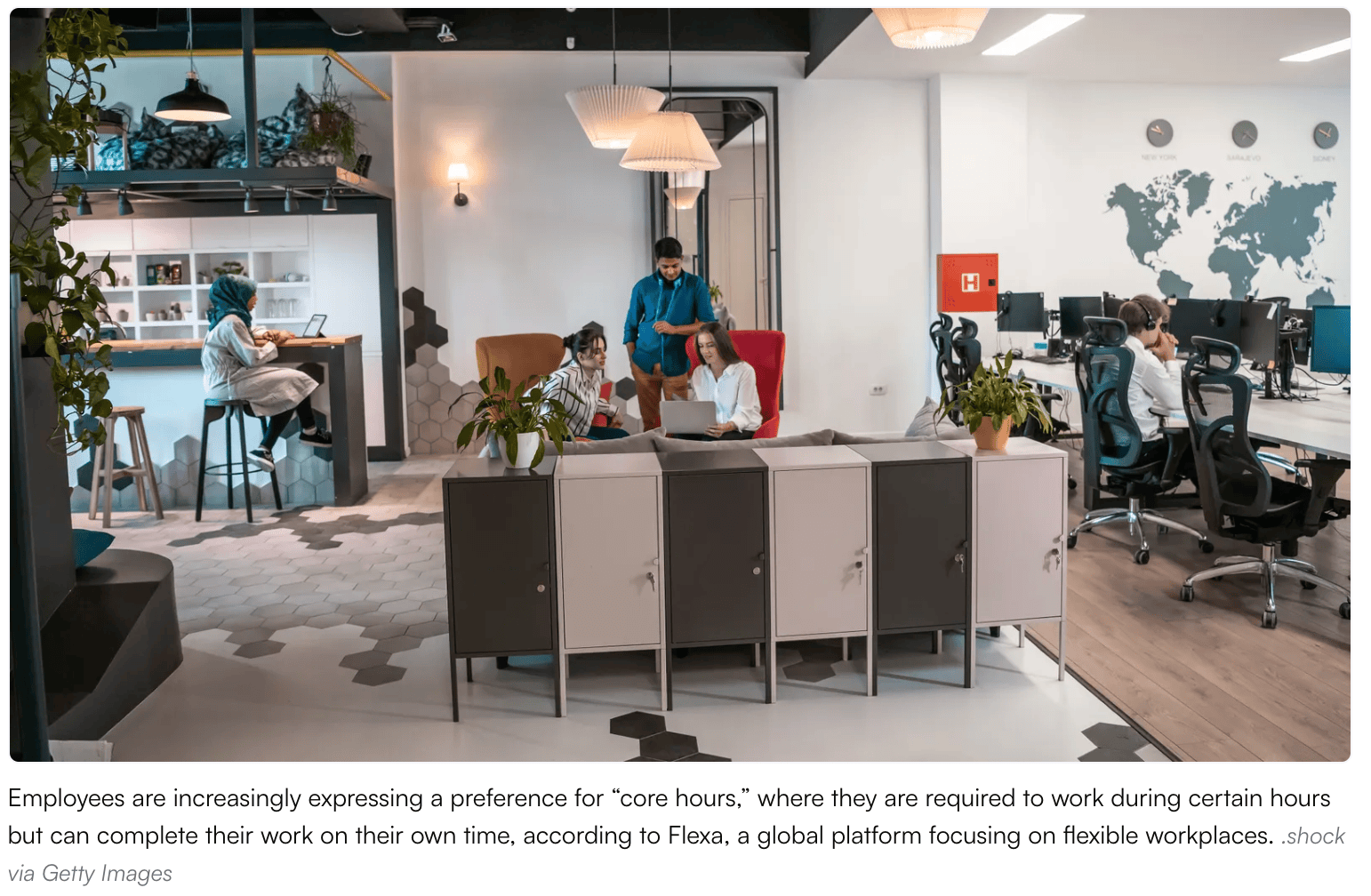
  • Employers may have found a compromise for staff resisting return-to-office mandates: Offering them a little flexibility over when they have to be at work, according to an analysis released Aug. 4 by U.K.-based Flexa, a global job platform focusing on flexible workplaces.
  • The analysis found that in June, 14% of job seekers, up from 11% in April, expressed a preference for roles offering “core hours” — where employees are required to work during certain hours, such as 11 a.m. to 3 p.m., but may complete their work in their own time.
  • From the employer side, the number of jobs offering “a little flexibility” more than tripled between June 2024 and the same time last year, Flexa’s data showed. “A little flexibility” means employers can start or finish their work a little early or a little late, but otherwise work regular hours, according to the platform. In June, nearly 8 in 10 job postings mentioned the benefit, a steep increase from 50% two months earlier, Flexa found.

Dive Insight:

Workers’ post-pandemic preference for job flexibility isn’t limited to where they work, according to Flexa data from more than 4,000 job posts and preferences expressed by 9,473 job seekers in the U.S. and Europe between April and June 2024.

Employees are also looking for flexibility over when they work, the data showed. “Demand for core hours is not a million miles away from current levels of supply, but is increasing by contrast,” Flexa said.

In June, 39% of workers said they didn’t mind whether they had flexible hours or not (as opposed to it being something they sought specifically). But that’s a rapid downturn from April, when 49% said they didn’t mind, and it’s the lowest amount since December 2021, the platform pointed out, meaning employees increasingly seek it out.

Fortunately, “flexible working hours are something that far more employers agree with them on, thanks to the trend towards asynchronous work and output-led management,” Flexa CEO and co-founder Molly Johnson-Jones stated in the report.

For now, employers seem reluctant to offer anything more than “a little flexibility,” according to the data. In June, the number of job vacancies that offered core hours plummeted to 8%, down from 15% in April.

According to a 2022 survey from digital payroll solutions firm Deluxe, some employees may even prefer flexible working hours to the flexibility of working from home. One in five employees at small-to-mid-size businesses said the No. 1 action their employer should take to improve their working environment is to offer flexible scheduling that lets them adjust their work hours.

Notably, if employer support for flexible scheduling lags behind employee demand, employer support for hybrid working arrangements remains strong. Nearly two-thirds of employers who responded to the Society for Human Resource Management’s 2024 annual benefits survey, released in June, offer a hybrid work model.

Even so, most employers have yet to adapt their practices to support the shift to hybrid arrangements, a March report by TechSmith Corp., Global Workplace Analytics and Carytid Workplace Consultancy pointed out.

Leaders and managers need hybrid-related skills, such as establishing team or meeting norms, the report explained, but 3 out of 4 workers said they haven’t received training on these skills.

Employees’ current focus is on flexible working hours, Flexa indicated. “Not since the pandemic have workers cared as much [about this],” Johnson-Jones said. That could be for several reasons, such as staff wanting a better work-life balance or seeking a flexible schedule to balance out having less influence over their working location, she explained.

“Ultimately, flexible working hours meet many different needs for many different workers. And having even just ‘a little flexibility’ around work start and finish times can make a big difference,” Johnson-Jones added.

The secret to delivering constructive criticism, according to a psychologist

It’s hard to deliver constructive feedback in a way where someone can hear it without feeling defeated. Here’s what research says about how to do it effectively.

BY ART MARKMAN for FastCompany

As a manager, delivering constructive criticism is a necessary and difficult part of the job. It can be emotionally tough to say something to someone else that you know they don’t want to hear. In addition, when talking to younger employees, you may be concerned about deflating their confidence.

Lots of people (including me) have commented on the problems with the “sh*t sandwich” strategy in which you embed a criticism in between a couple of—often half-hearted—compliments. So, what can you do that is more effective?

My colleague David Yeager provides a great basis for understanding how to deliver good constructive criticism in his new book 10 to 25: The Science of Motivating Young People. He points out that when delivering criticism, you have to navigate a difficult line. You want your employee to feel valued and that you believe they can succeed. You also want your employee to have the tools they need to be successful.

THE PROBLEM WITH MOST CONSTRUCTIVE CRITICISM

Many types of criticism fail at one or more of these objectives:

  • If you just tell someone that they tried hard and their effort was noticed, you highlight that you don’t think they are currently capable of achieving difficult things.
  • If you tell them that they need to do better, you are giving them a goal without any instruction—the work equivalent of throwing someone in the deep end of the pool and hoping they will swim.
  • If you do the task for the employee or give it to someone else, you leave them with the sense that you have no confidence in what they can accomplish.

A MORE EFFECTIVE STRATEGY

Instead, Yeager suggests you want to adopt a “mentor mindset,” in which you have empathy with the difficulties someone has with a task, but at the same time you want to have high standards for them and push them to improve. There are several ways you can do this.

Rather than starting your criticism with a compliment, start by saying that you are going to dig into ways that your employee can improve their performance and that you’re giving this direct feedback because you know that with the right guidance they can improve.

Then, before launching into a long discussion of your view of what happened, ask them for their opinion. Do they think things went well? If not, what do they think was the problem? Not only does this make your employee a partner in the critique, but it starts to provide them with an internal dialogue they can have with themselves in the future so that they can begin to improve their own performance.

EMPHASIZING COLLABORATION

When you do identify something that needs corrected, ask what support they need to help them get better. Let them know that everyone needs to learn new skills, and that you value a willingness to learn more than a capacity to do a particular task—because eventually everyone hits a wall where they are asked to do something that goes beyond their current abilities. Then, develop a plan to enable your employee to get the assistance and training they need.

This collaborative mentoring approach to constructive criticism demonstrates to your supervisees (particularly those early in their careers) that you care enough about their development that you are spending the time to work with them. It also communicates clearly that you have high expectations, but that you believe that they can meet those expectations in the future. This also helps you to feel better about your interactions with your direct reports, because the criticism is given in a context of being helpful, rather than in a context of tearing someone down.

Once you master a mentor mindset for criticism, you can toss the sh*t sandwich in the trash.

Emotional Intelligence Enables Community Managers To Swiftly Address And Resolve Conflicts

By Lydia Pelliccia and Matthew Green, CAE

A smart, skilled and well-rounded community association manager is critical to a community’s success. The profession is known for its daily variety as each day brings new opportunities, challenges and rewards. A key component of a managers’ job is the ability to collaborate and solve problems.

According to Opportunities Knock: Opening the Door to Careers in Community Association Management, published by Community Associations Institute (CAI), the Foundation for Community Association Research (FCAR), and Community Association Managers International Certification Board (CAMICB) having multiple responsibilities, among other factors, is significant in community association managers’ overall sense of satisfaction.

According to an FCAR manager survey, cited in the January 2022 publication noted above, “Solving problems is listed as the main contributor to job satisfaction by 84% of community managers, followed by variety in their tasks each day (73%), and helping people (72%).”

“A community manager’s job is multi-faceted and being a moderator/conflict resolution specialist is an important role,” said Kayte Comes, MBA, MNML, who is the Executive Director of the CAI-Arizona Chapter.  “Any time you have to deal with someone’s most valued possession and money, people become uneasy.  If a community manager wants to be successful in their job, they must learn to not shy away from conflict but embrace it as a challenge.  Comes went on to explain that understanding human nature and body language goes a long way.  “Being aware of your own triggers and behaviors when confronted – and how to control your emotions – helps a manager gain strong conflict resolution skills.”

Comes notes, situations that require these skills can arise when a manager is communicating with their Board – or homeowner – on a variety of topics. For example,  questions about assessments, potentially fines or collections, architectural designs and the proper way to submit information, as well as neighbor to neighbor issues that have been brought to the manager’s attention.

Finetuning Emotional intelligence (EI) Skills

The CAI-Arizona chapter provides community managers the opportunity to participate in emotional intelligence courses. Joelle Hadley, the founder and president of The Culture Coaches, and the co-founder of The Southwest Institute for Emotional Intelligence, describes emotional intelligence in the following way: Balanced emotions are contagious. Emotional Intelligence is a professional and personal skill-set using the self and social awareness of emotions and understanding their impact on those around us. It’s the ability to manage the negative emotions of ourselves and others while motivating positive and effective emotions needed for performance. EI is rooted in the neuroscience of how our brain interacts with outside influences and with our neo cortex, otherwise known as the thinking brain. 

Comes has been participating in these types of classes since she began supervising staff nearly 35 years ago. “This is the best way to understand your communication style and to recognize the many different styles of personalities that a community manager might interact with on a daily basis,” said Comes. “Understanding how you react in certain situations will ensure you are always prepared and professional,” Comes added. She also notes that developing these skills is not something that happens overnight and one can never get enough EI training.

Comes observed that her managers continually express how much they get out of these courses and how it helps them grow both personally and professionally. Afterall, EI skills are needed every day in the community association management industry. A manager who has strong EI skills will succeed.

Resource Corner

Making use of the wide variety of professional development resources available to managers is critical to staying on top of industry news, trends, best practices and any changes arising in the profession.  Below is a sampling of industry resources.

Chapter Mediation Services – CAI chapters often offer mediation services. For example, the CAI AZ Chapter offers these services, for a fee https://www.cai-az.org/Mediation. 

The Culture Coaches – Master certified and accredited trainers and coaches who deliver effective and impactful speeches, workshops, and individual coaching in the EI arena. Visit www.theculturecoaches.comto view the different options in emotional intelligence.

CAI Publications – CAI offers a number of publications covering the topic of conflict resolution, including Perfect Phrases for Conflict Resolution: Phrases for Encouraging a More Productive and Efficient Work Environment and Conflict Resolution: How ADR Helps Community Associations, which can be found here: https://cai.caionline.org/eWeb/DynamicPage.aspx?site=CAI&WebCode=storeCatList&catKey=bcfed0fd-1ce2-4ecd-8cd2-42507b8c36bd&catName=Conflict+Management.  CAI also offers webinars on the topic, https://cai.mycrowdwisdom.com/diweb/catalog?q=conflict+resolution

Management Company Websites – Many management companies have blogs, case studies and other articles available to the public that cover conflict resolution strategies.

CAI Exchange – An online forum that allows members to collaborate and connect with colleagues. Topics range from emergency notification systems to budgeting for insurance in the coming year to managing board member actions, neighbor disputes and everything in between. 

Emotional Intelligence Enables Community Managers To Swiftly Address And Resolve Conflicts is the fourth in a series of articles, produced by CAMICB staff, that delve into the important issues and topics affecting community association managers.

Lydia Pelliccia is a freelance writer. Matthew Green is executive director of Community Associations Managers International Certification Board.

Choosing The Right Management Company For Your Community

By CAMICB Staff

As you search for the right management company for your community, don’t forget to check out CAMICB’s resources to aid in your efforts. We’ve prepared an RFP (Request for Proposals) checklist to help you select a company that values certification and professionalism.

Text Box: Earning the CMCA credential signals an individual’s commitment to professional standards and extensive knowledge of community management. The CMCA is the only credential in community association management accredited under the National Commission for Certifying Agencies (NCCA) and the International Organization for Standardization’s ISO 17024 standards.

CMCA-certified managers ensure:

  • Decisions are backed by industry-leading knowledge.
  • Provide guidance on community management best practices.
  • Offer assistance in adhering to local and state laws.

In addition, the CMCA-certified manager plays a vital role in preserving and enhancing property values within your community. They make sure your community is well-maintained and financially stable. Further they implement strategic plans for community improvements and maintenance while collaborating with the board to make informed decisions that benefit all homeowners.

Available Resources

The Request for Proposals (RFP) checklist is designed to assist you in finding a management company that values the CMCA credential and the professionalism it represents. The checklist will guide you through the essential aspects to consider when evaluating proposals from management companies, including their expertise, experience, and dedication to ethical conduct. When reviewing bids from management companies, consider company background and experience, for example, evaluate the management company’s years of experience, size, and the types of communities they have managed. To download the full RFP Checklist, go to –> https://bit.ly/3WwvdhF.

In addition, it’s important to confirm that the manager assigned to your community is CMCA-certified and has the expertise to handle your community’s unique needs.  When interviewing a CMCA-credentialed manager, it’s essential to ask questions that help assess their skills, experience, and capacity to manage unique community challenges effectively. To download a sampling of interview questions, go to –> https://bit.ly/3LAI10m.

Knowledgeable, committed community association managers are the professional mainstay of the communities they serve, providing the skills and expertise that are essential to the effective management of their homeowner associations. 

Meeting With The Nation’s Top Policy Experts At The 2024 NCSL Legislative Summit

By Matthew Green, CAMICB Executive Director

CAMICB is excited to once again partner with CAI and exhibit at this year’s National Conference of State Legislatures (NCSL) Legislative Summit in Louisville, KY for the annual meeting that gives the nation’s state legislators and staff a chance to connect, dive into policy issues and prepare for the legislative sessions in 2024.

The annual Summit is an important opportunity for CAMICB to educate – and update – state and international lawmakers about the community association management profession. Our team enjoys having many face-to-face conversations with lawmakers about HOA and condominium laws. We also exhibit annually to reinforce the CMCA credential be considered a primary certification option should legislatures pursue licensing the association management profession.

You can tune in by watching the livestreams from the Legislative Summit: https://www.ncsl.org/events/2024-summit/livestreaming

Your Gen Z employees will ask for mental health days. How you respond matters

You can’t ignore mental health if you want to retain young talent.

BY ELEANOR HECKS for FAST COMPANY

It wasn’t long ago that mental health was something that people would never talk about in the workplace. But as more and more people understand the importance of mental health and how stress can impact individuals physically, we’re seeing more and more people request mental health days off work to deal with personal matters.

And while we’re seeing increased awareness from all generations when it comes to mental health, work/life balance, and avoiding burnout, Gen Z employees are more likely to prioritize emotional well-being than older generations.

Talking about the impact of mental health stressors was once taboo in the workplace. However, the younger generations are breaking through those barriers and prioritizing personal well-being so they can perform at higher levels without compromising themselves. And that means that they’re not afraid to ask for mental health days when they need it.

Leaders should be able to handle requests for mental health days in an emphatic way, as well as set strong policies that encourage staff to take the time needed to feel better.

With that in mind, here are six ways to respond when one of your Gen Z employees inevitably calls off for their mental health.

1. UNDERSTAND WHY YOUR RESPONSE MATTERS

According to a 2024 Deloitte survey, around 56% of Gen Z feel comfortable speaking openly with their manager, about stress, anxiety, and other mental health challenges. Some common stressors, the survey found, include not being recognized at work, long working hours, and not enough time to complete work.

Gen Z understands that prioritizing mental well-being directly impacts job performance and life quality. They’re likely to leave a job that stresses them or an employer who doesn’t empathize.

At the same time, Gen Z workers have unique skills and outlooks older generations may not have. Employers should strive to keep Gen Z workers happy or risk losing top talent.

2. RESPOND POSITIVELY

When you get a call from one of your Gen Z workers asking for a mental health day, your first response should be positive. Try to ask only a few questions to assess how long they’ll be away. They likely have personal time they can use and have every right to take those days.

The following are examples of helpful responses:

  • “Absolutely. I hope you feel better.”
  • “We’ve got you covered. Let us know how we can best support you.”
  • “I’ve marked you down for three mental health days. Please let us know if you need more.”

Understand that sometimes a person only needs a short break from work stress or to deal with a personal situation. However, workers may require an extended leave to seek professional help or treatment.

3. LIST SUPPORT

Senior academic administrators have become more aware of students’ mental health. Around 57% of provosts say they are aware of student mental health and that some groups need more resources, according to a 2024 survey. Despite increased awareness, however, many Gen Z employees felt they struggled through college with few resources to help their mental state.

If company leaders can offer resources, it can help them feel less alone. If an employee reports a mental health episode or condition, refer them to any resources the company provides. Some brands employ social workers or counselors or have benefit representatives who can offer insight into what insurance covers for inpatient and outpatient treatment.

4. ENCOURAGE COMMUNICATION

Is your employee taking an extended mental health leave versus a single day or two? FMLA leave covers numerous mental health conditions, so a longer leave could well be a possibility.

Ask the employee to keep you informed about their progress if they feel comfortable doing so. If they can chat with you or a human resources representative every week or two, they can state whether their mental state allows them to return to work or if they need other accommodations.

5. RESPECT PRIVACY

Studies show that work impacts mental well-being. The global economy loses around $1 trillion a year to depression and anxiety, according to data from the World Health Organization. Fulfilling work in a nontoxic culture can protect people’s mental state.

Company leaders must balance the need for information to fix issues with employee privacy. No one other than the point of contact and manager should know why the worker took days off. And if someone wants to know the reason for their absence, it’s best to provide a generic response (i.e. “they will be back soon.”)

People may also not feel comfortable sharing their exact medical diagnosis for fear of company retribution or lack of future opportunities. You only need to know that they require time off to get better. Leaders should treat a mental health episode the same way they treat any physical ailment.

6. PLAN THEIR RETURN

Once the employee states they are ready to return, consider easing them back in, especially if  you know that stressful work environment was a factor. Allow them to work from home, offer a hybrid solution, or ask what you can do to prevent the stress that triggered their episode.

PREPARE POLICIES AND RESPONSES IN ADVANCE

Write out policies on mental health leave to avoid any misunderstandings. Managers should be able to refer to the employee handbook for rules, and HR should understand family leave and other regulations.

Have a prepared response for what you’ll say to the worker who asks for mental health days, so you can offer a supportive attitude to someone likely struggling already. Practice the statements and tone of voice. The last thing you want is to cause additional stress to an already struggling employee.

The more support you can offer, the more successful their eventual return to their position will be. And the more you invest in your employee’s mental health, the more you’re likely to get happy, productive employees that will do their best at work.

Here’s How to Force a Reluctant Condo Board to Hold Elections

Brooklyn; HABITAT Magazine

The board in a Brooklyn condominium hasn’t held elections in more than four years, and unit-owners are worried about the building’s financial management. The board has promised to set a date for the next election, but the management company is seeking candidates to replace one member — who will be chosen by the board, even though the bylaws state that a majority of the unit-owners must be present at the meeting and elect all three board members. What recourse do these aggrieved unit-owners have?

It’s possible that the board can select a member to fill a vacancy on an interim basis — most bylaws allow this, Bruce Cholst, a partner at the law firm Herrick Feinstein, tells the Ask Real Estate column in The New York Times. However, he adds, the board should also call an annual meeting at which an election of board members to full terms can be held.

To make this happen, concerned unit-owners can write a group letter to the board, the managing agent and the building attorney, requesting that an annual meeting and election be scheduled. The letter should state that the board is in violation of the bylaws because there hasn’t been an election in four years. The letter should also cite the relevant bylaws and request a response by a certain date.

If the letter does not yield results, unit-owners can hire a lawyer to write a letter demanding compliance and threatening legal action. “As always, litigation is the weapon of last resort,” says Debra Guzov, who practices real estate law in Manhattan.

It’s possible to begin such litigation through what’s known as an Article 78 proceeding, which occurs when a governing body is not adhering to its own internal documents. But it must be done within four months of the board’s refusal to take action, Guzov notes.

Dissatisfied unit-owners could also consider fielding a slate of candidates to take board control, so that they can ensure proper financial management of their building. But either way, unit-owners have the right to review the condominium’s annual financial statements, which is required under the New York State Condominium Act.

Condominium unit-owners are not powerless, but they must be motivated if they want to make changes to their condo board.