Leadership in a world gone mad: An ode to fewer, better meetings

Thinkers 50 Blog

How could you become a better, more efficient and collaborative leader? Anne Morriss and Frances Frei provide a persuasive and time-saving strategy in the first in a series looking at the practice of leadership in a mad, mad world.

One way that organizations have responded to the combination of unprecedented uncertainty and a more distributed workforce is to drag more people into more meetings during more hours of the workday. Researchers now estimate that workers are spending about a third of their time in meetings, and much of that time is unproductive. One study from meeting software company Doodle estimated that across the United States, the United Kingdom, and Germany, 24 billion hours will be lost to pointless meetings in the next year. 

All this time together is creating the illusion of progress while inhibiting the kind of deep work, true collaboration, and creativity needed to solve our increasingly complex problems. In response, some leaders have simply banned this toxic substance (no-meeting Fridays!), but a more effective remedy is to create a gathering culture defined by fewer, better meetings. Treat your people’s time as the most strategic resource you have. If you’re going to use it, use it wisely. 

One company we recently worked with leaned into this philosophy, reducing its employees’ time in meetings by fifty percent in just a few months. Early indicators of outcomes from this shift include reduced burnout and stronger customer relationships without any reduction in team connectivity. Tactics that worked well for this organisation: embracing old-school meeting agendas, using AI for notetaking, and sharing audio recordings with people who weren’t in the meeting, who could then listen to the proceedings on their own time (often at 2x speed).  

On our podcast Fixable we interviewed Claire Hughes Johnson about how to run a great meeting. As the former COO of Stripe, Claire helped grow the company from fewer than 200 employees to more than six thousand – and from millions in revenue to billions. A casual talk she once gave on how to run an effective staff meeting at Google, her former employer, immediately went viral. (Claire is now a corporate officer and adviser to Stripe, in addition to writing great books). 

Claire’s principal advice is to prepare. Before you have the audacity to convene people, make sure you have clear answers to these questions: 

  • Why are we meeting? What are our objectives? 
  • Who needs to be there to achieve these objectives? 
  • How are we going to spend our time together? 

Circulate materials in advance so that everyone has the runway to contribute effectively, which some people need more than others. “Extroverts talk to think,” Claire explained. “Introverts think to talk.” And, yes, she’s on board with agendas, which signal where you’re going and keep everyone on track. 

Once the meeting begins, the objective is to surface unique information and ideas from your fellow gatherers. Our favourite prompt is, “Can someone articulate a different point of view?” which is a lower-stakes variant of “Who has a different point of view?” This will also help you resist the temptation to converge too quickly on a less-than-optimal solution. In our experience, fast convergence typically leads to a false optima (also known as not our best idea) and a higher chance that people will hold back additional ideas, even when they’re better. 

Finally, stick the landing. Before your meeting ends, summarise key decisions and action items. Make sure everyone knows what they’re responsible for delivering and the deadlines they need to hit. Claire likes to use a “check-out” at the close of meetings – a rapid-fire prompt to help reinforce commitments and get a pulse check on the group’s experience. A standard check-out she relies on is: “Use one or two words to describe what you’re thinking as we close this meeting – it could be a feeling, an idea, a topic you want more of.” 

When it comes to meetings, we urge you to get into the organisational sandbox and play with new approaches. Are you meeting to ideate or execute? To learn from what happened or prepare for what’s coming? Adapt your meeting’s structure, style, and pace to your goals. The only truly universal meeting rule is that if you’re gathering in person for any significant amount of time, then you need to feed people. 

Make the experience of work feel a little less crazy by committing to fewer, better meetings. We’ve seen companies go from sixty-minute meetings to thirty-minute meetings, thirty-minute meetings to twenty-minute meetings, using our favourite intervention profile: no new people, no new technology, just a healthy dose of intention. 

Emotional Intelligence Enables Community Managers To Swiftly Address And Resolve Conflicts

By Lydia Pelliccia and Matthew Green, CAE

A smart, skilled and well-rounded community association manager is critical to a community’s success. The profession is known for its daily variety as each day brings new opportunities, challenges and rewards. A key component of a managers’ job is the ability to collaborate and solve problems.

According to Opportunities Knock: Opening the Door to Careers in Community Association Management, published by Community Associations Institute (CAI), the Foundation for Community Association Research (FCAR), and Community Association Managers International Certification Board (CAMICB) having multiple responsibilities, among other factors, is significant in community association managers’ overall sense of satisfaction.

According to an FCAR manager survey, cited in the January 2022 publication noted above, “Solving problems is listed as the main contributor to job satisfaction by 84% of community managers, followed by variety in their tasks each day (73%), and helping people (72%).”

“A community manager’s job is multi-faceted and being a moderator/conflict resolution specialist is an important role,” said Kayte Comes, MBA, MNML, who is the Executive Director of the CAI-Arizona Chapter.  “Any time you have to deal with someone’s most valued possession and money, people become uneasy.  If a community manager wants to be successful in their job, they must learn to not shy away from conflict but embrace it as a challenge.  Comes went on to explain that understanding human nature and body language goes a long way.  “Being aware of your own triggers and behaviors when confronted – and how to control your emotions – helps a manager gain strong conflict resolution skills.”

Comes notes, situations that require these skills can arise when a manager is communicating with their Board – or homeowner – on a variety of topics. For example,  questions about assessments, potentially fines or collections, architectural designs and the proper way to submit information, as well as neighbor to neighbor issues that have been brought to the manager’s attention.

Finetuning Emotional intelligence (EI) Skills

The CAI-Arizona chapter provides community managers the opportunity to participate in emotional intelligence courses. Joelle Hadley, the founder and president of The Culture Coaches, and the co-founder of The Southwest Institute for Emotional Intelligence, describes emotional intelligence in the following way: Balanced emotions are contagious. Emotional Intelligence is a professional and personal skill-set using the self and social awareness of emotions and understanding their impact on those around us. It’s the ability to manage the negative emotions of ourselves and others while motivating positive and effective emotions needed for performance. EI is rooted in the neuroscience of how our brain interacts with outside influences and with our neo cortex, otherwise known as the thinking brain. 

Comes has been participating in these types of classes since she began supervising staff nearly 35 years ago. “This is the best way to understand your communication style and to recognize the many different styles of personalities that a community manager might interact with on a daily basis,” said Comes. “Understanding how you react in certain situations will ensure you are always prepared and professional,” Comes added. She also notes that developing these skills is not something that happens overnight and one can never get enough EI training.

Comes observed that her managers continually express how much they get out of these courses and how it helps them grow both personally and professionally. Afterall, EI skills are needed every day in the community association management industry. A manager who has strong EI skills will succeed.

Resource Corner

Making use of the wide variety of professional development resources available to managers is critical to staying on top of industry news, trends, best practices and any changes arising in the profession.  Below is a sampling of industry resources.

Chapter Mediation Services – CAI chapters often offer mediation services. For example, the CAI AZ Chapter offers these services, for a fee https://www.cai-az.org/Mediation. 

The Culture Coaches – Master certified and accredited trainers and coaches who deliver effective and impactful speeches, workshops, and individual coaching in the EI arena. Visit www.theculturecoaches.comto view the different options in emotional intelligence.

CAI Publications – CAI offers a number of publications covering the topic of conflict resolution, including Perfect Phrases for Conflict Resolution: Phrases for Encouraging a More Productive and Efficient Work Environment and Conflict Resolution: How ADR Helps Community Associations, which can be found here: https://cai.caionline.org/eWeb/DynamicPage.aspx?site=CAI&WebCode=storeCatList&catKey=bcfed0fd-1ce2-4ecd-8cd2-42507b8c36bd&catName=Conflict+Management.  CAI also offers webinars on the topic, https://cai.mycrowdwisdom.com/diweb/catalog?q=conflict+resolution

Management Company Websites – Many management companies have blogs, case studies and other articles available to the public that cover conflict resolution strategies.

CAI Exchange – An online forum that allows members to collaborate and connect with colleagues. Topics range from emergency notification systems to budgeting for insurance in the coming year to managing board member actions, neighbor disputes and everything in between. 

Emotional Intelligence Enables Community Managers To Swiftly Address And Resolve Conflicts is the fourth in a series of articles, produced by CAMICB staff, that delve into the important issues and topics affecting community association managers.

Lydia Pelliccia is a freelance writer. Matthew Green is executive director of Community Associations Managers International Certification Board.

CMCA Exam Updates: What Candidates Need to Know — Changes Go Into Effect December 9

By CAMICB Director of Credential Services, Madeline Hay, CAE

Significant updates to the Certified Manager of Community Associations (CMCA®) exam take effect on Dec. 9. These changes stem from CAMICB’s 2021-2022 job analysis study that assessed the key tasks and knowledge areas required of community managers to ensure the exam content aligns with current professional standards.

Exam Changes

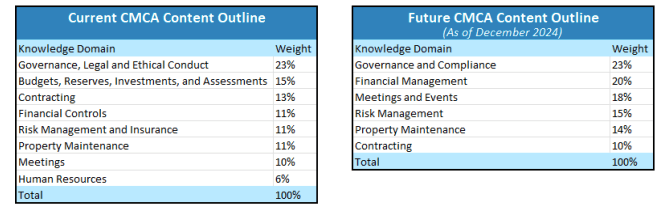
The updated content outline will condense the eight current exam domains into six broader categories, offering a more streamlined approach to understanding and preparing for the exam. 

One notable shift is the increased emphasis on the meetings and events domain, which will now represent 18% of the exam, up from 10%. This change underscores the importance of event planning, board meetings, and elections, which are essential aspects of a community manager’s role.

Three closely related content areas — budgets, reserves, investments, and assessments; financial controls; and risk management and insurance — will merge into the broader domains of financial management and risk management. While reorganized for clarity, the weight of these topics remains essentially unchanged and maintains the focus on financial stability and risk mitigation.

The emphasis on property maintenance will increase to mirror the growing importance of preserving property values and preventive maintenance. Meanwhile, governance and compliance remain the largest domain at 23%, reflecting the ongoing importance of legal accountability, rule enforcement, and transparency.

Notably, the human resources domain, which previously accounted for 6% of the exam, will be eliminated. This reflects the evolving scope of early-career managers’ responsibilities as HR tasks are increasingly managed by specialized staff or external providers.

Preparing for the Updated Exam

Candidates can review both the current and updated content outlines at camicb.org. Separate CMCA study guides are available for each version, allowing candidates to choose the guide that aligns with their planned exam date and preparation needs.

Both versions of the CMCA exam uphold the same rigorous standards and ensure credential holders are well-equipped for community association management. However, the revised outline will better reflect the profession’s evolving demands.

The upcoming changes allow candidates to align their skills with the latest industry developments. As the profession grows in complexity, the CMCA remains a hallmark of excellence and ensures credential holders are prepared to meet future challenges. With this updated exam, CAMICB reaffirms its commitment to maintaining the highest standards in community association management.

Upholding High Ethical Standards

CAMICB Updates Its CMCA Standards of Professional Conduct and Enforcement Procedures

By CAMICB Executive Director, Matthew Green, CAE

A key component of CAMICB’s Credentialing Program requires a Certified Manager of Community Associations (CMCA) to adhere to a high standard of ethical conduct. This means CMCA credential holders must comply with the 10 CMCA Standards of Professional Conduct, which are designed to ensure that managers uphold their fiduciary responsibilities and comply with laws, governing documents, and professional integrity.?

CAMICB recently conducted a thorough review of the CMCA Standards of Professional Conduct as part of its regular cycle to ensure these critical elements of the CMCA certification program continue to align with industry standards and best practices. In addition, the review was designed to ensure that the standards remain relevant and applicable to the evolving demands of the community association management industry, both domestically and globally. While some changes were made to the standards themselves, the most significant updates are found within the accompanying clarification document. This document provides detailed guidance on the practical application of the standards, ensuring they are interpreted and enforced consistently. By modernizing the standards and clarifications, CAMICB ensures that CMCAs are held to up-to-date ethical standards while addressing global applicability and evolving industry standards. 

Said Greg Smith, CMCA, AMS, PCAM, Chair of the CAMICB Board of Commissioners, “These revisions reflect a commitment to maintaining high ethical standards and professionalism for CMCA credential holders while incorporating more explicit guidance on fiduciary responsibilities, conflict-of-interest disclosures, and data security practices.”

A summary of the key changes and updates follows:

Standard 1: Global Applicability and Compliance

The changes to Standard 1 make the policies globally applicable by removing jurisdiction-specific references.

Standard 6: Gratuities, Compensation and Disclosure

The changes to Standard 6 strengthen the requirements for disclosure of gratuities and compensation to enhance transparency while reducing the likelihood of conflicts of interest.

Standard 7: Continuing Professional Education

The updates to Standard 7 further emphasize the need for continuous education aligned with CMCA recertification. 

Standard 8: Fiduciary Duty

The changes to Standard 8 clarify the expectations around fiduciary duty by detailing what constitutes a breach.

Standard 9: Professional Conduct and Violations

The revisions to Standard 9 shift the focus from defining what constitutes a breach of due diligence to emphasizing the expectation of maintaining professional conduct at all times.

Standards 10: Records, Confidentiality, and Data Security

The updates to Standard 10 focus on the handling of client records, particularly the secure management of electronic data, in line with current data security practices. 

“These updates ensure that CMCA credential holders are equipped to meet the evolving demands of the community association management industry, reinforcing the value and trust associated with the CMCA credential,” added Smith.

CMCAs are encouraged to review the updated standards and the clarification document thoroughly to ensure their practices continue to align with CAMICB’s expectations for ethical conduct and professionalism. By staying informed on these updates, CMCAs can confidently uphold the high standards required for maintaining their credential and serving their communities effectively.

About The Standards Of Professional Conduct

The Standards of Professional Conduct, detailed at https://www.camicb.org/standards/, range from understanding laws applicable to community association management, to being knowledgeable on association policies and procedures, to carrying out fiduciary responsibilities, and participating in continuing education coursework. A violation of any of these Standards of Professional Conduct may be grounds for administrative action and possible revocation of the CMCA certification by CAMICB.  Abiding by these Standards of Professional Conduct help protect consumers and associations that hire or contract with community association managers. 

Enforcing the Standards of Professional Conduct

In order to maintain and enhance the credibility of the CMCA Certification Program, the CAMICB Board of Commissioners follow strict procedures that allow consumers and others to bring complaints concerning CMCAs to the Board. Similar to a regular review of the Standards of Professional Conduct, CAMICB also reexamined the procedures for suspending and revoking certification every two years. 

Through this process, CAMICB enhanced its procedures for reviewing, suspending, and revoking certifications to ensure they reflect the latest industry standards. These improvements underscore our commitment to maintaining the highest level of professional conduct and ensuring our processes remain transparent, fair, and aligned with global best practices.

More information, including a set of Frequently Asked Questions, a list of the 10 clearly outlined Standards of Professional Conduct, the procedures for enforcing the standards, and other pertinent documents, can be found at https://www.camicb.org/standards/.

HOA Homefront: Why is HOA living and governance so HARD

By KELLY G. RICHARDSON | kelly@roattorneys.com | Contributing Columnist for the LA Daily News

Living in HOAs and governing HOAs can seem frustrating at times, but there are reasons for that frustration, and sometimes recognizing the issues helps.

Property independence

Our society highly prizes the independent ownership of land. The “my home; my castle” philosophy is uniquely strong in the American culture, and it’s hard for us to embrace shared ownership of property.

However, for over 50 years, economic forces have pushed the American public increasingly to common interest communities to make property ownership affordable with amenities in desirable living locations. Many cultures around the world have few problems with the concept of shared control of property, but we haven’t fully embraced it yet.

Failure to embrace the trade-offs

What makes common interest communities work is the tradeoff of shared benefits for shared control. It’s great to be able to use a tennis court or a nice clubhouse, but it’s not mine, it’s OURS. That means the individual doesn’t have control over management of the court or clubhouse. Homeowners who enjoy HOAs the most are those who recognize and appreciate that trade-off.

Failure to read governing documents

The Covenants, or “CC&Rs” operate as an agreement that automatically binds all owners in the HOA. This is very powerful document, with provisions enforced by California courts unless there is a specific legal reason not to do so. However, many HOA homebuyers never bother to read through the CC&Rs before agreeing to close escrow.

Only later, after getting a violation letter from the HOA do they learn that, for example; recreational vehicles cannot be parked in driveways, that pets or rentals are subject to limitations, or that certain aspects of the home cannot be altered without HOA permission.

HOA CC&Rs, bylaws, and rules should be reviewed by homebuyers before their cancellation rights cease, to avoid major surprises that can change the way the homebuyer might have expected to own in that HOA.

Believing myths

One very common HOA problem is the homeowner who “shoots first, and asks questions later” regarding alterations of their property or common area around their property.

There is a reported appeal case in Southern California upholding a judge’s order that a homeowner dismantle the second story they had added to their house (in violation of the CC&Rs) and that they pay the HOA’s attorney fees.

Some people think that once they’ve moved a fence or changed their driveway that it will be harder for the HOA to challenge it, which often proves to be a very expensive mistake.

“Me” instead of “we”

Brilliant and otherwise highly accomplished people can become highly negative factors in their HOA because either as a homeowner or a director they focus only on their own desires and interests and base their comments, actions, and decisions on that focus.

If one only wants to focus on their own desires and has no time for anyone else’s values, opinions, or desires, that person will not do well in the common interest community housing model – as a homeowner or volunteer leader.

Here’s hoping these help toward better understanding and neighborliness in your community!

Kelly G. Richardson CCAL is a Fellow of the College of Community Association Lawyers and Partner of Richardson Ober LLP, a California law firm known for community association advice. Send column questions to Kelly@roattorneys.com .

Upholding High Ethical Standards

CAMICB Updates Its CMCA Standards of Professional Conduct and Enforcement Procedures

By CAMICB Executive Director, Matthew Green, CAE

A key component of CAMICB’s Credentialing Program requires a Certified Manager of Community Associations (CMCA) to adhere to a high standard of ethical conduct. This means CMCA credential holders must comply with the 10 CMCA Standards of Professional Conduct, which are designed to ensure that managers uphold their fiduciary responsibilities and comply with laws, governing documents, and professional integrity.?

CAMICB recently conducted a thorough review of the CMCA Standards of Professional Conduct as part of its regular cycle to ensure these critical elements of the CMCA certification program continue to align with industry standards and best practices. In addition, the review was designed to ensure that the standards remain relevant and applicable to the evolving demands of the community association management industry, both domestically and globally. While some changes were made to the standards themselves, the most significant updates are found within the accompanying clarification document. This document provides detailed guidance on the practical application of the standards, ensuring they are interpreted and enforced consistently. By modernizing the standards and clarifications, CAMICB ensures that CMCAs are held to up-to-date ethical standards while addressing global applicability and evolving industry standards. 

Said Greg Smith, CMCA, AMS, PCAM, Chair of the CAMICB Board of Commissioners, “These revisions reflect a commitment to maintaining high ethical standards and professionalism for CMCA credential holders while incorporating more explicit guidance on fiduciary responsibilities, conflict-of-interest disclosures, and data security practices.”

A summary of the key changes and updates follows:

Standard 1: Global Applicability and Compliance

The changes to Standard 1 make the policies globally applicable by removing jurisdiction-specific references.

Standard 6: Gratuities, Compensation and Disclosure

The changes to Standard 6 strengthen the requirements for disclosure of gratuities and compensation to enhance transparency while reducing the likelihood of conflicts of interest.

Standard 7: Continuing Professional Education

The updates to Standard 7 further emphasize the need for continuous education aligned with CMCA recertification. 

Standard 8: Fiduciary Duty

The changes to Standard 8 clarify the expectations around fiduciary duty by detailing what constitutes a breach.

Standard 9: Professional Conduct and Violations

The revisions to Standard 9 shift the focus from defining what constitutes a breach of due diligence to emphasizing the expectation of maintaining professional conduct at all times.

Standards 10: Records, Confidentiality, and Data Security

The updates to Standard 10 focus on the handling of client records, particularly the secure management of electronic data, in line with current data security practices. 

“These updates ensure that CMCA credential holders are equipped to meet the evolving demands of the community association management industry, reinforcing the value and trust associated with the CMCA credential,” added Smith.

CMCAs are encouraged to review the updated standards and the clarification document thoroughly to ensure their practices continue to align with CAMICB’s expectations for ethical conduct and professionalism. By staying informed on these updates, CMCAs can confidently uphold the high standards required for maintaining their credential and serving their communities effectively.

About The Standards Of Professional Conduct

The Standards of Professional Conduct, detailed at https://www.camicb.org/standards/, range from understanding laws applicable to community association management, to being knowledgeable on association policies and procedures, to carrying out fiduciary responsibilities, and participating in continuing education coursework. A violation of any of these Standards of Professional Conduct may be grounds for administrative action and possible revocation of the CMCA certification by CAMICB.  Abiding by these Standards of Professional Conduct help protect consumers and associations that hire or contract with community association managers. 

Enforcing the Standards of Professional Conduct

In order to maintain and enhance the credibility of the CMCA Certification Program, the CAMICB Board of Commissioners follow strict procedures that allow consumers and others to bring complaints concerning CMCAs to the Board. Similar to a regular review of the Standards of Professional Conduct, CAMICB also reexamined the procedures for suspending and revoking certification every two years. 

Through this process, CAMICB enhanced its procedures for reviewing, suspending, and revoking certifications to ensure they reflect the latest industry standards. These improvements underscore our commitment to maintaining the highest level of professional conduct and ensuring our processes remain transparent, fair, and aligned with global best practices.

More information, including a set of Frequently Asked Questions, a list of the 10 clearly outlined Standards of Professional Conduct, the procedures for enforcing the standards, and other pertinent documents, can be found at https://www.camicb.org/standards/.

How much are organisations losing from unnecessary tasks?

BY Dexter Tilo for Human Resources Director

Organisations are losing an average of $15,138.03 per employee annually due to unnecessary tasks, according to a new report from Wrike.

Wrike’s 2024 Impactful Work Report found that employees are spending 11.24 hours or 30% of their work week on unnecessary work.

The biggest time waster? Finding information from multiple systems because it isn’t all accessible through a single interface (2.4 hours)

Also a problem are:

  • Having to find and send information to other people they work with because it isn’t easily accessible to them (1.4 hours)
  • Chasing other people they work with for status updates, approvals, etc. (1.5 hours)
  • Doing work only to find actions weren’t recorded correctly, so it isn’t what should have been done (1.1 hours)
  • Repeating work they’ve already done because the original work was lost (1 hour)
  • Doing work only to find out someone else has also done the same thing, so they’ve duplicated one another’s actions (1 hour)
  • Repeating work they’ve already done because they can’t demonstrate to superiors that it’s been done (0.9 hour)

According to Wrike, the “whopping” $15,138.03 figure does not even account for low-impact work, or tasks that are necessary to complete but do not directly impact goals.

These kinds of tasks make up 46% of the tasks performed by employees across organisations, consuming 18.4 hours of work per week, the report found.

But the problem also extends to business decision-makers.

According to Wrike, only 57% of business decision-makers’ work is considered high-impact. The remaining time is spent on low-impact activities, such as:

  • Attending meetings, whether in person or over the phone or video
  • Telling people they now have to complete an action and/or finding out whether they themselves need to complete an action
  • Providing status updates to teams/individuals

Wrike has calculated that this equates to $7,016.82 in lost productivity per business leader each year, excluding the time spent setting up projects.

Paradox of increased workloads

The monetary costs of unnecessary tasks come as Wrike’s report uncovers a paradox within the workplace: increased workloads are not translating to higher productivity.

The report, which surveyed 1,000 business leaders and 2,500 knowledge workers across various regions, highlights growing dissatisfaction as employees face escalating demands but less impactful results.

Knowledge workers reported a 31% increase in their workload over the past year, while business leaders saw an even larger increase of 46% for their teams.

Despite these growing demands, only 54% of work completed by knowledge workers is considered high-impact.

“So, knowledge workers are doing more, but they are achieving less as things stand. Despite good intentions, increasing the number of applications knowledge workers use on a daily basis has added to workloads instead of reducing them,” the report read.

Efficiency measures, including the integration of artificial intelligence (AI) tools, have been implemented across many organisations in recent years. However, Wrike’s findings suggest these measures have not yet reached their full potential.

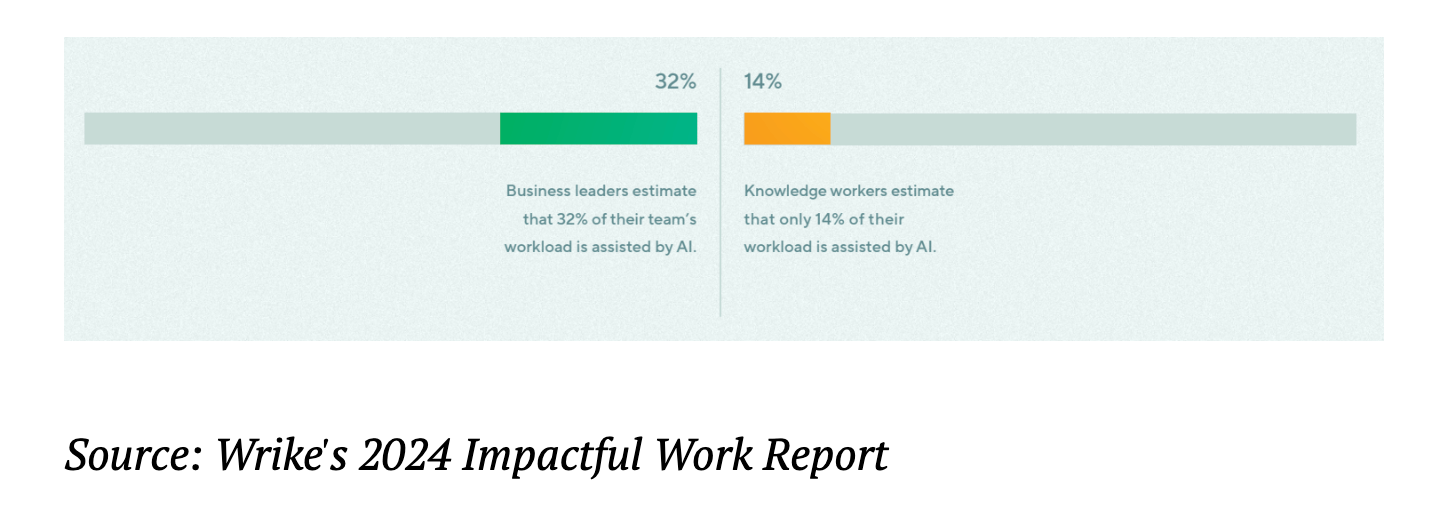
Business leaders believe AI assists with 32% of their workload, but knowledge workers report a much lower figure of 14%.

According to Wrike, its findings underscore the need for businesses to align on goals, eliminate unnecessary work, automate low-impact work, and prioritise high-impact initiatives.

“Our research shows that businesses are at a critical juncture,” said Thomas Scott, CEO of Wrike, in a statement.

“Organisations that take decisive action to prioritise impactful work, consolidate tools, and embrace automation will not only see increased efficiency but also happier, more engaged employees.”

Community Associations on the Rise in 2023

Ashok Chaluvadi National Association of Homebuilders

In 2023, 64.8% of all new single-family homes started were built within a community or homeowner’s association. This share increased from the 62.6% recorded in 2022, according to data tabulated from the Census Bureau’s Survey of Construction (SOC). This marks the third highest share since the beginning of the series in 2009, after the high point of 67.1% in 2020 and 65.5% in 2021.  Prior to 2021, the share had been on a decade-long upward trend.  In absolute numbers, a total of 601,558 homes were started in community associations in 2023.

The Census Bureau defines community or homeowner’s associations as “formal legal entities created to maintain common areas of a development and to enforce private deed restrictions; these organizations are usually created when the development is built, and membership is mandatory.”

A recent NAHB study, What Home Buyers Really Want,  asked recent and prospective home buyers to rate the influence that 29 community features would have on their purchase decision.  For more than 65% of buyers, being near retail space and park areas, and having walking/jogging trails are the most influential community features. In contrast, only 39% feel the same way about a homeowner’s association.

When analyzed by the nine census divisions, the highest share of new homes started within a homeowner’s association was in the Mountain Division, where 81.9% of new homes were in such communities. In the Middle Atlantic Division, on the other hand, the share was only 28.6%. The share of new homes started within a community across U.S. divisions are shown in the map below.

New Rules to Help Co-ops and Condos Comply With Local Law 97

Habitat Magazine

The word “final” has been getting a workout from the city’s Department of Buildings this year. The DOB has just released yet another “final” set of rules laying out how co-op and condo boards and other building owners can comply with the city’s ambitious and controversial climate law, Local Law 97.

With the first year of the law’s implementation drawing to a close, the DOB is seeking to allay concerns of building owners who are worried that the retrofits required to bring their buildings’ carbon emission into compliance will be financially devastating. Here are a few of the highlights of the latest batch of rules:

The Affordable Housing Reinvestment Fund will help pay for electrification retrofits in rent-stabilized apartments and low-income co-ops. Under the program, dubbed GreenHOUSE, building owners will be able to buy carbon offset certificates early next year, before the May 2025 deadline when owners of covered buildings need to file their initial report detailing their 2024 emissions and a decarbonization plan. They can buy offset certificates for up to 10% of their emissions limit.

Adjustments for legal, physical or financial constraints. The new rules lay out case-by-case adjustments to emissions limits if buildings face constraints that prevent compliance — such as historic preservation or accessibility requirements, physical conditions, or distressed finances. The proposed rules provide much-needed detail on why and how those adjustments may be granted.

Detail on fees. The proposed rules also set fees for various covered-building submissions, including simple building emissions reports, complex building emissions reports and “good faith efforts” reports, which apply to owners who make a sincere attempt to comply with the law but are financially unable to bring their carbon emissions below prescribed caps.

On Oct. 9 at 10 a.m., Urban Green Council is hosting a special webinar with the DOB to unpack the proposed rules. To participate, register here.

The DOB will also hold an online public hearing on the proposed rule changes at 11 a.m. on Nov. 7. To participate, register here.

The majority of covered buildings are already in compliance with Local Law 97’s first emissions caps, which went into effect on Jan. 1, 2024. But many will need to make retrofits to comply with more stringent caps that will go into effect in 2030 and in future years. A bill now before the city council, sponsored by Queens Councilmembers Linda Lee and Sandra Ung, would delay fines and increase carbon emissions caps for co-ops and condos across the city, especially the garden apartment complexes that are prevalent in their districts. Plus, Local Law 97 is facing a legal challenge from building owners in Queens who hope to overturn it.

It turns out, finally, that very little about Local Law 97 is final.

CMCA Exam Updates: What Candidates Need to Know

By CAMICB Director of Credential Services, Madeline Hay, CAE

Significant updates to the Certified Manager of Community Associations (CMCA®) exam take effect on Dec. 9. These changes stem from CAMICB’s 2021-2022 job analysis study that assessed the key tasks and knowledge areas required of community managers to ensure the exam content aligns with current professional standards.

Exam Changes

The updated content outline will condense the eight current exam domains into six broader categories, offering a more streamlined approach to understanding and preparing for the exam. 

One notable shift is the increased emphasis on the meetings and events domain, which will now represent 18% of the exam, up from 10%. This change underscores the importance of event planning, board meetings, and elections, which are essential aspects of a community manager’s role.

Three closely related content areas — budgets, reserves, investments, and assessments; financial controls; and risk management and insurance — will merge into the broader domains of financial management and risk management. While reorganized for clarity, the weight of these topics remains essentially unchanged and maintains the focus on financial stability and risk mitigation.

The emphasis on property maintenance will increase to mirror the growing importance of preserving property values and preventive maintenance. Meanwhile, governance and compliance remain the largest domain at 23%, reflecting the ongoing importance of legal accountability, rule enforcement, and transparency.

Notably, the human resources domain, which previously accounted for 6% of the exam, will be eliminated. This reflects the evolving scope of early-career managers’ responsibilities as HR tasks are increasingly managed by specialized staff or external providers.

Preparing for the Updated Exam

Candidates can review both the current and updated content outlines at camicb.org. Separate CMCA study guides are available for each version, allowing candidates to choose the guide that aligns with their planned exam date and preparation needs.

Both versions of the CMCA exam uphold the same rigorous standards and ensure credential holders are well-equipped for community association management. However, the revised outline will better reflect the profession’s evolving demands.

The upcoming changes allow candidates to align their skills with the latest industry developments. As the profession grows in complexity, the CMCA remains a hallmark of excellence and ensures credential holders are prepared to meet future challenges. With this updated exam, CAMICB reaffirms its commitment to maintaining the highest standards in community association management.