Five Years Later: Has the Economy Bounced Back?

By Margo Epprecht

Five years after the fall of Lehman Brothers, the evaporation of credit, and the collapse of the economy and stock market: Where does the economy stand?
Image

Square One

In one sense, the economy is back where it started. Real gross domestic product per person has just about recovered to where it stood in 2007, around $50,000 per person in 2011 dollars. That still makes the U.S. the richest large country in the world, ranked seventh by the World Bank, behind smaller nations like Qatar and Switzerland. But the U.S. is not used to standing still. If growth in the last five years had been on trend, we would be approaching $60,000 per capita by now.

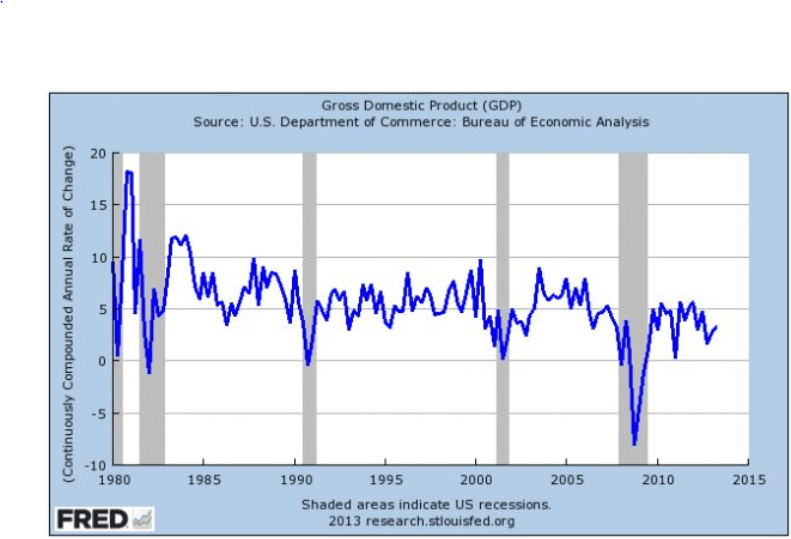
This is far from the normal “bouncy” kind of recovery we historically experience coming out of recessions. The chart below shows the annual rate of change in real (inflation-adjusted) GDP from the Federal Reserve Bank of St. Louis. The usual change after recessions (shaded) is above five percent, whereas this recovery is below five percent.

Still Behind On Jobs

Almost 2 million fewer people today have jobs than at the end of 2007. Last Friday, the Bureau of Labor Statistics reported that the labor participation rate fell to its lowest since 1978. Normally, a recovering labor market attracts more people wanting work. Instead, more people are opting out of the workforce.

Incomes have recovered and surpassed 2007, but the growth in income has been highly concentrated in the wealthiest households. The number of people on food stamps soared 70 percent over the past five years; one in five households now utilize food stamps according the Department of Agriculture.

And on the housing front, a strong recovery from the bottom makes headlines, but the equity value of America’s homes has fallen from $13.5 trillion at its peak in 2007 to $9.1 trillion now, says the Federal Reserve.

Smaller Business Profits Hit Hard

The Inc. 500 show the challenges coming out of the “great recession.” The Inc. 500 in 2008 had more than $18 billion in revenue; last year, that number was $14.1 billion. Employment in the Inc. 500 topped 57,000 in 2008. In 2012, it just passed 52,000. Corporate profits overall, on the other hand, have surpassed their peaks in 2007 because large companies have leveraged economies of scale and technology to boost margins.

What Can You Conclude?

The economy lacks vitality, but it is growing, and there are sweet spots within it. Pent up demand for housing and cars makes these industries look good for this year and next. Selling to the “1%” remains an excellent business proposition. Business-to-business looks to remain a key growth category. Business confidence has rebounded more than consumer confidence. Regionally, the southwest, northwest, and some southern markets show more economic dynamism than the northeast and midwest. But this economy is fragile. With home values still $4 trillion below their peak, the majority of households are not in a better financial position than they were six years ago.

Goldman Sachs predicts faster U.S. growth in 2014, but it’s probably too early to tell. Decisions in Washington before year-end on tax policy and the budget, the next Federal Reserve Chairman, and mid-east military action may tip the balance for business confidence and the economy next year. If uncertainties clear out of the way, more hiring and capital investment could boost growth in 2014 and make the U.S. look more like the economic powerhouse it should be.

MARGO EPPRECHT is a chartered financial analyst and freelance business writer. A former stock analyst who covered retailing and health care, she regularly writes about the economy for Inc.com.


Questions from the Listserv

CAMICB hosts a listserv for community association managers. The listserv is intended to create a powerful, on-line community for community management professionals to share information. Recently, some questions have been sent to the listserv. Are you able to help? Leave and answer in the comment section below and CAMICB staff will post your answer to the listserv.

Question 1: Greg from Missouri

Does anyone have RV parking policies they would be willing to share?


Question 2: Doug from Florida

We are trying to write a swimming pool rule relative to owner’s guest’s use of the pool.  If you have a policy in that regard, would you kindly share it? 


Question 3: Donna from Minnesota

My association in MN has stringent rules on leasing, including you may only lease one time, no exceptions. We have a unit owner who has violated that rule after being sent a letter denying him his request for waiver of the leasing restrictions to begin a new lease agreement with a new tenant. The governing documents do not mention the association having the right to evict a tenant if this happens. I have searched the statutes and laws and can only find laws pertaining to landlord and tenant. Does the association have any right to evict a tenant due to the landlord/homeowner violating the governing documents?

Lessons From Diana Nyad’s Historic Swim

1111

By MINDA ZETLIN

On her fifth try, 64-year-old Diana Nyad swam 110 miles from Havana to Key West. We can all learn from her accomplishment.

In 1978, when I was 18 and she was 28, Diana Nyad first attempted to swim from Cuba to the Florida Keys. I read about her at the time with fascination–she was fairly well known in Manhattan, where I grew up, for her record-setting swim around the island in just over eight hours. I was rooting for her on that first Cuba-to-Florida attempt and sad when her medical team pulled her from the water after rough swells buffeted her.

She tried it again in August 2011, then again the following month, and yet a fourth time in August 2012. Each time she was stopped by jellyfish stings, sometimes combined with storms. When I heard she was trying it yet again last week, I was decidedly skeptical. “Isn’t it time she faced reality?” I asked. “Enough is enough.”

Boy was I wrong. Around 2 p.m. on Labor Day she walked out of the water in Key West, having finally finished the swim, 35 years after she first tried it and just 12 days past her 64th birthday. Wavering on her feet, slurring her words, and about to be carried off by stretcher, she nonetheless summoned the energy to deliver an important lesson to the hundreds of people standing on the beach and the millions more watching by video. “I got three messages,” she began:

“One is, we should never, ever give up.”

On three of her previous tries she suffered through box jellyfish stings so debilitating they’re known to bring Navy SEALs low. “I feel like boiling hot oil I’ve been dipped in, and I’m yelling ‘Fire! Fire! Fire!'” Nyad recalled.

Would you jump back in the water, knowing those things were in there? I sure wouldn’t, but she did, again and again. Is there anything you want in this life so badly that you’d deliberately face that kind of pain? If there is, chances are you’re going to get it.

“Two is, you’re never to old to chase your dream.”

“A couple of years ago I was turning 60, and I don’t like being 60,” she said in a 2011 TED talk. “How could this have gone by like lightning? I couldn’t forgive myself for the countless, countless hours I had lost in negative thought.”

Then her mother died at 82, and Nyad suddenly felt not only unsatisfied about the past, but also a keen sense that the future was finite. The answer, she decided, was to throw herself into an all-consuming dream, one that had been nagging her since she first failed to make the crossing in her 20s. She hadn’t swum, she said, in 31 years, but she was prepared to put everything on the line to make that long-term dream a reality. “We blink and another decade passes,” she told a live chat audience that same year. She wasn’t willing to reach the end of her life and regret not giving it her all. And so she started to train.
What might you regret not having done, when you reach the end of your own life? And what’s stopping you from starting on whatever that is right now?

“Three is, it looks like a solitary sport, but it’s a team.”

Having the right people to back her up was what finally made the difference. Nyad brought in jellyfish experts and following their advice, she spent nights swimming in a special suit that covered her arms and legs, spread with “sting stopper” gel. Perhaps even more important, she had shark divers on her team who chased away sharks and jellyfish before she ran into them.

The lesson is clear: If you want to do something extraordinary, you need extraordinary people working with you. And you should never be afraid to ask for help.

“I can swim from Cuba to Florida. And I will swim from Cuba to Florida.”
Nyad made this simple declarative statement near the end of her TED speech. She’d tried and failed to do exactly that the previous the month, and the month before. Yet her calm confidence that it could be done and that she would do it was unswerving.

Anyone who’s ever approached a project or a challenge with that kind of absolute certainty can attest to its effect, both on the people who work with you, and on the universe at large–things seem to just fall into place. That’s what happened for Nyad on her final attempt. Sharks stayed away and there were fewer jellyfish than usual. There was only one brief storm, and even the current helped her along, bringing her in to Key West a bit earlier than planned.

Thanks to Diana Nyad for the inspiration her perserverence provides. Yes, we should never, ever give up. And we should never doubt that we’ll accomplish what we set out to do.

MINDA ZETLIN is a business technology writer and speaker, co-author of “The Geek Gap,” and president of the American Society of Journalists and Authors.
@MindaZetlin

CMCA Recertification

CAMICB sent final reminder notices this morning to individuals who need to recertify and/or pay their annual service fee by October 1, 2013. Here are a few helpful links:

A few things to note:

  1. It is the responsibility of each CMCA to provide documentation of their 16 hours of continuing education at the time of recertification. CAMICB does not track your CEs. If you took a class with CAI, please log into their website (caionline.org) to print out a certificate of completion.
  2. Only courses completed between October 1, 2011 and present will count as continuing education.
  3. If you have held an active AMS, PCAM, FL CAM, NV CAM or NAHC-RCM for at least a year, this will satisfy your CMCA continuing education requirement.
  4. Credit hours may be earned only for education that meets either of the following criteria: It pertains to community association operations or management and/or it contributes to the professional development of the CMCA.
  5. The CMCA Annual Service Fee is $105.00. Oftentimes this fee is confused with CAI’s individual manager membership. Recently, CAI increased the rate of the individual manager membership from $130.00 to $134.00. While CAMICB maintains an affiliate relationship with CAI, we are an independent credentialing body: separately incorporated, governed by an independent Board of Trustees, and guided in the administration of our program by the standards of our accrediting body, the National Commission for Certifying Agencies. We are not a membership organization; we do not collect membership dues. We assess our credential holders an annual maintenance fee which is used to support the development and delivery of our core exam and the operation of our program in accordance with best practices in professional credentialing.

Roland Richardson, Certification Assistant, is happy to assist you with the recertification process. Contact Roland at rrichardson@nbccam.org with any questions.

In The News…

in-the-news

HOA used satellites to spot violations
A homeowner is up in arms after he says his neighborhood association crossed the line. The HOA even admits that a previous board used Google satellite technology to scope out violations. Pflugerville, Texas

HOA builds playground to block sex offenders
A simple playground is blocking sex offenders from moving into a Central Florida neighborhood. Police agencies across Volusia County are pretty sure this is the first time in Florida that an HOA has built a playground to make sure sex offenders cannot move in to their neighborhood. It’s a case of homeowners teaming up to protect their kids. Daytona Beach, FL.

Vacation home rentals gaining momentum
Angel Luna decided to offer her bungalow in Apollo Beach as a vacation rental. It was a mostly positive venture until her homeowners association told her renting her home was a violation. The trend is growing as a way to augment homeowners’ incomes. Tampa, FL

Clothesline users call laundry flap overblown
Thousands of developments, apartments and condominiums across the Northwest ban clotheslines outright as unsightly and potentially dangerous artifacts of the past. Others have de facto bans where clotheslines can be ordered removed if they are visible from a neighbor’s property, can be seen from the street or are considered offensive by those living nearby.

Justice Department Reaches Settlement with HOA
The Justice Department announced yesterday that the Townhomes of Kings Lake HOA Inc. (HOA) and Vanguard Management Group Inc. have agreed to pay $150,000 to settle a lawsuit alleging violations of the Fair Housing Act (FHA). Washington, D.C.

11 Body Language Essentials for Your Next Negotiation

Negotiating successfully is about more than just saying the right thing. Commanding body language is an essential business tactic and has been studied for years–but mastering it can be a challenge. We asked 11 successful entrepreneurs from YEC for their best body-language tips.

1. Mirror Their Actions
Mirroring is when one person adopts another person’s body language, vocal tone, and behavior, which builds rapport. For example, if the prospect is engaged, he or she will lean forward and follow your movements. If that’s not the case and the person is leaning far back and crossing his or her arms, be sure to find a way to bring the person back in and ask what isn’t right. –Kenny Nguyen, Big Fish Presentations

2. Nod Your Head
I adopted a negotiation trick from President Obama after observing the following: Even when he’s in the middle of a disagreement or being harshly criticized, he nods his head and maintains eye contact. I found that doing the same in negotiations defuses tension and builds alignment, even during contentious conversations.
–Christopher Kelly, Convene

3. Pay Attention to Your Hands
When people are nervous or stressed, it often shows in their hands. When you’re negotiating, make sure your hands project confidence and poise. Fidgeting or clasping your hands tightly together reveals that you’re nervous. The other party can take advantage of that. Try putting your hands just below your chest and put your fingers together when you want to confidently make a point.
–Natalie MacNeil, She Takes on the World

4. Plant Your Feet
Your face, head, and hands are obvious body parts to control when negotiating. But your feet? Not so much. Keep them firmly planted on the ground to show your resolve. It also ensures that you avoid coming off as ambivalent or stubborn. This helps you stay confident, too. –Danny Wong, Blank Label

5. Relax Your Body
Negotiations can be intense, so assume a relaxed body position to help ease the tension. Complement that body language with soft-spoken or non-aggressive commentary. This can help build trust and lead to more effective negotiations.
–Andrew Schrage, Money Crashers Personal Finance

6. Remember to Smile
It’s important that the environment doesn’t get too intense. For the deal to be successful, it will most likely be a long-lasting relationship, and that can’t happen if it’s not friendly between both sides. –Jordan Fliegel, CoachUp

7. Keep an Open Posture
Keep yourself pleasant and appealing. Lean in and act engaged, and keep your stance open. People want to feel like the deal is about (or at least includes) them, even if it’s not in their best interest. So they may not get exactly what they want, but they do want to know that you’re interested in their thoughts or feelings about a topic in the negotiation. Otherwise, they shut down.
–Andy Karuza, brandbuddee

8. Hide Your Nerves
Do not fidget during a negotiation. Any signs of being nervous or anxious can be a red flag. Don’t bounce your legs, tap your feet, or touch your face. You want to appear calm and confident to the person with whom you are negotiating.
–Heather Huhman, Come Recommended

9. Keep a Poker Face
A good poker face is essential. I once heard someone say, “Don’t negotiate like you’re Tony Soprano unless you have a gun in your hand.” That’s true. People think they have to talk like Gordon Gekko in a negotiation. The best do their homework, come with really strong data and facts, and don’t show their hand.
–Danny Boice, Speek

10. Show Your Patience
When negotiating, pretend that you are sitting with your grandmother. You need to focus because she might speak softly, and you certainly need to be patient explaining things because topics that are obvious to you (Facebook and mobile apps) may be foreign to her. Make sure to smile a lot, too. And focus on your partner; be empathetic to his needs. –Aaron Schwartz, Modify Watches

11. Hold Eye Contact
Although there are other body language factors that can detract from your negotiation skills, faltering eye contact is the most detrimental. The saying that eyes are the windows to the soul also applies to effective communication. Not maintaining eye contact gives off a perception of uneasiness, as well as a lack of confidence and conviction–characteristics that no strong negotiator embodies.
–Fabian Kaempfer, Chocomize

In the News…

home prices 2013

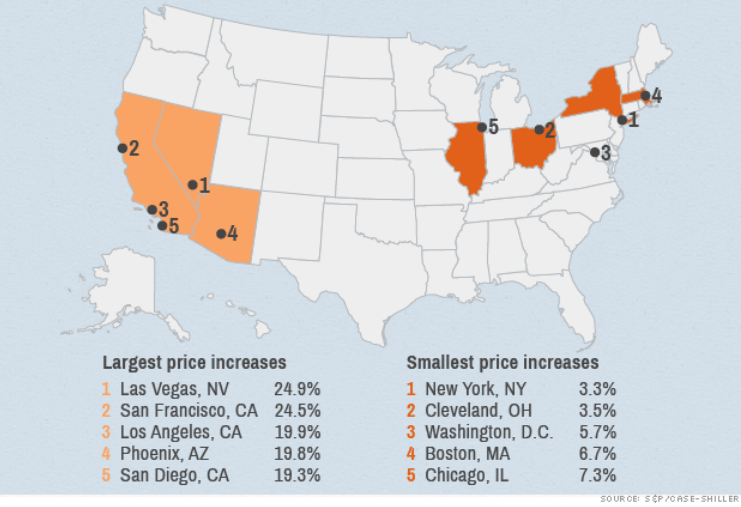
Home prices are still surging, but the pace of the gains has steadied as interest rates continue to rise.

Prices for homes in the nation’s 20 largest cities in June rose 12.1% over the last year, according to a report Tuesday from S&P/Case-Shiller home price index.

While that gain is still robust, it didn’t quite match the gain of 12.2% reported for May. Rising mortgage rates may be to blame.

“With interest rates rising to almost 4.6%, home buyers may be discouraged and sharp increases may be dampened,” David Blitzer, chairman of the Index Committee at S&P Dow Jones Indices, said in a press release.

Home prices have been on a tear for the last twelve months. June marks the first time in over a year that the overall increase has been smaller than the month before. While prices rose in all 20 cities measured by the index, only six cities in June saw price increases larger than the month before, down from 10 cities in May.

Prices in Dallas and Denver hit all-time highs, while San Francisco housing prices notched the biggest rebound, rising 47% from their low in March 2009.

U.S. home prices are now at early 2004 levels — still 23% below their peak in mid-2006.

And while mortgage rates have been steadily rising for the last few months, they’re still at historically low levels.

Record-low rates, a lack of new homes on the market and years of pent up demand have been the driving forces behind the recent home price spike, according to Erik Johnson, senior U.S. economist at IHS Global Insight.

“The shortages are likely to get larger before getting smaller,” Johnson wrote in a note Tuesday. “We still expect housing to remain a key driver of growth for at least the next couple of years.”

Related: How the Fed can taper without killing housing

The recovering housing market has been a big part of the nation’s economic recovery since the Great Recession. But many fear that rising mortgage rates could put a damper on that growth.

Rates have risen more than a full percentage point since May, when Federal Reserve Chairman Ben Bernanke indicated the Fed may soon ease its bond buying program that’s helped keep interest rates at record lows.

While some cheer the Fed stepping back from its unusual bond purchases amid fears the buying will spark inflation, others worry that it may be too soon.

CAMICB: New Name for NBC-CAM

CAMICB_LOGO_RGB

The National Board of Certification for Community Association Managers (NBC-CAM), the organization that administers the Certified Manager of Community Associations (CMCA) credential, was recently renamed Community Association Managers International Certification Board (CAMICB). The name change reflects a strategic commitment to professionalism, knowledge and sound business practices in community association management throughout the world.

The organizational name change is effective immediately. The new organizational name will be phased in over the coming weeks online and in all print materials.

In discussing the rational for the name change, Rob Felix, CMCA, LSM, PCAM, RS, chair of the NBC-CAM board of commissioners, has noted, “In recent years we have partnered with organizations in Australia, Dubai, South Africa and elsewhere to instill high standards of professionalism in our industry across international boundaries. As we expand the use of the CMCA to international audiences, a name change became appropriate.”
It is important to note that the policies, procedures and processes in place for the administration of the CMCA credentialing program are not impacted by the change in organizational name.

The CMCA application process will not change, nor will delivery of the CMCA exam. The CMCA examination will continue to be developed and maintained in full compliance with the standards linked to the examination’s accreditation through the National Commission for Certifying Agencies (NCCA).

The CAMICB Board of Commissioners and staff look forward to increasing both the reach and the recognition of the CMCA credential –“The Essential Credential” in the field of professional community association management.

For more information, e-mail info@camicb.org.

Do You Need a Résumé in the LinkedIn Era?

by Alexandra Samuel

Now that LinkedIn has become the standard place to present your professional history and credentials — not to mention the fastest way to check somebody else’s — the humble résumé has lost its once-hallowed position as the canonical version of your professional identity. Your LinkedIn profile should be the most-viewed and most current version of your professional life. That has many people asking: Do I even need an old-fashioned résumé anymore?

The answer is a highly qualified “yes”.

The Value of LinkedIn

In the past, résumés have served several functions:
1. Applying for a job: When you’re applying for an advertised position, you almost certainly need to submit a résumé as part of the application process.
2. Job hunting: Even if you’re not applying for a specific job, you may still use a résumé as part of your search process, as a way of introducing yourself to people who may be interested in your skills.
3. Professional credentialing: Résumés act as a way of establishing your professional credentials in many circumstances, like grant applications, requests for proposals, and conference or speaker submissions.
4. Professional memory: Your résumé is your own professional memory. Keeping it up-to-date is a way of ensuring you don’t forget the professional accomplishments or qualifications you may want to highlight during your next job hunt.

In the world of LinkedIn, blogs, and professional landing pages (a.k.a. “nameplate” sites), however, most of these functions can be better accomplished through your online presence. If you are job hunting, send people to your LinkedIn page instead of sending a PDF of your résumé. (Unlike a résumé, a solid LinkedIn profile includes not only your self-proclaimed qualifications, but testimonials from colleagues, clients, and employers.) If you need to establish your professional credentials, sending someone a link to your LinkedIn page will often be the most efficient way to convey your relevant experience. And for maintaining a professional memory, LinkedIn is unbeatable, precisely because it’s easy to update, and because you’re likely visiting the site on a regular basis.

To serve any of these purposes, however, your LinkedIn presence must be well-crafted and up-to-date. Even if you aren’t sending people to your LinkedIn page, it is likely to be one of the first results for anyone who Googles you to find out about your professional qualifications and experience. That’s why you need to ensure it’s accurate, compelling, and current; unless you’re updating your LinkedIn profile monthly or at least quarterly, you’re not putting your best foot forward. Setting up a memorable short URL for your LinkedIn profile, and including that URL in your email signature line, is a good way to remind yourself that this is something people are going to look at regularly.

Blogs, Websites, and Landing Pages
For all its merit, LinkedIn has limitations: you have to fit your career story into its structure, and you have only minimal control over formatting. That’s why many professionals use their own blog, personal website, or professional landing page to craft a more strategic online presence. For many professionals, the best bet is to maintain several presences, customized to different purposes, so that you can point people to the presence that is relevant to each specific scenario. For example, you might maintain:
• A speaking profile: Professionals who do a lot of speaking or conference submissions would do well to create a specialized presence on a speaker directory like ExpertFile (formerly Speakerfile), a nameplate site like about.me, or even on Slideshare.
• A services profile: If you offer services as a independent contractor, whether that’s as a web developer, a designer, a coach or an accountant, setting up a landing page for your contract work can be an efficient place to point potential clients.
• An author profile: If you have a book, blog, or publication file, you will want to profile yourself for readers or future writing assignments with an author page on Amazon, a writing marketplace like MediaBistro, or a web presence for your book.

Why You Still Need a Resume
When you are actually applying for a job, however, neither LinkedIn nor a professional landing page can replace the résumé. A strong résumé is still the gateway to an interview, and with more and more employers relying on Applicant Tracking Systems (ATS) — software that screens résumés to determine which applications warrant human review — you need a résumé that you can upload to those systems. Nor can it be the same résumé for every application; since an ATS typically screens for specific qualifications and keywords, you need to customize your résumé for each job (or type of job) that you apply for, and optimize it for ATS screenings.

Even when you are reduced to creating a résumé that is an old-fashioned printable document, LinkedIn can still make your life easier. LinkedIn offers a free résumé builder that converts your profile into a draft résumé which you can format, tweak, and even download as a PDF. Don’t rely on the résumé builder to do the work of résumé creation on its own, however. When I compared LinkedIn’s automatically-generated résumé with the latest version I authored myself, the handcrafted version got an A+ from the résumé evaluation service RezScore, while the LinkedIn version only got a B-. And that was after I gave up on the PDF, and turned it into a more scannable Word document that I then cleaned up.

While it can’t eliminate the job of editing and formatting your résumé for specific job searches, LinkedIn and its résumé builder can and should change the way you think about and maintain that résumé. The standard wisdom — treat your résumé as a living document that you update anytime you have a new accomplishment to record — now applies to LinkedIn, not to your résumé itself.

Keep your LinkedIn profile up-to-date, along with any professional landing pages or blogs you choose to maintain, and most of the purposes of your résumé will be well-supported. And at the moment that you’re actually applying for a job and need an old-fashioned résumé, LinkedIn’s résumé builder will give you a strong head start.

Alexandra Samuel is Vice-President of Social Media at Vision Critical, a market research technology provider. She is the author of Work Smarter with LinkedIn (Harvard Business Review Press, June 2013). Follow her on Twitter at @awsamuel.

How to Work Less and Do More

Work/life balance is every entrepreneur’s dream. Here are one entrepreneur’s tips for growing your business without giving up your life outside the office.

By Tom Searcy
About a year ago, a CEO I know well was on the verge of burning out so she decided to set about transforming her business-life routine. She wanted to work less and yet still see her continue to grow rapidly. Who doesn’t, right? In fact, her goal was to double her business and at the same time work only four days per week. A year into her quest, I caught up with her and asked her how things were going.

She said that the business was doing surprisingly well, even ahead of the aggressive projections for growth she had set. How did she do it? The key was in changing some long-established habits. Below, she explains some of the changes she enacted that allowed her, and her company, to get more efficient.

1. Check email 2-3 times a day and never first thing in morning–As CEO, I found I was spending entirely too much time on busywork and other people’s priorities. Cutting back the number of times I checked e-mail freed up a significant chunk of my time every day. I also learned how to utilize the functionality of Microsoft Outlook (especially e-mail rules) and set up automated filing of routine e-mails into folders that I can batch and read at my convenience and not be distracted by them individually.

2. Establish rules about communications:
a. E-mail is not for urgent issues. My rule is “If you need to speak with me urgently, call me.”
b. Meeting management. Meetings are 30 minutes by default (instead of 60) unless otherwise needed and justified. They also are not accepted on the calendar without an agenda 24 hours in advance.
c. Meetings are for decisions only. That means they are not just for communication–that can be accomplished more efficiently by other means.

3. Keep a running list of items to discuss with your team–Often times being in attendance at the office every day of the week creates an environment of “drop-in” availability which is inefficient. By keeping a running list of items to discuss with key team members and then using scheduled time to unpack all of the issues at once limits the frequency and inefficiency of one-off meetings. You also get the added benefit of more self-reliant people.

What she learned along the way:
1. Improved productivity–Freeing up the time also freed up my mind. One of the great values that CEOs can bring to their company is clarity and decisiveness. This requires time out of the snowstorm of the day-to-day operations.

2. Focused on doing important things rather than everything–Setting the rules for communication not only changed my perspective on my day-to-day contributions but also changed my team’s approach to their workload and productivity.

3. An improved work/life balance–It may seem like a little change, but that extra day per week has really helped my mental and physical health.
It’s possible. You can do this. In this case, the transition took about 3 months to complete, and there have been some exceptions to the 1-day off schedule because of conferences and clients. However, I have a 75 percent success rate of taking Mondays off and things are getting better.
Author, speaker and consultant TOM SEARCY is the foremost expert in large account sales. With Hunt Big Sales, he’s helped clients land more than $5 billion in new sales. Click to get Tom’s weekly tips, or to learn more about Hunt Big Sales.
@tomsearcy