CAMICB is a more than 25 year old independent professional certification body responsible for developing and delivering the Certified Manager of Community Associations® (CMCA) examination. CAMICB awards and maintains the CMCA credential, recognized worldwide as a benchmark of professionalism in the field of common interest community management. The CMCA examination tests the knowledge, skills, and abilities required to perform effectively as a professional community association manager. CMCA credential holders attest to full compliance with the CMCA Standards of Professional Conduct, committing to ethical and informed execution of the duties of a professional manager.
The CMCA credentialing program carries dual accreditation. The National Commission for Certifying Agencies (NCCA) accredits the CMCA program for meeting its U.S.-based standards for credentialing bodies. The ANSI National Accreditation Board (ANAB) accredits the CMCA program for meeting the stringent requirements of the ISO/IEC 17024 Standard, the international standards for certification bodies. The program's dual accreditation represents compliance with rigorous standards for developing, delivering, and maintaining a professional credentialing program. It underscores the strength and integrity of the CMCA credential.
Privacy Policy: https://www.camicb.org/privacy-policy
The Board of Commissioners and staff of Community Association Managers International Certification Board (CAMICB) are deeply saddened to see so many of our credentialed professional managers and the communities they serve, impacted once again by a natural disaster of historic proportions. We have profound respect for the commitment each of you in the path of Hurricane Ida have demonstrated in recent days to your communities, and will continue to demonstrate as you begin a painful process of recovery.
Our thoughts are with you and the residents who rely on you to provide steady, focused leadership. Homes are destroyed, power outages are extraordinarily widespread, movement is limited, and daily life will not return to normal for a very long time. And, unfortunately, as the storm moves deeper inland its impact will continue to be felt as torrential rains trigger massive flooding.
We are reminded of, and grateful for, the vast team of first responders who have stepped up in response to the hurricane as soon as conditions permitted and continue to work tirelessly against one of the most powerful storms ever to hit the United States.
Please stay safe. We wish your communities a quick and full recovery.
Like most people at work and in their personal lives, you probably spend many hours a day conversing with others informally or in meetings, face-to-face interactions, telephone calls, and so forth. These conversations can either strengthen or weaken work and other interpersonal relationships, including ties to friends and loved ones.
Listening lies at the heart of just about everything we do with people. The average person spends about 50 percent more time listening than speaking. In fact, the typical person listens about a book’s worth a day.
The cost of ineffective listening is most clear in your relationships. Poor work relationships can be disastrous to one’s career, while strong work relationships boost one’s career.
If you want to practice your listening skills so you can build strong relationships at work and at home, take note of the following do’s and don’ts of great listening from Listen Up or Lose Out by Robert Bolton:
8 DO’S & DON’TS OF GREAT LISTENING SKILLS
? Don’t ignore trouble spots in the talking-listening process. Trouble spots in the talking–listening process make it vulnerable to miscommunication. Language is imprecise. Talking conveys only an approximation of what we mean. Any miscommunication can likely be traced four common impediments:
People often assume they perceive a situation objectively when, in fact, they often are reacting to it and thus may misunderstand it and speak inaccurately about it.
To speak meaningfully to another person, you must translate your thoughts and/or feelings into words—a process called encoding.
We ad-lib our way through most conversations, so when we talk, we’re usually winging it.
It can be challenging to read the nonverbals of whoever is speaking to you.
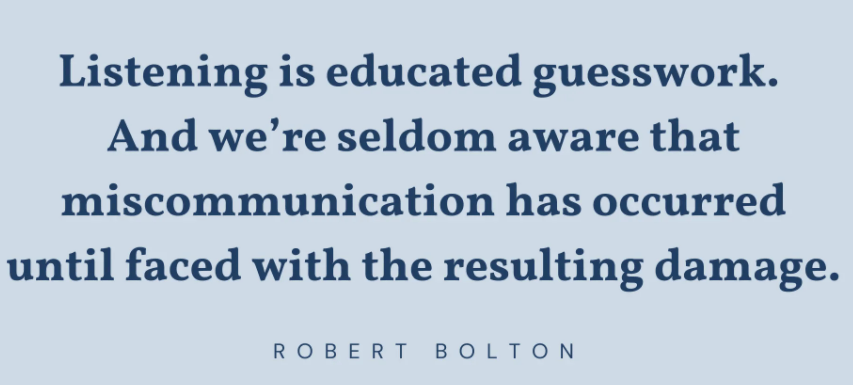
Listening is educated guesswork. And we’re seldom aware that miscommunication has occurred until faced with the resulting damage.
?? Do identify your listening missteps. People often turn what should be a listening situation into a speaking situation. And when they reply instead of listening, they often use one of 6 common communication missteps: disagreeing/agreeing, criticizing, questioning, advising, reassuring, or diverting. Your ability to recognize your one or two most often used listening missteps is an important first step toward eliminating those that you over-rely on and thereby greatly improving your listening.
?? Do reduce major missteps. Once you know your listening missteps, you must practice replacing the misstep with good listening. It’s important to identify and decrease your reliance on missteps that have been damaging your listening effectiveness. But be kind to yourself as you practice because ridding yourself of a given misstep will often take four stages.
First, you’ll notice your misstep after it has already occurred. Then, you’ll realize it as the words come out of your mouth. Next, you’ll reach an understanding of your misstep that allows you to consciously refrain from uttering it. Finally, you’ll be free of the misstep as you’ve created a habit of much better listening!
?? Do practiceSkill-Based Listening. Right now, you probably engage in ordinary listening. Great listeners practice skill-based listening, which means they use a set of skills to accurately understand the speaker’s thoughts and feelings from the speaker’s point of view and restate the essence of the speaker’s message until the speaker has fully expressed the point he or she is making. (Whew, we’re out of breath…develop these skills by reading Listen Up or Lose Out)
? Don’t forget to wait your turn. Knowing when to listen and when to speak is central to making your interactions more focused and productive. Use the communication skill selection question, which you can use to guide you into making good decisions about when to listen and when to speak. At the beginning of each conversation (and at key junctures during the interaction), ask yourself the communication skill selection question: “Whose need to talk is greater?” When the other person has the greater need to talk, you listen.
?? Do focus your attention. Good listeners focus their undivided attention on the speaker—giving him their full postural alignment, mental concentration, and emotional responsiveness. This skill, known as attending, is the body language of listening. Also use the companion skill of using encouragers—one- to three-word statements or empathic sounds like “Mm-hmm” that enable a listener to participate audibly in the conversation without distracting or interrupting the speaker.
? Don’t neglect your ability to ask questions. Asking well-targeted questions can be immensely important in one’s business as well as personal life. Robert and Dorothy Bolton share five guidelines for the process of asking questions productively in Listen Up or Lose Out.
?? Do create and sequence productive questions. It’s not enough to know how to answer well-targeted questions. You must also sequence your questions productively. How you phrase a question can have a significant impact on the usefulness of the responses you get.
Next Steps
Now that you know the do’s and don’ts of great listening, it’s time to get strategic. Create a plan for how you’ll practice your listening skills with your coworkers, boss, family, and friends.
Use Listen Up or Lose Out as a guide and let us know how your relationships improve by working on this one, simple skill in the comments!
By Madeline Hay, CAMICB Manager of Exam Administration
Over the past 25 years, the Certified Manager of Community Associations (CMCA) credential has been a catalyst in establishing community association management as a discrete profession. The common interest community housing model exists around the world and there has been consistent interest in the CMCA credential, the educational pathways to achieve the credential and the continuing education requirement to maintain the credential. Passing the CMCA examination and maintaining the standards of the CMCA certification is proof that a manager is knowledgeable, ethical and professional. CMCA-certified managers have the skills to safeguard the assets of homeowners’ associations, giving homeowners peace of mind and protecting home values across the globe.
We, at the Community Association Managers International Certification Board (CAMICB), are incredibly proud that the CMCA credential is the only international certification for managers that is accredited by the US-based National Commission for Certifying Agencies (NCCA) and the globally recognized ANSI National Accreditation Board (ANAB). This dual accreditation underscores the strength and integrity of the CMCA credential. As we continue to celebrate our 25th anniversary year, we are reminded of our number one priority: maintaining, updating and validating the CMCA examination.
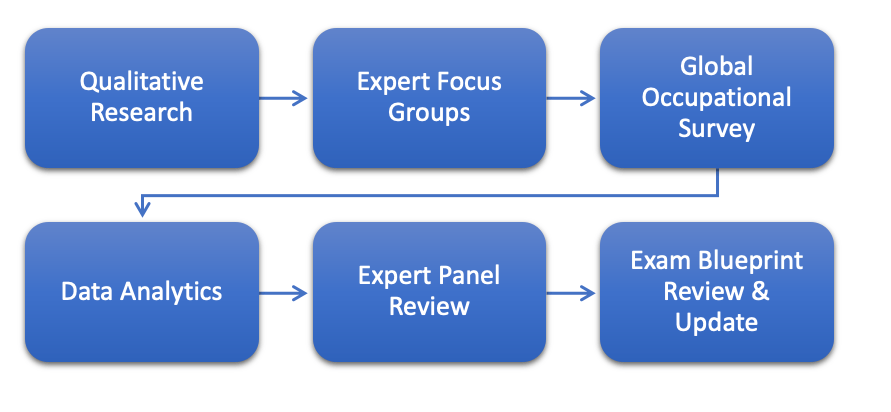
The process we use is rigorous, systematic and in strict compliance with best practices in the credentialing industry. A crucial step in this process is completing a job analysis to examine the current state of community association management – the responsibilities of a professional manager and the knowledge and skills required to fulfill those responsibilities. We carry out this process approximately every five years to provide a benchmark for updating the CMCA exam. Our next job analysis cycle begins this year, concluding in 2022.
The job analysis approach we use involves collecting and aggregating information and insights from job incumbents and occupational experts to determine the content specifications for the CMCA exam. This process is illustrated in the graphic below. A significant component of the process is an electronic survey sent to thousands of association management professionals worldwide to gather information about their job duties and requirements. The survey results will be reviewed with the pool of subject matter experts comprising the CAMICB Exam Development Committee to obtain their input and judgments regarding current trends in the profession and the importance of the knowledge for competent performance in the field.
As the CMCA credential has grown internationally, this upcoming study will build on that growth. Joseph Caramagno, MA, who leads the survey process and analysis and is a Senior Research Scientist for Human Resources Research Organization (HumRRO), CAMICB’s test development partner said, “While the job analysis survey has taken a global approach in the past, we’re making changes to the process to reach even more managers working around the world.” Caramagno explained, “The focus for this survey cycle is to fully understand, at a global level, the essential tasks and duties that comprise a manager’s day-to-day work and what they must know to carry out those duties effectively. Additionally, this input will help shape our understanding of the profession.”
The survey will be available to managers all over the world in the second quarter of 2022, and managers at all levels of experience must participate to ensure we have broad representation and an accurate view of the profession.
Said Chair of the CAMICB Board of Commissioners, Drew Mulhare, CMCA, LSM, PCAM, “This process is a critical component to maintaining and validating the exam as the results guide the development of a new CMCA exam blueprint, which assures we are testing what we need to be testing. In addition, this comprehensive survey will help us emerge with a clear vision of what the field of association management around the world is today, how it has changed over the last five years, and what the minimum requirements for certification are when we take that global perspective.”
Julie Winkle Giulioni for SmartBrief Industry News, Leadership and Management
Today’s hybrid and remote environments offer organizations a range of ways to deploy staff and get work done. But flexible new arrangements also introduce complexity.
What’s the impact on culture when huge numbers of employees are no longer co-located? How can we handle the resentment of those who, because of their roles, cannot work elsewhere? What will the office of the future look like? How can communication remain clear and consistent when the workforce is so dramatically distributed?
Perhaps the most vexing question is: “How can leaders ensure fair and equal treatment to all employees?” Why? Because face time, or proximity, bias now joins the lengthy list of biases we must become aware of and guard against to ensure the success of hybrid and remote efforts.
To be fair, this issue isn’t new. UK government data on home-based work over the past decade suggests that, even pre-pandemic, working remotely “could negatively affect an employee’s earning potential, their chances of promotion and their likelihood of receiving a bonus.” And an April 2021 survey of US employees finds that 52% fear being remote means having fewer chances for career advancement.
What is new, however, is the volume of employees facing this new reality and the risks it poses to an organization in terms of reduced leadership diversity, unwanted turnover, lackluster performance and even legal action.
While it’s frequently thought that success of hybrid and remote workplaces rests with executives or HR, the truth is that in many ways, it’s in the hands of leaders and employees.
This article is the first of a two-part series that will offer steps leaders can take to combat proximity bias and help our organizations realize the extraordinary benefits associated with a well-functioning distributed workforce. This first part addresses the leader’s role. Next month, we’ll explore what employees can do as well.
The leader’s role
Leaders have always played a central role in the employee experience; but they may be even more of a lynchpin today for hybrid and remote workers. That’s why overcoming proximity bias becomes all the more critical. You can take steps in the right direction with these strategies.
Raise your personal awareness
Overcoming any bias requires first becoming aware of it. So, begin by exploring how you really feel about remote work and workers. Honestly confront your personal preferences (which might include having all team members in one place). Consider your assumptions about employees who operate virtually. Ask yourself what “reliability,” “hard work” and “commitment” look like. Take some time to reflect and unpack what’s operating unconsciously (as well as consciously) around this topic for you.
Once you’ve begun to understand your own biases, take a look at your team. Notice your feelings toward each person. Is there a relationship between your go-to resources and where they work? Candidly challenge yourself to see if you may be inadvertently favoring some employees over others based upon proximity.
Redefine “face time” and “right place, right time”
Serendipity is part of business. The informal give-and-take wandering around the office, impromptu meetings and casual watercooler conversations certainly contribute to culture and the informal flow of information among employees. But these shouldn’t be the exclusive vehicles for making that happen.
Leaders who are willing to reimagine the idea of connection can create new norms, such as spontaneously looping remote workers into an on-the-spot conversation and formalizing informal conversations with more frequent check-ins.
Pro tip: Create a roster of all employees. Each time you have even a casual exchange with someone, mark it down. Routinely review the roster to consider your natural connection trends and the biases that might be associated with your behavior. Then, make a point to even things out with more — and more conscious — attention to communicating with underrepresented co-workers.
Establish clear and measurable expectations and standards for all employees (and use them to make data-driven people decisions)
One of the first steps toward ensuring equity among team members is to hold everyone to objective standards. Doing so allows you to evaluate specific, observable performance data against the established measuring stick. This can help you focus on the quality of the work rather than where the work is performed. And as with any bias, it can be helpful to check yourself by seeking out and considering disconfirming evidence. Allow data (rather than impressions) to drive decisions and actions that are fair and equitable.
Elevate the inclusive quality of meetings
Meetings have long been an important feature of the business landscape, but in a remote environment, they’ve taken on greater significance because meetings tend to be a virtual employees’ primary vehicle for visibility.
As a result, additional attention to how meetings operate can help leaders challenge and combat their own proximity biases — as well as the biases of other team members. This includes attention to such things as:
Technology: Is the meeting platform accessible to everyone? Do remote attendees have the same tools and ability to participate as others?
Configuration: Is it better for all employees (even those who are co-located) to dial in from separate phones/computers to even the playing field?
Scheduling: Are meetings scheduled at a time that consistently disadvantages those who work virtually? Can the schedule rotate among times zones?
Agenda: Does the agenda include items that all team members can contribute to? (If your purpose is information-sharing, meetings are a costly way to make that happen. Consider another form of communication instead.)
Roles: Will those who are joining remotely be playing as active a role as others? Is there a way to share responsibilities (facilitation, timekeeping, notetaking, etc.) with virtual attendees?
Build a sense of community among employees
Leaders experience proximity bias. But so do employees. And this can lead to a variety of negative outcomes within a team, including resentment, hostility, disengagement and undesirable performance. That’s why leaders should prioritize creating the conditions that build support among employees.
You can do this in a variety of ways. Encourage the sharing of progress and accomplishments. When co-located employees don’t have visibility to what their virtual peers are doing, it’s easy for them to assume that nothing is happening. Launch a buddy system with remote and co-located employees who are paired up for reciprocal mentoring and support. Create open chat spaces or virtual watercoolers. And strategically delegate work in a way that ensures collaboration between co-located and remote employees.
Unfortunately, bias takes many forms and has many targets. But there’s growing awareness of its insidious impact in an increasing number of organizations, and many leaders are making a conscious effort to understand it, root it out and take the steps necessary to ensure equity for all employees. With 26% of the American workforce working remotely through this year, “where someone performs their work” is another bias we must address immediately.
Check in next month for strategies that you — and employees in general — can implement to combat the potentially career-thwarting impact of proximity biase.
Thank you to Peter Giulioni for his research that contributed to this article.
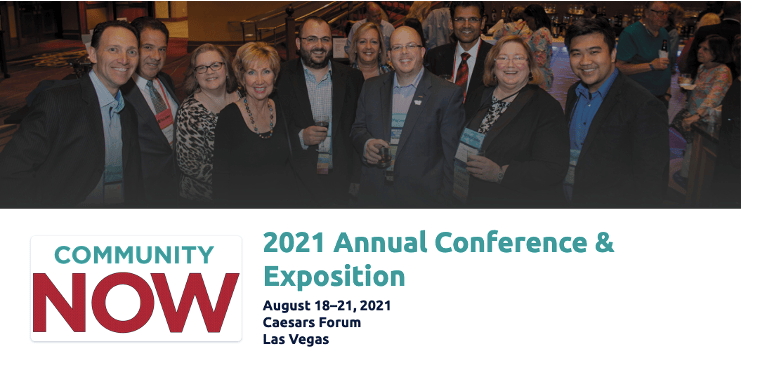
Summer is flying and we can’t wait to see many of you – in person Thursday – at CAI’s epic event of the year, Community NOW: 2021 Annual Conference & Exposition.
CAMICB is eager to resume the celebration of our 25th anniversary after many personal and professional activities were put on hold for the past 18 months. We’re very much looking forward to the premiere of CAMICB’s 25th anniversary video. We’ll be unveiling this celebratory video at the conference during the Thursday general session on August 19. The video depicts two working community association managers who speak eloquently about what the CMCA credential has meant to them throughout their careers in community association management. We couldn’t be more proud.
We’re also excited to have a presence at the conference in a number of ways, beginning with sponsoring the morning coffee service on Thursday, August 19. Please stop by and join us for a cup of coffee; our staff will be available to answer any questions about the CMCA credential.
Additionally, we’re pleased to serve as presenting sponsor for the Chapter Executive Director lounge at the conference. There too, a CAMICB staff member will be available to meet with chapter personnel and answer any questions about the CMCA credentialing program.
And wherever we are, we’ll have lots of special items commemorating CAMICB’s 25th anniversary! Finally, please stop by the CAMICB desk adjacent to the Exhibit Hall. We’d love to catch up with friends and meet new colleagues and we’ll be there throughout the conference.
Summer is flying and we can’t wait to see many of you – in person next week – at CAI’s epic event of the year, Community NOW: 2021 Annual Conference & Exposition.
CAMICB is eager to resume the celebration of our 25th anniversary after many personal and professional activities were put on hold for the past 18 months. We’re very much looking forward to the premiere of CAMICB’s 25th anniversary video. We’ll be unveiling this celebratory video at the conference during the Thursday general session on August 19. The video depicts two working community association managers who speak eloquently about what the CMCA credential has meant to them throughout their careers in community association management. We couldn’t be more proud.
We’re also excited to have a presence at the conference in a number of ways, beginning with sponsoring the morning coffee service on Thursday, August 19. Please stop by and join us for a cup of coffee; our staff will be available to answer any questions about the CMCA credential.
Additionally, we’re pleased to serve as presenting sponsor for the Chapter Executive Director lounge at the conference. There too, a CAMICB staff member will be available to meet with chapter personnel and answer any questions about the CMCA credentialing program.
And wherever we are, we’ll have lots of special items commemorating CAMICB’s 25th anniversary! Finally, please stop by the CAMICB desk adjacent to the Exhibit Hall. We’d love to catch up with friends and meet new colleagues and we’ll be there throughout the conference.
The Courtyards community in Suntree has two entrances, one on Pinehurst Avenue south and one on St. Andrews Drive.
Since the beginning of the community, there has been a 20-foot flagpole at the Pinehurst entrance.
Today, there is a new 20-foot flagpole at the St. Andrews entrance, thanks to a community effort.
The community began exploring the possibility of installing a more substantial flagpole at St. Andrews. The homeowners association board decided to ask for donations from the community to pay for the pole, the flag and for the installation.
In December 2020, the board gave homeowners Judy Barrett and Leslie Marcaurelle approval to move ahead with the project, which they named Operation Flagpole.
Federal Flags of Wisconsin guided them through the process of selecting the best flagpole for the area. They chose one that can withstand hurricane winds of up to 225 mph.
They also purchased two 4-foot by 6-foot U.S.-made nylon flags and a solar light for the new flagpole.
The community members responded generously to cover the cost of the flagpole, the accessories and the related landscaping.
Brandy Gautney of Natural Harmony, LLC was hired as the contractor to guide the team through the project.
The project was completed, including landscaping for both entrances just in time for a Memorial Day dedication May 31, 2021.
At the dedication, attended by 25 residents, Sue Hodgson read “My Name is Old Glory.” The Pledge of Allegiance was recited and, just at the conclusion, a U.S. Air Force C-17 slowly flew over the dedication in a fitting tribute to The Courtyards’ new flagpole.
Given these benefits, firms have been expanding their efforts to make it easier for current employees to learn about and apply for new internal opportunities. Creating more open internal talent markets certainly increases the odds that a hiring manager will find that perfect internal candidate, but it also means that hiring managers more often find themselves in the unenviable position of having to tell other employees that they did not get the job. While good data on internal application patterns is hard to come by, recent estimates suggest that managers can expect to receive an average of 10 internal applications for every open job, a number that was confirmed in our conversations with talent acquisition leaders across more than two dozen large organizations. That means it is often the case that 9 employees — 10 if you hire an external candidate — hear “no” each time a job is posted.
How do those rejected employees respond? They respond poorly, at least in the short term. After all, no one wants to be turned down for a job, and the sting is often greater when you are told “no” by your current employer. Studies have shown that internal rejection leads to reduced job satisfaction and reduced commitment to the organization. Rejection can also engender feelings of envy toward the workers who “beat them out” for the job or lead employees to engage in counterproductive work behaviors, such as stealing from their companies. If employees stick around a few months after rejection, however, these negative attitudinal effects tend to fade away.
But many employees decide not to stick around. In fact, research indicates that rejected internal candidates are nearly two times as likely to leave their organizations compared to those who were either hired for an internal job or had not applied for a new job at all. The lost productivity, combined with the costs of finding replacements for these employees, is often substantial. We wanted to figure out how firms might systematically reduce the likelihood that rejected candidates will exit. Fortunately for firms, our research suggests that while rejection may be inevitable, turnover is not.
We analyzed just over 9,000 rejection experiences of employees at a Fortune 100 company over a five-year period. A key insight from our research is that employees do not apply for jobs solely because they want a new job right now; they also apply to learn what opportunities might be available to them in the future. If an employee is rejected today, they are more likely to stick around if they feel they will have good chance to advance tomorrow. Because flatter hierarchies, rapidly changing job requirements, and increased external hiring have combined to leave employees perplexed as to what career paths look like within their organizations, the easiest and most straightforward way for employees to figure out what opportunities are likely to be available — both today and in the near future — is to apply for a job. While a rejection is a clear indication that the employee is unable to move into a role now, employees also pay close attention to two aspects of the hiring process to determine whether they are likely to be able to move into a similar role in the future.
Did they interview with the hiring manager?
We found that internal candidates who were rejected after interviewing with the hiring manager were half as likely to exit as those rejected earlier in the process. The reason is twofold. First, because hiring managers usually only interview a very small number of candidates (recent estimates suggest about 2% of applicants), getting an interview signals to the candidate that they already possess many of the characteristics needed to move into the job. Second, an interview provides a forum for hiring managers to give feedback to candidates about any knowledge and skills they may currently lack, as well as how to acquire them if they wish to be hired for a similar job in the future.
In contrast, employees who do not advance to the interview stage tend to feel that their application was not given serious consideration and rarely receive concrete feedback about how to improve their chances of success in the future. They are therefore more likely to look externally for subsequent advancement opportunities.
Important to note: Having someone from HR interview a candidate is not a substitute for a hiring manager interview. In fact, we found that rejected candidates who interviewed with HR but not the hiring manager were just as likely to leave as those candidates whose applications were rejected as part of the automated pre-screening process baked into most applicant tracking systems.
Were they rejected in favor of an internal or external candidate?
We also found that a rejected candidate’s likelihood of leaving was cut in half if they were passed over in favor of an internal candidate rather than an external candidate. Why do candidates seem to pay such close attention to whether a colleague or an outsider was hired? Not surprisingly, employees believe that the past predicts the future. When they see their organization favor an external candidate, they assume they will have to face external competition for similar jobs in the future, lowering their own chances of being hired. When employees see a colleague get hired, they assume that internal candidates (like themselves) will be favored in the future. They are therefore less likely to explore external opportunities.
Additionally, seeing a colleague get hired initiates a positive, upward social comparison process, wherein rejected employees feel as though they can emulate those employees’ successful mobility attempts in the future. We ran additional analyses that supported this argument: rejected internal candidates who were more similar to the winning candidate (in terms of functional expertise and tenure in the company, for example) were much more likely to stick around following a rejection.
Given these results, what should companies do?While it is impractical for most companies to guarantee that every internal applicant will be interviewed, firms must be strategic in considering which employees are interviewed.
Consider the case where a star employee in the marketing department applies for a finance job. It is quite possible that the hiring manager has no idea that this employee is a star in marketing, and it would be reasonable for a hiring manager to be hesitant to interview someone that has little related experience. However, not interviewing that candidate doubles the likelihood that he will leave the company. Organizations should therefore ensure that their applicant tracking systems have a capability to flag applicants whom the organization wants to retain and require that they be interviewed. To prevent hiring managers from being overwhelmed with internal applicants, some of whom might not be right for a given job, we suggest that organizations be thoughtful about who they include on a “must interview” list.” They might also redirect workers to other jobs within the firm for which they might be better qualified. Companies such as IBM, for example, have developed technology that explicitly provides individualized information about alternative internal career paths through online career management tools.
While we do not suggest that organizations should only hire internal candidates, our work does suggest that organizations should carefully consider whether to hire an external candidate when there is a viable internal candidate. External hires can bring valuable knowledge and new perspectives into the organization, but doing so also increases the odds that current employees will take their own knowledge elsewhere.
In short, companies that strategically manage their internal talent market are better positioned to keep rejected employees onboard.
Pay, incentives, and benefits haven’t significantly changed for decades, but people’s preferences have. Employee compensation needs a rethink if companies are to attract and retain talent.
Recently, a major US insurance broker with 20,000 agents started to question why so many were leaving the company—and taking their business books with them. The answer lay in the data about reward. It turned out the company was significantly out of touch with what people wanted. The company’s employee preference surveys had not been translated into the type of benefits it was offering. Based on the new analysis, the company redesigned its performance-based compensation, reduced equity awards, improved supplemental healthcare, and implemented a personalized training and development portal. The result: increases in agent sales performance (of 5 to 20%), engagement (up to 21%), and employee satisfaction and retention (up to 20% in some areas). What’s more, all of these gains came with a decrease in compensation costs of 8 to 12%.
Similarly, a global bank was able to redesign a costly reward package that was failing to retain key talent when it realized that what employees wanted was more than money and shares. They valued choice—especially the flexibility to control certain aspects of the employee experience, including training, working patterns, and even their home office setup. The bank made a number of changes to its offerings, created a platform for individuals to mix and match different corporate benefits, and ended up saving as much as US$2,800 per employee per year while maintaining (and often increasing) retention and employee satisfaction.
These are good examples of why it’s important to regularly rethink old practices. Over the past decade, what people value in terms of employee benefits packages has changed, even though the fundamentals of corporate rewards have not. Year after year, most employers offer the same menu of choices—health benefits, pension contributions, gym memberships, cash incentives—without bothering to ask employees which ones they prefer and which ones they value most highly.
Such complacency has costs. If companies were to ask whether the rewards they offer make a difference, they’d get a shock. Today’s workforce is more diverse than it used to be, attitudes toward work are evolving, and employee preferences are changing. And the speed of that change is only accelerating in the post-COVID-19 world. We know this because for ten years we’ve been collecting data—more than 50 million data points from more than ten million surveys undertaken with global companies—on the trends in employee preferences for financial and nonfinancial benefits, and how much value employees place on them. What we’ve found makes it clear that it’s time to rethink the approach to rewards.
If companies were to ask their employees if the rewards they offer make a difference, they’d get a shock. Today’s workforce is more diverse, attitudes toward work are evolving, and employee preferences are changing.
A key trend we see in the preference data is that employee populations have become more heterogeneous. That means that standardized approaches will rarely lead to an optimal result. Employers need to understand preference at the individual level—in other words, from the bottom up, not from the top down. Rather than offering a plethora of alternatives for people to choose from, the list of options should reflect an understanding of the potential impact on every single employee, not just employees in aggregate.
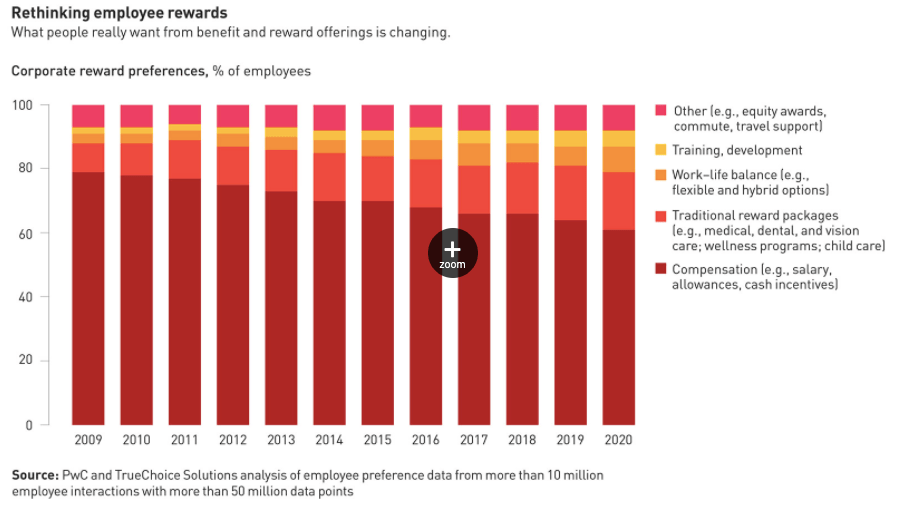
Our proprietary analysis, which uses data collected via TrueChoice Solutions, a preference analytics company headquartered in New York, shows that the relative importance of financial compensation has declined by 11% over the past decade. The importance of other types of benefits—medical, dental, vision, and life insurance; wellness and supplemental health benefits; and child care—has doubled. Work–life balance options and training and career development have tripled in importance (see chart). But HR departments, overly concerned with what other companies are doing or what benefits are most cost-effective, are not keeping up.
Old-fashioned engagement surveys provide little or no meaningful insight into reward strategies because they focus on a point-in-time sentiment rather than a gauge of employee preferences. Companies need a new approach to understanding the big picture of reward that will allow employees to tailor their options. Our data suggests that in many cases, as with the insurance and bank examples above, this will cost companies less than their current blanket reward packages while yielding measurable improvements in engagement, satisfaction, retention, and performance. We suggest a four-step approach to designing reward packages that are fit for today’s changing world: start with the data, customize, communicate, and, continually monitor.
How we got here
Traditional incentive-based pay started with the dawn of industrial manufacturing in the 1920s, when workers were given one-time cash bonuses to meet quotas. The 1940s saw the introduction of longer-term incentives to deliver sustained performance. And through the decades, inducements have been introduced to encourage behavior change and drive results, especially as the global war for talent escalated.
The annual bonus and ratings-based performance management processes that most organizations use today took hold in the 1980s. Companies that wanted to offer more simply added benefits to their offerings, such as company cars, gym memberships, private medical insurance, and cafeterias with free food. Once these became standard, companies that didn’t follow suit became uncompetitive.
That takes us to about 2010. Although some tech companies and startups have sought ways to differentiate themselves (vegan cafeterias, unlimited time off), for the most part reward offerings have not evolved. Recently, environmental, social, and governance (ESG) issues have emerged as a factor in the way people view their relationship with their employers and technology. In a recent PwC survey of 2,500 employees in the US, 84% said they wanted to work for a company that valued ESG. That also includes how it rewards its staff. At more senior levels, bonuses are increasingly based on delivering on ESG metrics, for example.
Companies differ by sector in the types of employees they have. Not everyone wants a gym membership in lieu of higher pay, for example. Nevertheless, our underlying TrueChoice data shows that it’s important to ask people the right questions and understand that how the reward offerings are valued is changing. Some of the topics to ask about:
Well-being. In many instances, employees are willing to trade 20 to 25% of their salary for a much better work–life balance. Understanding this can reduce costs and improve employee well-being.
Healthcare. Supplemental healthcare offerings, such as dental care and private care in countries with a national health service, continue to increase in perceived value for employees and are now worth at least 1.5 times the cost of providing such benefits. This ratio might even increase in the wake of COVID-19.
Purpose. If a company is perceived by employees to live its “sense of purpose,” people consider that to be worth as much as 20% of the total reward in comparison with companies in the same industry that do not.
Training. The perceived value of training and development has almost doubled in the last five years. A person will accept a job at a company that offers a strong development path over a company that doesn’t, even if the job pays less. And digital upskilling is viewed as highly valuable by most employees.
Lifestyle. Benefits such as the provision of a car, a phone, internet service, and a travel allowance are increasing in perceived value even though they can affect taxes.
Pensions. For younger employees, pension contributions by an employer often yield a low perceived value when compared with the cost.
Even though there are demographic and cultural idiosyncrasies to the data, these insights start to help us think differently about what employees should and shouldn’t be offered.
A new urgency
The COVID-19 pandemic and its effect on where and how people are working have given HR departments good reasons to rethink their reward offerings now. The blurring of the boundaries between work and home and the emergence of hybrid working means that traditional structures are no longer fit for purpose. Couple that shift with an increasingly diverse workforce that is looking for new approaches to rewards, and it’s clear companies need to make adjustments.
For example, a London-based banking organization we’ve worked with is planning a “return to work” road map that incorporates flexible working. Its traditional offerings of a car allowance and high-cost-location supplement (also known as London weighting) are no longer relevant for some. Instead, it should think about providing well-being support, helping with home office setup, and offering training to future-proof skills in a changing organization.
In the current squeeze for global and local talent, PwC Australia decided to take a new look at its rewards and benefits options to understand what influenced people to work for the firm and stay. “Like many [other] organizations, we have been challenging ourselves to reimagine how we do things in response to the uncertain global environment. This drove us to consider something beyond the usual market analysis, benchmarking, and tinkering with our old systems,” said Catherine Walsh, head of people and culture at PwC Australia.
The data showed clearly that although financial reward remained important, career development, skill-building, mentoring support, and well-being were much more than afterthoughts for most people. The analysis looked at the “whole person” and not just the “person on the job,” taking into account employees’ stage of career and stage of life. Then, using predictive analysis, the organization can restructure the menu of benefit choices. This approach can yield a return on investment that is up to five times by giving people what they want and not paying for things that are not valued. “From pay, bonuses, recognition, career paths, promotions, development, flexibility, and hybrid work to social inclusion and personal impact, our new model truly reflects what our people value most, depending on level and stage of career,” said Walsh.
Here are four key areas to consider to create rewards that work for you and for your employees:
Data and insights. Understand your employees and your workforce segmentation. Collect a series of data sets from engagement surveys and real-time preference analytics that give employees choices. These can be cross-referenced with other data, including demographics, locations, and career development goals, to elicit rich insights and identify what is valued. Companies can use predictive analytics to make evidence-based decisions and apply the results to reward offerings. Because financial compensation appears to be declining in importance compared with other rewards, companies should ask what employees would trade for cash, for example.
Customize and be creative. Understanding the data and insight allows companies to personalize their total reward packages, offering “deals” that bundle types of rewards, benefits, and experience. Our data indicates that if employees feel they have choice and control, they place greater value on the overall offering. Reward today might even include choices involving environmental impact or time with the family.
Using the data, companies can step out of the traditional rewards silo and come up with new rewards to match the new ways of working. Two of the main drivers of preferences and value are the life stage of an individual and that individual’s career aspirations. Understanding these drivers for each employee should inform the new ways of rewarding people, with more focus on learning, mentoring, career development, and well-being than on financial reward. Customization is challenging, as the added complexity generally costs more. We have found the best path to improved business performance is to apply an 80/20 rule: maintain 80% of the current offering (albeit streamlined and simplified) and redesign 20%.
Communicate and implement. Once the total reward offerings have been personalized, they need to be effectively communicated. The value proposition needs to be explained clearly. Our research shows that 80% of people expect a more consumer-based experience in the workplace. Importantly, employers need to combine such an experience with the ability to personalize offerings and provide support and guidance for those decisions. It should be as easy as using a restaurant delivery app, for example, to sign up for a customized reward package. A significant driver of perceived value can be found in helping employees answer the question “What is right for me?” However, most employers fall short in this area and in describing their total reward offerings. More than 70% of employees feel they do not know or understand what benefits their employer offers and would value better guidance and decision support.
Increasingly, companies are tying rewards messaging to a broader agenda—for example, upskilling and learning pathways, or agility and internal mobility. One company we worked with tied its offerings to “limitless possibilities” and gave individuals control over learning playlists, projects, and working abroad.
Monitor and evolve. Leaders need to be agile and recognize that the landscape will continue to transform. Employee preferences will change. Today, “learning is the new pension.” Companies can experiment with offering a learning pot, or allowance, for example, directed to new skills for the job; education could be traded off against pension contributions. Or there could be incentives for “intrapreneurship,” such as a points system for creative contributions to the company.
Customization doesn’t mean absolute choice. Employers create offerings based on employee preferences, which is why step one—data and insights—is so important. And trade-offs need to be quantified. It may be too expensive, for example, to offer everyone the same upskilling opportunities.
Today’s total reward offerings need to keep up with the dynamic and increasing heterogeneity of preferences and perceived values of employees. Competitive salaries are important, but they are only one piece of the puzzle. It is critical that companies focus on the needs of the whole person and not the requirements for the job, and offer the benefits employees value. The real differentiator for companies looking to attract, keep, and motivate talent today is customization and communication. Employers that transform their total reward offerings with this mandate in mind will create a sustainable win for all stakeholders and have a significant competitive advantage in the ever-present war for talent.
Author Profiles:
Andrew Curcio is the joint global leader of the reward and benefits practice of PwC. He specializes in solving complex people problems for global organizations, focusing on total reward and performance improvement. Based in Melbourne, he is a partner with PwC Australia.
Alastair Woods is the joint global leader of people analytics at PwC, working with multinational global clients. Based in London, he is a partner with PwC UK.
Gratitude doesn’t have to be complex to be powerful. Dr. Bob Nelson, author of 1,501 Ways to Reward Employees, offers seven simple tips.
By Bob Nelson for Chief Executive Magazine
1. It isn’t about money. “Money is compensation,” says Nelson. “Compensation is a right, recognition is a gift. Part of why recognition means so much is you don’t have to do it.”
2. Timing is everything. Nelson urges leaders to lose no opportunity to praise swiftly, sincerely and proactively. “You can do a great praising in 10 seconds in the hallway. The sooner you can catch people doing something right, the more you reinforce it, the more likely they’ll be repeated. So, if you see something, say something.”
3. Be sincere. “It has to come from the heart to be sincere, which sometimes is a difficult thing to teach someone. Some of the sincerity comes from specifics. Use specifics. Tell them what you heard, what you saw, what came to your attention. That gives it more credibility.”
4. Make it personal. “Which of course is tough because you can’t be everywhere all the time. But when you can add the personal touch, when you can do it face-to-face or with a direct phone call, that’s going to have more power.”
5. Praise, then stop. “A lot of executives…they’ll say something nice and then, they’ll take it away with what was wrong with the project, that there were typos or whatever it might be. My advice is to just stow that for now. Keep it 100 percent positive. Managers and leaders do this so infrequently—so don’t mess it up when you do it, keep it pure.“
6. Make it a habit. “I like to think of ways you can work it into your daily pattern, for instance, at a staff meeting Monday morning, that type of thing. You can use that initial start time to call out recognition of good things individually for the team, for the company. That’s very powerful.”
7. Be proactive. “You’ve got to actually look for opportunities to acknowledge and be grateful for people. If you’re just reactive, you end up being reactive around the mistakes. If you’re an executive, it has more punch, more power. Often it’s more symbolic, and it sends a message to other people that this is something we all need to do.”