CAMICB is a more than 25 year old independent professional certification body responsible for developing and delivering the Certified Manager of Community Associations® (CMCA) examination. CAMICB awards and maintains the CMCA credential, recognized worldwide as a benchmark of professionalism in the field of common interest community management. The CMCA examination tests the knowledge, skills, and abilities required to perform effectively as a professional community association manager. CMCA credential holders attest to full compliance with the CMCA Standards of Professional Conduct, committing to ethical and informed execution of the duties of a professional manager.
The CMCA credentialing program carries dual accreditation. The National Commission for Certifying Agencies (NCCA) accredits the CMCA program for meeting its U.S.-based standards for credentialing bodies. The ANSI National Accreditation Board (ANAB) accredits the CMCA program for meeting the stringent requirements of the ISO/IEC 17024 Standard, the international standards for certification bodies. The program's dual accreditation represents compliance with rigorous standards for developing, delivering, and maintaining a professional credentialing program. It underscores the strength and integrity of the CMCA credential.
Privacy Policy: https://www.camicb.org/privacy-policy
Drama over drag is taking center stage in a valley homeowner’s association after a community drag bingo event dropped the drag queen.
The drag bingo event planned for next month was supposed to feature local drag queen Rusty Waters, but the HOA board abruptly sent a memo to community members saying they’d made the decision to remove Waters from the event “based upon concerns voiced by some members of our community regarding Mr. Waters.”
Trilogy resident Cathy Smithweiss installed gay and trans pride flags outside her home to show her support for the LGBTQ+ community. She said she was outraged by the HOA’s decision and spoke out at the board meeting on Thursday. News Channel 3 was not permitted inside.
“I believe that there were some people here that are homophobic,” Smithweiss said, “We’ve now discriminated against people who are our friends and our neighbors.”
In a statement to residents, the HOA board said that the event was rescheduled “out of concern for the entertainer, and not because of the type of entertainment. The board claimed that the decision was not made in a discriminatory manner towards Rusty Waters, who they support performing at their community.
Cathy Smithweiss, a resident of Trilogy La Quinta, installed gay and trans pride flags all over her home She called on community leaders to reverse their decision at the HOA’s board meeting Thursday, saying, “We’ve now discriminated against people that are who are our friends and our neighbors.”
The HOA board issued a statement to residents saying that their decision hold the event with a drag queen was “Out of concern for the entertainer, and not about the type of entertainment…” and that it was not done in a discriminatory manner towards Rusty Waters. The board also emphasized that Trilogy is an open and inclusive community, saying the event would be rescheduled at a later date, and that people who don’t like it can choose not to attend.
However, Smithweiss remains skeptical of the board’s explanation and says that they haven’t said when they plan to reschedule the event.
“I think they’re trying to push it under the rug and pretend they didn’t make this mistake,” she said.
With the ACLU tracking 469 anti-LGBTQ+ bills across the U.S., Smithweiss said that Trilogy’s drag bingo night may not seem like a big deal, but it is.
“Too many small decisions like this are snowballing and they’re really hurting a lot of very good people. These are our friends and our family members. And discrimination is wrong. And we have to stop doing this,” she said.
News Channel 3 spoke with Rusty Waters, the queen who was removed from the even. She said she doesn’t necessarily want to perform at Trilogy in the future and that people against drag should spend their energy on more important issues.
A bill in the Missouri House could allow homeowners from across the state to be freed from the constraints put on them by homeowners’ associations.
“If I could afford a helicopter pad for the property I just bought and I couldn’t build it, I’d be suing everybody,” Rep. Donna Baringer, D-St. Louis, said during a hearing on House Bill 1089, referring to building restrictions imposed on people by homeowners’ associations (HOAs).
Many members of the House Committee on Local Government criticized homeowners’ associations during a hearing Tuesday morning. The bill would create a standard for HOAs across the state and require them to incorporate as a nonprofit. It would also, broadly, compel homeowners to be more active in their HOAs through mandating a certain percentage of a community serve.
“I’m here today to urge you to vote in favor and consider HB 1089. If passed, HB 1089 will establish a Homeowner’s Bill of Rights within the state of Missouri,” said Phoebe Neseth, the director of government and public affairs for the Community Associations Institute, an organization that advocates for HOA members and other community associations.
The Community Associations Institute, according to Neseth, has been advocating for standard regulations across the country for HOAs.
“Each state has the opportunity to create and establish these types of acts that best impact their community associations, homeowners, volunteer board members and managers,” she said.
The bill is sponsored by Rep. Brad Christ, R-Sunset Hills, who said it could potentially erase all HOAs in Missouri.
Some lawmakers still raised issue with the bill, despite their personal experiences with HOAs.
“I don’t agree with everything with my HOA, we’re in the process of changing our bylaws, which is an extremely difficult situation,” said Rep. Gretchen Bangert, D-Florissant.
A clause in Christ’s bill would force all active HOAs to incorporate as a mutual-benefit nonprofit corporation. Bangert took issue with this clause, saying achieving nonprofit status would be a “big feat” for local HOAs to take on.
“I have a little bit of a concern with that … a lot of associations are not incorporated,” she said.
“Yes, that was a piece of the opposition to it, there’s a lot of rules that come together with a nonprofit association like that,” Christ replied.
The bill has changed since it was first introduced 15 years ago, according to Todd Billy, an attorney in favor of the bill. Billy said the bill would address restrictive covenants in cities like Kansas City and St. Louis, a practice that, according to the Metropolitan St. Louis Equal Housing and Opportunity Council, historically kept Black people from owning homes in many neighborhoods in the state.
An article published by the Metropolitan St. Louis Equal Housing and Opportunity Council — an organization that “seeks to ensure equal access to housing and places of public accommodation for all people” — outlined how deeds for houses often had specific clauses that prevented owners from selling, conveying, leasing or renting homes to Black people. Despite no longer being legally enforceable, many of these laws are still on the books to this day.
These laws are called “uniform restriction agreements.” The article states the city of St. Louis saw Black homeowners as a nuisance. These agreements had language that said some cites in the St. Louis region needed to “preserve the character of said neighborhood as a desirable place of residence for persons of the Caucasian Race.”
“If you’re on the St. Louis side, … most have restrictive covenants. On the Kansas City side, there’s usually a declaration of a homeowners’ association and then a declaration of conditions covenants and restrictions,” Billy said. “We’re not even using the same terms through the state. So because of that variety, what we consistently struggle with is associations’ inability to adapt — and properly balance its relationship — with homeowners.”
Billy addressed some concerns raised by lawmakers about title companies and how they often fail to notify homeowners about bylaws their neighborhoods have, including restrictive covenants imposed by HOAs. He said incorporating HOAs as nonprofits would fix this.
“So a nonprofit is actually very easy to form in Missouri. We are not tax exempt, so we don’t have to go through the IRS stuff. So in terms of creating a nonprofit, if I had my computer, I could do it in less than five minutes,” Billy said. “With title companies, (they) don’t know that there’s an HOA and the nonprofit statute already has very good protections.”
Billy said the bill could address the apathy many people have to their HOA, by giving the community greater control and investment in its management. It would require a quorum of at least 20 percent of households in a neighborhood for an HOA to function.
The bill would also mandate a two-thirds vote to pass a raise in the fees charged. Billy used the example of an unincorporated municipality in St. Louis County that brought an internal dispute in their neighborhood to court.
“Their burden on the government is absolutely tied to the HOAs inability to help,” he said. “Instead we empower the owners too, the board proposes a budget and the owners can reject it, which is the same thing we’ve been doing for condos since 1983.”
Arnie Dienoff, a self-identified public advocate and frequent witness during public testimony at hearings, testified against the bill.
“Homeowners associations are a mess, but they’re the (most local form) of governance in our state,” Dienoff said.
While he agreed with much of the bill’s language, like requiring more participation and notifying homeowners of the bylaws in their community, he was concerned by a clause in the bill that would require an audit of an HOA every three years.
“In my HOA, we’ve never had a financial audit and that’s going to be very expensive and very cumbersome for HOAs that are, I would say, 1,000 homes or less,” he said.
HB 1089: Establishes the Missouri Homeowners Bill of Rights
ANNA MARIA – City officials continue to lead the opposition to proposed state legislation that would curtail local governments’ ability to regulate short-term vacation rentals.
Senate Bill 714 and House Bill 833 seek to preempt the regulation of vacation rentals to the state, specifically to the Florida Department of Business and Professional Regulation (DBPR).
According to the April 15 staff analysis provided to House of Representatives Commerce Committee members, HB 833 would still allow local governments to create local vacation rental registration programs and charge an annual registration fee, but the fees could not exceed $50 to register a single vacation rental home or unit, or $100 to collectively register vacation rental homes or units.
The proposed legislation would make the regulation of online vacation rental advertising platforms such as Airbnb and Vrbo exclusively the state’s responsibility and take enforcement abilities away from local governments.
The staff analysis notes the proposed legislation would not supersede the authority of condominiums, cooperatives or homeowners’ associations to restrict the use of their properties and prohibit short-term vacation rentals.
Legislative actions
On April 12, HB 833 successfully passed through the House Ways & Means Committee by a 13-10 vote. State Rep. Will Robinson Jr. (R-Bradenton) was among the 13 members who voted favorably on the bill.
The bill was scheduled to be discussed and potentially voted on by the House’s Commerce Committee on Monday, April 17, the third and final committee stop for the bill before it can be brought to the floor for a final vote by all House members.
SB 714 was scheduled to be discussed and potentially voted on by the Senate’s Appropriations Committee on Agriculture, Environment and General Government Committee on Tuesday, April 18. This is the second of three committee stops scheduled for the Senate bill.
On May 13, SB 714 successfully passed through the Senate’s Regulated Industries Committee by a 5-2 vote.
The proposed legislation dies if it does not successfully pass through three preliminary committees. The 60-day legislative session is scheduled to end on May 5.
Local concerns
Anna Maria Mayor Dan Murphy provided the city commission with an update on the city’s opposition efforts on April 13, noting the issue is the city’s primary legislative focus this year.
Murphy referenced the emails and letters that continue to be sent to state legislators through the city-owned and managed Home Rule Florida website, www.HomeRuleFl.com.
“It’s very impressive the amount of mail that this little city has generated. It didn’t all come out of this city. It comes from across the state because of our website. The lobbyist has assured me our efforts have not gone unnoticed, but we need to keep the pressure on,” Murphy told the commission.
“This thing is sailing through the House and the Senate along party lines. The Democrats are voting no and the Republicans are all voting yes. If it sails through along party lines, which it very well might do, it’ll then go to the governor’s desk for signature. If the governor sees that we already have all these letters, he’s going to think twice before he would sign off on it knowing there’s mass opposition amongst the public,” Murphy said.
Murphy said it’s premature to start lobbying Gov. Ron DeSantis before the proposed legislation reaches his desk.
“The governor’s not going to interfere in the legislative process,” Murphy said. “We need to save our thunder for when and if this thing gets to his desk. That’s when we really need to put a full-court press on.”
Commissioner Charlie Salem asked if the city’s lobbyist has at least informed DeSantis that the proposed vacation rental legislation might be headed his way. Murphy said that’s a good idea.
Murphy implored the city commissioners to urge their constituents to continue sending emails and letters to the Senate and House committee members who will determine whether the proposed bills make it to their respective floors for a final vote.
Murphy said the city’s recent labeling of the proposed legislation as a “party house bill” has gained a lot of traction in Tallahassee.
City Clerk LeAnne Addy and her staff manage the Home Rule Florida website that issues email updates and calls to action to those registered to receive them. The website contains pre-formatted email messages users can use to quickly and easily contact multiple state legislators at one time.
During the April 13 meeting, Addy said HomeRuleFl.com users have sent 30,489 emails to state legislators since the legislative session began in March.
“I’m very impressed by the work LeAnne and the mayor are doing,” Commissioner Jon Crane said. “I’m very impressed with the use of party house branding for this issue.”
“It takes away our right to regulate occupancy and they can jam as many people into a house as they want,” Murphy said in response.
Commissioner Deanie Sebring said most people who vacation in Anna Maria don’t want to stay next to a “party house.”
“If I was going on vacation and renting a house, I wouldn’t want all that madness next to me because it would ruin my vacation,” she said. “If you want to party, don’t rent a place in Anna Maria. Rent it someplace else.”
“It’s a family destination,” Commission Chair Mark Short added.
By Madeline Hay, CAMICB Director of Exam Administration
This summer we asked our vast community to participate in an important global survey of community association managers (CAMs) – and you did. More than 2,100 managers responded to CAMICB’s 2022 Job Analysis Survey that was sent to over 25,000 managers worldwide and ran from mid-June through the end of August. Thank you for taking the time to respond and share your experiences and insights.
Collection of this survey data is the cornerstone of a larger research project, known as a Job Analysis Study, which CAMICB conducts approximately every five years. The purposeof the Job Analysis (JA) is to identify the roles and responsibilities expected of early career CAMs as well as the knowledge and skills they need to perform those tasks successfully. The findings of the study are used to update the CMCA exam structure and content as necessary to ensure relevance to the community association management field of practice.
An overview of the team and methodological approach
To ensure broad representation from the profession, our Job Analysis Project Team included 55 Subject Matter Experts (SMEs), 20 of whom are from countries outside the United States, including the United Arab Emirates, Australia, Canada, South Africa and Spain. In addition, the project team consisted of entry-level and experienced CAMs familiar with the tasks and knowledge expected of early career managers as well as current professional issues.
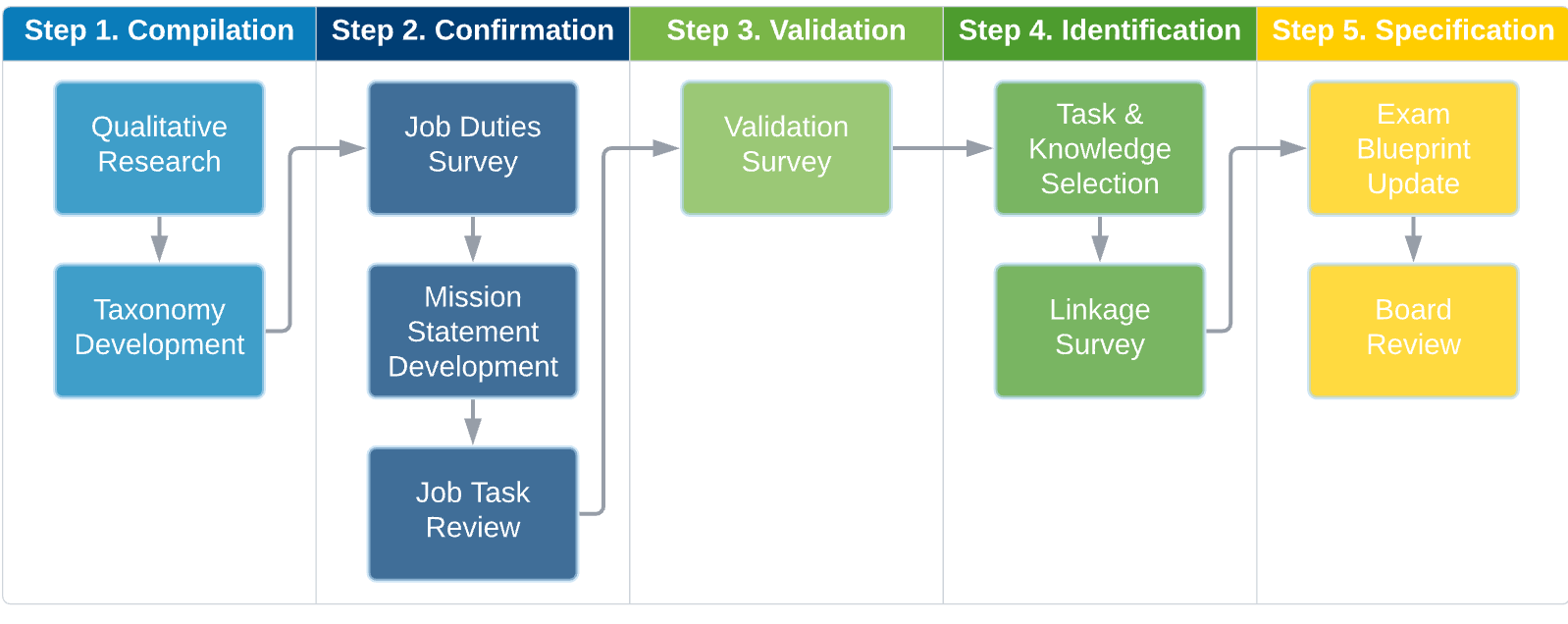
It’s important to note that there were more than a dozen significant steps and qualitative research tasks conducted before developing and administering the Job Analysis Survey. The JA Team started by analyzing over 100 primary sources (training manuals, job descriptions, legal documents, research articles, etc.) to establish a preliminary framework of the job requirements that may be expected of a CAM. From there, they spent 10 months analyzing the types of job tasks and knowledge that early career managers need and classifying them into seven performance areas that describe the major operational aspects of the job.
Using the JA Survey responses collected from thousands of managers around the world, the project team identified which of these tasks are performed most often by early career managers and which are most important to success on the job. The tasks that survey respondents identified as the most common and critical were selected as the tasks that will be tested on the updated CMCA exam.
After finalizing the task list, the JA Team connected each task statement with the knowledge required to perform them competently. The resulting product is a comprehensive examination framework that details the tasks and corresponding knowledge that are expected of a Certified Manager of Community Associations.
As the final step of the study, the JA Team convened for a two-day working session to determine what percentage of the exam should be allocated to each performance area. These percentages will be stated in the forthcoming exam blueprint that will provide the structure and layout for the CMCA exam over the next five years.
Next steps – bringing a new exam form to fruition
To recap, the job analysis study is a research project used to identify the critical work functions carried out by CAMs and the knowledge and skills they need to work effectively. The final product of the study is the CMCA exam blueprint, a document that identifies which knowledge and skills will be measured by the exam and the proportion of the exam allocated to each performance area. After more than 16 months of work, the Job Analysis Study concluded in early December when the CAMICB Board of Commissioners approved the updated CMCA exam blueprint. The team will now carry out the practical steps to update the CMCA exam content to match the new blueprint. The following are some of the steps that will take place throughout 2023 and into 2024:
Item Development: Using approved source materials, the Project Team will draft new exam questions to assess the content areas on the exam blueprint. SME panels will conduct multiple reviews to evaluate the technical quality, fairness, and content validity of the items. The items that pass reviews will then be pilot tested to collect response data and those items that meet all statistical performance standards will be eligible for use on future forms of the exam.
Passing Score Study: CAMICB will conduct a passing score study to update the performance standard established for the CMCA certification program and, subsequently, update the minimum score required to pass the exam (i.e., the “cut score”).
Exam Publishing: CAMICB will publish the new exam blueprint well in advance of updating the exam forms, so that candidates have time to familiarize themselves with the changes they can expect to see in the exam content.
This extremely comprehensive process speaks to the importance the CAMICB Board of Commissioners places on conducting the CMCA program in full accordance with best practices in professional credentialing. We take this responsibility to the profession seriously and are extremely proud of the work we do to continue to establish the credential as a baseline for building the profession worldwide, placing the CMCA credential in an elite cohort of professional certification programs.
A license to vent. Disputes between co-op and condo boards and their shareholders or unit-owners have become more vitriolic than ever, thanks in no small part to the Internet. People can complain viciously and broadcast it instantly while remaining anonymous. It’s a recipe for charges of defamation.
That was the case in Brightwater Towers Condominium v. Vitebsky, Zilberman and Sosina. A number of unit-owners felt that the board was not handling the operations of the 700-unit Coney Island condominium properly. Three of them — Alexander Vitebsk, Leonid Zilberman and Irana Sosina — created a Google group, BWTUnitOwners, and sent out accusatory statements to the nearly 500 unit-owners who belonged to it.
Initial emails stated that board members should not “harass, threaten or attempt any means to control” residents and that the board was “no longer functioning to benefit the owners but to…squeeze extra income from us.” Another declared that the condo had “reached a serious moment of crisis which, if not addressed immediately, will have grave consequences on all BWT owners.”
Another email provided a list of actions board members should not take, including accepting gifts from owners, residents, contractors or suppliers, or spending unauthorized association funds for their own benefit. While the board was not directly accused of such improper behavior, one might get the impression that the board was guilty of such actions. Subsequent emails asked why board members were ignoring the condo’s bylaws and whether there was enough misconduct to warrant “removal for cause.”
See you in court. The condo board brought an action for defamation, claiming that all statements by the group were false. In addition, the board claimed that the group’s accusations were libelous. According to the board’s complaint, the statements were made with malicious intent to injure its reputation, and the defendants acted with knowledge of the falsity of the statements, and with reckless disregard for the truth.
For the plaintiffs to prevail in a defamation action, the statements made must be false, which means they must allege facts and not opinions. The second hurdle is that the defamatory statements must be “published.” This traditionally means that the statements must be broadcast or sent in some manner to the public at large — for example, by placing an ad in a newspaper.
However, there is the so-called “common interest privilege,” which allows statements to be made to a group of individuals who share a common interest, such as the unit-owners in a condominium. The Brightwater defendants invoked this privilege when they made a motion to dismiss the complaint, but it was denied by the court, which ruled their accusations could be read as “statements of fact, not opinion.” Further, the court felt that the defendants failed to prove that the common interest privilege applied. This decision was appealed by the defendants, and the Appellate Division reversed the lower court. The appeals court held that the statements constituted rhetorical hyperbole that could not be proven true or false. Further, the court held that a reasonable reader would have concluded they were reading opinions rather than facts.
A preemptive defense. So what can a board do to prevent a handful of dissidents from spreading nasty and often anonymous statements insinuating that it is acting improperly? Communication is the key. Quarterly newsletters are one way to keep residents abreast of the operations of the building and the decisions of the board. But the best way may actually have been provided by the pandemic — virtual meetings. The sniping by a few owners will most likely have very little effect if all residents hear directly, and frequently, from the board. Provided, of course, that the board is telling the truth.
ATTORNEYS:
For Vitebsky, Zilberman and Sosina: Kenneth Michael Giancola, Sam J. Shlivko
For Brightwater Towers: Daniel Szalkiewicz
Andrew P. Brucker is a partner at the law firm Armstrong Teasdale. The statements and views in this article are his own and not necessarily those of the firm.
While technology has enabled unprecedented connectivity and collaboration, a multilingual workforce remains vital to succeed in our increasingly globalized world. But unfortunately, language remains a critical hurdle businesses still need to overcome. Research has shown that full literacy in another language brings substantial economic benefits. Nine out of 10 U.S. employers report reliance on US-based employees with language skills other than English.
Despite this, many employers report that their employees are unable to meet foreign language needs, resulting in lost opportunities and business. But companies that can overcome these challenges can gain a competitive advantage in a competitive market. Here’s why.
Benefits of multilingualism in the workforce
A multilingual workforce means that a company employs individuals proficient in more than one language. Working at a Spanish language teaching school in the US, I’ve seen firsthand how being multilingual can be a game-changer.
Cognitive development/problem-solving skills
Polyglots have greater cognitive flexibility, enhancing their creative thinking and problem-solving abilities. Research shows that people fluent in multiple languages tend to make more rational and impartial decisions, highlighting their objective decision-making approach, which can be a tremendous asset in a professional setting. For instance, having a multilingual human resources team can enhance recruitment decisions.
Moreover, multilingual employees have better communication skills overall and can understand the intentions and perspectives of others. Suppose accountants can fluently discuss financial reporting in various languages. In that case, they can effectively communicate with potential investors and stakeholders from different countries, paving the way for new opportunities and increased growth.
The ability to navigate programming languages with English keywords like “if” and “function” as a non-English speaker demonstrates how being multilingual can influence cognitive development. Furthermore, as a Spanish speaker, I can access programming content in Spanish, communicate and exchange ideas with Spanish-speaking programmers, and read code in Spanish with variable and function names such as “crearUsuario($usuario1).”
Greater diversity in the workspace
The perks of speaking multiple languages don’t just lie in the ability to communicate but also represent a unique culture, way of thinking and set of values. With employees fluent in more than one language, companies can tap into this wealth of knowledge and experience to create innovative products and services that cater to different cultural preferences and needs.
Imagine having numerous Spanish speakers on your team. In that case, you could tap into the Latin American market more easily than other companies. Your employees would be a great help in creating innovative products that could satisfy the region’s needs.
Improved employee retention
Fostering a multilingual workforce can improve employee retention; enabling employees to speak their mother tongue makes them feel valued, understood and included, encouraging a sense of comfort and engagement among employees and increasing job satisfaction and loyalty. Several companies are now integrating multilingual support into their recruitment and training processes by training employees in their native language, offering interpreters for business meetings and ensuring that all materials distributed to employees are translated into the appropriate languages.
How businesses can encourage multilingualism
By implementing the following tips, you can showcase your dedication to nurturing a more inclusive and diverse workplace and promoting language and personal development among your staff.
Online language training tools: Popular examples that employees can access to learn or improve their language skills are Duolingo, Coursera and FluentU. These tools can be especially beneficial for remote employees.
Language classes as an employee benefit: This is an effective way to incentivize and support employees in their language-learning journeys. These classes can be conducted in person or online. They can be particularly beneficial for remote workers who live in a country where a different language is spoken from the company’s primary language.
Encourage the use of multiple languages in the workplace: Employers can offer language support for those who need to become more fluent in the language of the workplace, such as language training or translation services.
Language exchange programs: Language exchange programs can pair employees who speak different languages to practice and converse in their respective languages. Another approach is establishing language exchange groups, which offer opportunities for employees to regularly practice their language skills and engage in conversations in a supportive environment.
Rewards: Rewarding employees who hit learning milestones can motivate them to use and improve their language skills.
When President Biden signed the Inflation Reduction Act (IRA) last summer, he opened the spigot on a $27 billion pot of money known as the Greenhouse Gas Reduction Fund. Its mission is to help building owners, including co-op and condo boards, make the switch from fossil fuels to renewable energy.
One of the features of the sweeping legislation was an expansion and extension of the investment tax credit, which can reduce the taxes of homeowners or investors who install solar panels. The credit, instituted in 2006, was at 26% and set to expire in 2024. Under the IRA, the credit was extended for 10 years and raised to 30% — with available increases if certain criteria are met. These changes are already benefiting a moderate-income co-op in the Bronx, and they offer a glimpse of what’s in store for other co-op and condo boards as they struggle to meet carbon-emission caps under New York City’s looming Local Law 97.
Before the IRA became law, this 132-unit co-op near the New York Botanical Garden had embarked on an ambitious $600,000 string of capital projects, including a roof replacement and work on parapets and facades. That’s when the co-op’s property manager, Anker Management, connected the board with Urban Energy, a solar consultancy founded by Russell Wilcox. The company offered to pay the co-op $129,000 for a 25-year lease of its roof, which would help defray the cost of the roof replacement. Urban Energy would install and own an array of 220 bifacial solar panels on the new roof, and the co-op would get a $120,000 abatement on its city property taxes spread over four years. The co-op also got a $59,400 grant from the state’s New York Sun program. The co-op board did not have to put up any money, and in addition to the cash windfall its electricity bills would be cut by 10%.
Then the IRA became law, and the calculations changed. The increase to 30% in the investment tax credit would bump the roof lease to $134,000. A 10% boost for buying domestic materials would bump the number even higher, to $147,000. And another 10% boost for installing the panels in a low- to moderate-income area would raise the lease to $160,000.
“These boosts, known as ‘adders,’ are a new concept,” Wilcox says. “The Internal Revenue Service has put out information on who’s eligible for them, but they haven’t yet put out who’s going to get that money. The original deal that we had with the Bronx co-op board was to provide a roof replacement budget of $129,000, and with the IRA improvements we negotiated a roof replacement budget of $150,000, since the process for receiving the adders is still undefined. Hopefully it will be clarified this year.”
Peter Morello, the president of the co-op board, sees multiple benefits in the project. “We’re getting a 10% discount on our electric bill,” he says, “we’re getting money to defray the cost of the roof work, a property tax abatement, and we’re hoping that the solar panels will wipe out any fines in 2030 and beyond under Local Law 97. Another benefit is that we didn’t have to buy the solar panels — and we don’t have to maintain them. It’s a nice package.”
Under Urban Energy’s business model, it will sell the project to investors — who will be attracted by the improved investment tax credit. The bottom line is that the IRA is a pot of gold for co-op and condo boards struggling to turn their buildings green.
“More solar projects will happen in the future because there’s more federal government support,” Wilcox says. “That support used to be in flux. Not anymore.”
By Kelly Richardson for The San Diego Union Tribune
Unruly board meetings may be the most discouraging part of HOA living. Mature homeowners avoid such meetings, managers fear such meetings, and directors cannot even discuss the agenda without interruptions. When normal manners and courtesies are abandoned, meetings end in frustration. Directors are discouraged that they cannot deliberate (consequently tempted to do so instead in closed session), and observers are discouraged not only from attending meetings, let alone volunteering.
Here are eight tips to improve board meetings.
Meeting room setup. Avoid setting up the board table so that all directors sit facing the audience and not each other. That sends two bad messages at once — that the board is talking to the audience but not each other. Adjust tables so directors can better face each other, in a “C” shape with the open end facing the audience.
Disorderly open forum. Directors should not talk during open forum. If a director interrupts someone’s open forum remarks, it can seem fair to that person that they can interrupt board deliberations. Directors and managers should listen attentively to open forum remarks and save any responses to questions or comments until open forum ends. If the board desires further member input on an issue during the meeting, the board can re-open open forum on that issue.
Stay on target. Non-urgent matters can only be discussed after posting them on the agenda four days before the meeting. Directors need to be disciplined and focus on the agenda instead of topics that come to mind. When the discussion strays off topic, the chair or any director should politely object and request a return to the motion at hand. Avoid discussing a new motion until the pending motion is resolved.
Avoid lengthy meetings. Overly long meetings lead to tired and cranky attendees. Energy and focus both decrease as the length increases, raising the chances of unfocused discussions and poor decisions. Avoid overly ambitious agendas and insist that directors read all meeting materials in advance. Limit repetitive and excessive argumentation by moving to close debate and vote when everyone’s position has become clear.
Don’t ignore disruption. Some owners or directors cannot control themselves and continually talk over others, interrupt, or otherwise interject themselves in a disruptive way into meetings. Support your chair’s reasonable judgment in reining in misbehavior. There are many possible measures including warning the violator, asking for a vote to censure, or even ejecting the disruptive participant.
Allow disagreement. Build an environment in which disagreement is not viewed as disloyalty. There is nothing wrong with a “nay” vote if one believes that vote is in the association’s best interests. There is also nothing wrong with a 3 to 2 vote, which is just as binding as a unanimous 5 to 0 vote. Pressure to achieve unanimity increases the likelihood of tension as dissenters feel that pressure and the majority feels frustrated because they cannot get consensus. So, debates run too long, or tempers get short … or both.
Meeting rules and Code of Conduct. All but the smallest associations should have meeting and board conduct rules, describing meeting procedures but also establishing standards of conduct which are expected from directors and audience.
CAI. The Community Associations Institute has helpful education and publications regarding positive association governance. Find your local chapter at www.CAIonline.org.
Kelly G. Richardson, Esq. is a Fellow of the College of Community Association Lawyers and Partner of Richardson Ober LLP, a California law firm known for community association expertise. Submit column questions to Kelly@roattorneys.com. Past columns at www.HOAHomefront.com.
There are hundreds of articles written each week about creating workplace morale through improved employee engagement, yet how many of those articles describe the specifics of what leaders must do to achieve this important, yet elusive objective?
Meet Bob Richards, CEO of North American operations for a global logistics company. Bob has extensive experience in building engaged, productive teams (that are fun to work with!) which earned him a reputation for creating positive workplace morale, as well as several industry and employer awards.
Recently I sat down to talk with Bob about his philosophy on creating employee engagement, despite the barriers of distance created by leading team members from across the world. Below are excerpts from our conversation. Bob’s bio is at the end of this article.
What advice do you have for creating healthy workplace morale?
No micromanaging.
If people need to take time off because of a doctor’s appointment, or they just don’t feel well, I don’t micromanage them. I tell them, take care of the most important thing [which is you] and the job will take care of itself. For example, I remember a company policy at [a former place of employment]. There was a policy where if a relative died, you got three days of bereavement pay. The policy was that you had to bring the funeral program in to prove that your relative died. And I stopped that immediately; people didn’t have to “prove” to me that their relative died.
I trust that people will do the right thing. And there are hardly ever any abuses.
Address the exception to the rule; don’t make up a bunch of rules.
Speaking of abusing company policy, the reason that company policy [described above] was put into place is that there was one employee who had five “grandmothers,” so they created the policy. Instead of addressing the abuse directly with the policy abuser, the company put an entire policy into place, which is ridiculous.
Know which behaviors to encourage, discourage, and ignore.
When it comes to workplace morale, you will sometimes have peer to peer competition, like sibling rivalry; and you can contribute to that as a leader. If you allow people to bring the “he said/she said” stuff to you, then you are part of the problem. I think some leaders feel like they need to be involved in the interpersonal squabbles. And I just don’t provide an audience for that. My response is, “You know, we are all here to do a job and if there is an issue, talk to the person one-on-one. I don’t need to be involved in that.”
You can kind of tell the difference between the tattletale stuff and the serious things. For example, I had an issue with an employee who had a tendency to look at the “top half” of the women he worked with, so I called the guy in. I said, “This is what I’m hearing and this is from more than one person. You’ve got to stop doing that.”
So, you react to the things that are important and the things that aren’t important, you ignore. You fan good behavior, you shine light on bad behavior and you ignore annoying tattletale behavior.
How do you foster a sense of employee engagement?
Establish boundaries and then get out of the way.
This is something I learned from a former boss at General Motors: if you have the right people, give them what they need and get out of their way. Give them the overall strategy, give them the “what” and the “why,” but let them figure out the “how.” And so you put boundaries around it; but they are pretty loose boundaries. Then you just kind of point the team in the right direction of where you are going, and people perform.
Get to know your team and match their strengths to projects.
You need to get to know your employees: What do they like to do? What energizes them at work? What types of projects do they enjoy? I have made use of resources like the [Clifton] StrengthsFinder assessment. Everybody has their own strengths and weaknesses, and that is why I really like this assessment. As a leader it’s important that you know where people’s strong points are and you give them assignments that play to their strengths. And they are just energized by it.
Remove the distractions of pay inequities.
At the end of the day, people come to work to earn a living. If they don’t feel like they are being treated fairly for their primary reason for working, it’s a big distraction. If you [as a leader] are assigned to a new team, you should pay attention to who has what job, what the pay is (and if it’s fair and uniform), and if the job description is correct. Then you make sure that it is right with the employee and HR.
I spend a lot of time on that upfront, because I don’t want people worrying about, “is Susie getting paid more than Joe, and am I getting paid a fair wage and fair benefits?” So you take care of that and for the most part, the people can concentrate on work.
Have fun.
When it comes to engaging employees, it’s important to have as much fun as possible. There is a belief that you can’t work hard and have fun at the same time. [Some believe] those two things are mutually exclusive, but they aren’t. In fact, I have gotten more out of people because there is an environment of “have fun as you are working.” It just makes the day go faster and it helps people cooperate better.
For example, at a previous employer, one of the roles my administrative assistant played was to come up with a seasonal contest or put jigsaw puzzles in the break area. Also, we put foosball tables in the break area. At first, nobody knew how to play foosball. And then everybody got into it and eventually we had a tournament.
Bob Richards is the Chief Executive Officer of Rhenus Automotive North America. Prior to his role at Rhenus, Bob led teams for global manufacturers Kennametal, Herman Miller and General Motors in several functions including operations, manufacturing, quality, and environmental health and safety. Several of Bob’s teams have garnered industry recognition, including Kennametal being named “America’s Safest Company,” and “Most Engaged Team” in an all-company Voice of the Employee survey.
You should never lie to a co-op board, but you don’t necessarily have to disclose future plans, either. But, ethically, is this a plan that will keep you up at night with guilt?
Q: I want to buy a co-op in New York City, partly to have space for a piano, which I don’t currently own. I intend to play the piano for an hour or two a day. I don’t plan to mention this detail at the co-op board interview — and since I don’t own the piano yet, I wouldn’t be lying if the board asked about such a thing. I’d rather be more forthcoming, but prefer not to jeopardize my chances of getting the apartment. Once I am in the building, I don’t think the board could stop me from buying a piano and playing it during reasonable hours, since I wouldn’t make an offer in a building that prohibits instruments. Is this is a bad plan?
A: You should not lie to a co-op board at an interview, however you are not obligated to disclose future plans that may or may not come to pass.
Whatever building you choose will have rules about noise, and probably about what times you can practice instruments and for how long. Be sure to carefully read them before buying an apartment. Keep in mind that there are noise limits even within the permitted hours. “No matter what time it is, you can’t create disturbances in the building,” said Steven D. Sladkus, a Manhattan real estate lawyer.
What you’re asking, however, is an ethical question. Are you being dishonest by not disclosing your intentions? It is possible to deliberately mislead a person without making false statements. But omitting goals is not necessarily misleading. It’s possible that you might not get the piano. It’s also possible that you could take up tap dancing, or ask a roommate who plays the clarinet to move in with you, or have a child. Who knows what potentially noisy events life holds in store?
If you buy the piano two weeks after you move into the building, be prepared for some sideways glances from the board. Although, if you buy it a year from now, people will notice, too. “People’s antennae will be up,” Mr. Sladkus said.
Ask yourself: are you O.K. with that? “At the end of the day, they have to live with themselves,” said Taya R. Cohen, an associate professor of Organizational Behavior and Business Ethics at the Tepper School of Business at Carnegie Mellon University. “Is the person going to feel comfortable or are they going to feel guilty? How do they want to manage that? Will they later feel bothered?”
If this omission will cost you a good night’s sleep, consider buying an apartment in a condo, which would not involve a cumbersome board interview. Or, buy a digital piano and practice with headphones, a solution that would make your neighbors happy.