CAMICB is a more than 25 year old independent professional certification body responsible for developing and delivering the Certified Manager of Community Associations® (CMCA) examination. CAMICB awards and maintains the CMCA credential, recognized worldwide as a benchmark of professionalism in the field of common interest community management. The CMCA examination tests the knowledge, skills, and abilities required to perform effectively as a professional community association manager. CMCA credential holders attest to full compliance with the CMCA Standards of Professional Conduct, committing to ethical and informed execution of the duties of a professional manager.
The CMCA credentialing program carries dual accreditation. The National Commission for Certifying Agencies (NCCA) accredits the CMCA program for meeting its U.S.-based standards for credentialing bodies. The ANSI National Accreditation Board (ANAB) accredits the CMCA program for meeting the stringent requirements of the ISO/IEC 17024 Standard, the international standards for certification bodies. The program's dual accreditation represents compliance with rigorous standards for developing, delivering, and maintaining a professional credentialing program. It underscores the strength and integrity of the CMCA credential.
Privacy Policy: https://www.camicb.org/privacy-policy
Co-op and condo boards are required by federal, state and local laws to make reasonable accommodations for residents suffering from a long list of disabilities. Failure to do so can result in potentially crippling financial penalties. One disability that draws little attention recently caused a problem: hearing impairment.
It happened at a Manhattan co-op, where a shareholder suffering from “profound deafness” is unable to understand voices coming over the apartment’s intercom. This shareholder has a question: “What is the law regarding a workable intercom phone for a person with disabilities?”
Intercoms are legally required in most New York City apartment buildings, replies the Ask Real Estate column in The New York Times. Co-op and condo boards and landlords in rental buildings have the added obligation of making reasonable accommodations for people with disabilities under the federal Fair Housing Act and state and city human rights laws.
An intercom that is functional for a hearing-impaired person would “almost certainly be considered reasonable under the law,” says Ali Frick, who practices discrimination law at Kaufman Lieb Lebowitz & Frick in Manhattan.
You can make a request in writing to the building’s management for an intercom that will accommodate your deafness. State what you are asking for, and why you require a different intercom — though you are not required to go into great detail about your disability, says Maureen Belluscio, managing attorney in the Disability Justice Program at New York Lawyers for the Public Interest. Just explain how different equipment will allow you to use the building’s services, and include information about any previous intercom requests you’ve made.
If the board fails to act, the shareholder will have a “very solid” discrimination case, in which a court would likely order the modification and even award monetary damages to compensate for things such things as emotional distress, says Andrew Lieb, who practices real estate and discrimination law at his eponymous firm, Lieb at Law.
The co-op board’s failure to address the request by engaging with the shareholder to find an acceptable solution — what is called the “cooperative dialogue,” — is a separate cause for legal action under city law, according to Lieb, who adds, “A visual interface is what this reader should demand and receive, not just a speakerphone. The reader has a right to understand the entire conversation rather than being relegated to a second-class citizen status within the co-op.”
In other words, it’s time for this co-op board to get busy.
Sue, a former client of mine, was starting a new VP role at a fintech organization. She found out quickly that the team she inherited had a lower level of participation, collaboration, questioning, and general engagement than the one she had left behind. This was particularly evident in team meetings.
Sue’s challenges aren’t surprising given the widespread issues withmeeting culture. Research has shown that 9 out of 10 people daydream in meetings, 50% find meetings to be unproductive, 25% of meetings are spent discussing irrelevant issues, and 75% of leaders have not received formal training on how to conduct a meeting.
Reduced collaboration. When people don’t contribute to the discussion or pay attention to what’s being said, the team fails to reap the full benefits of convening, and the meeting wastes everyone’s time.
Decision-making challenges. Low participation means fewer perspectives are considered, resulting in suboptimal decisions.
Team unity. Lack of participation can erode team cohesion, as some team members may feel disengaged or undervalued.
Traditional advice for leaders who want to increase meeting participation call for clarifying expectations, setting clear agendas, and asking open-ended questions. While these strategies have their merits, they might not always work because they’re usually based on the leader’s assumptions about what the team needs, rather than facts about what they actually need. For example, despite implementing those traditional engagement strategies, some of Sue’s team members did not change their behavior, and their meetings weren’t any more effective.
Managers like Sue who want their teams to be more engaged in meetings need to foster a safe, inclusive team culture, which requires a deep understanding of their team’s unique dynamics. Consider both personal and group dynamics.
Personal Dynamics
Understanding and addressing your team members’ individual strengths, weaknesses, aspirations, and fears is key to fostering an inclusive and participatory environment. People’s self-perception and their individual personalities can discourage them from engaging. For example, introversion, a lack of confidence, impostor syndrome feelings, or feeling like their contributions aren’t valued or relevant could all make a person reluctant to share their thoughts.
Sue found that asking open-ended questions in team meetings didn’t lead to participation. However, when she posed open-ended questions in her one-on-one meetings, members felt a greater sense of psychological safety, and she was able to uncover valuable insights and encourage future engagement.
So, conduct one-on-ones with the disengaged individuals. To set a positive tone, start each conversation by recognizing their valuable contributions to the team. Then, ask open-ended questions to explore how they feel about team meetings. For example: How do you feel about your role and contributions? Are there any personal challenges or concerns that might be impacting your active participation? What changes could we make to our meeting structure that would make you feel more inclined to participate? How can I support you in feeling comfortable expressing your ideas?
Finally, once you’ve identified the personal factors affecting the person’s participation, invite them to engage more actively. You could say:
I want you to know that your ideas and feedback are not only welcome but key for our success. For our next meeting, I’d love for you to share your thoughts on [specific topic/project]. I’ll make sure to create a space for you to express your ideas comfortably. Your perspective is unique and can help us see things we might otherwise miss. How does that sound?
Group Dynamics
The way team members interact with each other is also a critical factor in their meeting participation. For example, language barriers and cultural differences can easily create misunderstandings. Power dynamics including but not limited to those related to gender, sexual orientation, neurodivergence, and race can intimidate people into silence, as can dominant voices that tend to be louder than others.
Given those power dynamics, it’s critical that you show your team members that they’re valued and make it safe for them to participate.
Show they’re valued.
Here’s how to set clear expectations about your team’s behaviors while demonstrating that you value them and their contributions. The key here is to work on the culture for the benefit of the team, rather than focusing on one disengaged individual. Your goal should be to create a psychologically safe environment for your team, not just increasing participation.
Define desired team behaviors. Declare the type of team you would like to have and the behaviors you would like them to adopt to create a culture of support. For example, you could say, “As a team, we support each other, we tackle challenges together, and we communicate transparently and constructively.”
Model the behaviors. Show empathy in your interactions and actively participate in collaborative problem-solving. Your actions set the tone for the team’s culture.
Reinforce and recognize. Celebrate whenever a team member exhibits these behaviors. For example, “I would like to recognize something. Alex, the way you just acknowledged Jordan’s contribution embodies the supportive culture we want to have on our team — one where every team member’s input is recognized and appreciated. Alex, thank you for demonstrating this and setting a positive example for us all.”
Invite participation. Embedding the behaviors into every meeting and team interaction will, over time, encourage participation. For instance, when planning the next team meeting, you might say: “As we prepare for our discussion on [topic], let’s remember our team behaviors: we support each other, we tackle challenges together, and we communicate transparently and constructively. I encourage everyone to bring their insights and questions, as your unique perspectives enrich our team. Let’s make this a productive and inclusive meeting where every voice is heard.”
Make it safe to participate.
Group-level meeting factors such as ineffective facilitation, lack of structure, and noninclusive behaviors impact participation, as Tope Awotona, CEO of the scheduling software company Calendly, pointed out to me in a recent conversation. For example, predetermined or habitual speaking orders (e.g., always starting with most senior members) will inhibit spontaneity from other members. Subgroups within the team (e.g., more tenured team members vs. newer members) can also create echo chambers and an imbalance of power in discussions.
Fostering a supportive team culture is key to encouraging meeting participation. How likely are your team members to take the risk of offering their point of view? Is your team supportive or competitive? Are members open to considering diverse perspectives?
Consider adopting these changes at the group level to build psychological safety in meetings:
Introduce new rituals. Begin meetings by reaffirming the team’s culture and behaviors: “Welcome to Meeting X. We are Team Y, and we embrace three key behaviors: We support each other, we tackle challenges together, and we communicate transparently and constructively.” This sets a positive tone and clear expectations, and when done consistently, rituals can deliver performance.
Challenge existing rituals that may hinder participation. For example, to ensure issues are resolved during meetings, clarify that silence will be interpreted as agreement.
Enhance meeting structure and facilitation. Make sure agendas are clear and expectations are communicated in advance. Everyone should know the purpose of the meeting, why it’s important and relevant, and what’s expected from them. This helps team members feel more prepared and inclined to participate.
Empower varied participation. Rotate the meeting facilitation among all team members. Giving those who are typically less vocal a structured role can help empower them to speak. Offer multiple ways for team members to contribute, making sure to accommodate neurodivergent individuals. For example, allow for written input before, during, or after meetings to ensure everyone can contribute in a way that suits them.
Confront power dynamics. Actively work to ensure all voices are heard equally. Make it a practice to acknowledge and, if necessary, paraphrase comments from women, people of color, and people from other underrepresented groups to amplify their voices.
. . .
As leaders, we must cultivate teams where every member’s contributions are not only heard but eagerly anticipated, and where every member feels safe to voice their opinion, even contrarian ones. It’s our job to be orchestrators of inclusive and safe cultures. We should amplify the quiet voices, challenge the status quo, and embrace diverse perspectives. Ask your team “What can we do better?” and let their answers guide you to a more engaged and participative meeting environment.
Community association managers who hold and retain the CMCA credential demonstrate they’re accomplished professionals committed to developing their skills and knowledge by participating in ongoing continuing education (CE) coursework and professional development opportunities year-round.
Recertification, the process through which CMCAs retain their credential, is not just a requirement but a valuable opportunity for promoting and demonstrating continued competency in the association management profession. Over the last ten years, an impressive 88 percent of CMCAs, on average, successfully finished the recertification process.
By participating in CE opportunities that pertain specifically and primarily to community association operations or management, CMCAs contribute to their own professional growth and the development of the CMCA as a recognized standard for experienced managers.
The types of professional development CMCAs participate in encompass a variety of facilitated learning opportunities, ranging from college degrees and coursework, conferences, professional coaching, community workshops, seminars, symposiums, and webinars. In addition, courses may include accounting, human resources, and public administration.
A Sampling of CE Opportunities
The following are some examples of the many different types of programs in which CMCAs participate, including CAMICB’s newest opportunity, volunteer service credits.
The CAMICB Continuing Education Review Committee must review and approve any in-house training management companies provide to qualify for CE credit.
CMCA prerequisite coursework is also approved for continuing education. It’s important to note that CMCAs may not use the coursework to meet examination eligibility and continuing education requirements. For example, if a CMCA used CAI’s M100: The Essentials of Community Association Management as their prerequisite education to sit for the CMCA examination, they may not submit it for CMCA recertification continuing education credit. Coursework that meets the standard criteria may be submitted for review and approval to CAMICB. If the proposed coursework meets the requirements, it will be approved for a two?year cycle.
Volunteer service credits: Credit hours may be earned for volunteer service to organizations advancing community associations or the management profession. Credit hours for advocacy work supporting community associations and management professionals may also be granted. CAMICB must approve the organization and service hours before a credential holder submits their recertification application. The maximum total hours allowed for volunteer service during the two-year recertification cycle is 8 hours. Credential holders must provide objective evidence of their participation to receive continuing education credit for volunteer service.
CAI: CAI’s website (www.caionline.org) and local CAI Chapters offer an array of resources, networking, and professional development opportunities. To find a local chapter, go to: https://www.caionline.org/Chapters/Pages/Find-A-Chapter.aspx. Your local chapter will also offer specific opportunities to impact your community, specifically your state. For example, in California, opportunities may be state-specific to drought, wildfires, the Davis Stirling Act, etc.
Coursework that supports the operations of a community: Credit may be awarded for attendance at local law seminars and local college or university courses about accounting, business practices, computers, or foreign languages. CAMICB calculates CMCA credit on an hour?for?hour basis (e.g., one hour of class attended equals one hour of CMCA credit). Courses related to buying and selling real estate are not acceptable.
Self-study: Self-study credits are limited to no more than four hours every two years and must be pre?approved by CAMICB. A written request for approval should include a description of the course or activity (including outline, syllabus, or summary, as applicable) and the estimated length of time. Institute of Real Estate Management (IREM) home study courses are not considered self?study.
Teaching credits: Teaching a course related to community association management can qualify for continuing education credit. Two credits are earned for each class hour the first time the course is taught. When the same course is re?taught, one hour of credit is earned for each class hour.
Authorship Credits: An article for a regional or national community association publication may qualify for continuing education credit. A copy of the published work and the total number of words written must be submitted to CAMICB. The determination of the number of hours depends upon the word length of the article; the longer the article, the more credits. Please note that copies of publications must be submitted within ample time for review before the recertification due date.
If you have questions about whether a particular course or activity is eligible for CE credits, please visit www.camicb.org or contact CAMICB at info@camicb.org—we’re here to help!
For co-op and condo boards struggling to cut their buildings’ carbon emissions enough to comply with Local Law 97, the solution might be a prosaic piece of equipment that’s hiding in plain sight: the humble radiator.
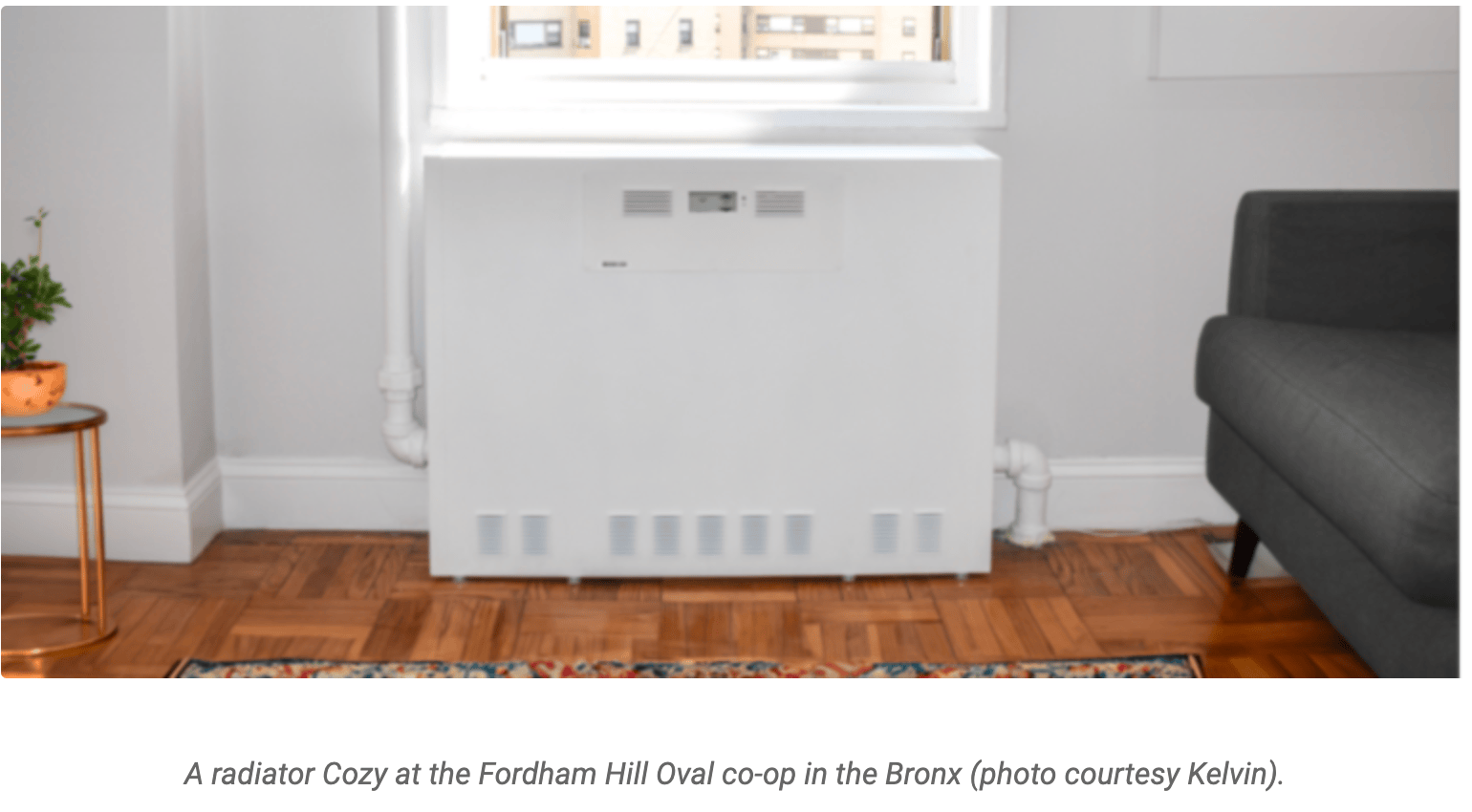
Tired of having to open windows in overheated apartments in mid-winter — and literally watching money fly out of those open windows — the board at the 175-unit co-op at 2 Charlton St. in Greenwich Village has embraced a new technology called the radiator Cozy. Manufactured by Brooklyn Navy Yard startup Kelvin, these “smart” radiator covers trap steam heat, then use sensors to release heat based on the desired temperature of the room. When the room needs heat, the fan within the Cozy circulates hot air through the room. The trapped steam can also be sent to other parts of the building that may need heat — a welcome fix for the many New York City buildings where some apartments are sweltering hot while others are underheated.
More than 60% of the units at 2 Charlton St. have installed Cozys, Crain’sreports, and the building has recouped its investment, having saved $37,662 in fuel costs and 168.2 tons of carbon emissions. That’s enough to bring the building into compliance with Local Law 97. As a bonus, apartments are now comfortable.
“It’s New York City, life isn’t exactly perfect, but this is a major step in the right direction,” says Chris McGinnis, a member of the co-ops board who first brought the Cozy to the attention of his fellow board members in 2021.
The Cozy costs about $850 per unit, including installation, but there are ways to shrink that number. The cover qualifies for incentives in the Biden administration’s Inflation Reduction Act, and combined federal and state incentives cover between 50% and 70% of the Cozy’s cost, making the potential price tag of each radiator cover around $200.
As Habitatreported recently, there’s another funding option. The board at the 1,130-unit Fordham Hill Oval co-op in the Bronx became the first property in the city to take advantage of a no-money-down subscription model offered by Kelvin in conjunction with ClearGen, part of a portfolio set up by the Blackstone investment management company to fund clean energy projects. The co-op will pay for 2,400 Cozys through a monthly $15 fee per unit for 15 years. The cost will be offset by the estimated 24% savings in annual energy bills, amounting to more than $170,000.
“Based on future revenue from projects, ClearGen will fund the entire project upfront,” says Marshall Cox, Kelvin’s CEO and founder.
Already stretched thin by numerous capital projects, including electrical upgrades, facade repairs and the installation of smart building-wide sensor technology, the Fordham Hill Oval co-op board jumped at the chance to cut carbon emissions by installing radiator Cozys without putting a penny down.
“That,“ says board treasurer Blandon Caenave, “was why board members were convinced it was the way to go.”
Homeowners and board members in the City of Surprise can cool off with some summer learning thanks to free virtual classes on managing their associations. The City is offering the Virtual HOA/Condo Academy, featuring a slate of topics relevant to homeowners associations (HOAs) and condominium boards.
Attorney Beth Mulcahy, leading the charge, will conduct the informative sessions via Zoom and Facebook Live, starting this month and continuing through the end of the year, according to the City of Surprise website. Participants must register to join the online classes, which aim to decode the complexities of HOA and condo management.
The summer series kicks off with “Charting Your Course: A Comprehensive Guide to Board Roles & Responsibilities in HOAs/Condos” on May 21, promising a rundown of board member duties. It’s followed by June’s class on navigating the treacherous waters of HOA politics and frequent queries, aptly titled “Untangling the Web: Navigating Politics and FAQs in HOAs/Condos”.
The curriculum covers a range of pressing issues, from amending governing documents to enforcing community rules. Future classes will delve into fiscal matters, such as creating budgets and reading financials, and the realities of running a successful community association. Special sessions include a deep dive into new laws affecting HOAs and condos, and through an end-of-year session, homeowners can even bring their burning questions about holiday decorations.
Filling a niche for reliable and accessible homeownership education, Surprise’s Virtual HOA/Condo Academy aims to strengthen the savviness of its residents and community leaders. For further details or questions about the program, residents can get in touch by emailing surprisecares@surpriseaz.gov.
A smart, skilled and well-rounded community association manager is critical to a community’s success. The profession is known for its daily variety as each day brings new opportunities, challenges and rewards. A key component of a managers’ job is the ability to collaborate and solve problems.
According to Opportunities Knock: Opening the Door to Careers in Community Association Management, published by Community Associations Institute (CAI), the Foundation for Community Association Research (FCAR), and Community Association Managers International Certification Board (CAMICB) having multiple responsibilities, among other factors, is significant in community association managers’ overall sense of satisfaction.
According to an FCAR manager survey, cited in the January 2022 publication noted above, “Solving problems is listed as the main contributor to job satisfaction by 84% of community managers, followed by variety in their tasks each day (73%), and helping people (72%).”
“A community manager’s job is multi-faceted and being a moderator/conflict resolution specialist is an important role,” said Kayte Comes, MBA, MNML, who is the Executive Director of the CAI-Arizona Chapter. “Any time you have to deal with someone’s most valued possession and money, people become uneasy. If a community manager wants to be successful in their job, they must learn to not shy away from conflict but embrace it as a challenge. Comes went on to explain that understanding human nature and body language goes a long way. “Being aware of your own triggers and behaviors when confronted – and how to control your emotions – helps a manager gain strong conflict resolution skills.”
Comes notes, situations that require these skills can arise when a manager is communicating with their Board – or homeowner – on a variety of topics. For example, questions about assessments, potentially fines or collections, architectural designs and the proper way to submit information, as well as neighbor to neighbor issues that have been brought to the manager’s attention.
Finetuning Emotional intelligence (EI) Skills
The CAI-Arizona chapter provides community managers the opportunity to participate in emotional intelligence courses. Joelle Hadley, the founder and president of The Culture Coaches, and the co-founder of The Southwest Institute for Emotional Intelligence, describes emotional intelligence in the following way: Balanced emotions are contagious. Emotional Intelligence is a professional and personal skill-set using the self and social awareness of emotions and understanding their impact on those around us. It’s the ability to manage the negative emotions of ourselves and others while motivating positive and effective emotions needed for performance. EI is rooted in the neuroscience of how our brain interacts with outside influences and with our neo cortex, otherwise known as the thinking brain.
Comes has been participating in these types of classes since she began supervising staff nearly 35 years ago. “This is the best way to understand your communication style and to recognize the many different styles of personalities that a community manager might interact with on a daily basis,” said Comes. “Understanding how you react in certain situations will ensure you are always prepared and professional,” Comes added. She also notes that developing these skills is not something that happens overnight and one can never get enough EI training.
Comes observed that her managers continually express how much they get out of these courses and how it helps them grow both personally and professionally. Afterall, EI skills are needed every day in the community association management industry. A manager who has strong EI skills will succeed.
Resource Corner
Making use of the wide variety of professional development resources available to managers is critical to staying on top of industry news, trends, best practices and any changes arising in the profession. Below is a sampling of industry resources.
Chapter Mediation Services – CAI chapters often offer mediation services. For example, the CAI AZ Chapter offers these services, for a fee https://www.cai-az.org/Mediation.
The Culture Coaches –Master certified and accredited trainers and coaches who deliver effective and impactful speeches, workshops, and individual coaching in the EI arena. Visit www.theculturecoaches.comto view the different options in emotional intelligence.
Management Company Websites – Many management companies have blogs, case studies and other articles available to the public that cover conflict resolution strategies.
CAI Exchange – An online forum that allows members to collaborate and connect with colleagues. Topics range from emergency notification systems to budgeting for insurance in the coming year to managing board member actions, neighbor disputes and everything in between.
Emotional Intelligence Enables Community Managers To Swiftly Address And Resolve Conflicts is the fourth in a series of articles, produced by CAMICB staff, that delve into the important issues and topics affecting community association managers.
Lydia Pelliccia is a freelance writer.Matthew Green is executive director of Community Associations Managers International Certification Board.
A neighborly dispute is headed to the Washington Supreme Court after a state appellate court decided a homeowners association rule preventing a member’s trees from obstructing others’ views could stand.
The issue stems from two homeowners in Camas’ View Ridge Estates, which sits north of state Highway 14 overlooking the Columbia River and Mount Hood.
One couple, Ronald Haertl and Leslie Kolisch, claimed the other, Walter and Mariann Guetter, had trees blocking their view. The homeowners association had recently modified its rules to prohibit vegetation from obstructing other members’ views. The association took its case to Clark County Superior Court, which ruled in its favor. The Washington Court of Appeals upheld that decision April 8.
“I applaud the Washington Court of Appeals for this decision, which legally ensures that (homeowners associations) have the right to certain expectations of their members,” Michael Vial, attorney for the homeowners association, said in a recent statement.
Don Grant, attorney for the Guetters, said the appellate court’s decision isn’t final until the Washington Supreme Court decides whether to review the case. The couple filed a petition for review with the Washington Supreme Court on Tuesday.
In 2004, the Guetters bought a home in View Ridge Estates with several trees on the property, according to court documents. At that time, the homeowners association’s rules stated owners could use their property for their own enjoyment so long as they don’t “offend or detract” from neighbors’ enjoyment of their own properties.
Those rules dated to creation of the homeowners association in 1982 and also stated no outbuildings or fences could obstruct another homeowner’s view.
In 2018, the homeowners association revised the original rules to establish that trees and vegetation in “a view and/or view corridor area” must be smaller than 15 feet or first-story gutter height in the front or backyard of any home. The committee decided taller trees would only be allowed if they didn’t obstruct a neighbor’s views.
Soon after, Haertl and Kolisch notified the homeowners association trees located on the Guetters’ property were blocking their views of the Columbia River and Mount Hood.
The Guetters refused to cut the trees, according to court documents.
The homeowners association subsequently filed a lawsuit against the couple in Superior Court. Haertl and Kolisch joined the suit.
The Superior Court then issued an injunction, requiring the Guetters to trim, top or remove trees from their property in accordance with the homeowners association’s landscape committee desires.
The Guetters appealed the ruling to the Washington Court of Appeals, where they argued the homeowners association’s original rules didn’t authorize new rules in the future, only changes to current rules. The couple argued the 2018 changes constituted a new rule.
The appeals court disagreed.
“Rather than creating an entirely new covenant, the adopted covenant constituted only a change to View Ridge Estates’ existing covenants, a change which the association gathered sufficient support to validly adopt,” the appeals court ruled.
Vial said his law firm, VF Law, strives to ensure the rights of homeowners associations and their communities are protected. He called the appellate court’s decision a victory for homeowners associations across the state.
Co-op shareholders and condo unit-owners dread the news that their board is levying an assessment on top of monthly charges. Lately, that dread has shaded to raw terror as boards grapple with ways to pay for costly retrofits that might be required to bring their building’s carbon emissions into compliance with Local Law 97.
When a Riverdale co-op board announced a $500,000 assessment to cover repairs and new city mandates, one shareholder thought the board was being vague about how it arrived at that $500,000 figure. Research revealed that the proprietary lease and bylaws do not give the board specific authority to impose assessments, but those governing documents do give the board power to determine maintenance payments and cash requirements. Is there any way for shareholders or unit-owners to challenge an assessment?
Courts allow co-op and condo boards significant power to manage a building’s finances, especially when it comes to maintenance and compliance with city codes, through a legal principle called the business judgment rule, replies the Ask Real Estate column in The New York Times. Even if the governing documents don’t use the specific word “assessments,” the board still has the right to raise money to keep the building in proper order, as long as it is acting in good faith, says Joseph Colbert, a real estate lawyer at Colbert Law. If a board fails to act in good faith — or indulges in self-dealing — it forfeits the considerable protections of the business judgment rule.
“Courts are unlikely to overturn a decision solely based on terminology,” Colbert says. “They prioritize the board’s underlying authority and the purpose of the charge.”
In any event, an open dialogue between shareholders and the board is preferable to a costly legal conflict that would create tension in the building. “If there is a basis for a challenge, it is best to aim for an amicable resolution rather than running into court to embark on a protracted and costly legal battle,” says Debra Guzov, a real estate lawyer in Manhattan.
Start by approaching the managing agent to request the minutes from the board meeting in which the assessment was discussed and adopted. The minutes can offer insight into why the board believes the assessment is necessary and how the $500,000 sum was calculated, Guzov says.
If the minutes don’t offer the clarity you seek, you can ask the managing agent for specifics on how the money will be spent. You can also ask to review contracts that were executed to complete the work, to see how much it will cost, though you might not automatically be entitled to see them. Check your bylaws for guidance.
The bottom line: if the board levied the assessment in good faith, disgruntled shareholders are probably out of luck. Time to pay up.
A smart, skilled and well-rounded community association manager is critical to a community’s success. The profession is known for its daily variety as each day brings new opportunities, challenges and rewards. A key component of a managers’ job is the ability to collaborate and solve problems.
According to Opportunities Knock: Opening the Door to Careers in Community Association Management, published by Community Associations Institute (CAI), the Foundation for Community Association Research (FCAR), and Community Association Managers International Certification Board (CAMICB) having multiple responsibilities, among other factors, is significant in community association managers’ overall sense of satisfaction.
According to an FCAR manager survey, cited in the January 2022 publication noted above, “Solving problems is listed as the main contributor to job satisfaction by 84% of community managers, followed by variety in their tasks each day (73%), and helping people (72%).”
“A community manager’s job is multi-faceted and being a moderator/conflict resolution specialist is an important role,” said Kayte Comes, MBA, MNML, who is the Executive Director of the CAI-Arizona Chapter. “Any time you have to deal with someone’s most valued possession and money, people become uneasy. If a community manager wants to be successful in their job, they must learn to not shy away from conflict but embrace it as a challenge. Comes went on to explain that understanding human nature and body language goes a long way. “Being aware of your own triggers and behaviors when confronted – and how to control your emotions – helps a manager gain strong conflict resolution skills.”
Comes notes, situations that require these skills can arise when a manager is communicating with their Board – or homeowner – on a variety of topics. For example, questions about assessments, potentially fines or collections, architectural designs and the proper way to submit information, as well as neighbor to neighbor issues that have been brought to the manager’s attention.
Finetuning Emotional intelligence (EI) Skills
The CAI-Arizona chapter provides community managers the opportunity to participate in emotional intelligence courses. Joelle Hadley, the founder and president of The Culture Coaches, and the co-founder of The Southwest Institute for Emotional Intelligence, describes emotional intelligence in the following way: Balanced emotions are contagious. Emotional Intelligence is a professional and personal skill-set using the self and social awareness of emotions and understanding their impact on those around us. It’s the ability to manage the negative emotions of ourselves and others while motivating positive and effective emotions needed for performance. EI is rooted in the neuroscience of how our brain interacts with outside influences and with our neo cortex, otherwise known as the thinking brain.
Comes has been participating in these types of classes since she began supervising staff nearly 35 years ago. “This is the best way to understand your communication style and to recognize the many different styles of personalities that a community manager might interact with on a daily basis,” said Comes. “Understanding how you react in certain situations will ensure you are always prepared and professional,” Comes added. She also notes that developing these skills is not something that happens overnight and one can never get enough EI training.
Comes observed that her managers continually express how much they get out of these courses and how it helps them grow both personally and professionally. Afterall, EI skills are needed every day in the community association management industry. A manager who has strong EI skills will succeed.
Resource Corner
Making use of the wide variety of professional development resources available to managers is critical to staying on top of industry news, trends, best practices and any changes arising in the profession. Below is a sampling of industry resources.
Chapter Mediation Services – CAI chapters often offer mediation services. For example, the CAI AZ Chapter offers these services, for a fee https://www.cai-az.org/Mediation.
The Culture Coaches –Master certified and accredited trainers and coaches who deliver effective and impactful speeches, workshops, and individual coaching in the EI arena. Visit www.theculturecoaches.comto view the different options in emotional intelligence.
Management Company Websites – Many management companies have blogs, case studies and other articles available to the public that cover conflict resolution strategies.
CAI Exchange – An online forum that allows members to collaborate and connect with colleagues. Topics range from emergency notification systems to budgeting for insurance in the coming year to managing board member actions, neighbor disputes and everything in between.
Emotional Intelligence Enables Community Managers To Swiftly Address And Resolve Conflicts is the fourth in a series of articles, produced by CAMICB staff, that delve into the important issues and topics affecting community association managers.
Lydia Pelliccia is a freelance writer.Matthew Green is executive director of Community Associations Managers International Certification Board.
Requests for paid time off increased globally in the first quarter – but more were declined, finds survey
By Dexter Till for Human Resource Director
Requests for paid time off increased across the world in the first quarter of 2024, but approvals declined, according to BambooHR.
Nearly half of employees (47%) worldwide requested for PTO in the first quarter of the year, a seven per cent increase compared to the same quarter last year.
But only 45% of PTO requests were approved in the first quarter, down by six per cent than in Q1 2023, according to BambooHR’s Workforce Insights report.
PTO monthly data
Month-on-month, there was a one per cent decrease in PTO requests worldwide between February and March 2024, according to the report.
There was also a one per cent increase, however, in the percentage of PTO requests approved.
By industry, employees in Finance and Non-profit had the highest number of employees requesting for PTOs, with 54% each. But approval rate was higher for Finance (47%) than for Non-profit (41%).
On the other hand, the healthcare sector saw 56% of PTO requests approved, a 10% increase from the previous month. It also has the highest approval rate across all sectors, according to the report.
Meanwhile, the report also found that hiring slowed down as job openings year-on-year are “flat globally.”
Employees also stayed with their employers in the past year as hiring and turnover went down 24% and 26%, respectively, between March 2023 and March 2024.