Corporate email: Too much of too much

An abundance of email was stressing people out before the pandemic; now the overload is even worse. Here’s how to strike a healthier balance.

By Sally Ann O’Dowd for Ragan

Corporate communicators sent 72% more emails in 2020 than they did in 2019, according to a new study by PoliteMail.

While the company says email was a “corporate success story” last year, the significant jump in email content may actually have had a detrimental effect on employees, says Kristin Graham, a former Amazon communications executive now working as a culture and employee engagement consultant at Ragan Consulting Group.

“We have been getting too much email for years, because we have to read them,” Graham says. “It’s like having to endure PowerPoints in meetings. Emails have become a part of our corporate experience, not necessarily our preference in the corporate experience. And that was the dynamic before the world went uber digital.”

Inbox recovery

Several studies over the years have documented the ill effects of email overload. According to McKinsey research, the average employee spends 28% of the work week reading and answering email, compared with 39% of working hours on actual job-related tasks.

Reading emails is also a distraction. In fact, it can take 64 seconds for someone to “recover” from an email interruption (regardless of the email’s importance) and return to work at the same pace, according to an often-cited 2004 study by the U.K.’s Loughborough University. That helps to explain the findings of a 2012 UC Irvine and the U.S. Army study, which concluded that limiting email access reduces stress and helps people to focus better.

PoliteMail’s 2021 Internal Communications Benchmarks Data Report advances the global discussion with data based on 300 enterprise clients. Researchers analyzed 1.3 billion internal emails employees sent to 8.5 million employees around the world.

“This report provides visual evidence that email had more relevancy than ever during 2020, as a crisis disrupted the way people work,” PoliteMail Founder and Managing Director Michael DesRochers says in a press release.

The report’s findings include several year-to-year comparisons:

  • Corporate communicators sent 72% more email broadcasts than in 2019, averaging 68 emails a month last year. They also increased the number of content minutes by 58%.
  • Employees received on average 16 email broadcasts per month, which collectively contained nearly 35 minutes of content and 121 links to additional content.
  • Employees read 44% more minutes of email in 2020 and clicked 82% more links.
  • Overall employee engagement with the medium increased 71%.

“This study shows that corporate communicators have had good intentions – that in this last year, communicators were making a concerted effort to connect during these digital times,” Graham says. “That’s the good news.”

On the flip side, she says, “The impact of those intentions has been to put more heavy rocks on our employees to carry around all day long. We’re not solving a problem. We’re creating a problem.”

Do open rates matter?

The 475 words in the average corporate email take nearly two minutes to read. Of the employee audience, 60% will read 77% of it. Of recipients who open and don’t ignore the message, 20% will skim the content, reading less than 30%.

PoliteMail asks the burning question: Do open rates matter?

“An email open simply tells you the message was viewed by the recipient, including the preview pane,” PoliteMail writes. “Like a web page view, it is a simple measure of audience reach. What if the email is opened, but not more than a few words are read?”

For her part, Graham says it’s important to remember the employee perspective. “What’s important to us as communicators is not always important to them,” she says. “With our polite intentions, we’re eroding our productivity.”

How Interruptions Can Make Meetings More Inclusive

By Gia Storms, Harvard Business Review

I’m sitting in the back of the meeting, watching the minutes tick by, unsure how to interrupt the continuous flow of voices competing for airtime that make it harder and harder to get a word in edgewise.

I’m an extrovert/introvert mix by nature, but when the stakes are high and opinionated personalities crowd into a room, my default pattern is to shrink away from competing to get my opinion heard. I’ll often leave a meeting kicking myself for having contributed little or nothing at all to the conversation.

Many leaders today find themselves struggling to perform in high-pressure (and these days, usually virtual) meetings, either because their performance anxiety causes a heightened level of fear and paralysis, or because they end up having to compete with bosses and coworkers who overtalk and take up more than their fair share of space in the room. Still others work valiantly to insert themselves but are passed over or rendered invisible or silent because of implicit bias or exclusive group norms.

Whatever the cause, for both leaders who struggle to be heard and bystanders who want to hear more from quiet colleagues, the skill of interrupting can be helpful to practice to disrupt group norms and bring out reserved voices.

For example, my client, Max (not his real name), is an HR leader at a Fortune 500 company. He spends most of his days answering hard questions with polish and candor. But recent feedback from his colleagues revealed that he’s perceived as avoiding hard, messy conversations around diversity and inclusion, and he admits that when he doesn’t know the right words, he can freeze or clam up in meetings.

For two months now, Max has been trying out a new practice when this happens: interrupting. Whenever the conversation moves toward a tense or complicated topic, Max inserts himself by saying, “I get that this is messy, and I want to try to share my perspective,” which allows him to participate powerfully and paves the way for him to share imperfectly. This simple practice has helped him stay present and vocal in these hard subject areas. It also invites others to participate in these challenging conversations.

Interrupting is controversial. When we’re interrupted while speaking, we can feel disrespected, and men tend to view women who interrupt as rude. Conversational style can also play a part in how a person views an interruption, as can cultural context.

However, as we work toward more inclusive workplaces, leaders can learn how to interrupt with respect to make space for the voices that are often silent or marginalized. The following tips can help you skillfully interrupt and bring yourself and others forward.

Start by noticing.

Observe the conversational dynamics and patterns in the room. Who’s talking a lot and who isn’t? Tune into self-awareness to notice your own contributions. Are you holding back? Are you oversharing? Evaluate how much psychological safety exists in the meeting and consider the topics that aren’t being voiced aloud. You can also review a video recording of the meeting to notice the patterns that aren’t visible in the moment.

Practice speaking up early.

If your tendency is to hold back, try speaking up in the first 30% of the meeting. When we take a risk and use our voice early — even in a simple act of noticing and naming — we can interrupt our brain’s proven fear-based amygdala response, making it easier to speak up later in the meeting. Answer a question early on or make small talk with a colleague before the meeting starts to habituate yourself to speaking up and make it easier to contribute when the stakes are higher.

Pause the action skillfully.

In the book Subtle Acts of Exclusion, authors Tiffany Jana and Michael Baran stress the importance of interrupting microaggressions in real time with a simple phrase to pause the action while putting the other person at ease. Witnesses can interrupt by stating a helpful intention: “Can we pause to discuss something that was just said? I’m sure you didn’t mean anything by it, but…” This is a moment to reinforce the relationship by communicating that you want to help, calling the other person in instead of calling them out.

Be willing to get it wrong.

In coaching, the skill of blurting helps give permission to be clumsy, messy, and human in our attempt to speak our truth. Blurting asks that we be willing to not know the right words or have the perfect way to name what we need to say. Blurt by using “I” statements to ground your observations in your own experience. For example, “I noticed that Karim was going to say something back there, can we go back?” or, “I noticed that I was holding back just there about something hard,” or, “I noticed that there’s something I want to say that’s messy, can I take a moment to try to put words to it?”

Design practices for interruption as a team.

Interrupting successfully as a team requires building a group norm of doing it with skill and respect and to not take it personally. Do your work’s cultural norms welcome interruption or punish it? Which topics and people can currently tolerate interruption? For whom is it not safe or accessible? Start a discussion to make your team aware of these dynamics.

In the practice of interrupting, clumsiness and awkwardness are a sign that it’s working. Over time, you’ll find it easier to insert yourself in spaces and make it safe for others to do the same. You’ll become more adept at finding the right moment to interrupt with fluidity and humility, and the systems and spaces you’re a part of may even come to welcome the interruption.

Gia Storms is a leadership coach and member of The Boda Group. She facilitates team and executive coaching from Los Angeles.

Do Co-op and Condo Boards Have to Play COVID Cop?

Marc Schneider and Justin Buchel  For Habitat Magazine

Laying down the law. As the coronavirus pandemic passes the one-year mark, co-op and condo boards are facing a pair of challenging questions: How far must a board go to enforce state and local laws and its own COVID-related house rules? And What are a board’s options when a shareholder or unit-owner fails to comply with laws or rules?

Many boards have struggled with the extent to which they must become COVID Cops. If masks are required in all public spaces, should the same apply to indoor co-op and condo common areas? We believe the answer is yes, which is why most of the boards we represent immediately enacted COVID emergency house rules that require wearing masks in common areas, social distancing in tight spaces (elevators, mailroom, etc.), restrictions on showing apartments as well as the closure of amenities (gyms, party rooms, pools, clubhouses, etc.). By doing this, boards were able to treat residents who weren’t following basic COVID protection guidance as violators of the co-op’s or condo’s governing documents.

Enforcing the law. But now that they have enacted the rules, what should boards do when people ignore them? Since the pandemic started, we have seen boards being flooded with complaints about other residents who are violating COVID safety measures. “John is not wearing a mask!” “Mary and Jane rode the elevator together even though they don’t live in the same household!” In our opinion, provided your board enacted proper house rules and regulations, you can legally enforce them in the same manner you would enforce any other violation of a house rule. If your governing documents give the board the legal power to levy fines, we recommend you use it. If your board is disinclined to do so, you should at least send warning notices or have the community’s attorney send a legal cease-and-desist notice. In whatever manner you proceed, we believe boards are within their legal right to enact and enforce basic COVID safety rules – and, in effect, become the COVID Cops of the community. If the violation is serious enough, such as a COVID-positive person walking around the building without a mask when that person should be quarantining, your board should take the necessary steps to stop the violation, which may even require taking the person to court.

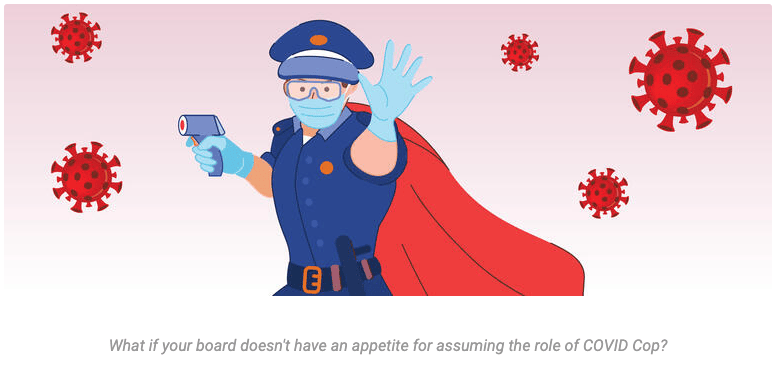
Bending the law. But what if your board doesn’t have an appetite for assuming the role of COVID Cop? We believe that, in some instances, that’s OK, too. Board members are volunteers, and they typically have no obligation to go hunting for violators of the rules. However, that doesn’t mean board members can turn a blind eye. If a violation is obvious and either proven by photo or video evidence, or supported by witnesses, it should be addressed. But we do not believe boards need to set up stakeouts to catch people in the act of violating the rules. It’s impractical, if not impossible, for boards to ensure that all residents comply with COVID safety protocols every moment of the day. Moreover, such extreme measures are rarely necessary since, in most instances, the residents of the community will let the board or management know if they see a constant violator.

Regardless of the extent to which your board is willing to play COVID Cop, you should adopt house rules in accordance with the governing documents and make residents aware of those rules and any penalties for violating them. You should also advise residents that if they see someone violating those rules, they should say something to management or the board so it can be addressed.

Marc Schneider and Justin Buchel are partners at the law firm Schneider Buchel.

Is Your Organization Ready for Hybrid Work?

At the start of the pandemic, chances are your work life changed. If your role remained, you likely moved from working in the office to working from home. That was a big change for many people to adapt to working apart from each other. From the time we closed offices, many have been waiting for a return to normal. But guess what – the new normal will be different and more complex than it was before. Welcome to the work of hybrid work. Is your organization ready for it?

Deciding How To Decide

I realize that a future of hybrid work isn’t a foregone conclusion. Organizations must first decide what options will be considered and how to come to that decision. Our recommendation on those two points would be to open up the options and include as many parts of the organization as possible.

What are the options?  It seems to us, there are at least eight options – two we already know and have experienced and six that are variations on hybrid work.

  • A full return to work. Everyone returns to the workplace, like it in January 2020.
  • Remain fully (or largely) remote. Everyone remains in a work situation like they have been since March of 2021.
  • Hybrid by organizational choice. The organization will determine which jobs need to be in-office and which can be fully or partially remote.
  • Hybrid by individual choice. People, based on their circumstances or interest, choose office or remote.
  • A flexible working option. Everyone comes to work some of the time, and when they come to the office, they still have their own desk and workspace.
  • Few if anyone is in the office every day, and when they do come in, they will be assigned a workspace, but not necessarily the same desk or workspace every time.
  • In-person infrequently. In this option full teams will gather but do so infrequently. Most likely this would be for specific meetings, events or training. While this could happen with any of the other hybrid work options, in a pure sense this is a largely remote scenario.
  • Something else. This is the catch-all option for a scenario that isn’t quite any of these others or is a combination of some of them.

When looking at the options consider the needs (and wants) of the organization and the needs (and wants) of the teammates. How these will be weighted and how the ultimate decision is reached will of course, need to be determined for your organization. If you take all of that into account and engage a wide range of perspectives you will come to a decision that will be better understood and gain wider acceptance sooner.

After You Decide

After a decision on the future of work in your organization is made there are two big next steps:

  • Create clarity. Very little of what you just read is black and white. While the options will be helpful in guiding discussion, once an option is selected, there will be dozens of questions that ill need to be clarified. The more clearly you can describe your plan and the answer the “what-if” questions, the faster people will understand and be ready to move forward.
  • Build commitment. Clarity is an important step towards commitment, but the more committed your team/organization is to the selected working option, the more effective they will be throughout the transition.

What To Do Now

What you can do now depends on where your organization is in the decision-making process and what your role in the organization might be.  Regardless though of your role however, there are some things you can be doing to help the organization and yourself.

Thinking organizationally, you can be engaged by:

  • Being positive and offer to help where needed
  • Offering your perspective in a helpful way
  • Showing your interest in the future
  • Sharing this article if it might help others
  • Being a force for the change as it arrives

Thinking individually, you can:

  • Continue to build your skills for the future of work
  • Keep a positive outlook about the future
  • Keep your family and those around you aware of what the future might be – because they are a part o your personal transition as well

The decisions that organizations make about hybrid work in the coming weeks/months will have a lasting impact on their results and culture.  Thinking about these monumental decisions now will help you prepare for and be ready for your future.

Virtual homeowners association meetings lead to increased attendance nationwide

By Ed Crump for ABC Channel 11 News in Raleigh, NC

When the pandemic first hit, homeowners association boards had a dilemma – how to hold meetings when people can’t meet in person like the government requires?

Hope Carmichael, an HOA attorney and past president of Communities Associations Institute of North Carolina, told ABC 11 that CAI members turned to the governor.

“We have an executive order, and in fact it’s been extended now through May the 10th, for associations to hold their membership meetings virtually,” Carmichael said.

Carmichael, of Raleigh, explained that the emergency order allowed board members to set up online meetings.

The emergency experiment ended up working better than expected according to Carmichael who said, “The real benefit that has surprised everyone is that participation by members in the community has increased.”

Some HOA members, who may have previously found attending board meetings too much of an effort, realized it was much easier when you could just log in on your computer or smartphone.

And if you weren’t showered or properly dressed, you could log in with audio only.

Carmichael said HOA board members reported to CAI comments from homeowners like, “We love that we didn’t have to leave home to go to the meeting.”

Another reply being, “We love that both my husband and I can be at the meeting and didn’t have to get a babysitter.”

Virtual attendance was especially good at HOA meetings for second-home neighborhoods, like at the beach or in the mountains, where owners are often out-of-town or out-of-state.

And homeowner attendance wasn’t the only benefit.

Board member attendance also increased, meetings were shortened and the boards found they also saved money.

“A homeowner association can take advantage of that software for less than $100,” Carmichael said, “That’s less than the cost of renting the church fellowship hall.”

And renting meeting space, at a local church or other facility, is what many HOA boards have to do.

So there is a desire by both board members and homeowners to continue some form of virtual meeting because in many ways online conferencing has proven beneficial.

“Hopefully a benefit that the legislature will see fit to pass some laws and allow it to happen,”

Carmichael expects legislation to be introduced soon and expects that any attempt to change the current HOA meeting rules will have to balance the benefit to both HOA boards and homeowners and likely involve hybridized meetings in order to be voted into law.

The end of COVID-19: What the workforce thinks about returning to the office

by Brandon Vigliarolo in CXO For TechRepublic

As vaccination rates increase it’s time to start thinking about the world post-pandemic, and business leaders should use this Glassdoor survey as a way to gauge how they respond.

A survey of United States workers performed by Glassdoor found that the national workforce has some very particular opinions about what the workplace should look like in the post-pandemic world, including the fact that 86% want to continue working from home at least part of the time.

The COVID-19 pandemic started just around a year ago, and it seems like we may finally be glimpsing a light at the end of the Zoom-heavy tunnel we’ve been in for the past 12 months. Vaccination rates are increasing in the U.S. and around the globe, and President Joseph Biden said there will be enough vaccines for every American who wants one by mid-May. 

With those facts in mind, it’s time for the business world to start thinking about what comes next. “Employers must take employee feedback into account to determine what is best for their workforce, including how to best support employees who plan to get the vaccine, and employees who do not,” said Carina Cortez, Glassdoor chief people officer. 

Seventy percent of employees, the survey found, want COVID-19 vaccines to be required for employees who want to return to the office. Those numbers are higher for employees ages 35 to 44, of whom 84% want a vaccine mandate, as opposed to only 58% of 18- to 34-year-olds.

Most may want a vaccine requirement, but most don’t consider that a necessary condition for employment: Only 23% said they would quit if they were required to return to the office before all employees were vaccinated.  

Strong opinions on the vaccination of coworkers is reflected in the rate at which respondents said they plan to get vaccinated. Seventy-six percent said they’ll get the shot once it’s available to them, and as with the opinion on requirements, there’s a split between age groups. Eighty-one percent between ages 35 and 44 said they plan to get the vaccine, while only 66% of the 18-34 group plan to. A quarter of respondents said they don’t plan to get the vaccine.

Most employees would also appreciate employer incentives for getting the vaccine, with 69% saying companies should offer financial incentives like cash bonuses or extra PTO. Sixty-eight percent said they would be more likely to get the vaccine if such an incentive program was in place in their business. 

Lastly, it seems that employee opinions on working from home, as mentioned above, are near universal: 86% said they want to continue working remotely at least part of the time once offices reopen. Seventeen percent even take a hard-line position on their remote work: They’d consider quitting if they were required to return to the office five days a week, regardless of their opinion on vaccine requirements, incentives, or the like. 

“Remote work is here to stay” has been a common refrain since mid-2020, with plenty of experts weighing in on what seems to be the likely course of the future of business. Glassdoor’s findings reflect that employees agree with those assessments, and business leaders would do well not to ignore their opinions as the world starts to reopen and prepare for life in a post-COVID world. 

How To Embed the CMCA Digital Badge into your Email Signature

Adding a hyperlinked badge image to your email signature is a great way to make sure your professional network is aware of your certifications, credentials and other badge-worthy recognition.  Watch this video for a quick tutorial on how to add your badge to an email signature, using Outlook and Gmail as examples. 

These instructions are for PC users. If you’re on a Mac, click here for instructions on adding your badge to email using Gmail.  If you’re having any trouble with adding your badge to your particular email client, contact the Acclaim Support Team. They’ll be happy to help you troubleshoot. 

Step-by-step: Outlook

  1. ?From Acclaim, click the badge you’d like to embed in your email signature. Click the blue ‘Share’ button. 
  2. Click the ‘Download’ icon. Choose the small image – that will fit best in your email signature. 
  3. Click the ‘URL’ icon and copy it to your clipboard. 
  4. Over in Outlook, create your new email signature by opening a new message, then clicking ‘Signature.’
  5. Click ‘New’ to create a new signature. If you’d like to modify an existing signature, highlight it. 
  6. Name your new signature.
  7. Type any text you’d like in the signature, then click the ‘Image’ icon. 
  8. Locate the badge image you downloaded, then click ‘Insert.’
  9. Next, hyperlink the image  by clicking the badge, then selecting the ‘Hyperlink’ icon.
  10. Paste the URL you copied from Acclaim. 
  11. Click OK to save your new signature. 

Step-by-step instructions: Gmail

  1. From Acclaim, click the badge you’d like to embed in your email signature. Hover your mouse over the badge and right click to copy it.
  2. Within Gmail’s settings, access your email signature.
  3. Right click to paste the badge image into the signature. If the image appears too large, click the badge and select Small from the options presented.
  4. Back in Acclaim, click the blue ‘Share’ button underneath your badge.
  5. Next, click the ‘URL’ icon and copy it to your clipboard.
  6. Within your email signature, highlight the badge image and create a hyperlink with the URL you just copied. 
  7. Click OK to save your new signature.

Delaying Elections Can Backfire for Co-op and Condo Boards

Frank Lovece in Board Operations for HABITAT magazine

A forced election can lead to an unwindable tug of war for co-op and condo boards.

It’s perfectly understandable that some co-ops and condos have postponed their annual meetings and board elections. Amid the upheavals caused by the pandemic – including working from home alongside equally frazzled family members – distracted board directors may not realize that a year has already flown by. Or they may simply want to adhere to the health and safety protocols of avoiding large public gatherings.

But pandemic stress and safety concerns aside, boards can no longer afford to miss their due dates. With a recent change to the Business Corporation Law (BCL) that now allows for virtual annual meetings, buildings that fail to hold theirs in time could find themselves facing not only a revolt from residents but also legal headaches and hefty fines.

“You don’t want to get to the point where people have to force an annual meeting,” says Steve Wagner, a partner at the law firm Wagner, Berkow & Brandt. “That’s like a shot across the bow.”

Essentially, the October 2019 amendment to the BCL allowing virtual meetings gives more teeth to shareholders to demand action. Section 603 of the BCL states that if 13 months have passed without the election of “a sufficient number of directors to conduct the business of the corporation,” the board must call for a special election within two weeks. If it doesn’t, holders of 10% of the shares entitled to vote may demand, in writing, a special meeting to be held not less than 60 or more than 90 days later.

Some co-op bylaws may require that 20% or 25% of shareholders sign the petition, as opposed to 10. But either way, the board secretary has five business days to give notice of the requested meeting. Fail to do so, and the annual meeting can be called by any single person who signed the petition – and the optics aren’t good. “It makes the board look ineffective,” Wagner says. “That’s one reason why, in my experience, anytime I’ve sent a 603 demand, the board has responded promptly.”

As for condos, which are governed under the New York State Condominium Act and not the BCL, their boards aren’t off the hook, either. “I’ve never seen a provision of condo bylaws that didn’t include the right to a special meeting,” Wagner says. “The unit-owners can get together to call for an annual meeting exactly the same way shareholders can.”

There’s another incentive for boards to move quickly: When shareholders convene a meeting, whoever shows up is considered a quorum. One person can constitute a quorum. Even though a Section 603 petition strictly limits shareholders from conducting any business other than holding elections, that alone can be damaging. The last thing any board wants is to be forced by a handful of shareholders to hand over control. It’s an unwindable tug of war that boards should avoid. 

“It goes without saying that you don’t want the people you’re fighting with running an election,” Wagner says. “You want it to be orderly, proper and transparent, but if it comes down to a special meeting, you’ve lost control.”

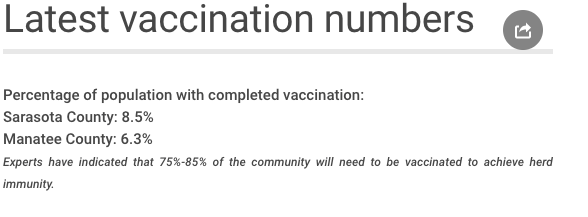
Venice paramedics administer COVID-19 vaccines to homebound residents

Earle Kimel Sarasota Herald-Tribune

VENICE – Quietly over the past two weeks, paramedics with Venice Fire Rescue have been participating in a state pilot program to administer COVID-19 vaccines to homebound residents.

On Tuesday, Venice Fire Rescue Chief Shawn Carvey told the Venice City Council that paramedics have been administering between 10 and 20 doses per day.

“We’re the only department in this area that works under that program; we’re very fortunate to be part of that program,” Carvey said.

“The feedback from the community is, we’ve received happiness and tears,” he added.

As part of the process, Carvey said Venice Fire Rescue reached out to different community leaders, including the Central Venice Coalition and other homeowners associations the department regularly visits as part of its community outreach to establish a list of qualified homebound recipients.

“We have liaisons that our department works with at a lot of those different associations,” Carvey said. “They started emailing us lists of people that may be or definitely are homebound.

Fire Department administrative assistant Tammy Short has been calling people on that list to determine eligibility.

“We look for people who are physically unable to make it to a vaccination site,” Carvey said. “It may be because you’re wheelchair-bound or you’re severely immunocompromised so you can’t get there.”

He added that someone who simply doesn’t have a car would not qualify, since there are other ways to get to a vaccination site.

Also, “if somebody is homebound and they’re under 65, they do qualify for this program,” Carvey said.

Now that Short has established a list of questions and criteria to determine whether someone is homebound, Carvey said individuals can call the main administration number at 941-480-3030 to be put on the list.

Venice Fire Rescue is the only department in Sarasota County that’s enrolled in the pilot program.

“We’ve spoken to other departments around this area; they’re definitely looking at doing something like this,” Carvey said.

The vaccine doses Venice receives are part of 1,500 shots a week that Gov. Ron DeSantis set aside for the pilot program.

Carvey said the city had been working with the Florida Department of Health Emergency Medical Services System.

“Maybe I called at the right time and we were selected,” he added.

Carvey was told that only four or five departments are enrolled in the program, including departments in Miami Dade and Palm Beach counties.

Carvey said Venice currently has between 40 and 60 doses left and has already put in for an additional 100 to 200 doses.

“We know there’s a bigger need than 180 right now,” he added.

Once the state allocates the first doses of vaccine, it automatically sets aside the second dose too, Carvey said.

So far, the city has received doses of the Moderna vaccine.

A firefighter/EMT and paramedic use the fourth ambulance Venice acquired once it took over EMS service in October to visit homebound patients, so the city’s overall emergency response system is not diminished.

Earle Kimel primarily covers south Sarasota County for the Herald-Tribune and can be reached at earle.kimel@heraldtribune.com. Support local journalism with a digital subscription to the Herald-Tribune.

Is Now A Good Time To Change Careers? MoreWorkers Are Feeling Good About It.

In an exclusive ‘Fast Company’-Harris Poll, 59% of middle-income workers said they’re thinking about changing jobs. Remote work continues to be a draw.

Last year changed everything for workplaces across America. But now that 2020 is finally behind us, changes are still afoot. They’re just more self-directed.

A new survey conducted by Harris Poll exclusively for Fast Company found that the majority (52%) of U.S. workers are considering a job change this year, and as many as 44% have actual plans in place to make the leap.

As for who’s contemplating a job hop, the most likely candidates were those whose annual household income is between $50,000 and $75,000 (the middle-income bracket). Fifty-nine percent of those individuals said they’ve thought about making a switch.

Prior to the pandemic in 2018, 51% of workers were planning to change jobs that year according to data from Statista.

But the poll indicated that even more managers and highly skilled workers are prepared to change jobs. Close to half (48%) of six-figure salaried workers are plotting their switches and as many as 66% of them are feeling more confident about their decision to change jobs than they did six months ago. Across the board, 21% of workers surveyed felt there were “better opportunities available to [them] at other companies.”

And those opportunities aren’t just found in steps up the corporate ladder. As the jobs market continues to rebound, it’s safe to say that the great remote work experiment thrust upon many American workers last March has changed perceptions about where they want to work. Flexibility is in high demand for workers looking for new positions.

Remote work and work-from-home options are valued by 68% of currently employed workers, and 43% of women asserted that these options are “very important,” versus 33% of men. Eighteen percent of workers said they’d prefer to have more flexible hours in a new job.

By Lydia Dishman for Fast Company