What’s the best way for our condo board to collect unpaid common charges?

BY WOODS LONERGAN PLLC for BRICK UNDERGROUND Real Estate. Real Life. Real New York.

How a condo board can handle common charge arrears will be governed by the bylaws.

Q: Several owners in our condo building are in arrears on their common charges. What’s the best way to collect the money they owe?

A: Common charges are important revenue for condos and are necessary in order for the condo to meet operating expenses, maintain common areas, and pay employees.

“If apartment owners fail to pay common charges, it can deplete the building’s reserve fund and could result in higher common charges or assessments for owners who are paying their obligations,” says James Woods, Esq., a partner at Woods Lonergan PLLC, who is a litigation attorney with a concentration in representing condo and co-op boards, as well as other corporate and business entities.  

Woods recommends boards be proactive when a condo owner defaults on their common charges.

 “A responsive board signals to residents that the board will remain diligent and vigorously pursue payment when there is this type of delinquency,” he says.

If owners don’t keep up with their payments, there are substantial penalties and the default could ultimately result in unit owners losing their home, says Lauren Tobin, Esq., an associate attorney at Woods Lonergan PLLC, who specializes in representing condo and co-op boards, as well as buyers and sellers.

The specific steps the board takes will be determined by the building’s bylaws. Boards should refer to them for information on notices of arrears, debt collection, late fees, and interest.

 “Actions by the condo board are governed by the bylaws, so any actions taken to collect arrears must be consistent with the governing documents,” Tobin says. 

Impose late fees and issue a notice of collection

Usually the first step is to issue a notice of arrears or notice of debt collection to the defaulting owner and advise them that late fees will be imposed for non-payment of common charges. 

Late fees typically range from $50 to $100. The notice of debt collection should provide the amount owed including a breakdown of any late fees, assessments, parking fees, common charges and other fees. Tobin says this is important because it can help a unit owner understand the statement and that they are in arrears.  

“We’ve seen situations where the autopay for common charges wasn’t working—payments were bouncing on the bank’s end or the management company changed—and the unit owner thinks they are paying but in fact they are not,” Tobin says. Advising the unit owner could rectify a simple mistake and solve this problem.

A notice might provide an amicable solution, she says. The notice should also advise them they have 30 days before the board imposes a common charge lien—the next step which would put a claim on the title to their apartment. 

File a common charge lien

If the notice of collection is ignored, the next step is to file a common charge lien against the condo unit. 

A publicly filed lien serves two important functions. It is an avenue that allows the board to later foreclose on the unit if the lien is not paid in a timely manner and it prevents the owner from selling or refinancing the apartment without first paying the debt owed to the condo. 

Banks will not approve a buyer’s loan if there is a lien on the apartment. 

“If the unit owner understands the implications of the lien—that it’s the first step to starting a foreclosure action—they are often incentivized to pay what is owed,” Tobin says. 

If the bylaws provide for it you can also include late fees, interest and other costs as part of the lien. This means you can add the expenses incurred by the board to the total sum owed by the condo owner. 

This might include attorneys fees incurred in the process of collecting the debt—which will include any work involved in issuing notices as well as the process of filing the lien. This could amount to several thousand dollars. There are also recording costs which the bylaws may entitle the board to include in the lien. 

“This means these additional amounts will be paid back to the board whether from the condo owner directly or in a foreclosure action,” Woods says. 

Take the rent from a tenant in the condo

In a situation where the condo is being rented out to tenants, the board has the statutory right to take rent payments directly from the residents of the apartment if the condo owner is in default. 

“The board management must provide notice to the tenant and the condo owner that due to the default in common chargers future rent payments must be made directly to the condo. Payment to the condo will satisfy the tenant’s obligation to pay rent under the lease,” Tobin says. 

This can continue until the owner is current with common charges. If the unit owner is living there and it is not rented out, this avenue is not open to the board. 

Foreclose on the common charge lien

The next step would be to start a foreclosure action in court to sell the condo owner’s apartment and recoup the funds. Getting the advice of an attorney with expertise in this area is helpful when commencing this type of litigation. 

In most circumstances, the first mortgage, if there is one, will take priority and must be satisfied before a lien for common charges can be paid to the condo. Additionally, “more often than not, a default in paying common charges constitutes a default in the mortgage agreement with the bank,” Tobin says. 

So in some situations it will be a case of which entity—the bank or the board—begins the foreclosure action. If the amount of the debt owed to the lender is substantial then it may be advantageous for the board to monitor the bank’s foreclosure, as the condo’s lien will be subordinate to the bank’s mortgage. 

Pursue a money judgment 

Another option is to direct your condo attorney to bring a lawsuit for a money judgment. 

“Depending on the amount of the common charge arrears, it can be in civil court or even in a small claims court in lieu of a foreclosure action,” Woods says. 

This is a less common route, because if the condo owner doesn’t have the money to pay the common charges, the money judgment won’t carry much weight and the condo board will therefore not receive the money owed. 

“The cost to pursue the money judgment will depend on whether the condo owner challenges it in court. “Even in a scenario when it is not contested, the board may expend $5,000 or more in filing action and obtaining the judgment,” Woods says. 

James F. Woods is a partner at Woods Lonergan PLLC and Lauren K. Tobin is an associate attorney at Woods Lonergan PLLC. Woods Lonergan PLLC  represents New York City cooperative corporations, condominium boards, management companies, buyers, sellers, commercial landlords and tenants. To submit a question for this column, click here. For a free, 15 minute legal consultation, call 212-684-2500 or send an email.

HOA Homefront – Which type of management Is best for your HOA?

BY KELLY G. RICHARDSON For the San Diego Union Tribune

Determining which type of management services is best for the HOA is a very important HOA board decision. Even the smallest associations need some form of professional management.

What is a “manager”? Managers oversee the association’s day to day operations, advising and informing the board and following its policies and instructions regarding association property and funds. A manager may be an unpaid volunteer or may be paid. The paid manager may be an association employee, a consultant, or an employee of an outside company. California requires no license to manage HOAs.

Volunteer management. Many associations use volunteers for their management functions. The motivation for volunteer management is primarily to save cost. In volunteer management, volunteers place themselves in the role of an unpaid manager, with all of the risks and no reward. Volunteer-managed associations often find it difficult to find board candidates, since directors work so much harder when they are also managers.

Financial management. This involves collecting assessments, paying bills, and preparing monthly and annual financial reports, disclosures, and budgets. A financial manager typically does not visit the property. Management companies often prefer financial management because it is more predictable and less prone to the extra work of managing the property. Some accountants also offer financial management services. Associations struggling with the cost of full association management may wish to consider at least financial management.

Property management. Property management involves responsibility for keeping up the condition of the buildings and grounds and may include routine inspections for architectural violations, maintenance items, and repair needs. The plumbing leak on a Sunday afternoon and the broken window on Tuesday evening are all part of the routine for a property manager. Property management, when coupled with financial management, is called “full management.” Some associations choose to hire one company for financial management and another for property management services. Full management services normally cost significantly more than “financial-only” management.

Off-site/On-site. Most associations are managed by persons working at a location at a management firm office. Some companies provide managers working at the association property, at a greater cost. However, on-site managers typically a higher level of service, which can offset the greater cost.

Portfolio vs. General Manager. Portfolio managers simultaneously work for multiple associations, while general managers work for just one. Most associations cannot afford general managers. An important question to the portfolio manager is “how many other associations will you handle along with ours?” A lower management fee can result from a company overloading its managers. For some HOAs, cost is the only concern, but level of service, experience, and management credentials should also be considered. Ask questions and make sure your association understands what it is receiving. HOAs normally get what they pay for.

In-house management. Larger associations may choose to hire their manager and staff as direct employees. This gives the association more control of its management at less cost than the rates charged by a management firm for the staff it provides. The drawback is the opposite side of the coin – the association takes on the responsibility of finding, screening, and supervising the manager and dealing with personnel issues.

Choose the management style best serving the community’s interests and needs, rather than automatically selecting the cheapest.

Kelly G. Richardson is a Fellow of the College of Community Association Lawyers and Partner of Richardson Ober DeNichilo LLP, a California law firm known for community association advice. Send questions to Kelly@RODllp.com. Past columns – www.HOAHomefront.com.

HOA safety concerns arise after deadly Midtown Atlanta shooting

Two people were killed and one is still fighting for his life after an HOA dispute at a popular midtown condo.

By Kaitlyn Ross for Atlanta 11 local News

ATLANTA — People in Midtown are asking serious questions about safety in homeowners associations after a deadly shooting this week. Two people were killed and one person is still fighting for his life after a HOA dispute at a popular Midtown condo.

George Nowack’s law firm was representing the condo association at the center of the dispute in Midtown –  and he said they were all really scared. 

They evacuated their offices Monday and he said now the industry as a whole must focus on how to keep people safe. 

“From our perspective, our name is all over that lawsuit as defending these people that she said wronged her,” Nowack said. “We got a call basically right after it happened. And we reacted. We did what we needed and wanted to do to protect everyone in our firm. And we did it. And so it’s still very emotional.” 

Nowack said his entire firm is still reeling from the deadly shooting in Midtown Monday that killed two other people named in a lawsuit and left another in critical condition. He said he’s always feared this would happen. 

“It certainly raised with me the thought, the concern that I’ve had for many years that there would be at some time: a manager, a lawyer, a groundskeeper, someone who is involved with the association, being hurt or killed,” Nowack said.

He said those fears are compounded by a recent Georgia Court Decision that found homeowners associations must go on the properties, regardless of who owns them to fix any violations they see themselves, before coming to the court to collect on fines. 

“The court is ordering a confrontation. Between the owner and the association over a failure to maintain,” Nowack said. 

The Georgia Supreme Court just affirmed the decision this month–  meaning board members may have to confront homeowners on their own property. 

“What can we do about it? And the answer is we can’t do anything about it. But, what is going to be the reaction on dealing with people who are upset with you,” he said. 

He believes the court ruling has created more opportunities for dangerous situations.  

Novak said he knows a number of on-site managers who have refused to go back on their properties right now until some of these safety issues are addressed. He said it’s horrifying it took this tragedy to bring those concerns into sharp focus.

Your Zoom Party Isn’t Easing Remote Work Anxiety

Creating a work culture centered on overall well-being will enable companies to attract and retain top talent.

By Kathleen Quinn Votaw for Training Magazine

At first, Zoom was fun, kind of like a party. You could see how people lived, and it was cute when the dog wandered into the meeting with a ball in its mouth or the toddler said, “Hi.”

But it didn’t take long for those interruptions to become distractions, and instead of laughing, people on both sides of the screen started getting anxious. What will people think if I can’t control the background noise? How can we get the job done with all these disruptions?

Other issues started to arise. Bosses were sending e-mails at 9 p.m.; workers were responding at midnight. No one seemed to know when to stop, and workdays became endless.

Additional confusion resulted when goalposts were moved numerous times over the pandemic as returns to the office were announced, then delayed; when masks were required, then not; when social distancing mattered, then it didn’t; when some businesses were open, and others were not; and then came the vaccine issues. People with school-age children or caregiving responsibilities struggled with figuring out what to do and when.

The “Great Resignation”

Along with anxiety, employees increasingly felt stressed, worried, frustrated, and angry—all harbingers of our current burnout and the “Great Resignation.” And Zoom? It will be with us for a long time as we make the massive transition to a future of remote and hybrid work. Business leaders have the power to figure it out and are obligated to do it now.

Over the last nearly two years of the pandemic, we’ve learned that employers need to see their people holistically and recognize that experiences outside of work affect the work itself. For businesses to thrive, employees must thrive, which requires leaders to focus on employee well-being during and outside of it. Leaders can do many things, large and small, to foster well-being.

Broadly, leaders need to dare to care about their employees, making well-being a cultural priority. That’s the only way employees will know they are trusted. Leaders need to give up the authoritative and hierarchical styles of the past and lead with empathy. This means being transparent, fair, authentic, and respectful—becoming less of a boss and more of a coach.

Another significant leadership change is to model the behavior you want to see, which requires you are thriving and prioritizing your well-being so employees can follow your example. Make sure managers are the first to follow your lead. Your culture is only as broad as each manager’s style and influence.

Tips to Reduce Employee Burnout

There are also many specific things leaders can do to nurture well-being and eliminate, or at least reduce, burnout as we increase our commitment to remote and hybrid work modes:

  • Delay delivery of those late-night and weekend e-mails and texts, a great model of how to not work 24/7.
  • Be generous with time off and be flexible in terms of where, when, and how people get the work done. Each one of us is struggling and adapting in our own way.
  • Consider offering paid time off (PTO) and flexible benefits targeted to individual need.
  • Communicate often and clearly to reduce confusion about changes in your policies and expectations and let people know what’s coming next, at least as far as you know.
  • Ask employees frequently how they’re thinking and feeling, what they need, and how they’d like to work. Don’t ignore the input; act on it.
  • Provide all the necessary support and technology employees need to work productively from remote locations with ease and confidence.
  • Make sure everyone feels included in hybrid situations when some people work in the office and some from home. This could mean leveling the playing field by asking everyone to attend meetings on Zoom, even if some are sitting next to each other in the conference room.
  • People want to be together in person. Be creative about how you can safely organize periodic events.
  • Insert fun: Send cards, celebrate small things, have contests…use your imagination.
  • Sometimes people get tired of endless Zoom. Try a phone call here and there instead so they can dress in comfort clothes or walk in the park while they talk.

People are choosing where they want to work in the days to come based on the decisions leadership makes today. Decide to create a culture centered on overall well-being and you’ll be the organization that attracts and retains top talent. It’s clear that remote and hybrid must both be part of the equation in this moment and into the foreseeable future. And so must Zoom. Change is hard, but there is much you can do to reduce the anxiety it causes.

Hinsdale To ‘Play It Loose’ With Condo Park

The developer would keep the park as open space for the public, but it would not be dedicated to the village.

David Giuliani, For The Patch

HINSDALE, IL – One of the parks for a proposed condo development in Hinsdale was the focus of a Village Board debate this week, with one official saying the village should “play it loose.”

The board ultimately approved the plan for a dozen condos in the old Zion Lutheran School at 125 S. Vine St.

As part of village requirements, South Bend, Indiana-based Holladay Properties is proposing three pieces of open space for the complex.

One would be dedicated as a public park, while another would be private for the condo residents. The third, though, was a question mark.

The developer hoped for the third park to be open space, but not officially a place that would be advertised as a park.

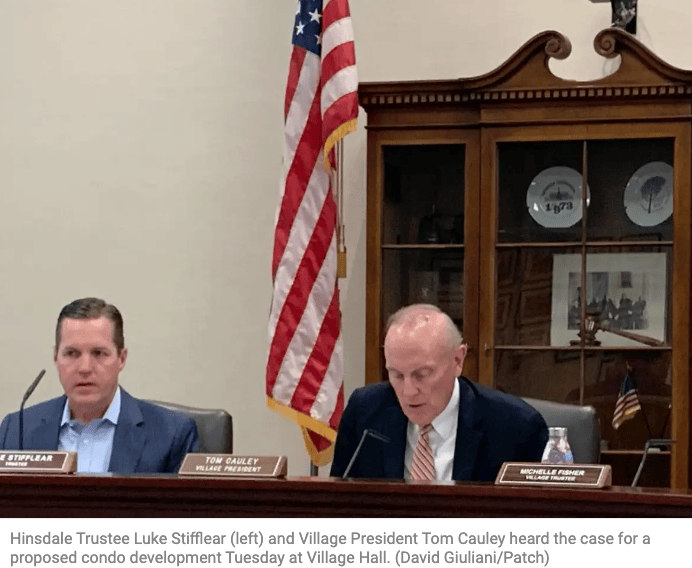
At Tuesday’s board meeting, Trustee Luke Stifflear said his recollection was that the third park would be dedicated to the village, but not be advertised as an open space for everyone.

Village President Tom Cauley recalled differently.

“I thought we were going to play it loose,” Village President Tom Cauley said. “If it was dedicated to the village, it would then be a public park.”

Drew Mitchell, a Holladay partner, agreed. He said the idea was for the third park to be quasi-public. While residents could access it, he said, no sign would be posted to indicate it was a public park.

At some time in the future, the homeowners association may change the use of that particular open space, Mitchell said.

Cauley said the thought was to keep it open, but not for intensive uses.

“If they had rugby matches there, you may decide that’s not an appropriate use,” he said.

Trustee Laurel Haarlow said she had trouble with making the open space quasi-public.

“I think that it would be difficult to enforce if it’s not more clear-cut,” she said. “What kind of precedent does that set for future property for (planned unit developments)?”

She questioned whether the homeowners association would privatize the space within a year.

Cauley said he did not want to “scare off” the development, to which Haarlow responded she, too, supported it.

He said the village should “leave it loose” on the third park.

“If it becomes a problem, let’s talk about it,” Cauley said. “We won’t advertise it as a park.”

The board unanimously approved the concept for the development. Now, the developer must present a more detailed plan to the village’s Plan Commission, which Mitchell said would happen in a couple of months. The Village Board would have the final say.

At a meeting last month, trustees said they preferred the development be age-restricted – in other words, for those 55 and older.

The developer originally wanted it to be age-targeted. That means the company would make the complex appealing to senior citizens without an age rule.

Holladay agreed to go with age-restricted, which was part of the board-approved concept.


Voices & Vignettes From CMCAs 

As CAMICB continues to celebrate its 25th anniversary, we reached out to CMCAs who’ve held the credential for 25, or more, years. Many CMCAs graciously offered to share their experiences, highlights, career paths and advice with us. 

John Schick, CMCA, AMS, PCAM, is a Management Executive with Hawaiiana Management Company, Ltd. in Honolulu.  He was a member of the Beta Test Group for the original CMCA examination. Prior to entering the field of professional community association management, John spent 20 years in the United States Air Force and then two decades in motion picture exhibition and theatre building – clearly many talents and interests!

Now with 29 years of community association work in his vast professional repertoire, John finds what he likes most about this profession is assisting home owners and helping them understand the system and how it works, including training board members and helping them  make the best decisions to benefit their properties.

He also enjoys the networking offered at industry-related events. Accepting his PCAM designation at a CAI convention in Ft. Lauderdale in a room full of CAI members was a highlight of his community association management career.

John offers important advice for new managers entering the field, “This is a unique industry. Call on all the life experiences you’ve had to help you come up with solutions. Do not assume you know or understand it all. And, be sure to ask your co-workers questions; someone has certainly been there before you.”

CAMICB’s CMCA Exam Preparation E-Learning Course Helps Candidates Get A Head Start

Free Online Resource Helps Candidates Successfully Prepare For The CMCA Exam

By Madeline Hay, CAMICB’s Manager of Exam Administration

Underscoring a quarter century of commitment to professionalism and excellence in community association management, CAMICB is excited to continue to celebrate the organization’s 25th Anniversary with the launch of a free, interactive online CMCA Exam Preparation e-Learning course. 

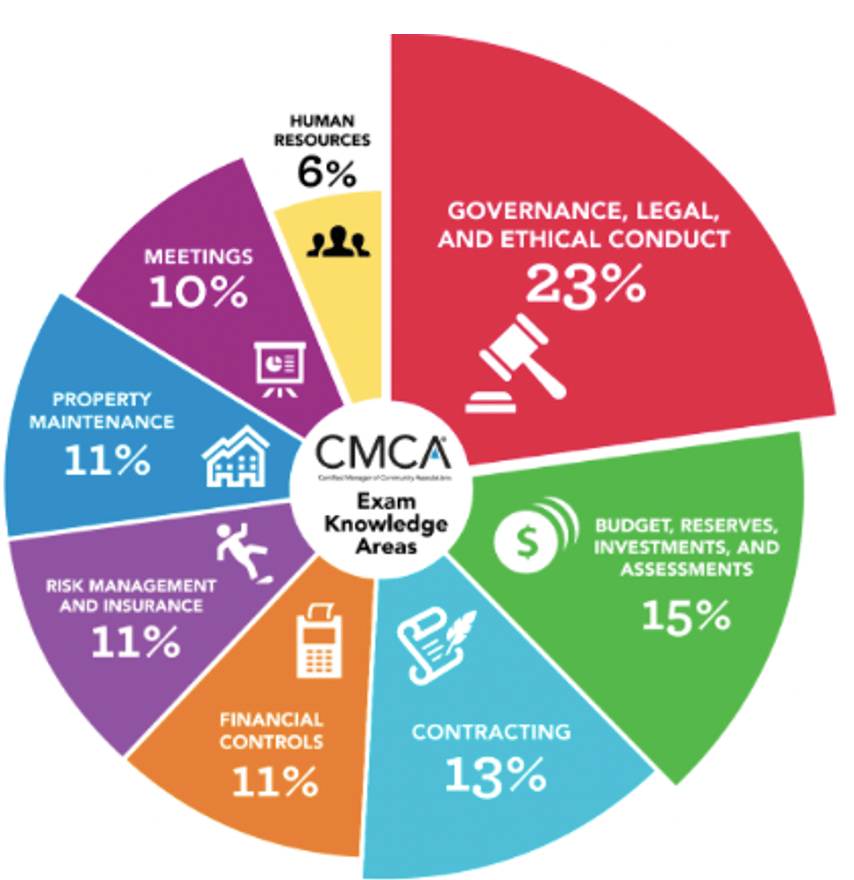
The three-hour course, featuring a series of eight modules, is divided into two components. The first component features four learning modules focused on creating an examination review and preparation plan. The second component includes three scenario-based learning modules that are designed to put several of the knowledge areas tested on the CMCA examination in context using real-life scenarios. The three modules address knowledge areas that are challenging for many CMCA candidates: Risk Management & Insurance; Financial Controls; and Governance, Legal & Ethical Conduct.  A final module is intended to offer some perspective on the exam preparation process and next steps.

Said Chair of the CAMICB Board of Commissioners Drew Mulhare, CMCA, AMS, LSM, PCAM, “CAMICB is always working to identify new tools to help CMCA candidates succeed on the exam. We’re excited to launch the CMCA Exam Prep e-Learning course – a free resource intended to put candidates on the path to the CMCA credential.”

The Course Modules

The exam preparation modules offer constructive test taking tips, discuss the composition of examination questions, give preparation advice, and provide an interactive self-assessment tool to help a candidate develop a study plan specific to that candidate’s needs and goals. The content-based modules ask the candidate to solve problems and answer questions using downloadable sample documents. 

Each module takes approximately 10-25 minutes to complete. The course is designed to accommodate busy schedules and to allow candidates to work at their own pace, so they may stop and resume the modules as their schedule permits. Below is a brief description of the different modules and what candidates can expect.

Module 1: An Introduction

Learn what it takes to pass the CMCA exam. Get advice from working CMCAs about what worked for them as they were preparing for the test – and what didn’t. Find out some common misconceptions about the CMCA exam and uncover the key for understanding how to approach the exam questions.

Module 2: Devising a Study Plan, Part 1 – Prioritizing Topics 

Discover how to establish and follow a solid study routine that’s tailored to your experience level. Get an in-depth look at the topic areas covered on the test and participate in a self-assessment exercise to determine which topics should be prioritized in your study plan. 

Module 3: Devising a Study Plan, Part 2 – Strategies and Tips 

Find out how to put your study plan into action. Learn practical tips and tricks to make the most of your prep time and take a closer look at some of the study resources available to you. 

A recent course participant shared, “The study resources provided in the CMCA exam prep course are excellent. It gave me a much better understanding of what material to really focus on.”

Module 4: Test-Taking Strategies

Learn how to maximize your potential on exam day. Find out how taking practice tests can improve your performance on the exam, get some guidance on strategies to overcome test anxiety, and see what to expect when you go to the testing center. 

Modules 5 and 6 use real-life scenarios that help you learn from detailed feedback. They also make use of downloadable sample files including Lakeside Terrace’s insurance declaration and financial documents to inform your decisions. 

Said one course participant, “For me, the CMCA exam prep course was so much more effective than simply reading different texts.”

Module 5: Risk Management & Insurance – Refresher Content 

Apply your knowledge of risk management and insurance topics by putting yourself in the shoes of the community association manager for Lakeside Terrace Condominiums. 

Module 6: Financial Controls – Refresher Content 

Revisit your role as Lakeside Terrace’s community association manager as you encounter some scenarios that test key knowledge about financial controls.

Module 7: Governance, Legal & Ethical Conduct – Refresher Content

Another real-life scenario allows you to visit Willow Grove Estates, where you have been hired as the association’s first community manager. 

Module 8: Looking Back and Looking Forward

An opportunity to recall what you’ve learned and consider what you want to keep working on. 

At CAMICB, we’re committed to offering a combination of study tools to enhance candidate performance.  Therefore, we encourage exam candidates to develop a personal study plan incorporating a wide range of resources and reference materials. CMCA preparatory materials are all available online – most at no cost – to managers employed anywhere in the world. We’re thrilled to add our newest offering, the CMCA Exam Prep E-Learning Course, to our portfolio of resources. 

Earning and maintaining this internationally-recognized credential propels a manager’s career forward, allowing for more advanced career opportunities and salaries that, on average, are 20 percent higher than non-credentialed managers. To get started and to learn more about the CMCA Exam Prep E-Learning course, visit www.camicb.org.

The field of community association management is growing. Here’s what you should know about why and how to earn the Certified Manager of Community Associations (CMCA) credential!

By Matthew Green, CAMICB Associate Executive Director

If you love the idea of a job that offers opportunity, stability, and growth, community association management provides an excellent career path. Community association managers work with homeowners and service providers to take care of the many aspects and operations of condominiums, HOAs, and cooperatives. It’s a great job choice for people who previously worked in the leisure and hospitality industries. Those sectors continue to lead U.S. job losses amid COVID-19, with experts predicting slow growth until at least 2023. The good news is that though the coronavirus has dashed a lot of hopes for hospitality grads and veterans, the world of community association management is a bright spot. The field continues to grow and offers excellent opportunities for anyone who wants to continue in a people-oriented career. 

Community Association Management Stats

The Foundation for Community Association Research reports that as of 2020, there were approximately 355,000 community associations in the United States. They house over 74 million residents, over 12 million more than just a decade ago. Twenty-six percent of people in the U.S. live in a community association. More than 60 percent of new housing completed and over 75 percent of new housing sold is in a community association. 

There are over 8,000 community association management companies in the U.S. and up to 60,000 community association managers. Further, there is an additional 100,000 individuals employed by management companies and onsite for associations with staff. As the number of people living in community associations continues to rise, so does the number of jobs for community association managers. If you’re a people person who’s skilled in handling multiple tasks, a career in community management can be an incredibly rewarding career choice.

Community Association Management Career Outlook

Job prospects in the community association management sector are excellent and growth is stable. Though a college degree and professional designation are not necessary to land a position in the field, those who do command a higher salary when starting out. As of May 2020, the median wage for community association managers was $59,660 per year. In 2019, there were 367,900 jobs in the field. Job prospects and projected wages vary from state to state and community to community, so it’s a good idea to check out your area’s particulars.

CMCA – The Essential Credential 

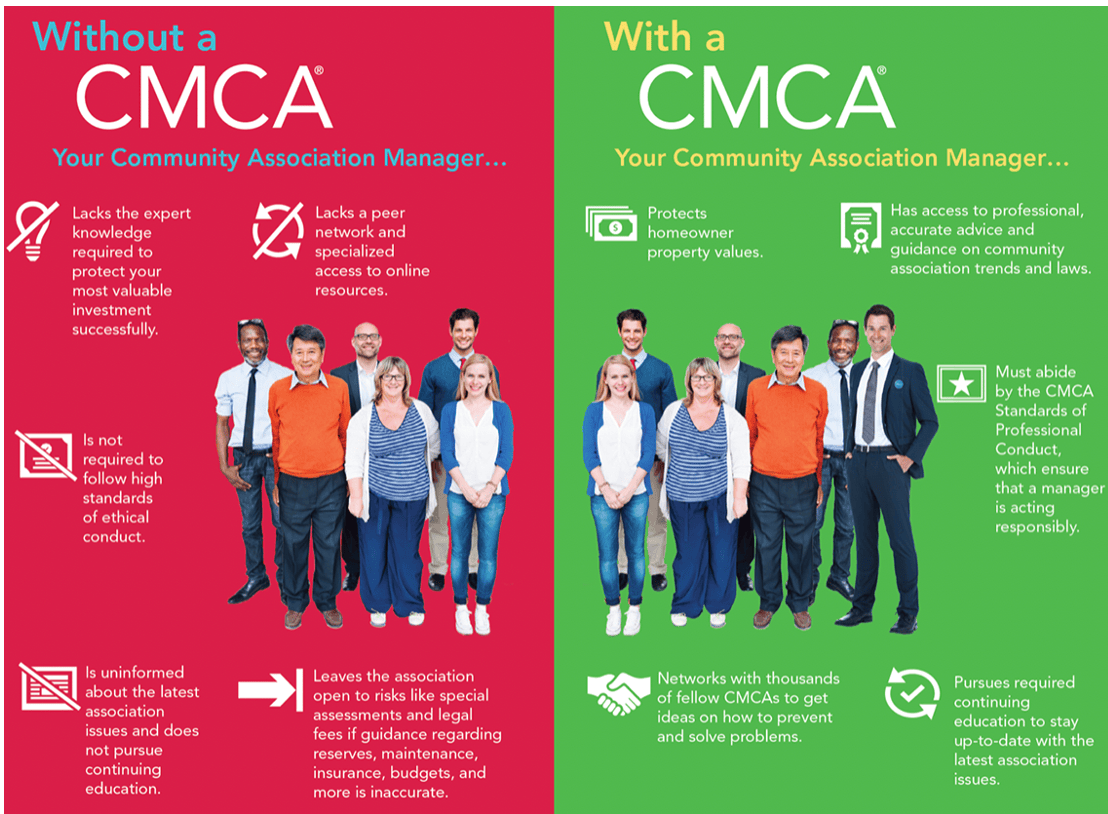
The key to building a successful community association management career is the Certified Manager of Community Associations (CMCA) credential. Holding the certification lets employers know you’re educated and competent in certain management practices. It also indicates your dedication to professional excellence, ethical business standards, and continuing education. Community management employers are continually looking for committed professionals. The CMCA certification can often make the difference between whether or not you land a first interview.

The CMCA credential is relatively easy to obtain and:

  • Requires limited time and money investments.
  • Demands just a few days of prerequisite course work, some time to study, and one day for the exam. 
  • Is relatively low-cost for such a valuable investment in your career and future.

Earning the CMCA credential opens the door to earning additional credentials and up to 20% higher earnings than community association managers who are non-credentialed.

Studying for the Exam and Earning the Credential

Several resources are available on the Exam Preparation Resources page of the CAMICB website. You’ll find these items and more:

  • CMCA Handbook
  • CMCA Study Guide
  • CMCA Exam Preparation E-Learning Course
  • Community Association Management Best Practices Reports?
  • Community Association Institute’s M-100: Essentials of Community Association Management Course Material Information
  • Community Association Institute’s Guides for Association Practitioners (GAPs)
  • CMCA Practice Exam
  • CMCA Examination Quizlet 

Becoming a Certified Manager of Community Associations is not merely a designation; it can lead to the career journey of a lifetime. It elevates your credibility as a community association manager and makes employers more confident in hiring you. Finally, it offers you a wealth of opportunity, stability, and growth potential in an exciting career that currently shows no sign of slowing down.

For further information, please visit camicb.org or email us with any questions at info@camicb.org. 

Privacy Policy: https://www.camicb.org/privacy-policy

Workers see inflation as biggest obstacle to retirement savings goals: Schwab

According to a new survey from Schwab Retirement Plan Services, investors consider inflation the biggest obstacle to saving for a comfortable retirement

By Alan Goforth for BenefitsPro

Investors consider inflation the biggest obstacle to saving for a comfortable retirement, according to a new survey from Schwab Retirement Plan Services. Forty-five percent of respondents cited inflation, followed by monthly expenses (35%), stock market volatility (33%), and unexpected expenses (33%).

“Workers have been through a lot over the past two years, and it’s only natural that recent economic and geopolitical turbulence has continued to fuel financial concerns,” says Catherine Golladay, head of Schwab Workplace Financial Services. “While plan participants can’t control inflation or the markets, the good news is they are taking steps to manage their finances with an eye to the future.”

For more go to: https://www.benefitspro.com/2022/07/29/workers-see-inflation-as-biggest-obstacle-to-retirement-savings-goals-schwab-survey-finds/

The Organization Behind The Essential Credential

It takes vision and determination to drive successful organizations forward and it’s not just one area of focus that creates a success story. From the very beginning, CAMICB has been the certification body with oversight responsibility for developing and delivering the CMCA examination, including the maintenance and promotion of the CMCA credential. In fulfilling that role for more than 25 years, the organization supports homeowners living in community associations by recognizing managers who’ve demonstrated an operational understanding of the tasks essential to performing the job of a community association manager. 

But supporting the community association management profession is far more than ensuring the CMCA credential is maintained at the highest possible standard. CAMICB must also make sure that homeowners, employers, the businesses that support community associations, legislative and regulatory bodies, and professional peers understand the value of the CMCA credential and the many benefits a credentialed manager, versus a non-credentialed manager, brings to your association. 

A Behind The Scenes Look At CAMICB Operations

The CAMICB office is located in Northern Virginia and is comprised of a seven-member professional staff who execute operational matters. Staff members manage exam development, certification applications, credential renewal and recertification, the delivery of direct customer service to candidates and credential holders, and the conduct of all CMCA activities in full compliance with the rigorous standards of the CMCA’s domestic and international accrediting bodies. 

Volunteers are at the heart of CAMICB’s work starting with a nine-member volunteer Board of Commissioners who govern the organization and are charged with representing the interests of the constituencies served by professional managers. To ensure a wide-range of talent and expertise are represented, the Board includes a minimum of five CMCA credentialed managers, up to three members drawn from a field serving the profession, and a public member.And, we are fortunate that the contributions of volunteers’ time, talent and expertise goes beyond the Board of Commissioners. For example, the CMCA exam is developed by a broad and diverse team of volunteer Subject Matter Experts (SMEs).  Subject Matter Experts work under the direction of the CAMICB Director of Examination Administration and the exam development process is overseen by our test development partner, Human Resources Research Organization (HumRRO). 

Additionally, a group of volunteer leaders oversee compliance with the CMCA Standards of Professional Conduct, a professional and ethical roadmap for CMCA credential holders. Full compliance with the Standards ensures the highest level of professionalism – and accountability – in working with boards and associations.

CAMICB Supports Managers From The Start Of Their Professional Careers Through Retirement

It’s important to note that while CAMICB is not an educational entity, it’s deeply committed to offering resources and guidance to CMCA candidates that will position them for success on the exam. In doing so, CAMICB offers a number of free tools to help candidates prepare for the CMCA exam including a comprehensive candidate handbook and study guide, an online preparatory course, an exam “Quizlet” tool and webinars focused on exam preparation. Further, staff work daily to offer individual support to candidates and credential holders.

A broader suite of resources and programs help support managers and the profession, including the following:

  • CAMICB offers managers who earn the CMCA credential a CMCA Digital Badge that credential holders can use as an easily shareable online “resume,” highlighting the value of earning and maintaining the CMCA credential.  Credential holders are also offered several resources to assist them in promoting their credential.
  • CAMICB maintains a robust bank of approved continuing education programs – many offered at no cost – to assist credential holders with ongoing professional development and to assure that credential holders have access to the continuing education required to maintain their CMCA credential. 
  • CAMICB maintains a public-facing directory of credentialed professional managers so that homeowners and potential employers can quickly confirm a credential holder’s active status. Interested parties can search by entering key terms such as last name, city, company, state, etc.
  • CAMICB offers the CMCA (ret.) program for retired professional managers. The program is for individuals who want to stay connected to an expanding group of committed professionals with no obligation to meet continuing education requirements.

The more than 73.5 million people in the United States who live in covenant-protected communities rely largely on CMCA certification as proof of ethical, knowledgeable, professional community association management and CAMICB is proud to support the highest level of professionalism in the field.