Free Online Resource Helps Candidates Successfully Prepare For The CMCA Exam
By Madeline Hay, CAMICB’s Manager of Exam Administration
Underscoring a quarter century of commitment to professionalism and excellence in community association management, CAMICB is excited to continue to celebrate the organization’s 25th Anniversary with the launch of a free, interactive online CMCA Exam Preparation e-Learning course.
The three-hour course, featuring a series of eight modules, is divided into two components. The first component features four learning modules focused on creating an examination review and preparation plan. The second component includes three scenario-based learning modules that are designed to put several of the knowledge areas tested on the CMCA examination in context using real-life scenarios. The three modules address knowledge areas that are challenging for many CMCA candidates: Risk Management & Insurance; Financial Controls; and Governance, Legal & Ethical Conduct. A final module is intended to offer some perspective on the exam preparation process and next steps.
Said Chair of the CAMICB Board of Commissioners Drew Mulhare, CMCA, AMS, LSM, PCAM, “CAMICB is always working to identify new tools to help CMCA candidates succeed on the exam. We’re excited to launch the CMCA Exam Prep e-Learning course – a free resource intended to put candidates on the path to the CMCA credential.”
The Course Modules
The exam preparation modules offer constructive test taking tips, discuss the composition of examination questions, give preparation advice, and provide an interactive self-assessment tool to help a candidate develop a study plan specific to that candidate’s needs and goals. The content-based modules ask the candidate to solve problems and answer questions using downloadable sample documents.
Each module takes approximately 10-25 minutes to complete. The course is designed to accommodate busy schedules and to allow candidates to work at their own pace, so they may stop and resume the modules as their schedule permits. Below is a brief description of the different modules and what candidates can expect.
Module 1: An Introduction
Learn what it takes to pass the CMCA exam. Get advice from working CMCAs about what worked for them as they were preparing for the test – and what didn’t. Find out some common misconceptions about the CMCA exam and uncover the key for understanding how to approach the exam questions.
Module 2: Devising a Study Plan, Part 1 – Prioritizing Topics
Discover how to establish and follow a solid study routine that’s tailored to your experience level. Get an in-depth look at the topic areas covered on the test and participate in a self-assessment exercise to determine which topics should be prioritized in your study plan.
Module 3: Devising a Study Plan, Part 2 – Strategies and Tips
Find out how to put your study plan into action. Learn practical tips and tricks to make the most of your prep time and take a closer look at some of the study resources available to you.
A recent course participant shared, “The study resources provided in the CMCA exam prep course are excellent. It gave me a much better understanding of what material to really focus on.”
Module 4: Test-Taking Strategies
Learn how to maximize your potential on exam day. Find out how taking practice tests can improve your performance on the exam, get some guidance on strategies to overcome test anxiety, and see what to expect when you go to the testing center.
Modules 5 and 6 use real-life scenarios that help you learn from detailed feedback. They also make use of downloadable sample files including Lakeside Terrace’s insurance declaration and financial documents to inform your decisions.
Said one course participant, “For me, the CMCA exam prep course was so much more effective than simply reading different texts.”
Apply your knowledge of risk management and insurance topics by putting yourself in the shoes of the community association manager for Lakeside Terrace Condominiums.
Module 6: Financial Controls – Refresher Content
Revisit your role as Lakeside Terrace’s community association manager as you encounter some scenarios that test key knowledge about financial controls.
Another real-life scenario allows you to visit Willow Grove Estates, where you have been hired as the association’s first community manager.
Module 8: Looking Back and Looking Forward
An opportunity to recall what you’ve learned and consider what you want to keep working on.
At CAMICB, we’re committed to offering a combination of study tools to enhance candidate performance. Therefore, we encourage exam candidates to develop a personal study plan incorporating a wide range of resources and reference materials. CMCA preparatory materials are all available online – most at no cost – to managers employed anywhere in the world. We’re thrilled to add our newest offering, the CMCA Exam Prep E-Learning Course, to our portfolio of resources.
Earning and maintaining this internationally-recognized credential propels a manager’s career forward, allowing for more advanced career opportunities and salaries that, on average, are 20 percent higher than non-credentialed managers. To get started and to learn more about the CMCA Exam Prep E-Learning course, visit www.camicb.org.
IGHTER PILOTS must make thousands of decisions, often with incomplete information during each flight. U.S. Air Force fighter pilot and Chief of Training Systems Hasard Lee helped develop a program to boost pilots’ critical thinking skills and mental toughness to skew the odds in their favor when making these critical decisions. He passes the lessons learned on to us in The Art of Clear Thinking.
Understanding how our decisions are made and how they can be improved going forward is essential with high-stakes decisions, but it is also important in our business and personal lives.
The right approach to decision-making can save us a lot of regret down the road. He organizes his experience and training into a concept they call the ACE Helix. It has three parts: Access, Choose, and Execute. It is designed to bring out the best options while remaining flexible in ever-changing circumstances.
1. Assess the Problem
Lee spends a lot of time explaining this step as the foundation for the success of the other two steps. “Developing a proper understanding of the problem is the first step to solving it. Our instinct is often to bypass this critical step and begin acting.” If we aren’t solving the right problem, we can make the right decision.
It is important to keep the big picture in mind and not focus on just one piece of information. This is the ability to “make sense of a chaotic environment while simplifying and structuring information. This requires judgment, and judgment requires non-linear thinking.
Often, our actions don’t result in a single outcome. Instead, they can lead to outsized outcomes that go beyond our imagination. They are non-linear outcomes. “For a multitude of reasons, people consistently fail to account for them, which often leads to a skewed assessment of the problem they’re facing and results in a poor decision.”
These non-linear relationships are governed by power laws that can lead to exponentially greater or encompassing outcomes than we anticipated, which Lee explains in the book. “We become accustomed to how our actions are affecting a system, and then suddenly, the outcome is much different from what we were expecting.
It helps if we have a broad understanding of the probable consequences of our decisions. We can adapt more quickly and accurately to changing circumstances. We can move our thinking beyond a narrow set of conditions.
Lee talks about the approach they have during fighter training that all too often goes against the approach we have and certainly have experienced throughout our life. He says, “Our job wasn’t to weed them out but to coach them throughout each training event so that they could leave as the best possible pilots.” We tend to eliminate to try to cultivate the best and brightest. He adds, “We found that almost everything is coachable and correctable if identified early enough. Even supposedly intangible attributes, such as attitude, work ethic, and flying instinct, can be significantly improved if coached properly.”
2. Choose the Correct Course of Action
To find the best solution, simplify.
They use a technique called fast-forecasting. It is designed to build a mental model of the problem focusing on the few variables, due to strong power laws, that drive the system. This allows you to quickly approximate a ballpark solution. “We’re starting with the big-picture concept and slowly adding in detail until we have a good enough resolution to make a decision.”
The key to fast-forecasting is to not get overwhelmed by the details—logic and reason are what drive the technique. Precision is often the enemy of conceptual thinking. What we’re trying to do is bring to bear the mental framework that we’ve accumulated over our lifetimes to estimate the expected value of a decision. If we instead make the problem overly complex, we lose the ability to quickly manipulate the relevant information through the lens of our concepts, principles, heuristics, and facts.
Lee writes, “Creativity is one of the few resources that can provide an exponential advantage to those who are able to harness it.”
Encourage creative decision-making with an effects-based approach. Start with the desired outcomes and work backward. “Breaking down the requirement into effects needed gives us at least an opportunity to explore alternative solutions.” Our desire to quickly find an answer or solution can lead us to jump to a solution that we are familiar with that might have worked in the past but is not really relevant to the current circumstance.
3. Execute
Good execution requires the management of stress and, emotional control – and resilience in the face of failure. “While stress exposure can slightly increase performance for simple, well-rehearsed tasks, it severely reduces performance for tasks that require complex or flexible thinking.” Mental toughness is a skill that can be learned and improved.
In fighter training, they incorporate a number of concepts into their training. Preparation is key. Mental toughness needs to be practiced until it is a subconscious reflex. They also include focus-based training. “The key to maximizing our mental resources is to focus only on what we have control over, which is the next decision to make.”
Part of the training involves systematically building confidence. Confidence is not something you have, or you don’t. “Confidence is a skill that can be improved, primarily through our internal dialogue—how we talk to ourselves.” Perfectionism and focusing on our mistakes creates self-doubt, which is detrimental to high-stakes decision-making. Trainees are taught to reframe and replace negative self-talk with a successful counterexample from their past.
In stressful and uncertain moments, it is important to keep your priorities your priorities. Focus on and prioritize what is important. “If there isn’t a clear vision, our minds will default toward urgent tasks.” At some point, you have to be decisive. You’ll never make the perfect decision. You can remove all uncertainty from your decision-making. When making decisions, “we’re just trying to remove the choices that are clearly not optimal.”
Lee says that “when there are multiple seemingly equal choices,” he has found that “going with the riskiest viable option usually provides the greater return in value. Most people hate uncertainty, particularly when it’s combined with risk. As humans, we are biologically programmed to overestimate risk. If you’re able to overcome that mental hurdle, it becomes easy to differentiate yourself and greatly increase your odds of success.”
The Art of Clear Thinking is full of great stories to illuminate the concepts and makes this business book read like a gripping novel. He shares a lot of information, so you will need to go back and reflect on how it can best be applied to your tough decisions.
CMCAs’ Commitment to Following Strict Standards of Professional Conduct
An important – yet often overlooked – component of CAMICB’s Credentialing Program requires a Certified Manager of Community Associations (CMCA) to adhere to a high standard of ethical conduct. This means Certificants must comply with the 10 CMCA Standards of Professional Conduct, which govern their professional activities.
These Standards of Professional Conduct, detailed at www.camicb.org/standards, range from understanding laws applicable to community association management, to being knowledgeable on association policies and procedures, to carrying out fiduciary responsibilities, and participating in continuing education coursework. A violation of any of these Standards of Professional Conduct may be grounds for administrative action and possible revocation of the CMCA certification by CAMICB. Abiding by these Standards of Professional Conduct help protect consumers and associations that hire or contract with community association managers.
“When a community association manager earns the CMCA, they’re pledging to uphold a strict code of professional conduct which is critical to the profession,” said Ron Perl, Esq., a Partner at Hill Wallack LLP, who leads the firm’s community association practice group. “This is more than understanding the many facets of community association management and troubleshooting challenging situations, it brings about accountability, responsibility and trust to the individuals the profession serves.”
Enforcing the Standards of Professional Conduct
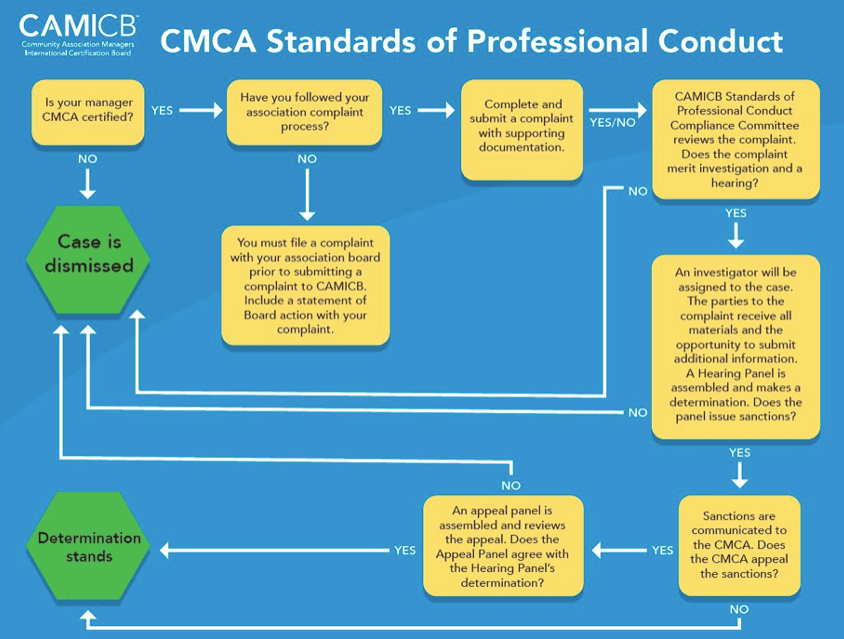
In order to maintain and enhance the credibility of the CMCA Certification Program, the CAMICB Board of Commissioners adopted strict procedures that allow consumers and others to bring complaints concerning CMCAs to the Board.
The CAMICB Chair of the Board appoints members of the Standards of Professional Conduct Compliance Committee which oversees the process and procedures for enforcing the Standards of Professional Conduct. Once a complaint – received in writing – is deemed valid and actionable by the Committee, it will be brought before a Review Panel for investigation and a determination of whether there has been a violation of the Standards. If the Review Panel determines a violation has occurred, an appropriate sanction will be imposed. This process, including the internal investigation, hearing, and timeline of activities, is clearly detailed in the Procedures for Enforcement of the Standards of Professional Conduct document available on the CAMICB website.
The grounds for sanctions under these Procedures range from conviction of a felony, to gross negligence or willful misconduct in the performance of professional services, to fraud or misrepresentation and, where applicable, loss of state license required to practice community association management.
“These Standards of Professional Conduct are the foundation of the CMCA credentialing program,” added Marilyn Brainard, a public interest member of the CAMICB Board of Commissioners. “We take them very seriously and are proud of the work our colleagues and managers do to uphold them.”
Heidi Brooks Senior Lecturer in Organizational Behavior
Interview by Emily Gordon
The pandemic changed where we work and how we work, how we think about the place of work in our lives and vice versa—all against a backdrop of rapid technological change, economic upheaval, and a reckoning with racism. We talked with Heidi Brooks, who teaches leadership at Yale SOM and advises companies on everyday leadership and organizational culture, about how to have necessary conversations about a new experience of work.
The last time we talked about returning to the office, you suggested that we take this opportunity to think about the workplace—not just how to organize workers and cubicles, and whether we mask, and what the hybrid policy is, but to assess how our organization works, and how we‘re working together as a team. Now it’s 2023. Do you think that those conversations are still needed?
Absolutely. For the most part, business people and executives are interested in solving problems that are in their subject-matter expertise. And re-envisioning work is not an area of expertise for most of them.
So we are re-envisioning work and having some trouble with the process. Part of what has happened is that people have tried to make it a problem that they can solve with the tools available, the kind of questions we are used to asking. What days should we all be in the office? How can we have time when people encounter each other, have spontaneous collisions? How can we recapture some of the liminal, in-between space where there was creativity about our shared work and also bonding and building familiarity? More recently, I’m seeing more bids for empathy skills re-emerging. I’m listing those questions in a way where they get increasingly toward what I think is the real issue, which is, what does it mean to recraft being together in a world we have never quite visited before? It escalated the priority of the future of work that’s now here. And it turns out we’re not ready.
Why not?
We don’t even know if we’re ready for new technology. We’re confused, and agitated and worried and fascinated, about AI and ChatGPT. This is supposed to be humanity at its smartest and best, producing technical excellence—we‘re not even ready for ourselves.
On the other side of the equation, how do we ask questions that don’t use our very refined and familiar problem-solving mindset? We’re so ready to be a heat-seeking missile toward a problem we can solve and get our heads and hands around. But our problem-solving muscles are not equipped for a different set of questions, like people asking, who am I at work now? That’s not a problem to be solved. It’s a question to sit with and get curious about.
We were tragically disturbed by the pandemic. Our survival was threatened. We’ve also, in the last three years, faced very deep questions of racial equity in the workplace, and foundational questions about whether our planet is safe and whether we ourselves are the greatest threat. We are at war in certain ways, and we’re not quite sure what that means for each and all of us.
We have been and continue to be disturbed by fundamental questions of what it means to be human. We don’t know how to really be in a world where we don’t have the answers and we disagree about even how we see the issues. And these are the kind of questions that are coming up about what it means to work together. We think the question is, should we all be in the office on Friday? The question is actually more, do we even want to work? What is work? And why is work? How can we expand our experience of work to be simultaneously many things at once: be more meaningful, cultivate more belonging, unleash more potential and yet, cost less time, effort, energy and “human-ness”? How can work be better?
Just as wearing a mask became a political statement, talking about how we work together and what office culture is like is also considered a battle in a lot of workplaces. To even say out loud “Things aren‘t normal; let‘s confront that” is controversial in a lot of workplaces because a lot of people seem to want to get back to the way it was before.
That’s the human draw toward familiarity. But one of the funny things is that we have different versions of familiar. For some people, what has become familiar is staying at home. For other people, what is familiar is being in the office. Our reference points are different. And since we’re not great at understanding each other’s perspective, we might be picturing different parts of the elephant. I’m not even sure if we’re picturing the same mammal.
I don’t think we were great at this question before. But the conversation has gotten more demanding and more urgent. We were already bad at discussability of tensions, and coordinating our time and interactions together, and coordinating around productivity and individual wellbeing and sustainability in a meaningful way that promotes belongingness and unleashes potential. We were horrible at all of those things before. So why should we be better under duress? If you’re not great at running a marathon, you’re not going to be better just because there’s suddenly a hill. You’re going to be worse.
Some companies are probably better at this than others.
The marathon example is a nice analogy, because when you come to the hill, you can see the groups that are stronger get separated from the ones that are struggling. When you put a unit under stress, whether it’s a company or an individual, you see what’s strong and what’s weak.
What are the necessary components for workplaces? You mentioned those happenstance interactions and that sense of actually getting to know people. What else is important in terms of those micro-moments that you study and teach about?
Micro-moments have to connect to a bigger picture. They have to connect to values and strategy and purpose. One of the reasons to look at micro-moments is that we’re often misaligned—we’ve only looked at strategy, and have not held ourselves accountable to a clear line of enactment of those principles in our micro-interactions and people’s lived experience of the organization.
What does it mean to be a strong organization that can turn the corner? What does it mean to be robust and resilient? If I had to boil it down, I would point to the capacity for learning. This is a time of learning and adaptation. When people are saying, “Let’s get back to normal,” I sometimes hear that as, “Let’s not learn a new way. Let’s just try to do the old way.”
Well, new times are here. So it’s not appropriate to ignore adaptation opportunities—nor is it appropriate to only do new things. Agile learners don’t throw out what works. They use what works and build on that to adapt to the new demands. Individuals and organizations that are able to, with curiosity and openness, take this on as a learning challenge, and even enjoy it—I’m much more hopeful about those organizations and individuals than I am about the ones that say, “Close the doors. Don’t let in the new way. Let’s regress back to a yesterday that we’re comfortable with.”
If you’re talking to an organization that says, we have spent years or decades perfecting the way we do things around here and everyone’s working together functionally, what’s the incentive for them to do better?
Maybe they’re fine. I don’t have an agenda for them that they don’t have for themselves. A lot of the groups I’m speaking to are the groups that are saying, “We have outpaced the skills and mindsets and ways of thinking about leading our organization and especially our organizational culture that have always served us. We are now not able to keep up with the demands of a very diverse, not co-located, sometimes younger workforce that wants something a little bit different from work than they did not very long ago.”
Some people may not be able to express what they’re looking for.
Right. When we talk to people, there are people who haven’t articulated it, but they can feel the tensions. They have the sense that it used to be the case that managing people by assigning tasks and being a subject-matter expert got the job done. And somehow things are more complex now, and what’s being asked of me goes beyond that orientation of solving the problem.
Being a subject-matter expert of all things on your team is really no longer possible for many managers. So what you need to be able to do is to help people collaborate and grow and deal with pace and stress and volatility, and be curious about each other’s perspective, and be able to elicit information from other groups, and to collaborate across languages and disciplines and functions. And that’s very different than being a subject-matter expert in a straightforward kind of way. People often were not trained for it and haven’t thought about it.
I had someone say to me, “I’m known to be pretty good at what I do. I’m pretty senior in my field. I’ve been doing this for 30 years. And in the past few months I felt like I should have studied psychology. There are very different demands that are being asked of me—developing people and helping teams to be able to function and collaborate, dealing with social justice issues, questions about ESG. This is another job. What do I do now and how do I meet what’s being asked of me?”
So what’s the answer, if you can’t take a break and get a degree in psychology? What could you start doing next week to bridge this perhaps terrifying gap between what’s always worked for you and what the world has become?
There’s a way in which this is not a problem to solve, but a dilemma to navigate. We have to learn our way forward, and to be able to discern what of the challenges in front of you are things that you can meet with familiarity and calm and a sense of competence and what are the things that are new, where you don’t necessarily know the answer, and yet your leadership, your presence, is still quite central.
I’m not just talking about formal leadership. I’m talking about people who are influential in their settings—informal leaders. Those voices are very important now too. I consider that part and parcel of what I call everyday leadership.
We have to get more comfortable with being uncomfortable as part of valid and relevant leadership. Leading in the face of ambiguity and complexity is part of what’s so confusing. So if we insist on holding the frame that leadership is about knowing the answer and solving the problem, we’re going to stay confused and in a corner, because we’re at a place where we don’t know the answers and can’t solve all problems in readily available ways.
The type of leadership that might help at this point is one that can help people exist with the ambiguity of not knowing the answer and still feel like they are part of an organization that’s engaged in meaningful work. Where individual efforts contribute to the whole, they have a sense of meaningful belonging, and their interfaces with the organization unleash their potential rather than waste their time.
Then there’s the challenge of leading on questions of diversity. Often the leaders are White, and are reluctant to bring up issues like racially motivated violence. But it’s something we’re living through, especially people of color. If you, a manager, are afraid of talking about confronting the issues of how we create belonging and unity as a team working hybrid, it’s much harder to know how I, a White man, can lead this organization and try not to step into landmines but also be helpful and supportive to my workers.
Before we were talking about the example of the hill during the marathon; the hill is any source of stress or duress. That also applies to situations of perceived difference. We know we have a preference for familiarity and similarity. We have a similarity bias. When we are leading or working in a team with perceived bias, it can create some frictions over not being able to understand each other’s perspective. Now it turns out those same frictions can be very productive because if you figure out how to unearth more information, we have more data on the table.
But anything that presents a little bit of strife stresses a system that wasn’t in many cases very strong before. So if before we weren’t good at naming tensions in the workplace, or getting through difficult times that were out of the everyday routine of solving problems, then when problems are a little bit more complex and nuanced and demanding, it’s even more challenging.
I’ve read that people of color have benefited more from working remotely.
People have been saying that there is a benefit for people who are of a different demographic than most of their offices. So if they’re the only woman among many men, or the only person of color in a predominantly White organization, there can be so much everyday friction—just the cost of being different. Not having to navigate that constantly reduces a strain and stress from their life.
What’s a first step for a person reading this at an organization that could use some improvement, but there’s fear and anxiety around it? Change has come but they don’t know how to talk about it and how to deal with it.
One of the questions that I like to ask learners is starting with yourself first: What of your everyday experiences with your organization are enlivening and which of those things are depleting? That’s a basic question. Sometimes people who are in a role of leading, or serving their organization without a formal leadership role, forget to do a little check-in with themselves.
It’s a place to go for the sake of curiosity, but also for empathy for the next layer of questions, which is, what are the things that other people are experiencing in the organization, including things that I create with my impact, that are enlivening or depleting to people’s experience at work? And then sticking around to hear the answer with curiosity and learning and openness to really get where people are coming from and what they’re seeing and experiencing from their perspective. Especially if they’re different than you are in some way.
Your intention is not necessarily to fix these things immediately, because some of them you won’t be able to fix. Some of the things that are depleting are going to stay. And some of the things that are enlivening you might not be able to intentionally reproduce. But just listening and getting a sense of their experience of work, and then getting curious about what they want to be their experience of work.
Q: We’re shareholders living on the top floor of a co-op in Yorkville. Once or twice a year, the ceiling leaks during rainstorms. We always notify the super and the management company, and the super “finds” a problem and “fixes” it. But the leaks keep happening. What can shareholders do to pressure a co-op board to get a more thorough evaluation and make a permanent fix?
A: Ceiling leaks can lead to much bigger problems if they aren’t fixed, so they must be addressed properly and promptly for the good of your unit and your building, replies the Ask Real Estate column in The New York Times. As a first step, you need an evaluation by a professional who’s experienced in finding leaks, typically an engineer.
Reaching out to your managing agent was a good first step. Document the dates of contact, and the response you did or didn’t receive. Managing agents often have many buildings in their portfolio, and shareholders’ concerns aren’t always addressed promptly. If your engineer’s findings don’t produce results, here are three more steps to take to force the board into action:
1. Hire a lawyer.Then have the lawyer draft a letter to the co-op’s board of directors and managing agent. Tell them you are aware of the leak, make clear that it is a recurring problem, describe the damage it is causing, and note that your repeated efforts to address the issue have failed to result in a professional evaluation. “In many instances, a lawyer’s letter will get the attention of the building,” says Lawrence Chaifetz, a real estate lawyer with Chaifetz & Chaifetz.
The co-op board has a fiduciary responsibility to take care of the building, which is why the board must respond. “I think the most important thing is to impress upon the board their responsibility in addressing it,” says Lorraine Nadel, a lawyer with the firm Nadel & Ciarlo, who handles real estate disputes and litigation.
2. Call 311.If the board doesn’t respond to your lawyer’s letter, you can call 311 to report the leaks. If a city inspector visits, it could result in a building violation — or, if the inspector finds other problems, unrelated violations. Just be aware that this could damage your relationship with the board. It could also result in a building-wide maintenance increase if the property has numerous unaddressed violations that require major repairs.
3. File a lawsuit. Litigation is the nuclear option — after all, you’re suing the corporation in which you own shares — and it should be seen as the last resort. Despite the severity of this step, lawsuits are not uncommon, Nadel says, if the board is dysfunctional or if there is no money available for repairs.
Editor’s note:Attorneys at Goede, DeBoest & Cross respond to questions about Florida community association law. With offices in Naples, Fort Myers, Coral Gables and Boca Raton, the firm represents community associations throughout Florida and focuses on condominium and homeowner association law, real estate law, litigation, estate planning and business law.
Q: My homeowners’ association just posted a notice that the Board meeting to approve the 2024 budget will be held at our clubhouse in five days. I thought that the homeowners’ association was required to post and mail the notice of a budget Board meeting and the proposed budget to all owners at least 14 days prior to the Board meeting. Is what they did correct? –J.R., Hollywood
A: What the homeowners’ association did could be correct depending on whether there are other provisions in your community’s governing documents on additional requirements of the association when it comes to the budget Board meeting. Chapter 720, F.S., the HOA Act, does not require mailing and posting of the budget Board meeting notice and the proposed budget at least 14 days prior to the Board meeting. In fact, the only requirement is that the notice of the Board meeting be posted in a conspicuous place within the association at least 48 hours prior to the Board meeting and the meeting notice must state that assessments will be considered at the meeting. Additionally, after the budget is approved, the Association is required to provide each owner with a copy of the annual budget or a written notice that a copy of the budget is available upon request at no charge to the owner.
The time period and process of mailing and posting that you’ve stated in your question is required of Florida condominium associations. Many homeowners’ associations have also voluntarily begun to comply with this process. However, unless an association’s governing documents explicitly requires it to comply with the longer notice requirement and the requirement to mail the notice and proposed budget, a homeowner’s association is only required to post a notice at a conspicuous place within the association at least 48 hours prior to the budget Board meeting.
Q: My homeowner’s association just had a board member resign, in writing, effective immediately. The annual meeting for the Association is not until March 2024. To further complicate matters, this board member had a two-year term so his term would not be up until March 2025. Is the board allowed to appoint a replacement? Can the new director be appointed for the length of the resigning director’s term? –K.T., Boca Raton
A: The provisions regarding director appointments and length of terms for replacements directors will be found in the association bylaws. Section 720.306(9)(c), Florida Statutes, provides that unless otherwise provided in the bylaws, the board of directors is authorized to appoint someone to an open seat on the board and that person would fill the term of the open seat. However, it all depends on whether there are differing provisions in the bylaws. I have seen some bylaws require a new homeowner vote for the open board seat. I have also seen bylaws that have stated that the director filling the open board seat may only serve until the next annual election, regardless of whether there is another year on that board member’s term. That being said, the more common provisions are consistent with the statute in that the replacement director shall be appointed by the board of directors and shall serve for the length of the term of the director he/she replaced. As such, I encourage you to review your bylaws to see if there are differing provisions. If you have any questions, please contact your association’s legal counsel
Q: There was a sale that just occurred in our condominium association. There were delinquent amounts owed to the association. Unfortunately, these amounts were not listed on the estoppel document issued by the Association in conjunction with the sale. Can we pursue these amounts against the new owner? –C.M., Coral Gables
A: No, unfortunately, you will not be able to pursue these amounts against the new owner. The estoppel certificate is a legal document that provides the buyer with information regarding the association and the unit he/she is purchasing. If the association omits unpaid assessment information, it will be unable to collect those amounts from the new owner. This is specifically stated in Section 718.116(8)(c), Florida Statutes.
Meetings are broken. Something happened when work moved online in 2020, and opening up the office hasn’t fixed it. Every interaction with colleagues became a video call, and our days became a game of transactional Tetris: Where can I slot in this or that meeting? Now, with policies directing which days of the week to be where, the Tetris has gotten more complex.
In my work helping distributed and hybrid organizations flourish, I see employees commuting only to spend time in near-empty offices or on calls. It feels less like flexibility than a new constraint, and it’s not building the relationships we intended. It’s the worst of both worlds.
There is a better way. Instead of focusing on when and where we meet, we ought to start with why we’re coming together and let that dictate logistics. When I’m asked to help rebuild relationships and strengthen complex collaboration, I begin with foundational advice: The new work calendar isn’t about office or home, it’s about three gathering types and the conditions that serve them best.
Three Types of Gatherings
Why do I call them gatherings and not meetings? Names signal purpose. Meeting has a strong connotation, suggesting people around a conference table (or the online equivalent) and a tight agenda. Gatherings offer multiple purposes and release the idea that we must conduct a time-stamped march to check things off lists.
Transactional gatherings move work forward; relational gatherings strengthen connections; and adaptive gatherings help us address complex or sensitive topics. As transactional gatherings are easier to conduct online, relational and adaptive gatherings have become relatively scarce. Now is a great time to reintroduce and redesign these gatherings, as all had flaws even before the pandemic. Let’s look at the best conditions for all three. While I focus on distributed and hybrid environments, the lessons apply for any organization.
1. Transactional Gatherings
Transactional gatherings are about getting things done. Examples include daily standups, weekly sales updates, and planning meetings. They need three things to be successful:
Shared working documents
Cloud-based tools like Google Docs, Miro, and FigJam are game-changers. If your team hasn’t been using them, now is the time. Because multiple people can edit simultaneously, everyone sees updates in real time, and they far outweigh a whiteboard only a few can see.
Screen parity
Hybrid transactional gatherings — where at least two people are in the same room and the rest are distributed — benefit from screen parity, or having each person appear in an individual tile. As anyone who’s attended a hybrid meeting remotely likely knows, it’s hard to interact with a virtual conference room full of blurry people.
A host on the lookout for signals of participation
While tech adjustments go a long way, hosts have an additional responsibility when not everyone is together: spying signals of participation. A raised hand or a mic going off mute are signals to engage participants. I’ve found it advantageous to add a supplementary role: an engagement lead to support the host in ensuring active, equitable participation. In smaller events, the engagement lead and the host are synonymous. In bigger gatherings, consider appointing separate owners.
2. Relational Gatherings
Relational gatherings are intended to strengthen our connections. Examples historically included offsites, group lunches, or team-building outings. They need three things to be successful:
Clear objectives
Relational gatherings suffer most from “let’s just get everyone together” syndrome: the idea that just throwing people together will suffice. While these types of events can be lovely, they are not relationship builders. Instead, whether you’re convening two people or the whole organization, relational gatherings should be intentionally designed, with clear objectives. Instead of “get to know everyone,” try objectives like:
Learn about career evolutions
Understand driving motivations
Reflect on growth moments
These objectives give people a hook so they can get to know each other more naturally.
Structured activities
Instead of an amorphous free-for-all, structure time deliberately. Split the session into times to reflect (alone) and share (in small groups) through activities like the following:
Draw a map of your career, highlighting pivots.
Share one piece of work-related advice you return to often.
Tell a story of resilience.
Strong relationships are built by laddering up levels of openness, so these activities allow people to choose comfortable levels of exposure. A leadership team who has worked together for years and navigated rocky waters would likely share deeper stories than newcomers at an onboarding event.
If you have a subset of your team together, create a distinct, asynchronous way for non-attendees to engage. For example, for the advice activity, you could ask people to share their example over video in advance.
A mix of people from across functions, levels, or locations
Left to our own devices, we go where we’re comfortable: talking to our teammates, our peers, or those in similar circumstances. But organizations need us to have relationships beyond these silos, which relational gatherings can support by deliberately mixing people who wouldn’t naturally gravitate to each other.
3. Adaptive Gatherings
Adaptive gatherings help us address complex or sensitive topics where the right process or the desired outcome are not clear from the outset. These gatherings require agility and sensitivity. Examples include strategy sessions, innovation sprints, career conversations, or navigating the organizational impact of a societal issue. To be successful, they require three conditions:
A malleable, distinct environment
When I was at the design firm IDEO, where almost every client gathering was adaptive, we preferred rooms separate from team meeting spaces. Ideal were spaces where furniture was moveable, people could mill around, and there was no formal hierarchy implied (board rooms: out!). Space influences how people interact, so the location was the first clue to participants that this was not a run-of-the-mill conversation.
If you’re online, break out of video boxes. Design brainstorming sessions with video off and the focus on a digital jamboard. And try to host delicate conversations (where body language matters) with people sitting on couches or chairs rather than at desks, with the camera farther back to reduce intensity and allow for full-body signals.
A sense of safety
Historically, difficult or sensitive conversations happened in person, so we could watch body language and use physical surroundings to create a sense of safety. But we’ve learned over the pandemic that this isn’t always necessary — or desirable. An example is sensitive career conversations. While your instinct may be to hold these meetings in person, several employees have told me they prefer these discussions online. The screen helps them hold their emotions in check, providing a greater sense of control. Allow employees autonomy over where these are held (some may prefer online, others a walk-and-talk).
Release valves to dissolve tensions
Often, complex problems have time pressure, and release valves can help. To navigate to conclusions from a place of calm, create separation between discussing options and making decisions. In the room, that might be a coffee break with a shared laugh about something off topic. Online, encourage everyone to get outside and not think about the issue. This change in focus is not expendable, but rather a critical component of a successful outcome.
In a distributed organization I led, we needed to build a new guiding framework after a charged incident. To dissipate tension, we altered cadence and structure. First, we hosted a small digital round table to reflect on the incident (to allow emotions to flow when assessing the pain point). Next, we held one-on-ones with various individuals to understand diverse needs (the intimacy helped people feel more comfortable being vulnerable). Finally, we hosted a session to craft our new framework (by then, the emotions from the first two stages had sufficient space to dissipate).
What should you do if your gathering is all (or none) of the above?
While these use cases benefit from different conditions, it doesn’t mean you can’t combine them. An example is an offsite slated to build relationships, address complex strategic issues, and get work done. Set separate conditions for each: Mix and match people who wouldn’t naturally gravitate to each other, allow strategic discussions to have breathing room, and use distinct spaces for each type of activity.
Other events may not feel like they are transactional, relational, or adaptive gatherings. That’s okay, too. Because the path to an effective gathering is always to ask: Why are we meeting? What are we trying to accomplish? And to let each need have its own space and place. You may be surprised by the rhythm of when to convene in person. While it will vary by team needs, it’s more likely to be on a monthly, quarterly, or project cadence than weekly.
And if you can’t make organization-wide change, you can still impact your own gatherings. Within a policy that dictates where you should be, not why, reorient how you conduct gatherings by shifting your priorities from the logistics of your calendar to the needs of your people.
Amy Bonsall is the CEO of Collective, a platform that helps distributed organizations and their people flourish. Prior, Amy was an IDEO and Old Navy executive. She’s been on the pages and stages of Entrepreneur, IDEO.com, SXSW, Singularity University, and more, covering flourishing at work, working from anywhere, distributed organizations, and behavioral prototyping. She co-teaches a course on Designing a Business, hosted by IDEOU. Follow Amy on Instagram.
As a leader, your biggest responsibility is to the people in your organization. As you serve your team, you may wonder about the possibility of sharing your expertise more widely with larger audiences to create greater reach for your ideas and a lasting contribution. You could write a book to capture your knowledge. Or, if you’d like to start on a simpler, but also influential path, you could become a thought leader by sharing your ideas online.
When you purposefully choose to share content in online spaces to advance ideas around important topics, you become a thought leader. A thought leader, according to Peter Winick, is someone who has both thoughts and leadership, a point of view to share. Your act of sharing content is an act of leadership.
If the thought of creating content to grow thought leadership online is overwhelming, consider that you likely have a wealth of content to reshape and repurpose.
Leaders of organizations of any size regularly communicate vision and values to their teams and may also share their subject matter expertise or business acumen with internal and external audiences in a variety of ways: in email messages, internal documents, one-on-one interactions, internal team meetings, meetings with customers, in training materials or through presentations at industry events. It’s also possible your company already creates content on your team’s core areas of expertise through a blog, podcast or video series.
Here are five steps to follow to make the most of the content you already have (but may not recognize.)
1. Identify the content you want to share
On which topics are you best positioned to share? Do you want to share about your company’s vision, values and approaches to establish thought leadership around organizational culture, leadership, team building or collaboration? Or do you want to share content on the topics related to your organization’s subject matter expertise?
Identify and clarify your key topics, themes and areas of expertise, whether related to the way you work or the work you do.
2. Figure out what content you already have and create a content catalog
A content catalog is a listing of all your existing content assets, organized to identify the theme of each one, its location or link and its format. I recommend using a spreadsheet to capture these assets. (I like Google Drive for its ease in sharing and updating in real time.)
Do you have slide decks from speeches or presentations?
Have you written articles or blog posts?
Have you published any articles?
Have you written any FAQs about your areas of expertise?
Have you sent any email answers to commonly asked questions?
Have you delivered any webinars?
Have you written any newsletters?
Have you created any videos?
3. Create a content calendar
Once you complete your content catalog, organize it according to the key themes and topics you outlined previously. This will help to identify any gaps with your existing content and give you creative ideas about places you can create new content, when time allows.
Create a yearly content calendar to guide your thought leadership content creation. Include your key themes in the calendar so it can drive your content focus. Your audiences will not likely pick up on the themes, but the themes will provide structure, giving you or your marketing team a roadmap for supporting your content sharing.
Where new content is needed, think about the everyday activities during your work when you are speaking or writing to others about your core areas of expertise. Be present in your day and think about the stories you tell again and again. What are the questions you always get asked? What are the frameworks you share? Are there any unique differentiators that cause people to come to you instead of someone else? Those are the clues to the content you should be creating.
If you find yourself answering the same questions over and over, record your answers and get a transcription. (Otter.ai automatically transcribes Zoom calls, and you can easily cut, paste and edit content from transcripts to use in other ways.)
4. Flex to repurpose your content
Remember that content is flexible. Consider the various ways your audience may consume your content. If you have content in a written format, like a blog post, consider taking three minutes to talk about that content on a video to be shared to YouTube or on Instagram as a reel. If your audience prefers audio content, investigate turning your written content into a podcast series or audiogram.
Any longer content can be made into shorter forms for sharing on social media, and any shorter form content can be bundled to create a longer form content asset.
5. Bundle it up!
As you continue to develop content, move toward creating content bundles on your core topics and themes. For example, take a question you get asked all the time, and then create a variety of different content types that can reach people in different ways over time. You don’t need to create these various content assets at once, and you would not share them all at once. But, they will give you a content pipeline for the future.
As you create content to share with external audiences, people in your organization will benefit in two ways. First, your team will benefit by learning from the content you’re creating. Additionally, as you grow your thought leadership, you’ll expand awareness of your organization and its expertise, increasing your company’s success.
Becky Robinson is the founder and CEO ofWeaving Influence, a full-service marketing agency that specializes in digital and integrated marketing services and public relations for authors, business leaders, coaches, trainers, speakers, and thought leaders. Becky’s first book,Reach: Create the Biggest Possible Audience for Your Message, Book, or Cause (Berrett-Koehler Publishers), shares how to create the biggest possible audience for an idea, book, business, or cause.
With AI advancing, EQ has become more important than ever. Here’s how to ensure it remains a core component of your organization.
If your business is like most businesses, you are likely currently experimenting with ways in which artificial intelligence can make you better. Maybe you are exploring how AI can analyze operational data to improve your decision-making, or perhaps you are testing out how AI-driven chatbots can streamline your customer service.
There is a good deal of excitement about AI’s potential for boosting employee efficiency and effectiveness. But at the same time, there are concerns about the negative impact it could have.
While I believe that AI can be leveraged to enhance our human efforts, I don’t believe it can replace the human connection that is so important to a healthy workplace. As we move into the age of AI, emotional intelligence (EQ)—and the human connection that it empowers—has become more important than ever. Leaders who want to use AI effectively must ensure that EQ remains a core component of their business.
Why we need EQ more than ever
The physical challenges brought on by the Covid-19 pandemic may be behind us, but the mental challenges triggered by the pandemic have not gone away. People are still struggling to make sense of the new normal and they need leaders with high EQ to help them.
Some employees still reeling from the pandemic are showing up to work, but failing to engage. They have a million things on their minds and doing their best work is not one of them. That is a problem for business leaders because it dramatically affects their organization’s productivity.
Addressing the problem requires EQ. A leader needs to discern what is going on with his or her team. Is someone sad, depressed or frustrated? If a leader is not able to figure out where their employees are, then he or she won’t be able to move them forward to a better place.
The insight that EQ brings also allows leaders to craft a narrative that empowers people because it acknowledges where people are, what they are feeling and the steps that the organization is taking to make things better. Great leadership creates and communicates narratives that give people hope.
How AI threatens an EQ-centered workplace
If you believe the hype, the applications for AI are endless. The media tells us it can help any size business and it can help in any department — from managing recruiting and hiring to training and performance evaluations. Engagement with both employees and customers can benefit from the use of AI-driven tools.
AI is able to manage all of these things because it delivers speed and automation, both of which make a human connection all the more challenging to sustain, but for all that it can do, AI will never care how an employee feels. An AI-driven chatbot will never say, “This person is having a bad day. How can I make it better?”
As companies turn to AI to empower greater efficiency, they must also take steps to ensure that leadership continues to value the human connection. Here are a few they should consider:
• Foster an AI-augmented culture. Using AI to replace people and the roles that they play in workplace interactions will absolutely have a negative impact on human connections. A better approach is to leverage AI to augment the current culture and enhance human performance.
Decision-making provides an excellent example of an area where organizations should pursue AI augmentation, as better decision-making is one of the benefits that AI developers are promising to the business world. AI-driven tools can analyze vast amounts of data in short periods of time to provide invaluable insights.
However, traditionally decision-making has relied heavily on emotional intelligence. Leaders leverage EQ to understand the emotions and motivations of others, ultimately making decisions that anticipate the impact they will have on employees, customers, and other stakeholders.
An AI-augmented approach can utilize AI to uncover insights that further inform decision-makers, but it would not leave AI to make its own data-driven decision.
• Hire high-EQ leaders. For EQ to remain at the core of a company, it must flow from the top down. After all, a leader’s behavior reveals what is valuable to a company, so if leadership is not taking the time to notice and acknowledge feelings, they shouldn’t expect to see their employees engaging with EQ.
One way to identify high-EQ leaders during the recruiting process is to go a little deeper during interviews. Explore situations applicants have been in and ask how they felt about it. Remember that people who feel they need to justify their feelings don’t typically have a high EQ. The same is true of those who aren’t aware of how they are feeling or why they are feeling that way.
• Include EQ in performance evaluations. Holding people accountable for the way they practice EQ is an effective way to keep it a core component of your culture. Take the time to notice who is disengaged and initiate a conversation to find out why.
What you will likely find is that the people who are the most challenged to be sympathetic toward other people are the ones who need sympathy the most. Peel back the onion, and you’ll find those people need some help. If they aren’t concerned with how others are feeling, it is usually because they are not feeling good themselves.
Organizations that want to excel in the age of AI will need more than AI-driven tools. They will also need motivated and engaged employees who can wield those tools.
To build that type of workplace, leaders must continue to place a high priority on keeping EQ at the core of what they do.
With aging populations, many co-op and condo boards are struggling with residents whose abilities to care for themselves are greatly diminished. In some cases, an elderly shareholder or unit-owner may only need greater attention from her neighbors and building staff. On the opposite end of the spectrum, some residents have not thrown anything away for years and they’ve been hoarding rotting food and containers for months and years. Some of these individuals actively bring trash into the building, live with vermin, mice and roaches. These hoarders present health and safety risks to both themselves and their neighbors.
And it is not an uncommon problem. The American Psychiatric Association defines Hoarding Disorder as “Persistent difficulty discarding or parting with possessions, regardless of their actual value.” The association states that the disorder affects 2.6% of the overall population, with higher rates for people over 60 years old and for people with other psychiatric diagnoses, especially anxiety and depression.
What is a co-op or condo board to do?
First, we recommend attempting to contact relatives who may take an interest in the individual. Often they are out-of-state, and sometimes they may not be aware of the scope of the problems. As family situations are different in each case, relatives’ willingness to assist with a troublesome resident varies widely.
If there are no known relatives and no one is willing to intervene, the building may have to take action directly. Various New York City agencies and private organizations may be able to assist, including Adult Protection Services (APS) and Selfhelp/Naturally Occurring Retirement Community Services, but both have limited resources and require the individual’s cooperation or a court order to access an apartment. If APS is allowed in the apartment, it can perform a deep cleaning of the unit and arrange for on-going extermination services.
In instances where the shareholder refuses access, a co-operative may have commence a proceeding in the applicable Landlord and Tenant part of the Civil Court and seek appointment of what’s known as a Guardian ad Litem (GAL), who will have the power to address pressing physical conditions. While the case is filed as a holdover eviction proceeding, usually the aim is not to evict a shareholder from her home. Rather, the goal is to obtain the help she needs but may not be able or willing to request.
Finally, the option of last resort is to seek a guardian pursuant to Article 81 of the Mental Hygiene Law in State Supreme Court. This action is far more involved than a request for a GAL in a Landlord-Tenant proceeding. In an Article 81 case, the court usually requires an evidentiary hearing with witnesses before a guardian is appointed with varying powers that may last for several years.
We have seen all of the above circumstances in recent years, and expect that co-op and condo boards will continue to face similar issues in the future as the population grows older. Now is the time to review your building’s occupants and plan for possible action.
Mark N. Axinn is chair of the cooperative and condominium practice group at the law firm Phillips Nizer.