CAMICB is a more than 25 year old independent professional certification body responsible for developing and delivering the Certified Manager of Community Associations® (CMCA) examination. CAMICB awards and maintains the CMCA credential, recognized worldwide as a benchmark of professionalism in the field of common interest community management. The CMCA examination tests the knowledge, skills, and abilities required to perform effectively as a professional community association manager. CMCA credential holders attest to full compliance with the CMCA Standards of Professional Conduct, committing to ethical and informed execution of the duties of a professional manager.
The CMCA credentialing program carries dual accreditation. The National Commission for Certifying Agencies (NCCA) accredits the CMCA program for meeting its U.S.-based standards for credentialing bodies. The ANSI National Accreditation Board (ANAB) accredits the CMCA program for meeting the stringent requirements of the ISO/IEC 17024 Standard, the international standards for certification bodies. The program's dual accreditation represents compliance with rigorous standards for developing, delivering, and maintaining a professional credentialing program. It underscores the strength and integrity of the CMCA credential.
Privacy Policy: https://www.camicb.org/privacy-policy
A variety of study aids are available to CMCA exam candidates online at CAMICB.org. Because CAMICB recognizes that people have different learning styles, multiple resources are available in various formats. A quick glance at those resources can be overwhelming. Here, we offer a roadmap designed to help you select and properly use those resources towards a successful outcome.
STEP 1. CMCA Study Guide. Download this FREE guide for an overview of how the CMCA exam was developed and how it’s structured. This is important to developing a study strategy. Here, you will also find the key to your studying success: The CMCA Knowledge
8 Knowledge Areas
Areas. You will be evaluated on these 8 knowledge areas, and understanding your strengths and weaknesses in each area, as well as how each knowledge area is weighted, will help you properly prepare a solid study plan.
STEP 2. CMCA Handbook. Download the FREE handbook for an overview of the program, paying particular attention to:
Section 2: Taking the CMCA Exam highlights the policies and procedures of the exam.
Section 3: CMCA Examination Content and Study Materials offers just that, as well as strategies for standardized test-taking.
STEP 3. If you took CAI’s M-100: The Essentials of Community Association Management, you are not fully prepared to sit for the CMCA exam. The M-100 will provide you with concrete knowledge (i.e., terms and definitions) but will not give you the knowledge to apply those terms and definitions to concepts. For example, What is a Quorum? is not a question you will see on the CMCA exam. You may, however, see a question like this, Quorum requirements conflicts are resolved by which of the following? That doesn’t mean you can skip this step. It’s still important to know the definitions in order to be able to apply them.
STEP 4. Quizlet is a FREE online tool that uses fun games and exercises to test your concrete knowledge. If after reviewing the M-100 course material, you find that your knowledge of terms and definitions is lacking, Quizlet is an excellent way to help you master those key terms and phrases, and prepare you for the next step in your study plan.
STEP 5. Best Practices Reports are FREE resource guides courtesy of the Foundation for Community Association Research. These Reports will help you gain applied knowledge in key areas found on the exam. Each report also contains case studies to help you understand how best practices are applied in real life situations, which is key to grasping an applied knowledge of these topics. If you’re a seasoned manager, spend a little extra time here. What you’ve learned on the job, may not be deemed best practices in the industry.
STEP 6. The CMCA Study Kit is available for purchase from the CAI Bookstore. A great tool for developing applied knowledge, you may purchase individual titles or the entire package depending on your needs.
STEP 7. CMCA Practice Exam is available online at a cost of $25 for one attempt and $40 for two. The Practice Exam includes questions that have been rotated off the exam and offers real time feedback on whether you were right or wrong on a question and why, offering real-world insight into the CMCA exam experience.
All of these materials to prepare you for the CMCA Exam can be found at CAMICB.org on the Exam Preparation web page. We encourage you to spend at least 6-8 weeks preparing for the Exam, and if you have any questions you can contact us at 866-779-CMCA or info@camicb.org.
We’d like to hear from managers who are studying for the exam. What’s working for you? What’s not? Please use the Comments section to let us know how you’re doing!
A website is a handy tool for any homeowners association. It defines how a community interacts with its residents and eases communication. What’s more? An HOA website makes it easy to access community rules and improves transparency between the residents and the management. Are you seeking ideas for the best HOA and condo website? Well, every association has unique needs, but there are must-have features to look out for.
What features define the best HOA websites?
The features matter a lot when it comes to the choice of website. Although all associations are different, the site should make it easier to manage your community. To build a website with the best features, seek help from an HOA Website company, and consider the following characteristics.
1. Dedicated domain
The website should feature a dedicated domain. This makes it easy for others to locate it, thus the need to choose something straightforward.
2. Resident portals
The HOA website should also have portals to serve both existing and potential homeowners. The current members should access account balances, file service requests, and retrieve vital documents with ease.
3. Online payment options
Online payment options are also vital. Collecting dues using conventional means is inconvenient and time-consuming. The best websites integrate an online payment option, allowing homeowners to settle dues using their user accounts.
4. Calendar& Communication channels
The site should also feature a community calendar for events, communication channels, and polling abilities. Lastly, it should be mobile-friendly and easy to use.
What are the best HOA& Condo websites?
1. The Towers Of Channelside
This is a perfect choice for people seeking to build a condo association website. The site features an easy-to-use interface with clear and professional images of both the building and neighborhood. Still, it provides basic information about the community, and the clickable links appeal to all visitors. A vital feature of the website is the resident portal. You can include private access with logins assigned to all members.
2. Kensington Glen
Kensington Glen website is one of the best HOA & Condo websites. It’s renowned for its crisp, clear images on the landing page and all over the site. Moreover, it features a call to action, which prompts user interaction among members. The site is easy to use and very inviting, and you can use it to list the homes for sale in the neighborhood. This is an impressive bonus that allows residents to learn more about the house on sale.
3. Islands of Cocoplum
This HOA website is excellently designed and features professional photos and an aerial view of the property. It includes features like property information, contact information, excellent imagery, and private resident portals.
4. Waterfall South Jacksonville Beach Condos
Waterfall South Jacksonville Beach Condos makes a great association website due to its intuitive features. It presents simple clickable links on the homepage directing users to useful information and services. It also features information and contact details, making it easier for visitors to get an idea of the property.
Final Thoughts
An HOA website is a great way to organize and automate responsibilities. It acts as a central spot where all members can access information and build better relationships. It also helps board members to keep residents posted on any initiatives and events. However, the best HOA website incorporates various features to enhance communication and ease payments.
In an exclusive ‘Fast Company’-Harris Poll, 59% of middle-income workers said they’re thinking about changing jobs. Remote work continues to be a draw.
Last year changed everything for workplaces across America. But now that 2020 is finally behind us, changes are still afoot. They’re just more self-directed.
A new survey conducted by Harris Poll exclusively for Fast Company found that the majority (52%) of U.S. workers are considering a job change this year, and as many as 44% have actual plans in place to make the leap.
As for who’s contemplating a job hop, the most likely candidates were those whose annual household income is between $50,000 and $75,000 (the middle-income bracket). Fifty-nine percent of those individuals said they’ve thought about making a switch.
Prior to the pandemic in 2018, 51% of workers were planning to change jobs that year according to data from Statista.
But the poll indicated that even more managers and highly skilled workers are prepared to change jobs. Close to half (48%) of six-figure salaried workers are plotting their switches and as many as 66% of them are feeling more confident about their decision to change jobs than they did six months ago. Across the board, 21% of workers surveyed felt there were “better opportunities available to [them] at other companies.”
And those opportunities aren’t just found in steps up the corporate ladder. As the jobs market continues to rebound, it’s safe to say that the great remote work experiment thrust upon many American workers last March has changed perceptions about where they want to work. Flexibility is in high demand for workers looking for new positions.
Remote work and work-from-home options are valued by 68% of currently employed workers, and 43% of women asserted that these options are “very important,” versus 33% of men. Eighteen percent of workers said they’d prefer to have more flexible hours in a new job.
From casual Fridays to after-work drinks, those weekly rituals once taken for granted are returning as Americans head back to the office. And while masks, plexiglass and empty conference rooms will alter the cubescape, employers are nevertheless invested in getting things back to normal—or at least as normal as possible.
But that won’t be easy. COVID-19’s damage may be felt in the workplace long after the disease has receded. That’s thanks to the mental and emotional toll the pandemic has taken on employees who, like everyone else, have spent the past year living in fear, isolation and sorrow.
“We’re seeing pretty alarming numbers,” said Vaile Wright, senior director of healthcare innovation at the American Psychological Association (APA), who oversees its Stress in America survey. “People’s bodies and minds just aren’t in quite the fit place they were in a year ago.”
APA data shows extensive markers of unhealthy coping—including disrupted sleep, increased drinking and low physical activity. Moreover, some 61 per cent of adults are reporting undesired weight gain or loss—though mostly the former, with a typical increase of 15 pounds. “All the research coming out now is really aligned,” Wright said. “Rates of depression, anxiety, substance use and suicidality have all increased.”
To understand what this will mean for workplaces, it may help to understand what healthy coping looks like.
Generally, the APA and other experts encourage healthful eating, sleep and exercise, with abundant social connections, all of which combines to build a “strong foundation” that allows people to withstand everyday pressure—like that encountered in the office. This foundation typically depends on routines: a consistent bedtime and wake time, regular exercise and meal times.
For many, the pandemic has managed to blow all this up.
“We’re hearing, both from the data and anecdotally, that people just aren’t able to do those things,” said Wright. “Someone who isn’t coping effectively may be less present, even when they are ‘at work,’ and they’re more likely to not be as productive, to not show up—and to quit.”
And it’s not just the office where this malaise is manifesting itself. According to Professor Lawrence Katz, an economist at Harvard University, it’s on full display in classrooms, where he sees undergraduates performing in a different gear than usual.
“They want plain vanilla—you know, the sort of generic courses where you just do exams and don’t have to do anything much extra,” Katz said. Junior seminars that typically feature more expansive projects have seen enrollments drop by half, he said. “They seem to be less willing to do challenging things,” Katz said.
For employees, this dynamic could translate into lower work capacity than pre-pandemic times—making addressing it an economic imperative for companies.
So how should managers cope with this diminished ability to cope?
Cathleen Swody, an organizational psychologist at the consulting firm Thrive Leadership, said bosses need to be cognizant that many employees are—for the first time in their lives—facing a bout of overeating, anxiety, depression or even substance use.
“Know that it’s going to vary person-to-person, depending on their personal circumstances and pandemic experiences,” she said. “Some will be eager to come back to the office and [be] right back at it, and others will have a lot of resistance to it because they’re just not up for it.”
Parents may be in for a particularly rough time.
“I am always surprised by how many working parents will bring up that they’re physically in a really bad place, as well as their mental health—the guilt, the overwhelm and the stress,” said Daisy Dowling, a consultant and author of the upcoming book, “Workparent.”
“Any time they would spend attending to their health is spent attending to the health and safety of their children,” she said.
Wright, Swody and Dowling all agree that as workers come back, employers must make access to wellness resources easy. Companies should subsidize online exercise classes, gym memberships and mental health programs. These include stress management, therapists and employee assistance programs. New strategies unique to the pandemic can include outdoor video chats and “walk-and-talks” with mental health professionals.
However, such offerings may go unused if managers don’t explicitly normalize their use during the workday. This, the experts said, is a critical consideration for staff whose mornings and evenings are occupied with obligations such as elder or child care.
For global companies, outfitting workers with additional physical and mental health resources can be complex, but Wright notes “employers have more power than they sometimes recognize in terms of negotiating and contracting with insurance providers.”
Mary-Alice Vuicic is chief people officer for business information company Thomson Reuters. She said her company has expanded its mental health and well-being resources. “We’re looking to make access easier for people around the globe, a lot of which can come through telehealth and the breadth of providers,” she said.
One ready-made option for employers looking to ease workers back into the office is making sure they take all the vacation they’ve accrued. Stuck at home with nowhere to go and nothing to do, Americans who were lucky enough to stay employed in 2020 invariably banked a lot of days.
“You’re just basically penalizing people for having gone to the wall for you during the pandemic.”
“A lot of companies are going to find themselves in a really weird situation where they have gigantic vacation rollover issues,” said Dowling, with many employees sitting on eight-plus weeks off. “What do you do with that? If you’re an HR head, and you haven’t come up with a solution, you’re just basically penalizing people for having gone to the wall for you during the pandemic.”
Now with vaccinations, falling infection rates and reopenings, U.S. employees can actually do something fun with that time off. Dowling said companies that are worried about staffing issues might consider buying out vacation time, or allowing workers to apply it to flex time. “This really needs to come from the top, because vacation is very rules based,” she said.
Rue Dooley, a longtime HR knowledge adviser for the Society for Human Resource Management, said that beyond basic benefits or flexible vacation, simply listening to employees can guide organizations trying to smooth the post-lockdown transition: are workers gabbing about Peloton instructors? Nanny services? Their pandemic rescue pets?
“An employer could empathetically listen to that and say, ‘Hey, here’s this inexpensive benefit, we can subsidize your pet insurance,’” Dooley said. “Employees will tell you what they need if you listen.” Bloomberg LP, parent of Bloomberg News, competes with Reuters in providing financial news and services.
Community Association Managers International Certification Board (CAMICB) marked a milestone anniversary – 25 years – in 2020. Like so many aspects of each of our lives, a celebration of that anniversary was overtaken by events. But we want you to know that for our candidates and credential holders, 2020 was in no way a lost year. A committed corps of Certified Managers of Community Associations (CMCAs) adjusted and adapted to a working environment and to management challenges that no one could have anticipated. The health and wellbeing of the residents and communities we manage became a key priority in every action we took and every decision we made. We were not confronted simply by a new way of doing business; we faced a new way of defining – and protecting – “community.” The COVID-19 pandemic is not behind us; there continues to be a need for care and vigilance. But we – and our communities – are beginning to emerge from the most extreme constraints of our pandemic year, stronger and more aware of the profound value of community, in every way community manifests itself. And it is time to begin to celebrate the success of your credentialing program.
International Recognition
In March 2020 the CMCA examination was successfully reaccredited by the National Commission for Certifying Agencies (NCCA), recognition that the CMCA program is developed and delivered in accordance with the rigorous standards the Commission sets for United States-based professional credentialing bodies. Just over one year later, in early April 2021, the American National Standards Institute (ANSI) accredited the CMCA credential under the ANSI/ISO/IEC Standard 17024. International Standards Organization (ISO) accreditation represents compliance with professional credentialing standards recognized and respected around the world. It makes the CMCA credential one of a small number of dual-accredited credentialing bodies, and the only accredited certification for community association management professionals around the world. Our accreditation standing is a great source of pride for CAMICB, and we hope it is a source of pride for our credential holders: a strong testament to the strength and value of the CMCA credential.
Commitment to Professionalism
CAMICB awarded the CMCA credential to 650 managers in 2020; 88% of active CMCAs chose to renew their CMCA credential during a year marked by personal and professional uncertainty.
In March 2021 we saw the highest volume of candidates taking the CMCA exam in a single month since 2015. CAMICB also approved a higher-than average volume of new CMCA applications, and we have a robust pool of candidates prepared to take the CMCA examination. The commitment to laying the foundation for a successful career in community association management remains strong.
A Look Ahead
We believe it is appropriate to begin to plan the celebration of our milestone anniversary in ways that honor the professionalism that is at the core of the CMCA credential and look toward the future with renewed commitment and genuine optimism. Please be sure to follow us on Facebook and LinkedIn and visit https://www.camicb.org/25years for updates in the coming months as CAMICB celebrates 25years of professionalism and growth in the field of community association management and – most of all – celebrates the individual credential holders who are the heart and soul of our credentialing program.
Sincerely, Drew Mulhare, CMCA, AMS, LSM, PCAM , Chair of the CAMICB Board of Commissioners
CAMICB offers a number of online continuing education opportunities. Be sure to regularly check out our helpful list of On-Demand webinars available here for managers to view that are free or low-cost, and CAI Headquarters has an entire library dedicated to webinars available for continuing education credit available here. All of CAMICB’s continuing education opportunities can be found here.
CAMICB also offers the option for managers to seek out online opportunities that work best for them, and unapproved online options can be e-mailed to info@camicb.org for approval consideration.
For any questions, please reach out to CAMICB at info@camicb.org.
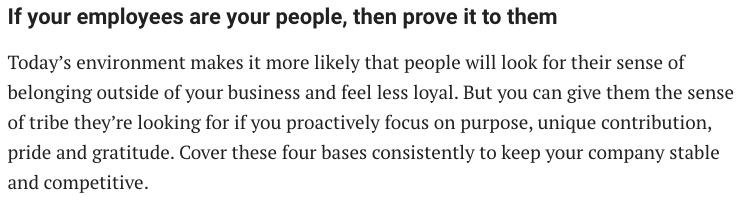
Through all this, one thing has not changed — the natural psychological need people have for a sense of belonging. They want to know they have a tribe and a place to look for cues about what to do. And as people move out of the office to work digitally from anywhere with anyone, loyalty to specific employers isn’t as strong as it used to be. People are looking for a sense of community and family not from a single business but from their professional network as a whole.
In this environment, your new task is to find ways to deliver a sense of tribe to your team no matter where they’re working so that they stay with you. Doing this well will allow you to keep morale and productivity high while ensuring good retention that protects your bottom line.
Where do people get a sense of tribal belonging?
The sense of tribal belonging usually comes from four key sources:
Gratitude for what others in the tribe have offered
If people are going to feel like they belong to your team, then you must address each of the above areas.
1. Sense of purpose
Everybody understands “purpose” when we’re talking about a grand cause. But what if your organization’s role is not to eradicate diseases, fight poverty or clean the oceans? Purpose can be found in the smallest of things. It’s why we do what we do every day. In a B2B context, it might just be to achieve your clients’ business goals. It might be to solve a given problem in the industry. Whatever the purpose is, it makes the team raise their heads high and see the horizon.
In our day-to-day routine and the work-from-anywhere environment, it’s easy to forget that purpose can come from more minute ways of serving. So, whatever purpose your team might claim, take every opportunity to expose them to that vision and reinforce it. Even better, let them co-create it and own it. The conversation changes completely when the team sets its own purpose. Ownership also usually means that teams consistently keep their purpose at the front of the discussions they have.
We’ve seen this effect many times in our own strategy sessions or when we run a discovery session with a client to make sure everyone is aligned on what we need to achieve. In both cases, people are crafting the vision themselves. The engagement and commitment of team members from different backgrounds and opinions are leveled up to the highest point. It’s a tribe in formation.
Purpose doesn’t need to be perennial. It can, and perhaps should, be renewed constantly.
2. Unique contribution
If purpose says “why,” then a tribe also wants to feel that how they go about achieving that purpose is, in certain ways, unique. It’s the mark of the tribe and what differentiates them from other tribes. There’s an aspect of authorship here that fulfills people’s desire to feel special.
This sense of authorship is directly connected to what you’re offering to the market, but it’s not only that. How the company operates internally could also bring a lot of “uniqueness” — how leaders relate to employees, the management philosophies, how they engage in communications, the autonomy of teams, how the company deals with diversity, equity and inclusion, and how it sees its role in society at large can all contribute to this. No matter what combination of contributing factors you might have, the more you hear people pointing out how “weird” the company is in a positive way, or the more you hear “this could only have happened here,” the more likely it is that there’s a strong sense of tribe brewing.
3. Pride
Everyone wants to feel proud of their achievements and the mark they’re leaving on the world. Knowing they are contributing to something uniquely valuable, as described above, is half of it. But they need to feel that their individual contribution was important, as well. People will generally have an intrinsic sense of pride based on their own self-awareness, and allowing them to show that pride goes a long way.
Demonstrating pride is not necessarily bragging or self-promoting. You may feel proud even if somebody else is speaking of the achievements of your team. One experiment we did internally, for example, was to create room for each team to tell their “Powerful Stories” in short videos published at the CI&T University. These were available to every employee and included client testimonials. The narrative always started with the intended business goals and ended with the outcomes, and the story in between was always very rich. These videos helped to promote learning across different parts of the organization, and at the same time, instilled a sense of pride. Communicating your story, or allowing others to communicate theirs, can build pride with those in your business in the same way.
As you offer rewards for people’s achievements, provide consistent updates to show the real-world influence their work is directly or indirectly having. Praising the interactions involved in achieving the final result will ensure that everyone understands the collective effort involved, has a full sense of their role and knows that they can collaborate instead of going it alone.
4. Gratitude
People can feel grateful for what is beyond expectations, outside the norm, or simply out of the blue. It’s the “we have your back” feeling, which is put to proof in times of need. The past 12 months, in particular, have given an exceptionally high number of opportunities to test whether we can count on others. Gratitude is also multi-directional: you may feel grateful for something your leader has done, your peers or people on your team.
In my experience, gratitude doesn’t come from major game-changing, heroic acts. It comes from small, unexpected, and absolutely sincere acts, most often from one-on-one relationships. You can’t forge gratitude. The best you can do is to create a truly collaborative environment where people genuinely care about each other and feel safe to offer their own personal help to others.
Personal ties and gratitude solidify each other. When somebody expresses gratitude, it reinforces a sense of pride within the other person and creates memorable moments, even if they have never met in person.
Speaking from my own experience, the times that I recall as meaningful and that I am most proud of are the ones where somebody came to me and thanked me for something I said or did that was important to them in some way. They’re never planned, and I never anticipate that I’ll have such an influence. In fact, I wouldn’t know I had that much of an effect if those people didn’t spontaneously come back to tell me. It’s this random expression of how I made a difference that makes the interaction so memorable. All of this can happen only in an environment where it is safe to be vulnerable and to lend a hand.
Behavioral science has shown over and over again that helping others benefits both the helper and the recipient. If team members are doing that for each other, then they will really feel they belong in the tribe.
If you live in a community with a homeowners association, chances are good that you may be limited to just the Stars and Stripes.
By Debra Kamin For The New York Times
David Pendery, a marketing executive who lives outside of Denver, reached out to the American Civil Liberties Union of Colorado last year when he was told he could not fly a pride flag outside of his home. The A.C.L.U. sued his district on his behalf, and won.Credit…Benjamin Rasmussen for The New York Times
David Pendery’s rainbow pride flag had only been waving outside his house for a few days when a letter arrived ordering him to take it down.
Mr. Pendery, 44, a marketing executive, lives with his husband and their two children in Arapahoe County, Colo. When he hung up the flag at the end of August 2020, he hoped that the pennant would show solidarity for L.G.B.T.Q. families like his. What he didn’t anticipate was a drawn-out legal battle, one that took him all the way to Denver Federal District Court in early March.
There are more than 370,000 homeowners associations across the country, collectively representing more than half of all owner-occupied U.S. homes. Homeowners associations, which are created with the purpose of upholding property values, also dictate quotidian duties of homeownership: where to place trash bins, when to trim lawns, even which colors of paint are appropriate. But buried in their contracts are often limits on the size and style of flags that homeowners can fly. At a time when even the image of the American flag has become polarizing, these policies are leading to accusations of partisanship and violations of constitutional rights.
“HOAs get most of their powers from the contracts that they make their residents sign,” said Jeremy Rovinsky, a law professor and dean of National Paralegal College. “These allow the HOA to regulate expression that would otherwise be considered ‘free speech.’”
In Mr. Pendery’s case, his community is overseen not by a traditional homeowners association, but a metropolitan district, which is a government entity with a democratically elected board. That district maintains a home improvement reference guide, which states that preapproval is required for nearly all flags. Only military pennants and the U.S. flag are exempt.
Flag restrictions for private homes can be as varied as U.S. housing stock. Some stipulate the size of permissible flags; others allow holiday signs and sports banners, but little else.
They also vary by state. California prevents homeowners associations from restricting flags except in matters of public health or safety; in Arizona and Texas, restrictions on political signs are lifted in the months immediately preceding an election and for a handful of days following.
In this past election cycle, flags were unfurled with a new urgency. “I think I saw more flags used as political symbols than at any other time in my life,” said Michael Green, a flag researcher and designer. He started his own company, Flags for Good, in the lead-up to the 2020 election.
David Pendery’s pride flag flying outside of his home in Arapahoe County, Colo. Mr. Pendery was initially told he would need to apply for approval in order to fly his flag. He chose not to do that and instead filed an open-records request to see if there were irregularities in how and when his district enforced its flag guidelines.Credit…Benjamin Rasmussen for The New York Times
The 2005 federal Freedom to Fly the American Flag Act makes it illegal for any homeowners association or property management company to restrict a resident from flying the American flag, although many associations do place limits on the size and height of the Stars and Stripes. But when it comes to other pennants, a homeowner’s right to free speech is often irrelevant if they live in a community with a homeowners association.
The First Amendment prohibits the government from infringing on a citizen’s right to free speech, but homeowners associations aren’t government entities. Their ability to censor expression is much broader. “For a constitutional violation to occur, you need a state actor,” Mr. Rovinsky said. “Yes, you do have freedom of speech, but while the government can’t infringe on that, your HOA can say you can’t put up a Black Lives Matter sign.”
Residents who have challenged HOAs have had more success arguing violations on the Fair Housing Act or the Civil Rights Act, which both prevent discrimination based on race, religion or gender. “A court would want to look for discriminatory intent,” Mr. Rovinsky said.
Mr. Pendery was told he would need to apply for approval in order to fly his flag, which he chose not to do. Instead, he filed an open-records request to see if there were irregularities in how and when his district enforced its flag guidelines. He read through 500 pages of emails from district committee members, then reached out to the American Civil Liberties Union of Colorado, who sued the district on his behalf.
“I believe it was selective enforcement,” Mr. Pendery said. “My flag was clearly so egregious that within 48 hours of me putting it up, I had a letter about it. I didn’t see that sort of expeditious action being taken against their other guidelines.”
The A.C.L.U. of Colorado won an injunction on March 4, and the district is now hammering out new language that removes the requirement that residents submit flags for approval before flying them. “I put my flag back up the same day,” Mr. Pendery said. The incident, he said, was a lesson for his children, ages 2 and 8.
“We made this case because it’s important to stand up for what you believe in, and what’s right,” he said. “The biggest thing I want them to know is that there are people who have been marginalized or taken advantage of, and you need to stand up for the little guy. You need to stand up for your family.”
Mr. Pendery’s case was just one of about 50 complaints about flag restrictions that the A.C.L.U. of Colorado has heard of this year. “It’s snowballed since last fall,” said Mark Silverstein, A.C.L.U. of Colorado’s legal director. The vast majority of complaints, he said, are centered around flags with social justice messages or political symbols associated with Democratic and left-wing causes.
“Some HOAs may have tolerated or declined to enforce rules when the signs or flags were not viewed as controversial,” Mr. Silverstein said. But when residents complain, he said, they are more likely to issue a citation. “And in some quarters, these social justice signs are perceived as having a more controversial edge to them, and that has resulted in people nudging HOAs to enforce their rules.”
When it comes to homeowners’ free speech, courts often disagree about the classification of homeowner associations. While some states view them as purely private organizations, other states, like California, see them as an extension of the government. “Several court decisions in California have considered HOAs to be quasi-governmental entities,” said Patricia Brum, a Los Angeles-based attorney with the law offices of Snell & Wilmer. “So in that context, the HOAs in California are more restricted when it comes to the application of free speech.”
The fact that Mr. Pendery’s community is overseen not by a traditional HOA but a metropolitan district with a democratically elected board likely gave him a significant edge in his legal case.
Kara and Ben Wilkoff, who live with their three children in an community run by a homeowners association in Littleton, Colo., also reached out to the A.C.L.U. of Colorado for help with a flag issue. Ms. Wilkoff, 40, and Mr. Wilkoff, 38, hung a Black Lives Matter flag outside of their home last August. Four months later, their homeowners association ordered them to take it down and submit a formal approval request.
Ms. Wilkoff, a TV producer, said that she chose to raise the Black Lives Matter flag after the deaths of Black Americans at the hands of police, including Breonna Taylor, Elijah McClain and George Floyd. It was a sign of solidarity, but also a way for Ms. Wilkoff, who has a Black father and a white mother, to connect with her own identity.
Paul Whelan, 74, an automotive technician in Waterside, Penn., was devastated by the election of President Joe Biden in November and decided that same month to take down the American flag in front of his home. In its place, Mr. Whelan, a veteran of the U.S. Marine Corps, raised the Gadsden flag, the yellow banner with a coiled rattlesnake and the words “Don’t Tread On Me.” The flag, which has been used by both the U.S. Marine Corps and the U.S. Navy, dates back to the American Revolution but was also among the far-right symbols seen during the January 6 insurrection at the U.S. Capitol.
He soon received an email from his homeowner’s association telling him the flag was not in compliance with the homeowner association’s flag rules, and he would have to take it down.
“The Gadsden flag was one of our country’s first flags. There’s nothing wrong with it. Yes, the Tea Party and Trump supporters have carried it, but that doesn’t make it bad,” he said. “This is cancel culture.”
Mr. Whelan said he chose not to challenge the homeowners association’s ruling so as to spare his wife, who is currently undergoing treatment for aggressive breast cancer, any additional stress. “I love a good fight, but she doesn’t need any more aggravation in her life,” he said.
For now, the flagpole in front of his home stands empty.
Mr. Silverstein, of the A.C.L.U., says that while it’s difficult to anticipate whether or not the uptick in homeowner complaints might change federal laws against flag restrictions, he believes there is a possibility that in Colorado, Mr. Pendery’s case could lead to a battle at the state level.
“Flags have always been communication tools,” said Mr. Green, the flag researcher. “They are the way we identify certain groups and how we define our tribes. It’s just fabric on a stick, but it’s a powerful thing.”
Annual shareholder meetings and board elections may have been disrupted during the coronavirus pandemic, but co-op boards need to remember that the meetings must still be held. No excuses. Boards that try to dodge this obligation should be aware that shareholders have a powerful recourse.
“If your board is actively preventing meetings or hasn’t called one in more than 13 months, shareholders with 10% of the shares can get together and demand an annual meeting to be called to elect directors,” Steve Wagner, a partner at the law firm Wagner Berkow & Brandt, tells Brick Underground.
Virtual meetings, which became the norm when COVID-19 shut New York City down at the beginning of the pandemic, are allowed through December 2021, subject to any extensions. But if a sitting co-op board does not convene a meeting – either virtual or in-person – shareholders holding just 10% of the corporation’s shares can call a special meeting, the sole purpose of which is to elect a new board.
In such a situation, disgruntled shareholders will join together to hire an attorney to advise them on the process of calling a special meeting. First, a written notice demanding a meeting must be sent to the board. The meeting needs to be scheduled for between 60 and 90 days from the date of the written demand. If the board doesn’t call the meeting within five days of the notice, any shareholder can sign the demand and call the meeting.
Getting a shareholders meeting doesn’t necessarily mean there’s going to be a shake-up of the board. “The shareholders who are demanding the meeting need to organize so that when the meeting is actually held, the election is fair and they will prevail,” Wagner says.
One way to ensure a fair election is to bring in a company with experience conducting virtual elections. The companies also offer balloting and oversight services. These companies have to take extra steps to verify shareholders, proxies and ballots. For example, shareholders might be given a unique QR code so when proxies or ballots are submitted, the code is used to confirm the vote. “These issues are readily resolved at a physical meeting,” Wagner says, “but with a virtual meeting it involves technical expertise to confirm the validity of proxies and ballots.”
It’s more efficient – and cheaper – to win an election than it is to take someone to court to throw him off the board. Another consideration arguing against a lawsuit is that the pandemic has slowed court cases to a trickle. “It’s expensive to begin a lawsuit just to challenge an election,” Wagner says, adding that disgruntled shareholders’ goal should be to get to the desired result as quickly as possible, without waiting for the gears of the courts to turn.
Lead Change is a leadership media destination with a unique editorial focus on driving change within organizations, teams, and individuals. Lead Change, a division of Weaving Influence, publishes twice monthly with SmartBrief. Today’s post is by Sabrina Horn.
As a young CEO, humility was not one of my core leadership traits. For the privilege of having those three letters after my name, I figured I’d better have all the answers or at least act like I did
But pretending to know something when you know you do not is faking it, and faking it has a way of catching up with you. Like many first-time executives, I confused humility with a lack of confidence and, therefore, chalked it up as weakness.
Being humble may not seem like an obvious CEO trait. It is true that you’d be hard-pressed to find a leader who lacked self-esteem or had a sense of unworthiness. In the real world, the CEO does not have all the answers, but does have all the questions and the confidence to ask them. The best leaders have a realistic appreciation of their strengths and weaknesses. They are secure in knowing that they don’t know everything, and they have no problem asking for help, learning from others and even apologizing for their mistakes.
That degree of confidence and open-mindedness draws people in. It levels the playing field for everyone you lead and nurtures a hunger for knowledge and data, thereby driving a culture of learning. For me, such confidence is inextricably linked to curiosity and a mindset receptive to discovery.
So, what does humility in leadership look like?
It is about learning in the moment. It nudges you to double-check and give a second thought to the most important decisions you make. When confronted with an unknown, the curious CEO will find the information needed before deciding how to proceed. Asking an open-ended question like “How will this plan really work?” is infinitely more useful than a yes-or-no question such as “Do you like this plan?”
One of the most useful questions I employ in everyday situations is “Tell me more?” Instead of a silent shutdown, it creates further dialogue and, with it, the opportunity to get more information. In contrast, the arrogant CEO never admits uncertainty or doubt and instead covers up, stumbles, doubles down on error and falls facedown.
Fakers think that asking questions is for losers. On the contrary, faking it is a loser’s game. It invites exposure as a liar. It’s a lot better to be exposed for an honest mistake than for pulling a fast one. For example, after losing a big sale, I sat down with my team to do a postmortem — not to point a finger, but to learn how to be better. I went around the table to ask everyone how we could improve.
“Where did we miss a step?” “How can we come together on this?” “How can I help us win next time?” “What do you need from me?”
Next, I acknowledged my own missteps and took responsibility for them: “I didn’t have the best connection with their top executive.” “I forgot to make that key point, thanks Jim for picking up on that and chiming in at the end.”
And finally, I took the opportunity to lead forward together: “Let’s institute these new checks and balances.” “We lost this one, but now we know how to win next time.”
In contrast, the faker CEO completely avoids the relevant issues, denies the problem and blames others: “Get a different guy to sell the product.” “Fire that guy.” “Send out more emails slamming the competition.” “Offer a discount.”
Humility is a superpower in leadership. It is about knowing what you don’t know and having the curiosity, authenticity and confidence to put that out there so that you and your team can find the answers. The ultimate reward rests both in the value of information you might not otherwise get and in the trust that it fosters between you and the people you lead.
Sabrina Horn is an award-winning CEO, author, speaker and C-suite advisor. Her book, “Make It, Don’t Fake It, Leading with Authenticity for Real Business Success,” (releasing June 22 from Berrett-Koehler) aims to help all leaders achieve business success with integrity. Visit her website for more information and to download Sabrina’s free resource, “You Can’t Fake Authentic Leadership: 5 Ways to Fight Faking It.”



 STEP 4. Quizlet is a FREE online tool that uses fun games and exercises to test your concrete knowledge. If after reviewing the M-100 course material, you find that your knowledge of terms and definitions is lacking, Quizlet is an excellent way to help you master those key terms and phrases, and prepare you for the next step in your study plan.