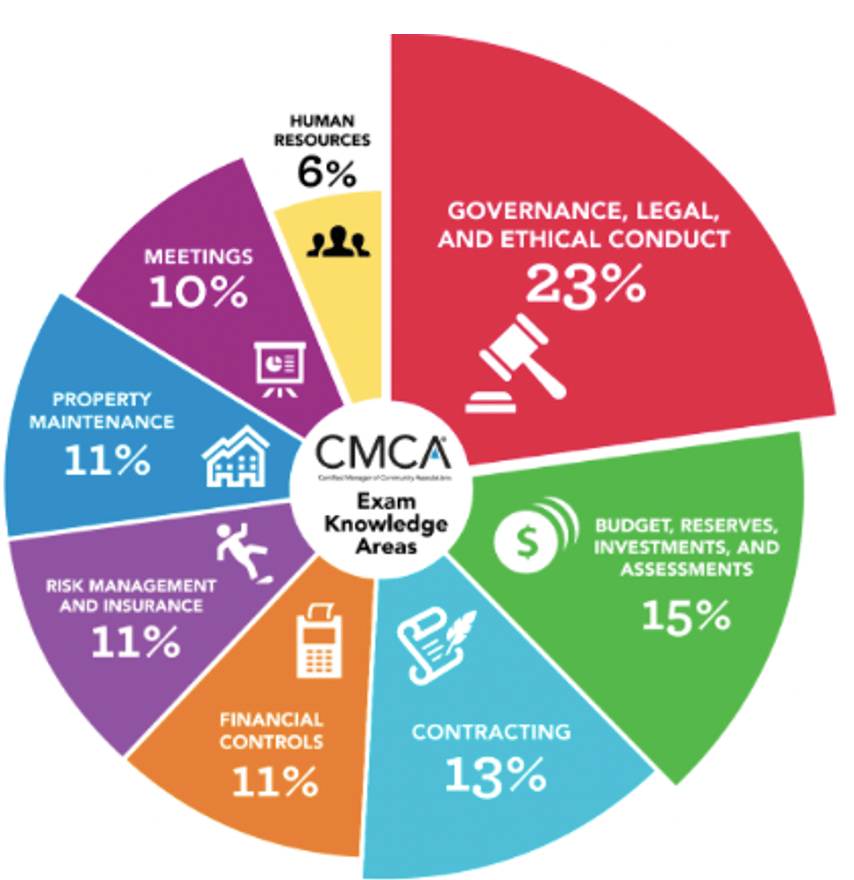
CAMICB is a more than 25 year old independent professional certification body responsible for developing and delivering the Certified Manager of Community Associations® (CMCA) examination. CAMICB awards and maintains the CMCA credential, recognized worldwide as a benchmark of professionalism in the field of common interest community management. The CMCA examination tests the knowledge, skills, and abilities required to perform effectively as a professional community association manager. CMCA credential holders attest to full compliance with the CMCA Standards of Professional Conduct, committing to ethical and informed execution of the duties of a professional manager.
The CMCA credentialing program carries dual accreditation. The National Commission for Certifying Agencies (NCCA) accredits the CMCA program for meeting its U.S.-based standards for credentialing bodies. The ANSI National Accreditation Board (ANAB) accredits the CMCA program for meeting the stringent requirements of the ISO/IEC 17024 Standard, the international standards for certification bodies. The program's dual accreditation represents compliance with rigorous standards for developing, delivering, and maintaining a professional credentialing program. It underscores the strength and integrity of the CMCA credential.
Privacy Policy: https://www.camicb.org/privacy-policy
As CAMICB continues to celebrate its 25th anniversary, we reached out to CMCAs who’ve held the credential for 25, or more, years. Many CMCAs graciously offered to share their experiences, highlights, career paths and advice with us.
John Schick, CMCA, AMS, PCAM, is a Management Executive with Hawaiiana Management Company, Ltd. in Honolulu. He was a member of the Beta Test Group for the original CMCA examination. Prior to entering the field of professional community association management, John spent 20 years in the United States Air Force and then two decades in motion picture exhibition and theatre building – clearly many talents and interests!
Now with 29 years of community association work in his vast professional repertoire, John finds what he likes most about this profession is assisting home owners and helping them understand the system and how it works, including training board members and helping them make the best decisions to benefit their properties.
He also enjoys the networking offered at industry-related events. Accepting his PCAM designation at a CAI convention in Ft. Lauderdale in a room full of CAI members was a highlight of his community association management career.
John offers important advice for new managers entering the field, “This is a unique industry. Call on all the life experiences you’ve had to help you come up with solutions. Do not assume you know or understand it all. And, be sure to ask your co-workers questions; someone has certainly been there before you.”
Free Online Resource Helps Candidates Successfully Prepare For The CMCA Exam
By Madeline Hay, CAMICB’s Manager of Exam Administration
Underscoring a quarter century of commitment to professionalism and excellence in community association management, CAMICB is excited to continue to celebrate the organization’s 25th Anniversary with the launch of a free, interactive online CMCA Exam Preparation e-Learning course.
The three-hour course, featuring a series of eight modules, is divided into two components. The first component features four learning modules focused on creating an examination review and preparation plan. The second component includes three scenario-based learning modules that are designed to put several of the knowledge areas tested on the CMCA examination in context using real-life scenarios. The three modules address knowledge areas that are challenging for many CMCA candidates: Risk Management & Insurance; Financial Controls; and Governance, Legal & Ethical Conduct. A final module is intended to offer some perspective on the exam preparation process and next steps.
Said Chair of the CAMICB Board of Commissioners Drew Mulhare, CMCA, AMS, LSM, PCAM, “CAMICB is always working to identify new tools to help CMCA candidates succeed on the exam. We’re excited to launch the CMCA Exam Prep e-Learning course – a free resource intended to put candidates on the path to the CMCA credential.”
The Course Modules
The exam preparation modules offer constructive test taking tips, discuss the composition of examination questions, give preparation advice, and provide an interactive self-assessment tool to help a candidate develop a study plan specific to that candidate’s needs and goals. The content-based modules ask the candidate to solve problems and answer questions using downloadable sample documents.
Each module takes approximately 10-25 minutes to complete. The course is designed to accommodate busy schedules and to allow candidates to work at their own pace, so they may stop and resume the modules as their schedule permits. Below is a brief description of the different modules and what candidates can expect.
Module 1: An Introduction
Learn what it takes to pass the CMCA exam. Get advice from working CMCAs about what worked for them as they were preparing for the test – and what didn’t. Find out some common misconceptions about the CMCA exam and uncover the key for understanding how to approach the exam questions.
Module 2: Devising a Study Plan, Part 1 – Prioritizing Topics
Discover how to establish and follow a solid study routine that’s tailored to your experience level. Get an in-depth look at the topic areas covered on the test and participate in a self-assessment exercise to determine which topics should be prioritized in your study plan.
Module 3: Devising a Study Plan, Part 2 – Strategies and Tips
Find out how to put your study plan into action. Learn practical tips and tricks to make the most of your prep time and take a closer look at some of the study resources available to you.
A recent course participant shared, “The study resources provided in the CMCA exam prep course are excellent. It gave me a much better understanding of what material to really focus on.”
Module 4: Test-Taking Strategies
Learn how to maximize your potential on exam day. Find out how taking practice tests can improve your performance on the exam, get some guidance on strategies to overcome test anxiety, and see what to expect when you go to the testing center.
Modules 5 and 6 use real-life scenarios that help you learn from detailed feedback. They also make use of downloadable sample files including Lakeside Terrace’s insurance declaration and financial documents to inform your decisions.
Said one course participant, “For me, the CMCA exam prep course was so much more effective than simply reading different texts.”
Apply your knowledge of risk management and insurance topics by putting yourself in the shoes of the community association manager for Lakeside Terrace Condominiums.
Module 6: Financial Controls – Refresher Content
Revisit your role as Lakeside Terrace’s community association manager as you encounter some scenarios that test key knowledge about financial controls.
Another real-life scenario allows you to visit Willow Grove Estates, where you have been hired as the association’s first community manager.
Module 8: Looking Back and Looking Forward
An opportunity to recall what you’ve learned and consider what you want to keep working on.
At CAMICB, we’re committed to offering a combination of study tools to enhance candidate performance. Therefore, we encourage exam candidates to develop a personal study plan incorporating a wide range of resources and reference materials. CMCA preparatory materials are all available online – most at no cost – to managers employed anywhere in the world. We’re thrilled to add our newest offering, the CMCA Exam Prep E-Learning Course, to our portfolio of resources.
Earning and maintaining this internationally-recognized credential propels a manager’s career forward, allowing for more advanced career opportunities and salaries that, on average, are 20 percent higher than non-credentialed managers. To get started and to learn more about the CMCA Exam Prep E-Learning course, visit www.camicb.org.
By Matthew Green, CAMICB Associate Executive Director
If you love the idea of a job that offers opportunity, stability, and growth, community association management provides an excellent career path. Community association managers work with homeowners and service providers to take care of the many aspects and operations of condominiums, HOAs, and cooperatives. It’s a great job choice for people who previously worked in the leisure and hospitality industries. Those sectors continue to lead U.S. job losses amid COVID-19, with experts predicting slow growth until at least 2023. The good news is that though the coronavirus has dashed a lot of hopes for hospitality grads and veterans, the world of community association management is a bright spot. The field continues to grow and offers excellent opportunities for anyone who wants to continue in a people-oriented career.
Community Association Management Stats
The Foundation for Community Association Research reports that as of 2020, there were approximately 355,000 community associations in the United States. They house over 74 million residents, over 12 million more than just a decade ago. Twenty-six percent of people in the U.S. live in a community association. More than 60 percent of new housing completed and over 75 percent of new housing sold is in a community association.
There are over 8,000 community association management companies in the U.S. and up to 60,000 community association managers. Further, there is an additional 100,000 individuals employed by management companies and onsite for associations with staff. As the number of people living in community associations continues to rise, so does the number of jobs for community association managers. If you’re a people person who’s skilled in handling multiple tasks, a career in community management can be an incredibly rewarding career choice.
Community Association Management Career Outlook
Job prospects in the community association management sector are excellent and growth is stable. Though a college degree and professional designation are not necessary to land a position in the field, those who do command a higher salary when starting out. As of May 2020, the median wage for community association managers was $59,660 per year. In 2019, there were 367,900 jobs in the field. Job prospects and projected wages vary from state to state and community to community, so it’s a good idea to check out your area’s particulars.
CMCA – The Essential Credential
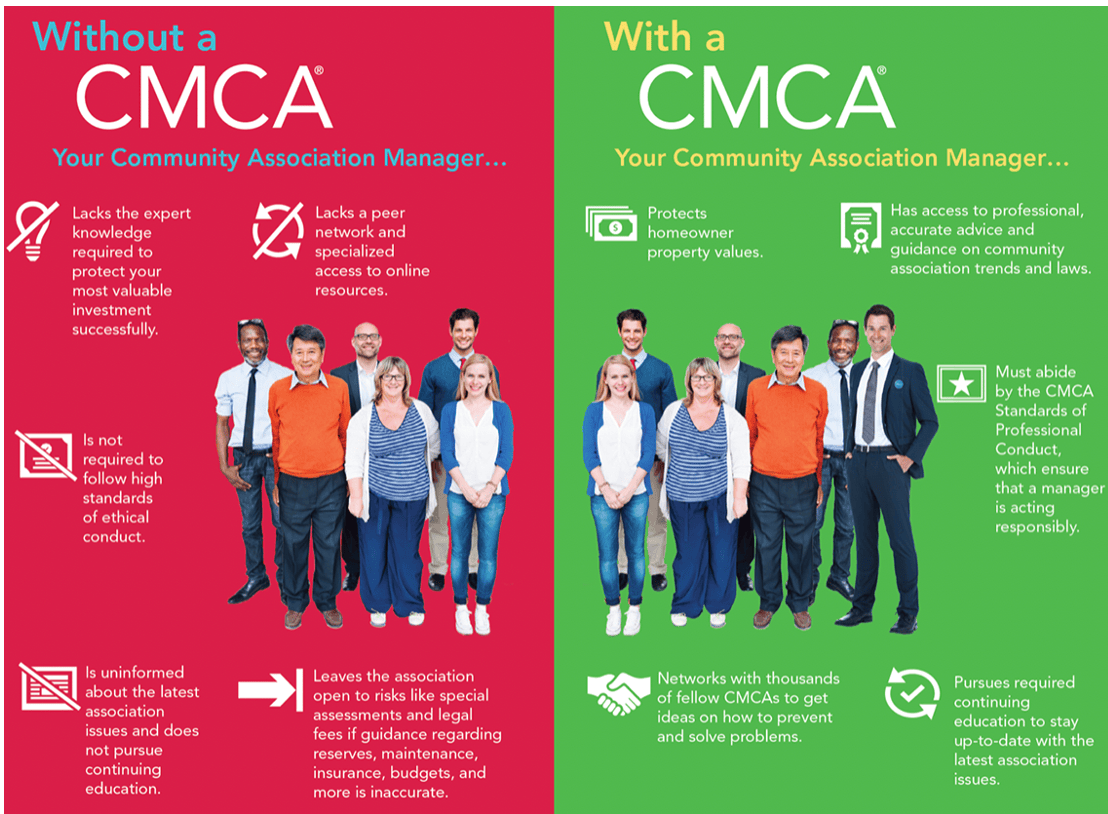
The key to building a successful community association management career is the Certified Manager of Community Associations (CMCA) credential. Holding the certification lets employers know you’re educated and competent in certain management practices. It also indicates your dedication to professional excellence, ethical business standards, and continuing education. Community management employers are continually looking for committed professionals. The CMCA certification can often make the difference between whether or not you land a first interview.
The CMCA credential is relatively easy to obtain and:
Is relatively low-cost for such a valuable investment in your career and future.
Earning the CMCA credential opens the door to earning additional credentials and up to 20% higher earnings than community association managers who are non-credentialed.
Studying for the Exam and Earning the Credential
Several resources are available on the Exam Preparation Resources page of the CAMICB website. You’ll find these items and more:
CMCA Handbook
CMCA Study Guide
CMCA Exam Preparation E-Learning Course
Community Association Management Best Practices Reports?
Community Association Institute’s M-100: Essentials of Community Association Management Course Material Information
Community Association Institute’s Guides for Association Practitioners (GAPs)
CMCA Practice Exam
CMCA Examination Quizlet
Becoming a Certified Manager of Community Associations is not merely a designation; it can lead to the career journey of a lifetime. It elevates your credibility as a community association manager and makes employers more confident in hiring you. Finally, it offers you a wealth of opportunity, stability, and growth potential in an exciting career that currently shows no sign of slowing down.
According to a new survey from Schwab Retirement Plan Services, investors consider inflation the biggest obstacle to saving for a comfortable retirement
By Alan Goforth for BenefitsPro
Investors consider inflation the biggest obstacle to saving for a comfortable retirement, according to a new survey from Schwab Retirement Plan Services. Forty-five percent of respondents cited inflation, followed by monthly expenses (35%), stock market volatility (33%), and unexpected expenses (33%).
“Workers have been through a lot over the past two years, and it’s only natural that recent economic and geopolitical turbulence has continued to fuel financial concerns,” says Catherine Golladay, head of Schwab Workplace Financial Services. “While plan participants can’t control inflation or the markets, the good news is they are taking steps to manage their finances with an eye to the future.”
It takes vision and determination to drive successful organizations forward and it’s not just one area of focus that creates a success story. From the very beginning, CAMICB has been the certification body with oversight responsibility for developing and delivering the CMCA examination, including the maintenance and promotion of the CMCA credential. In fulfilling that role for more than 25 years, the organization supports homeowners living in community associations by recognizing managers who’ve demonstrated an operational understanding of the tasks essential to performing the job of a community association manager.
But supporting the community association management profession is far more than ensuring the CMCA credential is maintained at the highest possible standard. CAMICB must also make sure that homeowners, employers, the businesses that support community associations, legislative and regulatory bodies, and professional peers understand the value of the CMCA credential and the many benefits a credentialed manager, versus a non-credentialed manager, brings to your association.
A Behind The Scenes Look At CAMICB Operations
The CAMICB office is located in Northern Virginia and is comprised of a seven-member professional staff who execute operational matters. Staff members manage exam development, certification applications, credential renewal and recertification, the delivery of direct customer service to candidates and credential holders, and the conduct of all CMCA activities in full compliance with the rigorous standards of the CMCA’s domestic and international accrediting bodies.
Volunteers are at the heart of CAMICB’s work starting with a nine-member volunteer Board of Commissioners who govern the organization and are charged with representing the interests of the constituencies served by professional managers. To ensure a wide-range of talent and expertise are represented, the Board includes a minimum of five CMCA credentialed managers, up to three members drawn from a field serving the profession, and a public member.And, we are fortunate that the contributions of volunteers’ time, talent and expertise goes beyond the Board of Commissioners. For example, the CMCA exam is developed by a broad and diverse team of volunteer Subject Matter Experts (SMEs). Subject Matter Experts work under the direction of the CAMICB Director of Examination Administration and the exam development process is overseen by our test development partner, Human Resources Research Organization (HumRRO).
Additionally, a group of volunteer leaders oversee compliance with the CMCA Standards of Professional Conduct, a professional and ethical roadmap for CMCA credential holders. Full compliance with the Standards ensures the highest level of professionalism – and accountability – in working with boards and associations.
CAMICB Supports Managers From The Start Of Their Professional Careers Through Retirement
It’s important to note that while CAMICB is not an educational entity, it’s deeply committed to offering resources and guidance to CMCA candidates that will position them for success on the exam. In doing so, CAMICB offers a number of free tools to help candidates prepare for the CMCA exam including a comprehensive candidate handbook and study guide, an online preparatory course, an exam “Quizlet” tool and webinars focused on exam preparation. Further, staff work daily to offer individual support to candidates and credential holders.
A broader suite of resources and programs help support managers and the profession, including the following:
CAMICB offers managers who earn the CMCA credential a CMCA Digital Badge that credential holders can use as an easily shareable online “resume,” highlighting the value of earning and maintaining the CMCA credential. Credential holders are also offered several resources to assist them in promoting their credential.
CAMICB maintains a robust bank of approved continuing education programs – many offered at no cost – to assist credential holders with ongoing professional development and to assure that credential holders have access to the continuing education required to maintain their CMCA credential.
CAMICB maintains a public-facing directory of credentialed professional managers so that homeowners and potential employers can quickly confirm a credential holder’s active status. Interested parties can search by entering key terms such as last name, city, company, state, etc.
CAMICB offers the CMCA (ret.) program for retired professional managers. The program is for individuals who want to stay connected to an expanding group of committed professionals with no obligation to meet continuing education requirements.
The more than 73.5 million people in the United States who live in covenant-protected communities rely largely on CMCA certification as proof of ethical, knowledgeable, professional community association management and CAMICB is proud to support the highest level of professionalism in the field.
By Matthew Green, CAMICB Associate Executive Director
May the woes of summer travel wane over the final weekend in July as I head to the 2022 National Conference of State Legislatures (NCSL) Legislative Summit in Denver. NCSL expects over 3,000 legislative staff and policymakers worldwide to attend.
The annual Summit is an important opportunity for CAMICB to educate – and update – state and international lawmakers about the community association management profession. We advocate for industry-developed professional certifications for community managers so they can self-regulate. Suppose regulation is bound and legislatures pursue licensing the trade. In that case, we promote the CMCA credential as the primary examination and certification option.
The Summit also allows us to exchange ideas and stories with colleagues from accredited certification boards regarding best practices in standards compliance – a top priority for CAMICB’s credentialing program.
CAMICB has partnered with Community Associations Institute (CAI) and exhibited at the Summit for more than ten years. Since then, our team has had tens of thousands of face-to-face conversations about HOA and condominium laws with lawmakers and their staff.For those interested in the hottest policy topics, NCSL will live stream seven sessions from the legislative Summit. Follow along here: https://www.ncsl.org/meetings-training/2022-summit-livestreaming.aspx
Lack of clarity on when – and if – companies are bringing workers back is leaving many workers in limbo. It’s taking a toll on those who are anxious to plan their lives and settle.
After two years living in Southeast Asia, Alex moved back to the UK in March 2021, with her husband Joe following a few months later. Both Londoners by origin, they wanted to put down roots somewhere outside the city. “My dream was to live by the sea,” says Alex. “We moved in with Joe’s parents, and tried to decide where we could buy a place.”
The couple began house hunting on the south coast of England, and came close to putting in an offer. But after months of uncertainty about whether they would be required back in the office, the consultancy business Joe works for announced it was looking for a space in central London. “That was a curveball, because it came after several years of not having an office – and there was no clear explanation of how often he would need to be back in,” says Alex, who works as a civil servant.
Then, Alex’s bosses told her she would be expected to come in four days a month. “Although no one was going to take our register at the door, there was a clear expectation from line managers, with the possibility of going up to eight days at some point in the future,” she says. “It was never clear what would happen after the eight-day policy introduction – which is frustrating, and means it’s taken us a very long time to settle back into life here.”
Amid the ebb and flow of Covid-19, and multiple return-to-work false starts, there are many things about which workers are still highly uncertain. Where will employees need to be to carry out their roles? How often will they need to be there? Will there be any leeway for those who can’t – for whatever reason – fulfil that expectation? All these are questions for which most employers still don’t have the answers, either.
Left in limbo, it’s been difficult for many knowledge workers to make life decisions with any kind of confidence, whether that’s buying a house like Alex, moving cities, arranging caregiving responsibilities – or putting into place many of the jigsaw pieces that make up a worker’s life.
Many American workers particularly flocked to suburbs during the pandemic (Credit: Getty Images)
This is taking a toll, says Dan Schawbel, founder of research-agency Workplace Intelligence, which tracks business trends. “A poorly managed return-to-the-office plan can greatly harm employee well-being. This is because employees feel stressed and worried about returning to an office knowing that there are new variants of Covid spreading, having to pay to commute again with gas prices rising and the uncertainty of what office life will be like on a daily basis.”
He explains that since many employees have been working remotely full-time over the past two years, return-to-office is a major disrupter to their ability to be with their family, set boundaries and manage their work-life responsibilities.
Amid the foggy picture of return-to-work, this stress is falling on people who have been holding off big decisions. Those who made major changes amid the pandemic are on tenterhooks, too: Harvard University analysed migration using change-of-address requests submitted to the US Postal Service, finding that there was a huge wave of moves early on in the pandemic and again in late 2020, with more individuals moving than families.
Many Americans moved out of core metro areas to suburbs and smaller cities that still offer proximity to where their jobs are theoretically based. For example, according to the US Census Bureau, 91% of suburban counties saw more people moving in than out during Covid, compared to pre-Covid. The shift is less pronounced in the UK, but certainly still notable as people sought more outdoor space and a dedicated room to work from. London saw a 3.2% drop in payrolls in June 2021, compared to February 2020 – the largest decrease in any of the UK regions.
While this data does mean that many workers are still within commuting distance of their offices, there are still logistics for them to figure out, contingent on their companies finalising return-to-office policies. “Lots of employees, especially millennials, have already relocated, bought a house, had a kid and got childcare sorted,” says Schawbel. “On a daily basis, employees have to grip with the fear of not knowing what each day at the office brings and those with families may have to rearrange their childcare situation and rely on their partners to fulfil many of the home responsibilities they did, which may not always be possible.”
It was never clear what would happen after the eight-day policy introduction – which is frustrating, and means it’s taken us a very long time to settle back into life here – Alex
For those who settled outside commuting distance, the worry goes deeper – they may have to uproot their lives again. In November 2021, Leah, who works in the DEI department at a London-based consulting firm, bought a house in northern England with her boyfriend, not far from her family, and with a lot more space. They even got a dog.
“The decision was based on the impression that we could carry on working from wherever,” she says. “Now, although no one’s said explicitly you need to come back to the office, there’s a lot coming from high-up about how much better it is to be face-to-face.”
It takes more than three hours each way from her home to the office, and although Leah doesn’t mind the journey, she’s having to do it more frequently than expected. She often has to book last minute return tickets, which means spending around £80 ($95) of her own money each time. That train arrives at 10 a.m., and leaves after 7 p.m., eventually getting her home at 11 p.m. Arriving or leaving any earlier would push the ticket to upwards of £150.
“I keep thinking, have I made the wrong decision by moving?” she says. “At the time, it was a good idea, but I don’t want to be that one person on a video call when everybody else is in the office – I actually like being in the office.” If in the short-term, Leah’s employer sets a certain number of days she needs to be in each week, commuting is going to be unmanageable because of the cost and inconvenience.
Denise Rousseau, professor of organisational behaviour and public policy at Carnegie Mellon University, US, adds that years of research into autonomy and job-related decision making have shown that control over the time and place of work is substantively more important than control over the work process itself. “If people are told different things at different times, without influence over that decision, it’s disturbing,” she says. “The yo-yoing back and forth breeds uncertainty and people don’t like that there are just so many unknowns.”
Now renting in Hampshire, about a two-hour drive from London, Joe has been looking at other jobs, but none are as well paid or exciting. Alex says she’s done the same, but would struggle to give up the London-based salary weighting. “If we moved jobs to be closer to an office where we wanted to live, and our old workplaces committed to more remote working longer term, we’d feel a bit miffed,” she explains.
Now that bosses are calling workers back, some who’ve moved are enduring long commutes – even hundreds of miles (Credit: Getty Images)
Both emotionally and logistically problematic, there’s yet another layer of stress amid this unforged path of remote and hybrid work: some employees are getting bespoke arrangements. “Employees will be negotiating idiosyncratic deals, for example if they’ve worked far away from a metropolitan HQ for the last two years and proved they can perform, they might make an offer that’s somewhere in between [what the company] is asking for,” says Rousseau. “If they have a good relationship with a boss, they’re much more likely to be granted that exception.”
However, case-by-case negotiation – although it may benefit the individual – weakens the collective. It can stoke resentment if someone is required to move back or change job because of their location, while a colleague is not. This could create undesirable hierarchies of haves and have nots.
It could also force workers to ‘justify’ why they want to take certain decisions in their lives. “The social dynamics of allowing one person a certain privilege, while not giving it to others creates a bad morale, more potential layoffs and friction within the company – that hurts productivity, happiness and wellbeing,” says Schawbel.
A personal approach
This is not to say every company is waffling, and every worker is in an uncertain position.
Some companies are providing clearer directives about the return to the office, which is enabling their employees to make plans and manage the stress of uncertainty. CEOs at large companies like Netflix, Goldman Sachs and Tesla have all announced that full-time, in-person attendance will be compulsory, and many business leaders believe the same. In early 2022, half of global leaders say their company already requires or is planning to require a full return to in-person work in the next year, according to Microsoft.
Still, the return to the office does not have a linear, or straightforward trajectory for most businesses. Ultimately, there’s no roadmap for a mass return to work after a global pandemic, and many workers insist that a ‘return to normal’ is now beyond the realm of possibility, anyway.
I keep thinking, have I made the wrong decision by moving? – Leah
For the time being, however, mitigating stresses is contingent on companies clearly communicating their recall plans, and ensuring workers understand what kind of flexibility they will have as well as how this could impact other areas of their lives, such as finances. However, many companies are wrestling with a volatile set of economic conditions that complicate decision making, such as how they want to deal with office space and worker incentives. Kicking the can down the road may be an approach that’s good for business – even if it’s not for employees.
And without knowing if, or when, a hard line will be introduced by their employers, workers are faced with a dilemma: ask for clarity on office attendance and have their freedom potentially curtailed, or stay silent and struggle with the precarity.
For those employees who can’t stay in limbo, Schawbel says there’s a strategic approach to take with their bosses. “Employees should speak with their managers directly about how to balance the needs of the business with their own personal needs,” he says. “While HR creates RTO policies that are approved by the CEO, it’s the day-to-day relationship with managers and employees that really matters.”
He recommends that employees are honest, direct and explain their situation in a way that also factors in how they’re contributing to the business. “Never make it all about your situation, but also about your partnership with your manager as it relates to the business,” he says. “Everyone’s situation is different, so a personal, one-on-one conversation is critical to being able to work things out.”
Alex, Joe and Leah’s surnames are being held for career concerns
By Marlena Weisbrot, CMCA®, Aperion Management Group, LLC, AAMC®, Bend, OR
No one will ever forget the Summer of 2020…the orange sky that hung over us for days. The stench of what remained of a destroyed landscape…the ash falling like snow in the 100-degree heat.
This was too close to home. This was real.
For the Board of Directors and Homeowners of Awbrey Butte Owners Association in Bend, Oregon, the achievement of obtaining a Firewise Designation had been a long-term goal which was sought in order to increase attraction to the Community, boost property values and decrease insurance dues. And of course, to increase fire safety. The Single-Family home Community performed the standard requirements of designation by encouraging all owners to clean up their properties by enticing them with free green waste disposal and providing them some education on how to increase defensible space by inviting local Firewise representatives to do presentations during Annual Meetings. Everything went splendidly- the needles from the thousands of pine trees covering “The Butte” were cleaned up, unsightly bitterbrush and other noxious weeds were pulled or trimmed, and people just felt better…
Until the Summer of 2020 when over 1 million acres burned in Oregon, pulling at least 500,000 of our fellow Oregonians out of their homes to seek safety. One day we were gazing out the window admiring the natural beauty of our Central Oregon forests…the next day we gazed out the same window and recognized the intense power of our Central Oregon ecosystem.
It was time to step up our efforts.
The Board of Directors, Firewise Committee and the Architectural Committee banded together for brainstorming sessions: the goal- keep our community and our homes safe and still beautiful at the same time. Deschutes County Forestry, representatives of local Firewise agency and Bend Fire Department were enlisted in the meetings to help sculpt a plan for long-term fire prevention efforts.
The Plan:
In the Spring of 2022, we had a group of 25 passionate members of the community come together to help the cause. The goal was to ultimately perform individual assessments of each of the 778 homes/lots within the community, render recommendations to the owners for modifications to their landscape and homes, while protecting the CC&R’s requirement for thorough review and approval by the Architectural Committee and keeping the high aesthetic standards of the Community. The Volunteers dedicated their time to training under the Forestry Dept and Fire Department, on what to look for when performing assessments. The trainings are designed to be continual and offered by vetted professionals in the fields of fire safety, and civic agents on a rolling basis. The Team also banded with fellow Firewise Designated HOA’s on their experiences for Home Assessment programs (albeit on a smaller scale.) The Association hired a Wildfire Consultant to join the Architectural Committee who began reviewing all plans with an eye on defensible space and ladder fuel reduction. Ultimately the Association’s Architectural Guidelines and Rules & Regulations were revised to ensure that homes were being built and maintained in a way that would aid in the safety of their structures and their neighbors’ properties. The assessments include checklists and custom notes sections per the Immediate Zone (0-5 feet from home) which covers the fire resistance of the home materials including roofing, siding, windows as well as seemingly insignificant items such as the size of mesh vent screening to ensure that embers are unable to pass through. The Intermediate Zone 2 (5-30 feet from home) checklist includes trees/tree limbs adjacent to the home, flammable plant material and debris and firewood storage. Next is the Extended Zone 3 (30-100 feet from home) which focuses on trees and other potential flammable materials in this native landscape zone. And finally, Zone 4, which covers curbside and Fire Department access.
The Assessors are put into pairs and are assigned to a group of addresses. They schedule their own inspections at theirs and the homeowner’s convenience and perform the assessment right alongside the owner to ensure they can answer any questions that may arise. At the end of the Assessment, a copy of the form is sent to the owner and to Management, who keeps a detailed database of all assessments, photos, owner, and assessor contact details, etc. When an owner submits an Architectural Modification application, Management pulls any assessment reports on file to send to the Arc Committee along with their plans. The plans are reviewed by the Arc Committee’s Wildfire Consultant who then drafts and presents a review to the Committee. Upon approval, the owner is notified. Upon completion of work, Management is notified, and their Fire Assessment files are updated reflecting the action taken. What may seem like a very tedious procedure, we have developed quite a groove where the process is streamlined and semi-automated using task management software.
The Progress:
In the Spring of 2022, during the span of just 3 months the Team had already received over 200 requests for Fire Assessments and have completed over 150 of them. No one had imagined how popular this program would be, but the Team has been at the top of their game in ensuring their assignments are completed as promptly as possible.
The members of the Association have grown more inquisitive about Fire Prevention and, in response- “The Firewise Bugle”, was created. This monthly newsletter shares news and tips for Firewise efforts, as well as links to helpful articles and impactful videos to “Remember our Why”.
The amount of flammable debris and hazardous trees that were removed in May 2022, during the Free Disposal event was double the amount of the year prior- all while maintaining the healthy, natural Central Oregon aesthetic beautifully.
And, of course, the people…the sense of community has strengthened as the neighbors working together have fostered friendships. The Association’s Annual Meeting this year has been moved up to the Summer to allow for greater attendance and to be able to host an in-person dinner for all, rather than a Zoom link in a lost email. We look forward to breaking bread in celebration of our progress while still ensuring adequate preparation for what we are working so hard to avoid.
Over my 8 years in this industry, I have never been prouder of a team as I am of Awbrey Butte Owners Association, their Board, Arc, Firewise Committee and Assessment Team. Additionally, I am in awe of the assistance received by the County, City, Fire Department and local experts by means of grants and training opportunities. By all means, we have a long road to go- but the great strides we have taken have proved the strength in our owners. Surely, I will never forget the ashy Summer of 2020, but it will also serve as a reminder of strength and hard work shown by this group of outstanding homeowners in Spring, 2022.
On Tuesday, July 12, North Carolina’s highest court made it harder to prohibit rooftop solar.
The North Carolina Supreme Court delivered a victory to clean energy advocates last month in a ruling that will make it easier for homeowners to install rooftop solar panels.
In a 4-3 bipartisan decision, the court ruled in favor of solar companies, environmental groups, and a Raleigh resident named Tom Farwig, whose rooftop solar panels had faced opposition from the Belmont Association. Despite a 2007 solar access law that prevented North Carolina homeowners’ associations from banning the “reasonable use of a solar collector” on single-family homes, Belmont argued that an exception in the law allowed street-facing panels like Farwig’s to be prohibited on aesthetic grounds.
The Supreme Court disagreed, claiming that Belmont couldn’t stop Farwig and other residents from installing rooftop solar panels without explicitly forbidding them in its community covenants.
Blue Raven Solar, which installed Farwig’s panels, celebrated the decision. “[W]e are vindicated in our support of our customers and in our fight to make rooftop solar available and affordable to everyone,” the company said in a statement.
Although the decision doesn’t entirely prevent homeowners’ associations from restricting street-facing solar panels, it will at least provide clarity to those who have been unsure whether rooftop solar is allowed in their communities. Statewide, 40 percent of North Carolinian homeowners are members of more than 14,000 homeowners’ associations, which will now have to write specific rules on street-facing solar panels if they wish to prohibit them. (Though clean energy advocates are trying to stop associations from being able to even do that, through a bill that passed the state House last year and has now moved on to the Senate.)
“There are now dozens of our clients who are excited to get the ball rolling on their solar projects,” Bryce Bruncati, director of residential sales for the solar company 8MSolar, told Energy News Network. “It opens the door to a good chunk of people.”
One group of skills career experts say is crucial to include is your soft skills. An overwhelming majority ? 93% of employers ? say “soft skills play a critical role in their decision about whom they want to hire,” Ian Siegel, co-founder and CEO of ZipRecruiter, said in the company’s recent report The Job Market Outlook for Grads.
Soft skills include a wide array of abilities. “I would say, in general, communication is very high on that list right now considering how people are working in very different situations, hybrid situations,” says Kristin Kelley, chief marketing officer at CareerBuilder, as an example.
ZipRecruiter compiled some of the most in-demand soft skills on its platform. Here are the top skills on that list, including the number of jobs on the site listing the skill as a requirement.
Communication skills
Number of jobs listing the skill: 6.1 million
Customer service
Number of jobs listing the skill: 5.5 million
Scheduling
Number of jobs listing the skill: 5 million
Time management skills
Number of jobs listing the skill: 3.6 million
Project management
Number of jobs listing the skill: 2.8 million
Analytical thinking
Number of jobs listing the skill: 2.7 million
Ability to work independently
Number of jobs listing the skill: 2 million
Flexibility
Number of jobs listing the skill: 1.3 million
When it comes to the importance of communication, in part, as Kelley says, that’s a result of the new remote and hybrid work arrangements that rely heavily on tech. “How you respond to someone who sent you an email” matters, she says as an example. “Formally respond to them in 24 hours.”
“To be a diverse and inclusive employer,” says Georgene Huang, co-founder and CEO of Fairygodboss, “you have to work with all different kinds of people, which means you have to be able to communicate effectively with all different kinds of people.”
When it comes to scheduling and time management, “no matter what kind of role you have, if you can’t organize your time,” you can’t be effective, she says.
Finally, when it comes to flexibility, “people really have to be able to turn left, turn right on a dime, join the Zoom, be able to manage their own instant messages coming in,” says Kelley. There’s an element of ease with multitasking and being able to switch what you’re doing at a moment’s notice that has heightened since the pandemic and as so many people continue to work from home.
Include your soft skills by giving concrete examples of how you’ve used them either in your resume intro or the bullets under your job descriptions.