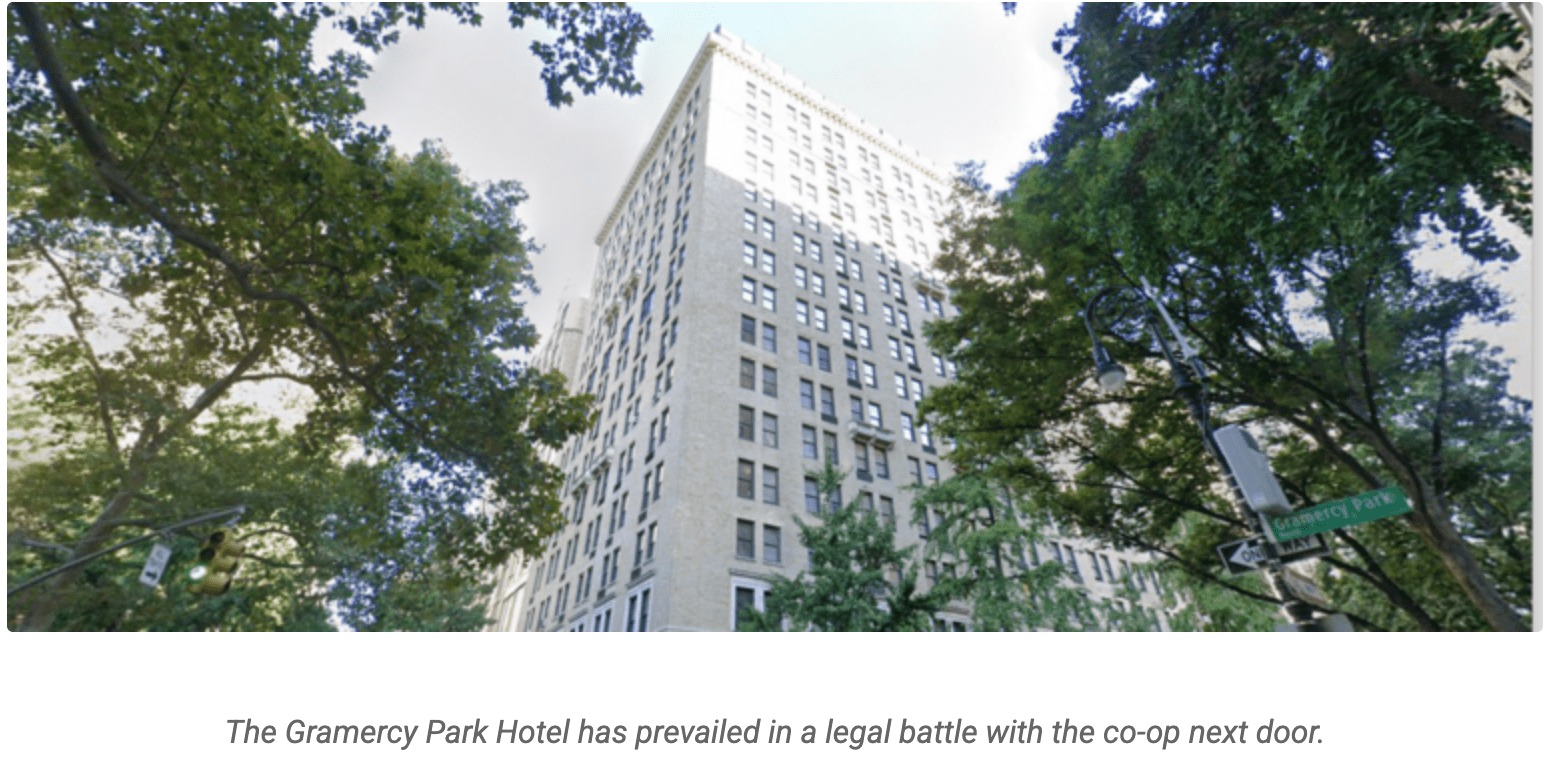
The Battle of Gramercy Park is finally over. The winner is the Gramercy Park Hotel while the loser is the co-op next door that sued, unsuccessfully, to retain access to the hotel’s rooftop.
While the rooftop war played out, the co-op at 50 Gramercy Park North succeeded in persuading a judge to stop construction work at the century-old hotel next door, which is under renovation and has been closed since 2020.
But that relief came to an end earlier this week when Manhattan Supreme Court Judge Anar Rathod Patel denied the co-op’s request for an injunction and overturned the stop-work order.
“To the extent that construction is being halted, there is no dispute that will cause delays or perhaps prevent the reopening of the hotel, which is a significant prejudice to the defendants,” Patel said from the bench after an hour-long hearing, Crain’sreports. “By contrast, there is not really any prejudice by the plaintiffs that has been established.”
This legal battle began when the 17-story, 21-unit co-op sued the hotel, claiming that the co-op’s “irrevocable and perpetual” right to the rooftop next door, atop the hotel, is being violated because an illegal members-only club is being built there “for guests of hotel operator’s choosing.” The court agreed to halt construction.
The hotel fired back by filing a counter-suit seeking $125 million in damages from the co-op. The hearing earlier this week allows halted construction to resume, signaling that the hotel has triumphed over the co-op.
In 2023 MCR Hotels bought the Gramercy Park Hotel’s ground lease and vowed to restore the splendor of the century-old hotel that closed in 2020. MCR secured a $150 million loan to renovate the building, and to sweeten relations with its new neighbors while work was underway, MCR offered to give 50 Gramercy Park North residents membership to the rooftop club, though they would have to pay for their own food and services.
A lawyer for the Gramercy Park Hotel, Vincent Pallaci, claimed that co-op residents have since been offered private space on the hotel’s third floor that is better than what they would have gotten on the rooftop. “The overall open space that they’re going to have access to is actually going to be nicer,” Pallaci said during the hearing.
The co-op’s residents can console themselves that sometimes you win even when you lose.
By Kelly G. Richardson, Esq. CCAL, HOA Homefront Column
Dear Kelly: Our reserves are very very low – can the city or state take over our association? B.P., Huntington Beach
Dear B.P: If the HOA’s reserve account balance is very low, meaning it is far less than the reserve study indicates should currently be accumulated to offset the existing level of deterioration of common area elements, the HOA is in financial danger. When a major common area element fails (decks, roofs, ?), the HOA will be unable to pay for replacement, leaving the members only two options: A major special assessment or a long-term bank loan (if the HOA qualifies for loans). Such an HOA may also violate FHA/FNMA lending requirements, which presently require that 10% of the HOA’s annual budget go to reserve accumulation. [Note- That figure will increase to 15% in 2027.] Condominium homeowners will have difficulty obtaining or refinancing mortgages if the association does not qualify for FHA and FNMA loans. If an HOA falls into complete disarray, it is unlikely that the city, county, or state would take it over. However, if someone petitions the court, a judge could order the HOA into a receivership. In receiverships, a third party takes over running the HOA for an expensive hourly fee. You don’t want that! Sincerely, Kelly
Mr. Richardson, I have enjoyed reading your articles for many years, and I have often shared them with our management and board. Recently, some directors have discussed using reserve funds to offset the operating budget and lowering our funded reserve level. The primary focus appears to be holding dues flat. This approach does not seem realistic or financially responsible. What would be the effect of reducing reserve levels? N.C., Mission Viejo
Dear N.C.: Reserve funds are specifically accumulated to offset the ongoing deterioration of HOA common area assets. If the HOA takes those funds and repurposes them, that is considered “borrowing” from reserves under Civil Code Section 5515. That borrowing must be repaid within one year, per Civil Code 5515((d). Boards skimping on reserve savings to artificially keep assessments low are not being truthful to their neighbor homeowners – because they are obscuring the fact that the HOA will not be ready for major replacement expenses. Thanks, Kelly
Kelly: What power does a board of directors have to implement a financial plan for the funding of the reserve account without approval of all the homeowners? B.W., Solana Beach.
Dear B.W.: Budgeting, including complying with reserve study accumulation requirements, is one of the board’s basic responsibilities. For HOAs without properly funded reserve accounts, Civil Code 5550(b)(5) requires the HOA to have a funding plan to catch the HOA up on its reserve accumulation needs. The HOA’s shortfall on reserve accumulation funding must also be disclosed annually to members under Civil Code Section 5570 and 5300(b)(3). It is a board responsibility because it is too complicated to submit to a vote of the entire membership.
HOAs that do not set aside sufficient money to offset deterioration of HOA-maintained common area components are quietly falling into unliquidated debt. Such a debt becomes liquidated when the component must be replaced and the “bill comes due.” Unfortunately, unwise HOAs will not have the funds ready for that expense if they shortsightedly only focused on month-to-month expenses. Best, Kelly
Living in a homeowners association has its perks—but it also comes with rules, fees, and, as we’ve seen time and again, disputes.
It’s become commonplace for residents to take to the internet to vent their frustrations, with trends like #HOAproblems, #HOAstories, and #HOAKarens gaining in volume on platforms like TikTok.
But while it might be tempting to share your frustrations on social platforms like Facebook, Nextdoor, or Reddit, doing so can cost you.
“Social media posts are out there for anyone to find. Since they’re usually monitored, what may feel like privately venting your frustrations can quickly turn into a public record that your HOA can and will use against you,” explains Edward Susolik, CEO and managing partner of Callahan & Blaine PC in Irvine, CA.
If you live in a home with an HOA, think twice before freely airing your grievances online. By understanding the implications involved, you can protect your finances, reputation, and sanity.
Dangers of venting about your HOA
Speaking up about your HOA on social media carries three major risks:
Legal exposure
Venting an opinion is fine, but as soon as it crosses over into false statements of fact about a specific board member or a community manager, it opens you up to a defamation lawsuit.
“Board members are volunteers, and they respond the same way anyone would. Attack them publicly and they shift into defending themselves and the association, making the underlying problem harder to resolve,” says Erik Leland, real estate broker at Realty First in Lake Oswego, OR.
If you approach them with a problem you want solved, most boards will collaborate and figure out a way to work with you.
“The same grievance can get two completely different outcomes depending on the approach,” Leland explains.
Governing documents
Some HOA covenants, conditions, and restrictions (CC&Rs) contain conduct or nondisparagement provisions with fine schedules attached. Unfortunately, you might not know these clauses exist until you receive a violation.
“The CC&Rs, in California HOAs, for example, include specific clauses, and violating them by making a social media post can be viewed as a breach of your governing documents. You could wind up with fines or face some other legal consequences,” explains Susolik.
Impact on property values
When a community’s public face is full of complaints, every seller in that neighborhood pays for it, including the person posting.
“Regardless of how valid your complaints are, choosing to lay them out online could cost everyone equity,” Leland explains.
Susolik also points out that publicly documented HOA disputes that are visible on Nextdoor or other platforms may show up in a buyer’s due diligence and complicate a sale.
“Some cases we’ve seen have resulted in huge retaliation enforcement from HOAs that cite every minor CC&R for the homeowner. If you get slapped with a lien for not paying HOA fines, it can make a mess of the title and either delay or destroy your home sale,” says Susolik.
What started as an argument on social media about your gripes with landscaping can bury things at the closing table.
How to raise concerns without crossing legal lines
When you have an issue with your HOA, take a constructive approach—instead of a confrontational one.
“If you must say anything on social media, only talk about documented facts and frame everything else as either a question or concern rather than an accusation, or it may very well come back to haunt you,” says Susolik.
It’s a good idea to put any concerns you have in writing and share them with the board so there’s a record. Show up to meetings, and request some time to explain your position.
Don’t forget to read the minutes and the budget, because most disputes come from a misunderstanding of process—not bad faith.
If you want to see a change in leadership, the bylaws spell out exactly how elections work. Organize neighbors and run for a spot to represent the community.
“Even easier, there are lots of volunteer positions available if you want more of a voice. The homeowners who engage in positive ways inside the process generally get more favorable outcomes,” Leland adds.
By Kelly G. Richardson, Esq. CCAL, HOA Homefront Column
Kelly: I’ve enjoyed and appreciated your articles in the paper. Wish more board members would read them and take your advice. Why do boards have closed sessions during our monthly meetings? What is it that the board members wish to hide? Owners should be able to address the board when matter(s) or issue(s) are discussed referencing our homes and properties. HOA closed meetings only are a cloak of secrets, that they do not wish the paid owners to hear or have knowledge of. The owners deserve to not be barred from any portion of the monthly meeting and be entitled to hear how the board & manager are spending our monies. J.H., Fullerton
Dear J.H.: There are certain matters, which if discussed openly, would harm either the HOA’s or a homeowner’s interests. So, Civil Code 4935 allows a very few specific topics to be discussed in closed session. In addition, the state Fair Housing regulations also require requests to accommodate a resident’s disability also be handled confidentially. J.H., I agree with you that boards should use closed session sparingly, and only in clear compliance with the statute. Unfortunately, some boards abuse closed session for convenience, which harms the board’s credibility and possibly opens those decisions to legal challenges. Thanks, Kelly
Mr. Richardson: A few years ago you said regarding Section 4935 of the Davis Stirling Act: “Many boards and even HOA attorneys overlook “formation,” and focus only on “contracts” and erroneously expand the use of closed session.” My interpretation is that a board in closed session may negotiate contract terms but the final approval be voted in an open board meeting. I think the phrase “formation of contracts” was intended to apply to contract negotiations and should not be interpreted to allow boards to avoid discussing actions in an open meeting. Regards, N.D., Palm Desert.
N.D.: Many lawyers, managers, and boards conveniently overlook the term “formation” and allow HOA boards to handle all contract-related matters in closed session. This does not comply with the few topics allowed to be discussed in closed session and builds mistrust in the board. The selection of a vendor should be in open session. The discussion of negotiation strategy, counter-offers, or legal discussion of the contract terms obviously must be in closed session to protect the HOA’s interests. I encourage boards to ask themselves “must this be in closed, or can it be in open session?” Sincerely, Kelly
Mr. Richardson: While attending a board meeting, our board stated that they were discussing committee members and committee chairs in executive session. They said it was acceptable to discuss committee members in executive session since they are “personnel.” Can boards view committee volunteers as personnel, thus allowing discussion in executive session? Thank you, R.G., Mission Viejo.
Dear R.G.: “Personnel” discussion that is allowed in closed sessions per Civil Code 4935(a), is the discussion of the HOA’s paid employees – people who receive paychecks from the HOA. Vendors and HOA volunteers are not “personnel” and so those discussions must be in open session.
Some boards try to justify their overuse of closed sessions by saying that their meetings are disorderly or too long – I say then improve your meetings!
Imagine you find the home of your dreams, only quickly find out that a hefty HOA fee is attached to it.
At first, you may be a bit bummed about the additional cost. You may even consider passing on an ideal property because of it.
But experts agree that HOA fees may actually be worth it, especially if the home is in a neighborhood you love and has the kind of amenities that you’ll actually use.
“An HOA can keep a neighborhood nice while allowing its home prices to rise and making resale more desirable,” says Teri Smith, broker and real estate agent at Newport Properties in Mooresville, NC.
Still, it’s up to you to weigh the benefits of an HOA against the costs so you can ultimately decide whether the home is a good fit for you and your family. Here’s what you should consider.
The purpose of HOA fees
HOA fees are recurring charges homeowners pay to maintain shared spaces and amenities in a community. They’re common in condos, townhomes, and planned neighborhoods, which have become increasingly popular properties for first-time homebuyers and retirees alike, given their price points.
“Besides landscaping, security, and amenities like pools, HOA fees may cover building insurance for common areas, utilities, community management, legal or accounting costs, and reserve contributions for future repairs,” says Stephen Lockard, litigation attorney at J&Y Law in Los Angeles.
This can be especially appealing to those who prefer to let the onus of the exterior of their home be someone else’s problem. For example, your HOA fees will be funneled into a reserve, saved for repairs like roof replacements and siding refinishing.
Typical HOA fees
In most cases, HOA fees are paid monthly, but amounts can vary significantly. Modest communities or those with few amenities may charge a couple hundred dollars each month or less. Luxury high-rises or neighborhoods with extensive services, on the other hand, can cost thousands of dollars.
“It really comes down to amenities, the level of service you receive, property values, and the age of the community,” explains Lockard.
According to Marcus Sturdivant, advisor, managing member and chief compliance officer at The ABC Squared² DBA All Bases Covered in Charlotte, NC, it’s a good idea to use the 1% rule, meaning your HOA fees should not exceed 1% of your home’s value.
For example, if you’re buying a home for $450,000 you should pay no more than $4,500 per year or about $375 per month in HOA fees.
How to decide whether they’re worth it
When considering a home in an HOA, experts recommend these considerations to determine if the fees (and property itself) are a good fit.
Understand what the fees cover
Request a copy of the HOA’s Covenants, Conditions, and Restrictions (CC&Rs) and find out what the HOA fees would pay for.
“If they include utilities, maintenance, or insurance, they could offset other bills,” says Lockard.
If most of the fees go toward the community pool and gym, ask yourself whether you’ll actually use these amenities.
Compare the fees and assess potential increases
See how the HOA fees compare to similar properties nearby. You may even be able to check the history of fee increases by asking the seller or listing agent for records. Determine if the fees are fair and whether you feel comfortable with them rising.
“If HOA fees are unreasonably high, or the association raises fees too frequently, be careful. That could be a sign of overall poor financial management,” explains Lockard.
Do your research
Read the CC&Rs carefully and check out online reviews of the HOA. You can even talk to residents of the community to get firsthand perspectives.
Your goal should be to understand how the association operates and how the rules are enforced. Are they strict and controlling or more relaxed and flexible?
“Make sure the HOA’s culture aligns with your unique lifestyle and preferences,” says Sturdivant.
Life is full of negotiations. At work, we negotiate contract terms and conditions, flex time and pay raises. At home, we negotiate where to go on vacation, what to order for dinner — and how much screen time is toomuch screen time.
Given how frequently we negotiate, it’s perhaps surprising that one of the most important skills of effective negotiation is often overlooked or undervalued: listening.
“The stereotype of a great negotiator is skewed,” saysAllison Elias, an assistant professor at the University of Virginia’s Darden School of Business. “People tend to think the more competitive and selfish you are, the better you’ll do. What they overlook is that some of the most astute negotiators actually use listening as part of their competitive strategy.”
Elias teaches courses about communication and negotiation in Darden’s MBA and Executive MBA programs, as well as for executive education audiences. But over the years, she found there was little practical guidance on how to listen well in a negotiation.
Until now.
Her new technical note, “Listening: A Negotiator’s Playbook,” introduces a three-phase listening framework designed to make listening teachable and actionable. And it’s not confined to work or business settings — it can be applied to everyday life.
“We tell people in class to listen to the other person,” she says. “But how do you really do that well? What’s the purpose? And why should you care?”
The note, she adds, fills a gap in the curriculum. “Renewing my mediation certification recently really emphasized the importance of listening in conflict resolution. And in negotiation too, you cannot be a great negotiator without listening well.”
Elias will be teaching the note in her fourth-quarter elective, “Negotiation.”
Her goal is to get students to think about how intentional one needs to be as a listener.
“When we prepare for negotiation, a lot of times we tend to over-focus on our own interests, our own planning, what we’re going to say,” says Elias. “But there could also be real value in preparing to listen, and brainstorming questions to ask the other person to try to understand them better and really listening to their answers.”
Why Negotiators Need to Listen
“Listening is not just a nice thing to do,” says Elias. “It has cognitive and affective benefits.”
In other words, when you’re listening intently, you’re learning new information that can help create or claim value in the negotiation. Listening also engenders a positive feeling between the parties and helps with relationship-building. “The consequence is that the other person feels respected,” she says.
Yet often, listening is easier said than done. When asked to describe a good listener, most people jump instead to what makes someone a bad listener, says Elias. They point to traits such as interrupting, responding vaguely or illogically, being distracted and fidgeting.
Being a good listener means more than just avoiding these behaviors.
“High-quality listening requires psychological presence, cognitive attention and emotional responsiveness,” Elias says.
How to listen:A Three-Phase Framework
Phase One: Prepare to observe and absorb.
Elias says one of the biggest obstacles she encounters when she teaches negotiation is a lack of curiosity about the other person’s perspective and world view.
“A lot of times I see people rush through the negotiation too fast, and students will say, ‘If this were real, I would have spent more time on it’,” Elias explains. “But if you’re really trying to understand another person, you’re trying to talk to them at length and ask them a lot of questions.”
She adds, “Sometimes we take too narrow of a view of what would be relevant in the negotiation, only focusing on the main issues on the table. If you can develop a curiosity about the other person, you’re going to be a better listener and more expansive about what you’re considering in the negotiation.”
The first phase of the framework is understanding that gaining leverage in a negotiation can begin before any words are exchanged.
“Effective negotiators prepare well by doing their research,” Elias says. “As they gather information and reflect on what they know, they also embrace the fact that there is a lot that they do not know.”
The core aim of this phase is to create conditions for openness. And to do that, Elias says, you must center yourself to quiet powerful cognitive traps, including confirmation bias.
Skilled negotiators bring an authentic curiosity to the discussion. “Embrace what you do not know,” she adds.
Phase Two: Engage and Interpret Signals
This phase is about being present during the conversation and taking note of various signals, including the dynamics of who’s who in the room.
“As effective listeners enter into a conversation, they take note of nonverbal cues such as the physical positioning of others in the room and their emotional states,” says Elias. “These observations provide additional information, perhaps about what has unfolded previously, to guide a communication strategy.”
Negotiators can absorb valuable information from all of these signals.
Doing so requires listening beyond words, attending to emotions and group dynamics, mirroring and paraphrasing conversations, and asking open-ended questions.
Phase Three: Monitor the Agreement as Partners
Elias says that negotiation courses tend to focus mostly on securing an agreement and neglect what happens next.
“Listening should not end when agreement is reached,” she says.
On the contrary.
“A lot of where value is created is in the phase after an agreement is created,” Elias says. “During the implementation phase, you need to continue to have curiosity, flexibility and awareness of the other person because there might be ways you need to tweak the agreement, or things that you hadn’t thought of before that need to be considered.”
You should also broaden your audience as the implementation phase unfolds. “Additional stakeholders who were not parties during the negotiation might emerge as critical to a deal’s success,” she adds.
The key takeaway from this phase is to maintain contact with more parties and remain open to adjustments.
Talk Less. Listen Better.
While listening is one of the most powerful tools a negotiator can bring to the table, we can all benefit from being good listeners. That means listening carefully and purposefully to other people.
Professor Allison Elias is author of the new technical note, “Listening: A Negotiator’s Playbook,” published by Darden Business Publishing (December 2025).
When a condo or co-op resident runs for a seat on their board, the decision to do so generally comes from a desire to ‘step up’ and participate in the governance of the place they call home, and the building or association community as a whole.
Often, the residents willing to serve on their board aren’t necessarily those with finely-honed skills and formal education in law, finance, and practical business management. And they don’t have to be—with competent management, legal, and accounting professionals on their side, a board composed of ‘civilian’ members can absolutely meet its oversight responsibilities and run a solvent, functional building or association.
But having said that, it’s also worth considering that a solid, practical base of knowledge in law, finance and management can be invaluable to a board, enabling them to interact more confidently with contractors and other professionals, make prudent financial decisions, and understand the implications of legislation and legal decisions impacting their community.
A Little Knowledge…
Given that, what base of knowledge does a board member—especially a newly elected one—need in order to contribute most effectively to the administration of their community? Most experts agree that understanding financial reporting, and to a slightly lesser extent, the laws and regulations governing shared interest communities in their area are the biggest help.
“Every board member needs to develop a basic skill set,” says Steve Silberman, a CPA and partner with PBG, a financial services firm located in Glenview, Illinois. “At a minimum, they need to learn to read and understand a financial statement, rather than just relying on the treasurer. The board has a fiduciary responsibility over the financial information of the association or corporation, so all the board members need to understand their finances.
“Revenue, minus expenses, equals net income,” says Jayson Prisand, an accountant and principal with Prisand Mellina Unterlack & Co, an accounting firm located in Plainview, New York. “That’s pretty much the starting point. The primary goal of maintenance or common charges is always to pay for expenses. It seems obvious, but if you don’t have the revenue, how can you pay for the expenses? Board members have a clear need to understand these basic processes. Cash and reserves and their differences are also important concepts in terms of short-, medium-, and long-term planning. Board members must know short-term concepts and goals for operating, and long-term concepts for capital projects. Especially in the current environment, they should understand inflation, and in New York City (and everywhere really), local regulations. It’s not an easy task.”
“The other concept they need to understand is fund accounting,” Silberman continues. “Operating accounts are based on fund accounting. They must also understand what a reserve fund is. A major issue for boards is the possible co-mingling between operating accounts and reserves. That requires understanding the difference between accrual versus cash-basis accounting. Most board members, regardless of their overall knowledge of accounting, understand ‘cash-basis’ accounting, as that’s how a personal checkbook works; income is accounted for when received, and expenses accounted for when paid. By contrast, accrual is more true to [a community’s] current financial position, because it records income when earned and expenses when incurred.”
“Financial literacy,” says Mark Love, principal of M. Love & Associates, CPA, with three offices in Massachusetts, “requires knowledge of matters involving finance, accounting, budgeting, taxes, investments, insurance, debt, financial planning, capital planning, and even economics.”
Michael S. Simone, an attorney and principal of The Simone Law Firm, based in Cinnaminson, New Jersey, focuses in a little more: “Board members must ensure that their association has a budget, and then make certain to run a monthly budget variance report to monitor the progress of the budget throughout the year. Understandably, everyone wants dues to be as low as possible, but an association needs to avoid having too many special assessments. Having special assessments every year is a red flag indicating that the budget is not properly funded. Furthermore, given the current stricter mortgage regulations, an association that does not have a properly funded budget might result in a potential buyer not being able to obtain a traditional mortgage.” Understanding basic accounting and financial principles is necessary for this.
Are All Board Members Equal?
Do all board members require the same level of knowledge of financial, management, legal and accounting issues? In a word, no.
However, according to Prisand, “Those board members who don’t have the most in-depth financial knowledge shouldn’t necessarily be the treasurer. The treasurer should have a solid grounding in financial data in their background. That’s not to say they couldn’t otherwise do the job, but you’re managing money—everybody’s money. There is always reliance on the management company, but don’t give them carte blanche. Overall, at least one person on the board needs to have a more complete, more complex understanding of finances and financing.”
Love concurs. “To be sure, at least one board member, generally the treasurer or the president, should have a moderate to semi-high level of understanding and awareness of these financial matters.”
Another area about which board members should have basic technical understanding is what their governing documents say and require relative to the financial management and maintenance of the property. “The first thing every board member should look at and understand are the bylaws and declarations of their association,” says Silberman. “The bylaws, etc., hold information about financial audits, what to do with excess cash from operations, and other details of financial management under the laws and regulations governing the association.” A law degree is not necessarily required for this, but as with the treasurer’s position, it certainly doesn’t hurt to have an attorney on the board. If that’s not possible, the community’s legal counsel can be tapped to provide any needed clarification.
Training Available
There are several organizations whose mission it is to help educate board members in the unique aspects of governing a building or HOA—including this publication, and its companion annual and biannual Expos, which offer rosters of free educational seminars, expert panel discussions, and legal advice booths. (Visit coopexpo.com for more information, registration, and descriptions of seminars.)
Another valuable resource —and the largest U.S. organization devoted to board education—is the Community Associations Institute (CAI). “CAI has over 40,000 members,” says Simone. “Their courses are offered both online and in-person, and are an excellent way to learn more about the role of being a board member. Further there is a web forum group where associations post problems and issues they are being confronted with, which is another way to learn from other potentially similar association’s issues.”
Along with these, “Boards should avail themselves of all manner of tutorials, workshops, seminars, and education courses on financial, operational, and management of an HOA,” says Love. “There are hundreds available at many organizations dedicated to the shared-interest sector.”
Spreading the Knowledge
In cases where a building or association is fortunate enough to have an accountant, attorney, financial or real estate professional as a board member—or even as a non-board resident—is it advisable for that person to help board members understand what can often be complex matters? The answer might depend on the community.
One co-op shareholder on Manhattan’s Upper West Side who is a professional commercial mortgage broker shares anonymously that in the 30 years he’s lived in his building, the corporation has refinanced its underlying mortgage twice. On both occasions, while not serving on the board, this shareholder offered his expertise to review the refi and advise the board in their decision making. The board turned down his offer both times—and in his opinion, they made serious mistakes, including the prepayment clause on the original refinance some 20 years ago, which precluded the corporation from taking advantage of lower interest rates when they had the chance.
On the other hand, Silberman says, “Boards could and should take advantage of members’ knowledge base. Depending on the size of the community, they might also have a finance committee or subcommittee apart from the board that would allow those with financial background but not on the board to serve on that committee, thereby bringing more people with knowledge into the equation.”
Prisand cautions that sometimes a little knowledge can cause friction. “I work with all types of people on boards. Senior fortune-500 types to housewives. Sometimes those with knowledge can present a different kind of problem; they think at too high a level. It’s not plain vanilla—every building is different—but it’s important to keep it fairly simple.” In the end it ‘takes a village’ to effectively run a village.
A Pressing, if Not-so-New Issue
Another issue has come to the fore for boards in the aftermath of the deadly Surfside, Florida, building collapse in 2021: reserves, and reserve studies. The high dollar amounts—and high stakes—make this yet another area where board members need to have at least a working knowledge and basic understanding of both their building’s physical condition, and the financial planning needed to properly maintain it.
According to Silberman, “Boards should plan for a reserve study, and a plan for investment of those funds. They need an investment policy, and should understand the financial and accounting principles underpinning that policy, including why and how reserve money is invested, its safety and liquidity, and yield. If you’re funding a reserve project, you’ll have a better idea of why the money is invested the way it is.” That knowledge of investment strategy is a good partner to understanding the financial principles relating to your regular operations as well.
It all boils down to boards and board members being as informed as possible about what goes into governing and administering their community from day to day, from its physical upkeep to financial decision-making and long-term planning. Reading—and understanding—your governing documents, consulting your legal and financial professionals when necessary, and taking advantage of educational and training opportunities are all great ways to make the most of your tenure, and make your board the best it can be.
A J Sidransky is a staff writer/reporter for CooperatorNews, and a published novelist. He can be reached at alan@yrinc.com.
Good community rules and regulations (“operating rules,” per Civil Code Section 4340) protect the community and encourage neighborly conduct. However, good rule ideas are not enforceable unless the HOA follows a prescribed rule amendment process. Because only boards have the power to create or amend rules, the law requires special procedures to alert members in advance about impending proposed rule changes.
Civil Code 4360 establishes the following two-step meeting process:
Meeting #1; Announcement #1 – In an open meeting the board approves a draft proposed rule change, and approves publishing to members the verbatim proposed change language along with a statement as to the change’s purpose and effect. The announcement also must announce a second open board meeting at least 28 days later when members can comment on the proposed change.
Meeting #2. At the next open meeting, the board must allow member comments before voting on proposed rule changes.
Announcement #2. If the rule change is adopted it must be announced in writing within 15 days after the meeting.
If a rule change is very controversial, 5% or more of the membership may within 30 days of announcement of the rule change demand a membership meeting to vote upon its reversal. If a majority of a quorum of members votes to overturn the rule change, the board cannot reinstate the overturned rule change for one year.
Civil Code 4360(d) allows emergency rules to be immediately adopted if immediate action is necessary to avoid imminent threat to health or safety or to avoid substantial economic loss. Emergency rules may last for up to 120 days but cannot be renewed.
Before changing association rules, consider these tips:
Don’t rush a rule. A rule change too complicated to draft during the board meeting should be delegated to someone (HOA’s attorney?) to draft language for consideration, to be picked up again at a later open meeting. Good rules adopted slowly are better than poor rules quickly approved.
Once the motion to adopt the rule change is made in the second board meeting, suspend deliberations and reopen members’ open forum on the rule change. Comments will typically be minimal unless the rule change is controversial.
Listen to your neighbors. The open forum element is important. Listen. If significant opposition to the rule arises, more consideration should be given. Can the proposed change perhaps be improved? Is the board unexpectedly upsetting so many homeowners that an overturn vote becomes likely? Such rule changes might be divisive to the community, even if they might originally have seemed like good ideas.
Don’t rush past member objections. After further study, discussion, and perhaps revisions, the improved proposed change can be republished to members.
Promptly announce approved rule changes. Don’t wait to send it with the draft meeting minutes – draft minutes are not due until 30 days after the meeting, while this announcement must be made within 15 days.
Have legal counsel review proposed rule changes.
Perfection is not required. Per Civil Code 4350(d), when boards act in good faith and substantially comply with the procedures, the rule should be valid.
The law, while potentially frustrating, adds transparency and deliberation to the rule-making process. The hoped-for results are better and less divisive rules – and more harmonious communities.
The state Legislature’s recent passage of a controversial pied-a-terre tax — a levy on second homes worth $5 million or more — generated a blizzard of headlines. Lost in the flurry was another controversial bill that failed to win passage.
For the fourth year in a row, the Ground Lease Co-op Bill failed to get a nod from the Legislature, leaving 25,000 New York City shareholders vulnerable to losing equity in their apartments. Under the land-lease arrangement, shareholders own shares in the co-op corporation but a separate landlord owns the land the building sits on. Those long-term land leases face periodic resets, and when they finally come due, most co-ops face sharp, sometimes fatal, increases in the land rent.
A recent example was the middle-class Carnegie House co-op, which has the misfortune of sitting on Billionaires’ Row in Midtown Manhattan, where land values have soared in recent years. When the Carnegie House’s land lease came due, courts upheld the landowner’s rent hike from $4.3 million to $24 million.
Shareholders in ground-lease co-ops generally pay a lower price for their shares but pay higher monthly maintenance charges than convention co-op residents. If a ground-lease co-op defaults, the building can revert to rent-stabilized apartments, a process known as de-conversion. If that happens, shareholders would lose their equity but would still owe their mortgages — the worst of all possible worlds.
The latest iteration of the Ground Lease Co-op Bill, sponsored by state Sen. Liz Kreuger and Assemblymember Linda Rosenthal, both Manhattan Democrats, would have restored shareholders’ ability to borrow for necessary maintenance and repairs, grant them the right of first refusal if their landlord decides to sell the land, and ensure that if the building is ever forced to deconvert to rentals, existing residents get reasonable first rents rather than being priced out on the spot. These are the same baseline protections that rent-stabilized tenants enjoy.
While the real estate industry and other opponents applauded yet another failure of the bill to win passage, proponents of the bill reacted bitterly.
William Maiman, president of the Mainstay SECTION ONE co-op board in Queens and member of the Ground Lease Co-op Coalition, issued the following statement: “Ground lease co-ops end yet another legislative session as New York’s last unprotected class of tenants. Year after year, advocates and families have urged legislators to close the loophole threatening our homes, all to no avail. The window to act is closing fast. Continued inaction means ceding the homes of over 25,000 middle-class New Yorkers to big real estate and private equity.”
In the closing days of the legislative session, the real estate industry argued, successfully, that the Ground Lease Co-op Bill would have benefited wealthy investors and part-time residents rather than working families.
Richard Hirsch, board president at the Carnegie House co-op, offered this blunt retort to that claim: “Ground lease co-ops, which own their homes but lease the land, primarily serve the middle class.”
Story by Stephanie Wicky for Entrepreneur Daily Newsletter
Key Takeaways
At times, the more you say, the less you are heard. Strategic restraint ensures the “why” of your message isn’t lost in the “how” of its delivery and allows others to build their own credibility.
Before every meeting, identify the one point you want to make, and wait for the right moment to make it. If you try to speak on every single topic, you dilute your impact and risk becoming white noise.
Recognizing the gap between intention and impact can unlock a more sustainable, high-trust form of leadership.
If you were to look back at my report cards from grade school, the commentary was remarkably consistent: bright, innovative, straight As — and talks way too much. I have always been a naturally gregarious person and, as a marketer, I am a storyteller by trade and by DNA. For a long time, I operated under the assumption that to be valuable, I had to be visible. I believed that if I wasn’t the most vocal person in the room, my peers and leaders wouldn’t know I was engaged or strategic.
As I rose into the executive ranks, however, I had to confront a humbling reality: At times, the more you say, the less you are heard. Learning the discipline of strategic restraint was a fundamental shift in how I viewed influence. I realized that being the loudest voice often turned my contribution into white noise. So in order to become a true strategic architect, I had to learn how to transmute my natural energy into a more intentional, calculated form of presence.
The 360-degree review
The turning point in my career didn’t come from a specific win, but from being gifted an executive coach. Part of that process involved a 360-degree review where peers, superiors and direct reports provide anonymous feedback on your leadership style. On paper, I was perceived as competent and creative. But the review also contained a jarring observation: I was described as someone who could “suck the air out of the room.”
It was a staggering realization because, where I thought I was being genuinely helpful, others saw me as overbearing. I had to step back and honestly confront the gap between my intention and my impact. It took a deep level of reflection to come to terms with the fact that much of my talkativeness was actually masking an insecurity — the fear that if I didn’t say it, they wouldn’t know I was thinking it. By trying so hard to prove my engagement, I was actually preventing others from engaging with me.
This dynamic is particularly nuanced for women in leadership, who often navigate a different set of expectations. We are frequently scrutinized for our tone and cadence, and I’ve spent years learning to manage my physical cues to ensure my passion isn’t misread as aggression. I often literally have to sit on my hands or consciously slow my speech to maintain a more grounded, executive authority. Far from a retreat, this restraint is a tactical adjustment that ensures the “why” of my message isn’t lost in the “how” of its delivery.
The “One Thing” discipline
To master this restraint, I began applying what I call the “One Thing” rule. In any executive meeting, there are usually half a dozen different topics in play. If you try to bat on every single one, you dilute your impact and risk becoming white noise in the discussion. Now, I decide before I walk into the room exactly what I want to achieve — the one specific goal I have for that session.
I wait for the right moment in the conversation to make that point with precision. And if that opening doesn’t arrive, or if I sense the room isn’t in the right mindset to hear it, I have the emotional intelligence to table it for another time. This discipline has fundamentally changed the caliber of my collaborations. When you aren’t fighting to be heard on every point, you create the space for others to feel ownership in the vision.
I think of it as stopping my boat to allow people to get on it before I take off. If you move too fast and say too much, you aren’t allowing your team or your peers to be part of the journey. Strategic restraint is about building a boat that others actually want to board, rather than one they feel they are being chased by.
The lesson of compounding growth
If I were sitting across from the 32-year-old version of myself today, I actually wouldn’t tell her anything. Every one of us has to live our own journey, and at that age, I simply wasn’t in the mind space to hear this advice. We have to live through the life lessons to truly understand them. My loud voice helped me rise to a certain level, but I had to learn that what got me here wouldn’t get me there.
For me, the shift toward a quieter power has unlocked a new level of growth — not just in my career, but as a person. Humbling as it was to realize I was overbearing, that feedback forced me to ask myself why I was doing it, and ultimately became the catalyst for a more sustainable, high-trust form of leadership.
Today, I see that same force-of-nature energy in my son and two daughters, and I am already working to help them harness that power so they can lead with it effectively. This practice of stewardship extends beyond my home and into my work on boards like Truckers Against Trafficking and the National Pediatric Cancer Foundation.
When we choose strategic restraint, we allow others to build their own credibility. By waiting for the right moment to speak, I am not just improving my own executive presence; I am returning capacity to the people and systems that supported my own growth. Because in the end, being the strategist in the room isn’t about the volume of our participation. It is about the intentional weight of our presence and the strategic space we create for the next generation of leaders to find their own voices.