
By Emily Myers For HABITAT Magazine
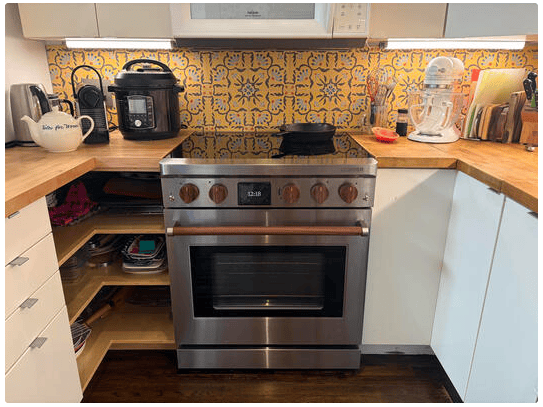
At 60 Court St., a switch to battery-equipped induction stoves by a third of unit-owners shaved $400,000 off the riser repair costs after a gas shutdown. (Photo courtesy Ted Booth)
A gas leak at 60 Court St. could have triggered a $1.5 million repair bill. Instead, the 33-unit downtown Brooklyn condo shaved $400,000 off the building’s riser replacement by giving owners the option to switch to battery-equipped induction stoves. “We saved because we didn’t have to do all the branch lines,” says board president Ted Booth, “And that was two thirds of the project costs.”
The shutdown couldn’t have come at a worse time. The condo was just days away from starting a major roof replacement and reserves wouldn’t cover both projects. “We had to stop that and lost the downpayment on the roof,” Booth says. It was also October, the start of heat season when heat and hot water are a necessity, since the leak put the condo’s gas-fired boiler out of action. A temporary oil-fired boiler was brought in — at significant cost. “Between the boiler rental and the oil it was probably $250,000,” Booth says.
The leak was in the cellar, where gas enters the building, but when a shutdown happens all the risers need to be pressure-tested before supply can be returned — which can take up to a year or more. At Court St., engineers and plumbers told the board the original risers were most likely leaking in multiple places. Fittings and valves would also need to be replaced.
One option for boards in this situation is to consider electrification. For the condo to move away from gas entirely the boiler would need to be replaced with electric heat pumps for space heating and domestic hot water. That would have required upgrading the building’s electrical capacity, and estimates for the work were as high as $6 million. “It felt like an impossible situation,” Booth says.
Ruling out electrification due to cost, the board knew gas lines would have to be replaced to the boiler. They then learned about induction stoves with built-in batteries. The battery allows the stove to plug into a standard 120 volt outlet, eliminating the need for electrical upgrades. If enough owners were willing to make the switch, the scope of the gas repair work could be scaled down. “We ended up giving owners a choice,” Booth says.
Lines were restored for unit-owners wanting gas, but for more than a third of residents who chose to switch to induction, branch lines were disabled. For them, the original gas appliances were replaced with 30-inch stoves bulk-purchased from Copper, a company that produces a battery-supported induction range that plugs into a 120 volt outlet. This cut the cost of the gas repair work to $1.1 million. For boards with aging risers, Booth says it’s definitely worth floating the idea of a building-wide switch to induction. “That might be more fun than writing a big check to a bunch of plumbers and tearing open walls.”
Getting all 33 unit-owners to make the switch to Copper stoves would have cut the cost of gas repair work by around two-thirds. Branch line repairs are the most disruptive for residents and often require plumbers to go through cabinetry and walls to access pipes. However, a 100% switch was near impossible; some owners had recently renovated, and some couldn’t accommodate a 30-inch stove, the only Copper model currently available. (A pilot project providing 100 simplified 24-inch Copper stoves to New York City Housing Authority residents is expected to expand the company’s offerings in coming years.)
At 60 Court, another obstacle the board faced was the condo’s offering plan, which requires owners to have gas service for appliances. The board agreed that changing this “would have been wildly divisive and difficult,” Booth says. Instead, they accepted that if someone who opted for the induction stove sold their apartment and a new owner wanted to return to a gas appliance, the condo would restore the gas. “Just because you decided to forgo the branch line today in favor of electric doesn’t mean you should be penalized for changing your mind later,” Booth says.
An assessment was put in place to fund the gas repair work and refill the condo’s reserves. Individual apartment owners paid separately for their induction stoves, adding around $6,000 to their costs. “Copper worked with us on a group order and gave us a little discount,” Booth says. Not only did those who made the switch to induction get functioning stoves three or four months before the gas was back on, Booth says he’s loving the new appliance. “The oven can hold temperature very precisely,” he says. “And it is so beautifully simple and focused on cooking.”