By CAMICB Executive Director, Matthew Green, CAE
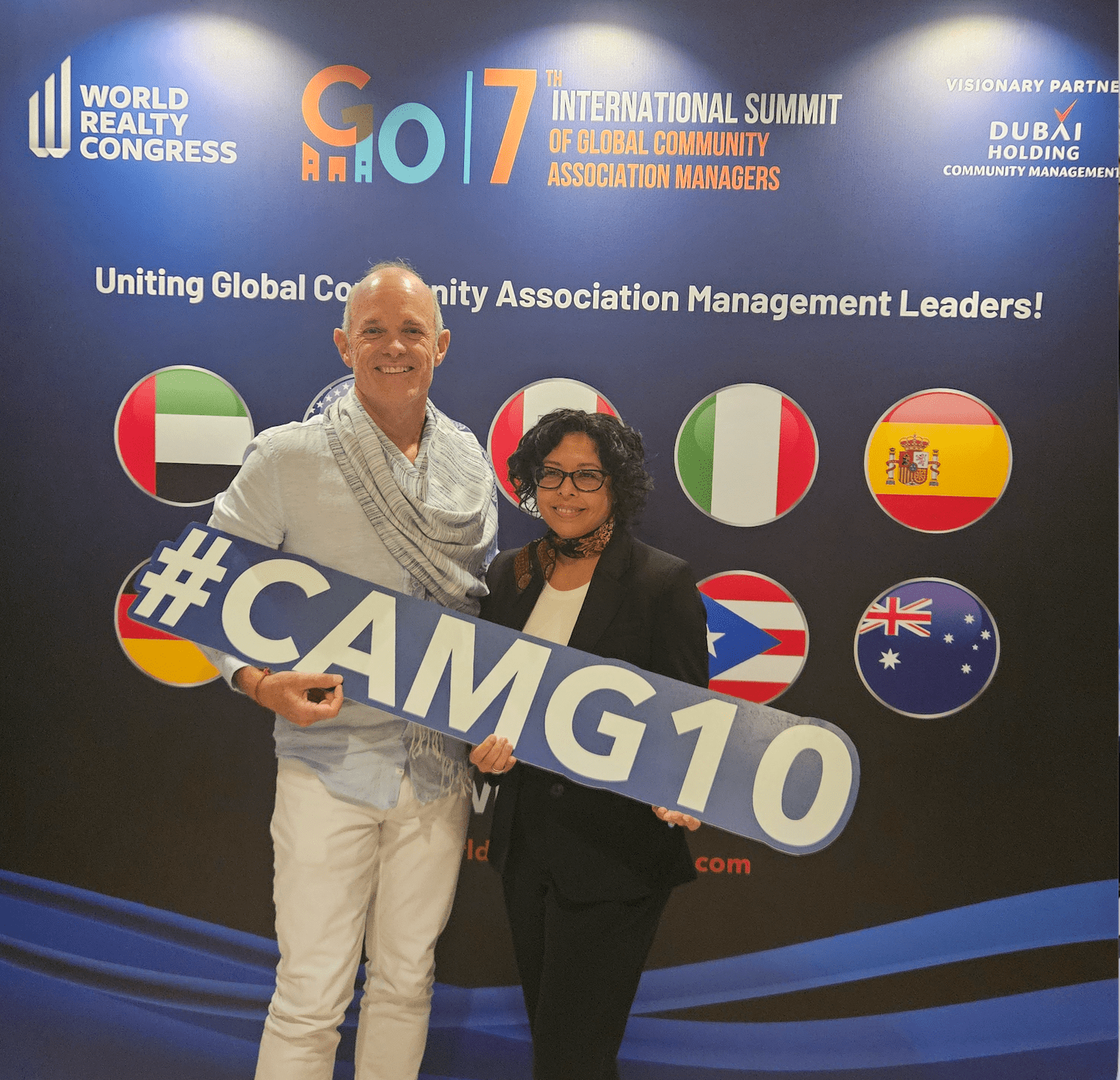
During a recent visit to the United Arab Emirates, CAMICB engaged with community management professionals in conjunction with the World Realty Congress and events hosted by CAI’s Middle East Chapter. The visit included time in both Dubai and Abu Dhabi and was approached with a clear sense of responsibility. The purpose was not comparison or promotion, but observation. We wanted to listen, learn, and better understand how community management is practiced in a rapidly developing region, recognizing that local context shapes professional practice.
Our time with CAI’s Middle East Chapter provided an opportunity to engage directly with local professionals, including many early-career community managers. I had the opportunity to present on the CMCA credential to both CAI members and non-members, focusing on the fundamentals: what the credential represents and what it takes to earn and maintain it. The conversation was intentionally practical, emphasizing professionalism and the role a credential can play in establishing credibility.
Those discussions reinforced an important reality for CAMICB as we consider international engagement. While core elements of community management remain consistent across markets—financial stewardship, communication, accountability, and ethical practice—the day-to-day execution of the role can vary significantly. Local norms, regulatory frameworks, relationships with developers, and interactions with government authorities all shape how community managers operate and how their expertise is recognized. For me, the visit reinforced that professional standards gain strength not by assuming sameness, but by understanding difference.
One of the most striking aspects of visiting the UAE was observing the rapid pace and massive scale of its development. Across the communities we visited, this growth is supported by a large and diverse workforce drawn from many parts of the world. Their efforts make possible a level of building and expansion that isn’t feasible in most other contexts. Alongside this workforce is a growing population of young professionals entering community management roles. These managers are ambitious and motivated, seeking pathways for professional growth. Our interactions, though necessarily limited, offered valuable perspective and underscored the importance of continued listening and observation.
In both Dubai and Abu Dhabi, we spent time with large management organizations that operate in close alignment with government entities. These organizations approach community management holistically, considering not only operational needs but long-term planning, accessibility, and infrastructure coordination. One organization, in particular, emphasized thoughtful accommodations for residents with disabilities, embedding accessibility considerations into both planning and management practices. These examples reflect a specific segment of the market, but they offer valuable insight into what is possible when development, governance, and stewardship are closely coordinated.
Government alignment emerged as a defining feature of the environment. The level of coordination between developers, management entities, and public authorities appeared intentional and forward-looking, enabling comprehensive planning across entire districts rather than individual communities. Observing how coordination occurred across developers, management entities, and public authorities illustrated how long-term planning and cross-sector collaboration can influence community outcomes.
Experiencing community management at this scale also reinforced an important boundary for CAMICB. The CMCA is designed to establish a professional foundation for community managers, particularly those early in their careers, by assessing core competencies, ethical responsibilities, and standards of practice. Exposure to highly specialized, development-focused roles underscores the profession’s diversity, but it also highlights the importance of understanding where the certification provides the greatest value and where continued listening and learning are needed.
Ultimately, the value of engaging with professionals in the UAE was not in drawing conclusions, but in sharpening perspective. Seeing the breadth of how community management can be practiced across cultures, governance models, and scales of development reinforced the responsibility of stewarding a professional certification. For CAMICB, that responsibility means advancing standards thoughtfully, growing deliberately, and ensuring that the CMCA remains grounded in the purpose it was created to serve: supporting competent, ethical community managers wherever they practice.