The Leadership Cost Of Avoiding Hard Conversations

Hard conversations are not a sign of poor leadership. They are evidence that a leader is committed to accountability, transparency and growth.

By Melissa Powell for Chief Executive

Leadership often involves moments that feel uncomfortable. Directly addressing performance concerns, interpersonal conflicts or strategic disputes is the most difficult. However, many leaders put off or avoid these discussions altogether. Avoiding disagreement may seem like a short-term solution, but there are serious long-term repercussions for teams and businesses.

Silence Allows Small Problems to Become Systemic

Many workplace challenges begin quietly. Early on, a missed deadline, a pattern of disengagement or conflict among coworkers may seem manageable. However, problems seldom go away on their own when leaders ignore these signs. Rather, they become ingrained in team culture and day-to-day operations.

If performance issues are not resolved, they eventually affect the team’s expectations. Workers start to wonder if responsibility is really important. What first seemed to be a singular issue eventually turns into a commonplace behavioral pattern.

Leaders often assume they are preserving harmony by delaying difficult feedback. In reality, silence creates ambiguity. Without clear communication, team members are left to interpret expectations on their own, which often leads to misalignment and confusion.

Trust Erodes When Leaders Avoid Accountability

One of the most immediate consequences of avoiding difficult conversations is the erosion of trust. Teams closely observe how leaders respond to challenges, particularly when behavior or performance falls short of expectations.

When leaders avoid addressing issues directly, employees may begin to doubt whether leadership is willing to enforce standards consistently. High-performing employees, in particular, become frustrated when underperformance goes unchecked. They may feel their efforts are undervalued if others face no accountability for similar responsibilities.

Over time, this dynamic can create resentment within teams. Instead of fostering collaboration and shared responsibility, the workplace becomes divided between those who feel overburdened and those who perceive leadership as disengaged. Trust, once weakened, is difficult to restore.

Avoidance Undermines Organizational Performance

Beyond cultural consequences, avoiding difficult conversations has measurable operational costs. When leaders delay addressing performance gaps, teams operate below their potential capacity. Employees lack clarity about expectations, feedback is inconsistent and mistakes are repeated rather than corrected.

Unresolved issues also consume valuable time and energy. Employees spend hours navigating tension, interpreting unclear priorities or compensating for problems that were never directly addressed. In some cases, a single failed conversation can cost organizations thousands of dollars and multiple days of productivity due to rework, miscommunication and inefficiencies.

Innovation can also suffer in environments where difficult discussions are avoided. Teams may hesitate to share dissenting perspectives or challenge flawed assumptions if open dialogue is discouraged. Without candid conversations, organizations risk overlooking valuable insights that could drive improvement.

The Cultural Ripple Effect

Leadership behavior establishes cultural norms. Teams learn that openness and responsibility are expected when leaders are willing to have frank conversations. On the other hand, the message spreads swiftly throughout the company when executives routinely steer clear of tough discussions.

Workers may act similarly, avoiding confrontation with coworkers or refusing to provide constructive criticism that could improve performance. The culture gradually changes from one of openness to one of silent annoyance.

In these environments, collaboration weakens, morale declines and engagement drops. Employees who feel unheard or uncertain about expectations often disengage or seek opportunities elsewhere.

Courage Is a Core Leadership Skill

Addressing issues early requires courage, emotional intelligence and clarity. Leaders must balance honesty with empathy, ensuring that feedback is both direct and constructive. While these conversations may feel uncomfortable in the moment, they create the conditions for stronger performance, healthier relationships and clearer expectations.

Importantly, difficult conversations often become harder the longer they are postponed. What begins as a minor concern can escalate into a serious conflict if ignored for too long. Early intervention allows leaders to address issues while they remain manageable and before they damage team dynamics.

Leadership Requires Truth-Telling

At its core, leadership involves responsibility for the organization’s health and the development of its people. Avoiding difficult conversations may protect short-term comfort, but it ultimately undermines both.

Teams perform best when expectations are clear, feedback is honest and leaders address problems directly. Hard conversations are not a sign of poor leadership. They are evidence that a leader is committed to accountability, transparency and growth. In the long run, the cost of silence is always greater than the discomfort of speaking up.


Offsite Owners Aren’t Voting; Can Non-Owners Be Directors?

By Kelly G. Richardson, Esq. CCAL, HOA Homefront Column

Dear Kelly: If our offsite owners use a management company to run their units and use the management company as their preferred address, how do we get them to vote for restatement of governing documents when we need a super majority? Thanks, C.L. Pasadena.

Dear C.L.: Many older CC&Rs have a completely unrealistic requirement that 75% of all owners must approve amendments. At the same time, California homeowners often are less motivated to vote on such a matter, because CC&Rs are often complicated documents with parts that are quite technical. So, many homeowners treat amendment votes just like the way they handle public ballot propositions – if they didn’t have time to read all the material, or if they are not able to completely understand it, they “abstain” by not turning in a ballot. The problem is that when the HOA must have 75% of all members voting “yes,” an abstention functionally is the same as a “no” vote.

Just sending out reminders isn’t usually enough. HOAs should go the extra mile in trying to give members more opportunities to get information and understanding regarding major CC&R or bylaw amendments – such as special “town hall” meetings reviewing the proposed amendments. Even then, it’s a rare HOA that will have more than 25% of the membership attend such a meeting. The problem is compounded when many members rent their homes and do not live at the HOA.

I have found over the years that the best way to get out the vote is to have members contact their fellow members, and explain the need for the amendments and ask the members to support the amendments.

Of course, if the HOA can get at least a majority of all members (51%) to vote for the amendment, but can’t get meet the “supermajority” requirement (typically 67%  or 75%), Civil Code Section 4275 allows for a court petition to be filed asking the Superior Court to order the amendment deemed approved. That, in my view is a last resort. This solution can involve thousands of dollars in legal fees and still more mailing costs, but it is a viable “Plan B” for the HOA that really needs to amend its documents but cannot meet the supermajority vote requirement. Best regards, Kelly

Mr. Richardson: By California law, are non-titled spouses prohibited, in general, from serving on an HOA? W.C., San Diego.

Dear W.C.: In 2020, the HOA board eligibility statute was revised to make HOA membership mandatory as a requirement for board service. In years past, I would see a spouse occasionally argue that they actually were an owner because of the community property laws, now Civil Code Section 5105(b) clearly requires ownership – “An association shall disqualify a person from a nomination as a candidate for not being a member of the association at the time of the nomination…A director who ceases to be a member shall be disqualified from continuing to serve as a director.” Civil Code Section 4160 defines “member” as “owner of a separate interest.” Many bylaws or CC&Rs say that HOA owners or members are RECORD owners, meaning that a deed is on file in the county recorder office documenting that the person is an owner. Thanks for your question, Kelly

Must We Have a Nominating Committee?

By Kelly G. Richardson, Esq. CCAL, HOA Homefront Column

Hello Kelly: My HOA bylaws include a section that specifies that the board is required to form a “Nomination Committee” at each annual meeting of the association. The requirement has been ignored for at least five or more years in spite of requests by a few members. Consequently, the board continually consists of a small group of members that support each other. What can be done by a member to force compliance with the section of our bylaws? MW, Chowchilla

Dear M.W.: Before 2020, California HOAs used a variety of different board eligibility standards, because the Davis-Stirling Act didn’t specifically address the subject. Some HOAs required candidates to have no unresolved violations or unpaid fines, and others required candidates to live within the association. Other HOAs banned candidates who were in active litigation with the HOA or who refused to sign a board code of conduct.

All of that changed in 2020, when amendments to Civil Code Section 5105 added one mandatory eligibility standard (HOA membership) and added several optional board eligibility standards which HOAs could include in their election rules or bylaws. HOAs can require that candidates be current in their assessments or that candidates be a member of the HOA for at least one year. They also can disqualify candidates who have a felony conviction that would prevent the HOA from obtaining dishonesty insurance or whose co-owner already serves on the board. Most HOA lawyers agree that these four optional eligibility standards are an exclusive list, meaning that HOAs no longer can come up with their own creative eligibility requirements. That list was expanded in 2022 when a fifth optional standard, term limits, was added to Civil Code Section 5105(b).

Even though many HOA bylaws still reference nominating committees, the adoption of this short list of eligibility options leaves little for such committees to do. If a candidate is a member of the association, and if the HOA adopted all five of the optional eligibility criteria, a nominating committee would only be able to determine if a candidacy was barred by any of those five requirements.

Since Civil Code Section 5105(a)(3) specifically allows members to nominate themselves, once the “call for candidates” is issued there is really nothing for a nominating committee to do. Civil Code Section 5103(d)(1) requires that all candidates be allowed to run if nominated, so long as they aren’t disqualified, so the committee has no decisions to make. Consequently, HOA nominating committees are no longer useful. Most of my HOA clients delete the nominating committee requirement from their bylaws when updating that document.

Some HOAs allow for nominations from the floor or write-in votes, which further reduces the usefulness of nominating committees. My view is that nominations from the floor or write-in candidates violate the purpose of Civil Code Section 5115(b), which requires the names of all candidates to be announced at least 30 days before ballots are distributed.

M.W., any eligible member can put their name into nomination during the 30 day nomination period required by Civil Code Section 5115(a). So, if your community wants new blood on the board, get volunteer applicants who will garner broad member support – and elect them! Best, Kelly

The official site of the Davis-Stirling Act – www.leginfo.legislature.ca.gov (Civil Code 4000-6150).

Public Shaming Boosts Upper East Side Cooling Tower Compliance

Habitat Magazine

The recent outbreak of Legionnaires’ disease on the Upper East Side may have revealed an effective new tool for getting building owners to comply with rules on cooling-tower inspections.

Public shaming.

When the outbreak began in early July, the city ordered the immediate testing of 183 cooling towers in a swath of the Upper East Side from Central Park to the East River — and then released the initial test results publicly on July 10. At that time, Gothamist reports, 74% of the tested buildings were in compliance with new rules that require building owners to test the water in the towers for Legionella bacteria every 31 days instead of every 90 days. The stricter rule was the result of a deadly outbreak of Legionnaires’ disease in central Harlem in the summer of 2025.

In the two weeks after the city published the initial test results on the Upper East Side, the rate of compliance jumped to 92%, according to the health department. Among the cooling towers that actually tested positive for Legionella bacteria in the city’s initial round of testing, 97% are now in compliance with the new law.

It appears that public shaming had an impact — at least in the immediate neighborhood.

Citywide, the story is a bit different. About 80% of all cooling towers across the city are now in compliance — a minor uptick from about 77% at the time the initial Upper East Side test results were released July 10, according to the city health department.

In 2025, before the stricter inspection rules went into effect, the city issued more than $600,000 in fines for violations of cooling tower maintenance and testing laws. The city has conducted more than 630 cooling tower inspections since the new testing law took effect on May 8 and issued more than 700 violations for lack of compliance with the law and other issues, the health department said.

Rigorous inspections and reporting are critical because Legionella bacteria, which can cause a severe form of pneumonia, thrives in the warm water found in rooftop cooling towers in summer months. If released into the air, the bacteria can be inhaled by passersby or residents, triggering Legionnaires’ disease. So far, seven people have died from the outbreak on the Upper East Side.

Spokesman William Fowler said the health department is still trying to figure out how to increase compliance with the latest Legionella testing requirements. In addition to issuing summonses, he said efforts to do so have so far included sending email reminders and educating cooling tower operators, including co-op and condo boards. Meanwhile, the city health department is still addressing a staffing shortage that has hampered the pace of cooling tower inspections in recent years.

City Council Speaker Julie Menin and Health Committee Chair Lynn Schulman have said they want the health department to take more aggressive action as soon as test results are found to be missing from city records, and to provide more transparency around which buildings have been fined for not complying with the new law.

Based on those statements, the merits of public shaming will likely be part of the discussion in September when the city council holds an oversight hearing on the health department’s handling of this summer’s Legionnaires’ disease outbreak on the Upper East Side.

Who Handles Termites?

By Kelly G. Richardson, Esq. CCAL, HOA Homefront Column

Dear Kelly: I moved into my townhouse four years ago with the dry rot and termite situation apparent. I received a letter from the then-president that the situation would be handled shortly. I have requested numerous times over the years as to the status of repair and keep getting the same answers, we’re getting bids. The damaged wood is attached to the unit and also is very unsightly, not to mention the potential of termites entering the home. Do I have recourse? R.M., Tustin

Dear R.M.: Townhouses could be a planned development or a condominium. It’s important to know which kind of HOA you live in, because the HOA’s responsibilities regarding termite treatment are completely different. Unless the CC&Rs say otherwise, in condominiums, stock cooperatives, and community apartments, the HOA is responsible for termite repair and maintenance per Civil Code Section 4780(a). Subpart (b) of the same statute places the responsibility on the homeowner in planned developments. 

This can be very problematic in planned developments where homes are configured “townhouse-style,” meaning side-to-side attached homes. In townhouse-style planned developments it makes no sense to leave termite treatment to individual homeowners since tenting the entire building is the common method, and only the HOA would have the authority to do that. If your HOA is a condominium, stock cooperative, or community apartment, and termite damage is worsening without the HOA taking reasonable action, the HOA may be failing in its responsibilities to the members. If it is a planned development HOA, the answer could be quite different – check your CC&Rs.

Best, Kelly

Dear Mr. Richardson: I own a stock cooperative home and was informed that due to extensive infestation we were required to comply with tenting. I requested another opinion and a copy of the termite report but was denied. Units must be kept open for three days — doors unlocked and we are supposed to supply the keys to our units. I received calls from the association and a letter taped to my door informing me that if I do not comply then the association will fine me, charge me for all tenting expense, take me before the board and ultimately evict me. B.C., Laguna Woods.

Mr. Richardson: Is there a law that the homeowners association cannot inform homeowners about a scheduled termite tenting too far in advance? Thank you, J.L. Aliso Viejo.

Dear B.C. and J.L.: In wood-framed attached housing, termite prevention can be critical to the building’s long-term structural stability. So, Civil Code Section 4785 empowers HOAs to compel the occupants of the homes to temporarily leave so termite treatment can occur. The residents and homeowners must be given written advance notice at least 15 days but not more than 30 days before the residents need to be out of the residence. The notice must state the reason for the temporary dislocation and the dates and times treatment will start and is expected to end. The residents are responsible for their own temporary housing. If the HOA delivers the notice to the occupants and owners, the HOA can “summarily” remove the occupant (meaning, obtain a court order to that effect).

The HOA is trying to care for your property investment, which action while temporarily inconvenient should be in everyone’s best long-term interests.

Sincerely, Kelly

Seeing Community Associations Through a Different Lens at the NCSL Legislative Summit

By CAMICB Executive Director, Matthew Green, CAE

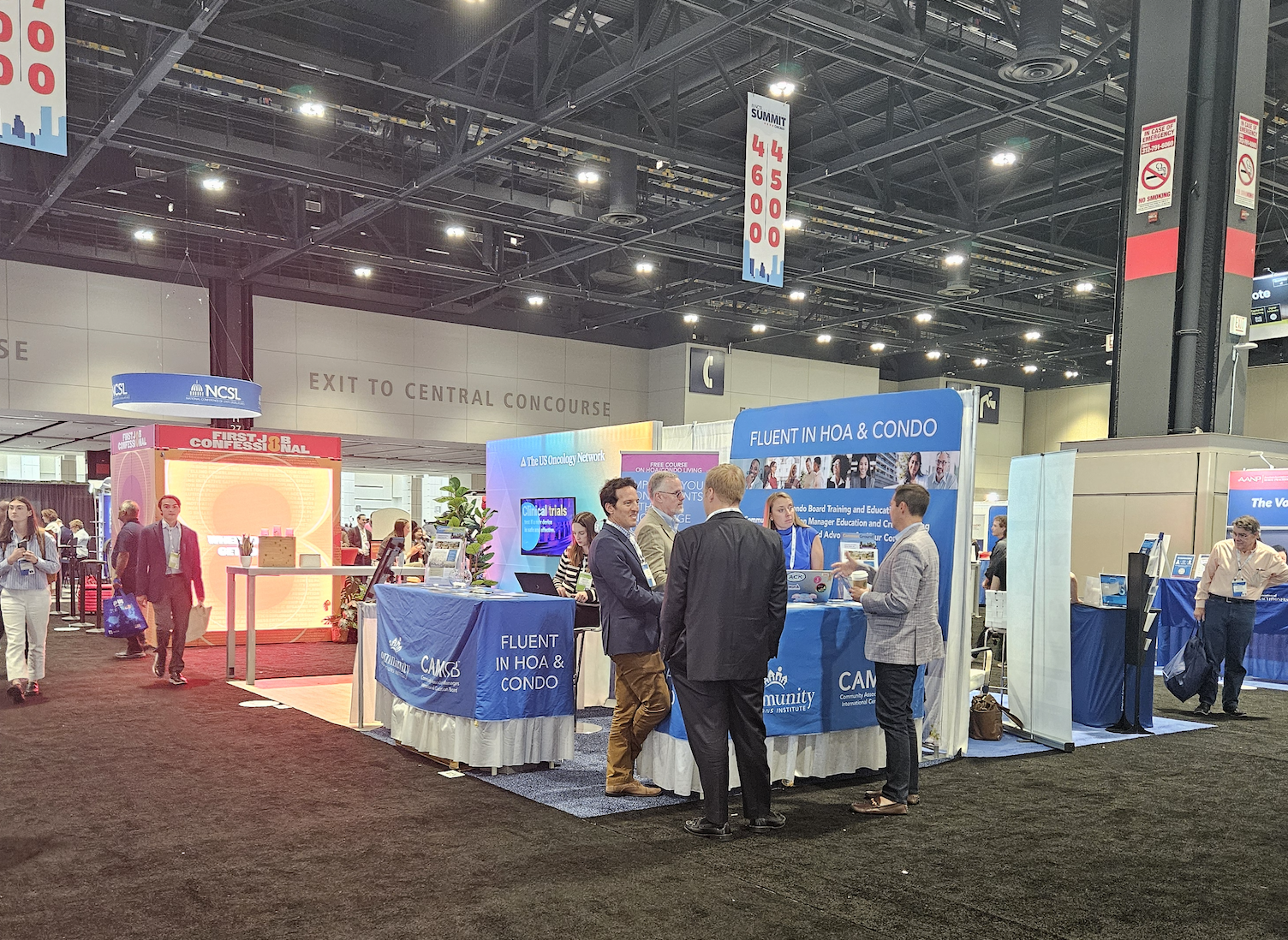
Each year, Community Associations Institute (CAI) and the Community Association Managers International Certification Board (CAMICB) exhibit at the National Conference of State Legislatures Legislative Summit. NCSL serves legislators and legislative staff throughout the United States, and its annual Summit brings together participants from all 50 states and U.S. territories for education, bipartisan dialogue, and an exchange of ideas about the issues confronting state governments.

For CAI and CAMICB, the Summit provides an important opportunity to engage directly with state legislators and legislative staff. CAI can help policymakers better understand the benefits of community associations and the resources available to the people who live and work in them. CAMICB can highlight the value of professional community association management—particularly the importance of choosing managers who have demonstrated their knowledge and competence through certification.

Those are the reasons we attend. What can be surprising, however, is how quickly conversations move beyond formal legislative roles.

Many legislators and legislative staff members are themselves homeowners in community associations. They may serve on a board, have questions about the management of their own community, or simply want to better understand how community associations operate. These conversations allow us to connect public policy with the everyday experiences of the people who live in these communities.

They also provide an opportunity to offer a broader perspective. Legislative discussions involving community associations can understandably be influenced by constituents who have experienced a problem or feel strongly about a particular issue. Those concerns deserve to be heard. At the same time, it is important for policymakers to understand the larger picture: community associations are home to millions of Americans, and effective governance and professional management contribute to the stability, maintenance, and overall well-being of those communities.

The Summit also gives CAI an opportunity to introduce legislators and staff to its information, education, and membership resources. For CAMICB, it provides a setting to explain why professional certification matters and how the CMCA credential helps homeowners and association boards identify managers who have met established standards of knowledge and professional conduct.

Beyond our own field, the Summit offers something equally valuable: perspective. Its broad program exposes us to the many competing issues state legislators must address and helps us understand where community association matters fit within a much larger public-policy environment. We also value the chance to meet representatives from other professional and credentialing organizations, including programs accredited by the National Commission for Certifying Agencies, and to learn how others are approaching certification, accreditation, and public protection.

Ultimately, the NCSL Legislative Summit allows us to step outside the community association world while helping others better understand it. The conversations may begin with legislation, but they frequently become conversations among homeowners—and that is often where the most meaningful connections are made.

Our Reserve Account Is Being Misused

By Kelly G. Richardson, Esq. CCAL, HOA Homefront Column

Mr. Richardson: Can our HOA board unilaterally write off borrowing from the reserve account as a bad debt? After the write-off can the board then declare another loan from the reserve account? D. A., San Diego 

Dear D.A.: Civil Code Section 5515 authorizes TEMPORARY borrowing from the HOA reserve fund if certain required notifications are made to the membership. However, that money must be repaid within one year of the borrowing per Section 5515(d). If at the end of that year the HOA needs a TEMPORARY delay in repayment, Section 5515(d) allows a delay in repayment but requires a board issue a written “finding” explaining the HOA’s need for more time. The statute doesn’t allow boards to simply “write off” such borrowing. Remember, while borrowing can be convenient to temporarily meet other HOA needs, until the reserve borrowing is repaid the HOA is in increased financial jeopardy because of that larger deficit in the reserve fund. Best, Kelly

Dear Kelly: How can homeowners protect themselves from mismanagement by the board and by the manager due to their incompetencies, negligence in failing to do the recommended yearly maintenance for the past several years, failure to fund our reserve account despite substantial HOA dues increases? S.S., Pasadena

Dear S.S.: Association boards who refuse to regularly set aside funds into the reserve account are driving their association into an unliquidated insolvency. It’s similar to someone living on credit cards for normal expenses – it’s convenient for a while, but can build to a very painful situation when the bill comes due.

HOAs lacking the discipline to accumulate funds to offset the ongoing deterioration of HOA common area elements will need major special assessments or long-term bank loans when those common area elements need replacement. Association members in condominium projects that are not properly funded will find it harder to obtain good mortgage loans. At some point, homebuyers may recognize that condominiums in underfunded associations could be worth less than their appraised value because traditional appraisals generally do not account for an HOA’s overall financial health.

If your board refuses to follow the law and refuses to prudently set aside funds in the reserve account and follow the HOA’s reserve study recommendations, perhaps the members should search for more disciplined volunteers to staff that board. Thanks, Kelly 

Dear Mr. Richardson: The management company without board approval used reserve funds for operating expenses – can the HOA board sue? J.M., Tustin

Dear J.M.: Civil Code Section 5510(b) prohibits boards from expending reserve funds except as necessary to fund repairs, restoration, replacement, or maintenance of common area components (or to fund litigation regarding those common area components). The statute does not mention managers, but that doesn’t mean that managers can expend HOA reserve funds on whatever they choose. Boards, not managers, make those decisions and managers should be carrying out the instructions of the board. The manager recommends, but the ultimate decision is the board’s to make. As to what happened in your HOA and whether there may need to be a claim, the board should discuss that with association legal counsel. Sincerely, Kelly

For the Davis-Stirling Act official site, visit www.leginfo.legislature.ca.gov, go to “California Law,” and scroll through the Civil Code. All other sites are unofficial (including www.hoahomefront.com).

Co-op Boards Face Tough Questions as Pied-a-Terre Tax Arrives

HABITAT Magazine

Love it or loathe it, the pied-a-terre tax on pricey second homes is here to stay, and co-op and condo boards need to start making preparations now.

The Department of Finance (DOF) will send out notices no later than August 30 identifying apartments that meet the criteria for the surcharge, Brick Underground reports. During the law’s initial phase, that generally means non-primary residences with a market value roughly equivalent to $5 million or more.

The city will bill condo unit-owners directly. In co-ops, however, property taxes are a portion of the monthly maintenance, so co-op boards will have to establish a process for collecting the tax. Here are five questions co-op boards will need to answer:

What qualifies an apartment as a pied-a-terre, or non-primary residence? DOF will likely use the co-op and condo tax abatement to determine whether an apartment is a pied-à-terre. Since this abatement is a tax break for primary residents, it follows that a shareholder or unit-owner who is receiving the abatement is using the apartment as their primary residence and therefore the pied-à-terre tax would not apply.

Can the determination be challenged? Condo unit-owners and co-op shareholders can contest the determination that an apartment is a second home. A challenge needs to be made within 30 days from the notice date. 

If the tax is contested, DOF will have to use additional information to determine whether the apartment is a primary residence. This might include voter registration as well as New York state and city income tax returns. Challenges about apartment valuations are typically made through the NYC Tax Commission.

How does the law change over time? During the first phase of the law, the city is not using actual sale prices. Instead, it is relying on DOF’s existing market values for co-ops and condos, which are based on comparable rental buildings. A DOF market value of $1 million generally corresponds to a co-op or condo worth about $5 million on the open market — which would make the apartment liable for the PAT tax.

Beginning in 2028, the city will switch to using real-world market values for co-ops and condos. The tax will then apply only to units with a sales-based market value above $5 million. To do that, DOF will need to publish a separate tax assessment roll for co-ops and condos based on comparable sales rather than rental-based values.

How will co-ops collect the tax? The co-op board or managing agent will receive notices identifying which apartments are subject to the pied-à-terre tax, and they will then have to notify the affected shareholders. Since the board pays the property tax bill, it will be the board’s responsibility to recoup the tax from the non-resident shareholders. If shareholders fail to pay, there could be a range of other problems.

Stuart Saft, a partner at the law firm Holland & Knight and no fan of the PAT tax, offers this scenario in the firm’s newsletter: “If a shareholder refuses to pay the PAT Tax, the board must decide between two unappetizing options: The board can pay the surcharge out of building funds, effectively advancing the nonpaying shareholder’s PAT tax obligation from reserves that belong to all shareholders; or (it can) allow the surcharge to remain unpaid on the building’s property tax account, where interest begins compounding at 18% per annum against the entire building while the board pursues the shareholder…with no certainty of ever being reimbursed… Neither option is acceptable because both cause direct harm to innocent shareholders who have nothing to do with the non-primary unit.”

What should co-op boards do now to prepare? Co-op boards should prepare a schedule of the units and the number of shares in the corporation to identify which apartments are likely to exceed the $1 million threshold. The board can then begin communicating with any non-resident shareholders, letting them know what the surcharge will likely be so they can start planning and budgeting.

Martha Stark, a professor at the Robert F. Wagner Graduate School of Public Service at NYU and a former city finance commissioner, has developed a second home surcharge tool to help answer questions about whether the tax applies and what boards should do if there are uncertainties. 

Boards should also be prepared for an uptick in sublet requests. Apartments rented for a full-lease term are exempt from the pied-à-terre tax, provided the tenant uses the unit as his or her primary residence.

Gramercy Park Hotel Wins Battle Over Rooftop With Co-op Next Door

Gramercy Park, Manhattan

HABITAT Magazine

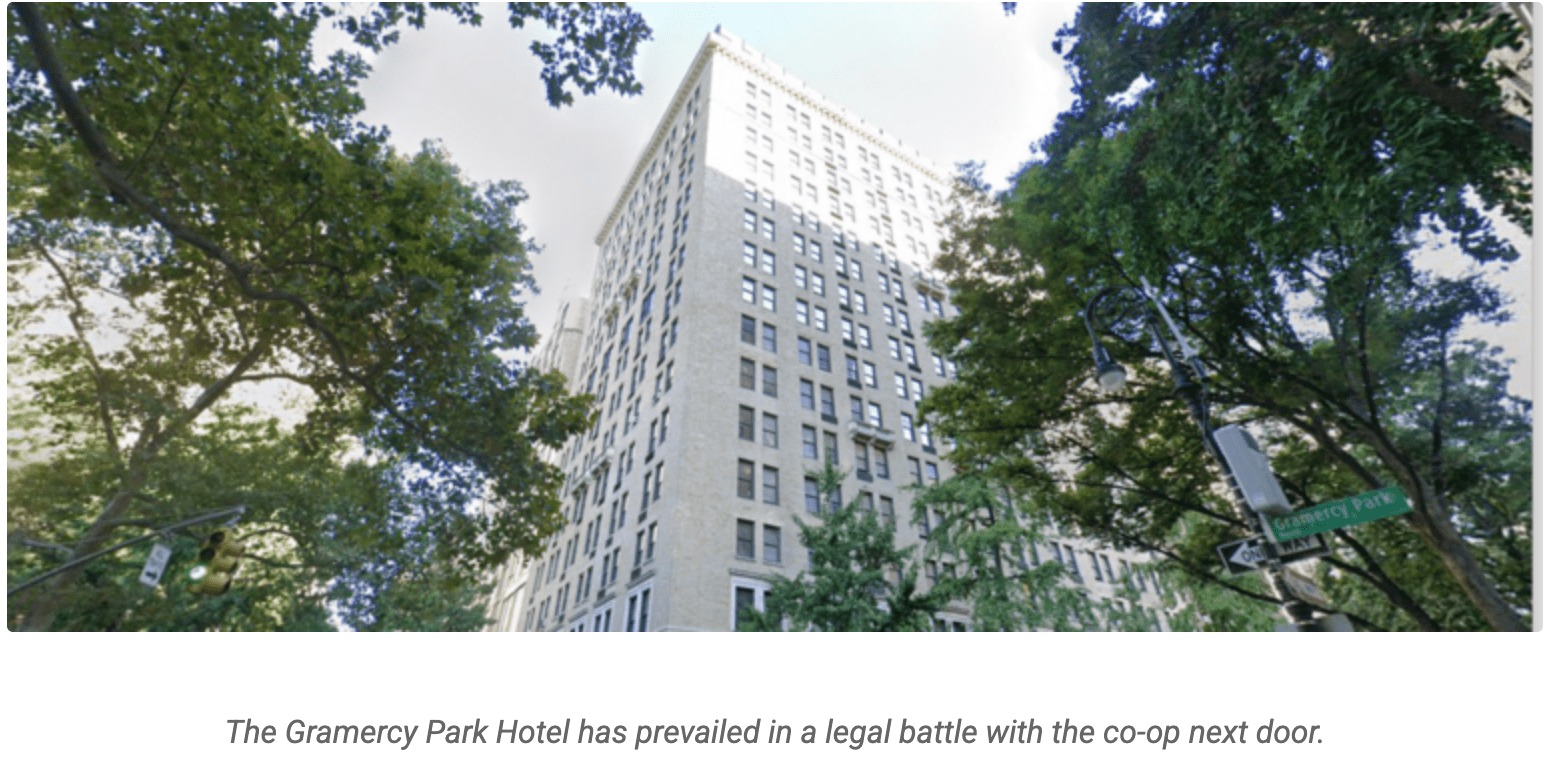
The Battle of Gramercy Park is finally over. The winner is the Gramercy Park Hotel while the loser is the co-op next door that sued, unsuccessfully, to retain access to the hotel’s rooftop.

While the rooftop war played out, the co-op at 50 Gramercy Park North succeeded in persuading a judge to stop construction work at the century-old hotel next door, which is under renovation and has been closed since 2020.

But that relief came to an end earlier this week when Manhattan Supreme Court Judge Anar Rathod Patel denied the co-op’s request for an injunction and overturned the stop-work order.

“To the extent that construction is being halted, there is no dispute that will cause delays or perhaps prevent the reopening of the hotel, which is a significant prejudice to the defendants,” Patel said from the bench after an hour-long hearing, Crain’s reports. “By contrast, there is not really any prejudice by the plaintiffs that has been established.”

This legal battle began when the 17-story, 21-unit co-op sued the hotel, claiming that the co-op’s “irrevocable and perpetual” right to the rooftop next door, atop the hotel, is being violated because an illegal members-only club is being built there “for guests of hotel operator’s choosing.” The court agreed to halt construction.

The hotel fired back by filing a counter-suit seeking $125 million in damages from the co-op. The hearing earlier this week allows halted construction to resume, signaling that the hotel has triumphed over the co-op.

In 2023 MCR Hotels bought the Gramercy Park Hotel’s ground lease and vowed to restore the splendor of the century-old hotel that closed in 2020. MCR secured a $150 million loan to renovate the building, and to sweeten relations with its new neighbors while work was underway, MCR offered to give 50 Gramercy Park North residents membership to the rooftop club, though they would have to pay for their own food and services.

A lawyer for the Gramercy Park Hotel, Vincent Pallaci, claimed that co-op residents have since been offered private space on the hotel’s third floor that is better than what they would have gotten on the rooftop. “The overall open space that they’re going to have access to is actually going to be nicer,” Pallaci said during the hearing.

The co-op’s residents can console themselves that sometimes you win even when you lose.

Is Our Reserve Account Short?

By Kelly G. Richardson, Esq. CCAL, HOA Homefront Column

Dear Kelly: Our reserves are very very low – can the city or state take over our association? B.P., Huntington Beach

Dear B.P: If the HOA’s reserve account balance is very low, meaning it is far less than the reserve study indicates should currently be accumulated to offset the existing level of deterioration of common area elements, the HOA is in financial danger. When a major common area element fails (decks, roofs, ?), the HOA will be unable to pay for replacement, leaving the members only two options: A major special assessment or a long-term bank loan (if the HOA qualifies for loans). Such an HOA may also violate FHA/FNMA lending requirements, which presently require that 10% of the HOA’s annual budget go to reserve accumulation. [Note- That figure will increase to 15% in 2027.] Condominium homeowners will have difficulty obtaining or refinancing mortgages if the association does not qualify for FHA and FNMA loans. If an HOA falls into complete disarray, it is unlikely that the city, county, or state would take it over. However, if someone petitions the court, a judge could order the HOA into a receivership. In receiverships, a third party takes over running the HOA for an expensive hourly fee. You don’t want that! Sincerely, Kelly


Mr. Richardson, I have enjoyed reading your articles for many years, and I have often shared them with our management and board. Recently, some directors have discussed using reserve funds to offset the operating budget and lowering our funded reserve level. The primary focus appears to be holding dues flat. This approach does not seem realistic or financially responsible. What would be the effect of reducing reserve levels? N.C., Mission Viejo 

Dear N.C.: Reserve funds are specifically accumulated to offset the ongoing deterioration of HOA common area assets. If the HOA takes those funds and repurposes them, that is considered “borrowing” from reserves under Civil Code Section 5515. That borrowing must be repaid within one year, per Civil Code 5515((d). Boards skimping on reserve savings to artificially keep assessments low are not being truthful to their neighbor homeowners – because they are obscuring the fact that the HOA will not be ready for major replacement expenses. Thanks, Kelly


Kelly: What power does a board of directors have to implement a financial plan for the funding of the reserve account without approval of all the homeowners? B.W., Solana Beach. 

Dear B.W.: Budgeting, including complying with reserve study accumulation requirements, is one of the board’s basic responsibilities. For HOAs without properly funded reserve accounts, Civil Code 5550(b)(5) requires the HOA to have a funding plan to catch the HOA up on its reserve accumulation needs. The HOA’s shortfall on reserve accumulation funding must also be disclosed annually to members under Civil Code Section 5570 and 5300(b)(3). It is a board responsibility because it is too complicated to submit to a vote of the entire membership.

HOAs that do not set aside sufficient money to offset deterioration of HOA-maintained common area components are quietly falling into unliquidated debt. Such a debt becomes liquidated when the component must be replaced and the “bill comes due.” Unfortunately, unwise HOAs will not have the funds ready for that expense if they shortsightedly only focused on month-to-month expenses. Best, Kelly